
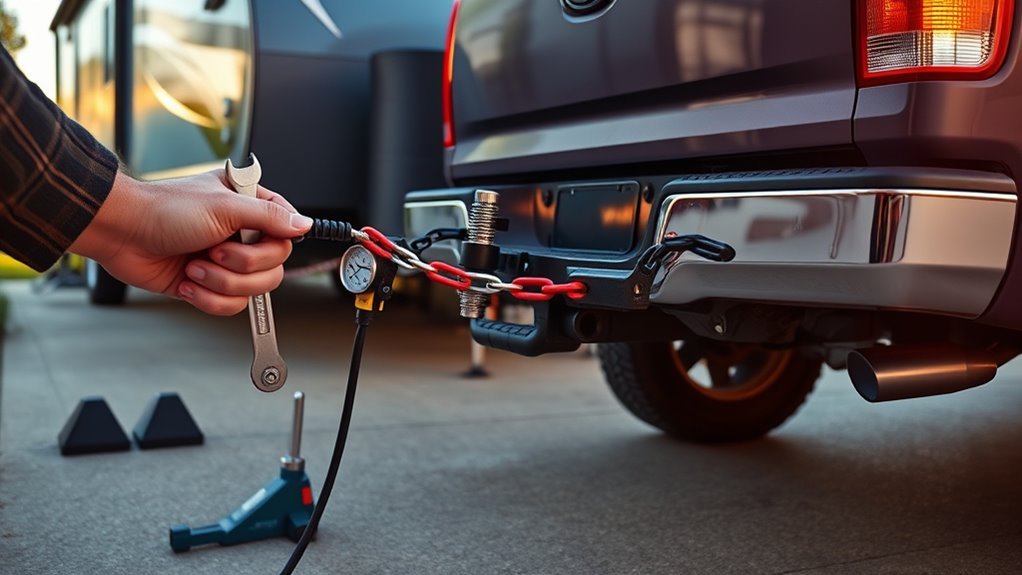
This Toyota Tundra towing checklist starts with the truck’s actual ratings, then checks the hitch, tongue or kingpin weight, tires, brakes, lights, safety chains, breakaway system, cargo, and driving setup before you move. Toyota lists the 2026 Tundra at up to 12,000 lb of maximum towing and up to 1,850 lb of maximum payload, but those are lineup maximums—not the rating for every truck. Your exact owner’s manual, certification label, Tire and Loading Information label, hitch ratings, trailer ratings, and loaded scale weights control.
Last updated: September 16, 2026. This checklist was rechecked against Toyota’s current 2026 Tundra specifications, Toyota’s 2025 Tundra owner guidance, and current NHTSA tire-safety information. This revision adds the 2025 new-truck towing break-in restriction, towing-speed guidance, the trailer service-brake threshold, clearer trailer-tire inflation guidance, and expanded safety FAQs. It is a document-based safety guide and does not claim hands-on testing of your truck or trailer.
Affiliate disclosure: This page may include affiliate links. If you buy through them, we may earn a commission at no extra cost to you.
Quick Answer
Before towing with a Toyota Tundra, confirm the lowest applicable truck, hitch, tire, axle, and trailer rating; verify loaded trailer and tongue or kingpin weight; secure the coupler, chains, and breakaway cable; check cold tire pressure; test trailer brakes and lights; secure cargo; and complete a final walkaround. After a short distance, stop safely and recheck the connection, tires, hubs, wiring, and cargo.
Key Takeaways
- The lowest applicable rating wins. Stay within TWR, payload, GVWR, GAWR, GCWR, hitch, tire, and trailer limits at the same time.
- Toyota’s 2025 Tundra owner guidance uses a 9% to 11% conventional tongue-weight range and a 14% to 16% fifth-wheel/gooseneck kingpin-weight range; verify the exact manual for your model year.
- Toyota’s 2025 Tundra owner guidance requires adequate sway control above 2,000 lb gross trailer weight and a properly rated weight-distributing hitch above 5,000 lb; verify the exact manual for your Tundra.
- Toyota lists up to 1,850 lb of maximum payload for the 2026 Tundra lineup, so payload or rear-axle capacity can become the practical limit before the headline tow rating.
- Toyota’s 2025 Tundra guidance says not to tow a trailer during the first 500 miles (800 km) of new-truck break-in; other model years or markets may differ.
- Toyota’s 2025 Tundra towing guidance says not to exceed 65 mph (104 km/h), the posted towing limit, or the trailer manufacturer’s limit, whichever is lower.
- Tires, brakes, lights, safety chains, the breakaway system, wheel bearings, and cargo restraints are go/no-go items, and the rig should be rechecked after a short drive.
Toyota Tundra Towing Checklist: What Should You Check Before a Trip?
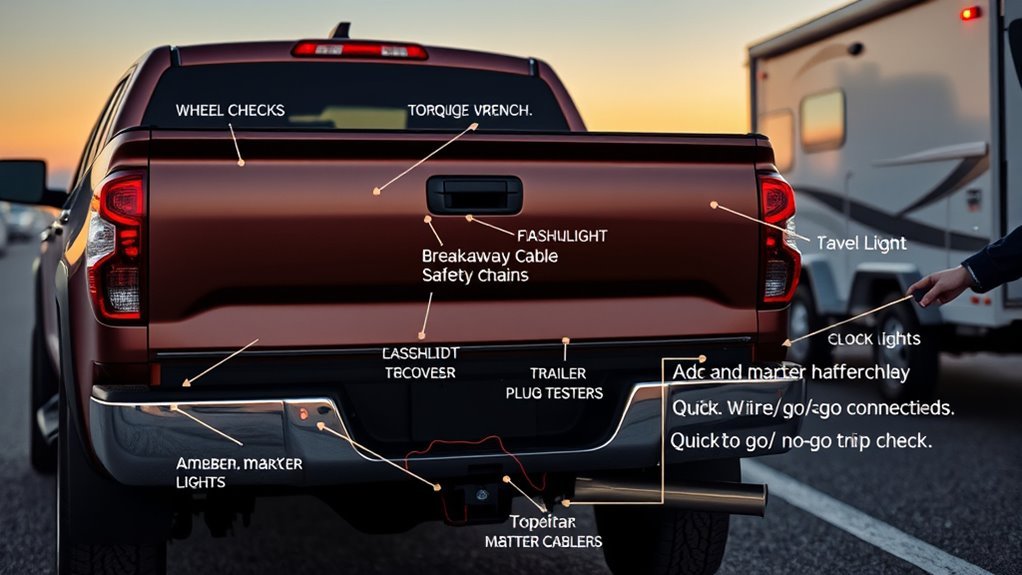
Use this checklist with the truck and trailer loaded as they will travel. If a safety item fails or a rating is exceeded, stop and correct it before towing.
- Ratings: Confirm the loaded trailer weight and truck load stay within TWR, GCWR, GVWR, front and rear GAWR, payload, hitch, tire, and trailer limits. Toyota explains the model-specific limits in its 2025 Tundra trailer-towing manual; use the manual for your exact model year.
- Hitch: Confirm the receiver, ball mount, hitch ball, coupler, pin, clip, and locks are correctly rated and fully secured.
- Ball size: Match the hitch ball to the coupler stamping. Do not tow with a loose or mismatched coupler.
- Tongue or kingpin weight: Toyota’s 2025 Tundra owner guidance uses 9% to 11% of gross trailer weight for conventional tongue weight and 14% to 16% for fifth-wheel/gooseneck kingpin weight. Confirm your exact manual before loading.
- Sway control: Toyota’s 2025 Tundra owner guidance calls for a properly rated sway-control device when gross trailer weight is over 2,000 lb; verify your model-year manual.
- Weight distribution: Toyota’s 2025 Tundra owner guidance calls for a properly rated weight-distributing hitch when gross trailer weight is over 5,000 lb; see the Tundra weight-distribution hitch setup guide for the separate setup procedure.
- Safety chains: Cross the chains under the coupler, connect them to approved tow-vehicle attachment points, and leave enough slack for turns without letting them drag.
- Breakaway system: Attach the breakaway cable to an approved tow-vehicle point as the trailer and breakaway-system manufacturers direct, then test the switch and battery.
- Tires: Check truck and trailer tire pressure cold, inspect tread and sidewalls, verify load ratings, and inspect the spare.
- Brakes: Test the trailer brakes and brake controller before entering traffic. Toyota’s 2025 Tundra guidance also requires trailer service brakes when gross trailer weight exceeds the truck’s unbraked TWR; applicable state or provincial rules may be stricter.
- Lights: Verify running lights, brake lights, turn signals, hazards, marker lights, license-plate light, and reverse lights if equipped.
- Cargo: Secure the load and place it so the trailer stays within its axle, tire, and tongue/kingpin-weight limits.
- Mirrors and visibility: Adjust mirrors so you can see down both sides of the trailer and meet applicable visibility rules.
- Tow mode: On equipped models, use TOW/HAUL or TOW+ only as your exact owner’s manual directs. These modes can change powertrain behavior but do not increase GVWR, GAWR, GCWR, TWR, payload, or hitch ratings. See when to use Tundra Tow/Haul mode.
- New-truck break-in: Toyota’s 2025 Tundra owner guidance says not to tow a trailer during the first 500 miles (800 km). Other model years or markets may differ, so check the manual for your exact truck.
- Speed plan: Toyota’s 2025 Tundra owner guidance says not to exceed 65 mph (104 km/h), the posted towing speed limit, or the trailer manufacturer’s limit, whichever is lower. Slow further when conditions require it.
Warning: Do not tow if you find a cracked hitch, damaged safety chains, leaking brake fluid, a bulging tire, exposed tire cords, loose steering parts, non-working trailer brakes, non-working lights, or a coupler that will not latch securely.
How Do Toyota Tundra Towing Limits and Payload Work?
Start with your exact truck, not a lineup maximum. Toyota currently lists the 2026 Tundra at up to 12,000 lb of maximum towing and up to 1,850 lb of maximum payload. Your truck may be rated lower. Cab, bed, drivetrain, engine, equipment, passengers, accessories, hitch hardware, tires, and cargo can all change the usable margin. For model-by-model capacity detail, see the Tundra towing-capacity guide.
Use the lowest applicable limit. A trailer can be below the advertised tow rating and still overload truck payload, the rear axle, a tire, the receiver, or the trailer itself. If you need definitions for the truck labels, see the Tundra GVWR, GCWR, and GAWR guide.
Use this order when checking limits:
- Owner’s manual: Find your model code and the TWR/GCWR table for your Tundra.
- Certification label: Check GVWR and front/rear GAWR on the driver-side door-jamb label.
- Tire and Loading Information label: Confirm the truck’s tire size, cold pressure, and combined occupant/cargo capacity. Toyota explains that vehicle load limits include total load capacity, seating capacity, TWR, and cargo capacity in its 2025 Tundra vehicle load limits.
- Hitch label: Confirm the receiver, ball mount, hitch ball, and weight-distribution setup are rated for the loaded trailer and tongue weight.
- Trailer VIN/rating label: Confirm GVWR, GAWR, tire pressure, tire size, and coupler rating.
- Scale weight: Weigh the fully loaded truck and trailer whenever the load is heavy, new, or close to any rating.
Worked Example: A 7,000 lb loaded conventional trailer at a 9% to 11% tongue-weight range places about 630 to 770 lb on the hitch. That load must fit within the Tundra’s available payload, rear GAWR, tire ratings, receiver rating, and all other limits after passengers, cargo, accessories, and hitch hardware are counted. This example does not establish the limit for your truck.
A simple payload check looks like this:
| Payload item | Count it? |
|---|---|
| Driver and passengers | Yes |
| Tools, coolers, camping gear, recovery gear | Yes |
| Bed rack, tonneau, topper, aftermarket bumper, winch | Yes |
| Tongue weight or kingpin weight | Yes |
| Trailer cargo weight | Counts toward trailer weight, and may affect tongue weight |
Payload formula: available payload minus people, cargo, accessories, hitch hardware, and tongue or kingpin weight must stay at or above zero. Then confirm the front and rear axle weights remain under GAWR and the combined truck/trailer weight remains under GCWR. Payload is only one check; passing the payload calculation does not override any other rating.
Note: Dry trailer weight is not enough. Add water, propane, batteries, food, tools, bikes, recovery boards, generators, and everything else loaded for the trip.
What Towing Gear and Hitch Hardware Do You Need?
Use towing parts that match the trailer’s loaded weight, not just its empty or “dry” weight. The receiver, ball mount, hitch ball, coupler, safety chains, breakaway system, brake controller, wiring, tires, and trailer hardware must work as one rated system. If you are unsure which receiver or connection your truck uses, check the Tundra hitch receiver size guide.
[Products Worth Considering]

This trailer coupler lock provides visible, dependable protection for your trailer with a rugged all-metal build and bright yellow finish that helps deter theft. Its universal adjustable design fits common coupler sizes and offers multiple locking positions for a secure, convenient setup. Built for all-weather use, it features protective rubber caps and anti-corrosion plating to help keep the locking mechanism working reliably.

The CURT 52010 Trailer Breakaway Switch helps keep towing safer by automatically engaging trailer brakes if the trailer disconnects from the tow vehicle. It features silver contact points for a dependable electrical connection, plus a nylon case and pull pin assembly designed to handle outdoor use and secure activation. The included metal mounting tab makes installation simple on trailers with electric brakes.

These car headrest hooks turn unused seat space into a handy organizer for everyday travel. Built from microfiber leather and alloy, they are sturdy enough to hold heavy bags while helping keep groceries, purses, backpacks, and other items secure and off the floor. The side-opening design makes installation quick and tool-free, so you can add convenient storage in seconds.
Hitch Type & Rating
Confirm the receiver class and ball mount rating meet or exceed the gross trailer weight and tongue weight you will actually tow. Use only a hitch ball with a load rating that meets or exceeds the trailer requirement, and match the ball diameter to the coupler. Most couplers are stamped with the required ball size.
Toyota’s 2025 Tundra owner guidance calls for a sway-control device with sufficient capacity when gross trailer weight is over 2,000 lb and a weight-distributing hitch with sufficient capacity when gross trailer weight is over 5,000 lb. Confirm the exact requirement in your model-year manual. Set up a weight-distributing hitch according to both Toyota and hitch-manufacturer instructions, then recheck truck and trailer attitude before driving.
Pro Tip: Keep a small towing kit in the truck: spare hitch pin and clip, trailer fuses, dielectric grease, tire-pressure gauge, tread-depth gauge, flashlight, gloves, wheel chocks, a torque wrench, and a plug-in trailer-light tester.
Optional Recovery Gear for Off-Pavement Towing
If your route leaves pavement, recovery equipment is a separate system from the trailer connection. Use only rated recovery gear and approved recovery points, and inspect it for damage before the trip. Never use a trailer safety chain, hitch ball, suspension part, bumper trim, or an unapproved tie-down point as a recovery attachment. A shovel, traction boards, tire equipment, and reliable communication may also be useful where roadside help is limited.
How Should You Set Tundra Tongue Weight and Hitch Load?
Correct tongue weight keeps the trailer stable and helps the Tundra steer and brake predictably. Too little tongue weight can create sway. Too much tongue weight can overload the rear axle, unload the front axle, aim headlights upward, and reduce steering control.
[Products Worth Considering]
This custom-fit floor mat and cargo liner set is designed for select Kia K5 and Hyundai Sonata models to help protect your interior from dirt, spills, snow, and everyday messes. Made with durable TPE and shaped with raised edges and precise channeling, it offers secure coverage, easy cleanup, and reliable all-weather performance. The set includes front, rear, and cargo protection for a cleaner, safer driving experience.

This all-in-one roadside emergency kit is designed to help drivers handle common breakdowns, minor repairs, and first aid needs with confidence. It includes a portable air compressor with tire pressure measuring and memory settings, safe jumper cables, and a versatile 14-in-1 pliers tool set, all organized for easy trunk storage. With a wide range of emergency supplies packed into one compact case, it is a practical choice for new drivers, daily commuters, and anyone preparing for unexpected roadside situations.
Proper Tongue Weight
Toyota’s 2025 Tundra owner guidance uses 9% to 11% of gross trailer weight for conventional tongue weight and 14% to 16% for fifth-wheel or gooseneck kingpin weight. Treat the manual for your exact model year as the controlling source. For measurement methods and edge cases, see the Tundra tongue-weight percentage guide.
- Measure the trailer fully loaded. Use a public scale, tongue-weight scale, or platform scale.
- Adjust cargo placement. Move cargo forward or rearward in small changes until tongue weight is within range.
- Check truck payload and axle ratings. Tongue weight counts against the Tundra’s payload and rear axle load.
- Level the combination. A level trailer and properly restored front-axle load improve stability.
- Recheck after loading changes. Water tanks, toolboxes, coolers, and bikes can change tongue weight quickly.
Safety Chains and Attachment Points
Inspect the receiver, hitch pin, mounting hardware, safety-chain attachment points, and nearby frame structure before every tow. Look for cracks, deep rust, elongated holes, bent parts, missing clips, loose hardware, or parts that have shifted. If anything is damaged or loose, do not tow until it is inspected and repaired.
Safety chains are the backup if the coupler or hitch connection fails. Connect them to approved tow-vehicle attachment points, cross them under the trailer tongue, leave enough slack for turns, and keep them off the road. Follow Toyota, hitch-manufacturer, trailer-manufacturer, and applicable state or provincial requirements. NHTSA notes that FMCSA rules on tow balls, safety chains, and breakaway devices apply to commercial users, so a private Tundra owner should not treat a commercial rule as the only requirement.
Correct Hitch Selection
Choose the hitch system by weight, trailer type, and how the trailer loads the truck:
- Conventional bumper-pull trailer: Receiver hitch, rated ball mount, correct hitch ball, safety chains, wiring, and sway/weight-distribution equipment when required.
- Weight-distributing setup: Toyota’s 2025 Tundra owner guidance calls for it above 5,000 lb gross trailer weight; verify your model-year manual and set the system according to Toyota and hitch-manufacturer instructions.
- Fifth-wheel or gooseneck: Confirm compatibility with your bed length, hitch system, kingpin weight, clearance, and Toyota’s model-specific limits.
Warning: Never assume an aftermarket hitch, lifted suspension, larger tires, air bags, or heavy-duty shocks increase Toyota’s factory GVWR, GAWR, GCWR, or TWR. They may change handling, but they do not rewrite the truck’s ratings.
What Suspension and Steering Problems Should Stop a Tow?
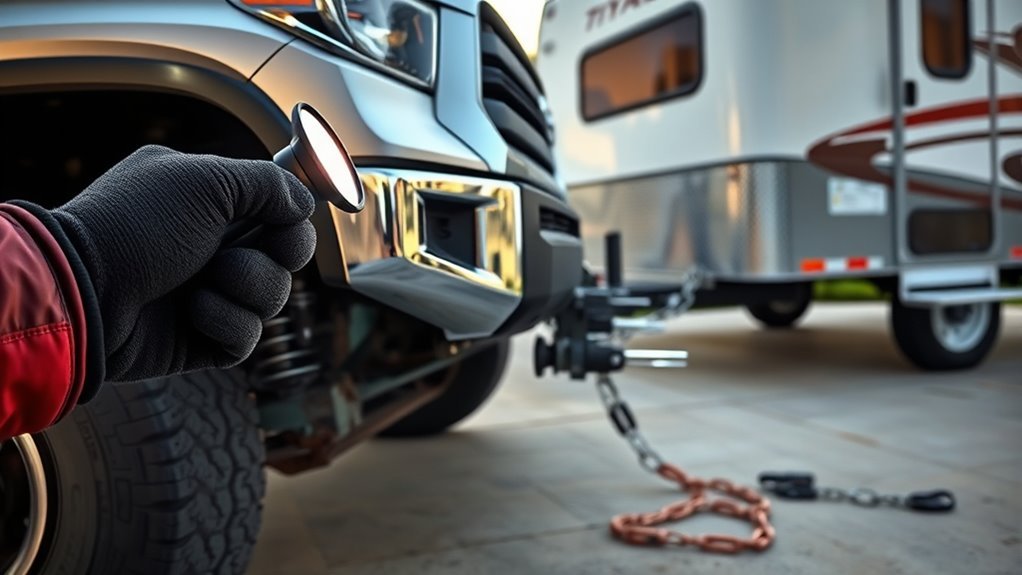
Towing adds load to the Tundra’s suspension, steering, tires, and brakes. Before a trip, do a hands-on inspection while the truck is parked on level ground.
- Control arms and bushings: Look for torn rubber, leaking fluid-filled bushings, bent arms, or loose hardware.
- Ball joints and tie rods: Check for torn boots, grease loss, looseness, clunks, or uneven steering feel.
- Shocks and mounts: Inspect for leaks, broken mounts, loose bolts, or rusted brackets.
- Sway bar links and bushings: Look for cracked bushings, missing hardware, or knocking noises.
- Alignment signs: Uneven tire wear, steering pull, or a crooked steering wheel should be corrected before towing.
- Rear suspension attitude: Excessive rear sag may indicate too much tongue weight, overloaded payload, or incorrect weight-distribution setup.
If steering feels vague, the truck wanders, the rear end sags heavily, or you hear suspension clunks, treat it as a go/no-go issue. Fix the truck before towing.
What Should You Inspect Under the Tundra Before Towing?
When the trailer is connected, the Tundra can sit lower at the rear and reduce departure angle, underbody clearance, and skid-plate clearance. This matters on steep driveways, boat ramps, rutted roads, construction sites, and off-road campsites.
- Inspect skid plates: Look for dents, cracks, deformation, missing fasteners, or plates pushed into the oil pan, transmission, transfer case, or exhaust.
- Check fasteners: Replace missing bolts and tighten loose hardware to the correct specification.
- Measure loaded clearance: Check clearance after the trailer is attached and loaded, not just when the truck is empty.
- Watch wiring and brake lines: Make sure no trailer wiring, underbody wiring, or brake lines hang low enough to snag.
- Plan your route: Avoid sharp breakover angles, deep ruts, and obstacles that can hit the hitch, jack, stabilizers, or trailer steps.
Underbody damage can quickly turn into an oil leak, transmission leak, wiring failure, or stranded trailer. If you frequently tow off pavement, consider stronger skid plates and a slower route plan instead of relying on momentum.
How Should You Check Tundra and Trailer Tires and Brakes?
Tires and brakes are go/no-go towing items. NHTSA reported 511 motor-vehicle traffic fatalities in tire-related crashes in 2024 and warns that poor tire maintenance can lead to flats, blowouts, or tread separation. Its tire-safety guidance also says to use the vehicle maker’s cold-pressure specification and replace tires at 2/32 inch of tread.
Truck and Trailer Tire Checks
- Cold pressure: Set Tundra tires to the cold pressures on the truck’s Tire and Loading Information label. Set trailer tires to the trailer placard/manual or the tire manufacturer’s load-and-inflation guidance for the actual load; do not assume a sidewall maximum is the correct target for every setup.
- Tread depth: Replace any tire at or below 2/32 inch. For wet roads, heavy loads, or long trips, replace earlier because towing reduces your margin for error.
- Sidewalls: Look for cracks, bulges, cuts, cords, impact bubbles, or weather checking.
- Load rating: Confirm every truck and trailer tire can carry its share of the loaded axle weight. Do not use a universal load-index number without checking your labels and sidewalls.
- Age: Check trailer tire DOT date codes. Trailer tires can age out before the tread looks worn.
- Spare tire: Confirm the Tundra spare and trailer spare are inflated, accessible, and compatible with the load.
- Lug nuts: Use a calibrated torque wrench and the correct torque for your exact wheel, lug nut, and vehicle data. Recheck after wheel service or a tire change.
Brake and Bearing Checks
- Tundra brakes: Look for fluid leaks, low brake fluid, brake warning lights, pulsation, grinding, thin pads, or scored rotors.
- Trailer brakes: Test the manual brake-controller lever at low speed and confirm the trailer brakes apply smoothly. For the 2025 Tundra, Toyota requires trailer service brakes when gross trailer weight exceeds the truck’s unbraked TWR; also follow applicable local requirements.
- Breakaway system: Test the switch and battery according to the trailer manufacturer’s instructions.
- Wheel bearings: Check for hub play, grease leakage, unusual noise, or heat after a short test drive.
- Brake wiring: Inspect wires near axles and backing plates for abrasion, broken insulation, or loose grounds.
Note: Trailer tires can use different pressures from the Tundra’s tires. Check them cold before driving and use the pressure guidance for the trailer, tire, and actual load rather than copying the truck’s placard pressure.
How Do You Check Trailer Wiring, Lights, and Brake Control?
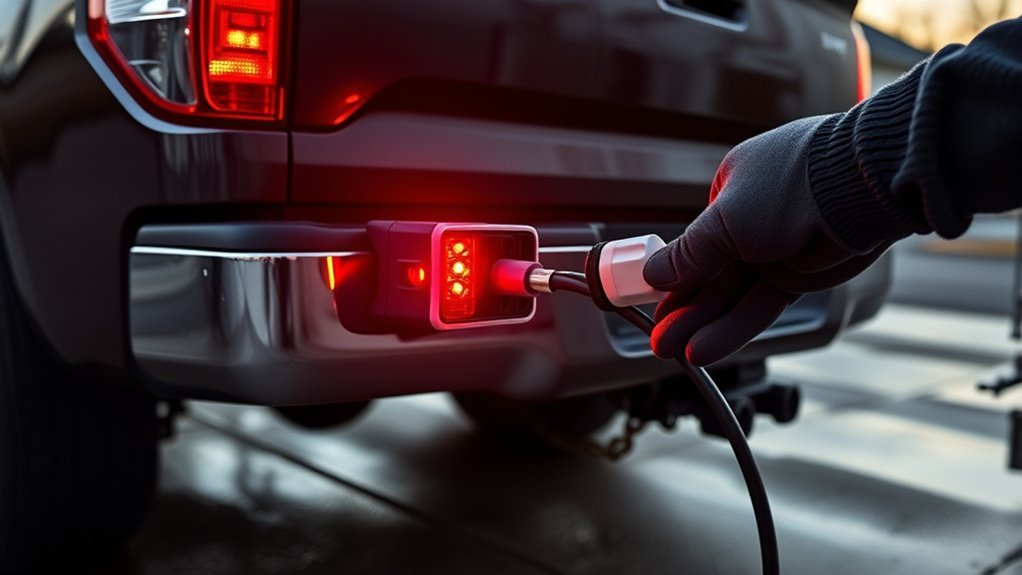
Trailer wiring controls visibility, signaling, electric brakes, and the breakaway charging circuit if equipped. A trailer that cannot signal or brake correctly is not road-ready.
- Connector fit: Confirm the 7-pin or 4-pin connector matches your trailer and locks firmly into the Tundra socket.
- Pin condition: Look for corrosion, bent pins, loose terminals, dirt, or moisture.
- Harness routing: Keep wiring away from the exhaust, sharp frame edges, suspension travel, and dragging points.
- Grounds: Clean and tighten trailer ground points if lights flicker or brakes act inconsistently.
- Light test: Verify running lights, brake lights, turn signals, hazards, marker lights, license-plate light, and reverse lights if equipped.
- Brake-controller test: Roll forward slowly in a safe area and use the manual override to confirm the trailer brakes engage.
- Breakaway test: Follow the trailer manufacturer’s procedure to confirm the breakaway switch and battery activate the trailer brakes.
A multimeter or plug-in trailer-light tester can help confirm voltage and isolate bad grounds, but do not rely only on the dashboard. Walk around the trailer and verify every lamp actually works.
[Products Worth Considering]

VERSATILE — Quickly and confidently confirm the functionality of your vehicle's trailer wiring harness with this connector tester for the taillights, brake lights, reverse lights, turn signals, electric trailer brakes and auxiliary power

【HIGH QUALITY】Trailer Tester is Made of High-quality ABS Plastic and Copper, with a Black Matte Exterior Shell for Optimal Weather, Corrosion and Impact Resistance for Long-term Use.

2 in 1 Design: This trailer wiring tester combines both 4 pin flat and rv blade 7 pin trailer light tester, allows you to test both the 4 and 7 pin trailer connectors; Note: This trailer tester does NOT work with vehicle has a lamp-out sensor
How Should You Load Cargo and Do the Final Walkaround?
Load placement can make a safe trailer feel stable or dangerous. Keep heavy cargo low, secure, and near the trailer axle area while still meeting Toyota’s tongue-weight target for your towing type.
| Item | Target | Action |
|---|---|---|
| Conventional tongue weight | 9%–11% in Toyota’s 2025 Tundra owner guidance; verify your year | Shift cargo and remeasure |
| Kingpin weight | 14%–16% in Toyota’s 2025 Tundra owner guidance; verify your year | Confirm with scale weight |
| Gross trailer weight | Below Tundra, hitch, and trailer limits | Weigh the trailer loaded |
| Trailer over 2,000 lb | Sway control | Install rated device |
| Trailer over 5,000 lb | Weight-distributing hitch | Set up per Toyota and hitch instructions |
| Final check | Everything secured and working | Walk around, test, and recheck |
Before departure, tighten straps, latch doors, raise stabilizers, lock the coupler, remove wheel chocks, retract the jack, connect the breakaway cable, connect safety chains, plug in wiring, test brakes, and check mirrors.
What Should You Recheck After the First Few Miles?
After the first few miles, pull over in a safe place and inspect the setup again. Loads settle, straps loosen, hubs warm up, and a bad connection may show itself only after movement.
- Check for unusual hub heat using a safe method recommended by the trailer or hub manufacturer; one hub much hotter than the others can indicate bearing or brake trouble.
- Recheck cargo straps, coupler latch, hitch pin, safety chains, breakaway cable, and wiring slack.
- Look for tire bulges, low tires, rubbing, dragging chains, or loose fenders.
- Confirm the trailer still sits level and tracks straight.
- Adjust brake-controller gain if the trailer pushes the truck or the brakes lock up.
How Should You Drive a Tundra With a Trailer Connected?
Your Tundra will accelerate, turn, stop, and reverse differently with a trailer. Leave more following distance, brake earlier, use wide turns, and avoid sudden steering. Toyota’s 2025 Tundra owner guidance says not to exceed 65 mph (104 km/h), the posted towing speed limit, or the trailer manufacturer’s limit, whichever is lower; reduce speed further for wind, grades, wet or slippery roads, poor visibility, or instability. Use TOW/HAUL or TOW+ only as your exact owner’s manual directs, and remember that a drive mode does not raise the truck’s ratings.
If trailer sway begins, hold the steering wheel steady, keep the rig pointed straight, ease off the accelerator gradually, and avoid abrupt steering or braking unless braking is necessary to avoid a collision. Pull over safely when you can and inspect cargo placement, tongue weight, tires, hitch setup, and other possible causes before continuing. For a deeper diagnostic guide, see the Tundra trailer-sway prevention guide. Follow posted towing limits, the trailer owner’s manual, and applicable state or provincial rules for brakes, lights, mirrors, and breakaway equipment.
The best towing setup is boring: level trailer, correct tongue weight, cool tires, working brakes, visible lights, tight hardware, and no surprises during the first-mile recheck.
Frequently Asked Questions
What should I check before towing with a Toyota Tundra?
Check the truck’s TWR, payload, GVWR, GAWR, and GCWR; the hitch and trailer ratings; loaded trailer and tongue or kingpin weight; coupler, chains, and breakaway system; cold tire pressure and condition; trailer brakes and lights; cargo security; mirrors; and any model-specific tow-mode or break-in instructions. If any safety item fails or any rating is exceeded, do not tow until it is corrected.
How much can a 2026 Toyota Tundra tow?
Toyota lists the 2026 Tundra at up to 12,000 lb of maximum towing and up to 1,850 lb of maximum payload. Those are lineup maximums. Your exact Tundra may be rated lower, so use its owner’s manual, certification label, Tire and Loading Information label, hitch ratings, and actual loaded weights.
Does trailer tongue weight count against Tundra payload?
Yes. Tongue or kingpin weight is load carried by the truck, so it uses part of the Tundra’s available payload along with people, bed cargo, accessories, and hitch hardware. You still must remain within front and rear GAWR, tire ratings, hitch ratings, GVWR, GCWR, TWR, and trailer limits.
What tongue weight should a Toyota Tundra use?
Toyota’s 2025 Tundra owner guidance uses 9% to 11% of gross trailer weight for conventional tongue weight and 14% to 16% for fifth-wheel or gooseneck kingpin weight. Confirm the exact range and limits in the owner’s manual for your model year and configuration.
When does a Tundra need a weight-distributing hitch?
Toyota’s 2025 Tundra owner guidance calls for a weight-distributing hitch with sufficient capacity when gross trailer weight is over 5,000 lb. The same guidance calls for a sway-control device with sufficient capacity when gross trailer weight is over 2,000 lb. Verify the requirement in your exact model-year manual.
Should I use TOW/HAUL or TOW+ when towing a Tundra?
Use TOW/HAUL or TOW+ only when your exact Tundra owner’s manual recommends it for the trailer and driving conditions. The mode can change powertrain behavior, but it does not increase the truck’s payload, axle, hitch, GCWR, or trailer-weight ratings.
What should I recheck after towing a short distance?
Stop safely after the first few miles and recheck the coupler, hitch pin, safety chains, breakaway cable, wiring, cargo straps, tire condition, trailer tracking, and hubs. Unusual hub heat, a loose strap, dragging chain, flickering light, rubbing tire, or shifting load should be corrected before continuing.
How fast should I tow with a Toyota Tundra?
Toyota’s 2025 Tundra owner guidance says not to exceed 65 mph (104 km/h), the posted towing speed limit, or the trailer manufacturer’s limit, whichever is lower. Slow further for wind, grades, wet or slippery roads, poor visibility, or instability, and verify the guidance in the manual for your exact model year.
Can I tow during the first 500 miles in a new Toyota Tundra?
For the 2025 Tundra, Toyota says not to tow a trailer during the first 500 miles (800 km). Break-in instructions can vary by model year and market, so check the owner’s manual for your exact truck.
When does a Toyota Tundra trailer need service brakes?
Toyota’s 2025 Tundra owner guidance requires trailer service brakes when gross trailer weight exceeds the truck’s unbraked TWR. State, provincial, trailer, or other applicable requirements may be stricter, so verify the rules for the places where you will tow and the manual for your exact truck.
Conclusion
A safe Tundra tow starts with the lowest applicable rating and ends with a physical walkaround. Before your next trip, load the truck and trailer as they will travel, verify the truck and trailer labels, measure loaded trailer and tongue or kingpin weight when needed, inspect the hitch, tires, brakes, lights, chains, and cargo, then recheck the rig after the first few miles. If a number is close to a limit or a safety item is questionable, resolve it before towing.
Sources
- Toyota 2026 Tundra — supports the current lineup maximums of 12,000 lb towing and 1,850 lb payload.
- Toyota 2025 Tundra Trailer Towing Manual — supports TWR, GCWR, tongue/kingpin weight, sway-control, weight-distributing hitch, service-brake, towing-speed, break-in, and towing-operation guidance for that model year.
- Toyota 2025 Tundra Vehicle Load Limits — supports payload, total load capacity, and cargo-capacity guidance for that model year.
- NHTSA Tire Safety — supports the 2024 tire-related fatality figure, cold-pressure guidance, tire-maintenance risks, and the 2/32-inch tread threshold.
- NHTSA Importation and Certification FAQs — clarifies that FMCSA trailer brake, tow-ball, safety-chain, and breakaway requirements cited there apply to commercial users.

[…] roads and for towing, car-top-carrier use, or heavy vehicle loading. If you tow regularly, the Toyota Tundra towing checklist can help you keep the transfer case in the context of the truck’s full pre-trip maintenance […]