
Last updated: July 31, 2026 · Reviewed by AutoReviewNest Technical Editorial Team · Rechecked against current NHTSA, U.S. Department of Energy, and manufacturer technical documentation.
12V vs. 120V tire inflator: choose a 12V tire inflator for vehicle storage and emergency roadside use, a 120V tire inflator for dedicated garage maintenance near a wall outlet, and a dual-power (12V/120V) model if you need both. Voltage alone does not determine inflation speed. Real-world fill times depend on pump displacement, airflow (CFM) under pressure, duty cycle, power connection limits, and tire air volume.
Affiliate disclosure: As an Amazon Associate, AutoReviewNest earns from qualifying purchases. This does not affect the price you pay.
Quick Answer
Choose a 12V tire inflator for roadside emergencies because it runs directly on vehicle DC power via an accessory socket (for compact top-offs under 10A) or battery clamps (for high-output compressors up to 30A). Choose a 120V tire inflator for routine garage top-offs without draining your car battery. For most drivers buying a single compressor, a 12V or dual-power inflator offers the greatest emergency utility. A dedicated 120V unit makes the most sense for multi-vehicle home maintenance where continuous AC power is accessible.
Key Takeaways
- 12V inflators are essential for travel because they operate from vehicle power without depending on an AC electrical grid.
- 120V inflators are ideal for home garages because they draw stable household power for routine tire maintenance without vehicle idling.
- Motor voltage does not dictate inflation speed. Speed is governed by compressor displacement, CFM delivered at 30–35 PSI, motor wattage, and thermal duty cycle.
- 12V electrical connections have strict limits. Compact units draw 8A–10A via accessory sockets; high-output inflators draw 15A–30A and require direct battery alligator clamps to avoid blowing car fuses.
- Wall power does not eliminate heat limits. Both 12V and 120V portable pumps generate intense cylinder heat and require model-specific cool-down intervals.
- Never inflate to the sidewall maximum. Always inflate to the vehicle manufacturer’s recommended cold pressure listed on the driver door jamb placard.
12V vs. 120V Tire Inflator Comparison
| Feature | 12V Tire Inflator | 120V Tire Inflator |
|---|---|---|
| Power Source | 12V DC vehicle accessory socket or direct battery terminal clamps | Standard 120V AC household wall outlet (15A/20A branch circuit) |
| Typical Current Draw | 8A–12A (socket) or 15A–30A (direct battery clamps) | 1.0A–2.5A AC (~120W–300W continuous) |
| Best Use Case | Roadside emergencies, highway travel, off-road airing up, trunk storage | Home garage maintenance, driveway checks, workshops, multiple cars |
| Inflation Speed Factor | Varies by cylinder bore/stroke and CFM @ 30 PSI; high-draw 12V pumps can exceed small 120V units | Varies by motor displacement and airflow; not automatically faster than 12V |
| Typical Duty Cycle | 10–15 minutes run time, followed by 10–20 minutes cooling | 10–15 minutes run time; subject to identical thermal cooling limits |
| Vehicle Fuse Risk | Moderate if plugging a >10A compressor into a 10A-fused socket; zero risk with battery clamps | None (operates on dedicated household AC circuit) |
| Emergency Utility | High (operates anywhere the vehicle is parked) | Low away from home unless paired with a heavy-duty pure sine inverter |
Evidence basis: This guide compares published power draw specifications, calibrated airflow metrics, duty cycle documentation, and manufacturer operating manuals. The specific manual for your compressor model remains the controlling authority for amperage limits, duty cycles, and safety guidelines.
[Products Worth Considering]
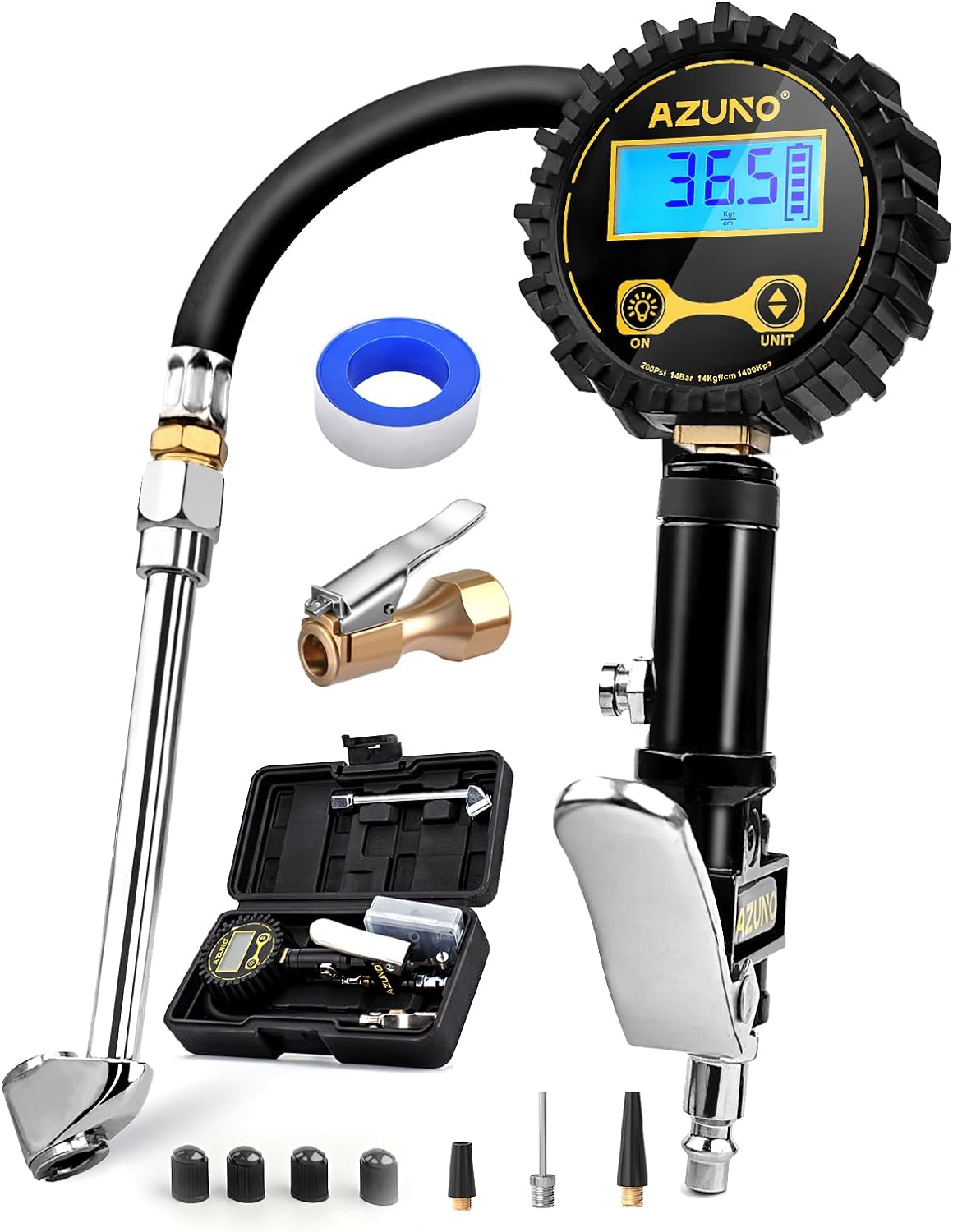
This digital tire inflator delivers accurate, easy-to-read pressure measurements with a bright backlit LCD and precise 0.1 resolution for confident inflation. Designed for single-handed use, it makes it simple to inflate or deflate tires while staying organized in the included portable carrying box. Built for a wide range of vehicles, it is a practical air compressor accessory for cars, trucks, SUVs, motorcycles, and more.

This portable tire inflator delivers fast, convenient inflation for cars, bikes, motorcycles, and balls with dual power options from a rechargeable battery or a 12V car cord. Its digital LCD pressure gauge and automatic shutoff help prevent over-inflation, while multiple preset modes and a custom setting make it easy to use for different inflation tasks. Built-in flashlight and USB power ports add extra emergency utility on the road.

This soft TPU key fob cover is designed to fit select Hyundai smart keys and helps protect against scratches, dust, and everyday wear while preserving signal performance. Its full-coverage design, stylish gold-rimmed look, and included leather keychain make it a practical and attractive upgrade for compatible Hyundai models.
What Does One Dual-Power Inflator Show?
A direct, same-pump engineering comparison isolates voltage from mechanical pump design. The Pittsburgh model 70680 manual publishes exact factory specifications for the same mechanical pump operating on both 12V DC and 120V AC:
| Published Specification | 12V DC Mode | 120V AC Mode |
|---|---|---|
| Airflow at 0 PSI | 0.483 CFM | 0.531 CFM (~10% increase) |
| Electrical Rating | 12V DC, maximum 10A (120W) | 120V AC, 60 Hz, 1.0A (120W) |
| Duty Cycle | 10 minutes on / 10 minutes off | 10 minutes on / 10 minutes off |
What this proves: Switching from 12V DC to 120V AC on the exact same compressor yields only a minor ~10% gain in free-flow airflow, while the heat-limited duty cycle remains completely unchanged. Because small reciprocating compressors are mechanically limited by cylinder bore, stroke, and air-cooling surface area, higher line voltage does not bypass thermal limits or fundamentally alter inflation times.
Three Compressor Specs to Read Correctly
- CFM or L/min at Working Pressure: Airflow rated at 0 PSI (free-flow) drops by 30% to 50% under working backpressure. Always evaluate CFM rated at 30 PSI or 90 PSI.
- Duty Cycle Rating: The percentage of time a compressor can safely run within a total cycle period (e.g., “10 min on / 10 min off” represents a 50% duty cycle at a stated ambient temperature).
- Maximum PSI vs. Working PSI: A “150 PSI” rating indicates burst pressure resistance of the internal valving, not rapid pumping speed at normal 32–36 PSI car pressures.
What Is a Tire Inflator?

A tire inflator is a dedicated positive-displacement air compressor engineered to deliver pressurized air to automotive tires, bicycle tubes, trailer wheels, and sports equipment. Unlike stationary workshop compressors with large storage tanks (e.g., 6- to 30-gallon reservoirs), portable inflators pump air directly into the tire cavity in real time.
Maintaining correct cold tire pressure is critical for vehicle braking distance, wet traction, casing durability, and optimal fuel economy. According to the National Highway Traffic Safety Administration (NHTSA), tires lose roughly 1 to 2 PSI per month in normal conditions, as well as 1 PSI for every 10°F drop in ambient temperature. Furthermore, U.S. Department of Energy data confirms that properly inflated tires improve fuel economy by up to 3%, while underinflated tires increase rolling resistance, heat buildup, and shoulder tread wear.
Warning: Never use the maximum pressure molded into the tire sidewall as your inflation target. That number represents the maximum cold inflation pressure the tire structure can support at maximum load. Always inflate to the vehicle manufacturer’s recommended cold pressure located on the driver-side door jamb placard.
The primary power configurations on the market include:
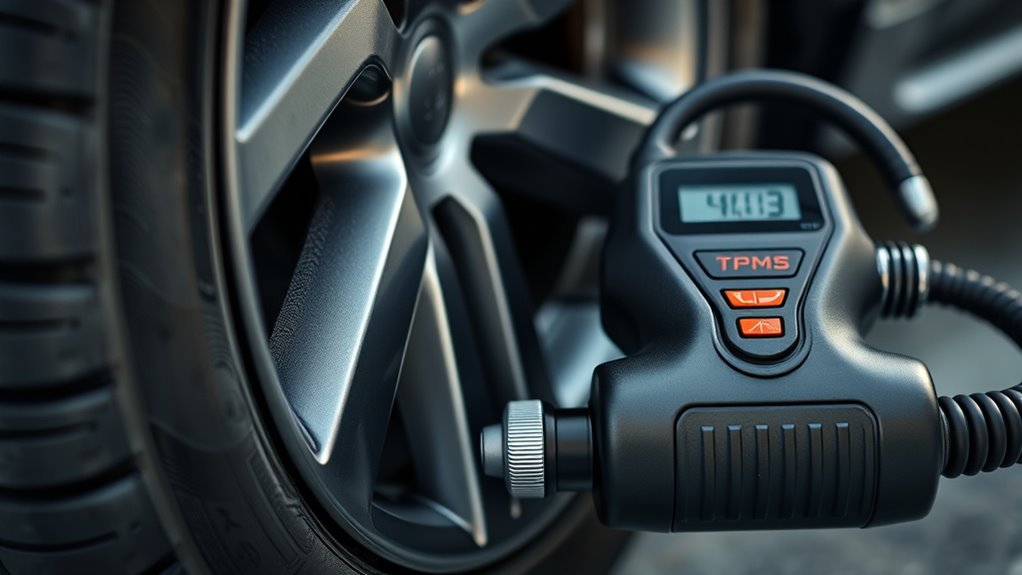
- 12V DC Accessory-Socket Inflators: Compact units drawing 8A–10A (under 120W) that plug directly into the vehicle’s interior 12V cigarette lighter outlet.
- 12V DC Battery-Direct Compressors: Heavy-duty units drawing 15A–30A (180W–360W) that clamp directly onto vehicle 12V battery posts using heavy-gauge alligator clips.
- 120V AC Inflators: Plug directly into standard North American 120V household wall outlets for garage and driveway maintenance.
- Dual-Power (12V/120V) Inflators: Contain dual internal power converters, allowing operation from both vehicle DC sockets and residential AC wall outlets.
- Cordless Battery Inflators: Powered by removable power-tool batteries (e.g., 18V/20V Li-ion) or integrated rechargeable packs.
When Is a 12V Tire Inflator Better?
A 12V tire inflator is the definitive choice for mobile readiness and emergency roadside safety because it utilizes the vehicle’s onboard electrical system wherever you drive.
Key operational advantages include:
- True Roadside Independence: Operates on highway shoulders, remote trailheads, or parking lots without relying on residential AC grid power.
- Trunk-Friendly Form Factor: Compact dimensions allow easy storage inside spare tire wells, side cargo cubbies, or underseat storage trays.
- Connection Adaptability: Drivers can choose between convenient 10A cabin plugs for light top-offs or high-flow 25A–30A battery-clamp compressors for off-road airing up.
- Emergency Integration: Most 12V models integrate bright LED floodlights or flashing hazard beacons powered directly from the vehicle.
Fill speeds among 12V inflators vary significantly by motor wattage. For instance, Slime rates its standard 12V digital tire inflator at roughly six minutes to inflate a standard passenger tire (P195/65R15) from 0 to 35 PSI, while its multi-purpose 12V inflator is rated at approximately eight minutes. Heavy-duty direct-battery models like the Pittsburgh 12V battery-clamp inflator flow significantly more CFM, filling comparable tires in under three minutes.
Pro Tip: Never rely exclusively on an inflator’s built-in digital or analog gauge while the pump is running. Active backpressure distorts running gauge readings by 2 to 4 PSI. Always switch the compressor off or check final pressure with a standalone calibrated tire pressure gauge.
Why Do 120V Tire Inflators Offer More Convenient Garage Power?
A 120V tire inflator connects directly to residential wall power, making it the most seamless tool for dedicated garage workshops, driveways, and planned multi-vehicle maintenance.
What Does Direct Wall Power Change?
Connecting to a 120V household outlet eliminates all reliance on vehicle battery health. You do not need to start the vehicle’s engine, route cords through car doors, or monitor battery voltage during extended inflation sessions across multiple vehicles.
This setup is especially advantageous for seasonal pressure adjustments in autumn and winter, servicing lawn tractors, trailers, and maintaining multiple family vehicles parked in proximity to the garage.
Is a 120V Tire Inflator Automatically Faster?
No. Motor voltage alone does not dictate air volume delivery. Performance is determined by:
- Displacement and Piston Diameter: A small 120V compressor with a 16mm piston cylinder will pump air slower than a heavy-duty 12V battery-direct compressor with a 30mm piston cylinder.
- True CFM under Load: Compare flow ratings at 30 PSI rather than 0 PSI free-air specs.
- Duty Cycle and Thermal Dissipation: Both AC and DC motors generate heat during air compression; 120V models require identical rest cycles unless equipped with active fan cooling or oil-lubricated cast-iron pump heads.
- Hose Internal Diameter: Narrow coiled hoses create significant airflow friction compared to 1/4-inch rubber air lines.
Key Differences Between 12V and 120V Tire Inflators
The core distinction is where and how power is delivered. Choosing the right configuration prevents blown fuses, dead starter batteries, or equipment overheating.
- Choose a 12V accessory-socket inflator for compact passenger cars, emergency kits, and occasional top-offs, verifying your vehicle’s 12V port fuse rating (typically 10A or 15A).
- Choose a 12V battery-clamp inflator for pickup trucks, full-size SUVs, off-road rigs, and horse/cargo trailers where current draw exceeds 15A.
- Choose a 120V inflator when your vehicle is parked within reach of a garage wall outlet and you prefer not running your car engine during monthly pressure checks.
- Choose a dual-power inflator to maintain one versatile tool for both driveway maintenance and long-distance road trips.
Electrical Safety Check: A 12V inflator drawing 14 amps will quickly blow a standard 10-amp vehicle accessory fuse. If your 12V inflator motor is rated above 120W (10A @ 12V DC), always use a model with direct battery terminal clamps or an approved battery-clamp adapter harness.
Common Use Cases for Tire Inflators: 12V vs. 120V

Match the tool to your physical parking situation and vehicle volume requirements:
- Roadside Flat or Slow Leak: A 12V inflator is mandatory. A 120V inflator is completely unusable on a highway shoulder unless you carry a dedicated 300W+ pure sine generator or power station.
- Multi-Car Household Maintenance: A 120V or dual-power model connected to a heavy-gauge garage extension cord allows you to service 3 or 4 cars in the driveway without repeatedly starting vehicle engines.
- Apartment Complex & Street Parking: 12V accessory inflators or cordless battery compressors are the only practical options when outdoor AC outlets are absent.
- Truck, SUV & Light Truck (LT) Tires: A standard passenger tire (~30 liters of air volume) takes 3–5 minutes to top off. An LT275/70R18 truck tire contains over 80 liters of air volume; filling it requires a high-flow 12V battery-direct compressor (1.5+ CFM) or a heavy-duty 120V unit to avoid triggering thermal overload shutdowns. Learn more about how CFM affects tire inflator speed.
- Bicycles, Sports Balls & Inflatables: Both 12V and 120V models handle low-volume items easily when equipped with Presta adapters, needle valves, and precise low-pressure gauge readouts.
Always inflate to the vehicle manufacturer’s cold tire inflation pressure on the driver door placard, never to the maximum PSI molded on the tire sidewall.
How Do Duty Cycle and Storage Affect Tire Inflator Life?
Portable tire inflators use oilless, PTFE-ringed pistons that generate intense friction and heat inside small aluminum or composite cylinders. Operating a compressor beyond its specified duty cycle scorches cylinder seals and causes premature motor burnout.
For example, a standard 50% duty cycle rating (e.g., 10 minutes running, 10 minutes cooling) must be strictly respected. Running a 10-minute rated pump continuously for 25 minutes across four large tires will degrade internal valving and melt fuse holders.
| Component / Factor | Failure Risk | Preventative Maintenance Action |
|---|---|---|
| Duty Cycle & Heat | Piston ring thermal breakdown and motor seizure | Limit runs to 10–12 minutes; allow full cool-down between tires |
| Brass Chuck Connector | Severe thermal transfer (can reach >140°F during use) | Wear gloves when detaching the chuck after prolonged inflation |
| Air Hose & Fittings | O-ring dry rot, micro-leaks, and crimp cracking | Avoid sharp bends and store hose coiled loosely in storage case |
| 12V Power Plug | Overheating and melting inside vehicle socket | Ensure tight socket fit; inspect internal glass fuse periodically |
| Trunk Storage Exposure | Condensation corrosion and cold-weather seal stiffness | Store inside a padded, moisture-resistant bag away from road debris |
Carbon Monoxide Safety Warning: If your 12V inflator instructions recommend running the vehicle’s engine to preserve battery voltage, always operate the vehicle outdoors in open air. Never run a vehicle engine inside an enclosed or attached residential garage.
Choosing the Right Tire Inflator for Your Usage Scenario
Evaluate your decision using this practical checklist:
- For Everyday Commuters (Emergency Backup): Select a compact 12V accessory-socket model with digital auto shut-off, an integrated LED light, and a current draw under 10A.
- For Homeowners & Multi-Car Garages: Select a dedicated 120V AC inflator or high-output dual-power unit that plugs into a 15A garage outlet.
- For Trucks, Large SUVs & Off-Road Drivers: Choose a high-CFM (1.5–2.5 CFM @ 30 PSI) 12V battery-clamp compressor with a minimum 20-minute duty cycle and an extended 25-foot coiled hose.
- For Maximum Versatility: Choose a dual-power 12V/120V model, ensuring it provides adequate hose reach (minimum 10–15 feet combined cord/hose) for your vehicle’s wheelbase.
For a detailed breakdown comparing corded models with rechargeable battery platforms, see our guide on corded vs. cordless tire inflators.
[Products Worth Considering]

This portable 12V tire inflator delivers fast, convenient inflation for cars, SUVs, trucks, motorcycles, and other inflatables. It features a digital display, bright LED lighting, auto shutoff, and multiple nozzle adapters to help you inflate accurately and safely, even in low-light situations. The long power cord and air hose make it easy to reach all tires and handle roadside emergencies or routine maintenance.
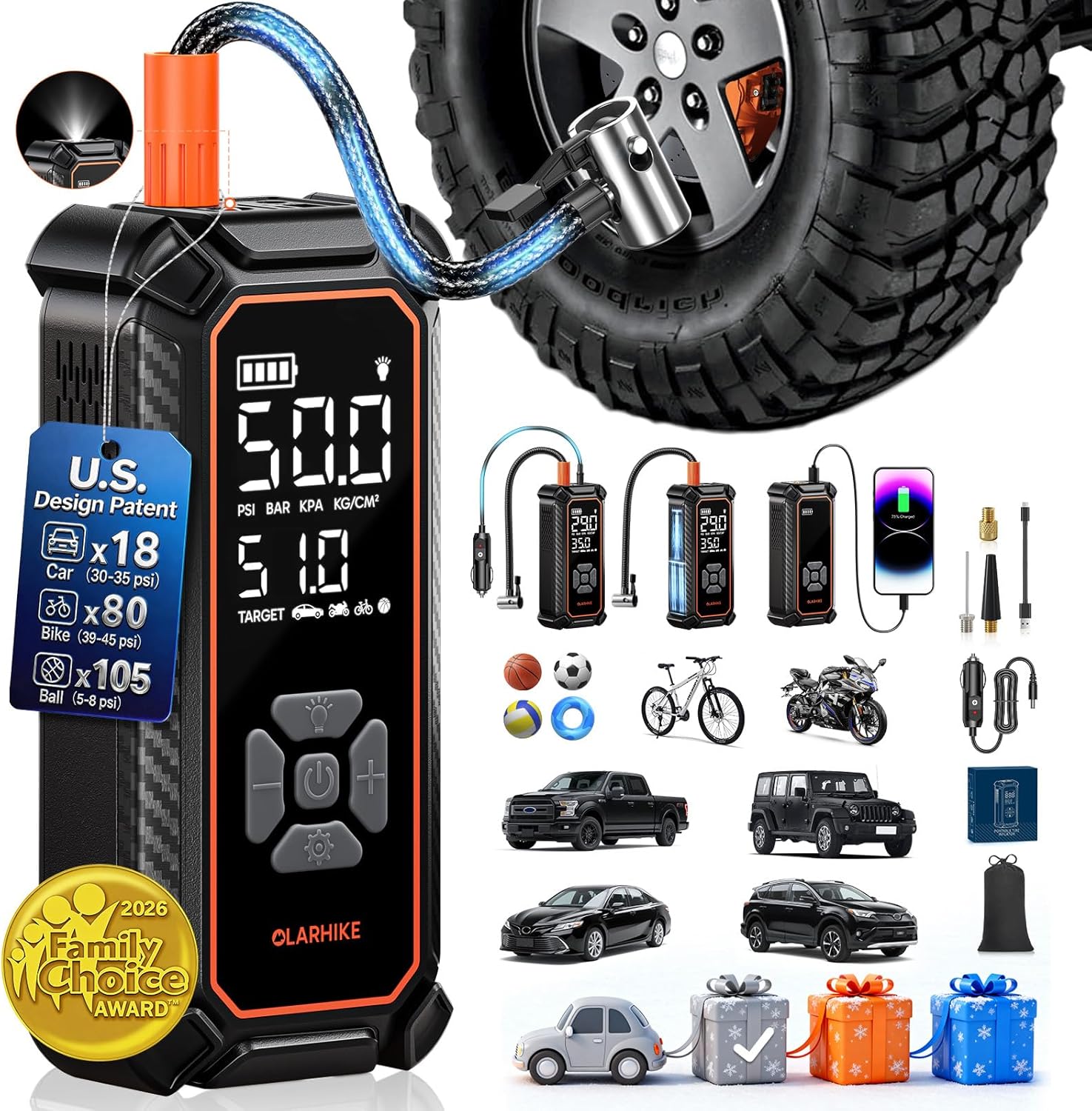
The OlarHike tire inflator delivers fast, reliable inflation for car, SUV, motorcycle, bicycle, and sports equipment needs, making it a practical tool for travel and roadside emergencies. Its dual power design lets you use either the built-in rechargeable battery or a 12V car outlet, while the auto shut-off function helps prevent over-inflation for safer, easier use. A bright display, preset modes, LED flashlight, and included accessories add convenience whether you're at home or on the road.
Which Tire Inflator Is Best for Emergencies: 12V vs. 120V?
For unexpected roadside tire emergencies, a 12V tire inflator is vastly superior. A 120V AC inflator cannot operate on the side of the road without a specialized high-capacity power station or inverter capable of handling compressor motor startup surges.
[Products Worth Considering]

[Powerful & Efficient Inflation] Heavy-duty twin-cylinder engine and high-torque motor for fast, reliable inflation. Inflate a 195/65R15 sedan tire (30-35 PSI) in just 20 seconds. Perfect for trucks, RVs, and cars.
Emergency & Use Case Selection Matrix
| Operating Scenario | Recommended Unit | Core Decision Reason |
|---|---|---|
| Unexpected highway puncture top-off | 12V DC (Socket or Clamps) | Draws available vehicle electrical power anywhere |
| Monthly garage tire maintenance | 120V AC or Dual-Power | Runs from wall power without running vehicle engine |
| Single unit for home and road trips | Dual-Power (12V/120V) | Seamless AC garage utility with DC roadside backup |
| Oversized truck / 33″+ off-road tires | 12V Battery-Direct (High-CFM) | Supplies 25A–30A power for fast multi-tire inflation |
| Remote camping or trail riding | 12V DC or Cordless Li-Ion | Complete independence from residential AC power grid |
How to Use a Tire Inflator Safely
Follow this precise step-by-step operating sequence to prevent electrical spikes, blown fuses, and inaccurate pressure readings. For deeper socket connection guidelines, review how to use a 12V tire inflator safely.
- Locate the Recommended Cold Pressure: Check the vehicle door placard on the driver’s B-pillar. Check tires when cold (parked at least 3 hours or driven under 1 mile).
- Park on Level Ground: Ensure the vehicle is parked away from moving traffic, set the parking brake, and activate hazard lights if on a roadway shoulder.
- Connect Power First:
- For 12V Socket: Insert the 12V plug firmly into the vehicle accessory port with the compressor power switch turned OFF.
- For 12V Battery Clamps: Connect the RED positive clamp to the positive (+) battery terminal, then the BLACK negative clamp to the negative (-) terminal or engine chassis ground.
- For 120V AC: Plug directly into a grounded 120V outlet (use a 14 AWG or heavier outdoor cord only if approved in the manual).
- Attach the Air Chuck Securely: Screw or clamp the air hose nozzle onto the tire valve stem without cross-threading until the gauge registers current tire pressure.
- Start the Compressor: Switch the unit ON (start the vehicle engine outdoors first if required by your 12V inflator’s manual to maintain 13.8V alternator voltage).
- Set Auto Shut-Off: Program your target cold PSI on digital models. Monitor analog gauges actively.
- Observe the Duty Cycle: Stop after 10–12 minutes of continuous pumping. Allow the motor and air hose to cool before moving to remaining tires.
- Verify Final Pressure: Disconnect the hose chuck (use gloves if the brass fitting is hot) and verify the final reading using a standalone, calibrated tire gauge.
Frequently Asked Questions
What is the difference between a 12V and 120V tire inflator?
A 12V tire inflator operates on direct current (DC) from a vehicle accessory socket or battery terminals, making it portable for roadside emergencies. A 120V tire inflator uses standard household alternating current (AC) from a wall outlet, making it ideal for garage maintenance. Voltage alone does not dictate speed; pump displacement, motor wattage, and CFM under pressure determine fill times.
Can I run a 120V tire inflator off a car inverter?
Generally no, unless you have a heavy-duty inverter. Electric compressor motors have an inductive startup surge (inrush current) that can demand 2 to 3 times their running wattage. A standard 100W–150W built-in car inverter will immediately trip on overload. Running a 120V inflator in a vehicle typically requires a dedicated 300W to 500W pure sine wave inverter connected directly to the battery.
Can I plug a 12V tire inflator into a 120V wall outlet?
Not without a certified AC-to-DC power converter. A simple mechanical plug adapter will destroy a 12V DC motor when exposed to 120V AC. To run a 12V inflator from a wall outlet, use a dedicated 120V AC to 12V DC power supply rated for at least 10 to 15 amps continuous output.
Is a 120V tire inflator always faster than a 12V inflator?
No. A high-output 12V battery-direct compressor drawing 25A to 30A often delivers 1.5 to 2.5 CFM at 30 PSI, easily outpacing a compact 120V household inflator flowing under 0.6 CFM. Always compare measured CFM at working pressure (30 PSI) rather than input voltage alone.
Does 120V wall power remove the duty-cycle cooling limit?
No. While household AC power eliminates vehicle battery drain, it does not prevent mechanical heat buildup. Air compression creates severe heat in the piston head and cylinder. Both 12V and 120V portable inflators require model-specific cool-down periods (typically 10 to 15 minutes of rest after 10 minutes of pumping).
Should my car engine be running when using a 12V inflator?
For brief top-offs (1–2 PSI), running the engine is usually unnecessary. For filling a flat tire or multiple low tires, running the engine is recommended to supply a stable ~13.8V–14.4V alternator voltage and prevent draining your 12V car battery. Always run the engine outdoors, never in an enclosed garage.
Why did my 12V tire inflator blow a fuse in my car?
Vehicle 12V accessory sockets are typically protected by a 10-amp or 15-amp fuse. Many compact inflators pull 12 to 14 amps under heavy backpressure (above 32 PSI), which trips the vehicle cabin fuse. If your compressor draws over 10A, switch to direct battery clamps or inspect your socket fuse rating.
Can a 12V tire inflator handle large truck or SUV tires?
Yes, provided you choose a heavy-duty, direct-battery model. Compact accessory-socket inflators lack the air volume (CFM) and duty cycle needed for 33″+ or LT-rated truck tires, often overheating before completing two tires. Choose a model rated for at least 1.5 CFM with alligator battery clamps.
Can I use a tire inflator on a completely flat tire?
A tire inflator can reinflate a flat tire provided the tire bead remains sealed against the wheel rim and there is no sidewall tear or rim puncture. If the tire has unseated from the bead or lost air due to severe structural damage, adding air will not hold pressure; mount your spare tire or contact roadside assistance.
Can I use an extension cord with a 120V tire inflator?
Only if the manufacturer permits it and the extension cord is properly rated. Using a thin (16 or 18 AWG) or excessively long cord causes voltage drop, making the compressor motor run hotter and slower. If an extension cord is needed, use a heavy-duty 14 AWG or 12 AWG outdoor-rated cord under 50 feet.
What should I look for when buying a tire inflator?
Key evaluation factors include: power connection type (socket vs. battery clamps vs. AC), airflow delivered at 30 PSI, duty cycle run-time limits, total reach (power cord plus air hose length to reach all four tires), digital auto shut-off, and gauge accuracy.
Conclusion
Choose a 12V tire inflator if your top priority is emergency roadside preparedness, trunk portability, and off-grid reliability. Choose a 120V tire inflator if your inflation tasks happen exclusively in a home garage or driveway where plugging into standard household AC power is fastest and avoids vehicle engine idling. For drivers seeking a single, do-it-all tool, a dual-power (12V/120V) inflator provides the ideal balance between garage convenience and roadside insurance.
Never base your buying decision solely on advertised voltage or maximum PSI ratings. Always verify the compressor’s measured CFM under 30 PSI backpressure, the manufacturer’s duty cycle rating, the total cord and air hose reach for your vehicle’s wheelbase, and whether your 12V electrical port or battery clamps match the compressor’s full amperage draw.
Sources
- NHTSA TireWise — supports monthly cold tire-pressure monitoring, spare tire checks, and placard pressure compliance.
- U.S. Department of Energy (FuelEconomy.gov) — provides empirical data on tire rolling resistance, fuel economy penalties of underinflation, and cold tire measurement protocols.
- Pittsburgh Dual-Power 120V/12V Tire Inflator Manual (Model 70680) — provides published comparative technical specifications on AC vs. DC airflow, electrical amperage, and thermal duty cycle.
- Pittsburgh 12V Battery-Direct High-Flow Inflator — supports technical distinctions and current draw ratings between cabin accessory sockets and direct-to-battery clamp setups.
- Slime 12V Digital Tire Inflator Specifications — supports manufacturer standard passenger tire inflation benchmarks and digital auto shut-off features.
- Slime Multi-Purpose Tire Inflator Specifications — supports fill-time comparisons and multi-adapter capabilities.


[…] For a deeper comparison of power sources, see the 12V versus 120V tire inflator guide. […]
[…] most sense if you already own their batteries. The DEWALT can also run on household power, and our 12V vs. 120V inflator guide shows where each power source makes […]