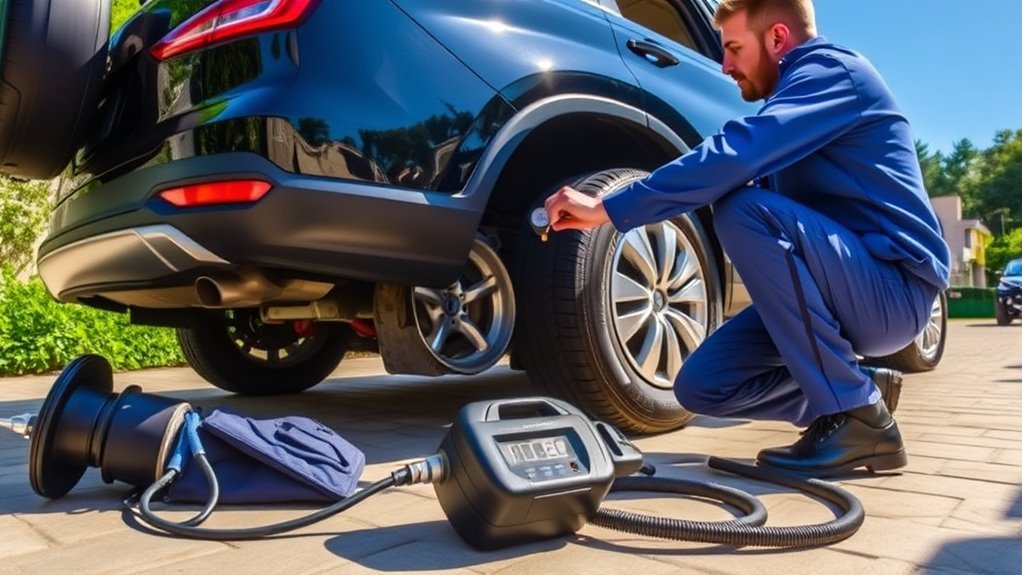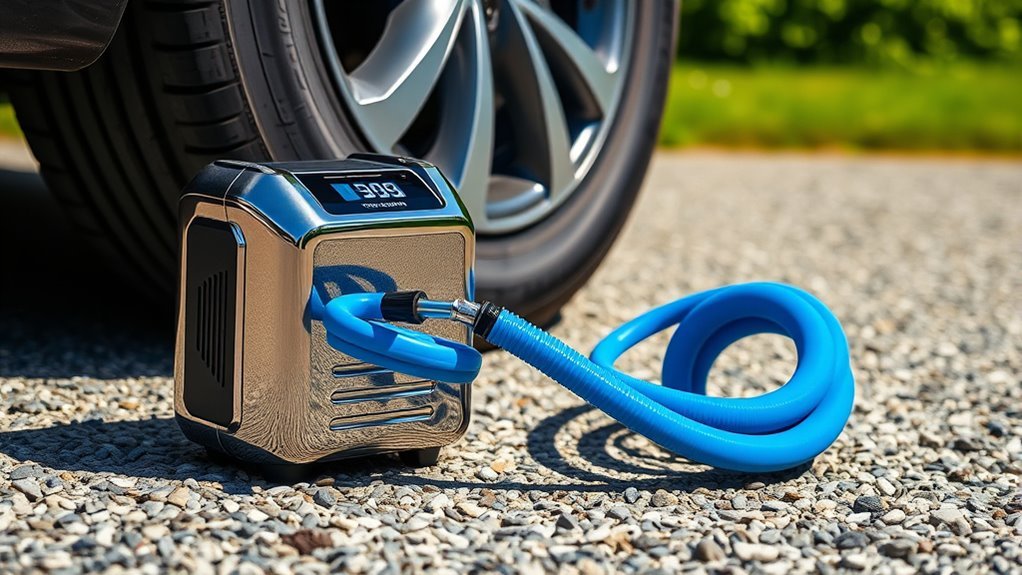
CFM, or Cubic Feet per Minute, is an essential measurement for your tire inflator’s performance. It tells you how much air flows out, directly impacting inflation speed. A higher CFM means quicker inflation, especially when targeting higher PSI; ideally, you want at least 4 CFM for efficient inflation. As pressure increases, CFM output can drop, so knowing this relationship helps you choose the right inflator. Keep exploring to discover more about optimizing your tire inflation experience!
What Is CFM and Why Does It Matter in Tire Inflators?
CFM, or Cubic Feet per Minute, is a critical measurement in the world of tire inflators that directly affects how quickly you can get your tires back to ideal pressure. Understanding the CFM rating of your tire inflator is essential for efficiency. A higher CFM rating means faster inflation, which is a game-changer, especially if you’re inflating multiple tires. For peak performance, aim for a minimum CFM of 3, but 4 or higher is even better. Keep in mind that CFM output decreases as PSI increases, so always check CFM specifications at various PSI levels to verify your inflator meets your needs. Choosing the right tire inflator can liberate you from the hassle of long inflation times, empowering your journeys.
Understanding the Relationship Between CFM and PSI
When you’re inflating your tires, the relationship between CFM and PSI can considerably affect the process. CFM, or Cubic Feet per Minute, measures the volume of air your inflator delivers. As you increase tire pressure (PSI), the CFM output typically decreases, meaning your inflator will take longer to fill tires at higher pressures. For peak performance, look for an inflator that delivers at least 3 CFM, with 4 CFM or more being ideal for quicker inflation. You’ll notice airflow specifications often show higher CFM at lower PSI, like 6.16 CFM at 0 PSI dropping to 4.68 CFM at 29 PSI. Understanding this relationship helps you select an inflator that meets your current and future tire inflation needs effectively.
How CFM Affects Tire Inflation Speed
The speed at which you can inflate your tires hinges greatly on the CFM rating of your inflator. A higher CFM means more air volume delivered per minute, allowing you to reach your desired tire pressure faster. For efficient tire inflation, look for inflators that deliver at least 4 CFM. However, keep in mind that as tire pressure rises, the CFM output typically decreases, which can slow your progress. For ideal performance, aim for an inflator that maintains a CFM above 3 at your target PSI. If you have larger tires or plan to upgrade in the future, consider how CFM influences airflow needs, ensuring you choose an inflator that meets your demands for speed and efficiency.
Choosing the Right CFM for Tire Inflation
Selecting the right CFM for your tire inflator can make all the difference in your tire maintenance routine. A minimum CFM of 3 is crucial for effective tire inflation, but if you want quicker results, aim for 4 CFM or higher. Remember, the airflow reduces as tire pressure increases, so check CFM specifications at various PSI levels to guarantee peak performance. If efficiency is your goal, higher CFM ratings allow you to inflate multiple tires simultaneously, which is especially useful during roadside repairs. Also, consider your future tire size needs; larger tires require higher CFM for effective inflation. By choosing the right CFM, you empower yourself to tackle tire maintenance with ease and confidence.
Essential Tire Inflator Features That Impact CFM Performance
When choosing a tire inflator, the power source and inflation speed specifications are essential features that can greatly impact CFM performance. A 12V DC inflator might be more convenient for on-the-go use, while a 110V AC option could offer higher efficiency for home use. Understanding these aspects will help you select an inflator that meets your needs for quick and effective tire inflation.
Power Source Options
Various power source options exist for tire inflators, each playing a crucial role in determining their performance and efficiency. Understanding these options helps you choose the right inflator that meets your needs for high volume and CFM.
- 12V DC: Powered via your car’s cigarette lighter, it’s portable and great for emergencies.
- 110V AC: Plug it into wall outlets for more power, usually providing higher CFM for faster inflation.
- Battery-Operated: Offers the ultimate portability, but CFM may vary widely depending on the battery capacity.
Selecting an appropriate power source is fundamental for achieving ideal CFM, especially when inflating larger tires or multiple tires simultaneously. This guarantees you maintain proper tire pressure efficiently.
Inflation Speed Specifications
Understanding inflation speed specifications is vital for maximizing the performance of your tire inflator, especially if you want quick and efficient tire maintenance. The CFM, or cubic feet per minute, is important here; a tire inflator with at least 3 CFM is recommended, but aiming for 4 CFM or higher is wise for faster inflation. Keep in mind that airflow decreases as tire pressure rises, so check the CFM rating at different psi levels to set realistic expectations. A higher CFM allows you to inflate all four tires simultaneously with ease, while lower ratings can extend your inflation time. Always review the CFM specifications to confirm your tire inflator meets your inflation speed needs effectively.
Common CFM Ratings for Different Tire Inflators
Tire inflators come with a range of CFM ratings, typically spanning from 1.5 to 6.5 CFM, which directly impacts how quickly you can inflate your tires. Understanding these ratings helps you choose the right inflator for your needs. Here are some common CFM ratings you might encounter:
- 1.5 to 2 CFM: Ideal for smaller tires or occasional use.
- 2 to 4 CFM: Most consumer-grade inflators fall here, delivering quick inflation at 0 PSI.
- 5 to 6 CFM: High-performance models that efficiently inflate tires even at higher PSI, guaranteeing you’re ready to hit the road faster.
Choosing an inflator with the right CFM and PSI balance guarantees the best inflation speed and efficiency for your driving adventures.
What If Your CFM Isn’t Enough for Your Tires?
When your tire inflator’s CFM rating falls short of what’s needed for your tires, you’ll likely notice a frustrating slowdown in the inflation process. Insufficient CFM can lead to prolonged inflation times, especially as tire pressure increases, making your inflator work harder and risking overheating. If you’re inflating larger tires or multiple tires at once, a minimum CFM of 3 is vital, but higher values are even better. It’s important to check your inflator’s CFM specifications against your tire size and pressure requirements to guarantee efficient performance. If you frequently face slow inflation, consider investing in a higher CFM inflator. This can save you time and frustration, enhancing your tire maintenance experience.
CFM Ratings of Popular Tire Inflators
When you’re choosing a tire inflator, understanding CFM ratings is essential. Most popular models range from 1.5 to 6.0 CFM, with higher ratings offering significant benefits, like quicker inflation times. By comparing different inflator models, you can find one that not only meets your speed needs but also aligns with your tire pressure requirements.
Typical CFM Ratings
Choosing the right tire inflator involves understanding typical CFM ratings, which can greatly impact your inflation experience. CFM, or cubic feet per minute, measures airflow, and different tire inflators vary markedly in this regard. Here are some typical CFM ratings to take into account:
- 1.5 to 3 CFM: Basic models suitable for light-duty inflation tasks.
- 3 to 4 CFM: Recommended for standard passenger tires, providing decent inflation speed.
- 4 to 6 CFM: High-performance models that inflate tires quickly, especially at lower psi levels.
Keep in mind that CFM ratings can change with air pressure, so always check both CFM and maximum psi output to confirm your tire inflator meets your needs efficiently. Understanding this will empower you to choose wisely.
High CFM Benefits
Releasing the benefits of a high CFM rating in tire inflators can dramatically enhance your inflation experience. When you choose a model with a CFM rating of 4 or higher, you’ll enjoy faster inflation times, particularly vital when handling multiple tires or larger sizes. For instance, a tire inflator boasting a 6 CFM rating at 0 psi can fill a standard tire much quicker than lower-rated options, helping you save valuable time. High-performance inflators, often utilized in professional settings, achieve CFM ratings above 4.5 at elevated air pressures, ensuring effective inflation for demanding applications. Understanding these CFM ratings isn’t just a detail; it’s key to selecting an inflator that meets your needs and optimizes your tire maintenance routine.
Comparing Inflator Models
Understanding how CFM ratings vary among popular tire inflators can help you make an informed decision. When you’re comparing models, consider these key factors:
- CFM Rating: Inflators typically range from 1.5 to 6.5 CFM. Higher ratings mean faster inflation times.
- Maximum PSI: Confirm the inflator meets your vehicle’s tire requirements, especially for larger tires on SUVs or trucks.
- Inflation Time: A tire inflator with a 3 CFM rating can inflate a standard tire to 30 PSI in 5 to 10 minutes, depending on the size.
Balancing CFM and maximum PSI in your choice will guarantee efficient and effective tire inflation, empowering you to maintain your vehicle’s performance with ease. Choose wisely!
How to Maintain Optimal CFM Performance in Your Tire Inflator
Maintaining ideal CFM performance in your tire inflator is vital for efficient inflation and overall functionality. Start by regularly cleaning the air filter to prevent airflow obstruction that can hinder your compressor’s efficiency. Confirm the hoses and connections are free from kinks and blockages; unrestricted airflow is essential for achieving maximum CFM. Regularly check for leaks in the hose and fittings, as even minor leaks can greatly reduce CFM and prolong inflation times. Use your inflator in a well-ventilated area, as high temperatures can negatively impact performance. Finally, monitor ambient temperature and humidity levels; operating in peak conditions helps maintain airflow and guarantees your tire inflator runs smoothly and effectively every time.
Frequently Asked Questions About CFM in Tire Inflators?
When it comes to tire inflators, understanding CFM—Cubic Feet per Minute—can make all the difference in your tire maintenance routine. You might wonder how CFM impacts inflation speed and how to choose the right value for your specific needs. Let’s explore these frequently asked questions to help you make informed decisions and keep your tires in top shape.
CFM Definition and Importance
CFM, or Cubic Feet per Minute, plays a crucial role in determining how quickly and effectively you can inflate your tires. Understanding CFM is important for selecting the right air compressor for your needs. Here are three key points to take into account:
- Minimum Requirements: A minimum CFM of 3 is recommended for effective tire inflation, while 4 CFM or higher is ideal for speed, especially for multiple tires.
- Pressure Effects: As tire pressure increases, the airflow capacity decreases, impacting inflation time.
- Future Needs: Choosing a tire inflator with a higher CFM rating guarantees you can efficiently handle current and future tire inflation requirements.
How CFM Affects Inflation
Understanding how CFM affects tire inflation can greatly enhance your experience with tire inflators. The volume of air a tire inflator delivers directly influences how quickly you can inflate your tires. A CFM rating of 4 or higher is generally ideal for faster inflation. As tire pressure rises, however, the CFM output decreases, slowing your inflation rate. Here’s a quick overview:
| CFM Rating | Efficiency Level | Ideal Use Case |
|---|---|---|
| 3 or lower | Low | Basic inflation tasks |
| 4 | Moderate | Standard vehicle tires |
| 5 | High | SUVs or light trucks |
| 6 or more | Very High | Rapid inflation needs |
| Varies | Dependent on PSI | Multiple tires at once |
Choosing the right CFM can make all the difference in filling tires efficiently.
Choosing Proper CFM Value
Choosing the right CFM value for your tire inflator can greatly impact your inflation experience, especially if you’re frequently on the go. To guarantee efficient inflation, consider the following:
- Minimum Requirement: Aim for a CFM of at least 3, but 4 CFM or higher is ideal for faster inflation rates.
- Tire Size: Match the CFM rating with your tire size; larger tires may need more airflow to inflate effectively.
- Pressure Considerations: Keep in mind that as tire pressure increases, your inflator’s CFM output typically decreases, slowing down inflation.
Frequently Asked Questions
What Is a Good CFM for an Air Compressor?
A good CFM for an air compressor starts around 3 CFM, ensuring efficiency in air consumption for tire maintenance. Higher ratings, like 4 CFM or more, boost performance and speed up your inflation tasks.
Is CFM More Important Than PSI?
CFM’s often more important than PSI for tire inflation. Higher CFM guarantees better air compressor efficiency, enabling faster inflation. Prioritize CFM to achieve peak performance and liberate yourself from prolonged waiting times during inflation tasks.
Is 4 CFM at 90 PSI Good?
Yes, 4 CFM at 90 PSI is good for tire inflator performance. It guarantees airflow efficiency for standard tires, staying within the ideal CFM range for quick inflation while meeting everyday demands. You’ll appreciate the results!
Which Is Better, CFM or SCFM?
CFM’s advantages lie in its ability to provide faster inflation, making it ideal for consumers. However, SCFM’s applications shine in professional environments, ensuring airflow efficiency under varying conditions. Choose based on your specific needs.
Conclusion
In the world of tire inflators, CFM is your trusty compass, guiding you toward efficient inflation. Understanding its significance helps you choose the right tool for the job, ensuring your tires are filled with precision and speed. Just like a well-tuned engine, the right CFM can mean the difference between cruising smoothly and feeling the bumps of the road. So, take the time to evaluate your inflator; it’ll pay off in performance and peace of mind.