
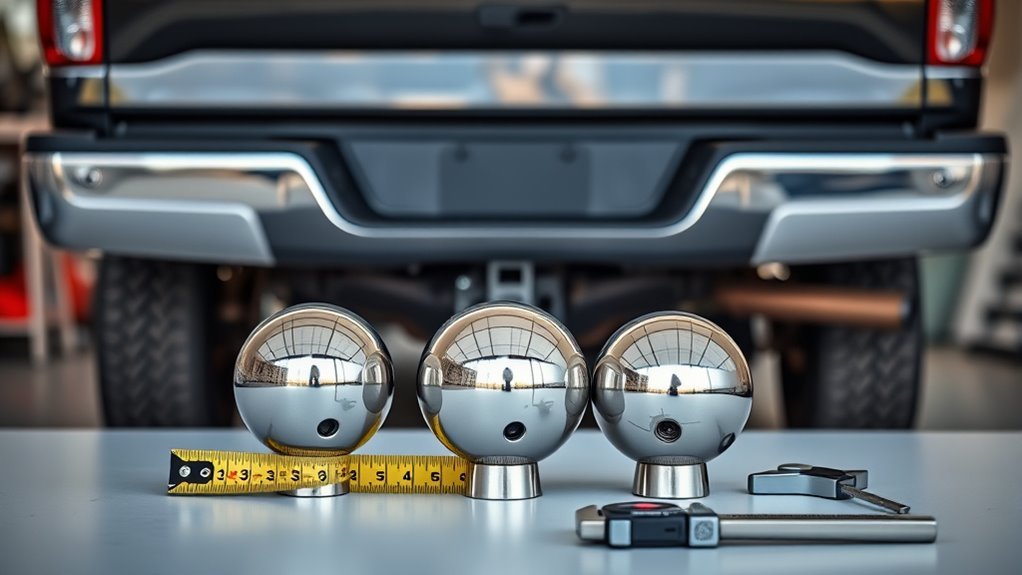
The correct Toyota Tundra trailer ball size is the size stamped on the trailer coupler—not a size chosen from the truck model. Depending on the trailer, that may be 1-7/8 inch, 2 inches, or 2-5/16 inches. After matching the diameter, confirm the loaded trailer weight, tongue weight, ball and shank ratings, ball-mount rating, receiver rating, and rise or drop before towing.
Last updated: August 31, 2026 · Rechecked against Toyota’s 2026 Tundra manual listings, current Tundra accessory materials, Toyota Genuine Parts, and CURT trailer-ball data.
Key Takeaways
- Choose the ball diameter from the trailer coupler stamp, not from the Tundra model name.
- Toyota currently offers 2-inch and 2-5/16-inch towing-ball options, but either one is correct only when it matches the trailer coupler and load.
- Ball-nut torque is determined by the exact hardware instructions and threaded shank diameter—not the ball diameter alone.
- Tongue weight uses part of the Tundra’s payload and must stay within the receiver, axle, tire, and vehicle ratings.
- Check the owner’s manual and labels for your exact model year, cab, bed, drivetrain, and installed hitch.
Verified for This Update
| 2026 Gas Owner’s Manual | Toyota 2026 Tundra manuals · OM0C084U |
| 2026 Hybrid Owner’s Manual | OM0C085U for Tundra HV; choose the manual for your exact powertrain |
| Toyota 2″ Trailer Ball | PT986-00270 · 6,000-lb published load rating |
| 2026 Toyota Ball Choices | Tundra accessory materials list 2″ and 2-5/16″ trailer-ball options sold separately |
Use This Five-Check Order
- Coupler diameter: Match the ball to the size stamped on the coupler.
- Loaded trailer weight: Use the trailer’s actual travel weight, not only its empty weight.
- Shank fit: Match the threaded ball shank to the ball-mount hole.
- Lowest rating: Check the ball, mount, receiver, truck, coupler, chains, tires, and trailer.
- Rise or drop: Select a mount that lets the loaded trailer travel at the attitude required by its manufacturer.
Which Trailer Ball Size Does a Toyota Tundra Need?

A Tundra may tow a trailer with a 1-7/8-inch, 2-inch, or 2-5/16-inch coupler. Toyota currently lists genuine 2-inch trailer ball PT986-00270 with a 6,000-pound load rating, while the 2026 Tundra accessory brochure lists both 2-inch and 2-5/16-inch trailer-ball choices sold separately. These listings show available hardware; they do not override the size stamped on your trailer coupler.
The rule is simple: match the ball diameter to the trailer coupler, then match every rating to the loaded trailer. A 2-inch ball with too little load capacity is unsafe. A 2-5/16-inch ball is also unsafe under a 2-inch coupler, even when the larger ball has a higher rating.
| Coupler Stamp | Common Trailer Types | Tundra Setup Note |
|---|---|---|
| 1-7/8″ | Very small utility, lawn, or light watercraft trailers | Use only when the coupler is stamped 1-7/8″ and every component is rated for the loaded trailer. |
| 2″ | Utility trailers, many boat trailers, small campers, and small equipment trailers | A common option, but ball capacity, threaded-shank fit, and mount rating still control. |
| 2-5/16″ | Large travel trailers, car haulers, equipment trailers, and heavy-duty bumper-pull trailers | Use only with a coupler stamped 2-5/16″ and a complete setup rated for the loaded trailer. |
| Gooseneck 2-5/16″ | Gooseneck livestock, flatbed, and equipment trailers | Uses a bed-mounted gooseneck ball, not a receiver-mounted ball mount. |
| Fifth-wheel kingpin | Fifth-wheel RVs and specialty trailers | Uses a fifth-wheel hitch and kingpin, not a trailer ball on the rear receiver. |
Warning: Never tow with a ball that is smaller or larger than the coupler stamp. A mismatched ball can prevent correct seating or allow the trailer to uncouple even when the latch appears closed.
[Products Worth Considering]
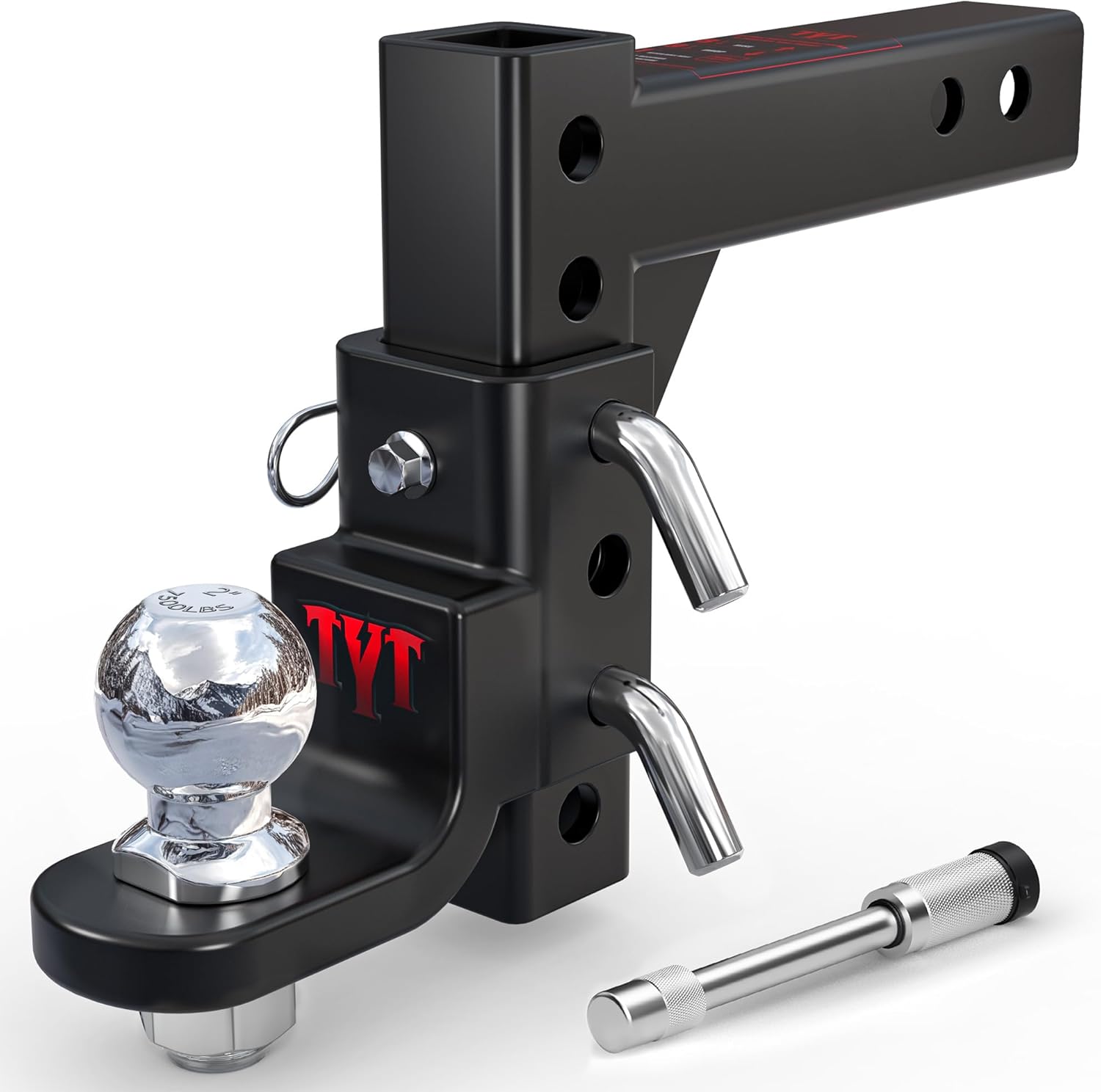
This adjustable trailer hitch ball mount is built for dependable towing with a standard 2-inch receiver and a high-capacity design suited for trucks, campers, boats, and utility trailers. Its adjustable rise and drop settings help you achieve a level tow, while the anti-rattle design supports a smoother, quieter ride. Complete with pins, clips, and a premium pin lock, it offers an easy installation and secure connection for everyday hauling needs.
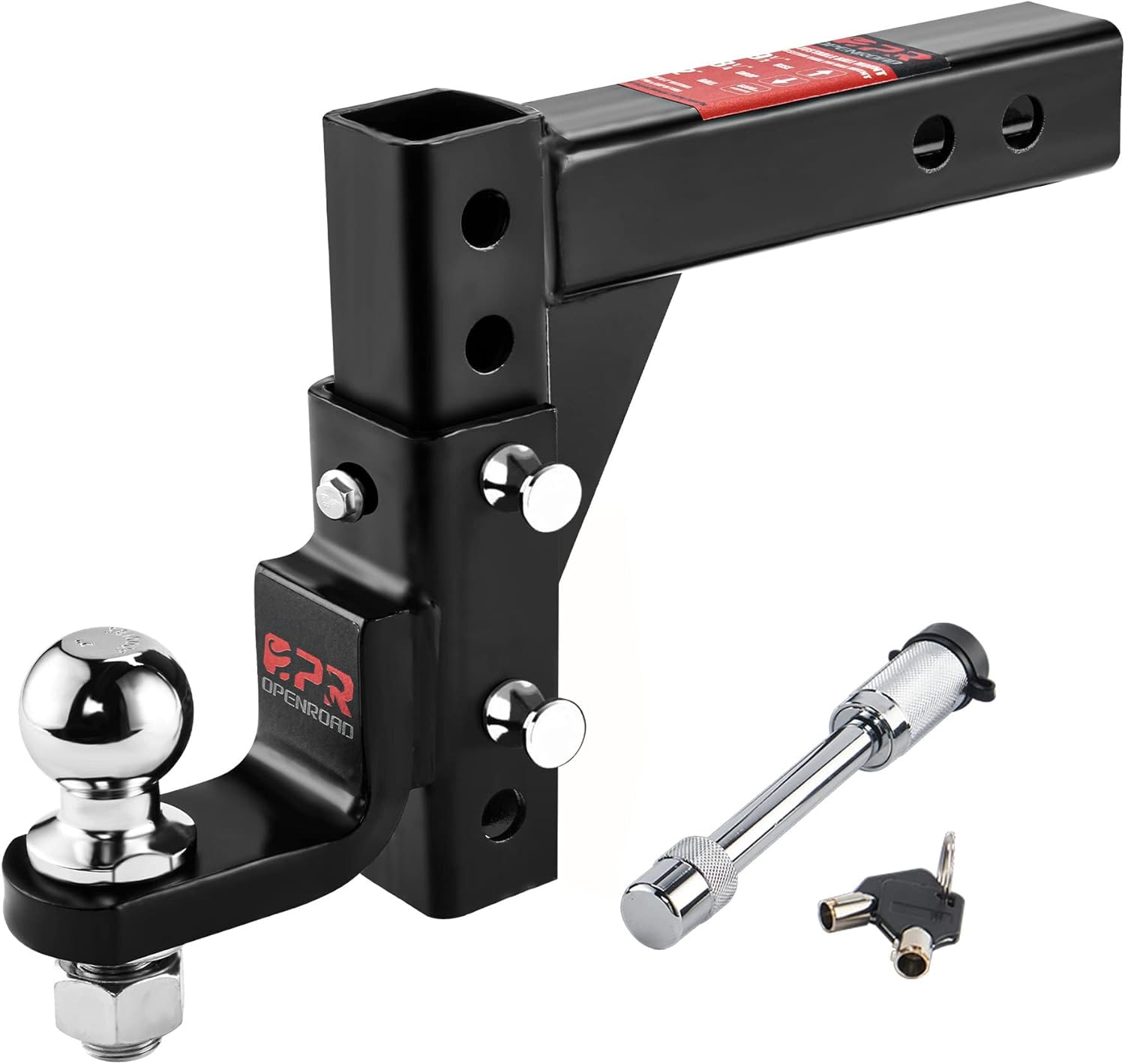
This adjustable trailer hitch ball mount is built for dependable towing with a strong steel construction and a versatile fit for 2-inch receivers. Its adjustable drop and rise settings help you dial in the right towing height, while the lock and keyed anti-theft design add security. A black powder-coated finish helps resist rust and wear for lasting performance on trucks and other towing setups.

This trailer hitch lock helps secure your trailer and hitch-mounted accessories with a high-strength steel pin designed for 2-inch receivers. It includes a weather-resistant cap to help keep out dust and moisture, plus rubber O-rings to reduce rattling during towing. With two copper keys and a sturdy lock core, it offers added peace of mind and dependable everyday protection.
How Do You Read the Coupler and Measure Tongue Weight?
Start at the trailer coupler. The required ball size is normally stamped into the coupler body, handle, or latch area. It may say 1-7/8″, 2″, or 2-5/16″. Clean away dirt or loose paint so you can read the marking. If the size cannot be confirmed, do not guess or tow until the coupler is identified.
Next, check the trailer’s gross trailer weight, cargo, and tongue weight. Tongue weight is the downward load the trailer applies at the hitch ball. Toyota’s 2026 manual set identifies OM0C084U for the gas Tundra and OM0C085U for the Tundra HV; use the Toyota 2026 Tundra manuals page to select the correct manual. Toyota’s conventional-towing guidance uses a 9% to 11% tongue-weight range; confirm the requirement in the manual for your exact powertrain and follow a more restrictive trailer or hitch instruction when applicable.
Use this formula:
Tongue weight ÷ loaded trailer weight × 100 = tongue-weight percentage
Example: a loaded 6,000-pound trailer at 10% tongue weight places about 600 pounds on the hitch. That load also consumes roughly 600 pounds of the truck’s available payload before passengers, bed cargo, tools, accessories, and hitch hardware are counted.
Check the payload label on your truck and review the site’s Toyota Tundra payload guide before towing a heavy trailer. For the percentage calculation and scale methods, use the dedicated Tundra tongue-weight percentage guide. A trailer can be below the truck’s advertised towing capacity while still exceeding payload, rear-axle, receiver, or tire limits.
Note: The safe limit is the lowest applicable rating in the complete setup: truck, payload, axle, tires, receiver, ball mount, trailer ball, shank, coupler, safety chains, and trailer.
What Receiver Size and Ball Shank Does a Tundra Use?
Toyota’s 2026 Tundra brochure lists a Class IV towing hitch receiver, and current Tundra accessory material is built around a nominal 2-inch square receiver. Verify the receiver opening and rating label on your own truck, especially when it has an aftermarket hitch or belongs to an earlier model year. The site’s Tundra hitch receiver size guide explains the receiver side of the setup in more detail.
The receiver opening is not the same measurement as the trailer-ball shank diameter. Check all three of these:
- Receiver opening: The square tube attached to the truck.
- Ball-mount shank: The square insert that slides into the receiver.
- Trailer-ball shank: The threaded post that passes through the ball-mount platform.
The threaded ball shank must match the ball-mount hole and have enough usable length for the specified washer and nut to seat correctly. Follow the instructions for both the ball and the mount; do not enlarge a mount hole or improvise spacers.
| Trailer-Ball Shank Diameter | CURT Published Torque Example | Important Note |
|---|---|---|
| 3/4″ | 160 ft-lb | Published by CURT for its 3/4-inch-shank trailer balls. |
| 1″ | 250 ft-lb | Published by CURT for its 1-inch-shank trailer balls. |
| 1-1/4″ | 450 ft-lb | Published by CURT for its 1-1/4-inch-shank trailer balls. |
The values above come from CURT’s trailer-ball catalog. They are examples for CURT hardware, not universal specifications. Use the torque stated by the manufacturer of your exact ball and mount.
Installation warning: Use a calibrated torque wrench with enough range. Have a qualified hitch installer perform the work when the specified torque exceeds your tools, the mount cannot be held securely, the threads are damaged, or the supplied instructions conflict.
Pro Tip: Torque follows the exact hardware instructions and threaded shank diameter. A “2-inch ball” does not have a 2-inch threaded shank.
2″ Vs 2-5/16″ Balls: When Should You Use Each?
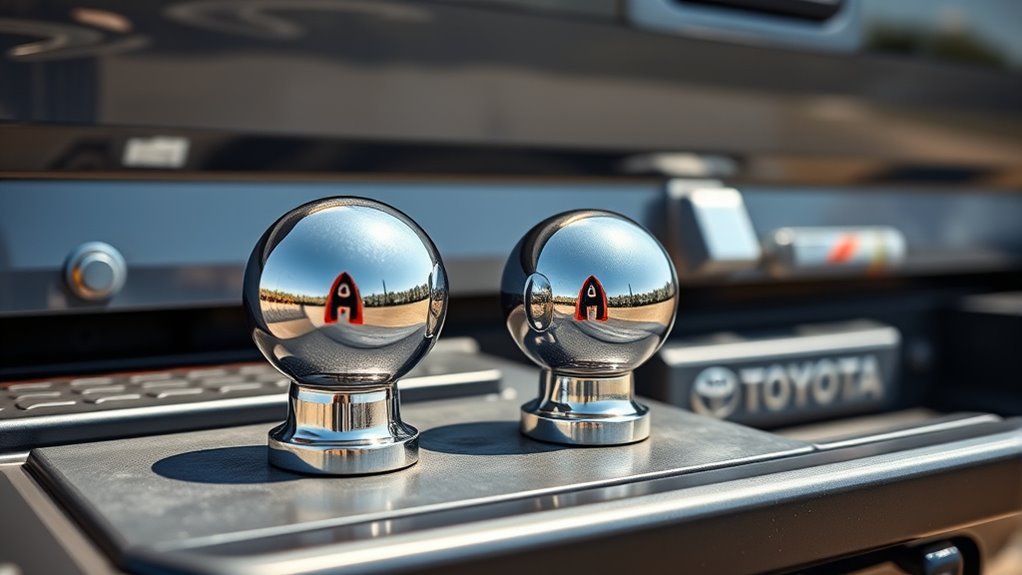
Both sizes can be used with a Toyota Tundra, but they are not interchangeable. Choose the diameter stamped on the trailer coupler, then check the ball’s gross trailer weight rating, tongue-weight rating when provided, threaded-shank dimensions, and ball-mount compatibility.
When to Use a 2-Inch Trailer Ball
Use a 2-inch trailer ball only when the coupler is stamped 2″ and the ball’s load rating meets or exceeds the trailer’s actual loaded weight. This diameter is found on many utility, boat, small camper, and light equipment trailers.
Do not assume all 2-inch balls have the same capacity. Toyota’s current genuine 2-inch ball is listed at 6,000 pounds, while other products may carry different ratings, shank sizes, or installation requirements. Read the marking and instructions for the exact part.
When to Use a 2-5/16-Inch Trailer Ball
Use a 2-5/16-inch trailer ball only when the coupler is stamped 2-5/16″ and every towing component is rated for the loaded trailer. This diameter is common on larger travel trailers, car haulers, equipment trailers, and other heavier bumper-pull trailers.
A 2-5/16-inch ball is not an upgrade for a 2-inch coupler. The coupler must close correctly around its specified diameter, and its latch must be secured as directed by the coupler manufacturer.
What About 1-7/8-Inch, Gooseneck, and Fifth-Wheel Setups?
A light trailer may use a 1-7/8-inch coupler. It can be connected to a Tundra only with a matching ball and a complete setup that remains within every applicable rating.
A gooseneck trailer normally uses a bed-mounted 2-5/16-inch gooseneck ball. A fifth-wheel trailer uses a kingpin and fifth-wheel hitch. Neither setup uses the ordinary receiver-mounted ball mount behind the bumper.
How Do You Measure Ball-Mount Rise or Drop?
Park the Tundra and uncoupled trailer on firm, level ground. Level the trailer as directed by its manufacturer, and load the truck and trailer as close as practical to their travel condition.
- Measure the receiver height. Measure from the ground to the inside top edge of the receiver opening.
- Measure the coupler height. Measure from the ground to the lower coupling surface of the level trailer coupler, following the ball-mount maker’s method.
- Find the difference. If the receiver is higher, you need approximately that amount of drop. If the coupler is higher, you need approximately that amount of rise.
- Verify the final attitude. Couple and load the trailer, then confirm it sits at the attitude required by the trailer and hitch manufacturers.
The CURT ball-mount guide also explains how receiver height, coupler height, shank size, capacity, and ball selection work together.
Important: An unloaded measurement is only a starting point. Recheck trailer attitude after passengers, cargo, hitch hardware, and tongue weight are applied.
Adjustable and Dual-Ball Mounts for Towing Multiple Trailers
If you tow more than one trailer, an adjustable or dual-ball mount can reduce hardware changes. A mount may carry 2-inch and 2-5/16-inch balls and provide several rise or drop positions.
Check the rating for the mount, each ball, every adjustment position, the pins, and the locking mechanism. Some mounts have different capacities depending on the ball diameter, rise position, drop position, or accessory attached. The lowest applicable rating controls.
Before each trip, inspect the ball surfaces, pivot points, locking pins, welds, adjustment holes, and shank. Remove the mount from service if you find cracks, elongated holes, bent metal, damaged threads, severe corrosion, or movement beyond the manufacturer’s allowance.
When Does a Tundra Need Weight Distribution or Sway Control?
Toyota’s Tundra towing guidance requires a weight-distributing hitch with sufficient capacity when gross trailer weight is over 5,000 pounds and calls for a sway-control device with sufficient capacity above 2,000 pounds. Because Toyota publishes separate 2026 gas and HV manuals, confirm both thresholds in the owner’s manual for your exact 2026 Tundra before selecting hitch hardware.
A weight-distributing hitch can transfer part of the hitch load toward the truck’s front axle and the trailer axles. It does not increase payload, GVWR, GAWR, GCWR, tire capacity, receiver capacity, or the trailer’s rating. See the full Tundra weight-distribution hitch setup guide before selecting or adjusting one, and use the Tundra trailer-sway guide for sway-specific loading and recovery guidance.
Warning: A higher-rated trailer ball cannot upgrade an underrated truck, receiver, ball mount, tire, axle, or trailer. The lowest-rated component remains the limit.
Step-by-Step: How to Choose and Install a Tundra Trailer Ball
- Read the coupler stamp. Confirm whether the trailer requires a 1-7/8″, 2″, or 2-5/16″ ball.
- Determine the loaded trailer weight. Include cargo, water, batteries, fuel, tools, and other travel equipment.
- Verify the exact Tundra. Check the owner’s manual, certification label, payload label, receiver label, and the towing information for your model year, cab, bed, drivetrain, and equipment.
- Choose a correctly rated ball. Its diameter must match the coupler and its capacity must meet or exceed the loaded trailer demand.
- Match the threaded shank to the mount. Confirm the required diameter, usable length, washer, nut, platform thickness, and hole fit from the hardware instructions.
- Check the receiver, mount, and pin ratings. Every part must remain within its gross trailer weight and tongue-weight limits.
- Calculate rise or drop. Compare receiver and level-coupler heights, then verify the final trailer attitude after loading.
- Torque the ball nut. Follow the specification supplied with the exact trailer ball and mount.
- Seat, latch, and secure the coupler. Follow the coupler manufacturer’s procedure and install the latch pin or lock.
- Connect the safety equipment. Cross the safety chains when required, connect the wiring, and attach the breakaway cable without wrapping it around the safety chains.
- Test the lights and brakes. Check running lights, turn signals, brake lights, trailer-brake response, and the breakaway system when equipped.
- Measure tongue weight and check payload. Adjust cargo only within the trailer maker’s loading instructions and every vehicle or hitch rating.
- Recheck after a short drive. Stop in a safe location and inspect the latch, pins, chains, wiring, tires, brakes, and hitch hardware.
[Products Worth Considering]

These car purse hooks turn unused headrest space into convenient storage for handbags, groceries, backpacks, and other everyday essentials. Built with durable leather and reinforced metal, they offer a secure, damage-free way to keep your vehicle organized while adding a clean, stylish look to the interior. Their universal fit and tool-free installation make them a practical choice for daily commutes, road trips, and family use.
This OEM-style backup camera delivers a clear rear view with a wide-angle HD sensor to help reduce blind spots and make parking easier. Its fully sealed waterproof construction and strong low-light performance support reliable use in all weather and lighting conditions. Designed for cars, trucks, SUVs, vans, and RVs, it also supports front-view switching and selectable guide lines for flexible installation.

【Heavy Duty Trailer Hitch】- Offers a gross trailer weight capacity of up to 15,000 lbs and 1,500 pounds tongue weight, Perfect for towing trailer, campers, hauling motorcycles and ATVs with 2 inch standard hitch receiver (weight capacity may change if trailer ball is removed)
Quick Buying & Installation Checklist for Your Tundra Trailer Ball
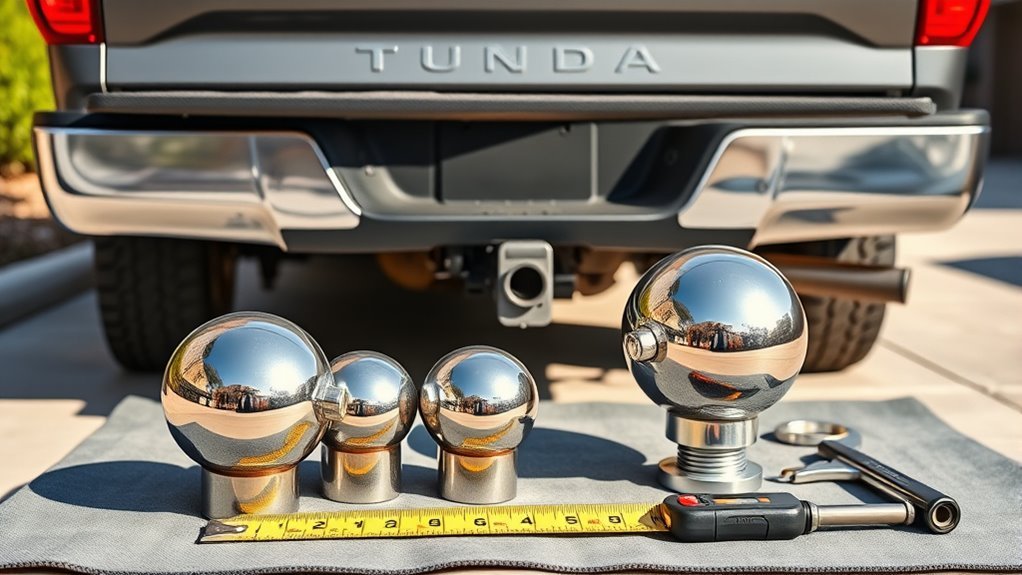
Confirm all of these items before buying or using a trailer ball:
- Coupler size: The stamped size matches the ball diameter exactly.
- Loaded trailer weight: The figure includes cargo and travel equipment.
- Ball rating: It meets or exceeds the actual trailer demand.
- Shank diameter: It matches the ball-mount hole and hardware instructions.
- Shank length: It allows the specified washer and nut to seat correctly.
- Ball-mount rating: It covers both loaded trailer weight and tongue weight.
- Receiver and pin ratings: They meet the load and fit the truck correctly.
- Truck ratings: Payload, GVWR, GAWR, GCWR, tires, and model-specific towing limit remain within specification.
- Rise or drop: The coupled trailer sits at its required travel attitude.
- Torque: The value comes from the exact hardware manufacturer.
- Safety equipment: The coupler pin, hitch pin, chains, breakaway system, wiring, lights, and trailer brakes work correctly.
The correct trailer ball is not the largest one. It is the ball that matches the coupler, fits the mount, and stays within every rating in the loaded towing system.
[Products Worth Considering]

RELIABLE STRENGTH. This trailer hitch ball is rated to tow up to 10,000 pounds gross trailer weight. It is constructed from hot-forged steel for reliable towing strength and confidence on the road ahead
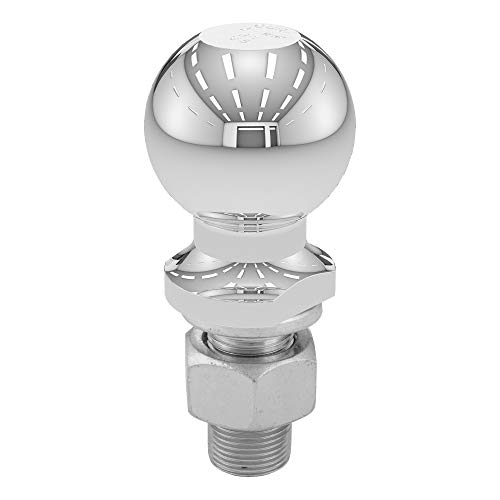
RELIABLE STRENGTH. This trailer hitch ball is rated to tow up to 7,500 pounds gross trailer weight. It is constructed from hot-forged steel for reliable towing strength and confidence on the road ahead
Troubleshooting Common Tundra Trailer Ball Problems
| Problem | Likely Cause | Fix |
|---|---|---|
| Coupler feels loose on the ball | Wrong ball size, worn parts, damage, or an incorrect coupler adjustment | Stop towing. Confirm the coupler stamp and have the ball and coupler inspected before reuse. |
| Trailer nose points up or down | Incorrect rise or drop, loading change, or hitch adjustment | Remeasure the loaded setup and select or adjust the mount according to the hardware instructions. |
| Trailer sways | Incorrect tongue weight, load placement, speed, wind, tire pressure, tire condition, or hitch setup | Reduce speed smoothly, avoid abrupt steering, stop safely, and inspect the load, tires, trailer attitude, and sway-control setup. |
| Ball nut loosens | Incorrect torque, damaged threads, wrong hardware, poor shank fit, or mount damage | Remove the assembly from service and have it inspected and reinstalled with the specified hardware and torque. |
| Rear of Tundra sags heavily | Excess tongue weight, overloaded payload or rear axle, incorrect loading, or an improperly selected weight-distribution system | Weigh the setup, reduce or reposition cargo only as permitted, and correct the hitch configuration before towing. |
Frequently Asked Questions
How do I know what size trailer ball I need for a Toyota Tundra?
Read the size stamped on the trailer coupler. Match the ball diameter to that stamp, then confirm that the ball, shank, mount, receiver, truck, and trailer are all rated for the loaded trailer weight and tongue weight.
Does a Toyota Tundra use a 2-inch or 2-5/16-inch ball?
Either size can be correct. Use a 2-inch ball only with a coupler stamped 2″, and use a 2-5/16-inch ball only with a coupler stamped 2-5/16″. Some light trailers use a 1-7/8-inch coupler.
Does a 2026 Toyota Tundra come with a trailer ball?
Toyota’s 2026 accessory brochure describes the trailer ball as sold separately. Confirm the equipment supplied with your individual truck or dealer-installed towing package before pickup.
What receiver size does a Toyota Tundra use?
Current Tundra materials list a Class IV towing receiver and reference 2-inch square receiver accessories. Verify the opening and rating label on your truck because model year, factory equipment, and aftermarket hitches can differ.
Can I use a 2-5/16-inch ball on a 2-inch coupler?
No. The ball diameter must match the coupler stamp exactly. A larger ball will not seat correctly, while a smaller ball can allow excessive movement or uncoupling.
What tongue weight should I use when towing with a Tundra?
Toyota’s Tundra conventional-towing guidance uses a 9% to 11% tongue-weight range. For 2026, select the correct gas or HV owner’s manual for your exact truck and follow any more restrictive trailer or hitch instruction.
What torque should I use for a trailer ball?
Use the torque specified by the manufacturer of the exact trailer ball and mount. CURT publishes examples of 160 ft-lb for a 3/4-inch shank, 250 ft-lb for a 1-inch shank, and 450 ft-lb for a 1-1/4-inch shank, but those figures are not universal.
How do I calculate the ball-mount rise or drop?
On level ground, compare the Tundra’s receiver height with the height of the level trailer coupler. If the receiver is higher, the difference is the approximate drop. If the coupler is higher, the difference is the approximate rise. Recheck the trailer attitude after the setup is loaded.
Do I need a weight-distribution hitch on a Toyota Tundra?
Toyota’s Tundra towing guidance requires a weight-distributing hitch with sufficient capacity when gross trailer weight exceeds 5,000 pounds. Confirm the threshold in the correct 2026 gas or HV owner’s manual and follow the hitch manufacturer’s setup procedure.
Can I choose trailer-ball size from trailer weight?
No. Trailer weight determines the capacity the ball and hitch components must carry; it does not choose the ball diameter. Match the diameter to the trailer coupler stamp first, then verify that the ball, shank, mount, receiver, truck, and trailer ratings cover the loaded weight and tongue weight.
Is a fifth-wheel hitch the same as a 2-5/16-inch trailer ball?
No. A fifth-wheel trailer uses a kingpin and fifth-wheel hitch. A gooseneck trailer commonly uses a bed-mounted 2-5/16-inch ball. A bumper-pull trailer uses a receiver-mounted ball behind the truck.
Conclusion
The correct Toyota Tundra trailer ball is the one that matches the trailer coupler stamp and remains within every loaded rating. Confirm the ball diameter, trailer weight, tongue weight, payload, threaded-shank fit, ball-mount capacity, receiver rating, rise or drop, and manufacturer torque before towing.
Before the first trip, photograph or record the truck, receiver, ball, mount, coupler, and trailer labels. Recheck the complete setup whenever you change trailers, cargo, hitch hardware, suspension height, or loading.
Sources
- Toyota — 2026 Tundra Manuals & Warranties — Official model-year manual portal; use OM0C084U for gas Tundra or OM0C085U for Tundra HV.
- Toyota — 2026 Tundra Accessory eBrochure — Current Tundra towing accessories and separately sold trailer-ball information.
- Toyota — 2026 Tundra eBrochure — Current factory towing-equipment overview, including the Class IV receiver listing.
- Toyota Genuine Parts — 2-Inch Trailer Ball PT986-00270 — Toyota’s current 2-inch ball listing and published 6,000-pound rating.
- CURT Trailer-Ball Catalog — Trailer-ball dimensions, capacities, shank measurements, and CURT torque examples.
- CURT — How to Measure Hitch Height, Rise, and Drop — Ball-mount fit and trailer-leveling measurements.



[…] must all be suitable for the setup. Review the Tundra hitch receiver guide and confirm the correct trailer ball size before […]