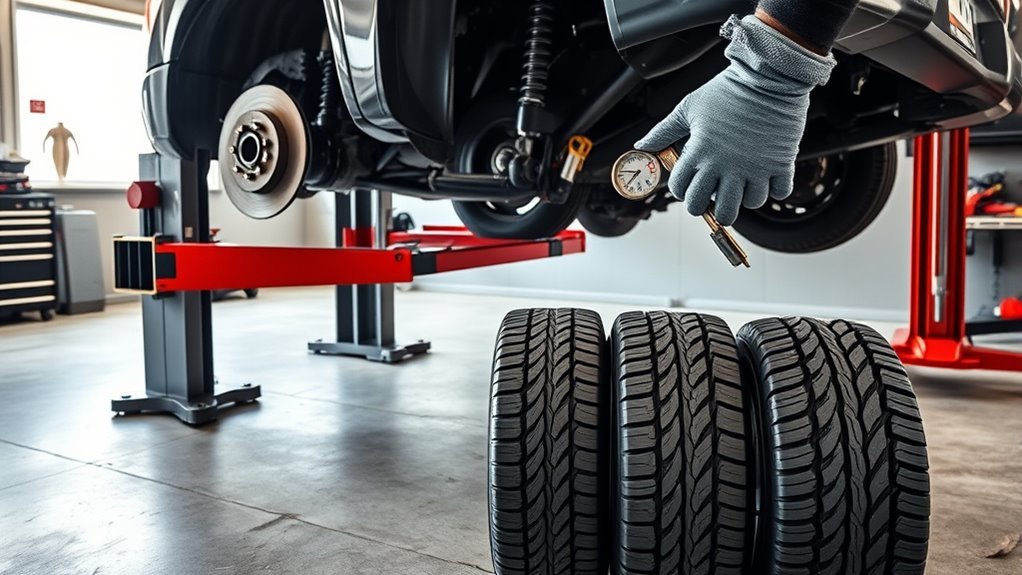
For the 2026 Toyota Tundra—and many recent model years—rotate the tires every 5,000 miles or six months, whichever comes first. Toyota’s 2026 maintenance chart lists tire rotation at each 5,000-mile service checkpoint through 50,000 miles. Older Tundras can use a different interval, so the maintenance guide for your exact model year and any tire-warranty requirement take priority. Regular rotation works best when you also check tire pressure, tread depth, alignment symptoms, and wheel torque during the same service.
Last updated: August 31, 2026. Maintenance intervals, torque examples, and tire-safety guidance were rechecked against Toyota, NHTSA, Bridgestone, and Michelin sources.
Quick Answer
For the 2026 Tundra and many recent model years, rotate the tires every 5,000 miles or six months, whichever comes first. Check the maintenance guide for your exact model year because older Tundras can differ. Use Toyota’s specified rotation pattern, confirm whether the tires are directional, and inspect tread more often when towing, hauling, or driving off-road.
Key Takeaways
- Toyota’s 2026 Tundra maintenance guide calls for scheduled maintenance every 5,000 miles or six months and marks tire rotation at each 5,000-mile checkpoint through 50,000 miles.
- The right pattern depends on your model year, wheel setup, tire direction, and owner’s manual—not just whether the tire is non-directional.
- Directional tires stay on the same side and move front-to-rear only; cross patterns apply only when the tire and vehicle guidance allow them.
- Use jack stands, wheel chocks, a torque wrench, and the exact wheel-lug torque spec for your Tundra and wheel type.
- Replace tires when treadwear indicators show, tread reaches 2/32 inch, damage appears, or uneven wear cannot be corrected safely.
At a Glance
| Time Required | 45–75 minutes for a careful DIY four-tire rotation |
| Difficulty | Moderate; safe lifting and correct torque matter |
| Tools Needed | Wheel chocks, floor jack, jack stands, lug wrench or breaker bar, torque wrench, tire-pressure gauge, tread-depth gauge |
| Cost | DIY has no service charge if you already own the tools; shop pricing varies and may be included with a tire purchase or maintenance plan |
How Often Should You Rotate Toyota Tundra Tires?

For a 2026 Toyota Tundra, the answer is every 5,000 miles or six months, whichever comes first. Toyota’s 2026 Tundra Warranty & Maintenance Guide says scheduled maintenance is due every 5,000 miles or six months and marks “Rotate Tires” at the 5,000-, 10,000-, 15,000-, 20,000-, 25,000-, 30,000-, 35,000-, 40,000-, 45,000-, and 50,000-mile checkpoints.
Model-year check: Do not apply the 2026 interval blindly to every Tundra ever built. Toyota documentation for older vehicles can use a 7,500-mile tire-rotation interval. Check the maintenance or owner’s manual for your exact model year before setting your schedule.
That interval gives you a predictable habit: rotate tires, check cold pressure, measure tread depth, inspect sidewalls, and note any feathering, cupping, or shoulder wear. Rotation helps each tire spend time in different wheel positions, which can even out the normal wear caused by steering, braking, acceleration, load, and cornering.
Note: “Every oil change” is not always the same as “every tire rotation.” The 2026 Tundra schedule uses 5,000-mile maintenance checkpoints, while oil-change timing can vary with engine and operating conditions. Use your exact model-year maintenance guide as the source of truth.
Keep a simple record with the date, mileage, tire positions, tread depths, tire pressures, and torque spec used. Good records help you catch wear problems early and support maintenance or tire-mileage warranty conversations if a problem comes up later.
[Products Worth Considering]

The NOCO GENIUS10 is an all-in-one smart charger, maintainer, trickle charger, and desulfator designed to keep 6V and 12V batteries performing at their best. It supports lead-acid and lithium batteries, charges deeply discharged batteries, and uses temperature compensation for safer, more accurate charging in changing conditions. Compact and versatile, it is ideal for a wide range of vehicles and long-term battery maintenance.

The JACO ElitePro Digital Tire Pressure Gauge delivers shop-grade accuracy with a clear digital readout, making it easy to maintain proper tire pressure for safer driving and better performance. Built with rugged brass and steel components, a protective guard, and a flexible air hose, it is designed for reliable use across cars, trucks, motorcycles, bikes, RVs, and trailers. The lock-on display, built-in bleeder valve, and bright backlit screen add convenience in any lighting condition.

This dial type tire tread depth gauge helps you quickly check tread wear on motorcycles, cars, trucks, and buses with easy-to-read 1/32-inch increments. Its colorful zone markings make it simple to assess tire condition for safer driving in different weather, while the durable zinc cast body and legible dial provide dependable everyday use.
Which Rotation Pattern to Use for a Tundra
The best Tundra tire rotation pattern is the one shown in your Toyota owner’s manual for your model year and tire setup. Do not choose a pattern from a generic chart until you confirm four things: tire direction, tire size, wheel size, and whether the spare is safe to include.
| Tire / Wheel Setup | Pattern to Use | What to Check First |
|---|---|---|
| Toyota manual shows same-side rotation | Front tires move straight to rear; rear tires move straight to front on the same side. | Follow Toyota’s diagram for your exact year and wheel package. |
| Directional tires | Front-to-rear only on the same side. | Look for “Rotation” or an arrow molded into the sidewall. |
| Same-size, non-directional tires where the manual allows a cross pattern | Rearward cross or X-pattern, depending on drivetrain and manufacturer guidance. | Confirm the owner’s manual and tire maker allow side-to-side movement. |
| Staggered aftermarket setup | Usually side-to-side only if tires are non-directional; directional staggered tires may need dismounting. | Confirm front and rear tire sizes and wheel offsets. |
| Temporary spare | Do not include it in regular rotation. | Only a matching full-size spare may be considered, and only if the manual allows it. |
General tire-manufacturer guidance, such as Bridgestone’s tire rotation guide, explains why directional tires stay front-to-rear and why cross patterns may apply to some non-directional setups. For your Tundra, Toyota’s manual still comes first.
Pro Tip: Before removing any wheel, mark each tire’s current position with chalk or tape: LF, RF, LR, RR. After the rotation, write the new positions and tread depths in your maintenance log.
[Products Worth Considering]

This click torque wrench delivers accurate, repeatable tightening for automotive and home repair tasks, helping prevent over-tightening and fastener damage. Its dual-range scale, knurled non-slip grip, and durable ratchet head make it easy to use, while the included extension bar and storage case add extra convenience.

NGK Iridium IX spark plugs are designed to deliver a stable spark, reliable ignition, and long-lasting performance for compatible Toyota Camry 2.5L engines. The fine-wire iridium center electrode helps improve durability and efficient combustion, making these plugs a smart replacement choice for maintaining smooth engine operation. Sold in a convenient four-pack, they are built for consistent performance and dependable fitment.

Durable strong rustproof automotive grade steel, tubing instead of soil designed
When to Rotate More Often: Towing, Off-Road Driving, and Heavy Loads
If you tow, haul heavy loads, drive rough roads, air down for trails, or spend a lot of time on dirt, do not automatically guess at a shorter mileage interval. Instead, inspect more often and let the tread tell you what to do.
Towing and payload shift more load to the rear axle. Off-road use can scrub shoulders, chip tread blocks, and stress sidewalls. Aggressive cornering and underinflation can wear outer shoulders quickly. In these conditions, check pressure and tread depth before trips and at every fuel stop on long towing days.
For a 2026 Tundra, keep the scheduled 5,000-mile/six-month rotation, but rotate earlier if tread-depth readings show one position wearing faster than the rest, shoulder wear appears, or your tire warranty requires a shorter interval. For an older Tundra, use that model year’s stated interval instead of assuming 5,000 miles.
Rotation is not a cure for bad alignment, wrong pressure, worn suspension parts, or overloaded tires. If the same tire position keeps wearing fast after rotation, diagnose the truck—not just the tire.
DIY Rotation Checklist: Tools, Steps, and Torque
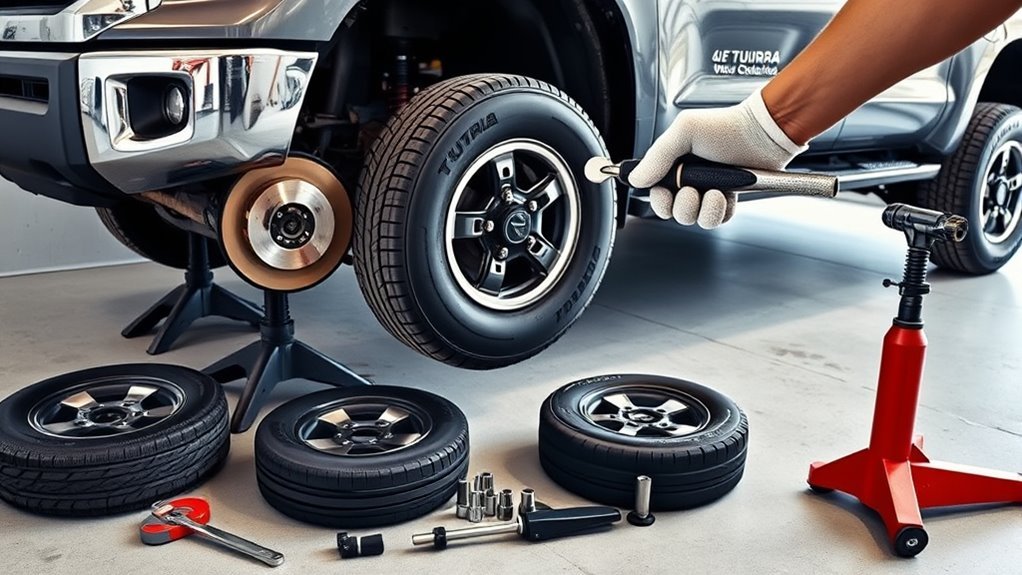
A DIY tire rotation is straightforward, but the safety margin matters because a Tundra is heavy. Work on a flat surface, use the correct lift points from your owner’s manual, and never rely on a jack alone.
Warning: Never crawl under or place any part of your body under a Tundra supported only by a jack. Use properly rated jack stands, chock the wheels that remain on the ground, and stop if the truck is unstable.
- Confirm the pattern. Check your Toyota manual, tire sidewall, and wheel setup before deciding whether the tires move same-side, cross-side, or front-to-rear only.
- Check cold tire pressure. Use the Tire and Loading Information Label on the driver-side doorjamb, not the maximum pressure printed on the tire sidewall.
- Measure tread depth. Record inner, center, and outer tread depth for all four tires. This shows whether pressure, alignment, or suspension issues are present.
- Park safely. Set the parking brake, place the transmission in Park, and chock the wheels.
- Loosen lug nuts slightly. Break them loose while the tires are still on the ground. Do not remove them yet.
- Lift and support the truck. Use the correct jack points and properly rated jack stands. Lift only as high as needed.
- Remove and inspect each wheel. Look for nails, cuts, bulges, cracks, bent wheels, uneven wear, and brake or suspension issues while the wheel is off.
- Move tires to the new positions. Follow the chosen pattern exactly and keep directional tires rotating the correct way.
- Hand-start every lug nut. This helps prevent cross-threading. Snug the nuts in a star pattern before lowering the truck.
- Torque to spec. Lower the tire until it just contacts the ground, then use a torque wrench and star pattern. Toyota torque can vary by wheel type and model year. For example, Toyota’s 2022 Tundra manual lists 97 ft-lbf (131 N·m) for aluminum wheels and 154 ft-lbf (209 N·m) for steel wheels. Verify the exact value for your truck before tightening.
- Set pressure and road-test. Adjust cold pressure, reset or relearn TPMS if your model requires it, then drive slowly and listen for vibration, pulling, or noise.
- Recheck if required. Follow your exact manual’s post-installation guidance. For example, Toyota’s 2022 Tundra manual says to retighten wheel nuts within 100 miles (160 km) after changing wheels.
Do not lubricate lug studs unless the service manual specifically calls for it. Oil or anti-seize can change clamp load and make a correct torque number behave like an over-torque.
[Products Worth Considering]

Pair of 3 Ton (2.7 metric Ton) jack stands with 6,000-pound capacity
Spotting Uneven Wear and When to Replace All Four
Uneven wear tells you what the truck has been doing between rotations. A tire rotation can even out normal position-based wear, but it will not fix mechanical or inflation problems. Inspect the tread before every rotation and compare all four tires.
| Wear Sign | Likely Cause | What to Do |
|---|---|---|
| Even low tread on all tires | Normal wear over time | Plan replacement; keep rotating until replacement if tread is still safe. |
| Outer shoulder wear | Underinflation, hard cornering, towing load, or alignment | Correct pressure, check alignment, and inspect load habits. |
| Center wear | Possible overinflation or load mismatch | Set cold pressure from the doorjamb label and recheck after load changes. |
| One-side wear | Camber/toe alignment issue or worn suspension part | Get an alignment and suspension inspection before buying new tires. |
| Cupping or scalloping | Balance, shocks/struts, wheel bearing, or suspension issue | Have the tire/wheel assembly and suspension inspected. |
| Treadwear indicators are flush | Tread has reached the replacement point | Replace the tire. NHTSA says tires are not safe when worn to 2/32 inch. |
The National Highway Traffic Safety Administration recommends checking cold tire pressure and tread at least monthly, and says tires are not safe when tread is worn to 2/32 inch. Toyota’s tire guidance also says to replace tires when treadwear indicators are showing.
Replace all four tires when the full set is worn, when two or more tires are near the wear limit, when tire age or cracking affects the set, or when matching diameter and tread is needed for safe 4WD operation. If only one tire is damaged and the others are still healthy, ask a tire professional whether a closely matched replacement is appropriate for your drivetrain. If you replace only two tires on a same-size setup, Michelin recommends installing the new pair on the rear axle for better wet stability. Do not mix tire sizes, load ratings, or construction types unless Toyota and the tire maker approve it.
Maintenance Records and Warranty Notes
Rotation records are worth keeping. Toyota’s maintenance guide explains that maintaining the vehicle according to the recommended schedule helps keep warranty coverage intact, and it also notes that maintenance can be performed by you or by an automotive service provider you choose.
For each rotation, record:
- Date and mileage
- Rotation pattern used
- Tread depth at inner, center, and outer grooves
- Cold tire pressures before and after adjustment
- Wheel-lug torque spec used
- Any damage, vibration, pulling, or alignment concerns
This log helps you prove regular care, spot repeat wear patterns, and avoid replacing tires early because a small issue went unnoticed.
Frequently Asked Questions
How often should you rotate tires on a Toyota Tundra?
For the 2026 Toyota Tundra, rotate the tires every 5,000 miles or six months, whichever comes first. Many recent model years use the same rhythm, but older Tundras can differ, so verify the maintenance guide for your exact year.
Is it okay to rotate Tundra tires every 10,000 miles?
For a 2026 Tundra, yes—10,000 miles is longer than Toyota’s scheduled 5,000-mile tire-rotation interval. Use the interval in your exact model-year guide rather than stretching the schedule, especially if tread wear is becoming uneven.
Is it okay to rotate tires every 7,500 miles?
For a 2026 Tundra, 7,500 miles is later than Toyota’s scheduled 5,000-mile interval. However, older Toyota/Tundra documentation can specify 7,500 miles, so the correct answer depends on model year. Follow the maintenance guide and tire-warranty requirement that apply to your truck.
What rotation pattern should I use on a Toyota Tundra?
Use the pattern in your Toyota owner’s manual for your exact model year and tire setup. Directional tires stay on the same side and move front-to-rear. Non-directional, same-size setups may allow a cross pattern, but confirm Toyota and tire-manufacturer guidance before moving tires side-to-side.
Should I include the spare tire in a Tundra rotation?
Do not include a temporary spare in regular rotation. Only consider a spare if it is a matching full-size tire and wheel, and only if your Toyota manual and tire setup allow a five-tire rotation.
Conclusion
For the 2026 Toyota Tundra and many recent model years, rotate the tires every 5,000 miles or six months to help keep tread wear even and handling predictable. Older Tundras can use a different interval, so confirm your exact maintenance guide. Use Toyota’s rotation pattern first, check the tire sidewall for directional markings, and avoid generic cross-pattern advice unless your truck and tires allow it. If you tow, haul, or drive off-road, inspect more often and rotate early when tread-depth readings show uneven wear.
For DIY work, use wheel chocks, jack stands, the correct lift points, and a torque wrench set to the exact spec for your model year and wheel type. Finally, keep a rotation log. It is one of the simplest ways to catch tire problems early and protect yourself from avoidable tire replacement costs.
Sources
- Toyota 2026 Tundra Warranty & Maintenance Guide — 5,000-mile/six-month maintenance timing, tire-rotation checkpoints, warranty record guidance, and special operating condition notes.
- Toyota 2022 Tundra Hybrid Owner’s Manual: Flat Tire — example wheel-nut torque values for aluminum and steel wheels and the 100-mile retightening instruction.
- Toyota Tire Rotation Guide — why tire rotation matters and why vehicle-specific guidance comes first.
- Toyota 2025 Tundra Owner’s Manual: Tires — tire inspection, treadwear indicators, and replacing or rotating tires according to schedule and treadwear.
- NHTSA TireWise Tire Safety — monthly cold-pressure and tread checks, treadwear indicators, and the 2/32-inch replacement threshold.
- Bridgestone Tire Rotation 101 — directional tire limits, cross-pattern guidance, full-size spare notes, and torque reminders.
- Michelin Tire FAQs — guidance to install a new pair of replacement tires on the rear axle when only two are replaced.