

For a Toyota Land Cruiser, set each tire to the cold pressure shown on the vehicle’s Tire and Loading Information label and use the TPMS reset or initialization procedure for your exact model year. As a current U.S. example, Toyota lists 33 psi (230 kPa) cold front and rear for the factory 18- and 20-inch tire packages shown in the 2026 Land Cruiser owner’s manual, with the spare also listed at 33 psi. Do not assume that 33 psi applies to older generations, other markets, or modified tire setups.
Last updated: September 1, 2026
Author: [VERIFY: confirm the real author/byline and relevant automotive or tire-safety experience shown by the CMS]
Quick Answer
Set your Land Cruiser tires to the cold PSI printed on the driver-side Tire and Loading Information label, not the number molded on the tire sidewall. Check all road tires after the vehicle has sat for at least three hours. Reset or initialize the TPMS only by the method listed for your exact model year. For the U.S.-market 2026 Land Cruiser, Toyota lists 33 psi cold for the factory tire packages shown in its current specifications, but other years and markets can differ.
Key Takeaways
- Use the door-jamb label or owner’s manual for the correct cold pressure. Do not use the tire sidewall maximum as your target.
- Check pressure after the Land Cruiser has been parked for at least three hours, and inspect the spare separately if equipped.
- Toyota lists 33 psi cold front and rear for the factory 18- and 20-inch tire packages shown for the 2026 U.S. Land Cruiser, but this is not a universal Land Cruiser specification.
- Older Land Cruisers may use a physical TPMS set switch, while newer models may use an instrument-panel menu.
- A steady warning usually points to low pressure. A light that flashes for about a minute and then stays on usually points to a TPMS malfunction.
- Do not reset the system at an unsafe off-road pressure just to silence the warning. Reinflate before returning to normal road speed.
At a Glance
| Time Required | 10 to 20 minutes, plus any drive time required by your manual |
| Difficulty | Easy |
| Tools Needed | Accurate tire-pressure gauge and an air compressor or reliable air source |
| Cost | Usually free if you already own a gauge and air source; otherwise about $10 to $50 for basic tools |
Find the Correct Land Cruiser Tire Pressure
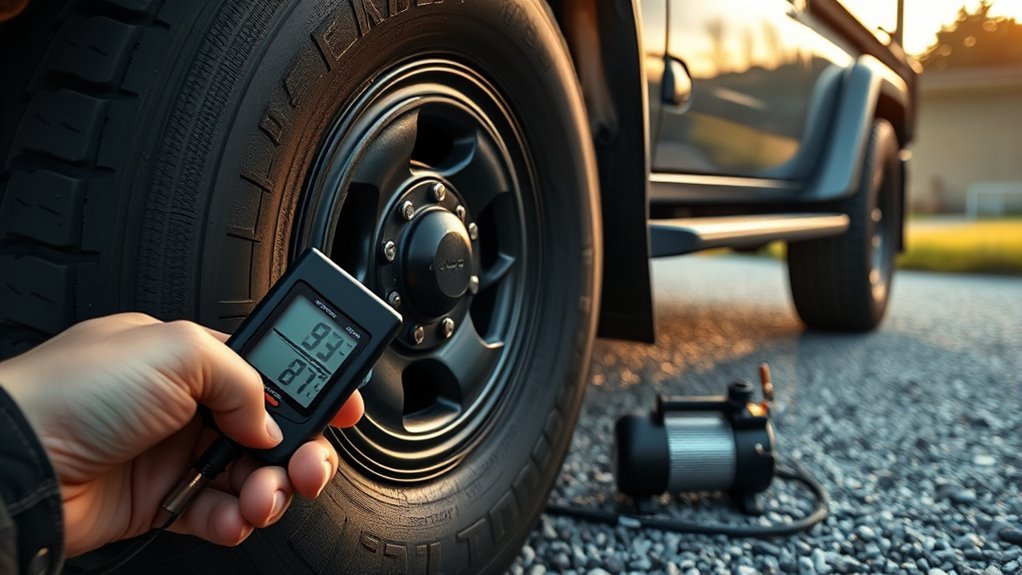
Open the driver’s door and find the Tire and Loading Information label on the door edge or B-pillar. It lists the recommended cold pressure for the original tire size. Front and rear values may be the same or different, so read both positions instead of assuming one PSI fits every tire.
The large pressure number molded into a tire’s sidewall is not the vehicle’s normal inflation target. It relates to the tire’s rated load and maximum cold pressure. Your Land Cruiser’s label accounts for the vehicle, original tires, axle loads, handling, and ride requirements.
Land Cruiser specifications vary across generations, trims, tire packages, and countries. Avoid generic advice such as “all Land Cruisers use 32 to 36 psi” or “add air to 40 psi when towing.” Use the label and the towing or loading instructions in the owner’s manual. If you installed a different tire size or load range, ask a qualified tire professional to confirm the correct pressure for that setup.
2026 U.S. Land Cruiser Tire Pressure Example
Toyota’s current U.S. specifications provide a useful model-specific reference. All three factory tire configurations listed below use 33 psi (230 kPa) cold at the front and rear. Toyota also lists the spare at 33 psi. These numbers are for the 2026 U.S. model and should not be carried over to another Land Cruiser without checking that vehicle’s placard.
| 2026 U.S. Tire Size | Front Cold Pressure | Rear Cold Pressure | Spare |
|---|---|---|---|
| 265/60R20 112H | 33 psi / 230 kPa | 33 psi / 230 kPa | 33 psi / 230 kPa |
| 245/70R18 110H | 33 psi / 230 kPa | 33 psi / 230 kPa | 33 psi / 230 kPa |
| 265/70R18 116S | 33 psi / 230 kPa | 33 psi / 230 kPa | 33 psi / 230 kPa |
See Toyota’s 2026 Land Cruiser maintenance specifications for the current U.S. data. For general placard guidance beyond the Land Cruiser, see the SUV tire pressure guide.
Warning: Never use the tire sidewall maximum as a substitute for the vehicle’s recommended pressure. Overinflation can reduce ride quality and change handling, while underinflation can build heat and damage the tire.
How to Check and Set Cold Tire Pressure
A cold tire is one that has not been driven for at least three hours. Check the pressure before a trip, not immediately after highway driving. Driving heats the tires and raises the displayed pressure. Do not bleed a warm tire down to the cold placard value simply because its pressure has risen during driving; recheck and fine-tune the pressure when the tire is cold.
- Park safely: Stop on a level surface, apply the parking brake, and let the vehicle sit for at least three hours.
- Read the label: Note the front and rear cold PSI or kPa values on the driver-side Tire and Loading Information label.
- Measure each tire: Remove the valve cap, press the gauge squarely onto the valve stem, and record the reading.
- Add or release air: Adjust each tire to its listed cold value. Recheck after every adjustment.
- Inspect the spare: If your Land Cruiser has a spare, check it separately. Use the pressure specified for that spare in the owner’s manual or on the spare tire.
- Finish the job: Reinstall the valve caps and inspect the tread and sidewalls for cuts, bulges, nails, or other damage.
Check all tires at least monthly and before long trips. Temperature changes can move the reading, so recheck when the seasons change instead of adding or releasing air based only on a dashboard number.
Pro Tip: Compare your handheld gauge with another reliable gauge occasionally. A damaged or inaccurate gauge can make every tire look consistently high or low.
[Products Worth Considering]

These aluminum alloy tire valve stem caps provide durable, corrosion-resistant protection for your vehicle’s valve stems while helping maintain stable tire pressure. The rubber seal design helps block dust, moisture, and debris, reducing the risk of air leakage and valve damage. Easy to install and styled for a clean look, they fit a range of cars, SUVs, trucks, and motorcycles.
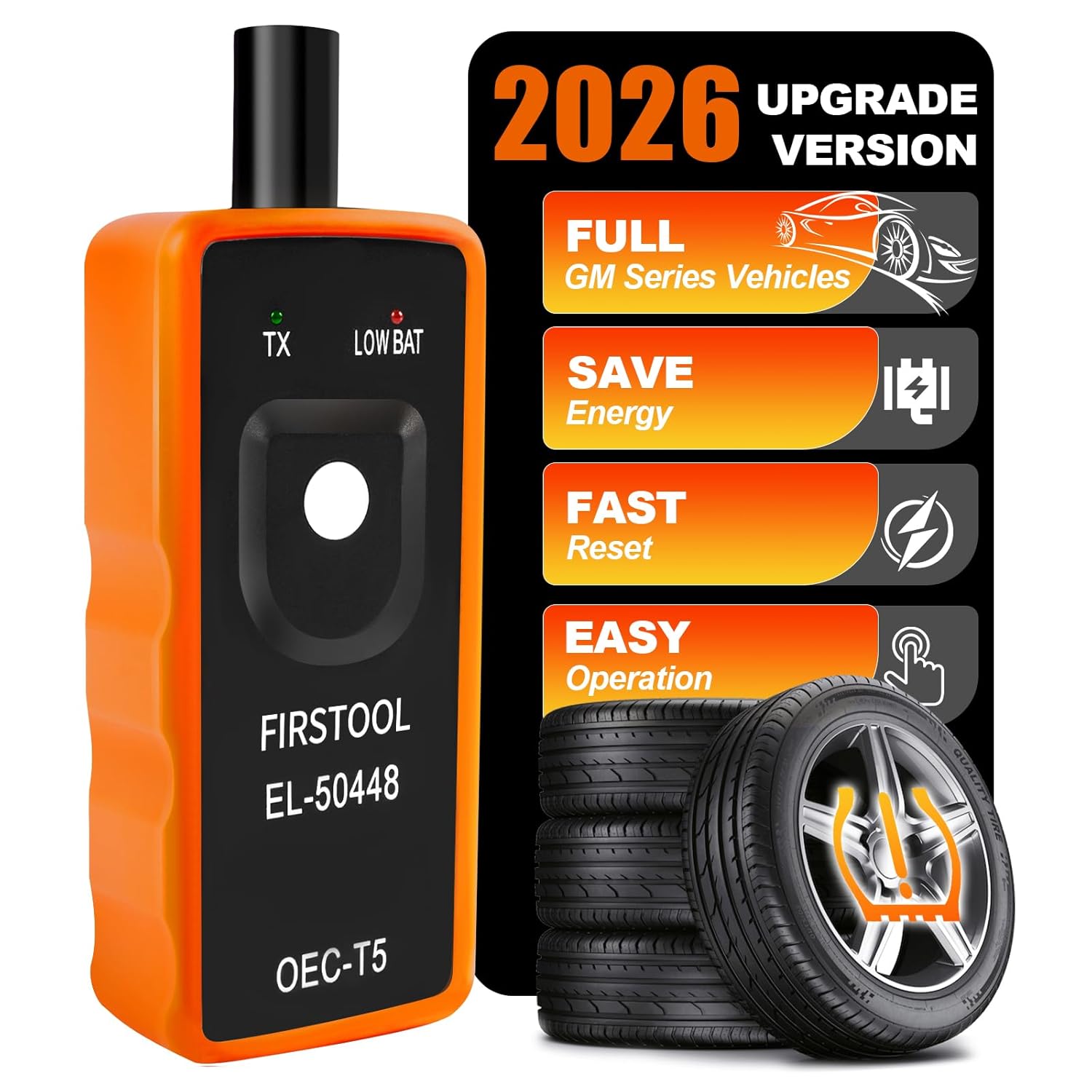
This EL-50448 TPMS relearn tool helps quickly activate and reset tire pressure sensors so your vehicle’s monitoring system stays accurate after tire rotations, sensor replacement, or seasonal tire changes. Designed for many GM-related vehicles and compatible with common 315 and 433 MHz TPMS systems, it offers simple one-button operation and reliable performance for clearing warning lights and relearning sensor positions.

This TPMS sensor training tool is designed for Ford, Lincoln, and Mercury vehicles with compatible tire pressure sensors, helping activate sensors after tire rotations or sensor replacement. It supports relearning and warning light reset workflows with a simple one-button operation, making tire pressure maintenance easier and faster. Built for reliable use and broad vehicle compatibility, it is a practical accessory for TPMS service and sensor activation.
Do You Need to Reset the Land Cruiser TPMS?
Correcting the pressure and resetting the TPMS are not the same task. First set every road tire to the correct cold pressure. In many cases, the warning will clear after the system sees normal readings and the vehicle is driven. Use a reset or initialization function only when your owner’s manual calls for it.
Toyota has used different TPMS controls across Land Cruiser generations and markets. Older systems can use a physical set switch under the lower dashboard, while current-generation vehicles can use TPWS settings in the multi-information display. Use the Toyota owner’s manual lookup to find the instructions for your exact year.
Models With a Physical TPMS Set Switch
Use this sequence only when your Toyota manual shows a physical TPMS set switch and gives the same instructions. Toyota documentation for older Land Cruisers, including the 2011 U.S. model, uses this type of procedure:
- Set every road tire to the placard pressure while cold.
- Turn the ignition to ON without starting the engine, unless the manual directs otherwise.
- Press and hold the TPMS set switch until the warning light flashes the number of times stated in the manual.
- Release the switch, then keep the ignition on or drive the vehicle for the learning period specified by Toyota.
Do not assume that every Land Cruiser uses a three-second press or three flashes. That sequence applies to certain Toyota systems, not every model year.
Models With an Instrument-Panel TPMS Menu
On newer systems, open the vehicle settings with the steering-wheel controls and look for a TPWS or tire-pressure setting. Current-generation Land Cruiser manuals use functions such as “Tire Pressure Setting,” with the exact wording and available options depending on model year and market. Confirm the setting only after the tires are at the appropriate cold pressure.
Menu names and confirmation messages vary. If you cannot find the option, do not keep changing unrelated vehicle settings. Check the owner’s manual by model year or ask a Toyota service department to identify the correct control path.
Note: A pressure reset and sensor-ID registration are different functions. Replacement sensors may require the registration procedure specified for your model year or compatible Toyota diagnostic equipment.
What the TPMS 25% Rule Actually Means
U.S. federal TPMS rules require a compliant system to warn when one or more road tires reaches a pressure equal to or below 25% under the manufacturer’s recommended cold pressure, or a tire-type minimum listed in the standard, whichever is higher. The system may warn earlier.
For example, 25% below a 32 psi placard value is 24 psi. That calculation explains the federal performance threshold, but it does not make 24 psi a safe driving target. It also does not prove that you can program any pressure you want as a new safety baseline.
TPMS is a warning system, not a replacement for a monthly check with an accurate gauge.
Airing Down Off-Road Without Creating a Safety Problem
Lower pressure can improve the tire footprint on some off-road surfaces, but there is no single safe off-road PSI for every Land Cruiser. The right pressure depends on vehicle load, tire construction, wheel size, speed, terrain, and the risk of sidewall or bead damage.
If you air down below the normal warning threshold, the TPMS light may come on. That warning is expected. Unless your exact Toyota manual specifically approves another procedure for your tire setup, do not change the TPMS baseline at a temporary trail pressure simply to hide the warning.
- Use a reliable gauge and lower pressure in small, even steps.
- Reduce speed and avoid sharp steering, hard braking, and impacts that could unseat a bead or damage a sidewall.
- Watch for visible tire deformation, steering changes, or heat buildup.
- Reinflate to the vehicle’s appropriate road pressure before sustained pavement driving or normal road speed.
- After reinflation, follow the owner’s manual if the TPMS needs to relearn or be initialized.
Warning: Driving fast on heavily aired-down tires can cause excess heat, poor handling, tire damage, or bead separation. Carry a compressor that can restore road pressure before you leave the trail.
[Products Worth Considering]

This GM TPMS relearn tool helps reset tire sensors, clear warning lights, and match tire positions after rotation quickly at home. Designed for Chevrolet, GMC, Cadillac, and Buick vehicles, it offers one-button operation, fast activation, and broad compatibility with many GM models. It is best suited for OE/OEM sensors and includes paper instructions plus video guidance for easier DIY use.
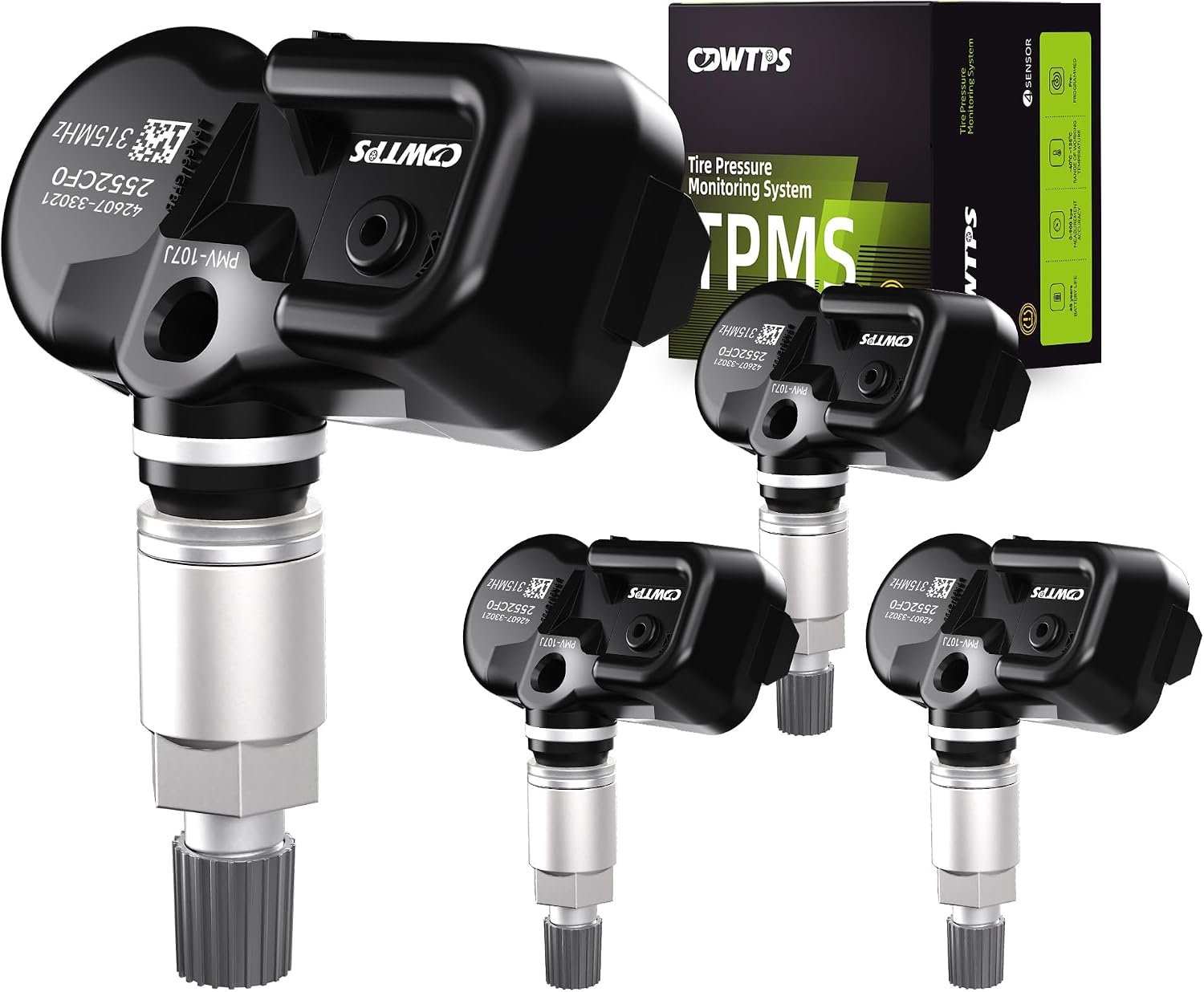
This set of four pre-programmed TPMS sensors is designed as a direct-fit replacement for compatible Toyota, Lexus, and Scion vehicles. It helps restore accurate tire pressure monitoring without sensor programming, and each unit is factory-tested for dependable performance. Built for long service life, these sensors offer a convenient solution for replacing worn or failed tire pressure monitors.

This CARORAV TPMS sensor set provides reliable tire pressure monitoring for a wide range of Toyota and Lexus vehicles with 315MHz compatibility. It is pre-programmed for easier setup, but still requires relearning or reset procedures after installation. Designed for accurate real-time pressure tracking, these sensors help support safer driving and long-lasting performance across many model years.
Troubleshoot a Land Cruiser TPMS Warning Light
The way the warning behaves can help you separate a pressure problem from a system fault.
| What You See | Likely Meaning | What to Do |
|---|---|---|
| Light stays on steadily | One or more road tires may be significantly low | Stop safely, inspect the tires, and check every pressure with a gauge |
| Light appears on a cold morning and later turns off | A tire may be close to the warning threshold | Check and adjust all tires when cold instead of waiting for them to warm up |
| Light flashes for about 60 to 90 seconds, then stays on | The TPMS has detected a malfunction | Check for recent wheel or sensor work, then schedule diagnosis if it repeats |
| Light remains after tire service | A sensor may be unregistered, incompatible, damaged, or installed in the wrong wheel set | Verify sensor compatibility and registration with a TPMS-capable shop |
DIY Checks You Can Do First
- Check all road tires cold with a gauge, even if the dashboard shows individual pressures.
- Inspect for a puncture, damaged valve stem, bent wheel, or slow leak.
- Confirm that the installed tire size and wheel sensors match the vehicle.
- Check the spare separately. Whether the spare is monitored depends on the model and system. Toyota’s 2025 U.S. Land Cruiser PDS documentation, for example, specifically states that the spare has a TPWS sensor.
- Follow the exact reset, initialization, or drive cycle in the owner’s manual once.
If the pressure drops again, repair the leak instead of repeatedly resetting the warning.
When to Use a Shop, Dealer, or Techstream
Use professional diagnosis when the light flashes and stays on, a pressure position is missing, a new sensor will not register, or the warning returns with verified cold pressures. A TPMS-capable scan tool can read sensor IDs and communication faults. Toyota’s Technical Information System provides factory service and diagnostic information for supported Toyota vehicles.
Do not replace every sensor based on guesswork. Ask the technician to confirm the fault code, failed sensor or communication problem, sensor compatibility, and registration status before authorizing parts.
TPMS Maintenance and Sensor Replacement
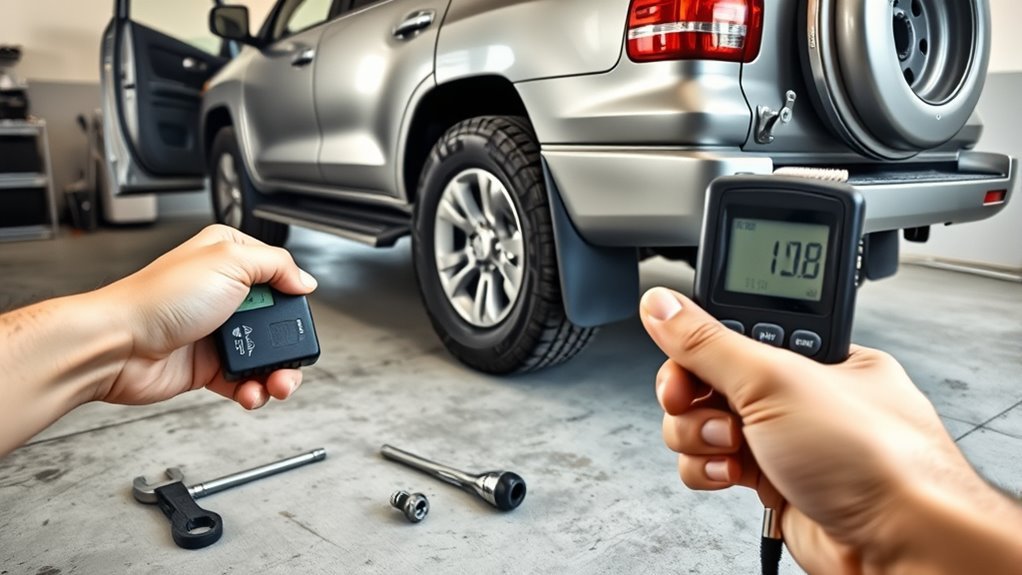
TPMS sensors use sealed batteries and can eventually stop transmitting. Service life varies with the sensor, climate, mileage, and transmission frequency. A flashing malfunction light, missing wheel reading, or scan-tool fault is more useful than age alone when deciding what to replace.
| Task | When | What You Need |
|---|---|---|
| Cold pressure check | At least monthly and before long trips | Accurate tire gauge |
| Valve and tire inspection | Whenever you check pressure | Visual inspection and soapy water if a leak is suspected |
| Sensor diagnosis | When the light flashes, a reading disappears, or a new sensor will not register | TPMS scan tool or Toyota diagnostic equipment |
| Sensor replacement | After a confirmed battery, valve, impact, or communication failure | Compatible sensor, service kit, installation, and registration |
Replacement cost depends on sensor type, wheel access, programming, labor rates, and whether you replace one sensor or several. Get an itemized estimate instead of relying on one universal price.
[Products Worth Considering]

The AICEL TPMS Relearn Tool helps quickly reset and relearn tire pressure sensors on compatible GM vehicles after tire rotation, sensor replacement, or warning light issues. Designed for easy handheld use, it works with most cars, SUVs, and pickup trucks and can save time by eliminating unnecessary trips to the auto store. Its durable ABS housing and simple activation process make it a practical tool for keeping the tire pressure monitoring system operating properly.

The XTOOL TP150 is a universal TPMS service tool designed to activate, relearn, program, diagnose, and reset tire pressure sensors with ease. It supports dual-frequency sensors and multiple relearn modes, helping DIY users and professionals quickly clear DTCs, reset warning lights, and verify sensor health across a wide range of vehicles. Built with physical buttons and lifetime updates, it is a practical solution for efficient TPMS maintenance in the garage or on the road.

This set of four pre-programmed TPMS sensors is designed to restore accurate tire pressure monitoring for a wide range of Toyota, Lexus, and Scion vehicles. Built to OE-quality standards with long battery life and broad compatibility, these sensors help maintain proper tire pressure, improve safety, and eliminate TPMS warning lights when installed and activated correctly.
Frequently Asked Questions
How do you reset the tire pressure light on a Toyota Land Cruiser?
First set every road tire to the correct cold pressure. Then use the physical TPMS set switch or the instrument-panel TPWS setting described in the owner’s manual for your exact model year. A pressure reset and replacement-sensor ID registration are different procedures.
What is the ideal tire pressure for a Toyota Land Cruiser?
Use the cold front and rear PSI or kPa printed on your Land Cruiser’s Tire and Loading Information label. For the 2026 U.S. Land Cruiser, Toyota lists 33 psi cold front and rear for the factory 18- and 20-inch tire configurations shown in its specifications, but there is no single PSI that applies to every Land Cruiser year, market, tire size, or load condition.
Should you use the maximum PSI printed on the tire sidewall?
No. The sidewall value is not the normal vehicle inflation target. Use the vehicle label or the pressure approved by Toyota and a qualified tire professional for a non-original tire setup.
Why is the TPMS light on when the tires look full?
A tire can be significantly low without looking flat. Check every tire with a gauge. If the light flashes for about 60 to 90 seconds and then remains on, the system may have a sensor, registration, receiver, or communication fault.
Can the spare tire trigger the Land Cruiser TPMS light?
It depends on the model year and market. Toyota’s 2025 U.S. Land Cruiser pre-delivery documentation specifically states that the spare has a TPWS sensor, but you should verify your exact model year rather than assuming every Land Cruiser monitors its spare. Maintain the spare’s specified pressure whether or not it is monitored.
Should you reset TPMS after airing down for a trail?
Do not change the TPMS baseline at a temporary low trail pressure simply to hide the warning unless your exact Toyota instructions and tire setup support that use. Monitor pressure with a gauge, drive slowly, and reinflate to the appropriate road specification before normal pavement driving.
Conclusion
Set your Land Cruiser tire pressure from the driver-side label, measure it cold, and treat the TPMS as a warning system rather than a replacement for an accurate gauge. The current 2026 U.S. Land Cruiser provides a useful 33 psi example, but always verify your own year and tire package. Use the correct reset method for your model, diagnose a flashing light instead of repeatedly clearing it, and restore the appropriate road pressure after off-road use.
Sources
- Toyota Manuals and Warranties — model-year owner’s manual lookup and vehicle-specific operating instructions
- 2026 Toyota Land Cruiser Maintenance Data — current U.S. factory tire sizes and recommended cold inflation pressures
- NHTSA TireWise — cold-pressure checks, door-label guidance, monthly inspection, and TPMS guidance
- 49 CFR 571.138, Tire Pressure Monitoring Systems — federal TPMS detection and malfunction-warning requirements
- Toyota Technical Information System — factory service and diagnostic resources
- Toyota T-SB-0091-24, 2025 Land Cruiser Pre-Delivery Service — model-year-specific TPWS information, including Toyota’s note that the spare has a TPWS sensor





[…] tire pressures when cold and set them to the door-jamb placard unless a qualified tire professional has specified […]
[…] the tires: Inspect tread, sidewalls, and tire pressure. Only reduce pressure when the surface, tire, load, and recovery plan support it, and carry a safe […]