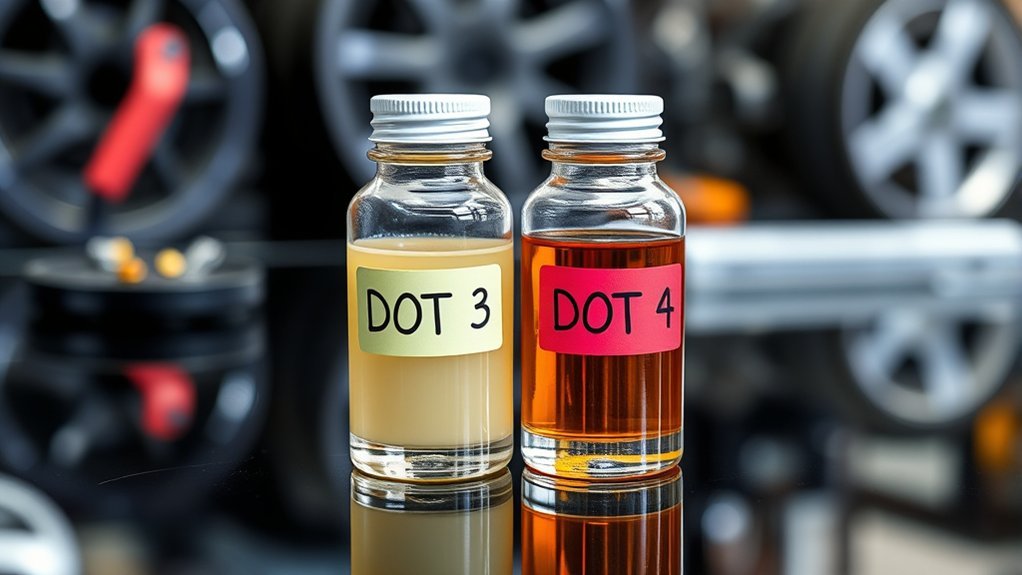
Choosing between DOT3 and DOT4 brake fluid starts with your vehicle manufacturer’s specification, not simply the higher DOT number. DOT4 has higher federal minimum dry and wet boiling points than DOT3, so it provides more heat margin during towing, mountain driving, repeated hard stops, or other demanding use. Conventional DOT3 and DOT4 fluids are generally chemically compatible, but they are not interchangeable in both directions: do not downgrade a DOT4-required system with DOT3. Check the brake-fluid reservoir cap and owner’s manual before adding, topping off, or flushing fluid.
Last updated: August 31, 2026 · Technical details rechecked against FMVSS No. 116, current brake-fluid manufacturer information, and AAA maintenance guidance. This guide does not claim laboratory or vehicle-specific brake-fluid testing; always follow the specification for your exact vehicle.
Quick Answer
DOT4 brake fluid has higher federal minimum dry and wet boiling points than DOT3, giving it more required protection against vapor formation when brakes get hot. If your vehicle specifies DOT3, an approved DOT4 fluid may be acceptable when the manufacturer allows it. If the vehicle requires DOT4, do not replace it with DOT3. Conventional DOT3 and DOT4 fluids can generally mix chemically, but a mixed fill may not deliver the full performance of the higher grade. Never substitute silicone DOT5 unless the vehicle specifically requires it.
Key Takeaways
- DOT4 has higher federal boiling-point minimums: Under 49 CFR §571.116, DOT4 must meet higher dry and wet boiling points than DOT3.
- The vehicle specification wins: Use the brake-fluid type and any additional specification listed on the reservoir cap or in the owner’s manual.
- Moisture reduces heat margin: Conventional DOT3, DOT4, and DOT5.1 fluids are hygroscopic, so absorbed moisture lowers boiling performance over time.
- Compatibility is not the same as equivalence: Conventional DOT3 and DOT4 fluids are generally miscible, but adding DOT3 to a DOT4-required system lowers the system’s intended performance margin. A complete fluid exchange is the cleaner approach when deliberately changing grades.
- DOT5 and DOT5.1 are different: DOT5 is silicone-based. DOT5.1 is a non-silicone fluid and is much closer in chemistry and compatibility to DOT3 and DOT4.
- DOT4 LV has an additional job: Low-viscosity DOT4 is intended for vehicles that specify fast low-temperature fluid response for modern ABS and stability-control hydraulics.
DOT3 vs DOT4 Brake Fluid: Which Should You Use?
The safest way to choose brake fluid is to work in this order: vehicle specification first, required viscosity or OEM approval second, and extra boiling-point margin third. A higher DOT number does not override a specific manufacturer requirement.
| What Your Vehicle Specifies | What to Use | Key Caution |
|---|---|---|
| DOT3 | Fresh DOT3, or another fluid the manufacturer explicitly approves for that system | Do not assume every higher-rated fluid meets every vehicle-specific requirement |
| DOT4 | DOT4 or another manufacturer-approved fluid that meets the required specification | Do not downgrade to DOT3 |
| DOT4 LV / low-viscosity specification | The specified low-viscosity DOT4 or equivalent approved specification | Ordinary DOT4 is not automatically equivalent just because it meets DOT4 boiling-point requirements |
| Specification unknown | Confirm the reservoir cap, owner’s manual, or manufacturer service information first | Do not choose fluid solely by the number on the bottle |
[Products Worth Considering]

Mixes well with conventional fluids

Ideal for hydraulic and disc brakes

08208-0080
Understanding Brake Fluid Ratings: DOT3 vs. DOT4
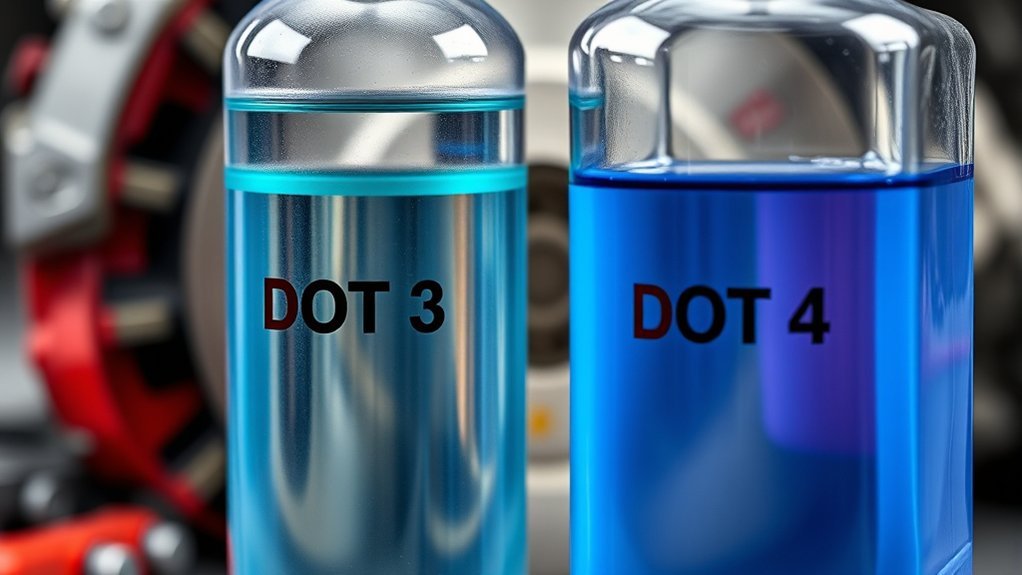
DOT3 and DOT4 are common performance classifications for hydraulic brake fluids. In practical terms, the DOT category establishes minimum performance requirements, including boiling point. Brake fluid must stay liquid as temperatures rise because vapor is compressible. If fluid boils and forms vapor in the hydraulic system, pedal travel can increase and braking performance can fall.
The official U.S. standard, FMVSS No. 116 / 49 CFR §571.116, sets these minimum boiling-point requirements:
| Brake Fluid Rating | Minimum Dry Boiling Point | Minimum Wet Boiling Point | Best Fit |
|---|---|---|---|
| DOT3 | 205°C / 401°F | 140°C / 284°F | Vehicles that specify DOT3 |
| DOT4 | 230°C / 446°F | 155°C / 311°F | Vehicles that specify DOT4, plus approved higher-heat use in compatible systems |
Dry boiling point refers to new fluid tested under the standard’s dry-fluid procedure. Wet boiling point represents performance after the standardized humidification procedure. The wet number matters in real service because conventional glycol-based brake fluid absorbs moisture over time.
These numbers are minimum standards, not the exact boiling point of every bottle. A particular DOT3 or DOT4 product may exceed its category minimum. Compare a product’s published performance only after confirming that it meets every specification required by your vehicle.
Warning: Do not choose brake fluid by “higher number” alone. Use the specification listed on your vehicle’s reservoir cap, owner’s manual, or manufacturer service information. Contaminated fluid, petroleum-based products, hydraulic mineral oil, or silicone DOT5 in a system not designed for it can create serious brake-system problems.
How Do Boiling Points Affect Brake Performance?
Brakes turn vehicle motion into heat. During steep descents, towing, repeated hard braking, or aggressive driving, some of that heat reaches the calipers and brake fluid. If fluid gets hot enough to form vapor, the pedal can feel soft or travel farther because vapor compresses more easily than liquid.
This is where the DOT4 standard has a clear numerical advantage over DOT3. Its required dry boiling point is 25°C / 45°F higher, while its required wet boiling point is 15°C / 27°F higher. That difference provides more mandated heat reserve before the fluid reaches its boiling threshold.
The main reason to choose DOT4 over DOT3, when your vehicle permits it, is extra boiling-point margin. DOT4 does not make the brake calipers or pads mechanically stronger during an ordinary stop.
Should You Choose DOT4 for Better Heat Margin?
DOT4 can make sense when your vehicle allows it and the brakes see more heat than average. Examples include towing, mountain roads, loaded vehicles, repeated braking on steep grades, or spirited street driving. However, a higher boiling point is only one part of compatibility. The fluid must still satisfy the viscosity, chemistry, and manufacturer requirements for the vehicle.
If the cap or owner’s manual requires DOT4, use DOT4 or another fluid that explicitly meets the manufacturer-approved specification. DOT3 does not meet DOT4’s federal minimum boiling-point requirements and should not be used as a normal substitute in a DOT4-required system.
| Question | Best Practice |
|---|---|
| My vehicle says DOT3. Can I use DOT4? | Often, if the vehicle manufacturer permits it and the chosen fluid meets all required specifications. Check the manual rather than assuming. |
| My vehicle says DOT4. Can I use DOT3? | No as normal maintenance. DOT3 has lower required boiling points and does not satisfy the DOT4 performance category. |
| Can I use DOT5? | Only when the vehicle specifically requires silicone-based DOT5. Do not confuse DOT5 with non-silicone DOT5.1. |
| Can DOT3 and DOT4 mix? | Conventional DOT3 and DOT4 fluids are generally miscible, but a blend may not retain the full performance of the higher grade. Never use DOT3 to downgrade a DOT4-required system. |
Pro Tip: If you are deliberately changing from an approved DOT3 fill to DOT4, a complete fluid exchange gives you a known fill of fresh fluid. Simply adding a small amount of DOT4 to old DOT3 does not turn the entire system into a fresh DOT4 fill.
How Does Moisture Affect Brake Fluid Lifespan?
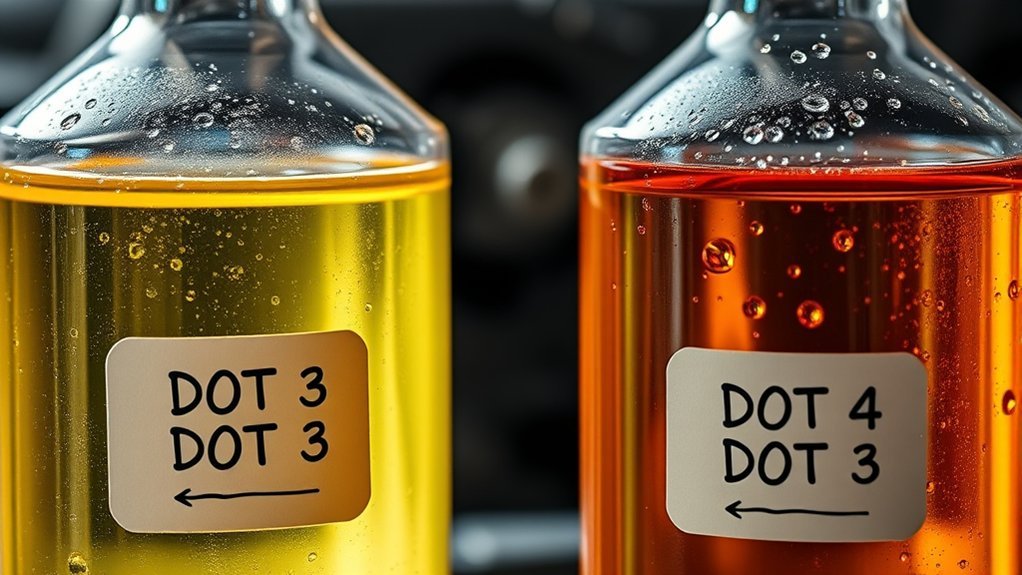
Conventional DOT3, DOT4, and DOT5.1 brake fluids are hygroscopic, meaning they absorb moisture over time. Moisture can enter during normal service exposure, through system venting, when the reservoir is opened, or through brake fluid stored in an opened container. As water content increases, boiling performance falls and internal corrosion risk can increase.
Federal brake-fluid labeling rules instruct users to keep brake fluid clean and dry, store it in its original container, and keep the container tightly closed to prevent moisture absorption. Dirt, water, petroleum products, or other contamination can lead to brake failure or costly repairs.
Moisture Absorption Effects
Moisture does not make brake fluid fail instantly. Instead, it reduces the fluid’s thermal safety margin over time. A noticeable change from the fluid’s normal appearance can justify inspection, but color alone does not measure moisture percentage or boiling point. A soft or spongy pedal can also result from air, a leak, hydraulic faults, or other problems and should not automatically be blamed on old fluid.
If the brake-fluid level keeps dropping, have the brake system inspected. The level can change as friction material wears, but an unexplained or rapid loss of fluid can indicate a leak and should not be handled by repeatedly topping off the reservoir.
Boiling Point Reduction
The gap between dry and wet boiling-point requirements shows why fresh fluid matters. The DOT4 category requires a higher wet boiling point than DOT3, giving DOT4 a higher minimum thermal threshold under the standardized wet test. That does not make DOT4 maintenance-free. Conventional DOT4 still absorbs moisture and still needs inspection or replacement according to the vehicle manufacturer’s requirements.
Fluid Replacement Frequency
Follow your vehicle’s maintenance schedule first. AAA notes that many manufacturers recommend brake-fluid replacement around every two to three years, but there is no universal interval for every vehicle. Climate, driving conditions, fluid specification, manufacturer instructions, and the brake system itself can all affect the correct service plan. See AAA’s brake-fluid maintenance guidance for the general interval context.
Note: A brake-fluid tester can provide useful condition information when used correctly, but it does not override the vehicle manufacturer’s service requirements. If the fluid’s history is unknown or contamination is suspected, have the system evaluated rather than relying on a top-off.
Can You Use DOT4 in a DOT3 System?
In many vehicles that specify DOT3, an appropriate DOT4 fluid can be used because DOT4 must satisfy higher federal boiling-point minimums. However, the DOT number is not the only requirement. Check the owner’s manual, reservoir cap, and product approvals. If the vehicle manufacturer restricts the system to a particular specification, follow that requirement.
The reverse is not a safe general rule. If a vehicle requires DOT4, DOT3 is a performance downgrade because it does not satisfy DOT4’s minimum dry and wet boiling points.
[Products Worth Considering]

Exceeds DOT 3 regulations: Formulated to meet or surpass DOT 3 requirements, ensuring consistent braking performance and dependable stopping power in all conditions

Provides an extra margin of safety in extreme braking conditions (packaging may vary)
Can You Mix DOT3 and DOT4 Brake Fluid?
Conventional DOT3 and DOT4 fluids are generally chemically miscible. That means they can blend without the incompatibility associated with silicone DOT5. But chemical compatibility does not make the grades performance-equivalent. Adding DOT3 to a DOT4-required system can lower the resulting thermal margin below what the vehicle specification requires.
If you are intentionally changing an approved DOT3 system to DOT4, a complete fluid exchange gives you a known fill of one fresh fluid. If you accidentally add a fluid that the vehicle manufacturer does not approve, especially silicone DOT5 or mineral-based hydraulic fluid, stop treating the situation as a normal top-off and consult the manufacturer’s service information or a qualified brake technician.
Is DOT5.1 the Same as DOT5?
No. The similar names hide an important difference. U.S. brake-fluid labeling distinguishes DOT5 silicone-base fluid from DOT5.1 non-silicone-base fluid. DOT5.1 belongs with the conventional glycol-based family used alongside DOT3 and DOT4 applications, while DOT5 is silicone-based. Do not substitute DOT5 merely because its number appears higher. Valvoline’s brake-fluid guide also distinguishes DOT5 from DOT5.1 and warns against mixing silicone DOT5 with other types.
For vehicle-specific examples, see the related RAV4 brake-fluid guide, Toyota Camry DOT3 guide, and Toyota Tundra DOT3 vs DOT4 guide. Those pages should be used for model-specific requirements, while this page covers the general DOT3-versus-DOT4 decision.
What Is DOT4 LV Low-Viscosity Brake Fluid?
DOT4 LV means low-viscosity DOT4 brake fluid. Its purpose is not simply to increase boiling point. It is formulated to flow more easily at very low temperatures, which can help electronically controlled hydraulic brake systems modulate pressure quickly.
This matters in systems such as ABS and electronic stability control, where valves and pumps may need rapid hydraulic response. For example, ATE describes its SL.6 DOT4 fluid as low-viscosity and suited to ESP, ABS, and ASR systems, while Brembo offers low-viscosity DOT4 fluid for modern electronically controlled braking and stability systems.
Do not assume every DOT4 vehicle needs DOT4 LV, and do not assume ordinary DOT4 is automatically equivalent when the manual specifies a low-viscosity fluid. Use DOT4 LV when the vehicle specifies low-viscosity DOT4, ISO 4925 Class 6, or another equivalent manufacturer-approved standard.
How Do You Keep Brake Fluid Fresh?
Fresh, correctly specified brake fluid is inexpensive compared with repairing a contaminated hydraulic system. The practical goal is to keep moisture, dirt, petroleum products, and incompatible fluids out while servicing the fluid according to the manufacturer’s requirements.
Regular Fluid Changes
- Check the owner’s manual: Use the listed DOT rating, any additional manufacturer specification, and the recommended inspection or replacement interval.
- Inspect the reservoir: DOT3 and DOT4 fluids are normally in the clear-to-amber color range when manufactured. A major change in appearance can justify inspection, but color alone does not measure moisture or boiling performance.
- Watch pedal feel: A soft, spongy, or sinking pedal can point to air, a leak, overheated fluid, or another hydraulic problem and should be diagnosed promptly.
- Use fresh fluid for a fluid exchange: Replacing the system fill removes far more old fluid than simply topping off the reservoir.
- Use a professional if unsure: Incorrect bleeding procedures can leave air in the hydraulic system or interfere with vehicle-specific ABS service procedures.
Proper Storage Practices
Brake fluid should come from a clean container and be protected from moisture. Federal labeling rules require brake-fluid containers to tell users to keep the fluid clean and dry, store it in its original container, and keep that container tightly closed. Follow the product manufacturer’s storage instructions for any opened bottle.
- Store brake fluid in its original container.
- Keep the cap tightly closed.
- Keep the container clean and dry.
- Do not transfer brake fluid into an unlabeled bottle.
- Do not use fluid that is visibly contaminated or from a questionable container.
Frequently Asked Questions
What happens if I mix DOT4 and DOT3 brake fluid?
Conventional DOT3 and DOT4 fluids are generally chemically miscible, so they do not behave like an incompatible DOT5 silicone mixture. However, adding DOT3 to a DOT4-required system can lower the resulting heat margin below the intended specification. For a deliberate grade change, use the manufacturer-approved fluid and a complete fluid exchange.
Can I use DOT4 brake fluid in a DOT3 system?
Often, yes, if the vehicle manufacturer permits it and the DOT4 product meets every required specification. DOT4 has higher federal minimum boiling points than DOT3, but the owner’s manual or reservoir-cap specification should override general advice.
Can I use DOT3 brake fluid in a DOT4 system?
Not as normal maintenance. DOT3 does not meet DOT4’s higher federal minimum dry and wet boiling points, so it can reduce the thermal margin in a system designed around a DOT4 requirement. Use the specification approved by the vehicle manufacturer.
Should I upgrade from DOT3 to DOT4?
Consider DOT4 only when your vehicle allows it. Its higher required boiling points can provide more heat margin for towing, steep descents, loaded driving, or repeated hard braking. For normal commuting, fresh fluid that meets the exact vehicle specification matters more than chasing a higher DOT number.
Is DOT4 LV the same as regular DOT4?
Not necessarily. DOT4 LV is designed for lower viscosity, especially at very low temperatures, so electronically controlled hydraulic systems can react quickly. If your vehicle specifies DOT4 LV, ISO 4925 Class 6, or another low-viscosity standard, ordinary DOT4 should not be assumed equivalent.
Is DOT5.1 the same as DOT5 brake fluid?
No. DOT5 is silicone-based, while DOT5.1 is a non-silicone brake-fluid grade in the conventional glycol-based family. Do not substitute silicone DOT5 for DOT3, DOT4, or DOT5.1 simply because the number is higher.
How often should brake fluid be replaced?
Use the interval or inspection procedure in your owner’s manual. Many manufacturers use roughly a two- to three-year interval, but requirements vary. Climate, driving conditions, fluid specification, contamination, and the vehicle’s brake system can change the correct service schedule.
Conclusion
For DOT3 vs DOT4 brake fluid, start with the vehicle specification. DOT4 has higher federal minimum dry and wet boiling points, making it useful where additional heat margin is required and the vehicle permits it. Conventional DOT3 and DOT4 fluids are generally chemically compatible, but that does not mean a DOT4-required system should be downgraded with DOT3. Also pay attention to low-viscosity requirements such as DOT4 LV or ISO 4925 Class 6, and never confuse non-silicone DOT5.1 with silicone DOT5. Before adding or flushing fluid, confirm the reservoir cap and owner’s manual and use fresh, uncontaminated fluid that meets the full required specification.
Sources
- eCFR — 49 CFR §571.116, Motor Vehicle Brake Fluids — DOT3 and DOT4 minimum dry/wet boiling points, brake-fluid requirements, labeling, and contamination warnings.
- NHTSA Interpretation ID 12089.MLS — DOT4 wet boiling-point labeling and 311°F minimum reference.
- AAA — Debunking Common Maintenance Myths — manufacturer-first service guidance and common two- to three-year brake-fluid replacement intervals.
- AAA — How to Care for Your Car Brakes — brake-fluid moisture, sealed-container advice, and contamination precautions.
- Valvoline — DOT3, DOT4, DOT5.1, and DOT5 Brake Fluid Guide — glycol-versus-silicone distinctions, grade compatibility, boiling points, and manufacturer-first selection.
- Brembo Brake Fluid Guide — vapor lock, moisture effects, DOT4 LV, and brake-fluid performance context.
- ATE Brake Fluids — low-viscosity DOT4 use in ESP, ABS, and ASR systems.