
By Merrick Vaughn · Founder, AutoReviewNest
Last updated: July 31, 2026 · Rechecked against the 2019 Toyota RAV4 Hybrid owner and maintenance guides, Toyota/NHTSA recall instructions, and the current eCFR text for FMVSS No. 116.
How this guide was checked: The fluid grades, federal boiling-point minimums, maintenance wording, recall details, and hybrid service cautions were compared across the sources listed below. This article does not claim hands-on brake-fluid testing and does not replace Toyota repair information for the exact VIN and brake-system configuration.
Affiliate disclosure: AutoReviewNest may earn a commission from qualifying purchases made through product links on this page, at no extra cost to you.
For a U.S.-market 2019 Toyota RAV4 Hybrid, use fresh brake fluid meeting SAE J1703 or FMVSS No. 116 DOT 3, or SAE J1704 or FMVSS No. 116 DOT 4. Toyota lists both grades. DOT 4 is optional, not universally required, and its practical advantage is a higher federal minimum dry and wet boiling point. That can provide more thermal margin during repeated braking or long descents, but Toyota does not publish a separate DOT 4 requirement for those driving conditions.
Quick Answer
A 2019 Toyota RAV4 Hybrid uses brake fluid meeting FMVSS No. 116 DOT 3 or DOT 4, also identified as SAE J1703 or SAE J1704. Either grade is Toyota-listed when fresh and correctly labeled. Choose DOT 4 only when you want its higher federally required boiling-point margin. Do not use silicone-based DOT 5.
Key Takeaways
- Toyota lists both DOT 3/SAE J1703 and DOT 4/SAE J1704 for the U.S.-market 2019 RAV4 Hybrid.
- DOT 4 has higher federal minimum dry and wet boiling points, but Toyota does not require it for every owner.
- Do not use silicone-based DOT 5, and do not choose a fluid merely because its DOT number is higher.
- A level at or below “MIN” needs inspection for pad wear, leakage, or another hydraulic problem before routine topping up.
- Owner-level visual checking is simple, but service-level adjustment and bleeding can depend on brake-system configuration and vehicle state.
- Toyota’s U.S. maintenance guide does not give this model a fixed brake-fluid replacement interval; it calls for level and condition inspections with service based on the results.
At a Glance
| Toyota-Listed Fluid | FMVSS No. 116 DOT 3 or DOT 4; SAE J1703 or SAE J1704 |
| Normal-Use Choice | Fresh DOT 3 or DOT 4 from a newly opened container |
| Higher Federal Boiling-Point Minimums | DOT 4 |
| Avoid | DOT 5 silicone fluid and any fluid not listed for the vehicle |
| Toyota Replacement Interval | No fixed interval in the U.S. 2019 maintenance guide; inspect level and condition |
| Owner-Level Work | Visual level check; investigate a low reading before adding fluid |
| Professional Work | Fluid exchange, bleeding, hydraulic repair, or actuator-related service |
Which Brake Fluid Should You Choose?
Toyota permits DOT 3 and DOT 4, so the decision is not about finding one universally “correct” grade. It is about using a fresh, properly labeled fluid and matching the service decision to the vehicle’s condition.
| Your Situation | Best Decision | Why |
|---|---|---|
| Normal commuting and routine service | Fresh DOT 3 or DOT 4 | Toyota lists both grades for the 2019 RAV4 Hybrid |
| Repeated braking or long descents | DOT 4 is a reasonable choice | Its federal minimum dry and wet boiling points are higher; this is a performance-based choice, not a separate Toyota mandate |
| Existing grade or service history is unknown | Have the fluid inspected before adding more | The Toyota material reviewed lists acceptable grades but does not give owners a blending procedure |
| Level is at or below MIN | Inspect for pad wear or leakage first | A low reservoir can be a symptom, not the root problem |
| Warning light, leak, changed pedal feel, or longer stopping distance | Stop driving and arrange diagnosis or towing | These symptoms can indicate a hydraulic or brake-assist fault |
Evidence boundary: Toyota lists both DOT 3 and DOT 4. The recommendation to prefer DOT 4 for more thermal margin is an inference from the higher federal boiling-point minimums, not a Toyota instruction that assigns each grade to a specific driving condition.
[Products Worth Considering]
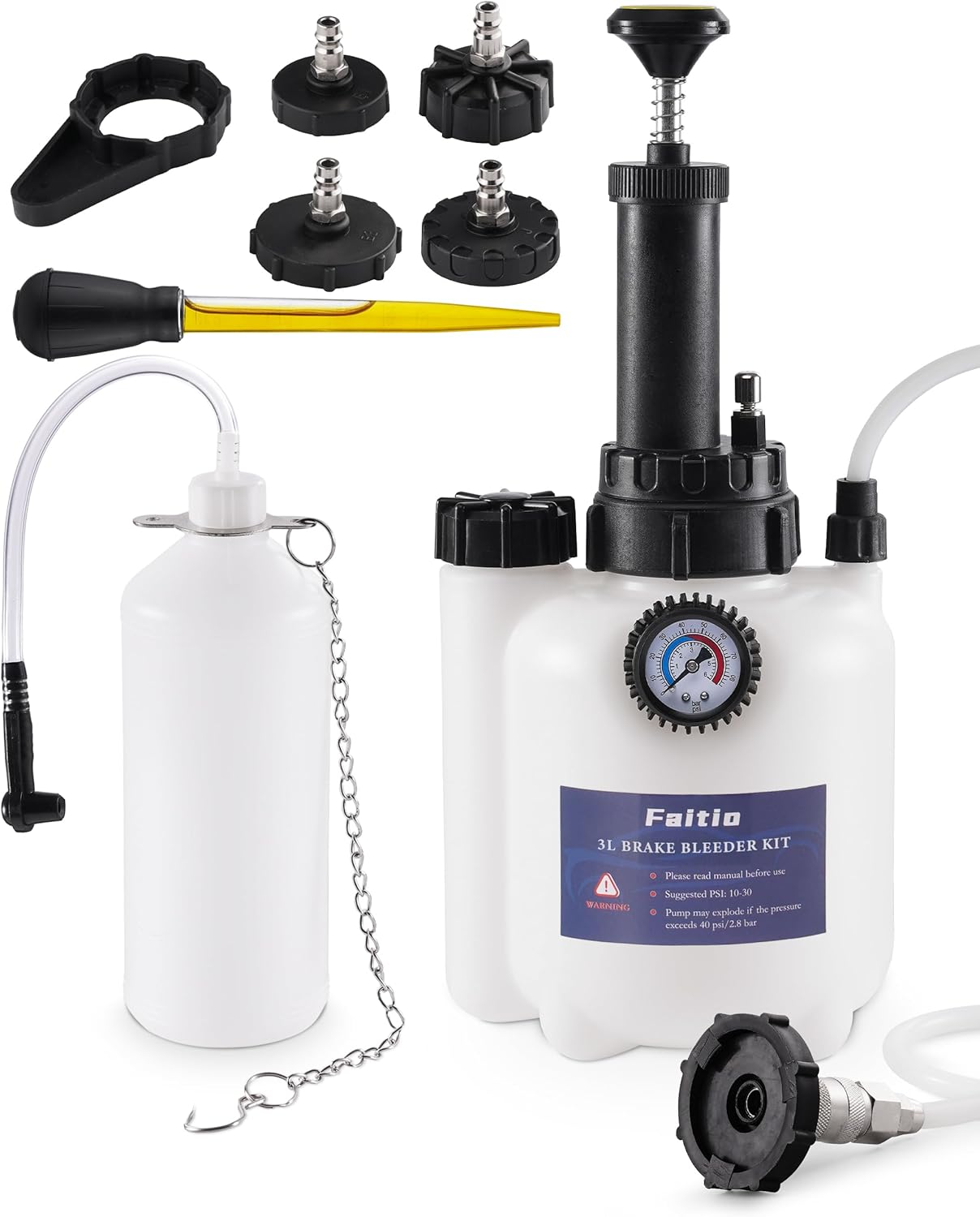
This one-man brake bleeding kit helps flush old brake fluid and remove trapped air for firmer, more responsive braking without the hassle of a second person. Its improved sealing and translucent catch bottle help prevent leaks while making fluid level checks easy during use. With multiple adapter sizes for many vehicle makes, it is a practical tool for clean, efficient brake system maintenance.

This universal brake bleeder kit makes one-person brake and clutch line bleeding simple by using compressed air to create stable vacuum-assisted fluid flow. Its extra-large 3L tank helps complete full-system flushes with fewer interruptions, while the included refill bottle, flexible hose, and universal adapter support clean, efficient use on standard and ABS brake systems.

The Mityvac MV8500 Silverline Elite is a versatile automotive service kit for brake and clutch bleeding, diesel fuel priming, and vacuum or pressure testing. Its dual-capability pump streamlines diagnostics and maintenance across motorcycles, cars, trucks, and SUVs, while the ergonomic design supports comfortable use during longer jobs. Built with a durable zinc-aluminum die-cast body and a 4.5oz fluid reservoir, it delivers reliable performance for professional and DIY repair work.
What Is the Difference Between DOT 3 and DOT 4?
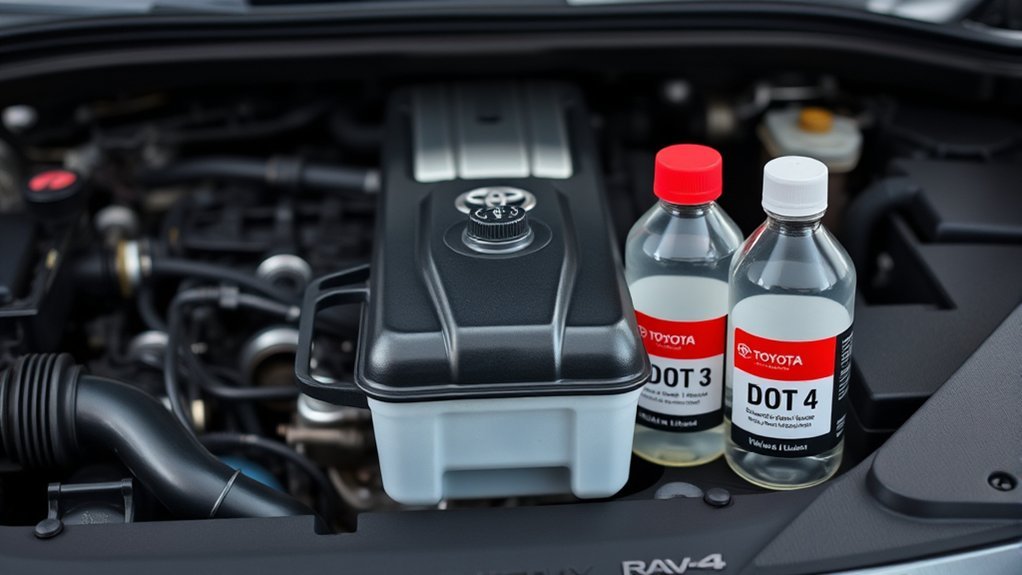
DOT 3 and DOT 4 are glycol-based hydraulic brake fluids. Their most relevant difference for a RAV4 owner is the minimum boiling-point performance required by federal regulation. Under FMVSS No. 116, DOT 4 must meet higher minimum dry and wet equilibrium reflux boiling points than DOT 3. “Dry” refers to the new-fluid test, while “wet” refers to fluid humidified under the federal test procedure.
The higher requirement gives DOT 4 more thermal margin during repeated or prolonged braking. It does not repair worn pads, warped rotors, sticking calipers, leaks, air in the hydraulic system, or an electronic brake-control fault. A fresh, correctly specified fluid is more important than choosing a higher grade that is old or contaminated.
| Brake Fluid Type | Minimum Dry Boiling Point | Minimum Wet Boiling Point | Practical Use |
|---|---|---|---|
| DOT 3 | 205°C / 401°F | 140°C / 284°F | Toyota-approved normal service when fresh and correctly specified |
| DOT 4 | 230°C / 446°F | 155°C / 311°F | Toyota-approved service with a higher required heat margin |
Note: DOT 5 is silicone-based and is not one of the grades listed in the verified 2019 RAV4 Hybrid service material. DOT 5.1 is a different, non-silicone grade, but it is also not one of the two grades listed in that material. Use DOT 3 or DOT 4 unless Toyota documentation for your exact vehicle states otherwise.
What Brake Fluid Does a 2019 Toyota RAV4 Hybrid Use?
The U.S. 2019 Toyota RAV4 Hybrid owner’s manual lists SAE J1703 or FMVSS No. 116 DOT 3, or SAE J1704 or FMVSS No. 116 DOT 4. Toyota’s recall service instructions for the brake-booster pump list the same two grades. Either is acceptable when the container clearly states the required standard and the fluid is clean and newly opened.
Toyota sells brake fluid under part number 00475-1BF03, but its product page directs owners to follow the applicable vehicle manual. Do not rely on the part number alone. Confirm the DOT/SAE specification on the actual container and verify that it is suitable for your vehicle before opening it.
Warning: Brake fluid can damage vehicle paint and may irritate skin or eyes. Follow the safety directions on the container, keep dirt and moisture out of the reservoir, and rinse accidental paint contact promptly with water.
[Products Worth Considering]

This brake bleeder bottle helps simplify brake fluid replacement by draining old fluid while reducing air in the line. Its rubber connector fits most bleed screws, and the included hose and chain help keep the bottle securely in place during use. Built from durable, corrosion-resistant plastic, it is suitable for a wide range of vehicles including cars, motorcycles, ATVs, dirt bikes, and scooters.

This brake bleeder bottle is designed to make fluid bleeding easier for one-person use with a built-in check valve and magnetic mount. The flexible hose fits most bleeder valves and helps reduce the chance of air entering the system during service. With a practical fluid capacity and universal fit, it is a handy tool for brake maintenance and repair.

Mixes well with conventional fluids
Check the 2019 RAV4 Hybrid Brake-Assist Recall
Certain 2019 RAV4 Hybrid vehicles were included in Toyota Safety Recall K0L, associated with NHTSA Campaign 19V544, for a brake-booster pump condition that could reduce or eliminate power-brake assist. The recall does not change the listed brake-fluid grade. Warning lights, audible alerts, increased pedal effort, or a longer stopping distance should not be treated as a simple fluid-level problem.
Safety check: Use the NHTSA VIN recall lookup to confirm whether your vehicle has an open recall. If the pedal feels abnormal, braking effort increases, fluid is visibly leaking, or a red brake warning remains on, stop driving and arrange professional diagnosis or towing.
How Do You Check the Brake Fluid Level?
A visual level check is reasonable for most owners, but level adjustment, fluid exchange, bleeding, or hydraulic repair is different. Toyota repair information distinguishes procedures by brake-booster configuration and, for some operations, uses Toyota Techstream or an equivalent capable scan tool.
For a complete illustrated owner-level procedure, use the dedicated RAV4 brake-fluid checking and top-off guide. The summary below focuses on what you can safely observe and when to stop.
Procedure boundary: The owner’s manual gives a visual MAX/MIN check. Toyota repair information can use different level-adjustment targets and vehicle states depending on the brake system and whether a scan tool is used. Do not turn this visual check into an improvised bleed or service-level adjustment.
Checking Fluid Reservoir Visibility
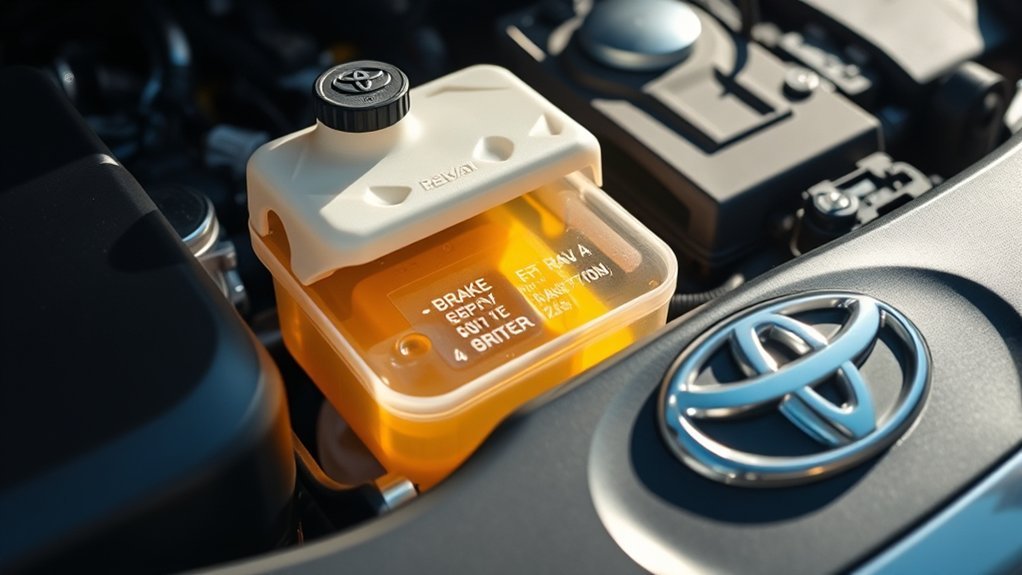
Park the RAV4 Hybrid on level ground, select Park, apply the parking brake, switch the vehicle off, and secure it against movement. Locate the translucent brake-fluid reservoir toward the rear area of the engine compartment. Read the level through the reservoir wall before opening the cap.
Keeping the cap closed during a routine visual check reduces the opportunity for dust and moisture to enter the hydraulic system.
Identifying Minimum and Maximum Levels
For the owner-level check described in the manual, the fluid should be between the “MAX” and “MIN” marks. A gradual level change can occur as brake pads wear, but a sudden drop, a reading at or below MIN, or a level that falls again after service needs investigation. A technician making a service-level adjustment should follow the exact Toyota procedure for the vehicle’s brake-system configuration rather than relying only on this general rule.
- If the level is near “MAX,” do not add fluid.
- If it is between “MAX” and “MIN,” continue to monitor it during routine inspections.
- If it is at or below “MIN,” inspect the pads and hydraulic system rather than assuming the vehicle only needs fluid.
- If low fluid appears with a warning light, leak, abnormal pedal, or longer stopping distance, do not continue driving.
Adding Brake Fluid Safely
Do not treat a low reading as an automatic top-up. First determine whether the level reflects worn pads, leakage, or recent brake service. Adding fluid without finding the cause can hide a fault and may cause the reservoir to overflow when worn pads are later replaced.
If inspection confirms that a small owner-level correction is appropriate, clean around the cap and use only fresh DOT 3 or DOT 4 fluid that meets the verified Toyota specification. Add it slowly, keep all tools and fluid clean, and stop at the mark specified by the applicable Toyota procedure. Do not guess at a target or overfill the reservoir.
Pro Tip: Buy the smallest sealed container that completes the planned service and write the opening date on it. An old, partly used bottle has had more opportunity to absorb moisture and collect contamination.
Does Brake Fluid Brand Matter?
You do not need Toyota-branded fluid or the same brand already in the reservoir. The important checks are the listed DOT/SAE specification, an intact sealed container, a clear product label, and clean handling.
Avoid mixing fluids unnecessarily. The Toyota material reviewed lists DOT 3 or DOT 4 as acceptable grades, but it does not give owners a procedure for blending them or calculating the performance of a mixture. If the existing grade or condition is unknown, have the system inspected and, when appropriate, exchanged using the correct hybrid brake procedure.
| Selection Check | What Matters |
|---|---|
| Specification | The label states DOT 3/SAE J1703 or DOT 4/SAE J1704 |
| Container condition | The seal is intact and the fluid has not been stored open |
| Service history | The grade and service date are documented when possible |
For a confirmed owner-level correction, matching Toyota’s listed specification is more important than matching a brand. Do not add an unknown, contaminated, petroleum-based, or silicone DOT 5 fluid.
Should You Use DOT 4 in Your RAV4 Hybrid?
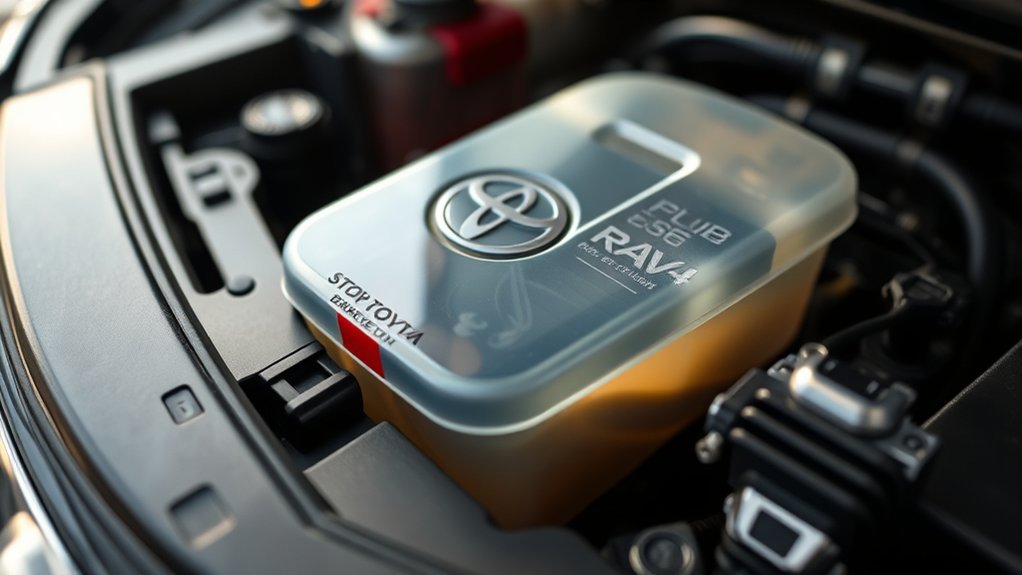
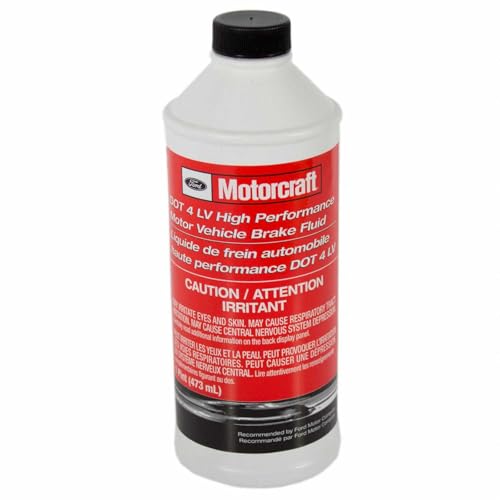
DOT 4 is a reasonable choice when you want more boiling-point margin, but it is not mandatory for every 2019 RAV4 Hybrid. Toyota’s verified service material permits both DOT 3 and DOT 4.
[Products Worth Considering]
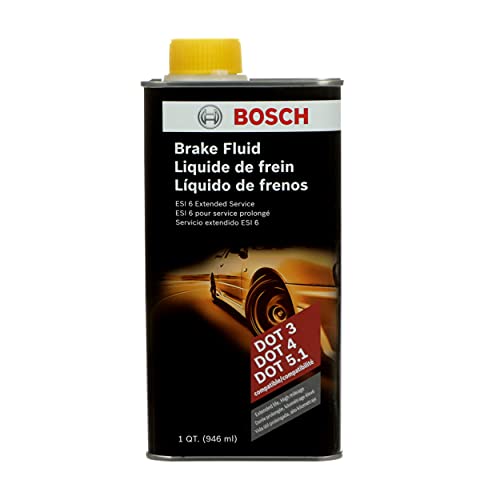
[NEXT GENERATION FLUID] - Bosch ESI6 is a next generation brake fluid designed for today's modern braking systems and is the first fluid to simultaneously combine both low viscosity and high wet boiling point (365 Degrees Fahrenheit)
New low viscosity formulation, faster response at lower temperatures
When DOT 4 Makes Sense
DOT 4 is a reasonable choice for repeated high-heat braking, long downhill routes, or heavy stop-and-go driving because its federal minimum dry and wet boiling points are higher than those for DOT 3. This is a use-case inference from the federal performance thresholds; Toyota lists both grades without assigning DOT 4 to a separate driving-condition schedule.
This extra margin applies to the fluid only. It cannot compensate for worn friction parts, tires with poor grip, air in the lines, hydraulic leakage, or an electronic brake-control problem.
What the Higher Boiling Point Means
Brake fluid must remain liquid to transmit hydraulic pressure. If contaminated fluid becomes hot enough to form vapor, the compressible vapor can increase pedal travel and reduce hydraulic effectiveness. DOT 4 begins with higher required dry and wet boiling-point thresholds than DOT 3.
Choose DOT 4 for its higher required heat margin, not because DOT 3 is prohibited. Toyota lists both grades for the verified 2019 RAV4 Hybrid service application.
What DOT 4 Does Not Solve
DOT 4 still absorbs moisture over time. Its advantage is not immunity to moisture but a higher starting performance requirement. Age and contamination can reduce the useful heat margin of any glycol-based brake fluid, so grade alone does not prove that the fluid is in good condition.
Fluid grade also does not diagnose a soft pedal. A changed pedal can result from a leak, trapped air, a component fault, overheated brakes, or another condition that needs immediate inspection.
When DOT 3 Is Still Fine
Fresh DOT 3 remains acceptable because Toyota lists it for this service application. It is a sensible option for normal commuting when the container meets SAE J1703 or FMVSS No. 116 DOT 3 and the brake system is in good condition.
For most owners, the best decision is simple: use one of Toyota’s listed grades, prioritize freshness and cleanliness, and select DOT 4 when its additional required heat margin suits your driving conditions.
How Often Should You Replace RAV4 Hybrid Brake Fluid?
Toyota’s U.S. 2019 RAV4 maintenance guide does not publish a fixed brake-fluid replacement interval. Its maintenance-log footnote for fluid inspections includes brake-fluid level and condition, and says a dealer may recommend additional service based on the inspection results.
Some dealers and independent technicians use a preventive time-based interval, often influenced by climate, fluid testing, service history, and operating conditions. Treat that as preventive shop guidance rather than a Toyota-mandated interval for this model.
Arrange inspection or fluid service when one or more of these conditions apply:
- The fluid contains visible dirt, debris, cloudiness, or severe discoloration.
- Appropriate testing indicates poor fluid condition or reduced boiling performance.
- The hydraulic system was opened for a caliper, hose, master-cylinder, actuator, or related repair.
- The service history is unknown and a qualified technician recommends an exchange after inspection.
- The pedal feel changes, warning lights appear, or braking performance changes. These symptoms require diagnosis, not an assumed fluid-only fix.
Color alone cannot measure moisture or boiling point. Use it as a reason to inspect the fluid, not as the sole pass/fail test. For more detail, see the dedicated RAV4 brake-fluid moisture and flushing guide.
Note: A fluid exchange is not the same as topping up the reservoir. Toyota electronically controlled brake systems can require specific depressurization, bleeding, initialization, and scan-tool steps. Professional service is the safer choice for most owners.
What Brake Fluid Mistakes Should You Avoid?
These mistakes can contaminate the system, hide a fault, or lead to the wrong service decision:
- Using an unlisted fluid: Use DOT 3/J1703 or DOT 4/J1704 for the verified 2019 RAV4 Hybrid application.
- Confusing DOT 5 with DOT 5.1: DOT 5 is silicone-based. Neither DOT 5 nor DOT 5.1 is one of the two grades listed in the verified service material.
- Using an old opened bottle: Use newly opened brake fluid and keep moisture and dirt out of the container.
- Automatically topping up a low reservoir: Check for pad wear, leakage, and hydraulic faults first.
- Overfilling: Stop at the mark specified by the applicable Toyota procedure; do not assume every service-level adjustment uses the same target.
- Judging fluid only by color: Appearance cannot confirm moisture level or boiling performance.
- Attempting an ordinary manual bleed: Hybrid brake-system bleeding may require Toyota-specific scan-tool functions and procedures.
- Spilling fluid on paint: Follow the container’s handling directions and rinse accidental contact promptly.
- Skipping records: Record the date, mileage, grade, and service performed.
How Do You Maintain the Complete Brake System?
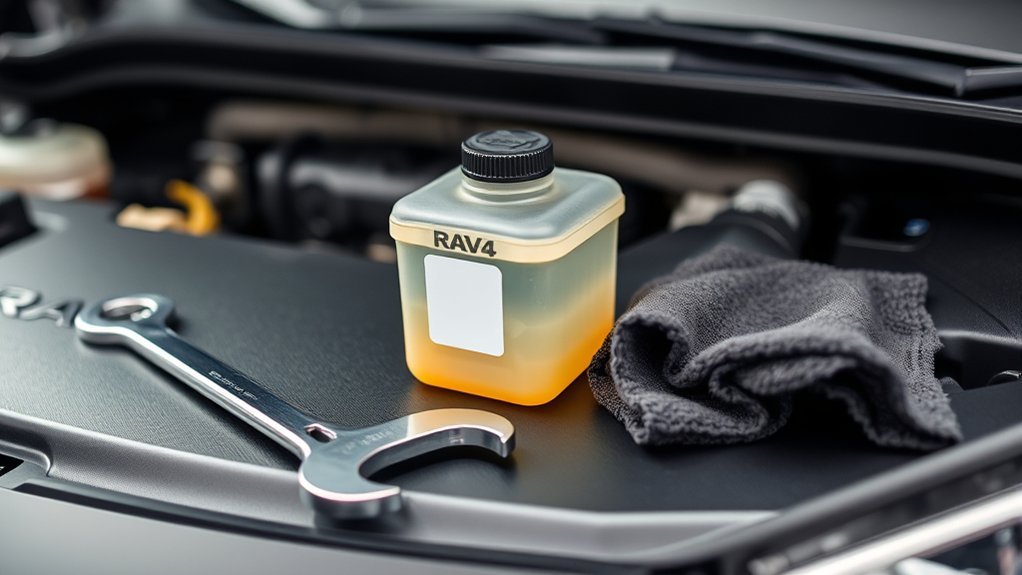
Brake fluid is only one part of the RAV4 Hybrid braking system. Safe operation also depends on the pads, rotors, calipers, hoses, lines, wheel-speed sensors, brake actuator, electronic controls, tires, and related warning systems.
Regenerative braking in a RAV4 Hybrid can reduce friction-brake use, but it does not remove the hydraulic brake system or eliminate fluid inspections. If one wheel becomes unusually hot, the vehicle pulls, or pad wear is uneven, review the RAV4 sticking-caliper symptoms and arrange an inspection.
Use this maintenance routine:
- Check the reservoir level during routine maintenance and before long trips.
- Look for visible contamination, but do not use color alone to judge fluid condition.
- Watch for wetness around the wheels, hoses, lines, master-cylinder area, and beneath the vehicle.
- Have the pads, rotors, hoses, and related hardware inspected at Toyota’s scheduled maintenance visits.
- Use only fresh DOT 3 or DOT 4 fluid meeting the verified specification.
- Check the VIN for open recalls and respond promptly to brake warning lights or changed pedal feel.
- Use a qualified technician for fluid exchange, hydraulic repairs, or brake-system bleeding.
Frequently Asked Questions
What kind of brake fluid does a 2019 Toyota RAV4 Hybrid take?
Toyota lists SAE J1703 or FMVSS No. 116 DOT 3, and SAE J1704 or FMVSS No. 116 DOT 4. Use fresh fluid from a newly opened container and confirm the specification on its label.
Is DOT 4 better than DOT 3 for a RAV4 Hybrid?
DOT 4 has higher federal minimum dry and wet boiling points, so it can provide more heat margin. DOT 3 is still acceptable for the 2019 RAV4 Hybrid when it is fresh and meets Toyota’s listed specification. Toyota does not require DOT 4 for every owner.
Can I mix DOT 3 and DOT 4 brake fluid?
Avoid unnecessary mixing. Toyota lists either DOT 3 or DOT 4, but the owner and service material reviewed does not give owners a blending procedure or a way to calculate the final boiling performance. Use the same known grade when possible. If the existing fluid is unknown or contaminated, arrange a proper inspection and exchange.
Can I use DOT 5 or DOT 5.1 in a Toyota RAV4 Hybrid?
Do not use silicone-based DOT 5. DOT 5.1 is non-silicone, but it is not one of the two grades listed in the verified 2019 RAV4 Hybrid material. Use DOT 3 or DOT 4 unless Toyota documentation for your exact vehicle states otherwise.
How often should I change 2019 RAV4 Hybrid brake fluid?
Toyota’s U.S. 2019 maintenance guide does not publish a fixed brake-fluid replacement interval. It calls for inspection of the level and condition, with additional service based on the findings. Replace or exchange the fluid when its condition, service history, hydraulic repairs, or a qualified inspection indicates that service is needed.
Should I top up low RAV4 Hybrid brake fluid?
Inspect the cause first. A gradual change can follow brake-pad wear, while a sudden or repeated drop can indicate a leak or hydraulic problem. If the level is at or below MIN, a warning light is on, the pedal feels different, or braking performance changes, have the vehicle inspected before driving.
Do I need Techstream just to check the brake-fluid level?
No. The owner’s manual provides a visual MAX/MIN check. Techstream or an equivalent capable scan tool may be required for service-level adjustment, bleeding, initialization, or hydraulic repair, depending on the brake-system configuration and procedure.
Does regenerative braking eliminate brake-fluid service?
No. Regenerative braking can reduce friction-brake use, but the RAV4 Hybrid still has a hydraulic brake system. The fluid level and condition still require inspection, and hydraulic repairs or bleeding still need the correct hybrid procedure.
Conclusion
For a U.S.-market 2019 Toyota RAV4 Hybrid, use fresh brake fluid meeting FMVSS No. 116 DOT 3/SAE J1703 or DOT 4/SAE J1704. DOT 4 provides a higher required boiling-point margin, while DOT 3 remains an approved choice for normal service.
Do not use silicone DOT 5, do not hide a low-fluid problem with repeated top-ups, and do not rely on color alone to judge fluid health. Toyota does not publish a fixed U.S. replacement interval for this model, so base service on inspections, fluid condition, repair history, and qualified diagnosis. Because the hybrid brake system may require scan-tool procedures, leave complete bleeding and hydraulic service to a properly equipped technician.
Sources
- Toyota 2019 RAV4 Hybrid Owner’s Manual: Engine Compartment — reservoir access, level guidance, handling precautions, and listed DOT 3/DOT 4 fluid standards
- NHTSA / Toyota Technical Instructions RCRIT-19V544-9054 — 2019 RAV4 Hybrid material listing SAE J1703/DOT 3 and SAE J1704/DOT 4, plus Safety Recall K0L information
- eCFR 49 CFR § 571.116: Motor Vehicle Brake Fluids — official DOT 3 and DOT 4 dry and wet boiling-point requirements and wet-test method
- Toyota Genuine Brake Fluid #00475-1BF03 — Toyota product information and direction to follow the applicable vehicle manual
- 2019 Toyota RAV4 Warranty & Maintenance Guide — scheduled maintenance and inspection-based brake-fluid guidance
- Toyota Technical Information System (TIS) — repair-manual documents RM100000001G0PI and RM100000001G0PK covering configuration-specific level inspection, adjustment, and scan-tool-guided bleeding
- NHTSA Recall Lookup — VIN-based open-recall checking

[…] Regenerative braking can reduce friction-brake use, but it does not eliminate inspections, brake fluid care, rotor corrosion, caliper problems, or normal pad […]
[…] hydraulic failure more often causes a soft, sinking, inconsistent, or weak pedal. Use the correct RAV4 brake fluid guidance and the RAV4 brake maintenance schedule for the exact […]
[…] brake fluid on a Toyota RAV4 is a quick driveway task, but it is still a safety-critical brake-system check. […]