

Most Toyota Camry humming noises come from tire wear, wheel bearings, wheel balance, brakes, or components that change with engine load or A/C use. First confirm whether the sound is normal for a hybrid Camry: at low speed, the vehicle may intentionally produce a smooth pedestrian-alert sound while the gasoline engine is off. A fault is more likely when the hum is new, continues as speed rises, changes during gentle turns, appears with vibration or heat, or follows throttle, braking, or climate-control input.
Last updated: July 31, 2026 · Reviewed against Toyota owner-manual resources, NHTSA tire guidance, and current Camry troubleshooting search results.
Quick Answer
Start by deciding whether the hum follows road speed, engine load, steering, braking, or A/C and blower settings. A road-speed hum usually points first to tires, wheel balance, brakes, or a wheel bearing. A low-speed electronic hum on a hybrid Camry may be the normal Vehicle Proximity Notification System. Stop driving and seek help if the sound comes with grinding, wheel looseness, strong vibration, overheating, smoke, a burning smell, or a sudden handling change.
Key Takeaways
- A hum that follows road speed even while coasting points first to tires, wheel balance, brakes, wheel bearings, or axles.
- A sound that changes during gentle turns suggests a load-sensitive tire or bearing issue, but turn direction alone does not prove which side is bad.
- Hybrid Camrys can make normal low-speed motor, regenerative-braking, cooling-fan, and pedestrian-alert sounds.
- A hum that changes with throttle at the same road speed needs drivetrain, mount, exhaust-shield, or rotating-accessory checks.
- A hot wheel, burning smell, grinding, or a hum that changes with braking can indicate brake drag and needs prompt inspection.
- Check tire pressure monthly when cold, even if the TPMS light is off.
At a Glance
| Time Required | 20 to 45 minutes for basic checks; longer if a shop performs a road test and lift inspection |
| Difficulty | Easy for tire pressure and tread checks; moderate to advanced for lifted wheel-bearing checks |
| Tools Needed | Tire pressure gauge, flashlight, tread-depth gauge or penny, notebook, and a safe road-test route |
| Cost | Free for basic checks; shop diagnosis and repairs vary by model year, trim, hybrid status, parts, and labor rate |
30-Second Symptom Sorter
| When the Hum Changes | Check First | Useful Next Test |
|---|---|---|
| Only while moving; rises with road speed | Tires, wheel balance, brakes, wheel bearings | At a safe steady speed, briefly ease off the accelerator. If the pitch stays tied to vehicle speed, keep checking wheel-end causes. |
| Changes during gentle curves or lane changes | Wheel bearing or tire wear | Record which direction changes the sound, but let a shop confirm the noisy corner. |
| Changes with throttle at the same road speed | Transmission or transaxle, axle, mount, exhaust shield, accessory | Compare light acceleration, steady throttle, and coasting without changing lanes. |
| Changes with braking or one wheel becomes hot | Dragging brake, rotor shield, wheel bearing | Stop if you smell burning, see smoke, or feel pulling. Do not touch a hot wheel or brake. |
| Changes with blower speed or A/C on/off while parked | Blower motor, debris, compressor, cooling fan, belt or pulley | Test each blower speed and A/C setting while stationary. |
| Smooth electronic hum only at low speed on a hybrid | Normal pedestrian-alert or hybrid-system sound | Compare the sound with the normal-sounds section of the owner’s manual for your exact model year. |
What’s in This Article
- Common Causes of Humming Noise
- Before You Diagnose the Noise
- Can a Camry Hybrid Hum Be Normal?
- How Tire Issues Contribute to Humming
- Identifying Worn Wheel Bearings
- Transmission Problems and Humming
- A/C and Other Components
- Brakes, Road Surface, and Loose Panels
- Tire Pressure and Alignment
- Worn CV Joints
- Preventive Maintenance Tips
- Steps to Diagnose and Fix Humming
- When to Get Professional Help
- Frequently Asked Questions
What Causes a Humming Noise in a Toyota Camry?

A Toyota Camry hum is easiest to narrow by its trigger. Noise tied to vehicle speed usually starts at the tires, wheels, brakes, bearings, or axles. Noise tied to engine RPM or throttle points more toward the transmission or transaxle, mounts, exhaust contact, or a rotating engine-bay component. Noise that appears while parked cannot come from tire balance or a road-speed wheel bearing.
Uneven tire wear can create a steady drone that changes with pavement. A worn wheel bearing may produce a deeper hum or growl that changes as cornering load shifts. A dragging brake can add a hum, scrape, heat, or pull. On a hybrid Camry, some low-speed electronic and motor sounds are normal and should be compared with the owner’s manual before parts are replaced.
A/C compressor, blower motor, radiator or condenser fan, belt pulley, loose heat shield, and worn mount noises may change when you switch climate control settings or change engine load. Because sound travels through the body, the place where you hear it is not always the failed part.
| Likely Source | What You May Hear | Quick Check | Urgency |
|---|---|---|---|
| Tires | Steady road hum that rises with speed | Check pressure, tread depth, cupping, feathering, and rotation history | Soon, especially if tread is worn or damaged |
| Wheel bearing | Hum or growl that changes during turns or lane changes | Listen during gentle steering input and inspect for wheel play | High if noise is loud, new, or paired with vibration |
| Transmission or drivetrain | Hum that changes with acceleration or load | Note whether the sound changes when you lift off the gas | High if shifting changes, fluid smells burnt, or warning lights appear |
| A/C, blower, or cooling fan | Hum that changes with fan speed or A/C on/off | Switch A/C and blower settings while parked and during a short drive | Moderate unless it comes with overheating or belt noise |
| Brake drag or rotor shield | Hum, scrape, or drone that may change with braking; possible heat or pulling | Note braking changes and compare wheel-area heat without touching the brakes | High if there is burning smell, smoke, strong pull, or abnormal pedal feel |
| Hybrid system or pedestrian alert | Smooth electronic hum, motor whir, fan noise, or regenerative-braking sound | Check whether it occurs only at low speed or during normal hybrid transitions | Usually normal unless new, harsh, loud, or paired with a warning message |
| CV joint or axle | Clicking, popping, or vibration during turns or acceleration | Inspect CV boots for cracks, torn rubber, or grease leaks | Soon if clicking or grease leakage appears |
Before You Diagnose a Camry Humming Noise
First test the Camry while parked. Cycle the blower through each speed, switch the A/C on and off, and note whether the sound changes with engine RPM. If the hum occurs while the car is stationary, focus on the blower, compressor, cooling fans, belt drive, mounts, exhaust shields, or hybrid-system components rather than tires or wheel balance.
For a road test, choose a smooth, familiar road with light traffic. Keep both hands on the wheel and avoid sudden swerves. Record the speed where the sound begins, whether the pitch follows vehicle speed, and whether it changes during a gentle curve, light acceleration, steady cruising, coasting, or braking. Do not shift to Neutral while moving and do not perform any test that distracts you from traffic.
Use the same road in both directions when practical. A hum that changes mainly with pavement or wind direction may be tire-pattern, road-surface, roof-rack, trim, or weather-seal noise rather than a failed bearing. These observations help a technician reproduce the symptom instead of guessing.
Warning: Never crawl under a Camry supported only by a jack. Use the correct lift points, wheel chocks, and rated jack stands, or leave lifted checks to a qualified shop.
Can a Camry Hybrid Humming Noise Be Normal?
Yes. A hybrid Camry can produce normal sounds that a gas-only car may not make. When the gasoline engine is off at low speed, the Vehicle Proximity Notification System can play a speed-related sound to warn nearby pedestrians. Hybrid motor, transaxle, regenerative-braking, relay, battery-cooling-fan, and engine start-stop sounds may also be noticeable.
The exact sound and operating range vary by model year and market, so compare the symptom with the hybrid-system and normal-sounds sections in the owner’s manual. Toyota moved the U.S.-market 2025 Camry to an all-hybrid lineup, which makes this distinction especially important for newer cars.
Likely normal: a smooth electronic hum at low speed, a brief motor or relay sound during startup or shutdown, regenerative-braking sound as you slow, or a cooling fan that runs without warning lights or loss of performance.
Needs inspection: a new grinding, scraping, harsh whine, strong vibration, burning smell, fluid leak, reduced power, overheating message, or hybrid-system warning. Normal hybrid operation should not be used to dismiss a sound that is getting worse.
How Do Tire Issues Cause a Camry to Hum?
Tire-related hum usually follows road speed and often changes with pavement type. Uneven wear, low pressure, skipped rotations, poor balance, tire construction, and alignment problems can all create a repeating drone. Because the sound may build slowly, compare all four tires instead of judging only the corner where the noise seems loudest.
[Products Worth Considering]

The JACO ElitePro Digital Tire Pressure Gauge delivers shop-grade accuracy with a clear digital readout, making it easy to maintain proper tire pressure for safer driving and better performance. Built with rugged brass and steel components, a protective guard, and a flexible air hose, it is designed for reliable use across cars, trucks, motorcycles, bikes, RVs, and trailers. The lock-on display, built-in bleeder valve, and bright backlit screen add convenience in any lighting condition.
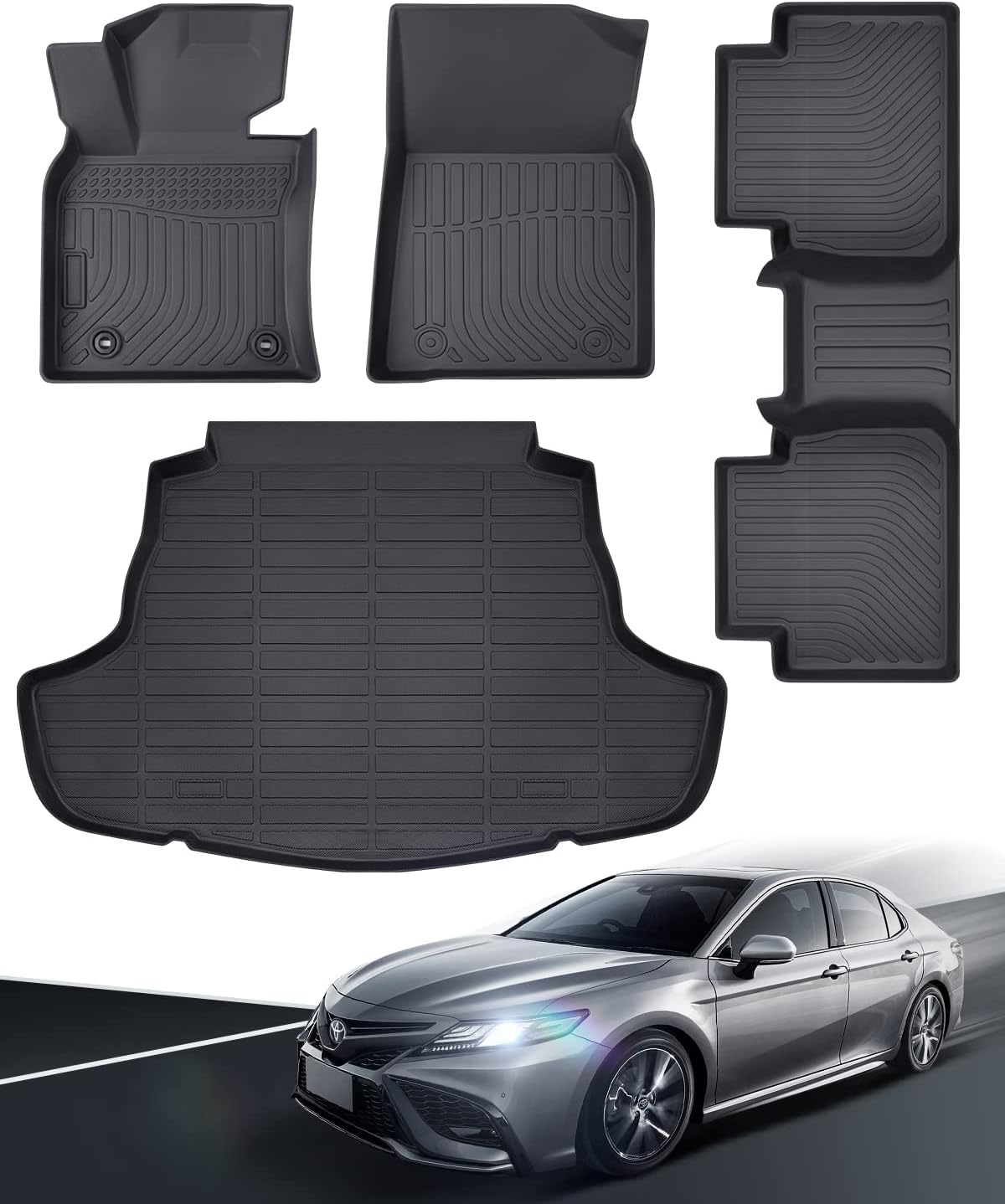
This custom floor mat and cargo liner set is designed to help protect the interior of Toyota Camry models from everyday messes like mud, spills, snow, and pet hair. Made for a precise fit on compatible 8th Gen FWD trims, it offers full coverage for both the cabin and trunk while remaining easy to remove, clean, and reinstall. The odorless TPE construction is built for all-weather durability and long-lasting comfort.

This heavy-duty car ramp set provides a stable, reliable lift for routine maintenance like oil changes, tire rotations, brake work, and undercarriage inspections. Built from high-impact poly with a non-skid tread and rubber feet, it helps keep vehicles secure while offering a lightweight, corrosion-resistant alternative to steel ramps. The wide, gradual design supports a broad range of vehicles, from compact cars to trucks, SUVs, and vans.
How Uneven Tire Wear Causes Humming Sounds
Uneven tire wear creates humming by disrupting smooth road contact. Cupping, feathering, shoulder wear, and flat spotting make the tread hit the road unevenly. That uneven contact can sound like a steady hum, drone, or low growl.
Poor alignment, unbalanced wheels, worn suspension parts, and incorrect inflation can speed up this process. Run your hand lightly across the tread when the car is parked and the tires are cool. If one direction feels smooth and the other feels sharp or choppy, tire wear may be part of the noise.
Pro Tip: A clear change during gentle steering input raises suspicion for a load-sensitive bearing or tire. It does not identify the failed side by itself, because tire wear, road crown, and sound transmission can mislead you.
Tire Pressure Maintenance Tips
Correct tire pressure keeps your ride smoother, quieter, and safer. Under-inflated tires can overheat and wear unevenly, while over-inflated tires can wear more in the center of the tread. The correct cold tire pressure is on the Tire and Loading Information Label on the driver’s door edge or doorjamb, or in your owner’s manual.
The National Highway Traffic Safety Administration recommends checking tire pressure at least once a month when the tires are cold. Check the spare too if your Camry has one. A TPMS light helps, but it does not replace regular pressure checks.
| Action | Frequency |
|---|---|
| Check Pressure | Monthly and before long trips |
| Inspect for Damage | Monthly or after pothole impact |
| Rotate Tires | Follow your Toyota guide; often around 5,000–8,000 miles if recommended |
| Replace Tires | At 2/32 inch tread depth, visible damage, age concerns, or unsafe wear |
NHTSA reported 511 motor vehicle traffic fatalities in tire-related crashes in 2024, so tire noise deserves a real inspection, not guesswork.
Why Regular Tire Rotation Prevents Humming
Tire rotation helps reduce irregular wear, which can reduce humming and keep your tires useful for longer. Check your Toyota owner’s manual or warranty and maintenance guide for the correct interval and rotation pattern for your model year. The Toyota Owners manual page lets you select your vehicle and access the correct documents.
Rotation also gives a technician a chance to spot cupping, feathering, sidewall damage, bent wheels, and uneven brake or suspension wear. If the hum started right after a rotation, ask the shop to recheck wheel balance, lug-nut torque, tire direction, and tire placement. If the main symptom is shaking at 60–70 mph, use the separate Camry highway vibration guide to avoid confusing a balance problem with a bearing hum.
How Can You Tell If a Camry Wheel Bearing Is Humming?
Worn wheel bearings are one of the first serious causes to rule out when a Camry hum grows with speed. The sound may feel like it comes from the floor, dash, or trunk, even when the problem sits at one wheel. A bad bearing can also send vibration through the steering wheel or body.
[Products Worth Considering]

Meguiar's Keep Clear Headlight Coating helps maintain crystal-clear headlights on both new and restored lenses for improved nighttime visibility and a cleaner look. Its durable UV-protective formula helps resist hazing, yellowing, and discoloration while delivering lasting clarity for up to a year. The easy aerosol spray application makes it simple to protect and refresh your headlights with minimal effort.

Steering Knuckles Replacement for 2007 2008 2009 2010 2011 2012 Lexus ES350 - [for 2007 2008 2009 Toyota Camry (3.5L)] - for 2010-2011 Toyota Camry (2.5L; 3.5L)

Kit Includes: 1 Front Driver Side Wheel Bearing & Hub Assembly; 1 Front Passenger Side Wheel Bearing & Hub Assembly
Signs Your Wheel Bearings Are Failing
A failing wheel bearing often makes a hum, growl, or rumble that gets louder as road speed increases. The noise may change when you turn or change lanes because the weight of the vehicle shifts onto one side. You may also feel vibration, roughness, or looseness during an inspection.
Do not rely on sound alone. Tire wear, tire balance, and some drivetrain issues can mimic bearing noise. A proper inspection looks for play, rough rotation, heat, wheel-speed sensor issues, and related hub or suspension wear.
Warning: A loud wheel-bearing hum, grinding sound, steering vibration, or wheel looseness is a safety concern. Avoid highway speeds and schedule inspection promptly if you notice these symptoms.
How to Inspect Your Wheel Bearings
Start with a safe road test. Listen for a hum that grows with vehicle speed and changes during gentle turns. A repeatable change supports a load-sensitive wheel-end problem, but do not order a left or right bearing from turn direction alone. Tire wear, road crown, brake contact, and cabin sound paths can point you toward the wrong corner.
If you know how to lift a vehicle safely, compare each wheel for play and roughness while following the correct Toyota lift procedure. Movement can also come from ball joints, tie rods, or other suspension parts, while a noisy bearing may have little obvious play. Any roughness, grinding, clunking, or visible looseness needs professional confirmation. Do not try to lubricate a sealed hub assembly.
When Should You Replace Wheel Bearings?
Replace a wheel bearing or hub assembly only after the noisy corner is confirmed through a road test and physical inspection. Delaying a confirmed bearing repair can increase heat, vibration, sensor problems, tire wear, and handling risk. Replace the failed unit and any related parts that test bad; replacing both sides automatically is not required when the opposite side is healthy.
- Listen for turn-related changes: A repeatable pitch or volume shift can support a bearing diagnosis, but it does not prove the side.
- Check for wheel play: Looseness during a lifted inspection is a stronger warning than sound alone.
- Ask for confirmation: A good shop should identify the noisy corner before replacing parts.
For bearing lifespan, replacement timing, warning-light clues, and shop checks, see the dedicated Camry wheel bearing guide.
Can a Camry Transmission or Transaxle Cause Humming?

A transmission, hybrid transaxle, axle, mount, or related drivetrain component becomes more likely when the hum changes with throttle or load at the same road speed. Compare light acceleration, steady cruising, and coasting. If the pitch follows vehicle speed regardless of throttle, keep tires, brakes, bearings, and axles high on the list.
Camry transmission designs and service procedures vary by model year, engine, drivetrain, and market. Some units do not offer a simple owner-level dipstick check, so do not open plugs or add fluid without the correct procedure and fluid specification. Look instead for leaks, burnt odor, delayed engagement, slipping, harsh shifts, shudder, warning messages, or loss of drive, then have the system checked with the correct Toyota service information.
Use the Camry transmission-type guide to identify whether the vehicle uses a conventional automatic or hybrid transaxle before following service advice. If the car also shifts harshly, review the separate Camry hard-shifting guide.
Note: A/C compressor hum and drivetrain hum can sound similar from inside the cabin. Turn the A/C off and change blower speeds during a short test. If the sound changes with climate-control settings, the A/C or blower system is more likely than the transmission.
Can the A/C or Blower Cause a Camry Humming Noise?
The A/C system and other rotating components can also create humming noises in your Toyota Camry. These noises often change while the vehicle is parked, which makes them easier to separate from tire and wheel-bearing noise.
- A/C compressor noise: A compressor or clutch-related noise may change when you turn the A/C on or off.
- Blower motor noise: A hum that changes with fan speed often points toward the cabin blower motor or debris near the blower wheel.
- Radiator or condenser fan noise: Electric fan motors, loose shrouds, or debris can hum or buzz when the cooling fans run.
- Belt or pulley noise: A worn pulley bearing can create a speed-related hum from the engine bay.
Test these systems while parked and while driving slowly in a safe area. If the hum changes with fan speed, A/C status, or engine RPM while the car is not moving, the source is probably not your tires.
Can Brakes, Road Surface, or Loose Panels Cause Humming?
Yes. A dragging brake can create a hum, scrape, heat, or pull that changes when you apply or release the brake pedal. A bent rotor dust shield may rub only during turns or over bumps. Stop driving if a wheel area smokes, smells burnt, becomes unusually hot, or the brake pedal or steering changes.
Road surface and tire tread can also create a powerful cabin drone. Repeat the test on a different smooth road before replacing parts. If the noise changes sharply with pavement but not with steering, throttle, or braking, tire pattern or road texture becomes more likely.
Loose underbody panels, exhaust heat shields, wheel-well liners, roof-rack parts, weatherstrips, or exterior trim can resonate at a narrow speed range. These noises may change with crosswind, bumps, engine load, or recent body work. Ask the shop to inspect fasteners and shields during the lift check instead of focusing only on the transmission.
How Do Tire Pressure, Balance, and Alignment Affect Humming?
Correct tire pressure and proper alignment are two of the simplest ways to prevent Camry humming. Under-inflated tires can develop uneven shoulder wear, while over-inflated tires may wear more in the center. Either pattern can make road noise louder.
Misalignment makes the tire scrub across the road instead of rolling cleanly. That scrubbing can create feathering, cupping, and steering pull. If your Camry drifts on a straight road or the steering wheel sits off-center, schedule an alignment check.
Wheel balance matters too. A balance problem usually creates a repeatable vibration band, but it can also amplify tire noise. If humming started after new tires, a rotation, or a pothole hit, recheck balance, wheel runout, tire condition, and alignment. If the Camry also drifts, use the Camry pulling-to-one-side checklist before assuming alignment is the only cause.
Can a Worn CV Joint or Axle Cause Humming?

Worn CV joints do not usually create a clean, steady hum by themselves. They more often make clicking, popping, or clacking sounds during turns. A worn axle can also cause vibration during acceleration.
- Clicking or popping during turns: This is the classic outer CV joint warning sign.
- Cracked or torn CV boot: A torn boot lets grease escape and dirt enter the joint.
- Grease near the wheel well: Splattered grease can point to a damaged boot.
- Vibration under acceleration: Shaking while accelerating can point to an axle, inner CV joint, tire, mount, or drivetrain problem.
Inspect the CV boots during tire checks. If you see torn rubber or grease leakage, schedule service before the joint runs dry and damages the axle.
Preventive Maintenance Tips for Reducing Humming
You cannot prevent every mechanical failure, but routine tire and brake checks reduce the most common avoidable noise causes. Check tire pressure monthly while the tires are cold. Inspect tread depth, treadwear patterns, sidewalls, valve stems, and any new heat, pull, or vibration.
Rotate tires according to your Toyota maintenance guide when rotation is recommended for your tire setup. Ask for alignment and balance checks when you see uneven wear, feel vibration, or hit a hard pothole. Keep records so you can connect a new sound to recent tire work or repairs.
Check transmission fluid, belts, mounts, and suspension parts according to the correct owner’s manual for your Camry. Toyota provides vehicle-specific manuals and warranty information through Toyota Owners. Use that source before following generic mileage advice.
Steps to Diagnose and Fix Humming Noises
Tracking down a Camry hum gets much easier when you work from simple checks to more serious causes. Do not replace parts based only on a sound clip or a guess. Confirm the symptom pattern first.
- Identify the Camry. Record the model year, gas or hybrid powertrain, drivetrain, recent repairs, tire age, and when the noise began.
- Test while parked. Cycle the blower, A/C, and engine RPM. A stationary hum cannot come from wheel balance or tire tread.
- Check tire pressure cold. Use the door-jamb label or owner’s manual, not the maximum pressure on the tire sidewall.
- Inspect tread, sidewalls, and wheel areas. Look for cupping, feathering, bulges, cuts, exposed cords, grease, loose liners, and signs of brake heat.
- Record the trigger. Note the exact speed, pavement, steering direction, throttle position, braking input, and climate-control setting.
- Compare acceleration with coasting. If pitch stays tied to road speed after you ease off the accelerator, prioritize wheel-end causes. Do not shift to Neutral while moving.
- Compare gentle steering input. A repeatable change supports a load-sensitive tire or bearing issue, but a shop must confirm the side.
- Check warning clues. ABS, traction-control, transmission, or hybrid-system warnings should be scanned before parts are replaced.
- Schedule a professional inspection. Use a shop if the noise is loud, new, worsening, paired with vibration or heat, or hard to isolate safely.
After diagnosis, the fix may be as simple as correcting tire pressure, rotating tires, balancing wheels, or aligning the suspension. More serious fixes can include tire replacement, wheel-bearing or hub replacement, axle service, A/C component repair, or transmission diagnosis.
[Products Worth Considering]

Complete Axle Bearing Tool Kit: This kit from Orion Motor Tech includes an axle bearing puller, an ABS tone ring driver, an ABS tone ring tool, an adapter plate, and a set of fasteners. It also comes with a pair of gloves to protect your hands during use

Comprehensive Tool Set: This wheel hub remover tool kit by Orion Motor Tech includes a remover plate, forcing screw, screw assembly, and two washers, ensuring faster and safer hub removal

Fit for Toyota 4Runner 1995-2020; Fit for Toyota Hilux 2004-2012; Fit for Toyota Tacoma 1995-2004; Fit for Toyota T100 1995-1998; Fit for Toyota Tundra 2000-2006. 1995-2020 4Runner, 2004-2012 Hilux, 1995-1998 T100, 1995-2004 Tacoma (This requires longer bolts), 2000-2006 Tundra. The 4-Runner tool kit is designed to be compatible with a wide range of vehicle makes and models, enhancing its usability across different automotive repair scenarios. This compatibility feature makes it a valuable addition to any mechanic's toolkit.
When to Get Professional Help for Persistent Humming
Some humming noises go beyond safe DIY checks. If the hum gets louder quickly, changes while turning, or comes with vibration, grinding, steering pull, or warning lights, schedule professional diagnosis. Do not keep driving at highway speeds with a suspected wheel-bearing problem.
Use this urgency guide when deciding what to do next:
- Stop driving and get help: grinding, wheel looseness, strong vibration, smoke, burning smell, a very hot wheel area, fluid leak, overheating, brake changes, or sudden handling change.
- Book service soon: hum changes during turns, tire wear looks uneven, CV boot is torn, or the sound grows every week.
- Monitor after basic maintenance: mild tire noise that improves after pressure correction, balance, rotation, or alignment.
Ask the shop to road test the car, identify the noisy corner or system, and give a written estimate before replacing parts. Repair costs vary by Camry model year, trim, hybrid status, part quality, and labor rate, so a confirmed diagnosis matters more than a generic price range.
Frequently Asked Questions
What can cause a humming noise while driving?
A humming noise while driving can come from uneven tire wear, low tire pressure, worn wheel bearings, poor alignment, wheel balance issues, transmission or drivetrain problems, A/C components, or worn axle parts. Note whether the sound changes with speed, steering, acceleration, braking, or A/C settings.
Is a low-speed humming sound normal on a Camry Hybrid?
It can be. Hybrid Camrys may produce a smooth pedestrian-alert sound at low speed while the gasoline engine is off. Motor, regenerative-braking, relay, transaxle, and battery-cooling-fan sounds may also be normal. Compare the sound with the owner’s manual for your model year, and get it checked if it becomes harsh, loud, or paired with vibration, heat, reduced power, or a warning message.
Why does my Toyota Camry make a humming sound when accelerating?
A hum that gets louder during acceleration may point to drivetrain load, transmission fluid condition, axle issues, engine mounts, or a rotating accessory. Tires and wheel bearings can also get louder with speed, so compare throttle input with road speed before assuming the transmission is the cause.
How do you fix a humming transmission?
Start by checking the correct Toyota maintenance guide for your model year. If the fluid is low, leaking, dark, or burnt-smelling, have a qualified technician inspect it. Do not approve a flush or major repair until the shop confirms the transmission is the source of the hum.
How can I tell if it is a wheel bearing or a tire causing the humming?
Tire hum often changes with pavement and may stay fairly steady during gentle steering input. Wheel-bearing hum is more likely to change pitch or volume as cornering load shifts. Neither test is conclusive by itself. A shop should compare tire wear, brake contact, wheel play, hub roughness, and road-test behavior before selecting a side.
Can a dragging brake make a Camry hum?
Yes. A sticking caliper, parking-brake issue, or rubbing dust shield can create humming, scraping, heat, or pulling. Stop driving if you smell burning, see smoke, feel a strong pull, or notice abnormal brake-pedal behavior. Do not touch a wheel or brake that may be hot.
Is it safe to drive a Toyota Camry with a humming noise?
Mild tire noise may be safe for a short time, but you should still inspect pressure, tread, and sidewalls. Do not ignore a hum that grows quickly, changes when turning, comes with vibration, or sounds like grinding. Those symptoms need prompt inspection before highway driving.
Can low tire pressure make a Camry hum?
Yes. Low tire pressure can create extra heat, uneven wear, and louder road noise. Check pressure when the tires are cold and use the driver’s door-jamb label or owner’s manual for the correct PSI. Do not rely only on the TPMS light.
Conclusion
Diagnose a Toyota Camry hum by its trigger, not by where it seems to come from. First separate normal hybrid low-speed sounds from faults. Then compare parked versus moving, road speed versus throttle, gentle steering, braking, pavement, and A/C settings. Check tire pressure and tread before approving parts, but treat grinding, heat, smoke, wheel looseness, strong vibration, warning messages, or a sudden handling change as reasons to stop and get professional help.
Sources
- Toyota Owners — Manuals and Warranties — supports using the owner’s manual and maintenance guide for the exact model year, powertrain, and market.
- NHTSA TireWise Tire Safety — supports monthly cold-pressure checks, door-placard guidance, tire inspection, rotation guidance, and the 2024 tire-related fatality statistic.
- NHTSA — FMVSS No. 141 Interpretation — explains minimum low-speed sound requirements for hybrid and electric light vehicles.
- Toyota USA Newsroom — Camry Goes Exclusively Hybrid — confirms the U.S.-market 2025 Camry’s move to an all-hybrid lineup.
- Timken Light Vehicle TechTips — provides professional resources for checking hub bearings and tracking wheel-end noise.


[…] soft brake pedal in your Toyota Camry can turn a normal stop into a real safety concern. The pedal may feel spongy, travel farther than […]
[…] fluid can still age, so visual checks do not replace routine service. Watch for these common warning signs during brake fluid […]