The 4Runner’s breakover angle tells you whether the chassis midpoint (usually the fuel tank) will ground when straddling a crest; stock TRD Off‑Road is about 19.8°, limiting steep apex clearance. It’s computed from wheelbase and midpoint clearance; modest lifts (≈2″) or larger tires (33″) add a degree or two each, while shortening wheelbase yields the most gain but is impractical. Expect hang‑ups when obstacle apex exceeds that angle, and further sections explain specific mods, formulas, and tradeoffs.
What Breakover Angle Means for 4Runner Drivers

Think of breakover angle as the geometric limit that tells you whether your 4Runner can straddle a crest without grounding the midsection; it directly links to how you exploit off road capabilities. You evaluate that angle from the lowest mid-chassis point—the fuel tank on a 4Runner—so measuring ground clearance and wheelbase gives you a practical metric for vehicle dynamics. With the 2022 TRD Off-Road around 19.8 degrees, you’ll see tangible gains from a 2-inch lift that nudges the figure into the 20–22-degree range, but wheelbase reductions yield larger improvements if you could alter platform geometry. Compare numbers to rivals—stock Bronco’s ~26.3 degrees—to prioritize modifications that free you from restrictive terrain. Trust field tests over pure calculations: real hills expose interactions between suspension travel, chassis geometry, and payload that theoretical values miss. Use breakover angle as a decisive, actionable parameter when planning upgrades and routes.
4Runner Stock Breakover Specs, Weak Points, and Limits
Numbers matter: the 2022 4Runner’s stock breakover angle sits at about 19.8°, calculated from a mid-chassis lowest point (the fuel tank) at roughly 12.5 in. of clearance and the vehicle’s wheelbase; that modest angle limits crest-straddling ability compared with rivals like the Bronco (~26.3°) and makes the 4Runner more prone to grounding in steep, peaked terrain. You should treat that figure as a baseline for evaluating 4Runner limitations on technical lines. The fuel tank’s position defines the critical datum; raise the chassis or increase tire diameter to shift the geometry in your favor. In practice, theoretical numbers vary with tire profile, suspension articulation, and load, so empirical testing is essential. For liberated trailcraft, plan routes that avoid long, sharp crests or accept modifications to expand obstacle navigation capability. Be explicit about trade-offs: lifts change center of gravity and driveline angles, so improve breakover deliberately, not impulsively.
When a 4Runner Will Hang Up on Trail Obstacles
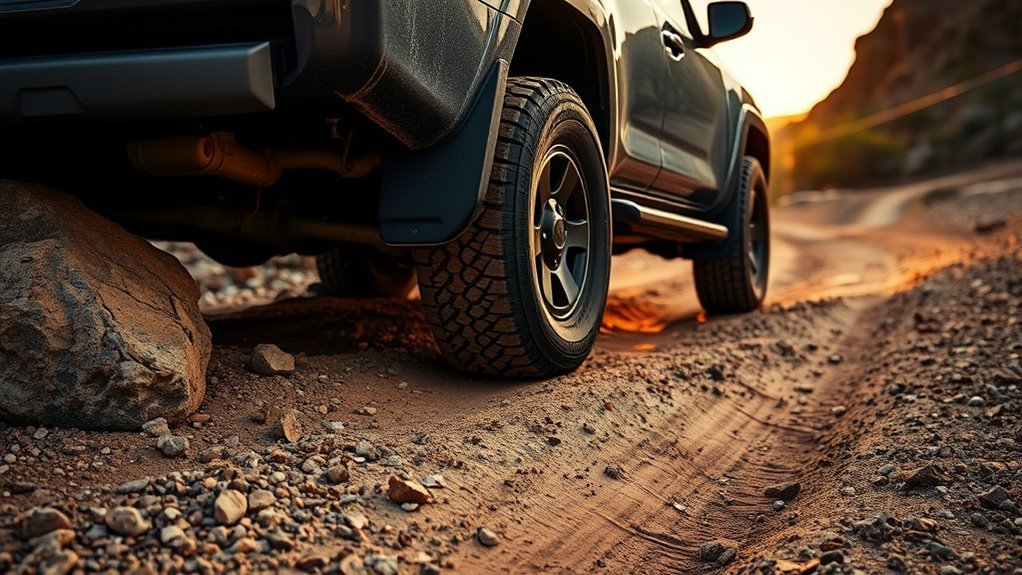
Having established the stock breakover baseline and its dependence on the mid-chassis fuel tank, the next question is when that geometry actually causes the 4Runner to hang up on a crest or peaked obstacle. You’ll see hang-ups when the apex angle of the obstacle exceeds the 19.8° breakover of the stock TRD Off-Road and the tank contacts the crest before the axles clear. Short wheelbase helps—your 4Runner clears some terrain challenges better than longer rigs—but the fuel tank remains the limiter.
- Test small hills to reproduce likely hang-up scenarios
- Note apex angle vs. 19.8° to predict contact points
- Consider underbody clearance at the fuel tank under articulation
- Observe wheel lift sequence to anticipate chassis grounding
- Use practical obstacle navigation drills to validate theory
You’ll gain liberation by understanding limits: predict hang-ups analytically, choose lines that reduce apex angle exposure, and rely on measured tests rather than guesswork.
How Lifts, Tire Size, and Clearance Change 4Runner Breakover (Quick Formulas)
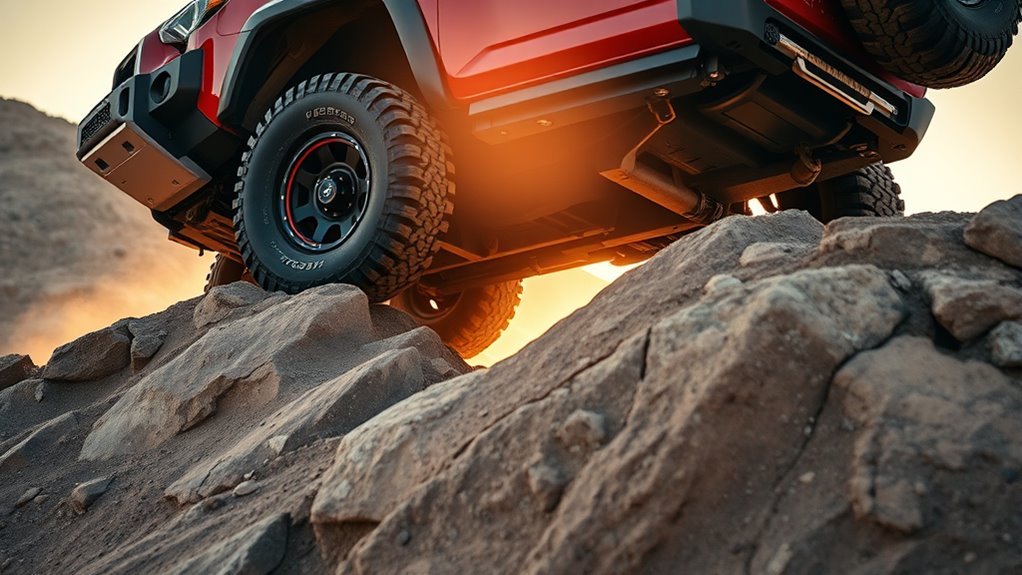
When you raise the 4Runner by 2 inches, its breakover improves from about 19.8° to roughly 20–22°, and you can estimate incremental gains from lifts, tire diameter, and clearance changes with simple geometry. Calculate breakover by modeling the vehicle as two contact points separated by wheelbase and a lowest midpoint clearance; an increase in ride height or tire radius directly increases that midpoint clearance. Use lift benefits and suspension upgrades to raise chassis height: add lift height to stock clearance and recompute arctan(2*clearance/wheelbase) to get new breakover. Account for tire impact by adding half the change in tire diameter to clearance; moving from stock to 33-inch tires yields measurable angle gains. For clearance calculations, identify the lowest point (fuel tank/air dam) and use its vertical change. A shorter wheelbase also increases breakover—use it in the denominator of the formula. Apply these quick formulas to quantify how specific mods free you from trail limitations.
Best Upgrades, Costs, and Tradeoffs to Improve Breakover
Now that you can quantify how lifts, tires, and clearance affect breakover, you can pick specific upgrades and weigh their costs and tradeoffs. You’ll prioritize tire selection and a modest lift kit first: larger tires (33-inch common) and a 2-inch lift reliably raise breakover a degree or two, with predictable cost and minimal handling penalty. Consider suspension upgrades (FOX, Old Man Emu) for sustained off road capability; they cost more but improve dampening and clearance together. Removing the air dam is a low-cost tweak that marginally boosts angle and approach. Wheelbase reduction yields the best pure breakover improvement but is rarely practical.
- Tire selection: size vs. weight tradeoff
- Lift kit: measured ground clearance gains
- Suspension upgrades: durability and damping
- Air dam removal: low-cost angle gain
- Wheelbase reduction: maximal benefit, high complexity
Do a strict cost analysis and balance performance tradeoffs against reliability and your liberation-focused mission.
Frequently Asked Questions
What Is the Breakover Angle of a Toyota 4runner?
About 19.8 degrees stock; with a 2-inch lift you’ll see roughly 20–22 degrees. You’ll improve off road performance by optimizing suspension design, letting you confidently clear obstacles and reclaim adventurous freedom.
Is a Higher or Lower Breakover Angle Better?
Higher’s better: you’ll gain breakover angle benefits for off road performance, letting you clear crests and obstacles without grounding. You’ll prioritize shorter wheelbase, added clearance or larger tires to maximize capability and preserve freedom.
What Is the Breakover Angle of the 2020 4runner?
You’ll get approximately a 19.8° breakover angle on the 2020 4Runner in stock 2020 specifications. That metric affects off road performance; modest improvement occurs with a 2-inch lift, aiding terrain liberation and clearance.
Conclusion
You now know how breakover angle affects your 4Runner, its stock limits, and when it’ll hang up — and by coincidence, the parts that fix it (lift, tires, skid) also change ride and budget in predictable ways. Apply the quick formulas to estimate gains before you buy, and weigh tradeoffs: more angle usually costs comfort and complexity. Upgrade strategically: aim for the smallest change that solves your trail problem without creating new ones.