
Last updated: July 31, 2026 — engine-number terminology, current U.S. Camry scope, source links, and technical inspection procedures reviewed.
Affiliate disclosure: As an Amazon Associate, AutoReviewNest earns from qualifying purchases. This does not affect our editorial independence or the price you pay.
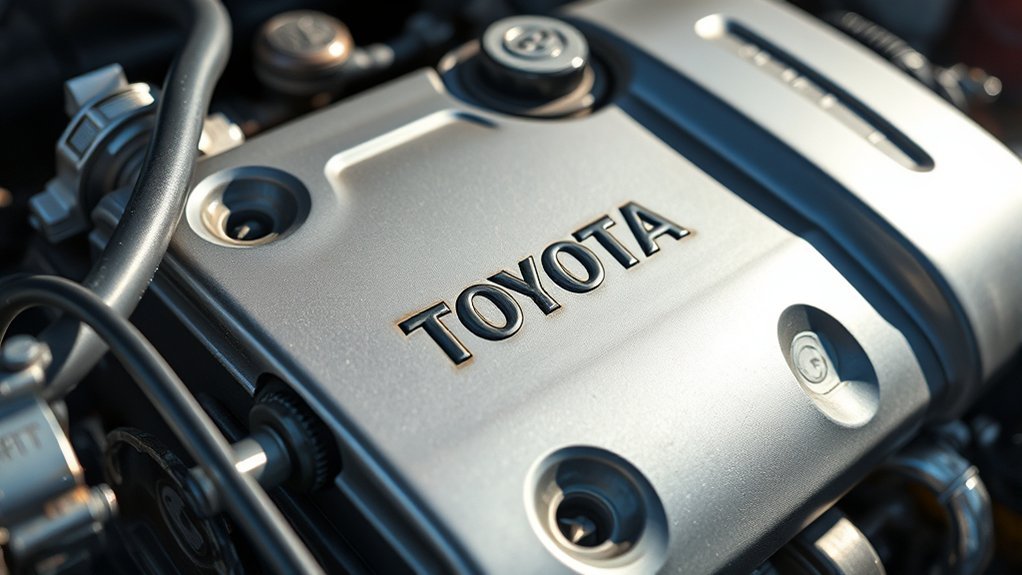
The Toyota Camry engine number is stamped directly onto a machined flat pad on the engine cylinder block, typically located near the mating flange where the engine joins the transmission transaxle. It is an individual 6- to 7-digit production serial number, completely distinct from the 17-character vehicle identification number (VIN), the generic engine model family code (such as 2AR-FE or A25A-FXS), or an onboard diagnostic (OBD-II) trouble code. Because the exact stamping position varies across Camry generations, engine sizes, and powertrain configurations, use the specifications diagram in your owner’s manual alongside the engine-specific physical guidelines below before inspecting the engine bay.
Quick Answer
Park on level ground, turn the ignition completely off (verify the hybrid “READY” light is off), and allow the engine to cool. Locate the machined pad on the cylinder block near the transaxle bellhousing seam. Shine a flashlight at a shallow 45-degree angle across the metal, gently clean dirt away using a nylon brush and solvent, and photograph the full stamped sequence. Do not confuse the stamp with a barcode sticker, casting part number, or VIN plate.
Key Takeaways
- Toyota defines the engine number as a physical production serial number stamped directly into the engine block metal casting.
- Toyota engine stampings typically feature a two-line layout: the engine family code on the upper line and the unique 6- to 7-digit serial number on the lower line.
- The engine model code (e.g., 2AR-FE, A25A-FKS) identifies the engine design family, whereas the engine serial number identifies that specific physical block.
- A VIN lookup confirms original factory assembly specs, but only inspecting the physical engine block stamp proves which engine is currently installed if a replacement occurred.
- For 2025 and 2026 U.S.-market Camrys, Toyota equips a 2.5L 4-cylinder hybrid powertrain (A25A-FXS) across all trim levels; non-hybrid gas options remain in select international markets.
At a Glance
| What You Need | The stamped physical engine serial number |
| Time Required | 5–10 minutes when unobstructed |
| Tools Needed | Owner’s manual, LED flashlight, clean cloth, soft nylon brush, smartphone camera, inspection mirror |
| Main Risk | Mistaking a 10-digit casting mark, VIN plate, emissions barcode, or OBD-II fault code for the engine serial number |
How Do You Find the Toyota Camry Engine Number?
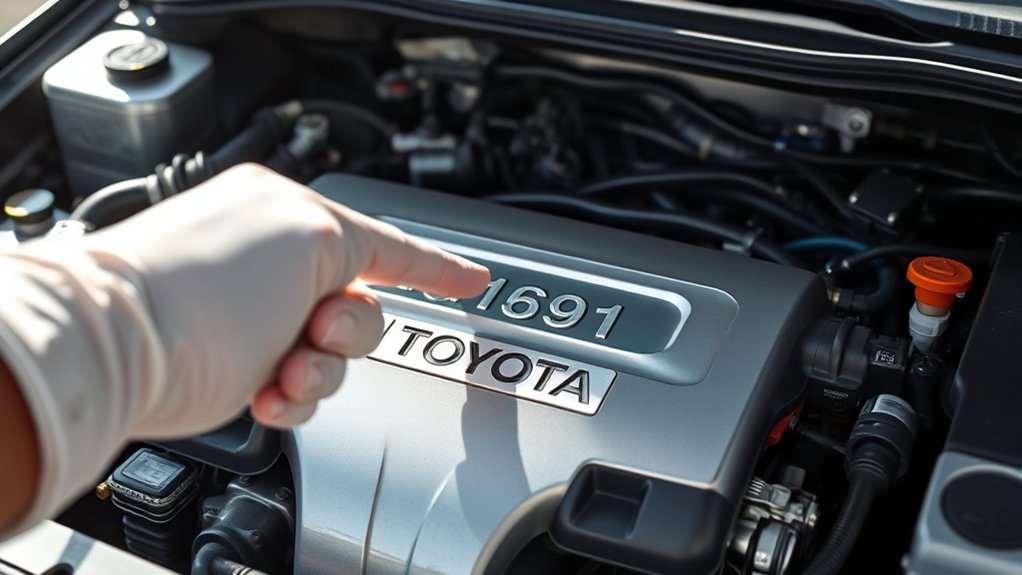
To find your Toyota Camry engine number, locate the machined flat pad stamped into the engine block casting near the transmission bellhousing mating flange. Position a bright flashlight at a shallow 45-degree angle across the metal to reveal shallow stamped characters, clean off road grime with a soft nylon brush, and photograph the entire sequence. This seven-step inspection procedure ensures an accurate reading while protecting the vehicle components.
- Identify the exact Camry specification. Note the model year, market of origin, trim level, and powertrain (gasoline or hybrid). If you are unsure of the engine family, verify the vehicle configuration via the VIN with an official Toyota owners portal.
- Open the vehicle manual specifications section. Check under Specifications, Vehicle Specifications, or Vehicle Identification for the official engine identification diagram showing the precise machined boss for your engine model.
- Power the vehicle fully off. Park on level ground, engage the emergency brake, and allow the engine bay to cool completely. On hybrid models, ensure the instrument cluster “READY” indicator is completely off and key fobs are kept away from the vehicle.
- Locate the engine block casting pad. Look below the cylinder head along the main engine block casting. Follow the manual diagram toward the machined flat surface located near the engine-to-transmission mating seam.
- Apply shallow side lighting. Hold your flashlight at an acute 30- to 45-degree angle. Side illumination casts distinct shadows inside shallow or dot-matrix stamped characters that wash out under direct overhead light.
- Clean the surface safely. Spray electrical contact cleaner or brake parts cleaner onto a cloth and gently wipe the pad with a soft nylon brush. Never use steel wire brushes, abrasive pads, or scrapers, which will permanently destroy shallow stamped numbers on aluminum blocks.
- Photograph and verify the stamping. Take high-resolution photos from multiple angles with camera flash disabled, transcribe every alphanumeric digit, and compare the result against your vehicle registration, title, or service paperwork.
Warning: Keep hands, clothing, and tools clear of hot exhaust manifolds, drive belts, pulleys, and electric cooling fans. On hybrid Camrys, never touch bright orange high-voltage wiring, inverter casings, or hybrid drive components. Confirm the vehicle is fully powered down, not resting in silent READY mode.
Where Is the Engine Number Located on Different Camry Engines?
While every engine number is located on the main engine cylinder block, the exact viewing angle, access corridor, and mounting pad change across Camry generations and cylinder configurations. Transverse four-cylinder engines place the stamp on an accessible front or side boss, whereas transverse V6 engines place the stamp in tighter clearance zones requiring an inspection mirror. Use this technical reference guide alongside your owner’s manual diagram.
| Camry Era / Engine Family | Engine Codes | Exact Physical Location & Search Method |
|---|---|---|
| Earlier 4-Cylinder Models | 5S-FE (2.2L), 2AZ-FE (2.4L) | Located on the lower front/side of the cylinder block casting, adjacent to the engine-to-transaxle bellhousing split line. Often visible from above between the radiator and engine block. |
| Later Gas 4-Cylinder Models | 2AR-FE (2.5L), A25A-FKS (2.5L Dynamic Force) | Stamped on a machined vertical pad on the cylinder block near the transaxle mating flange. On 2AR-FE, look near the front-left quadrant; on A25A-FKS, check the rearward block face near the bellhousing seam. |
| V6 Camry Models | 1MZ-FE / 3MZ-FE (3.0L/3.3L), 2GR-FE / 2GR-FKS (3.5L) | Located on the cylinder block casting near the rear cylinder bank (Bank 1) where the block mates to the transaxle. Tight access requires an LED inspection mirror or flexible borescope from above. |
| Hybrid Camry Powertrains | 2AZ-FXE, 2AR-FXE, A25A-FXS | Stamped on the internal combustion engine block casting near the transaxle interface. Power off completely, avoid orange high-voltage cables, and follow the hybrid manual diagram. |
| 2025–2026 U.S. Camry Lineup | 2.5L Hybrid (A25A-FXS + THS 5) | Stamped on the cylinder block of the 2.5L Atkinson-cycle gas engine. The U.S. lineup is exclusively hybrid; inspect the block pad near the transaxle joint under proper side lighting. |
If the stamping is obscured by an intake duct, wiring harness bracket, or engine beauty cover, do not forcefully pry components. Review the vehicle’s technical service procedures or visit the official Toyota Manuals and Warranties portal to inspect high-resolution engine bay diagrams for your model year.
What Is the Difference Between the Engine Number, Engine Code, VIN, and OBD Code?
Automotive identification numbers serve distinct tracking, diagnostic, and legal functions. Recording the wrong identifier can lead to incorrect replacement parts, rejected vehicle registrations, or failed import inspections.
| Identifier | What It Identifies | Where You Find It |
|---|---|---|
| Engine Number / Serial Number | The individual physical engine block assembly | Stamped directly into the metal of the engine cylinder block |
| Engine Model Code | The engineering family, displacement, and design series (e.g., 2AR-FE) | Owner’s manual, under-hood emissions label, dealer build sheets |
| VIN (Vehicle Identification Number) | The complete motor vehicle as manufactured | Driver-side dash plate, door jamb certification label, title documents |
| OBD Diagnostic Trouble Code | An active or stored electronic system fault code (e.g., P0300) | Retrieved from the vehicle’s OBD-II diagnostic port using an electronic scan tool |
The NHTSA VIN Decoder verifies factory-submitted vehicle build data from your 17-digit VIN. However, a VIN lookup cannot prove which physical engine block is currently fitted if the vehicle underwent an engine replacement. For a complete guide to all vehicle tags, review our guide on where to find the Toyota Camry VIN.
Common Camry Engine Model Codes
Camry engine model codes specify the mechanical family, valvetrain architecture, and fuel delivery system. Always confirm the complete alphanumeric suffix before purchasing powertrain components.
| Engine Model Code | Camry Application & Era | Key Identification Note |
|---|---|---|
| 5S-FE | 2.2L 4-Cylinder (1992–2001 Camry) | Cast iron block; do not confuse casting numbers with the stamped serial number. |
| 2AZ-FE | 2.4L 4-Cylinder (2002–2011 Camry) | Aluminum block; hybrid versions use the Atkinson-cycle 2AZ-FXE code. |
| 2AR-FE | 2.5L 4-Cylinder (2012–2017 Camry) | Distinct from the hybrid 2AR-FXE; shares no interchangeable serial records. |
| A25A-FKS | 2.5L Dynamic Force Gas (2018–2024 Camry) | Features D-4S direct and port injection; distinct block pad from earlier 2AR engines. |
| A25A-FXS | 2.5L Dynamic Force Hybrid (2018–2026 Camry) | Powers all 2025–2026 U.S. Camrys; Atkinson-cycle combustion design. |
| 1MZ-FE / 3MZ-FE | 3.0L / 3.3L V6 (1994–2006 Camry) | Timing belt valvetrain architecture; stamp is located on the rear block quadrant. |
| 2GR-FE / 2GR-FKS | 3.5L V6 (2007–2024 Camry) | Timing chain V6; 2GR-FKS uses D-4S direct injection. Suffix denotes unique internal components. |
For an in-depth technical comparison of four-cylinder and V6 designs, review our Camry engine-code guide. For generation-by-generation powertrain specifications, explore our guide to Toyota Camry engines by model year.
Current U.S. Specification: Toyota lists the 2025 and 2026 U.S. Camry exclusively with the fifth-generation Toyota Hybrid System (THS 5) paired with the 2.5L A25A-FXS four-cylinder engine. Output is rated at 225 net combined horsepower for front-wheel-drive models and 232 net combined horsepower for electronic on-demand all-wheel-drive models.
What Should a Toyota Camry Engine Number Look Like?
Toyota engine serial numbers do not follow a generic automotive standard. On most modern Camry engines, Toyota uses a distinct two-line mechanical or dot-matrix stamping format directly in the aluminum or iron block metal:
- Standard two-line format: The upper line typically displays the engine family model designation (e.g.,
2AR,A25A, or2GR), while the lower line displays the unique 6- to 7-digit production serial number (e.g.,1234567). - Impressed metal characters: The genuine engine number is stamped, dot-matrix punched, or laser-etched directly into the bare casting metal. A paper barcode sticker, plastic tag, or valve cover label is not an engine serial number.
- Distinguish from casting part numbers: Raised metal numbers cast directly into the mold (frequently starting with
11101or11401) are rough casting part numbers, not your unique serial number. - Avoid character misreading: Shallow stampings can cause confusion between
0andO,1andI,5andS, or8andB. Always cross-verify using side lighting and high-contrast digital photos. - Preserve surface integrity: Document the original condition with a photograph prior to wiping away grime during pre-purchase or import inspections.
Pro Tip: When photographing the stamping with your smartphone, manually lower the exposure slider in your camera app. Slightly underexposing the image deepens the shadows inside the stamped grooves, making faint characters significantly easier to read.
Can the Engine Number Confirm Parts Fit or Service History?
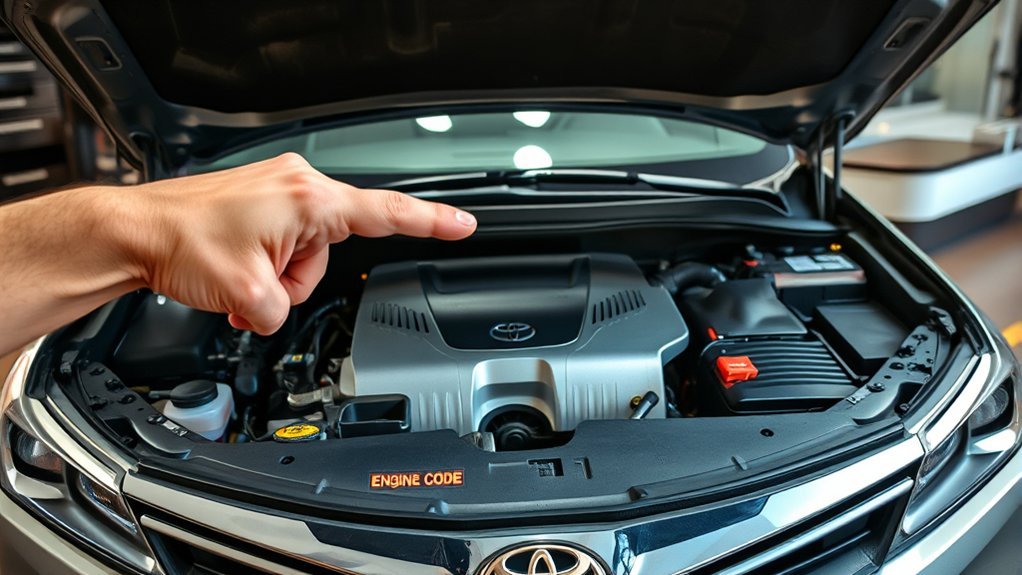
The stamped engine serial number provides physical proof of the engine block currently installed in your car. However, ordering replacement parts or verifying maintenance intervals requires combining the serial number with the VIN and engine model code.
- Parts ordering: Always begin with the 17-digit VIN and full engine model code (e.g., A25A-FKS). Use the physical engine serial number when ordering internal block components (bearings, pistons, crankshafts) that have mid-year production cutoff dates.
- Verifying replacement engines: If a used Camry has undergone an engine replacement, the physical engine number will differ from original factory build sheets. Comparing the physical stamp against original invoices confirms whether an OEM-spec replacement was installed.
- Used-car pre-purchase inspections: Verify that the stamped pad shows clean factory machining without grind marks, restamped characters, or welded metal that could indicate tampering or stolen components.
- Official registration and export/import: Many international licensing bodies (such as in Australia, the UK, and parts of Asia and Europe) legally require the physical engine serial number on registration and import compliance certificates.
- Routine maintenance schedules: Fluid capacities, spark plug gaps, and oil viscosities are governed by the engine model code and model year in your owner’s manual, not by the individual serial number.
Use the VIN to identify the vehicle chassis, the engine model code to identify the powertrain design family, and the stamped engine number to verify the physical engine block.
[Products Worth Considering]

This emergency tire repair kit helps you quickly fix tubeless punctures without removing the tire from the rim. It includes multiple screw sizes and sealant glue for a tight, reliable seal, making it a practical solution for roadside emergencies, travel, and everyday vehicle maintenance. Compact and easy to use, it is suitable for a wide range of vehicles, including cars, motorcycles, trucks, and ATVs.

This digital tire tread depth gauge helps you check tire wear quickly and accurately with fractional inch, decimal inch, and millimeter readouts. Its large LCD screen, zero reset function, and automatic shutoff make it easy to use for cars, motorcycles, SUVs, trucks, and pickups. Designed for clear readings and dependable measurement, it is a practical tool for routine tire safety checks.

The XINDELL Interior Windshield Cleaner Tool makes it easy to clean car glass inside and out with an extendable handle and 180° pivoting head for better reach and streak-free results. Designed for auto detailing and home windows, it includes reusable microfiber pads and a wash sponge for dry or wet cleaning, helping remove dust, fog, grime, and smudges with less effort.
Can You Find the Toyota Camry Engine Number From the VIN?
A VIN decoder cannot reveal the physical engine serial number of the engine currently under your hood. A standard VIN identifies vehicle-level build specifications (model year, manufacturing plant, body style, and engine family), but does not publicly decode the individual engine serial number. Furthermore, if a previous owner replaced the engine, the VIN will still reflect the original assembly line configuration.
- Consult official Toyota owner resources: Enter your VIN into the Toyota Owners Portal to download the exact owner’s manual and factory specifications for your vehicle.
- Request factory build records: An authorized Toyota dealership service department can look up your VIN within the internal Toyota Information System (TIS) to retrieve the original factory build sheet, which records the exact engine serial number installed at the factory.
- Inspect the physical cylinder block stamp: Physically check the machined pad on the block to confirm that the installed engine matches factory build documentation.
- Review historical service records: Check dealership maintenance invoices, warranty engine replacement paperwork, or vehicle history reports for recorded engine serial changes.
- Consult an authorized inspection station: If legal registration documents require engine verification and the stamp is inaccessible, have a licensed mechanic verify the number on a service lift.
Which Camry Details Should You Record Before Buying Parts?
Broad descriptions such as “2020 Camry 2.5L” are often insufficient for ordering engine, ignition, cooling, or emissions components. Record the following technical parameters before purchasing parts:
- Model year and target market: Emissions standards and powertrain tunings differ between North American, European, Japanese, and Australian models.
- Full 17-character VIN: Provides the exact vehicle production cutoff date and chassis platform code.
- Drivetrain configuration: Note whether the car is front-wheel drive (FWD) or electronic all-wheel drive (AWD), and gas-only or hybrid.
- Full engine model code with suffix: Distinguish carefully between codes such as 2AR-FE and 2AR-FXE, or A25A-FKS and A25A-FXS.
- Physical stamped engine number: Photograph the block stamping whenever ordering internal engine internals or submitting state registration paperwork.
- Build date on door jamb label: Identifies month/year production transitions where internal parts revisions occurred mid-model-year.
For fluid capacities, refer to our Camry oil-capacity guide, or explore our Camry engine timeline for generation-by-generation powertrain breakdowns.
[Products Worth Considering]

This 23-piece oil filter cap wrench set is designed to make oil filter removal faster, safer, and more efficient across a wide range of vehicle applications. The socket-style grip helps reduce the risk of crushing filters, while the included adapter and storage case make it a practical, organized choice for maintenance work. Built from lightweight aluminum alloy, this professional tool kit offers durable performance for routine automotive service.

AUTOBOO windshield wiper blades are designed for dependable all-season visibility with smooth, streak-free wiping in rain, snow, and heat. The bracketless aerodynamic design helps reduce noise and drag while the memory spring steel structure delivers even pressure for consistent windshield contact. Built for quick installation on compatible U/J hook arms, these blades offer a quiet, reliable upgrade for everyday driving.

Fitment: 2018-2024 Camry 4 Door Sedan , 2018-2026 Camry Hybrid 4 Door Sedan , (Only fit US Built Engine, Vin Number doesn't start with "J" )
What If the Engine Number Is Hidden, Unreadable, or Does Not Match?
If you encounter difficulty finding or reading the engine serial number, follow non-destructive inspection practices. Never grind or aggressively alter engine block surfaces.
[Products Worth Considering]

Rectangular Mirror Size:2.5"*1.7" Extended Length: 34" Collapsed Length: 7.5"

Easily Maneuver Your View: Tired of struggling with hard-to-reach areas during inspections? This two-way articulating borescope effortlessly navigates tight and complex spaces with its flexible and maneuverable probe. Enjoy crystal-clear visual feedback that saves you both time and money. Whether for automotive maintenance or household inspections, this tool transforms your inspection journey, making the process faster and easier than ever.

Comfortable design: the small observation mirror contains a metal frame design, which can be clipped in a shirt pocket when not in use or needs to be carried; It is not only lightweight and convenient, but also can be applied as an ornament; The grooved buffer handle provides a comfortable and tension-free holding experience, allowing You can easily check and adjust makeup
Common Engine Identification Issues
- Heavy oil or road grime buildup: Spray the pad with electrical contact cleaner or brake parts cleaner and scrub gently using a soft nylon brush. Avoid steel wire wheels or sandpaper that will erase shallow stamped grooves on aluminum castings.
- Faint or shallow dot-matrix characters: Illuminate the pad from a shallow side angle using an LED flashlight. Take high-resolution photos and increase contrast or lower exposure in a photo editor.
- View obstructed by cooling hoses or wiring: Do not disconnect pressurized coolant hoses or electrical harnesses. Use an articulated mechanics inspection mirror or a flexible USB borescope camera.
- Mistaking casting marks for the serial number: Verify that the characters are stamped into a flat machined boss. Raised casting marks represent foundry mold numbers, not individual serial numbers.
- Physical number does not match vehicle paperwork: Verify whether your paperwork lists the complete VIN or an engine model code rather than the serial number. If a discrepancy exists, request previous maintenance records to check for a documented replacement engine.
- Suspicious or altered stamping pad: If the pad exhibits grinder marks, uneven re-stamped fonts, or missing metal, photograph the area immediately and consult a certified vehicle inspection authority or Toyota dealership.
Which Tools Help?
| Inspection Tool | Primary Practical Benefit | Tool Limitation |
|---|---|---|
| LED Flashlight | Casts shallow directional shadows across stamped characters | Cannot locate obscured pads without an accurate manual diagram |
| Smartphone Camera | Enables digital zooming, exposure control, and image archiving | Direct flash causes severe glare on reflective bare metal |
| Inspection Mirror / Borescope | Accesses tight corridors behind V6 cylinder banks and transaxle seams | Mirrored images reverse character orientation; check orientation |
| OBD-II Diagnostic Scanner | Reads electronic control module fault codes, live sensor data, and VIN | Cannot electronically read the mechanical engine serial number |
| Toyota Dealership TIS Lookup | Retrieves original assembly plant engine serial records from the VIN | Does not reflect aftermarket or undocumented engine replacements |
What Should You Do About an Identification Error?
If an official title, registration, or purchase agreement contains an inaccurate engine number, gather your photographic evidence. Take high-resolution photographs of the VIN plate, emissions certification label, and the stamped engine block pad. Contact your local motor vehicle agency or dealership to initiate a formal document correction. Never restamp or mechanically alter the engine block surface.
When Should a Dealer or Mechanic Locate the Number?
Professional inspection is strongly recommended when the stamping cannot be reached safely from above, official import or registration compliance requires a certified inspection, or access requires raising the vehicle on a hydraulic lift.
- Authorized Toyota service center: Recommended when you need factory build-sheet verification tied directly to your VIN.
- Certified independent mechanic: Recommended when accessing the pad requires safely inspecting the lower engine block on a hydraulic service lift.
- Government inspection station: Required when resolving legal title discrepancies, vehicle identification verifications, or customs import clearances.
- Cease DIY inspection immediately: If reaching the pad requires working near high-voltage hybrid wiring, hot exhaust pipes, or unshielded moving drive components.
Does an Oil Change Reveal the Engine Number?
No. Oil change windshield stickers, lube invoices, and oil filter packaging list only the recommended oil viscosity (e.g., 0W-16 or 0W-20), fluid capacity, and occasionally the engine model code. They do not record the individual stamped engine serial number.
Can Coolant or Emissions Labels Identify the Engine?
Under-hood Vehicle Emission Control Information (VECI) labels identify the engine displacement, engine family group, and evaporative emissions standards. They are valuable for verifying the engine family, but they do not feature the stamped serial number.
Can the Timing Belt or Chain Tell You the Engine Code?
Visual inspection of the timing cover indicates whether the engine utilizes a timing belt (such as older 1MZ-FE V6s) or a timing chain (such as 2AR-FE, 2GR-FE, and A25A series engines), but it cannot provide the engine code or serial number. Use the VIN and cylinder block stamp for precise identification.
What Is Different on a Hybrid Camry?
Hybrid Camry models utilize internal combustion gasoline engines that have standard stamped serial numbers on the cylinder block. However, the engine compartment also houses high-voltage wiring, an electric inverter/converter, and transaxle motor-generators. Inspecting the engine serial number does not require contacting any orange cables or electrical enclosures. Under standard warranty terms, Toyota provides a 10-year or 150,000-mile hybrid battery warranty on qualifying model year 2020 and newer hybrid vehicles in the United States.
Hybrid Safety Protocol: The internal combustion engine in a hybrid Camry can start unexpectedly if the ignition is in READY mode. Always power the vehicle completely off, verify the instrument cluster READY light is off, and store the key fob outside the vehicle before inspecting the engine bay.
What Can the Engine Number Tell You, and What Can It Not Tell You?
The stamped engine serial number verifies the individual identity of the engine block assembly, confirms whether the engine matches original factory records, and supports accurate title registration and warranty tracking.
The engine serial number cannot indicate internal mechanical health, compression levels, maintenance history, or diagnostic fault codes. When purchasing a used Camry, pair physical engine number verification with an OBD-II diagnostic scan, oil condition check, cylinder compression test, and a comprehensive vehicle history report.
Frequently Asked Questions
Where is the engine number located on a Toyota Camry?
It is stamped directly on a machined flat pad on the engine cylinder block, typically near the mating seam where the engine connects to the transmission transaxle. The exact viewing position varies by engine family and model year; consult your owner’s manual specifications diagram for the exact illustration.
Is the Toyota Camry engine number the same as the VIN?
No. The 17-digit VIN identifies the complete vehicle chassis and assembly build. The engine number is a separate 6- to 7-digit serial number stamped directly into the engine block casting to identify that specific physical engine.
Can I get the engine number from the VIN?
A standard public VIN decoder cannot display the engine serial number. However, an authorized Toyota dealership service department can retrieve the original factory-installed engine serial number from internal factory build sheets using your VIN. Inspecting the physical block stamp remains necessary to verify that the original engine has not been replaced.
Where do I find the Toyota Camry engine model code?
The engine model code (such as 2AR-FE, A25A-FKS, A25A-FXS, 2GR-FE, or 2GR-FKS) is printed in the owner’s manual, on the under-hood emissions certification (VECI) label, and stamped on the upper line of the cylinder block identification pad.
Can an OBD-II scanner show the stamped engine number?
No. An OBD-II scan tool communicates with electronic control modules to read diagnostic trouble codes, sensor data, and the programmed VIN. It cannot read the mechanical serial number stamped into the metal engine block.
What should I do if the engine number is unreadable or does not match?
Clean the pad gently using a solvent cleaner and a soft nylon brush, avoiding abrasive wire wheels. Illuminate the pad at a shallow side angle and take high-resolution photos. If the number does not match your title or registration paperwork, verify previous maintenance records for documented engine replacements and consult an authorized Toyota dealer or certified inspection authority.
Conclusion
Locating your Toyota Camry engine number requires identifying the machined stamping pad on the cylinder block casting, typically positioned near the transmission bellhousing interface. Always utilize directional side lighting and non-abrasive cleaning methods to document the characters accurately. Keep the physical engine serial number distinct from the VIN, engine model family code, and OBD fault codes when ordering replacement engine components or submitting official registration documentation.
Sources
- Toyota Support: Where do I find my engine number? — official confirmation that Toyota engine numbers are stamped on the engine cylinder block and vary by engine series.
- Toyota Manuals and Warranties — factory owner’s manuals and mechanical specifications for North American Toyota vehicles.
- 2025 Toyota Camry Hybrid Vehicle Specifications — official owner’s manual specifications covering the current-generation A25A-FXS powertrain.
- Toyota USA Newsroom: 2026 Camry — verifies the hybrid-exclusive U.S. powertrain lineup and 225/232 horsepower ratings.
- NHTSA VIN Decoder — official National Highway Traffic Safety Administration VIN decoding portal.
- Toyota Hybrid Battery Warranty — factory warranty coverage details for Toyota hybrid components.



[…] the engine through Toyota service information or a VIN-based parts catalog. The site’s Camry engine-code location guide explains where to start when the engine designation is […]