Last updated: July 14, 2026
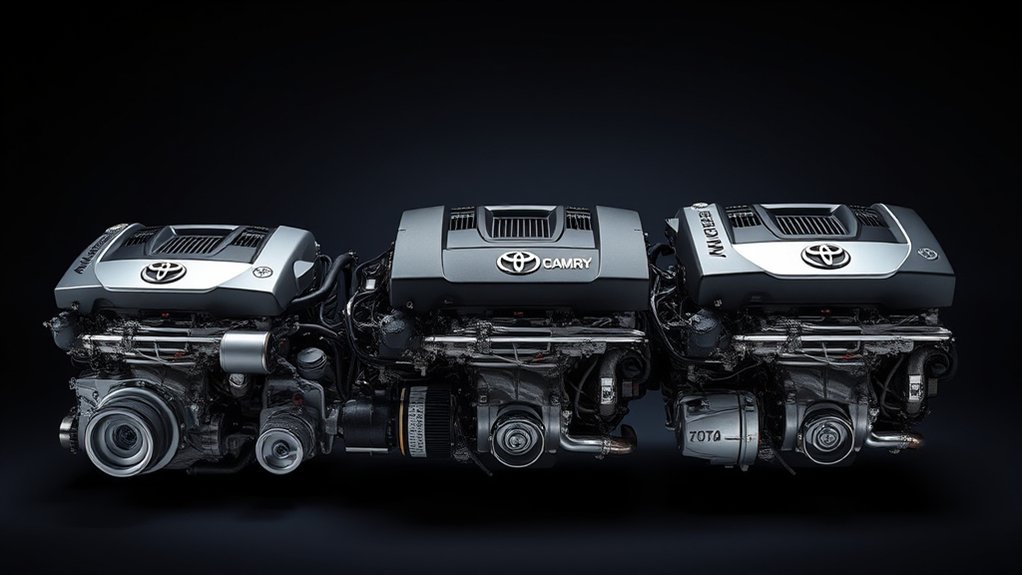
Toyota Camry engine options by model year progressed from four-cylinder gas and diesel engines to optional V6 power, then to a hybrid-only U.S. lineup for 2025 and 2026. Toyota introduced V6 power during the 1987-1991 generation and launched the first U.S. Camry Hybrid for the 2007 model year. The 2018-2024 Camry reached 301 horsepower with its 3.5L V6, while current U.S. models use a 2.5L hybrid system.
This guide focuses on major U.S.-market powertrain changes from 1983 onward. Toyota’s Japanese-market history is used only to explain the standalone Camry’s March 1982 launch. Engine availability can differ by country, trim, drivetrain, and production date.
Quick Answer
The Camry began with small four-cylinder engines, gained its first available V6 during the 1987-1991 generation, and added a hybrid for the 2007 model year. The 2025 and 2026 U.S. Camry use a 2.5L hybrid system on every trim, producing 225 net combined horsepower with front-wheel drive or 232 horsepower with all-wheel drive.
Key Takeaways
- The standalone Camry launched in Japan in March 1982 with a 1.8L four-cylinder engine.
- Toyota first offered a Camry V6 during the 1987-1991 generation.
- The first U.S. Camry Hybrid arrived for the 2007 model year.
- The 2018-2024 Camry offered the strongest U.S. V6, rated at 301 horsepower.
- The 2025 and 2026 U.S. Camry lineup uses hybrid power across every trim.
Toyota Camry Engine Options by Model Year
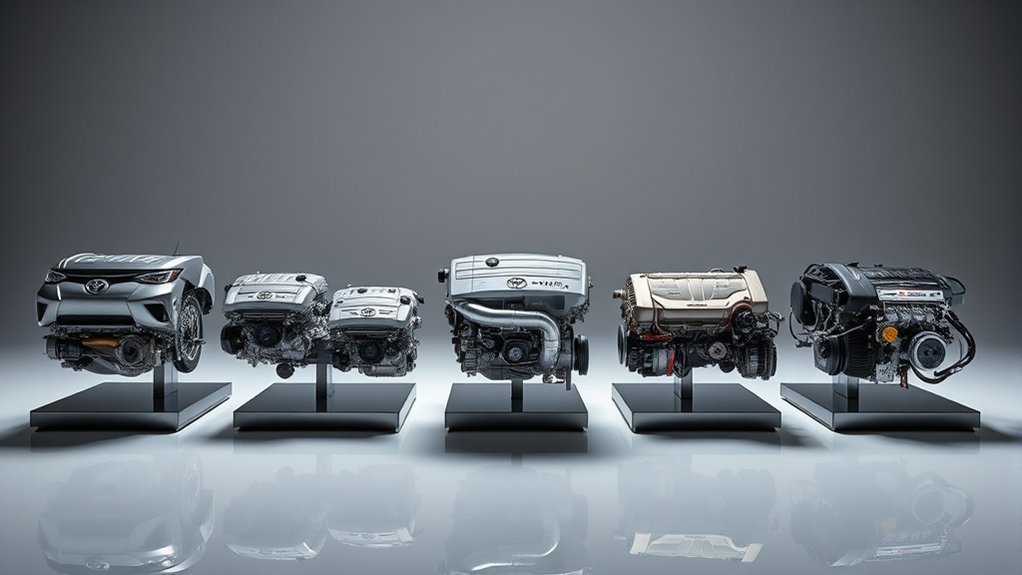
Toyota Global lists the March 1982 Japanese-market Camry with a representative 1.8L inline-four engine rated at 100 PS. Toyota added a 2.0L fuel-injected engine later in 1982, a 1.8L turbo diesel in 1983, and a 2.0L twin-cam engine rated at 160 PS in 1984.
The U.S. Camry arrived for the 1983 model year and followed a different engine path from some overseas versions. Over time, Toyota expanded the lineup from basic four-cylinder power to V6 and hybrid choices. The table below highlights major milestones rather than every engine sold in every country.
For engine-family details on later used models, see the Camry engine-code guide.
[Products Worth Considering]

KAX CA12377 Premium Engine Air Filter is designed as a replacement for select Toyota and Lexus vehicles, helping keep harmful particles out of the engine while supporting steady airflow. Its high-efficiency filtration and longer service life can help improve acceleration, maintain consistent performance, and support better fuel economy. Built for broad vehicle coverage, it offers dependable protection for everyday driving and extended maintenance intervals.

KAX CA12377 engine air filter is designed as a replacement for select Toyota and Lexus vehicles, helping deliver cleaner airflow to the engine for smoother operation and maintained performance. Its resin-impregnated fiber paper media and 3-layer composite construction are engineered to meet or exceed OE air filter requirements with low resistance and high efficiency. Built for dependable fit and recommended periodic replacement, it supports long-term engine protection across a wide range of compatible models.

This engine air filter is designed to fit select Lexus and Toyota hybrid models, helping maintain clean airflow to the engine for reliable performance. Built with high-fiber filter paper and a fine filtration layer, it offers strong dust capture while minimizing airflow resistance. It is a direct replacement for multiple OEM part numbers and is backed by warranty support.
When Did the Toyota Camry First Get a V6?
Toyota says a V6 became available for the first time during the 1987-1991 Camry generation. In the United States and Canada, the V6 also replaced the earlier diesel option. This gave buyers a clearer choice between lower-cost four-cylinder power and smoother six-cylinder performance.
For the 1992 redesign, the U.S. Camry offered a 2.2L four-cylinder and a 3.0L V6. Later models continued this two-level approach, although engine sizes, outputs, and trim availability changed within each generation.
The V6 remained an option on selected trims rather than becoming standard across most Camry models. Four-cylinder engines continued to serve as the volume choice for drivers focused on fuel economy and everyday use.
Toyota Camry Engine Timeline by Generation
This timeline covers the most important engine changes. Check the exact trim, drivetrain, market, and VIN before using it to identify a specific vehicle.
| Era | Main Engine Change | Why It Mattered |
|---|---|---|
| 1982-1986 Global/Japan launch |
1.8L and 2.0L gas four-cylinders, a turbo diesel, and a sport twin-cam option | Toyota established the standalone front-wheel-drive Camry and expanded its early engine range. |
| 1987-1991 North America |
The first available Camry V6 joined the four-cylinder lineup. | The V6 replaced the diesel option in the U.S. and Canada and added a stronger performance choice. |
| 1992-2006 U.S. |
Four-cylinder and V6 options continued, including a 2.2L four and 3.0L V6 in the 1992 redesign. | The Camry settled into its long-running economy-versus-power engine strategy. |
| 2007-2011 U.S. |
First Camry Hybrid, a 268 hp 3.5L V6, and a new 2.5L four-cylinder for 2010 | Toyota added hybrid efficiency while giving the V6 a major power increase. |
| 2012-2017 U.S. |
178 hp 2.5L four-cylinder, 268 hp 3.5L V6, and 200 hp hybrid system | Buyers could choose among economy, V6 performance, and hybrid fuel savings in one generation. |
| 2018-2024 U.S. |
203/206 hp 2.5L four-cylinder, 301 hp 3.5L V6, and a 2.5L hybrid | The Camry reached its highest-output production V6 era before the option ended after 2024. |
| 2025-2026 U.S. |
Hybrid-only 2.5L lineup with 225 hp FWD or 232 hp AWD | Toyota replaced separate gas, V6, and hybrid choices with one electrified powertrain family. |
How Did Camry V6 Performance Change?
The Camry’s 3.5L V6 became a major performance step during the 2007-2011 generation. Toyota rated the 2011 version at 268 horsepower and 248 lb-ft of torque. A six-speed automatic transmission was standard with that engine.
The 2012 redesign retained the 268 horsepower V6 while raising the standard 2.5L four-cylinder to 178 horsepower. Toyota also rated the revised hybrid system at 200 combined horsepower, giving buyers three distinct powertrain levels through the 2012-2017 era.
The 2018 redesign raised the 2.5L four-cylinder to 203 horsepower, or 206 horsepower in the XSE, and increased the 3.5L V6 to 301 horsepower. Toyota paired both gas engines with an eight-speed automatic transmission. These figures are listed in Toyota Canada’s 2018 Camry release.
The 2024 Toyota Camry still offered the 301 horsepower 3.5L V6, including the TRD trim. Because the 2025 lineup became exclusively hybrid, 2024 was the final U.S. Camry model year with a V6.
[Products Worth Considering]

KAX CA10741 is a premium engine air filter designed to help maintain clean airflow for compatible Toyota and Lexus vehicles. It offers extended service life, strong filtration efficiency, and dependable protection for critical engine components while supporting smoother performance and fuel economy. The rectangular, box-packaged filter is built for easy replacement in supported models.
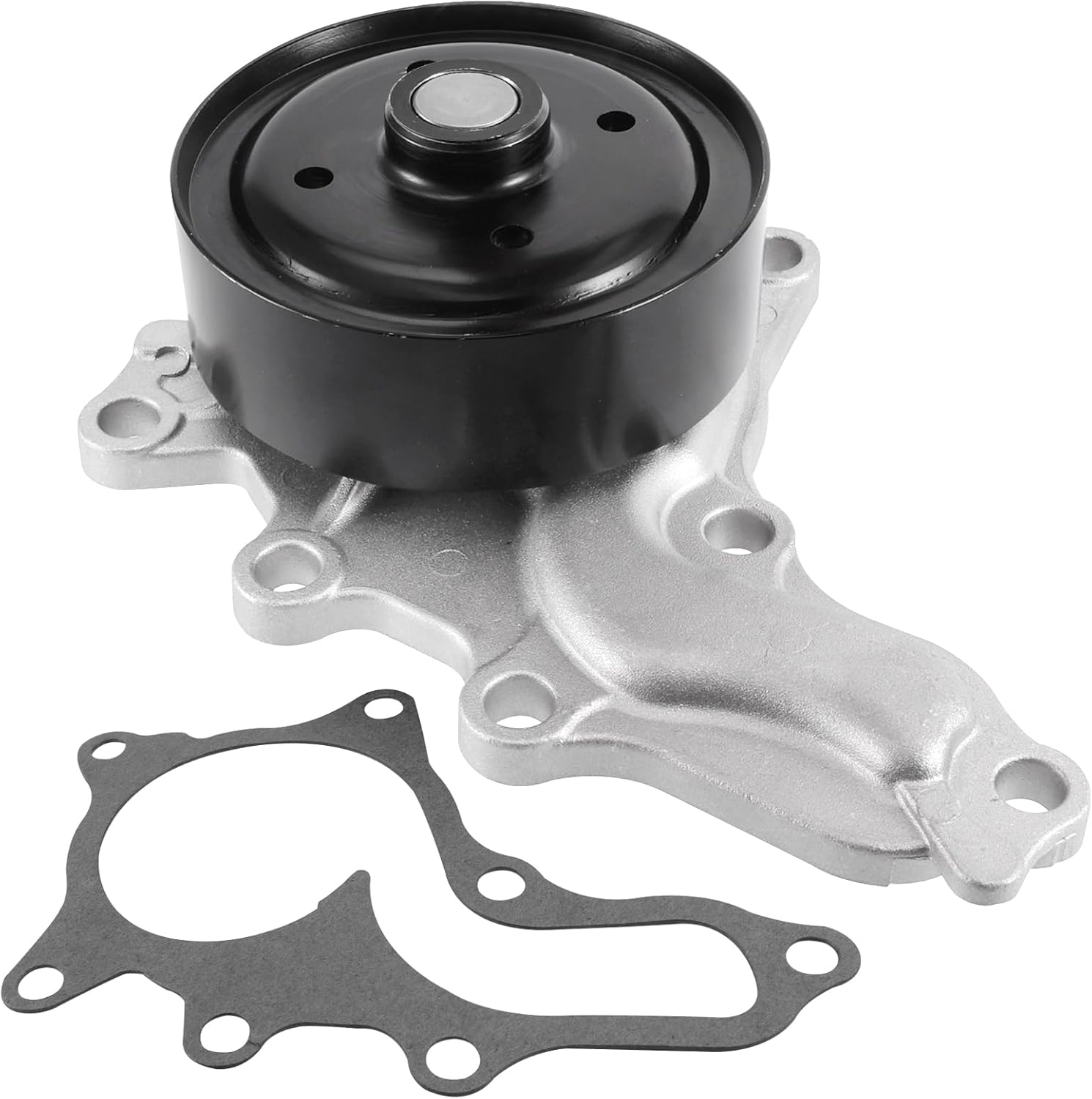
This AW6252 water pump is designed for a wide range of Toyota, Scion, and Lexus applications, helping maintain reliable engine cooling across compatible models. It features case hardened bearings for durability, a graphite-impregnated gasket for a secure seal, and 100% function and leakage testing for dependable performance. Built in TS16949 certified facilities, it offers a strong replacement option backed by service support.

Compatible with Toyota Camry V6 (2007-2011), Avalon (2005-2012), Corolla XRS (2009-2013), Matrix 2.4L (2009-2013), Venza V6 (2009-2016), RAV4 (2006-2012, Gas only)
When Did the Toyota Camry Hybrid Arrive?
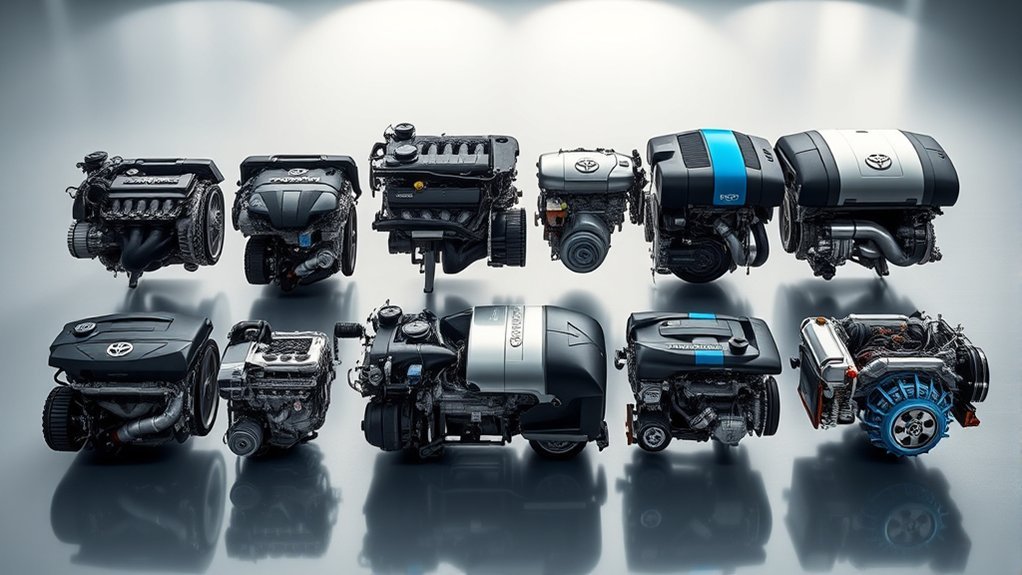
Toyota introduced the first U.S. Camry Hybrid for the 2007 model year. Toyota says the model was first offered in 2006 with a 2.4L Atkinson-cycle four-cylinder engine, an electric motor, a hybrid battery, and an electronically controlled continuously variable transmission.
For 2012, Toyota replaced the original hybrid gasoline engine with a 2.5L Atkinson-cycle four-cylinder and raised combined system output to 200 horsepower. Toyota estimated the 2012 Camry Hybrid LE at 41 mpg combined when the redesigned model launched.
Hybrid efficiency improved again in later generations. FuelEconomy.gov rates the front-wheel-drive 2022 Camry Hybrid LE at 52 mpg combined, 51 mpg city, and 53 mpg highway. Other 2022 Camry Hybrid trims have different ratings.
For 2025, Toyota paired its fifth-generation Toyota Hybrid System with a 2.5L four-cylinder engine across the entire U.S. Camry lineup. This change ended the separate gas-only four-cylinder and V6 options.
What Do the 2025 and 2026 Camry Engine Lineups Offer?
The 2025 and 2026 U.S. Camry use a hybrid powertrain on every trim. Front-wheel-drive models produce 225 net combined horsepower. All-wheel-drive models add a rear electric motor and produce 232 net combined horsepower.
Toyota lists an EPA-estimated rating of up to 51 mpg combined for the 2026 LE with front-wheel drive. Ratings decrease on some higher trims and all-wheel-drive versions, so compare the exact configuration rather than applying the LE figure to every Camry.
The current Camry remains a conventional, self-charging hybrid rather than a plug-in hybrid. Electric assistance supports acceleration, while regenerative braking and the gasoline engine recharge the traction battery during normal driving.
The hybrid system uses less fuel in EPA testing than older V6 Camrys, although your actual fuel cost depends on annual mileage, driving conditions, trim, and local fuel prices. Engine choices also vary outside the United States, so check your local Toyota market before comparing specifications.
[Products Worth Considering]

✅Batter dimensions: 10.75" L x 6.81" W x 8.98" H, Terminal: Tapered terminal (Left negative (-), Right positive (+)). ✅Please ensure to verify the dimensions and terminal position before making a purchase to guarantee compatibility with your vehicle to avoid any fitment issues.

OEM-Compatible Hybrid Battery Module - Specifically designed for Hybrid vehicles, ensuring a perfect fit and seamless integration.

Replacement Batteries for a 2007-2011 Toyota Camry and Camry Hybrid Smart Key with a low or dead battery.
How to Identify the Exact Engine in Your Camry
A model year does not always identify one Camry engine. Toyota often sold four-cylinder, V6, hybrid, front-wheel-drive, and all-wheel-drive versions during the same year.
- Confirm the market and model year. U.S., Canadian, Japanese, and other regional Camrys can use different engines.
- Check the trim and drivetrain. A Camry LE, XSE, TRD, Hybrid, FWD, or AWD model may have a different powertrain from another Camry built in the same year.
- Use the VIN in Toyota’s owner or dealer system. A manufacturer or dealer lookup can match the VIN to the original factory configuration.
- Compare the owner’s manual and emissions label. These identify the specifications and emissions family for the vehicle.
- Confirm the engine code when ordering parts. Use the 2AR-FE and 2GR-FE Camry engine guide for common later gas-engine examples.
Frequently Asked Questions
What Engines Do Toyota Camrys Have?
Toyota Camry engines have included inline-four gas engines, diesel engines in some early markets, V6 engines, and gas-electric hybrid powertrains. The 2025 and 2026 U.S. Camry use a 2.5L hybrid system across the lineup.
When Did the Toyota Camry First Get a V6?
Toyota says a V6 became available for the first time during the 1987-1991 Camry generation. In the United States and Canada, it replaced the previous diesel option.
When Did the Toyota Camry Hybrid Arrive?
The first U.S. Toyota Camry Hybrid was sold for the 2007 model year. Toyota says the hybrid was first offered in 2006.
Which Toyota Camrys Have a V6 Engine?
U.S. Camry models offered V6 power on selected trims from the late 1980s through the 2024 model year. The 2018-2024 generation used a 301 horsepower 3.5L V6 on trims including XLE, XSE, and TRD, depending on the year.
Did Toyota Discontinue the Camry V6?
Yes. The 2024 model year was the last U.S. Camry with an available V6. Toyota moved the 2025 and 2026 U.S. lineup to a 2.5L hybrid system on every trim.
What Engine Does the 2026 Toyota Camry Use?
The 2026 U.S. Toyota Camry combines a 2.5L four-cylinder gasoline engine with Toyota’s fifth-generation hybrid system. It produces 225 net combined horsepower with front-wheel drive or 232 horsepower with all-wheel drive.
Is the Newer Camry Hybrid More Efficient Than Older Gas Models?
Newer Camry Hybrids generally use less fuel in EPA testing than older gas-only Camrys. For example, the front-wheel-drive 2022 Camry Hybrid LE is rated at 52 mpg combined, while the 2026 Camry LE FWD is rated at up to 51 mpg combined.
Conclusion
The Toyota Camry’s engine history moved through three broad stages: four-cylinder foundations, optional V6 performance, and hybrid expansion. The first V6 appeared during the 1987-1991 generation, the first U.S. Camry Hybrid arrived for 2007, and the V6 ended after 2024.
For 2025 and 2026, every U.S. Camry uses a 2.5L hybrid system. When comparing used models, confirm the market, year, trim, drivetrain, VIN, and engine code instead of relying on the model year alone.
References
- Toyota Camry Vehicle Lineage, Toyota Motor Corporation Global Website, 2012
- Toyota Celebrates Production of 10 Millionth Camry in Kentucky, Toyota USA Newsroom, 2021
- A Visual History of the Toyota Camry, Car and Driver, 2021
- Camry Gains New Powertrain, New Styling for 2010, Toyota USA Newsroom, 2009
- Toyota Introduces Seventh-Generation Camry for 2012, Toyota USA Newsroom, 2011
- Transformed From Every Angle: The 2018 Toyota Camry, Toyota Canada, 2017
- 2024 Toyota Camry: Style and Performance, Toyota USA Newsroom, 2023
- Toyota Camry Goes Exclusively Hybrid, Toyota USA Newsroom, 2024
- Toyota Camry Brings Nightshade Edition to the 2026 Lineup, Toyota USA Newsroom, 2025
- Fuel Economy of the 2022 Toyota Camry Hybrid LE, U.S. Department of Energy and U.S. Environmental Protection Agency