
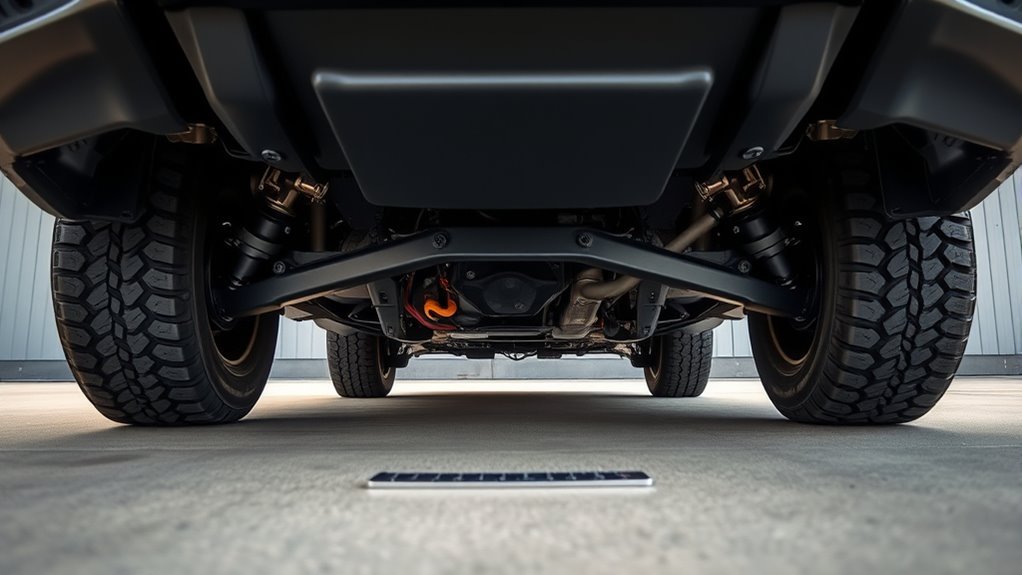
Ground clearance is one of the most useful numbers to know before you drive over ruts, snow, rocks, steep driveways, or uneven job-site roads. It tells you how much space sits between the ground and the lowest fixed part under your vehicle. The higher that gap is, the less likely you are to scrape; the lower it is, the more carefully you need to choose your line.
Quick Answer
Ground clearance is the vertical distance from level ground to the lowest fixed point under a vehicle, usually excluding the tires and flexible mud flaps. To measure it, park on flat ground, set correct cold tire pressure, identify the lowest hard point, and measure straight up from the ground.
Key Takeaways
- Measure the lowest fixed underbody point, not the body side, bumper height, or tire sidewall.
- Record tire pressure, fuel level, passengers, cargo, and accessories because each can change the real number.
- Approach, departure, and breakover angles matter as much as the clearance number when driving over obstacles.
- Lifts and larger tires can improve clearance, but they can also affect steering, braking, stability, speedometer accuracy, and tire load safety.
At a Glance
| Time Required | 10–20 minutes for a basic driveway measurement |
| Difficulty | Easy, as long as the vehicle is parked safely on level ground |
| Tools Needed | Tape measure or ruler, flashlight, tire pressure gauge, notepad or phone |
| Cost | Free if you already have a tape measure and tire gauge |
What Is Ground Clearance and Why It Matters
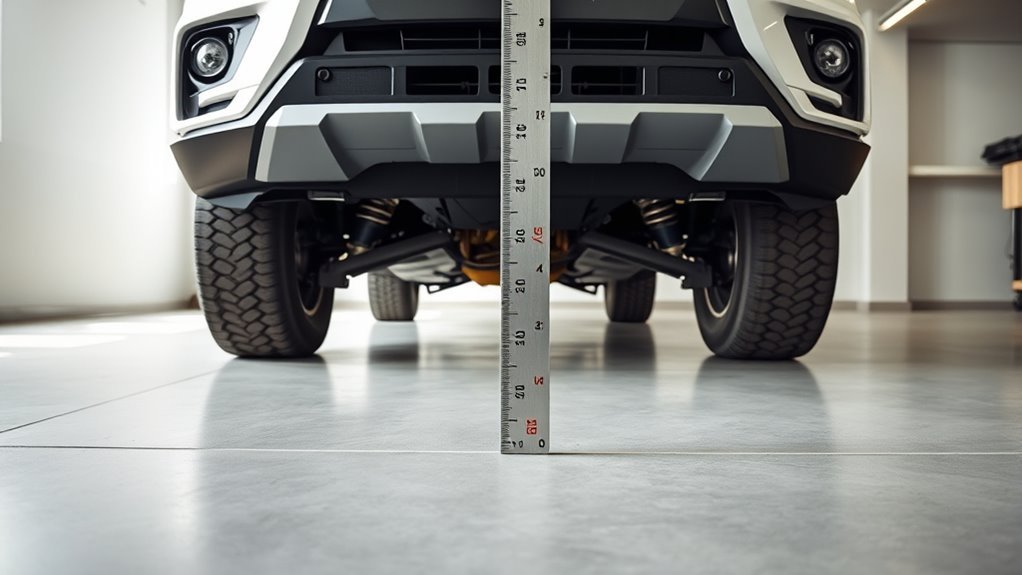
Ground clearance is the vertical distance between the ground and the lowest fixed point under your vehicle. That lowest point might be a differential housing, exhaust component, suspension link, skid plate, crossmember, fuel-tank shield, or trailer hitch receiver. Tires and flexible mud flaps are usually not counted because they are already touching or moving with the ground.
The number matters because it helps predict whether your vehicle can pass over an obstacle without scraping. More clearance can help on rocks, ruts, snow berms, steep driveway transitions, and washed-out roads. Less clearance usually improves step-in height, aerodynamics, and on-road handling, but it leaves less margin for rough surfaces.
For off-road use, ground clearance is only one part of the picture. Jeep’s Trail Rated explanation, for example, groups ground clearance with approach angle, breakover angle, departure angle, articulation, traction, and maneuverability because all of them affect whether a vehicle can get over an obstacle without damage. Jeep Trail Rated guidance describes ground clearance as space between the underside of the vehicle and terrain that helps prevent underbody damage.
Note: Two vehicles with the same ground clearance can behave very differently off-road. Wheelbase, overhangs, tire size, skid plates, suspension travel, and where the lowest part sits under the vehicle all change real-world performance.
Types of Ground Clearance and Off-Road Angles
Clearance is often talked about as one number, but the useful version depends on which part of the vehicle is likely to hit first.
- Minimum ground clearance: The shortest vertical distance from level ground to the lowest fixed underbody point.
- Axle or differential clearance: The gap below the axle housing or differential. This matters on solid-axle 4x4s because the differential can be the lowest point.
- Suspension clearance: The gap below control arms, trailing arms, shock mounts, and other suspension parts that may hang lower than the frame.
- Skid-plate clearance: The distance below protective plates. Skid plates help protect parts, but they can also become the lowest point.
- Running-board or side-step clearance: The space below side steps or rock rails. These can scrape even when the center of the vehicle clears.
Clearance angles are just as important:
- Approach angle: The steepest ramp or obstacle your front end can climb without the front bumper, air dam, tow hook, or skid plate touching.
- Departure angle: The rear version of approach angle. It tells you how steeply you can leave an obstacle without dragging the rear bumper or hitch.
- Breakover angle: The angle at which the middle of the vehicle may hang up on a crest. Longer wheelbases usually reduce breakover angle if clearance stays the same.
A simple way to estimate breakover angle is: breakover angle ≈ 2 × arctan(2 × ground clearance ÷ wheelbase). This is only an estimate because real vehicles have skid plates, exhaust parts, suspension pieces, and body shapes that may sit lower than the ideal center point.
What Is a Good Ground Clearance?
There is no single “good” ground clearance for every vehicle. A low sports car, family crossover, work truck, and rock-crawling 4×4 are built for different jobs. Use the ranges below as practical shopping and comparison guidance, not as universal rules.
| Typical Use | Practical Clearance Range | What It Usually Means |
| City cars and sedans | About 4–6 inches | Good for paved roads, but easy to scrape on steep driveways or deep ruts. |
| Crossovers and light snow use | About 6–8 inches | More useful for rough parking lots, snow, gravel, and mild dirt roads. |
| Light trail and camping roads | About 8–9 inches | Often enough for maintained trails, forest roads, and moderate uneven surfaces. |
| High-clearance 4×4 use | About 10+ inches | Better for rocks, deeper ruts, and technical trails, especially when paired with good angles and skid protection. |
For a real-world benchmark, the 2026 Jeep Wrangler capability page lists off-road figures such as an available approach angle of 47.4 degrees on 4-door models and a breakover angle of up to 32.4 degrees on 2-door models with available 35-inch tires. Those are high-clearance off-road numbers, not a requirement for normal daily driving.
[Products Worth Considering]

This all-in-one front end service kit is designed to help remove stubborn ball joints, tie rod ends, and pitman arms on a wide range of vehicles. Built from hardened alloy and organized in a portable ABS case, it offers reliable performance for both professional mechanics and DIY repairs.

This AstroAI digital tire pressure gauge delivers factory-calibrated readings with dependable ±1 PSI accuracy, helping you keep cars, trucks, motorcycles, and spare tires at the right pressure. Its bright backlit LCD and illuminated nozzle make nighttime checks easy, while the one-button unit switch and auto-off design add convenience and battery efficiency for routine maintenance.

This Toyota hitch cover helps protect your trailer hitch receiver from dirt and debris while adding a clean factory-style look to your vehicle's rear end. Designed for easy use, it offers a simple way to finish off your towing setup when the hitch is not in use. Its lightweight design makes it convenient to handle and install.
How to Measure Your Vehicle’s Ground Clearance: Step by Step
To get a useful number, measure the vehicle in a repeatable condition. If you want to compare against published specs, measure with normal equipment, correct tire pressure, and no unusual cargo. If you want to know trail clearance, measure again with your typical passengers, tools, recovery gear, camping load, or work equipment.
- Park on a flat, level surface. A garage floor, smooth driveway, or level parking lot works better than gravel or sloped pavement.
- Check cold tire pressure. Use the pressure listed on the vehicle tire placard or owner’s manual. NHTSA’s TireWise guidance says the recommended pressure is the manufacturer’s cold inflation pressure, measured before driving or after the tires have been parked long enough to cool.
- Set the vehicle load. Record whether the vehicle is empty, at curb-like condition, or loaded with passengers and cargo.
- Use a flashlight to find the lowest fixed point. Check the differential, control arms, skid plates, exhaust, frame crossmembers, fuel-tank shields, side steps, and hitch receiver.
- Measure straight up from the ground. Hold the tape measure vertical and perpendicular to the ground, then measure to the lowest hard point.
- Measure several points. Record front, center, rear, left, and right low spots because one suspension bracket or skid plate may sit lower than everything else.
- Write down the conditions. Note tire size, tire pressure, fuel level, load, and any aftermarket parts.
- Repeat after changes. Measure again after adding larger tires, a lift kit, skid plates, side steps, bumpers, winches, roof racks, or heavy cargo systems.
Pro Tip: Use a straight board or carpenter’s level across low points if the tape is hard to position. Slide the board under the vehicle until it touches the lowest part, then measure from the floor to the top of the board.
[Products Worth Considering]

This aftermarket front bumper tow hook eye cover cap set is designed to fit Toyota RAV4 AX40 models from 2016 to 2018, providing a direct replacement for the original left and right covers. Made from durable ABS plastic, these caps offer a precise fit, weather resistance, and reliable protection while restoring the clean factory look of the bumper.

This master ball joint removal kit gives you the tools needed to remove and install ball joints, tie rod ends, Pitman arms, and other front-end components. It is designed for broad compatibility with many GM, Chevrolet, Ford, and Dodge vehicles, including a range of light trucks, vans, and SUVs. Built from forged steel and stored in a molded ABS case, it offers durable performance and organized portability for garage or shop use.

This front license plate bracket is a direct replacement for compatible Toyota RAV4 models, offering an easy way to restore a damaged or missing front plate holder. Built from durable ABS material with the same dimensions as the original, it installs without modification and helps maintain a clean factory look.
Why Your Measurement May Not Match the Spec Sheet
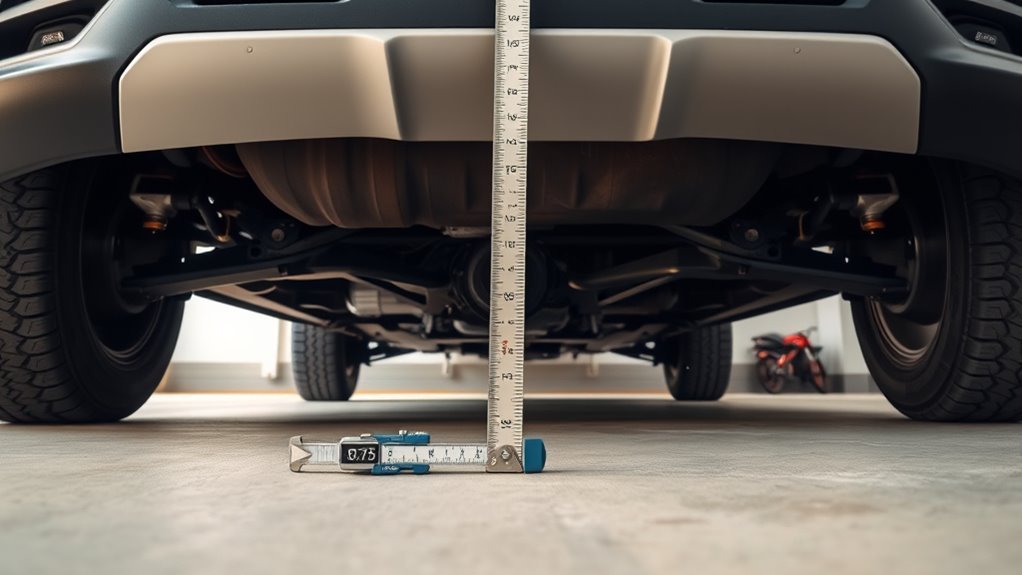
Manufacturer ground-clearance figures are useful, but they do not always match what you see with a tape measure. SAE’s J1100 motor vehicle dimensions guidance explains that vehicle dimensions are standardized measurements, and physical measurements can differ from design-intent values. That is one reason a showroom spec may not match your loaded vehicle in the driveway.
Common reasons for different numbers include:
- Tire pressure: Underinflated tires reduce clearance.
- Tire wear: Worn tires are slightly smaller than new tires.
- Passenger and cargo load: Extra weight compresses the suspension.
- Fuel level: A full tank can slightly change ride height compared with an almost empty tank.
- Options and accessories: Skid plates, side steps, tow hitches, roof loads, winches, and heavy bumpers can change the lowest point or suspension height.
- Trim and tire package: A base trim and off-road trim may have different tires, suspension, and published clearance.
- Measurement point: Some specs may describe a general minimum, while owners may measure a specific part such as a hitch, exhaust bracket, or differential.
Note: When comparing vehicles, look for the exact trim, tire size, suspension package, and measurement condition. A headline clearance number can hide important differences between models.
Troubleshooting Inaccurate Ground Clearance Readings
If your numbers seem inconsistent, check the setup before assuming the spec is wrong.
- Different left and right readings: Check for uneven pavement, uneven tire pressure, suspension sag, or heavy cargo on one side.
- Lower-than-expected clearance: Look for underinflated tires, worn tires, added skid plates, running boards, trailer hitches, or loaded cargo.
- Higher-than-expected clearance: Confirm tire size, previous suspension work, lift spacers, or larger-than-stock tires.
- Front and rear mismatch: Check rake from towing, cargo, helper springs, worn springs, or leveling kits.
- Spec-sheet mismatch: Confirm the exact trim, drivetrain, wheelbase, tire package, and accessory package before comparing.
When to Change Ground Clearance: Lift Options, Tradeoffs, and Safety Tips
Change ground clearance only when the benefit matches how you use the vehicle. A daily commuter that occasionally sees snow may need better tires more than a lift. A trail vehicle that regularly scrapes skid plates may benefit from more tire diameter, a carefully chosen suspension lift, or better underbody protection.
The main ways to increase usable clearance are:
- Larger tires: Increase axle and differential clearance, but may cause rubbing, speedometer error, gearing changes, and load-rating concerns.
- Suspension lift: Raises the frame and body, can improve approach, departure, and breakover angles, but may affect alignment, steering geometry, brake lines, driveshaft angles, and stability.
- Body lift: Raises the body from the frame on some body-on-frame vehicles, but does not raise axles or suspension parts.
- Skid plates and rock rails: May not increase clearance, but they protect parts when contact is likely.
- Shorter bumpers or high-clearance bumper designs: Can improve approach and departure angles without changing suspension height.
Warning: A taller vehicle can become more top-heavy. NHTSA’s rollover rating system uses Static Stability Factor to help judge how top-heavy a vehicle is, so lifts, roof loads, heavy bumpers, and larger tires should be chosen carefully and installed by qualified professionals.
Before installing larger tires or a lift kit, check tire load index, speed rating, wheel fitment, and manufacturer guidance. The Tire Industry Association advises never installing a tire with a lower load index than the original equipment tire and recommends professional input for custom wheel and tire packages.
After any clearance modification, complete this checklist:
- Get a professional alignment.
- Check tire rubbing at full steering lock and full suspension compression.
- Verify brake-line, ABS-wire, and sensor-wire slack.
- Inspect driveshaft, CV axle, and steering angles.
- Recheck torque on suspension and wheel fasteners after initial driving.
- Recalibrate the speedometer if tire diameter changed.
- Check headlight aim after a lift or leveling kit.
- Confirm towing, payload, warranty, insurance, and local-road legality if the modification is significant.
[Products Worth Considering]

This 2-piece suspension tool set combines a compact strut spreader with a high-leverage lower control arm prying tool to help speed up safe suspension service. Designed for many FWD, import, and domestic vehicles, it supports strut, hub, ball joint, and control arm work while helping reduce the risk of damage to surrounding components. Heavy-duty steel construction makes it a dependable choice for mechanics and serious DIY suspension repair.

This DIY toe alignment tool kit helps home mechanics quickly check and adjust front-end toe after suspension, steering, or tire service. Stainless steel toe plates and dual tape measures provide a simple, reliable reference for reducing uneven tire wear and improving straight-line tracking without needing a full alignment machine.

This wheel alignment tool makes it easy to check and adjust toe-in and toe-out at home for better handling, stability, and more even tire wear. Designed for one-person use, it includes tape-measure slots for simple setup and accurate measurements without extra help. Its stainless steel construction and broad vehicle compatibility make it a practical addition to any DIY garage.
Frequently Asked Questions
How do they measure ground clearance?
Ground clearance is measured from level ground to the lowest fixed point under the vehicle. For a useful owner measurement, park on flat ground, set correct cold tire pressure, identify the lowest hard point, and measure vertically from the ground to that point.
What is a good ground clearance?
For paved-road cars, about 4–6 inches may be normal. Crossovers often sit around 6–8 inches. Light trail vehicles are commonly more useful around 8–9 inches, while high-clearance 4x4s often have about 10 inches or more. The right number depends on terrain, wheelbase, overhangs, tire size, and underbody protection.
How do you calculate ground clearance?
You do not usually calculate ground clearance; you measure it. Park on level ground and measure from the ground to the lowest fixed underbody point. If you are estimating breakover angle, use: breakover angle ≈ 2 × arctan(2 × ground clearance ÷ wheelbase).
What is considered a high-clearance 4×4?
A high-clearance 4×4 is commonly thought of as having about 10 inches or more of clearance, but the clearance number alone is not enough. A good high-clearance 4×4 also needs useful approach, departure, and breakover angles, suitable tires, traction, articulation, and protected underbody components.
Does bigger tire size increase ground clearance?
Yes, larger tire diameter can raise axle and differential clearance by about half the tire-diameter increase. For example, moving from a 30-inch tire to a 32-inch tire can add roughly 1 inch of axle clearance. Fitment, load rating, gearing, braking, and speedometer accuracy still need to be checked.
Should I measure ground clearance loaded or unloaded?
Measure both if the vehicle carries people, gear, tools, or camping equipment. An unloaded measurement is useful for comparison, but a loaded measurement tells you what clearance you actually have on the road or trail.
Conclusion
Ground clearance is simple to define but easy to misread. The useful number is the distance from level ground to the lowest fixed underbody point, measured with tire pressure, load, and vehicle setup recorded. For real driving, also consider approach angle, departure angle, breakover angle, wheelbase, tires, skid plates, and suspension travel. If you modify clearance with larger tires or a lift, balance the extra obstacle room against steering, braking, stability, tire safety, and alignment checks.
Sources
- SAE International — J1100 Motor Vehicle Dimensions — supports standardized vehicle-dimension measurement context.
- Jeep Trail Rated — supports the role of ground clearance, approach angle, breakover angle, and departure angle in off-road capability.
- Jeep Wrangler Capability — provides current manufacturer examples of off-road clearance and angle figures.
- NHTSA 5-Star Safety Ratings — supports rollover-resistance and Static Stability Factor safety context.
- NHTSA TireWise — supports cold tire-pressure measurement and tire safety guidance.
- Tire Industry Association — Tire Replacement — supports tire load-index and custom wheel/tire safety guidance.



[…] Supra’s low sports-car ground clearance makes driveway angle, front overhang, vehicle load and aftermarket parts just as important as the […]
[…] slope, test it at low speed during a dealer-approved test drive. You can also review this guide to measure ground clearance and driveway fit before […]
[…] loss of ride height. For a deeper explanation of datum points and repeatable measurements, see the ground-clearance measurement guide. [VERIFY: confirm this internal link target is […]