Toyota RAV4 Turning Radius: Specs by Year, Trim, and What It Means for You
Parking the Toyota RAV4 in a tight spot or pulling a U-turn on a narrow street can feel unpredictable, but the numbers make it simple. The 5th-gen RAV4 (2019–2025) turns in 36.1 to 37.4 feet curb-to-curb, depending on wheel size. Older 4th-gen trims can tighten that arc to 34.8 feet. Below you’ll find the exact figures by year and wheel size, how rivals compare, and what you can safely do to improve your turning circle.
What’s in This Article
- How Tight Is the RAV4’s Turning Radius?
- What “Turning Radius” Actually Means
- How the RAV4 Compares to Rivals
- Which RAV4 Years and Trims Turn Tightest
- How Wheelbase, Steering, and Tires Affect Turning Radius
- How Turning Radius Affects Parking, U-Turns, and Off-Road
- Mods and Driving Tips for Tighter Turns
- How to Measure Your RAV4’s Turning Radius
- Frequently Asked Questions
Quick Answer
The 5th-generation RAV4 (2019–2025) has a curb-to-curb turning circle of 36.1 feet with 17- or 18-inch wheels, and 37.4 feet with 19-inch wheels. The 4th-gen 2017 RAV4 with 17-inch wheels turns in a tighter 34.8 feet. Wheel size is the main variable within each generation.
Key Takeaways
- The 5th-gen RAV4 (2019–2025) turns in a 36.1 ft curb-to-curb circle with 17″/18″ wheels, or 37.4 ft with 19″ wheels — not the 38.4 ft figure that appears in many online sources.
- The 2017 RAV4 with 17-inch wheels delivers the tightest factory turning circle in the lineup at 34.8 feet.
- The RAV4’s main rivals — the Nissan X-Trail and Honda HR-V — have comparable turning circles in the 35–37 ft range, so real-world differences are subtle.
- Correctly inflated, smaller-diameter tires can slightly reduce your turning circle without risky modifications.
- Measuring your actual turning circle with a controlled U-turn and a tape measure gives you a reliable baseline before making any setup changes.
How Tight Is the RAV4’s Turning Radius? (Quick Answer)

The 5th-generation RAV4 (2019–2025) has a curb-to-curb turning circle of 36.1 feet with 17- or 18-inch wheels, and 37.4 feet with 19-inch wheels. That range places the RAV4 competitively within the compact SUV segment, where most rivals land in a similar 35–37 foot window.
You can complete most U-turns on a standard two-lane street in a single motion. Parallel parking in a typical city bay stays manageable, and lane changes feel predictable at speed. Extremely narrow alleys may still need a multi-point turn, but the RAV4 handles everyday urban maneuvering without stress.
The 2017 4th-gen RAV4 with 17-inch wheels turns in just 34.8 feet. If you prioritize the tightest possible circle and don’t need the latest tech, that older trim has a real urban agility advantage over the current generation.
What Does “Turning Radius” Mean for RAV4 Drivers?
Note: “Curb-to-curb” measures the full circle the outer front wheel sweeps between two curbs. “Wall-to-wall” includes front and rear overhang and runs about 1–2 feet larger. Toyota’s published specs use curb-to-curb.
Turning radius describes the minimum circular path the RAV4 can trace. For the 5th-gen RAV4, that’s an 18.1 to 18.7-foot turning radius, which produces a 36.1 to 37.4-foot curb-to-curb turning circle, depending on wheel size. For you, that number means tighter arcs when executing U-turns, fewer steering corrections in multilane roundabouts, and less wasted space when reversing into parking stalls.
The RAV4’s 105.9-inch wheelbase stabilizes the chassis, so the turning geometry doesn’t compromise ride stability. A smaller turning circle simplifies urban navigation by shrinking the clearance you need and cutting the time you spend maneuvering in crowded areas. That gives you confidence to commit to tighter gaps with a predictable vehicle response.
How Does the RAV4’s Turning Radius Compare to Rivals?
Warning: Many online sources mix up turning radius (the distance from pivot to wheel center — half the circle) with turning circle (the full curb-to-curb diameter). All figures in the table below use curb-to-curb turning circle for an apples-to-apples comparison.
The 5th-generation RAV4 turns in a 36.1-foot curb-to-curb circle with 17- or 18-inch wheels. That puts it close to both the Nissan X-Trail and the Honda HR-V. Per official Nissan Australia specifications, the X-Trail’s turning circle is 11.1 meters, which converts to approximately 36.4 feet. All three vehicles land in a narrow 35–37 foot range, so real-world differences in everyday maneuvering are subtle.
| Model | Turning Circle, Curb-to-Curb (ft) | Practical Implication |
|---|---|---|
| Toyota RAV4 5th gen (17″/18″ wheels) | 36.1 | Agile urban handling; tightest 5th-gen option |
| Nissan X-Trail (T33, current gen) | 36.4 | Marginally wider; comparable urban agility |
| Honda HR-V (2023, EX-L) | ~35.2 | Slightly tighter; lighter vehicle aids low-speed turns |
| Toyota RAV4 5th gen (19″ wheels) | 37.4 | Widest 5th-gen option; minor impact in most real-world scenarios |
The RAV4 and X-Trail are nearly identical in this spec. The HR-V’s shorter body and lighter weight give it a marginal edge at very low speeds, but none of these gaps define daily driving on their own. If you want a versatile, dependable handler rather than a pure urban specialist, the RAV4’s balance makes good sense.
[Products Worth Considering]

Protect your Toyota RAV4 interior with this custom‑fit windshield sun shade that blocks 99% of harmful UV rays and reduces cabin heat. The mirror cut‑out ensures a seamless fit without gaps, while durable 240T polyester and bendable wire keep it sturdy through repeated use. Foldable and stored in a convenient pouch, it offers easy installation and removal for everyday comfort.

The Autovir windscreen shade offers full windshield coverage for Toyota RAV4 models from 2019 to 2026, blocking up to 99.95% of UV rays and reducing interior heat. Its multi‑layer reflective material provides SPF 100 and UPF 80+ protection while keeping the dashboard, seats, and steering wheel cooler. The foldable design installs quickly and stores conveniently in the glove box, and reinforced stitching ensures long‑lasting durability for daily use.

Upgrade your RAV4 interior with a sleek, retractable 4‑port USB hub that adds vibrant RGB lighting and fast charging for phones, tablets, and accessories. The intelligent retractable cables keep the console tidy while the snap‑in design ensures easy installation. Compatible with 2020‑2025 RAV4 models, it blends modern tech with a clean aesthetic.
Which RAV4 Years and Trims Turn Tightest?

The tightest-turning RAV4 comes from the 4th generation (2013–2018). Per Toyota product specifications, the 2017 RAV4 with 17-inch wheels turns in 34.8 feet curb-to-curb — the best factory figure in the RAV4 lineup’s history. That’s a real advantage in dense city streets and cramped parking structures. Step up to 18-inch wheels on the same 4th-gen platform and the circle widens to 36.8 feet.
The 2019 redesign introduced the 5th-gen (XA50) platform with a different steering geometry. With 17- or 18-inch wheels, the 5th-gen turns in 36.1 feet, which actually beats the 4th-gen 18-inch configuration. With 19-inch wheels, that arc grows to 37.4 feet. RAV4 Hybrid models on the 5th-gen platform use the same wheelbase and closely match those figures on equivalent wheel sizes.
If you’re choosing a 5th-gen trim for urban agility, stick to 17- or 18-inch wheels and skip the 19-inch option. For the absolute tightest turning circle in the lineup, a used 2017 RAV4 with 17-inch wheels is the clear choice.
[Products Worth Considering]

The Autopect side window sunshade sock screen-shade provides universal, elasticized mesh protection for car, truck, SUV, and van side windows. It filters UV rays, keeps interiors cool, and offers privacy while allowing fresh breezes and bug protection. Easy no‑tool installation and a compact drawstring pouch make it portable for travel and camping.
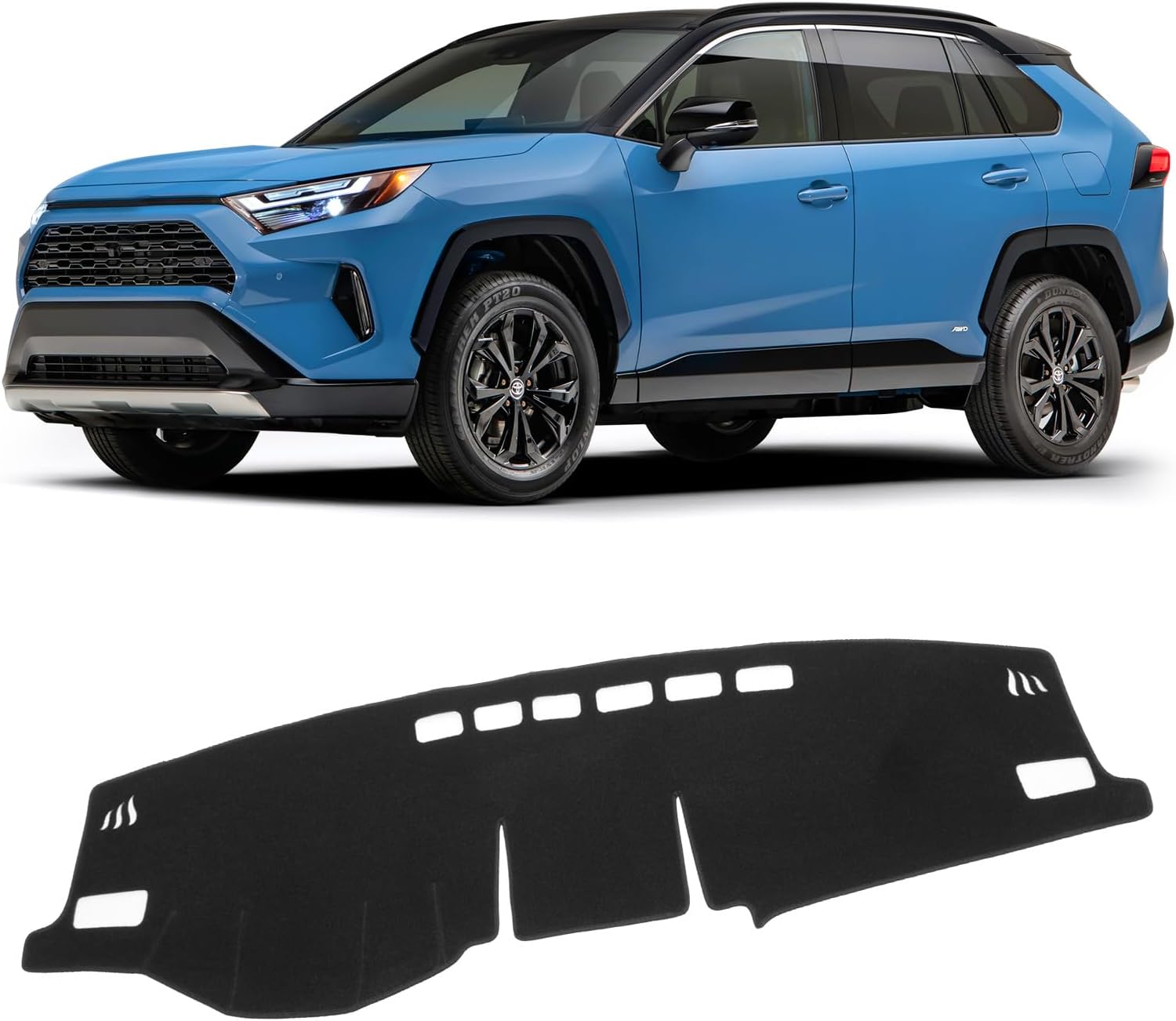
The KUST Black Dashboard Cover Mat offers a custom, eco‑friendly fit for Toyota RAV4 models from 2019 to 2025, protecting the dash from UV damage, scratches, and glare. Made from post‑consumer recycled polyester with a silicone anti‑slip underside, it stays soft, breathable, and odorless while securely adhering to the surface. Installation is quick and reversible, and the foldable design allows easy storage when not in use.
How Wheelbase, Steering, and Tires Affect Turning Radius
Wheelbase has the biggest impact on turning radius. A shorter wheelbase lets the front wheels cut a tighter arc. The RAV4’s 105.9-inch wheelbase stays consistent across the 5th-gen lineup, so wheel size becomes the main variable within that generation.
Steering system design also matters. The RAV4 uses a power-assisted rack-and-pinion setup. The steering ratio and lock-to-lock turns control how far the front wheels can pivot. Factory steering stops set the maximum steering angle. Adjusting those stops can tighten the turning circle, but that’s a job for a qualified technician. Too much change risks bump steer and wheel-to-fender clearance problems.
Tire size affects the turning circle in two ways. A smaller-diameter tire reduces the scrub radius slightly, letting the wheel pivot further before friction builds at the contact patch. Narrower tires also cut rolling resistance at full lock. Both effects are real but modest. Front and rear overhang and suspension pickup points also shape the swept path, especially on technical off-road trails where clearance is tight.
How Turning Radius Affects Parking, U‑Turns, and Off‑Road Maneuvering
The RAV4’s turning circle is comparatively tight for its class. Parking, U-turns, and tight off-road maneuvers need fewer steering inputs and less clearance than a larger SUV demands. That compact geometry gives you decisive control: you’ll complete U-turns in one motion more often, fit into tight parking bays with fewer adjustments, and thread between trail obstacles with less repositioning.
With a turning radius of about 18.1 feet, the RAV4 handles U‑turns, parallel parking, and trail threading with minimal drama.
- Urban parking: a smaller swept path means you can fit into tighter bays and parallel spots with minimal adjustments.
- U-turns: a reduced turn diameter lets you convert narrow residential streets without multi-point procedures in most cases.
- Off-road navigation: a tighter turning circle enables precise line selection and obstacle avoidance on narrow tracks.
The RAV4’s balance of turning circle and chassis stability preserves lateral control at varied speeds. You can move through dense city grids or technical trails without sacrificing predictable handling or passenger safety.
Safe, RAV4‑Specific Mods and Driving Tips for Tighter Turns

The 5th-gen RAV4’s 36.1 to 37.4-foot turning circle handles urban use well, but targeted changes can deliver measurable gains. Start with tires. Choosing smaller-diameter, load-rated replacements can reduce the scrub radius and allow slightly greater wheel articulation. Don’t go below the load rating your trim requires, and maintain correct tire pressure and alignment to prevent toe or camber shifts.
Pro tip: Check tire pressure before comparing turning circles. Under-inflated tires increase the contact patch and can make your circle feel 1–2 feet wider than the factory spec suggests.
If you pursue steering adjustments, limit the work to calibrated steering-stop refinement by a qualified technician. Removing too much stop travel risks bump steer and compromised steering returnability. Pair any mechanical change with an alignment check and dynamic testing in a controlled area.
Technique matters just as much as hardware. Practice low-speed reversing to exploit the chassis’s full steering angle, and rehearse turns to compensate for the RAV4’s long bonnet, which can obscure the front corners. These habits keep you maneuvering tighter without compromising handling predictability or safety.
How to Measure Your RAV4’s Turning Radius and Test It Yourself
Measuring your actual turning circle confirms how your specific trim’s setup performs against the factory spec. Use 36.1 feet as your baseline for a 5th-gen RAV4 with 17- or 18-inch wheels, or 37.4 feet for the 19-inch option. Variations from your benchmark point directly to wheel configuration, tire pressure, or alignment issues.
Measure your real turning circle with a controlled U-turn, compare to the factory spec for your wheel size, then use the gap to guide any setup changes.
- Select a flat, open area. Execute a single continuous U-turn at full lock while a partner marks the farthest point the outer rear wheel reaches from the circle’s center. Measure between those two points.
- Repeat in practical scenarios — parallel parking approach, narrow alley exit — to compare performance against the factory benchmark in real conditions.
- Test multi-point turns in constrained conditions, record deviations from the benchmark, and attribute variance to wheel configuration or technique before making changes.
Analyze your results, adjust your setup or technique, and re-test. A repeatable process gives you a reliable baseline for tracking any improvements from tire changes or steering adjustments.
Frequently Asked Questions
Does Turning Radius Affect Fuel Efficiency in the RAV4?
A tighter turning circle can marginally reduce fuel consumption in stop-and-turn scenarios by cutting the time and distance spent maneuvering. The effect on real-world fuel economy is small. Smoother, shorter maneuvers contribute to slightly more efficient driving overall, but turning circle alone won’t produce dramatic fuel savings.
Can Electronic Steering Assist Alter the RAV4’s Turning Radius?
Electronic power steering adjusts assist levels and steering feel, but it doesn’t change the physical lock-to-lock angle that sets the turning radius. It can make the RAV4 feel more responsive and lighter to steer. The actual turning geometry stays the same unless you modify the steering stops mechanically.
Do Aftermarket Wheels or Tires Void Warranty Related to Steering Components?
Aftermarket wheel or tire changes can void warranty coverage if they cause damage to steering or suspension components. Document your fitment choices, use OEM-equivalent load ratings and offsets, and be prepared to demonstrate that your modification didn’t directly cause the failure if a claim gets disputed.
How Does AWD Influence Turning Radius Versus FWD RAV4 Models?
AWD adds drivetrain components and weight that can slightly increase the turning circle compared to FWD. The difference is small in practical terms. FWD models feel lighter and a touch more responsive at very low speeds. AWD models gain traction in slippery conditions during turns. Both use the same basic steering geometry and steering stops.
Are Parking Sensors or Cameras Calibrated for Tight Turning Maneuvers?
Toyota’s factory parking sensors and cameras are calibrated to detect obstacles within the vehicle’s typical turning envelope. If you modify suspension geometry or tire size, recalibrating the system keeps sensor accuracy aligned with your vehicle’s actual swept path. Occasional recalibration is also a good idea after any aggressive off-road use that could shift sensor positioning.
Conclusion
The RAV4’s turning circle varies meaningfully across years and trim levels: from 34.8 feet in the most agile 4th-gen configuration to 37.4 feet on a 5th-gen with 19-inch wheels. Before you buy, check the spec sheet for your target year and wheel size. For the tightest factory circle, a 2017 RAV4 with 17-inch wheels is the clear pick. For a current-model RAV4 that still handles confidently in the city, choose a 5th-gen trim with 17- or 18-inch wheels. Keep the tires properly inflated and use smooth, deliberate steering inputs to work within the car’s real limits, whatever trim you drive.
References
- Turning Radius — Toyota RAV4 Forums (RAV4 World) — RAV4 World, citing Toyota Product Info, 2020
- Nissan X-Trail Specifications (T33, e-POWER) — Nissan Australia (official specification sheet)
- Honda HR-V Turning Radius (2016–2023) — AutoPadre, 2023
- Toyota RAV4 Dimensions — Maguire Toyota