Toyota Tundra Tire Rotation: Quick Answer
By Ryker Calloway · Last updated: July 31, 2026
Rotate Toyota Tundra tires every 5,000 miles or 6 months, whichever comes first, unless the maintenance guide for your exact model year says otherwise. Check cold pressure and Toyota Tundra tire pressure monthly, measure tread at the inside, center, and outside of each tire, and rotate sooner when uneven wear appears. Towing, heavy payloads, rough roads, and aggressive all-terrain tread can justify more frequent inspections, but they do not create one universal 3,000-mile rotation rule.
Quick Answer
Rotate your Toyota Tundra’s tires every 5,000 miles or 6 months, whichever comes first, for normal use. Inspect them before and after demanding towing, hauling, or off-road trips, and rotate before the next scheduled service if uneven wear develops. Follow the pattern in your model-year owner’s manual and the restrictions molded into the tire sidewalls.
Key Takeaways
- Use 5,000 miles or 6 months, whichever comes first, as the baseline for most Toyota Tundras.
- Towing, heavy payloads, off-road use, incorrect pressure, and alignment faults can accelerate or distort tread wear.
- Directional tires normally move front-to-rear on the same side unless they are professionally dismounted and remounted.
- Replace tires at 2/32 inch tread depth or when wear bars are flush; damage or age can require replacement sooner.
- If replacing only two tires, install the newer pair on the rear axle for better wet-road stability.
At a Glance
| Time Required | 30–60 minutes for a DIY four-tire rotation |
| Difficulty | Moderate; safe lifting and correct torque matter |
| Tools Needed | Lug wrench or breaker bar, floor jack, jack stands, wheel chocks, torque wrench, tread-depth gauge, tire-pressure gauge |
| Cost | Often included with tire or maintenance service; DIY cost is mainly tools if you do not already own them |
How Often Should You Rotate Toyota Tundra Tires?
For most Toyota Tundra owners, the baseline tire-rotation interval is every 5,000 miles or 6 months, whichever comes first. That schedule gives you a recurring point to inspect tread depth, cold pressure, sidewall condition, valve stems, and wheel damage.
Toyota’s owner information says to replace or rotate tires according to the maintenance schedule and treadwear. Check the guide for your exact model year because tire rotation may be due at a 5,000-mile service even when an engine-oil change is not. You can confirm the applicable schedule through the official Toyota manuals and warranties page.
| Driving Use | Rotation Interval | What to Watch |
|---|---|---|
| Normal commuting and highway use | Every 5,000 miles or 6 months, whichever comes first | Even tread depth, correct pressure, no vibration |
| Frequent towing or payload hauling | Inspect before and after demanding trips; rotate before the next 5,000-mile/6-month service if wear becomes uneven | Rear-tire shoulder wear, cupping, heat, pressure changes |
| Gravel, job sites, off-road trails, rough roads | Inspect after hard use; rotate sooner if tread wear is uneven | Cuts, chips, punctures, sidewall damage, abnormal noise |
| Uneven wear already visible | Rotate now only if tires are still safe; diagnose the cause | Alignment, worn suspension parts, pressure imbalance |
Pro Tip: Record both mileage and date. A low-mileage Tundra can reach the six-month service point before it reaches 5,000 miles, while a work truck may reach 5,000 miles first.
Choose the Right Rotation Interval for Your Driving and Towing
The correct tire-rotation schedule starts with the model-year maintenance guide, then adjusts to actual tread wear. A lightly loaded highway truck may still look even at 5,000 miles, while a Tundra that tows, hauls tools, runs aggressive all-terrain tires, or travels rough roads may show a pattern sooner. Inspecting sooner is evidence-based; choosing an arbitrary mileage without measuring the tires is not.
Drive Conditions Matter
Rough pavement, gravel, potholes, heat, aggressive acceleration, and frequent short trips can all speed up tire wear. Do not wait for a tire to look bald from across the driveway. Use a tread-depth gauge and check all four tires in three places: inside edge, center, and outside edge.
- Inspect: Measure tread depth at each corner and look for cupping, feathering, cracking, cuts, or bulges.
- Correct: Set cold tire pressure to the label on the driver-side door jamb, not the maximum pressure molded on the tire sidewall.
- Rotate: Follow the pattern allowed by your owner’s manual and tire construction.
- Recheck: If the same tire position keeps wearing faster, schedule an alignment or suspension inspection.
Towing Frequency Impact
Towing and payload hauling add load and heat, and trailer tongue weight can increase the work done by the rear axle. That does not change the truck’s payload, axle, tire-load, or towing limits. It means you should inspect all four tires more often and rotate before a repeatable wear pattern becomes permanent.
Before every towing trip, check cold tire pressure, look for punctures or sidewall damage, confirm trailer tongue weight is within rating, and inspect tread depth. After a long towing trip, look again for shoulder wear or cupping. If the rear tires are wearing faster than the fronts, rotate at the next safe opportunity and investigate pressure, alignment, suspension, and load distribution.
Warning: Tire rotation does not fix overloading, underinflation, bad alignment, or worn suspension parts. If a tire has cords showing, bulges, deep cuts, exposed belts, or tread at the wear bars, replace it instead of rotating it.
Manufacturer Interval Guidance
Use Toyota’s 5,000-mile/6-month service schedule as the practical baseline, then act sooner when tread measurements show uneven wear. The official Toyota Tundra tire information tells owners to rotate or replace tires according to the maintenance schedule and treadwear. That is why the odometer, calendar, and tread-depth readings all matter.
If you run aftermarket tires, oversized wheels, different front and rear tire sizes, or directional tread, also follow the tire maker’s instructions. A generic tire-rotation chart is not always correct for every wheel and tire setup.
Which Rotation Pattern to Use for Your Tundra’s Tires
The best rotation pattern is the one shown in your Toyota owner’s manual for your model year and the one allowed by your tire sidewall markings. Before moving any tire side to side, check whether it is directional, asymmetrical, staggered, or a different size than the opposite axle.
| Tire Setup | Pattern to Use | Important Check |
|---|---|---|
| Directional tires | Front-to-rear on the same side only | Look for a rotation arrow on the sidewall |
| Same-size, non-directional tires on a 2WD/RWD Tundra | Use the Toyota manual pattern; the industry fallback is commonly rearward-cross | Confirm the model-year manual and tire maker allow crossing sides |
| Same-size, non-directional tires on a 4WD Tundra | Use the Toyota manual pattern; industry guidance commonly uses an X or double-X pattern | Do not assume the 2WD/RWD pattern applies |
| Asymmetrical tires | May rotate normally if “inside” and “outside” remain correctly mounted | Check sidewall markings before crossing |
| Different front/rear tire sizes or aftermarket staggered setup | Often side-to-side only, and only if non-directional | Confirm size, wheel offset, and sidewall markings |
[Products Worth Considering]

The JACO ElitePro Digital Tire Pressure Gauge delivers shop-grade accuracy with a clear digital readout, making it easy to maintain proper tire pressure for safer driving and better performance. Built with rugged brass and steel components, a protective guard, and a flexible air hose, it is designed for reliable use across cars, trucks, motorcycles, bikes, RVs, and trailers. The lock-on display, built-in bleeder valve, and bright backlit screen add convenience in any lighting condition.

The ETENWOLF T300 digital tire pressure gauge delivers precise readings for cars, RVs, trucks, bikes, and heavy-duty vehicles with a wide measuring range and consistent accuracy. It is built to perform in extreme temperatures, includes a bright LED light for low-visibility use, and uses replaceable AAA batteries for convenient long-term operation. Durable enough to withstand rugged use, it is a practical tool for maintaining proper tire pressure across a variety of vehicles.
Upgrade your vehicle interior with Rubbermaid carpeted floor mats designed for everyday comfort, style, and protection. The two-tone look with faux leather accents adds a refined touch, while the reinforced heel pad helps handle frequent driver wear. Built for all-season use and easy cleaning, these universal-fit mats help keep cars, trucks, and SUVs looking neat and well protected.
Front-to-Back Basics
A same-side front-to-back rotation means the left-front tire moves to the left rear, the left-rear tire moves to the left front, and the same happens on the right side. This pattern is required for many directional tires because crossing them would make the tread roll the wrong way.
Front-to-back rotation is also the safest choice when you are unsure whether side-to-side movement is allowed. It is better to use a conservative pattern than to cross a directional or restricted tire incorrectly.
Rearward-Cross and X-Pattern Options
For same-size, non-directional tires, the fallback pattern depends on drivetrain. Tire Industry Association guidance uses a rearward cross for rear-wheel drive: rear tires move straight forward, while front tires cross to the opposite rear positions. For four-wheel drive, its general guidance uses an X or double-X pattern. Your Toyota manual and tire maker remain the final authority for the exact truck and tire setup.
Do not choose a cross pattern just because the tread looks non-directional. Read the sidewall first, then confirm the manual and tire maker allow it. The Tire Industry Association rotation guide explains the drivetrain-based fallback patterns, and the Michelin Tire Rotation Guide explains directional and non-directional limits.
Directional Tire Limits
Directional tires are designed to roll in one direction. They usually have an arrow or “rotation” marking on the sidewall. If you cross them to the opposite side without remounting them on the wheel, the tread can run backward, reducing wet-weather performance and increasing noise or uneven wear.
Note: If your Tundra has a full-size spare and you want to include it in the rotation, check the spare’s size, wheel type, tire age, tread depth, load rating, and owner’s manual guidance first. Do not mix an old or mismatched spare into normal driving service.
How to Spot Immediate Rotation or Replacement Needs
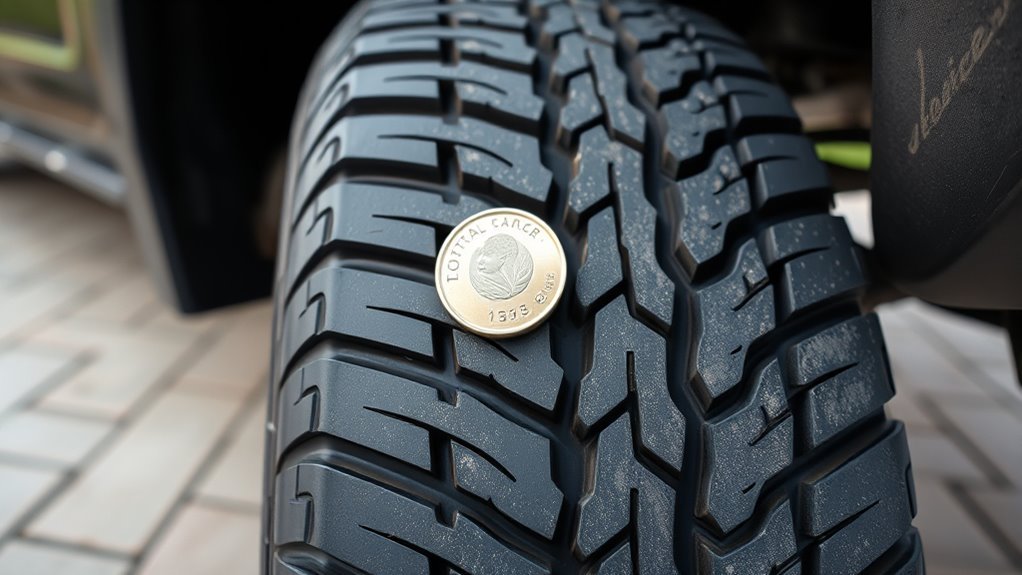
Rotation is preventive maintenance. Replacement is a safety decision. If a tire is already too worn, damaged, or separated, do not rotate it to another position and keep driving. Inspect the tire first and decide whether it is safe.
| Check | Signal | Action |
|---|---|---|
| Tread depth | At or below 2/32 inch | Replace; NHTSA treats this as the minimum safe tread depth |
| Wear bars | Wear bars are flush with the tread | Replace the tire |
| Shoulder wear | Both shoulders worn, or one shoulder worn more than the rest | Both shoulders: check underinflation/load; one shoulder: inspect alignment or suspension |
| Center wear | Middle tread worn more than shoulders | Check overinflation or incorrect load pressure |
| Cupping or scalloping | Patchy dips around the tread | Inspect shocks, struts, balance, and alignment |
| Tire age | Old DOT date code, cracking, hardening, or age limit reached | Follow the vehicle and tire maker’s age guidance even if tread remains |
| Bulges, cracks, exposed cords, punctures near sidewall | Visible structural damage | Replace immediately or have a tire professional inspect it |
The National Highway Traffic Safety Administration recommends checking cold pressure and tread at least monthly, replacing tires at 2/32 inch, and following the vehicle manual for rotation frequency and pattern. For a Tundra that tows or carries heavy loads, repeat the inspection before long trips and after unusually demanding use.
The best time to catch Tundra tire wear is before it becomes visible from ten feet away. A $5 tread-depth gauge can save you from replacing a full set early.
How Towing, Payload, and Alignment Change Rotation Frequency
Towing, payload, and alignment change how the tire contacts the road. A Tundra that is loaded correctly still puts more work on the tires than an unloaded daily driver. A Tundra that is overloaded, underinflated, or misaligned can destroy tires quickly.
- Track your use: Note towing miles, heavy payload trips, off-road days, and long highway runs in hot weather.
- Check pressure cold: Use the Toyota tire-pressure label on the driver-side door jamb. Do not use the tire sidewall maximum as the normal pressure target.
- Compare all four positions: Measure inside, center, and outside tread at every corner; tongue weight may increase rear-axle load, while steering and braking can still wear the front tires faster.
- Correct alignment issues: Feathering, one-edge wear, a crooked steering wheel, or pulling to one side are signs to schedule alignment service.
- Do not exceed ratings: Stay within payload, axle, tire load, and towing ratings listed by Toyota and on the truck’s labels.
If your tread-depth measurements show one tire position wearing faster every time, rotation alone is only moving the problem around. Fix the cause before the next set of tires wears the same way.
DIY Rotation Checklist: Tools, Safety, and Torque Specs for a Tundra
You can rotate Tundra tires at home if you have the right tools, a safe work area, and enough experience to lift the truck correctly. The non-negotiable rule is this: never work under or around a truck supported only by a jack. Use properly rated jack stands on solid, level ground.
[Products Worth Considering]

This tire repair rubber nail kit offers a simple self-service solution for punctures in cars, motorcycles, trucks, and more. The spiral rubber design helps create a firm seal that supports quick repairs without removing the tire, while the two included sizes make it easier to match different puncture types. Built for broad vehicle compatibility, it is a practical emergency repair option for roadside and garage use.

This click torque wrench delivers accurate, repeatable tightening for automotive and home repair tasks, helping prevent over-tightening and fastener damage. Its dual-range scale, knurled non-slip grip, and durable ratchet head make it easy to use, while the included extension bar and storage case add extra convenience.

Durable strong rustproof automotive grade steel, tubing instead of soil designed
Tools You Need
- Floor jack rated for the truck’s weight
- Properly rated jack stands
- Wheel chocks
- Lug wrench or breaker bar
- Torque wrench
- Correct socket for your lug nuts
- Tread-depth gauge
- Tire-pressure gauge
- Chalk, tape, or stickers to mark tire positions
Safe DIY Rotation Steps
- Park on a level surface, shift to park, set the parking brake, and chock the wheels that will stay on the ground.
- Check the sidewall markings and decide the correct rotation pattern before lifting the truck.
- Break the lug nuts loose slightly while the tire is still on the ground. Do not remove them yet.
- Lift the truck only at approved lift points and support it with jack stands.
- Remove the wheels and inspect tread, sidewalls, valve stems, and wheel damage.
- Move each tire to its new position according to the correct pattern.
- Hand-start every lug nut to avoid cross-threading.
- Snug the lug nuts in a star or crisscross pattern.
- Lower the truck until the tires touch enough to prevent spinning, then torque the lug nuts with a calibrated torque wrench.
- Set tire pressure cold, initialize or relearn TPMS if your model-year manual requires it, and test drive slowly while listening for vibration or noise.
Torque values vary by Tundra generation, wheel material, and hardware. Toyota manuals for many later Tundras list 97 ft-lb for aluminum wheels and 154 ft-lb for steel wheels, but those values are not universal across every year or aftermarket setup. Confirm the exact specification in your owner’s manual or the Toyota Tundra lug-nut torque guide before final tightening. Clean the hub and wheel mating surfaces, keep the threads dry unless Toyota or the hardware maker says otherwise, and recheck torque after wheel removal if your manual requires it.
Warning: Do not use an impact wrench for final tightening. Over-torque can damage studs or wheels, and under-torque can allow the wheel to loosen. Use a torque wrench and a star pattern.
What to Record at Each Rotation and When to Bring Your Truck to a Shop
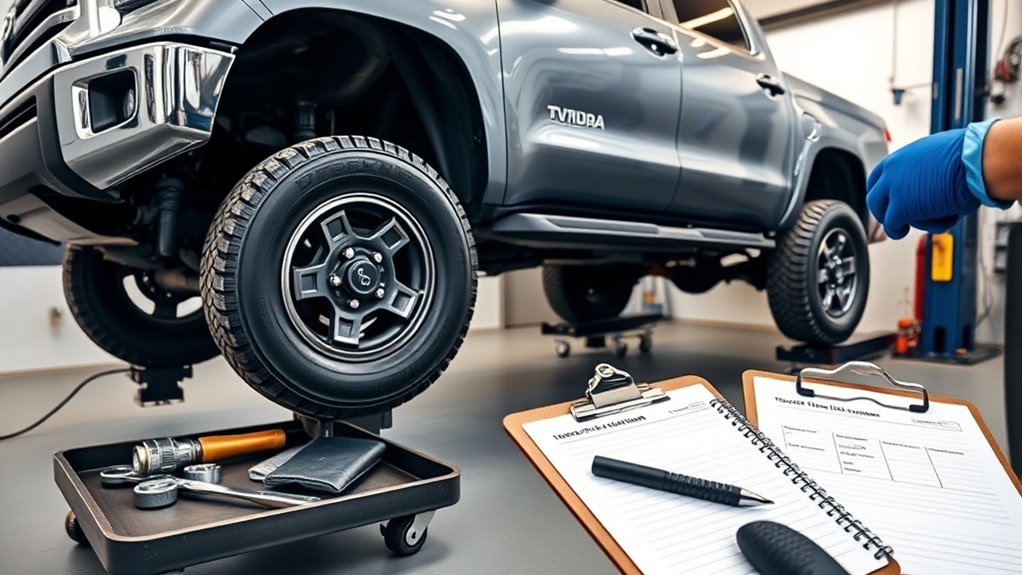
A good tire log makes wear trends obvious. You do not need a complicated spreadsheet. A simple note with date, mileage, tire position, tread depth, and pressure is enough.
| Record This | Why It Matters |
|---|---|
| Date and odometer reading | Confirms the rotation interval |
| Old and new tire positions | Helps trace which corner is causing wear |
| Tread depth at inside, center, and outside | Shows alignment, pressure, or suspension problems |
| Cold PSI for each tire | Catches slow leaks and pressure imbalance |
| Towing, hauling, or off-road use since last rotation | Explains faster wear and helps set the next interval |
Bring your Tundra to a tire shop or dealer if you see repeated one-sided wear, cupping, vibration, steering pull, uneven braking feel, air loss, cracked rubber, bent wheels, damaged valve stems, or tread depths that vary sharply between tires. A professional inspection can catch alignment, balance, bearing, brake, or suspension problems that rotation will not repair.
When to Replace Two Tires Versus All Four
Replacing all four tires is the cleanest choice when tread depths are widely different, tire models do not match, or a 4WD system requires closely matched rolling circumference. Matching size, construction, and tread depth helps keep handling predictable and reduces the chance of driveline binding. The allowable tread-depth or circumference difference is vehicle- and tire-specific, so confirm it with Toyota and the tire maker instead of using a generic number.
If you replace only two tires, install the newer pair on the rear axle. The Tire Industry Association and U.S. Tire Manufacturers Association recommend rear placement because the deeper-tread pair provides more wet-road grip and helps reduce oversteer and loss of stability.
Do not mix tire sizes, load ratings, speed ratings, or tread types unless the tire maker and Toyota guidance allow it. If one tire is damaged but the other three are worn, ask a tire professional whether shaving or matching the replacement tire is needed for your setup.
[Products Worth Considering]

BOB STROLLER TIRES INNER TUBE REPLACEMENT - There's no need to search for different-sized inner tubes in different shops. In this super value pack, we provide you a complete set of inner tubes that is compatible with 3-wheeler BOB Gear jogging stroller models (both single and double strollers) including BOB Gear Revolution SE, BOB Gear Revolution Flex, BOB Gear Alterrain Pro, BOB Gear Ironman, and Stroller Strides Fitness Stroller tires.

AR-PRO offers the perfect track replacements of Poolvergnuegen 896584000-143 in ground pool cleaner for less cost from the OEM yet is made of premium, heavy duty rubber
Frequently Asked Questions
Is it okay to rotate Toyota Tundra tires every 10,000 miles?
A 10,000-mile interval normally skips a Toyota 5,000-mile/6-month rotation checkpoint. Use the maintenance guide for your exact model year, and rotate sooner if uneven wear appears.
Is it okay to rotate tires every 7,500 miles?
A tire maker may allow 7,500 miles, but Toyota Tundra maintenance guides commonly use a 5,000-mile/6-month service checkpoint. Follow the shorter interval required by the vehicle guide or tire warranty, and rotate sooner if wear is uneven.
What does Toyota recommend for Tundra tire rotation?
Toyota tells owners to rotate or replace tires according to the maintenance schedule and treadwear. For most Tundra maintenance schedules, the practical checkpoint is every 5,000 miles or 6 months, whichever comes first, unless the exact model-year guide says otherwise.
Which tire rotation pattern is best for a Toyota Tundra?
Use the pattern shown in your owner’s manual and allowed by the tire sidewalls. Directional tires normally move front-to-rear on the same side. For same-size, non-directional tires, the fallback pattern differs between 2WD/RWD and 4WD, so do not assume one diagram fits every Tundra.
Can I rotate Toyota Tundra tires myself?
Yes, but only if you can lift and support the truck safely. Use wheel chocks, rated jack stands, the correct rotation pattern, and a torque wrench. Confirm the lug-nut torque for your exact model year and wheel type before final tightening.
Do I need to reset TPMS after rotating Tundra tires?
Some Tundra model years require TPMS initialization after rotation so the system can relearn positions or set the correct pressure baseline. Follow the procedure in your exact owner’s manual; initialization and registering new sensor IDs are different tasks.
Conclusion
Rotate your Toyota Tundra’s tires every 5,000 miles or 6 months, whichever comes first, unless your model-year guide says otherwise. Check the odometer, service date, cold pressure, and tread depth now; then record the next due mileage and date. Use the rotation pattern approved by the Toyota manual and tire sidewalls. If tread is at the wear bars, structural damage is visible, or the truck vibrates or pulls, stop treating it as a rotation-only job and have the tire, alignment, or suspension problem diagnosed.
Sources
- Toyota Owners Manuals and Warranties — official source for model-year Tundra owner’s manuals and maintenance guides
- Toyota Tundra Tire Information — Toyota guidance on inspection, rotation, treadwear, replacement, and TPMS initialization
- NHTSA TireWise — monthly pressure and tread checks, 2/32-inch replacement guidance, rotation, damage, and tire-aging information
- Tire Industry Association Tire Rotation — 5,000–7,000-mile general guidance and drivetrain-based fallback patterns
- Michelin Tire Rotation Guide — directional, non-directional, staggered, and full-size-spare considerations
- Tire Industry Association Tire Replacement — treadwear indicators, replacement timing, and set-matching considerations
- U.S. Tire Manufacturers Association Replacing Tires — replacement-size requirements and rear-axle placement when replacing two tires