The Toyota Camry P0012 code means the engine control module (ECM) sees Bank 1 “A” camshaft timing staying more retarded than commanded. The “A” camshaft usually means the intake camshaft. Before clearing the code, save all stored and pending codes plus freeze-frame data. Then check the engine-oil level, condition, leaks, filter, and exact oil specification. If P0012 returns, diagnose the intake VVT oil-control circuit, verify oil delivery when symptoms point to it, and check mechanical timing only when the test results support that step.
By Daxon Steele · Published March 31, 2026
Last updated: July 23, 2026 — technical claims rechecked against current SAE, Toyota, and NHTSA resources.
Method: This guide was checked against the SAE DTC standard, Toyota owner and service-information sources, federal OBD requirements, and NHTSA-hosted Toyota bulletins. Exact test values still require the Toyota procedure for the vehicle’s VIN and engine.
Quick Answer
A P0012 code on a Toyota Camry means Bank 1 intake-cam timing is staying more retarded than the ECM commands. Save the scan data before clearing anything. Check the oil level, condition, leaks, filter, and correct specification first. If the code returns, test the intake VVT oil control valve and circuit, compare commanded with actual cam timing, verify oil pressure when indicated, and inspect the timing chain or VVT actuator only when the evidence points to a mechanical fault.
Key Takeaways
- P0012 is a camshaft timing fault code, not automatic proof that one specific part has failed.
- Check the oil level, oil condition, and correct oil viscosity before replacing sensors or solenoids.
- A stuck VVT oil control valve, clogged oil screen, oil-delivery problem, damaged wiring, sensor-signal fault, timing-chain wear, or VVT actuator issue can trigger the code.
- Stop driving and get help quickly if the engine has low oil pressure, severe rattling, stalling, or a flashing check-engine light.
What’s in This Article
At a Glance
| Time Required | 15–30 minutes for basic checks; longer if testing VVT operation or timing components |
| Difficulty | Beginner for oil checks; intermediate to advanced for electrical and timing diagnosis |
| Tools Needed | OBD-II scanner, dipstick rag, correct engine oil, flashlight, basic hand tools, multimeter, and model-specific repair information |
| Cost | Oil check: free. Oil/filter service: usually low cost. Sensor, solenoid, VVT actuator, or timing-chain repairs vary widely by engine, parts quality, labor rate, and location. |
| Stop Driving When | The oil-pressure warning is on, the check-engine light flashes, the engine rattles severely, a major oil leak is visible, or the car stalls. |
Why Your Camry Model Year and Engine Matter
P0012 is a generic OBD-II code, but the correct test points, oil specification, component location, monitor conditions, and repair procedure depend on the Camry’s model year and engine. Toyota service procedures do not use one universal solenoid resistance, connector pinout, active-test sequence, or timing check for every Camry. Use the VIN, under-hood emissions label, owner’s manual, or Toyota repair information to identify the exact engine before removing parts.
- Inline 4-cylinder Camry: There is one cylinder bank, so Bank 1 is the only bank. Component locations still vary by engine generation.
- V6 Camry: Bank 1 is the side containing cylinder No. 1. Do not assume the front or rear bank without checking the engine-specific diagram.
- Camry Hybrid: Make sure the hybrid system is fully off before under-hood inspection. A vehicle left in READY can start the gasoline engine automatically.
- Any model year: Do not use another engine’s solenoid resistance, pinout, oil viscosity, or timing-mark procedure.
Scope: This guide gives a safe diagnostic order for P0012. It does not replace the Toyota repair manual and wiring diagram for your exact VIN and engine.
What Does the P0012 Code Mean on a Toyota Camry?

The standardized SAE J2012 diagnostic trouble code description for P0012 is “A” camshaft position timing over-retarded on Bank 1. In Toyota service logic, the code can set when actual intake-valve timing does not move toward the target as expected. It describes a control result; it does not prove that the engine jumped timing.
The “A” camshaft usually refers to the intake camshaft. Your Camry’s ECM uses the variable valve timing system to advance or retard cam timing based on engine load, speed, oil pressure, temperature, and sensor input. If the actual camshaft position does not match the commanded position, the ECM can store P0012 and turn on the check-engine light. Federal OBD rules require onboard diagnostic systems to detect malfunctions, store trouble codes, and alert drivers when needed.
Most importantly, P0012 tells you the condition the ECM sees. It does not automatically prove the camshaft position sensor, VVT solenoid, timing chain, or actuator is bad. A careful diagnosis prevents wasting money on the wrong part.
[Products Worth Considering]

Fix-A-Flat provides a quick emergency solution for temporary flat tire repair and inflation, helping drivers get back on the road without a jack, spare tire, or tools. Its formula seals small tread punctures in seconds, is safe for tires and TPMS systems, and offers an eco-friendly alternative for roadside emergencies. Designed for standard tires, it is easy to keep in the trunk for dependable peace of mind.

Camco Trailer Aid Plus provides a 5 1/2-inch lift to make tandem tire changes on trailers and RVs easier and faster. Its strong polymer construction is lightweight, waterproof, rustproof, and built for dependable outdoor use, while the high weight capacity supports a wide range of trailer maintenance needs. Designed for convenient portability, it helps you change a flat without unloading cargo or horses.
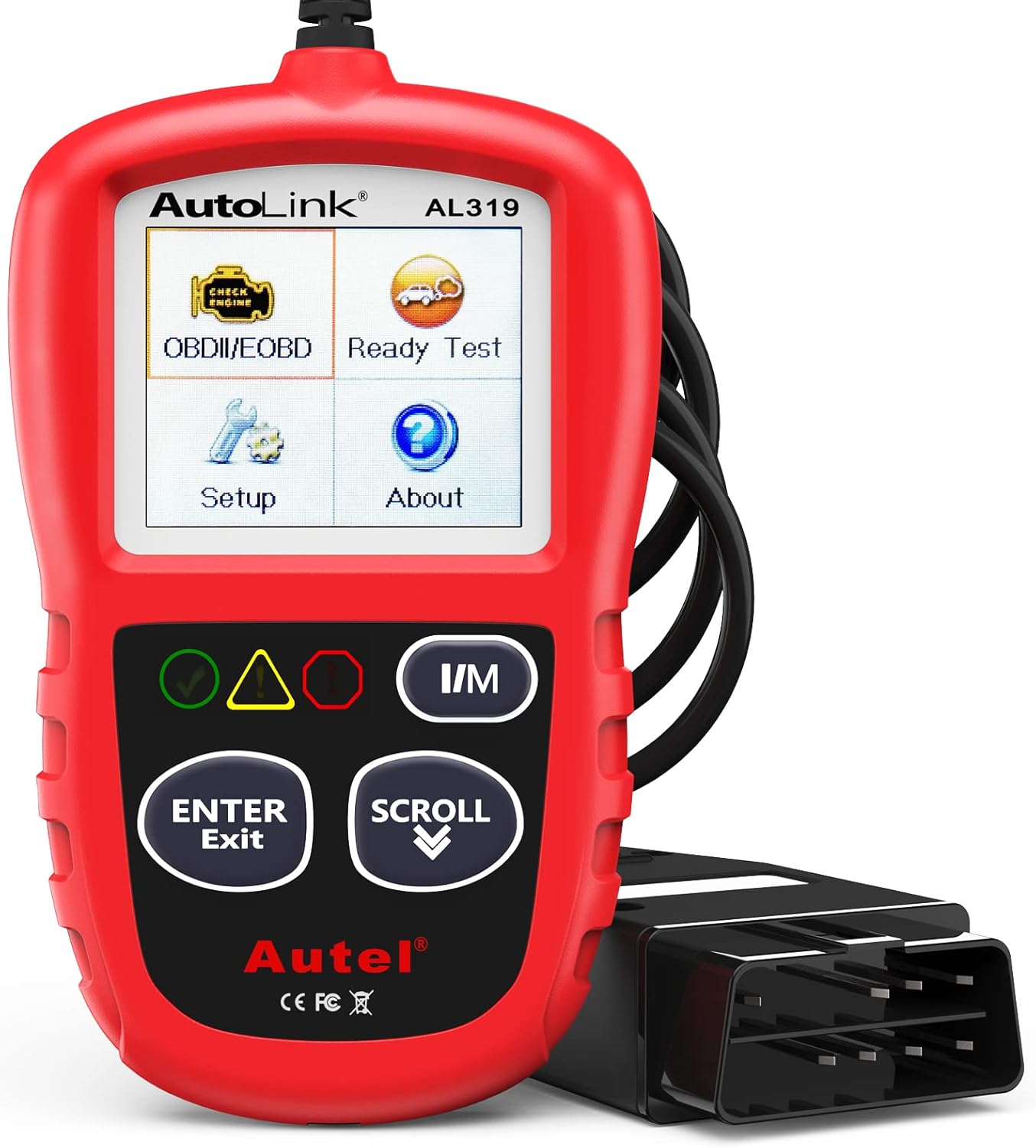
The Autel AL319 is a user-friendly OBD2 scan tool designed to help drivers quickly diagnose check engine light issues and understand vehicle fault codes. It supports reading and clearing DTCs, live data, freeze frame, I/M readiness, and vehicle information, making it a practical choice for DIYers and everyday car owners. With plug-and-play operation, a color display, built-in speaker, and broad vehicle compatibility, it delivers fast, reliable diagnostics without complicated setup.
What Symptoms Can a Toyota Camry P0012 Code Cause?
A Toyota Camry with P0012 may still run, but the symptoms can range from mild to serious. Watch for:
- Check-engine light or stored pending code
- Rough idle, hesitation, or reduced acceleration
- Hard starting or extended cranking
- Stalling, especially at idle or when stopping
- Poor fuel economy
- Engine rattling, especially during cold start on some engines
- Related codes such as P0010, P0011, P0016, or oil-pressure-related faults
Warning: Do not keep driving if the oil-pressure warning light is on, the oil level is very low, the engine is rattling loudly, the check-engine light is flashing, or the car is stalling. Shut the engine off safely and have the vehicle inspected before more engine damage occurs.
What Causes a P0012 Code on a Toyota Camry?
When dealing with the P0012 code, focus on oil flow, VVT control, sensor data, and mechanical timing. These are the most common areas to check before replacing parts.
| Possible Cause | What It Means | What to Check First |
|---|---|---|
| Low, dirty, or incorrect engine oil | The VVT system depends on clean oil at the correct level and viscosity. | Oil level, oil color, sludge, maintenance history, and correct oil specification. |
| Low oil pressure or restricted oil delivery | The oil level can look correct while the VVT system still receives inadequate pressure or flow. | Oil-pressure warning, engine noise, filter condition, pickup or passage restriction, and a mechanical pressure test using the exact engine specification. |
| Stuck VVT oil control valve | The oil control valve may not route oil pressure correctly to the cam phaser. | Connector, wiring, oil screen, and scan-tool command response. |
| Clogged oil passage or VVT filter screen | Sludge or debris can slow cam timing movement. | Oil condition, service history, and removable OCV screen where equipped. |
| Camshaft or crankshaft signal problem | This is a secondary possibility when related sensor or correlation codes are present; P0012 alone does not prove a bad position sensor. | P034x, P033x, or P0016 codes; unstable live data; connector corrosion; power, ground, and signal wiring. |
| Timing chain, tensioner, guide, or VVT actuator wear | Mechanical timing may be delayed or unstable. | Cold-start rattle, cam/crank correlation data, and model-specific TSBs. |
| Electrical fault | A broken wire, loose connector, short, or blown fuse can stop VVT control. | Harness routing, connector pins, fuse box, and voltage tests. |
[Products Worth Considering]

Puroma cabin air filter helps keep your vehicle interior fresher by capturing odor-causing contaminants and supporting cleaner airflow through the HVAC system. Its close-meshed filter layer and activated carbon design improve filtration performance while helping maintain efficient heating and air conditioning. Designed for a wide range of Honda and Acura models, it offers a straightforward installation and reliable passenger compartment protection.
This EL-50448 TPMS relearn tool helps quickly activate and reset tire pressure sensors so your vehicle’s monitoring system stays accurate after tire rotations, sensor replacement, or seasonal tire changes. Designed for many GM-related vehicles and compatible with common 315 and 433 MHz TPMS systems, it offers simple one-button operation and reliable performance for clearing warning lights and relearning sensor positions.
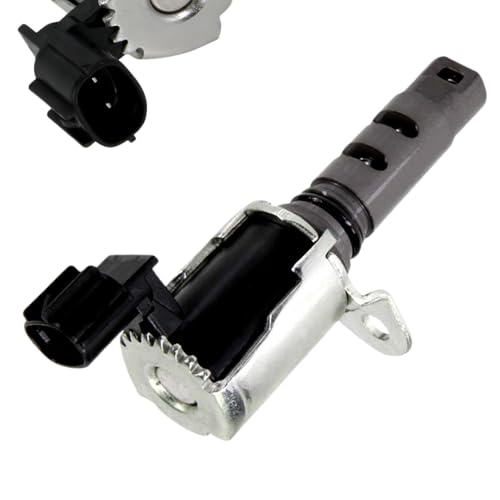
Part Number Fitment: 917-020, 1533028020, 19185367, TS1075, 15330-28020,917020
How Do You Check the Oil Before Diagnosing P0012?
Because Toyota’s VVT system depends on oil pressure and oil flow, the oil check comes first. Toyota’s 2025 Camry owner guidance says to warm the engine, turn the hybrid system off, wait about 5 minutes, and then check the dipstick. Older Camry procedures and oil specifications can differ, so follow the owner’s manual for your exact model year and engine.
- Park on a level surface. A slope can give a false dipstick reading.
- Warm the engine, then shut it off. Wait about 5 minutes so oil can drain back into the pan.
- Pull and wipe the dipstick. Reinsert it fully, then pull it out again for the real reading.
- Read the oil level. The oil should be between the low and full marks. Add the correct oil gradually if it is low.
- Inspect the oil condition. Very dirty, unusually thick, strongly fuel-smelling, milky, or sludgy oil needs attention before deeper VVT diagnosis.
- Check the maintenance history. If the oil is overdue, change the oil and filter with the correct viscosity and specification before deeper diagnosis.
Pro Tip: If P0012 appears right after an oil change, verify the oil level and oil viscosity first. Too little oil, too much oil, or the wrong viscosity can create VVT problems that look like a failed part.
What If P0012 Appeared After an Oil Change?
An oil change may reveal or contribute to a VVT problem, but the timing alone does not prove the shop caused the code. Check the simple service-related possibilities before replacing parts:
- Save the scan data first. Record P0012, related stored or pending codes, and freeze-frame data before clearing anything.
- Recheck the dipstick correctly. Confirm the engine is not underfilled or overfilled.
- Verify the oil container or invoice. The viscosity and specification must match the owner’s manual for that engine.
- Look for fresh leaks. Check around the oil filter, drain plug, oil cap, and the ground under the car.
- Confirm the filter is correct. A wrong, damaged, loose, or restricted filter can affect oil delivery.
Stop the engine: If the oil-pressure warning appears, the engine knocks or rattles loudly, or a major leak is visible, shut the Camry off and have it inspected before driving.
How Do You Inspect the VVT Oil Control Valve?
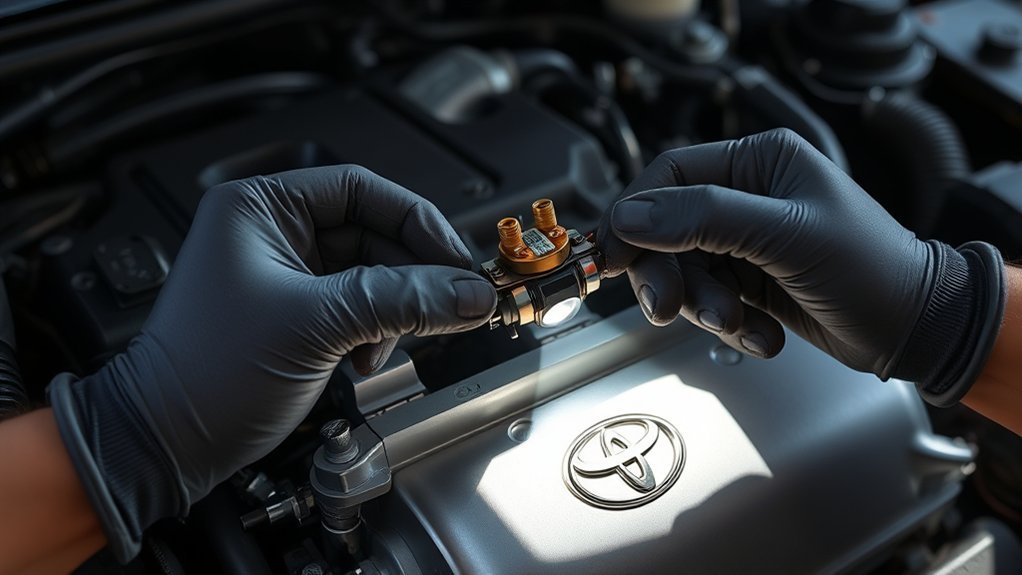
The VVT solenoid is often called the oil control valve or OCV on Toyota engines. Its job is to control oil flow to the camshaft timing actuator. If it sticks, gets clogged, loses power, or receives a bad command signal, cam timing may stay retarded and trigger P0012.
Do not assume the solenoid is in the same spot on every Camry. Location and removal steps vary by model year and engine. Use your exact engine code and Toyota repair information before unplugging or removing parts.
- Locate the correct valve. Confirm whether you are working on the intake-side oil control valve for Bank 1.
- Inspect the connector. Look for oil intrusion, corrosion, broken locks, loose terminals, or bent pins.
- Inspect the wiring. Follow the harness for rub-through, heat damage, rodent damage, or poor previous repairs.
- Check the oil screen or filter where equipped. Sludge or debris can block oil flow and slow VVT movement.
- Use a scan tool when possible. A professional scan tool can command VVT operation and compare commanded versus actual cam angle.
- Replace only after testing. A new solenoid will not fix P0012 if the real problem is dirty oil, low oil pressure, a wiring fault, or a mechanical timing issue.
Note: Some Toyota service information and TSBs require Toyota Techstream or equivalent scan-tool functions. A basic code reader can read and clear P0012, but it may not show the live cam timing data needed to confirm the fault. Do not apply battery voltage to an oil control valve or use a resistance specification unless the exact Toyota procedure calls for it; connector pinouts and test values vary.
[Products Worth Considering]

【Oe of products that mate with the plug & engine & year】Our vvt connector fit for 1533031020, 1533031030, 1534031020, 153300P020, 153300P030, TS1026, TS1027, TS1047, 153400P020 3.5L V6 2005 2006 2007 2008 2009 2010 2011 2012 2013 2014 2015 2016 05 06 07 08 09 10 11 12 13 14 15 16

Quality assurance service: If you encounter quality problems within one year, you can contact us and we will provide you with quality assurance service

Direct Replacement -Parts are manufactured to high standards of excellence, directly replacing the original damaged part.
When Should You Test the Camshaft Position Sensor?
Test the camshaft position sensor only when the evidence points toward a signal problem. P0012 by itself more often sends diagnosis toward oil flow, the VVT oil control circuit, or mechanical timing. Move the sensor higher on the list when P034x, P033x, or P0016 is also stored, the signal drops out, or the connector and harness are damaged.
- Scan for related codes. Look for cam sensor, crank sensor, VVT control, misfire, oil pressure, or cam/crank correlation codes.
- Review freeze-frame data. Note engine temperature, RPM, oil-related symptoms, and whether the code set at idle, startup, or highway speed.
- Inspect the sensor connector. Look for broken locks, pushed-out terminals, oil contamination, corrosion, or harness damage.
- Check power, ground, and signal. Use a multimeter or lab scope according to the service manual for your engine.
- Compare live data. If your scan tool supports it, compare commanded cam angle and actual cam angle while the engine warms up and RPM changes.
- Confirm before replacing. If the signal is stable and the cam still stays retarded, move back to oil flow, the VVT oil control valve, or mechanical timing checks.
When Should You Check the Timing Chain, VVT Actuator, or TSBs?
Many Camry engines that use VVT also use a timing chain, but older engines and different markets may use a different design. Verify the exact year and engine before assuming the timing drive, service procedure, or component location.
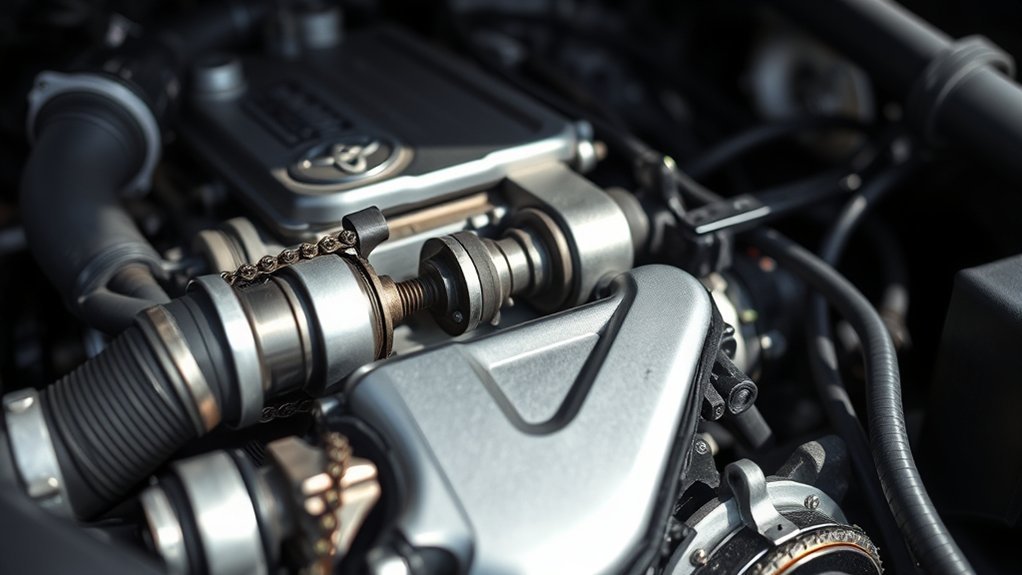
A stretched timing chain, weak tensioner, worn guide, stuck cam phaser, or failing VVT actuator can make actual cam timing lag behind the ECM’s command. Toyota T-SB-0041-13 Rev1 addresses an approximately one-second knock or rattle immediately after a cold-soak start on listed 1AR-FE and 2AR-FE applications, including specified 2010–2012 Camry VDS and WMI combinations. Its production-change limits also matter. The bulletin is not a universal P0012 repair and does not apply to every Camry with startup noise. Confirm the VIN, engine, production details, and current Toyota service information before using it.
| What You Notice | Possible Meaning | Next Step |
|---|---|---|
| P0012 returns immediately after clearing | Active VVT, wiring, sensor, or timing fault | Check live data and commanded vs. actual cam timing. |
| Rattle for a second or two at cold start | Possible VVT actuator, tensioner, or chain-related issue | Check Toyota TSBs and have mechanical timing inspected. |
| Sludge under oil cap or very dirty oil | Oil flow restriction to VVT components | Service oil properly and inspect OCV screen or oil passages. |
| Poor idle plus cam/crank correlation code | Possible chain stretch, jumped timing, or sensor issue | Do not guess; get a mechanical timing check. |
What Is the Best Diagnostic Order for P0012?
Use this order to avoid replacing good parts:
- Read and save all scan data. Use the Camry OBD-II system as a guide. Record P0012, stored and pending codes, freeze-frame data, and any related cam/crank, VVT, misfire, or oil-pressure codes before clearing anything.
- Identify the exact engine. Confirm the model year, engine code, and Bank 1 layout before using a pinout, resistance value, active test, or timing procedure.
- Check oil level, condition, leaks, filter, and specification. Correct low oil, an incorrect fill, a service leak, a wrong filter, or overdue oil service first.
- Recheck only when it is safe. If the oil issue is corrected, no oil-pressure warning or severe noise is present, and the engine runs normally, clear the code and follow the applicable Toyota confirmation pattern to see whether P0012 returns.
- Inspect the VVT oil control circuit. Check the connector, harness, relevant fuses, oil screen or filter where equipped, and scan-tool command response.
- Verify oil pressure when indicated. If the oil-pressure warning, abnormal engine noise, slow VVT response, or oil-delivery concern remains, test mechanical oil pressure against the exact Toyota specification before condemning timing parts.
- Check camshaft and crankshaft sensor data. Look for unstable signals, dropouts, or correlation faults, especially when related P033x, P034x, or P0016 codes are present.
- Inspect mechanical timing if needed. If the electrical, oil-control, and oil-pressure checks pass, inspect the timing chain or belt system, guides, tensioner, and VVT actuator according to the engine-specific procedure.
- Confirm the repair. After completing the repair, clear the Camry’s OBD-II codes safely, run the engine to operating temperature, and complete the applicable drive cycle while watching for returning stored or pending codes. Clearing codes also resets emissions readiness monitors.
When Should a Mechanic Diagnose a Camry P0012 Code?

If the oil level is correct, the oil is clean, and P0012 comes back, a mechanic is the safer next step. The diagnosis can require oil-pressure testing, an active VVT command, live commanded-versus-actual cam timing data, circuit checks, and mechanical timing verification. Ask the shop to document the failed test or out-of-range result before authorizing a sensor, oil control valve, VVT actuator, or timing repair.
Diagnosing Complex Issues
A technician can compare commanded cam timing against actual cam timing, test the VVT oil control valve circuit, inspect cam/crank correlation, and verify mechanical timing. This is especially useful when P0012 appears with rough running, rattling, stalling, or additional codes.
Avoiding DIY Mistakes
The most common DIY mistake is replacing the camshaft position sensor or VVT solenoid before checking oil level, oil quality, wiring, and scan-tool data. Another mistake is clearing the code without fixing the cause. If the cam timing stays retarded, the light will usually return.
Ensuring Proper Repairs
For Toyota-specific diagnosis, use the correct repair manual, wiring diagram, and technical service bulletins for your exact model year and engine. Toyota’s Technical Information System is the official source for Toyota repair manuals, electrical wiring diagrams, owner manuals, and TSBs.
Frequently Asked Questions
How do you fix the code P0012 on a Toyota Camry?
Save the scan data, then check the engine oil level, condition, leaks, filter, and correct oil specification. Correct any oil problem first. If P0012 returns, inspect the intake VVT oil control valve and circuit, compare commanded and actual cam timing, verify oil pressure when symptoms point to an oil-delivery problem, review camshaft and crankshaft signals when related codes are present, and inspect mechanical timing only when the test results support it.
How much does it cost to fix a P0012 camshaft timing issue?
The cost depends on the cause. Correcting the oil level may cost little or nothing, while an oil and filter service is usually a lower-cost repair. A VVT oil control valve, wiring repair, sensor, timing-chain repair, or VVT actuator repair can cost much more because parts, labor, engine design, and shop rates vary.
Can I drive my Toyota Camry with a P0012 code?
A short drive may be possible when the engine runs normally and the oil level is correct, but do not ignore the code. Stop driving if the oil-pressure light comes on, the check-engine light flashes, the engine stalls, a major oil leak appears, or you hear severe rattling.
Can low oil cause a P0012 code?
Yes. The VVT system uses engine oil pressure and flow to move the cam timing actuator. Low oil, dirty oil, sludge, a restricted filter or passage, or the wrong oil specification can slow VVT movement and cause the intake cam timing to stay too far retarded.
Will clearing the P0012 code fix the problem?
No. Clearing the code only removes the warning temporarily and resets emissions readiness monitors. If the ECM still sees the camshaft timing staying too far retarded, P0012 will return. Diagnose and repair the oil, VVT control, wiring, signal, or mechanical timing issue first.
Is P0012 always a bad camshaft position sensor?
No. P0012 alone more often points toward oil flow, the VVT oil control circuit, or mechanical timing. Test the camshaft position sensor when related sensor or correlation codes are present, the signal is unstable, or the connector and wiring are damaged.
Why did P0012 appear after an oil change?
Check for an incorrect oil level, wrong viscosity or specification, a leaking filter or drain plug, and the correct filter application. The timing may be coincidental, so save the code and freeze-frame data before assuming the oil change caused the fault. Stop the engine if the oil-pressure warning appears or the engine rattles loudly.
What is Bank 1 on a Toyota Camry?
On an inline 4-cylinder Camry, there is only one cylinder bank, so it is Bank 1. On a V6 Camry, Bank 1 is the side containing cylinder No. 1. Use the engine-specific Toyota diagram before choosing a sensor, oil control valve, or test point because the physical bank location varies by engine.
Does P0012 mean the timing chain jumped?
No. P0012 reports that actual intake-cam timing stayed more retarded than commanded. Low or contaminated oil, restricted oil flow, an oil control valve or circuit fault, low oil pressure, a sensor-signal problem, a VVT actuator issue, or incorrect mechanical timing can produce that result. Check the simpler oil and control causes before opening the timing system.
Conclusion
The P0012 code in your Toyota Camry means the ECM sees Bank 1 intake-cam timing staying more retarded than commanded. Save the scan data first, then check the oil level, condition, leaks, filter, and correct specification. If the code returns, test the intake VVT oil control circuit, compare commanded with actual cam timing, and verify oil pressure when the symptoms justify it before moving to sensor replacement or mechanical timing work. Stop driving for an oil-pressure warning, severe rattle, stalling, a major oil leak, or a flashing check-engine light. Otherwise, follow the Toyota procedure for your exact VIN and engine.
Sources
- SAE International J2012 Diagnostic Trouble Code Definitions — backs up standardized DTC definitions.
- eCFR 40 CFR 86.1806-17 Onboard Diagnostics — explains OBD systems storing malfunction codes and alerting drivers.
- Toyota Owners 2025 Camry Maintenance Data — supports Toyota oil-level checking guidance and owner-manual verification.
- Toyota 2025 Camry Warranty & Maintenance Guide — supports scheduled maintenance and oil/filter service context.
- Toyota Technical Information System — official source for Toyota repair manuals, wiring diagrams, owner manuals, and TSBs.
- NHTSA-hosted Toyota T-SB-0041-13 Rev1 — covers an approximately one-second cold-start knock or rattle on listed 1AR/2AR applications, including specified 2010–2012 Camry identifiers and production conditions.