
Your Toyota RAV4’s tire pressure can change quickly when the weather changes. Cold air usually lowers PSI, warm air raises it, and even a few pounds of pressure can affect handling, tire wear, fuel economy, and braking. The safest approach is simple: check the tires when they are cold, use the PSI listed on your driver-side door placard, and adjust before long trips or major temperature swings.
Quick Answer
Yes. RAV4 tire pressure typically changes about 1 PSI for every 10°F change in temperature. Many 2020 RAV4 Hybrid trims with 225/65R17 tires list 36 PSI cold, but some trims and wheel packages differ, so always follow the tire placard on your driver-side door jamb.
Key Takeaways
- Tire pressure usually drops about 1 PSI for every 10°F decrease and rises about 1 PSI for every 10°F increase.
- Check pressure when tires are cold, meaning the RAV4 has been parked for at least three hours or driven only a short distance.
- Do not rely on the tire sidewall number for normal inflation; that is a maximum tire rating, not Toyota’s recommended pressure.
- Use your RAV4’s driver-side door placard or owner’s manual because the correct PSI can vary by trim, tire size, and wheel package.
At a Glance
| Time Required | 5–10 minutes |
| Difficulty | Easy |
| Tools Needed | Accurate tire pressure gauge and air compressor |
| Cost | Usually free at home or a gas station; $5–$20 for a basic gauge |
Understanding Tire Pressure Basics for the RAV4
Tire pressure is the amount of air inside each tire, measured in PSI. On a RAV4, the correct pressure helps the tires carry the vehicle’s weight, keep stable contact with the road, and support predictable steering, braking, and fuel economy.
For many 2020 Toyota RAV4 Hybrid models with 225/65R17 tires, the recommended cold pressure is 36 PSI for both front and rear tires. However, not every RAV4 uses the same setting. Some trims and wheel packages, including certain 18-inch and 19-inch setups, may call for a different PSI. That is why the most reliable number is the one printed on your own vehicle’s tire and loading information label, usually on the driver-side door jamb.
Note: Check the Toyota placard or owner’s manual before adding air. The number molded into the tire sidewall is the tire’s maximum cold inflation pressure, not the recommended everyday pressure for your RAV4.
How Temperature Impacts Tire Pressure
Temperature affects tire pressure because air expands when it warms and contracts when it cools. A practical rule of thumb is that tire pressure changes about 1 PSI for every 10°F change in outside temperature. That means a RAV4 set to 36 PSI on a 70°F afternoon may read close to 32 PSI on a 30°F morning, even if the tire has no leak.
A 40°F temperature drop can reduce tire pressure by roughly 4 PSI, enough to make a properly inflated tire look under-inflated the next morning.
Temperature Drops and Low Pressure
Cold weather is the most common reason drivers suddenly see a tire pressure warning. If the air cools overnight, the pressure inside the tire drops. That does not always mean the tire is damaged, but it does mean you should check the PSI with a gauge and inflate to the placard pressure if needed.
Temperature Rises and High Pressure
Warm weather can raise tire pressure. Driving also warms the tires, which can make the PSI reading higher than it is when the tire is cold. That is why tire pressure should be checked before driving, not after a long trip.
Pro Tip: If you must check tires after driving, do not bleed air just because the reading is higher than the placard. Let the tires cool first, then recheck.
Why the Correct RAV4 PSI Matters
Keeping your RAV4 tires at the correct cold PSI matters because the tires are the only part of the vehicle touching the road. Proper inflation helps with:
- Fuel efficiency: Correct pressure reduces unnecessary rolling resistance.
- Even tire wear: Proper inflation helps the tread wear more evenly across the tire.
- Handling and braking: Correct pressure helps maintain traction and steering response.
- Ride comfort: Tires that are too low or too high can make the ride feel unstable, harsh, or sloppy.
- Tire life: Avoiding under-inflation and over-inflation helps reduce heat buildup, tread damage, and premature replacement.
Recommended RAV4 Tire Pressure by Trim and Tire Size
The original article treated 36 PSI as the universal 2020 RAV4 Hybrid number. That is close for some trims, but not all of them. RAV4 tire pressure depends on model year, trim, tire size, load, and wheel package.
| Example 2020 RAV4 Hybrid Setup | Common Cold PSI | What to Do |
|---|---|---|
| Hybrid LE / XLE with 225/65R17 tires | Often 36 PSI front and rear | Confirm on the driver-side door placard. |
| Hybrid Limited / XSE with 225/60R18 tires | Often around 33 PSI front and rear | Do not inflate to 36 PSI unless your placard says so. |
| Gas RAV4 trims with 17-, 18-, or 19-inch wheels | Varies by tire size and trim | Use the placard, not another owner’s setting. |
If your RAV4 has replacement tires in a different size than the factory tires, ask a Toyota dealer or qualified tire professional to verify the correct inflation pressure using approved load and inflation guidance.
[Products Worth Considering]

The JACO ElitePro Digital Tire Pressure Gauge delivers shop-grade accuracy with a clear digital readout, making it easy to maintain proper tire pressure for safer driving and better performance. Built with rugged brass and steel components, a protective guard, and a flexible air hose, it is designed for reliable use across cars, trucks, motorcycles, bikes, RVs, and trailers. The lock-on display, built-in bleeder valve, and bright backlit screen add convenience in any lighting condition.

The ETENWOLF T300 digital tire pressure gauge delivers accurate readings for cars, trucks, RVs, bikes, and heavy-duty vehicles with a wide pressure range and reliable calibration. It is built to perform in extreme temperatures, includes an LED light for dark conditions, and uses replaceable AAA batteries for long-term convenience. Its durable design and automatic shut-off make it a practical, dependable tool for everyday tire maintenance.

This portable tire inflator delivers fast, convenient inflation for cars, bikes, motorcycles, and balls with dual power options from a rechargeable battery or a 12V car cord. Its digital LCD pressure gauge and automatic shutoff help prevent over-inflation, while multiple preset modes and a custom setting make it easy to use for different inflation tasks. Built-in flashlight and USB power ports add extra emergency utility on the road.
Consequences of Under-Inflation in Your RAV4 Tires
Under-inflation means the tire has less air than Toyota recommends for your vehicle. This can happen after a cold snap, from natural air loss over time, or from a slow leak. Driving with low tire pressure can cause several problems:
- More heat buildup: A low tire flexes more as it rolls, which can raise internal heat.
- Uneven tread wear: Under-inflated tires often wear faster on the outer shoulders.
- Lower fuel economy: Low pressure increases rolling resistance.
- Poorer handling: The RAV4 may feel less stable during turns, braking, and lane changes.
- Higher risk of tire failure: Severe under-inflation can contribute to tread separation, flats, or blowouts.
Warning: Do not keep driving on a tire that looks visibly low, makes noise, shakes, or repeatedly loses pressure. Pull over safely, inspect it, and use the spare or roadside assistance if needed.
The Dangers of Over-Inflation and Tire Pressure Risks
Over-inflation means the tire has more pressure than recommended. Some drivers add extra air in cold weather or assume “more PSI is safer,” but that can create its own problems.
Over-Inflation Consequences
Too much air can reduce the tire’s contact patch and make the center of the tread carry more load than it should. Possible results include:
- Reduced ride comfort
- Less predictable traction on rough or wet roads
- Faster wear in the center of the tread
- Greater sensitivity to potholes and road impacts
Tire Blowout Risks
Both under-inflation and over-inflation can increase tire stress. Under-inflation is especially dangerous because it creates heat buildup, while over-inflation can make a tire more vulnerable to impact damage. The safest target is not “as much air as possible”; it is the cold PSI recommended by Toyota for your exact RAV4.
Handling and Stability Issues
RAV4 handling depends on all four tires having the correct pressure. If one tire is much lower than the others, the vehicle may pull, feel unstable, or respond differently during emergency braking. If all four tires are over-inflated, the ride may feel harsh and traction may suffer on uneven pavement.
How to Check RAV4 Tire Pressure Correctly
Checking tire pressure is simple, but timing matters. Follow these steps for the most accurate result:
- Park for at least three hours. Tire pressure should be checked when the tires are cold.
- Find the recommended PSI. Look at the tire and loading information label on the driver-side door jamb.
- Remove the valve cap. Keep it somewhere safe so it does not roll away.
- Press the gauge firmly onto the valve stem. A brief hiss is normal, but a long hiss means the gauge is not seated correctly.
- Compare the reading to the placard. Add air if the tire is low, or release a small amount only if it is above the cold recommended pressure.
- Recheck after adjusting. Confirm each tire matches the recommended cold PSI.
- Replace the valve caps. Valve caps help keep dirt and moisture out of the valve stem.
[Products Worth Considering]

This heavy-duty dual cylinder air compressor delivers fast, reliable inflation for off-road vehicles, trucks, RVs, and other outdoor gear. Built with a metal shell, aluminum cylinders, and thermal protection, it is designed to handle demanding inflating tasks while helping keep the motor cool and stable during use. The included hose, gauge, adapters, and carrying bag make it a practical portable solution for road trips, recovery kits, and recreational inflation needs.
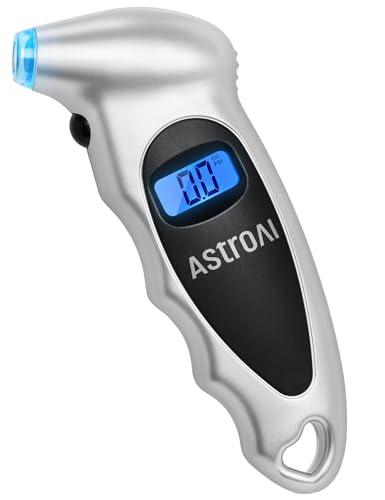
Accurate, Dependable Readings: Factory‑calibrated to ±1 PSI, so you can confidently match your vehicle’s recommended PSI (check the door jamb sticker). Ideal for monthly checks and road trips — consistent results every time, cold or warm.
Tips for Regular Tire Pressure Checks
Check your RAV4 tire pressure at least once a month and before long trips. You should also check it after a major temperature swing, before towing or carrying a heavy load, and whenever the tire pressure warning light turns on.
Use a reliable digital or dial gauge instead of judging tire pressure by appearance. Modern tires can look normal even when they are several PSI low. Also, remember to check the spare tire if your RAV4 is equipped with one.
What to Do When the RAV4 TPMS Light Comes On
The Tire Pressure Monitoring System, or TPMS, warns you when one or more tires are significantly under-inflated. It is helpful, but it is not a replacement for regular checks with a gauge.
- Slow down and drive carefully. Avoid hard braking, sharp turns, and highway speeds until you know what is wrong.
- Check all four tires with a gauge. Do not assume the lowest-looking tire is the only problem.
- Inflate to the door-placard PSI. Use the cold pressure recommendation whenever possible.
- Inspect for damage. Look for nails, cuts, bulges, cracks, or a valve stem leak.
- Drive normally and monitor the light. In many cases, the warning turns off after the system detects corrected pressure.
- Get service if the light stays on or flashes. A flashing TPMS light may indicate a system fault, sensor issue, or other problem that needs diagnosis.
Note: Federal TPMS requirements are designed to warn about significant under-inflation. Your tires can still be a few PSI low before the warning appears, so monthly gauge checks still matter.
[Products Worth Considering]

HIGH QUALITY: Marsflex tire pressure sensors include a CR2450 battery and a cutting-edge technology chip. The upgraded battery improves the operating temperature range to -40℃~+125℃, and has 5-8 years lifespan. The chip provides best signal strength, real-time reading the condition of your tire

[Accurate Real-time Monitoring & Multi-Alert System]: Tymate TM7 tpms sensor can be used to monitor your tires’ pressure and temperature data within robust accuracy of ±1.5 PSI or ±3°F (The units can be displayed as ℃ or ℉ & BAR or PSI). Designed with six distinct alarm modes: high/low pressure, fast leakage, high temperature, sensor low battery, and sensor signal lost. This system is a reliable tool for maintaining tire health, and it is especially beneficial for DIY enthusiasts and pre-owned vehicle markets, where constant vigilance on tire conditions is paramount for safety and vehicle longevity

[Discover Five Alarm Modes and Simple Setup for Alarm Thresholds]: With the Tymate Tire Pressure Monitoring System TM2, you'll access six distinct alarm modes, covering fast leak detection, high/low-pressure alerts, high-temperature warnings, and sensor low voltage/signal loss notifications. Upon pairing, the system seamlessly configures the current pressure as the reference point, allowing for easy setup of alarm thresholds (with an Alarming Range from +25% PSI to -15% PSI of Reference Pressure)
Adjusting Your Tire Pressure for Cold Weather
Cold weather is when RAV4 owners most often notice tire pressure changes. If the temperature drops sharply, check your tires before driving and inflate them to the cold PSI listed on your door placard.
Temperature Impact on Pressure
For every 10°F drop, expect about 1 PSI of pressure loss. A 30°F overnight drop can reduce tire pressure by about 3 PSI. That may be enough to trigger the TPMS light or reduce your safety margin.
Recommended Pressure Adjustments
Do not add a random amount of “winter air.” Instead, set the tires to the recommended cold pressure in the morning or after the vehicle has been parked. If your door placard says 36 PSI, set the tires to 36 PSI cold. If it says 33 PSI, use 33 PSI cold.
Regular Maintenance Importance
Winter tire care should include pressure checks, tread checks, rotation, and inspection for sidewall damage. Low pressure can reduce traction and increase wear, while worn tread reduces grip on wet, snowy, or icy roads.
How Quality Tires Impact RAV4 Performance in Temperature Changes
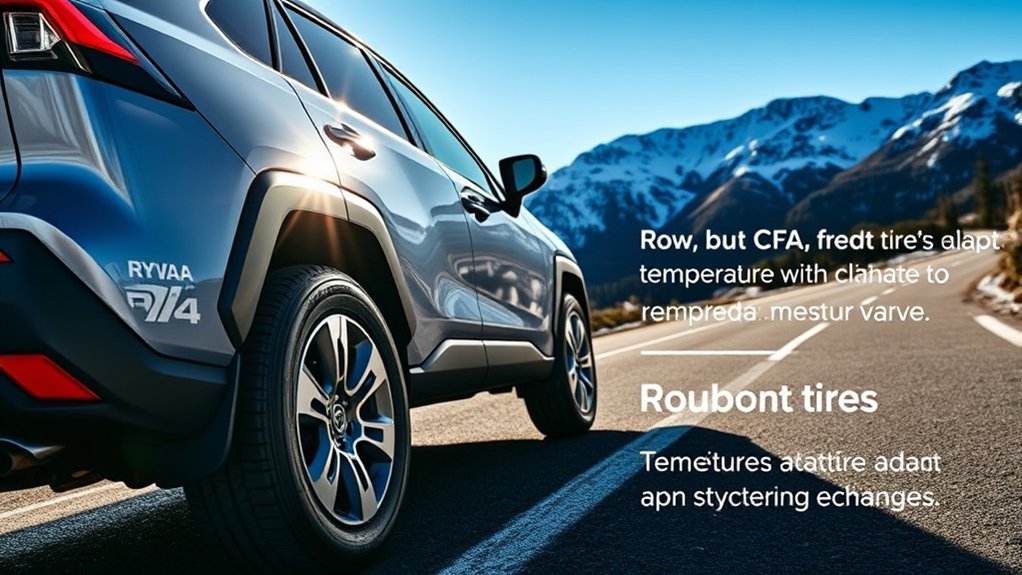
Tire quality affects how your RAV4 handles changing weather. A good tire with the right size, load rating, speed rating, tread depth, and seasonal design will handle temperature swings better than a worn, mismatched, or poorly maintained tire.
All-season tires are common on RAV4 models and work for many drivers, but severe winter conditions may require winter tires marked with the three-peak mountain snowflake symbol. If you switch to winter tires, use the size and pressure guidance recommended for your vehicle and tire setup.
Debunking Common Myths About Tire Pressure
Tire pressure myths can lead to poor handling, uneven wear, and unnecessary tire damage. Here are the big ones to avoid:
- Myth: The sidewall PSI is the correct pressure. The sidewall shows a maximum tire rating, not the recommended pressure for your RAV4.
- Myth: You only need to check pressure when the tire looks flat. Tires can be several PSI low and still look normal.
- Myth: TPMS replaces manual checks. TPMS is a warning system, not a monthly maintenance routine.
- Myth: Hot tires should be adjusted down to the placard PSI. Tire pressure rises after driving. Check again when cold before releasing air.
- Myth: Every 2020 RAV4 Hybrid uses 36 PSI. Many do, but some trims and tire sizes use different recommended pressures.
Resources for Tire Maintenance Education
For the most accurate tire pressure information, start with your RAV4’s tire placard and owner’s manual. Toyota’s owner resources explain vehicle-specific tire inflation guidance, while tire safety organizations explain general maintenance, cold-pressure checks, tread depth, rotation, and TPMS limits.
It also helps to keep a small tire gauge in the glove box. That way, you can check your tires at home, at a gas station, or before a road trip instead of waiting for the warning light.
Frequently Asked Questions
How does temperature affect RAV4 tire pressure?
Temperature changes tire pressure because air expands when warm and contracts when cold. A common rule is about 1 PSI for every 10°F change. Cold weather lowers pressure; hot weather and driving can raise it.
How much does tire pressure fluctuate with temperature?
Tire pressure typically changes about 1 PSI for every 10°F. For example, a tire set to 36 PSI at 70°F may read around 33 PSI at 40°F before the vehicle is driven.
Do I need to add air to my RAV4 tires when the temperature drops?
Yes, if the cold tire pressure is below the PSI listed on your driver-side door placard. Check the tires before driving and inflate them to the recommended cold pressure.
Should I put more air in my tires when it is hot?
Usually, no. Hot weather and driving naturally raise tire pressure. Check the tires when they are cold and set them to the placard PSI. Do not add extra air just because the weather is warm.
Is 36 PSI correct for every Toyota RAV4?
No. Many 2020 RAV4 Hybrid LE and XLE models with 225/65R17 tires use 36 PSI, but other trims and tire sizes can differ. Always use the tire and loading information label on your own RAV4.
Why did my RAV4 TPMS light turn on in the morning and go off later?
Cold morning air can lower tire pressure enough to trigger TPMS. After driving, the tires warm up and pressure rises, so the light may go off. You should still check the tires cold with a gauge.
Conclusion
Temperature absolutely affects RAV4 tire pressure. A drop or rise of only 10°F can change tire pressure by about 1 PSI, so seasonal weather shifts can move your tires several pounds away from the ideal setting. The best habit is to check tire pressure monthly, check it cold, and inflate to the PSI listed on your own RAV4’s door placard. That small routine helps protect fuel economy, tire life, braking, traction, and overall safety.
Sources
- Toyota Owners: 2020 RAV4 Hybrid Tire Inflation Pressure — vehicle-specific tire inflation reference.
- U.S. Tire Manufacturers Association: Tire Care Essentials — monthly checks, cold tire pressure, temperature changes, tread, rotation, and TPMS guidance.
- Bridgestone Americas: Tire Inflation — cold-pressure checking, 1 PSI per 10°F rule, and sidewall PSI clarification.
- NHTSA TireWise — tire safety, maintenance, recalls, and consumer tire care resources.
- 49 CFR § 571.138: Tire Pressure Monitoring Systems — federal TPMS performance requirements.



[…] sealant bottle, compressor, approved vehicle power outlet, gloves, and an RAV4 tire pressure gauge if […]