In a limited-slip differential vs locker comparison, choose a limited-slip differential for mostly paved driving, wet roads, light snow, towing, and street or track performance. Choose a locker when one driven tire may lift, unload, or lose nearly all traction off-road. If your vehicle regularly does both street miles and difficult trails, a selectable locker can provide normal open-differential behavior on pavement and full axle lock when the trail actually requires it.
Last updated: August 31, 2026 — revised with current Eaton, Torsen, ARB, and Ford guidance; expanded snow, traction-control, and differential-selection advice.
Quick Answer
Choose a limited-slip differential for smoother daily driving, predictable power delivery, and better traction on wet pavement or mild trails. Choose a locking differential when maximum low-speed off-road traction matters more than quiet street manners, tire wear, and smooth turning behavior. For a vehicle that spends substantial time both on-road and off-road, a selectable locker is often the most flexible compromise.
Key Takeaways
- Limited-slip differentials resist excessive wheel-speed difference and can bias more usable torque toward the tire with better grip while still allowing normal differentiation in turns.
- Selectable lockers mechanically couple both axle shafts when engaged, giving a major advantage when one tire is on mud, rocks, deep snow, or hanging in the air.
- Automatic lockers use their own mechanical locking and unlocking action, so their street behavior is different from a selectable locker.
- Selectable lockers are often the most flexible option for a mixed-use 4×4 because they can stay open on pavement and lock only when needed.
- Spools eliminate differential action completely and are not a good choice for normal street-driven vehicles.
- Always match the differential to your axle, gear ratio, tire size, driving surface, electronic systems, and maintenance tolerance before buying.
Quick Decision: Limited-Slip Differential vs Locker
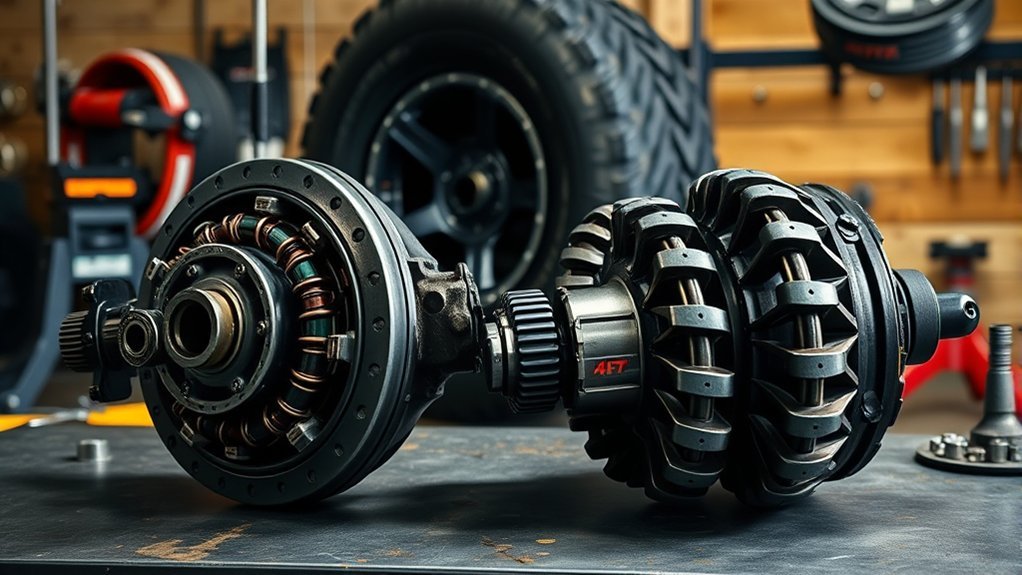
Pick the differential by the worst traction problem your vehicle regularly faces, not by which part sounds more aggressive. If both driven tires normally stay on the ground and road manners matter, an LSD is usually the better fit. If one tire regularly becomes nearly unloaded or airborne, a locker has the stronger mechanical advantage.
| Driving Use | Best Choice | Why |
|---|---|---|
| Daily commuting | Limited-slip | Smoother turns, less intrusive behavior, and improved traction under acceleration. |
| Rain, light snow, mixed pavement | Limited-slip | Usually smoother than a locked axle on paved winter roads while reducing one-wheel spin. Proper tires remain essential. |
| Track or spirited street driving | Clutch or helical limited-slip | Helps use the available traction across the driven axle while cornering and accelerating. |
| Rocks, deep mud, ruts, uneven trails | Locker | Keeps the axle mechanically coupled when one tire has very little resistance or leaves the ground. |
| Deep or uneven off-road snow | Selectable locker | Useful at low speed when one tire repeatedly unloads, provided the vehicle manufacturer allows locker use in those conditions. |
| Mixed street and trail use | Selectable locker or helical LSD | Choose a selectable locker for harder trails; choose an LSD when most miles remain on pavement. |
Decision Rule: If your main problem is wheelspin while both tires remain loaded, start with an LSD. If your main problem is one tire becoming almost completely unloaded, choose a locker. If both situations are common, a selectable locker gives you the clearest separation between street and trail behavior.
[Products Worth Considering]
Country of Origin : China

Precise Purpose: Designed to provide smooth yet aggressive traction, enhancing truck or car handling and stability in demanding conditions with composite clutches, giving optimal torque distribution

Differential Type: Limited Slip (LSD); Gear Spline Tooth Count: 27 EA
Why an Open Differential Is the Baseline
An open differential allows the two wheels on an axle to rotate at different speeds, which is necessary when turning. In a conventional open differential, the two outputs receive essentially equal torque. The limitation appears when one tire can support very little torque because it is on ice, loose mud, or nearly off the ground. The usable torque at the higher-grip tire is then limited too, even though that tire could handle more.
An LSD adds resistance to that differential action so the axle can support a larger torque difference between the two sides. A locker goes further: in its locked state, it prevents the two axle shafts from rotating independently.
For most cars and trucks that stay on pavement, a limited-slip differential is the easier choice. For a trail rig that regularly lifts a tire or crawls over uneven terrain, a locker gives a level of low-speed traction an LSD cannot always match.
How Limited-Slip (LSD) Differentials Work and When They Win
A limited-slip differential allows the left and right wheels to rotate at different speeds in a turn, but it resists excessive difference between the two outputs. That makes it more useful than an open differential when traction becomes uneven while still feeling more natural on pavement than a fully locked axle.
Different LSD designs use different methods. Clutch-type units use friction plates. Helical or Torsen-style units use gear geometry and internal friction. Viscous units use fluid resistance. Their common purpose is to reduce uncontrolled one-wheel spin and make more of the axle’s available traction usable.
How LSDs Transfer Torque
Think of an LSD as a traction-biasing device, not a full mechanical lock. A helical torque-biasing differential such as the Eaton Detroit Truetrac is designed to support a larger torque difference across the axle when traction differs. Eaton says a typical aftermarket Truetrac can deliver approximately three times the torque of the slipping wheel to the higher-traction wheel.
That torque-bias behavior is useful on wet roads, loose gravel, mild trails, and corner exit. It is not the same as a locker. If one tire has almost no resistance, such as when it is fully in the air, a gear-type torque-biasing LSD may need resistance from brake-based traction control or light brake input to develop useful bias.
Note: “Limited-slip” does not mean “always locked.” It means the differential limits or resists differential action according to its design. Exact behavior depends on the LSD type, preload, torque-bias characteristics, wear, lubricant, electronic controls, and available tire grip.
Clutch, Helical, and Viscous LSD Types
The three common LSD styles have different strengths:
- Clutch-type LSD: Uses friction plates and preload to resist differential action. It can be tuned for performance driving, but the clutches wear and the unit may require specific gear oil or friction modifier.
- Helical or Torsen-style LSD: Uses gears and internal friction to bias torque smoothly. These units are often quiet and low-maintenance, but their effectiveness depends on having enough resistance across the axle. Torsen describes its operation through helical gearing, internal friction, and a torque-bias ratio.
- Viscous LSD: Uses fluid shear to resist wheel-speed difference. Engagement is gradual, but older sealed viscous units can lose effectiveness as they age.
How Traction Control Can Change LSD Behavior
Brake-based traction control can complement a torque-biasing LSD. If the electronic system applies brake force to a rapidly spinning or lightly loaded tire, that resistance can give a helical differential more torque to work with on the opposite side. Torsen specifically notes that its differentials can work with brake-based traction and chassis-control systems to reduce the amount of electronic intervention required.
This does not make an LSD identical to a mechanical locker. Brake-based systems depend on vehicle calibration, brake temperature, available engine torque, and the exact differential design. On repeated low-speed obstacles where a tire continually becomes airborne, a true locker remains the more direct mechanical solution.
Best Use Cases for a Limited-Slip Differential
A limited-slip differential is usually the best choice when the vehicle needs more usable traction without giving up smooth road manners. It works especially well for:
- Daily drivers that see rain, snow, or mixed pavement.
- Rear-wheel-drive cars that need better acceleration traction.
- Street/track cars that need controlled power delivery while cornering.
- Tow vehicles that need more stable traction on boat ramps, gravel, or wet grass.
- Light off-road vehicles that do not regularly lift a driven tire.
If comfort, steering feel, and predictable pavement behavior matter most, start with an LSD before considering an automatic or permanently locked setup.
How Locking Differentials/Lockers Work and When They Win
A locking differential can mechanically couple both axle shafts so both wheels are driven together without relying on torque bias alone. That is why lockers are so effective off-road. When one tire is on a slippery rock or hanging in the air, the tire that remains on the ground can still receive useful drive.
This article is discussing axle lockers, which control left-to-right differentiation across an axle. A center differential lock controls front-to-rear driveline differentiation and is a different system. If your vehicle uses a center lock, see the site’s center differential lock guide for that distinction.
Lockers come in two broad categories: automatic and selectable. The difference matters because they behave very differently on the street.
[Products Worth Considering]

4-Pinion Net-Forged Gear Design For Max Strength And Durability


Eaton ELocker compatible with Dana 44 - 30 Spline Axles
How Lockers Engage
Automatic lockers, such as the Eaton Detroit Locker, manage locking and differentiation mechanically. Eaton describes the Detroit Locker as normally locked during straight-line driving while allowing wheel-speed differentiation during turns and maneuvers.
Selectable lockers, such as an ARB Air Locker, let the driver choose when the differential is locked. ARB describes its Air Locker as providing normal open-differential behavior when disengaged and mechanically locking both axle shafts when activated.
Pro Tip: For a vehicle that sees both pavement and difficult trails, a selectable locker is often easier to live with than an automatic locker because you can leave it unlocked until low-speed terrain actually requires full axle lock.
Benefits On Rough Terrain
Lockers win when traction becomes severely uneven. In mud, rocks, ruts, deep snow, and steep loose climbs, a locker can keep the vehicle moving when an open differential or torque-biasing LSD cannot make enough use of the tire that still has grip. This is why lockers are common on rock crawlers, overland builds, farm trucks, and serious trail vehicles.
The main benefit is mechanical consistency at the axle. When a selectable locker is fully engaged, both axle shafts are coupled rather than waiting for a clutch pack, torque-biasing mechanism, or traction-control system to react.
Tradeoffs For Street Use
The same locked behavior that helps on loose terrain can create problems on high-grip pavement. When both wheels are forced to rotate at the same speed, the inside and outside tires cannot naturally follow their different paths through a turn. That can cause tire scrub, binding, hopping, extra steering effort, noise, and faster tire wear.
Warning: Do not engage a selectable locking differential on dry pavement unless your vehicle or locker manufacturer specifically permits it. Ford’s electronic-locking-differential guidance, for example, warns that dry-pavement use can increase tire wear, noise, and vibration. Engagement speeds and allowed surfaces vary by vehicle, so follow the exact owner’s manual for your setup.
Automatic lockers can also feel abrupt during throttle changes. Eaton notes that many street drivers may find Detroit Locker engagement aggressive even though the unit can differentiate while turning. Some drivers accept that behavior for the traction benefit; others prefer a selectable locker or an LSD for a vehicle that spends most of its time on pavement.
Is an LSD or Locker Better in Snow?
For normal paved winter driving, an LSD is usually the easier choice because it can reduce one-wheel spin without forcing both axle shafts to stay locked together through every turn. A helical LSD can also work with modern brake-based traction control, depending on the vehicle.
A selectable locker becomes more useful in deep, uneven, low-speed snow where one wheel repeatedly loses most of its load or traction. Engage it only on surfaces and at speeds permitted by the vehicle or locker manufacturer. Neither an LSD nor a locker creates more tire-to-road friction, so winter tires, speed, braking distance, and careful steering remain critical.
Automatic vs Selectable Lockers
| Locker Type | Strength | Tradeoff |
|---|---|---|
| Automatic locker | Strong traction without a driver-operated engagement switch. | Can click, clunk, chirp tires, or feel abrupt depending on design and driving input. |
| Selectable air locker | Open when disengaged and mechanically locked when activated. | Needs air lines, compressor hardware, controls, and careful installation. |
| Selectable electric locker | Driver-controlled locking without a pneumatic system. | Needs wiring and may have vehicle-specific speed, mode, or engagement restrictions. |
| Factory electronic locker | Integrated with the vehicle and its electronic systems. | Often limited by speed, drive mode, drivetrain setting, or surface conditions. |
Spools vs Differentials: What They Do and When to Avoid Them
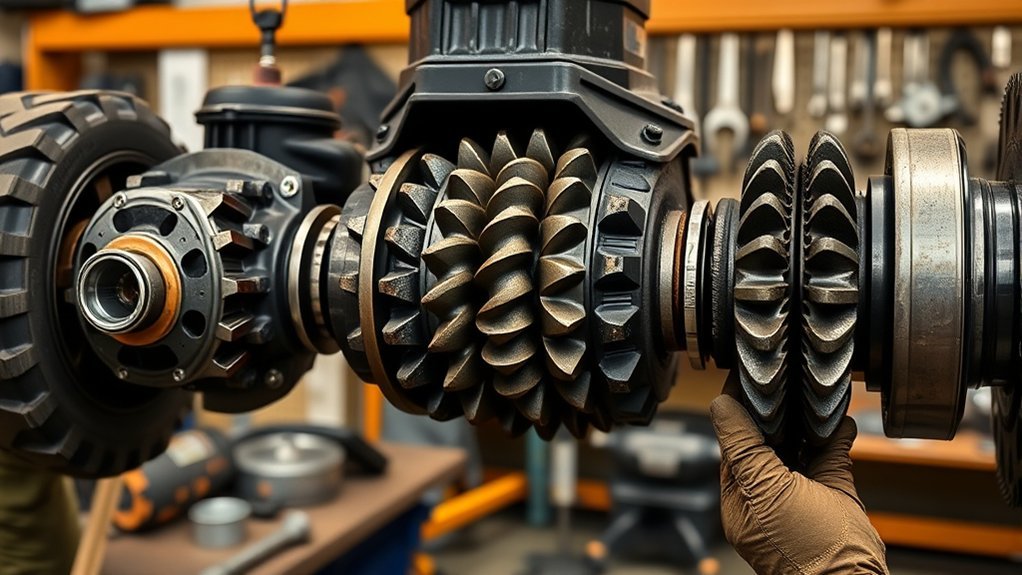
A spool is not really a differential. It connects both axle shafts together all the time, so both wheels are forced to rotate at the same speed. That gives consistent straight-line drive but removes normal differential action completely.
| Item | Benefit | Tradeoff |
|---|---|---|
| Full spool | Permanent axle coupling and simple operation. | Poor street manners, tire scrub, and heavy turning bind. |
| Mini spool | A simpler way to eliminate differential action in compatible applications. | Same permanently coupled turning behavior with little street refinement. |
| Open differential | Smooth, quiet cornering. | Usable axle torque can become severely limited when one tire has very little traction. |
| Limited-slip differential | Balanced traction and drivability. | Some types cannot match a locker when one tire has almost no resistance. |
| Locker | Excellent low-speed off-road traction when locked. | More bind, noise, steering effect, or tire wear depending on locker type and operating state. |
Avoid spools on normal street-driven vehicles. They make more sense in dedicated racing, off-road, or other controlled-use builds where differential action, turning comfort, and normal tire wear are not priorities.
Choose Your Axle: Daily Driver, Performance, or Off-Road
The best axle setup depends on how much traction you need and how much compromise you can tolerate.
- Daily driver: Choose a helical or appropriately calibrated clutch-type LSD for smooth behavior and improved all-weather traction.
- Performance street car: Choose a performance LSD matched to your suspension, tires, power level, and intended cornering behavior.
- Track car: Choose an LSD with lock characteristics that suit corner entry, mid-corner balance, and corner-exit traction.
- Tow vehicle: Choose an LSD for boat ramps, gravel, and wet roads, or a selectable locker if the truck also sees difficult trails.
- Overland or trail rig: A selectable rear locker is a strong starting point when difficult uneven terrain is common but normal road behavior still matters.
- Rock crawler: Front and rear lockers may provide the strongest capability, but confirm axle strength and understand that a locked front axle can make steering much harder.
[Products Worth Considering]

Easy, drop-in installation

✅【Compatible With 】For Cadillac Escalade 2007-2014; Chevrolet Express 1500 2013-2014; Chevrolet Silverado 1500 2013-2018; GMC Savana 1500 2013-2014; GMC Sierra 1500 2013-2018

Bulkhead fitting kit
Front vs Rear Locker or LSD
For many rear-wheel-drive trucks and 4x4s, the rear axle is the first place to consider an upgrade. A rear LSD improves traction with little direct effect on steering. A rear selectable locker gives a major off-road gain while leaving the front axle free to differentiate for easier turning.
A front locker is powerful off-road, but steering effort and turning resistance can increase sharply when it is locked. For that reason, many mixed-use 4x4s start with a rear selectable locker and add a front locker only if the terrain and vehicle setup justify it.
Quick Checklist: Maintenance, Compatibility, and Cost
Before buying any differential, confirm the details that affect fitment, driving behavior, and long-term cost. Do not order by vehicle name alone.
- Axle model: Match the differential to the exact axle housing and application.
- Spline count: Confirm axle-shaft spline count before ordering.
- Gear ratio and carrier break: Some axle families use different differential carriers or applications across gear-ratio ranges.
- ABS and traction control: Confirm that the differential is compatible with the vehicle’s electronic systems.
- Fluid requirements: Follow the instructions for the exact differential. Some clutch LSDs use dedicated lubricant or friction modifier, while some gear-type units specify different requirements. Do not assume one LSD fluid rule applies to every design.
- Installation skill: Carrier-bearing preload, backlash, gear contact pattern, and fastener torque matter. Poor setup can cause noise, heat, or gear failure.
- Street manners: Automatic lockers and permanently coupled setups can add noise, tire scrub, and abrupt behavior.
- Total cost: Include the differential, bearings, seals, oil, any required additive, wiring or air-system hardware, and installation labor.
Note: If the installation requires carrier or ring-and-pinion setup, professional installation is often worth considering. Incorrect preload, backlash, or gear-pattern setup can quickly become expensive.
Limited-Slip vs Locker: Final Comparison
| Category | Limited-Slip Differential | Locker |
|---|---|---|
| Daily comfort | Usually better | Depends strongly on locker type; selectable units are unobtrusive when disengaged |
| Wet pavement | Good when matched and driven appropriately | Automatic or engaged lockers can require more care |
| Paved winter roads | Usually the smoother choice | Use only as the vehicle and locker manufacturer permit |
| Rock crawling | Limited when traction becomes extremely uneven | Excellent |
| One tire in the air | Gear-type units may need brake resistance; behavior varies by LSD design | Strong advantage when mechanically locked |
| Noise and tire wear | Usually lower | Can be higher with automatic lockers or when a selectable locker is engaged on high-grip terrain |
| Best buyer | Daily driver, tow rig, street/track car | Trail rig, rock crawler, mud truck, mixed-use 4×4 with a selectable unit |
How This Comparison Was Built
This guide compares differential types by the conditions that actually separate them: whether both tires remain loaded, how the system behaves when one tire has very little resistance, street turning behavior, steering effects, interaction with traction control, maintenance needs, installation requirements, and manufacturer operating restrictions. Product names such as Detroit Truetrac, Detroit Locker, Torsen, and ARB Air Locker are used to explain specific designs; they are not blanket fitment recommendations for every axle or vehicle.
Frequently Asked Questions
Which is better, limited-slip or locking differential?
A limited-slip differential is better for most daily drivers because it improves usable traction without forcing the axle to remain locked through turns. A locking differential is better for serious off-road use because it can mechanically couple both sides of the axle when one tire has little or no usable traction.
Do both tires spin with limited slip?
Both tires can contribute drive with an LSD, but they are not automatically forced to rotate at the same speed like a mechanically locked axle. The result depends on LSD type, torque bias or preload, tire grip, lubricant condition, and any brake-based traction control working with it.
Is a locker bad for daily driving?
A selectable locker can work well in a daily-driven 4×4 because it can remain disengaged on pavement. An automatic locker can be less refined because engagement, disengagement, backlash, tire chirp, or throttle transitions may be more noticeable. Always follow the locker and vehicle manufacturer’s road-use instructions.
Is limited-slip good for off-road?
A limited-slip differential is useful for gravel, snow, sand, mild trails, and other conditions where both driven tires retain some resistance. A locker has the stronger advantage when one tire becomes almost completely unloaded or leaves the ground.
Should I put a locker in the front or rear first?
For many mixed-use 4x4s, a rear selectable locker is the simpler first step because it adds major traction without affecting steering as directly as a locked front axle. A front locker can add capability on harder obstacles, but steering effort and turning resistance can increase when it is engaged.
Is a limited-slip differential or locker better in snow?
An LSD is usually the easier option for normal paved winter driving because it can reduce one-wheel spin while preserving differential action in turns. A selectable locker can be more useful in deep, uneven, low-speed snow where one tire repeatedly loses most of its traction. Use a locker only under the conditions allowed by its manufacturer, and remember that winter tires remain critical for braking and cornering.
Do I need a locker if my vehicle has traction control?
Not always. Brake-based traction control can slow a spinning tire and may work especially well with a torque-biasing LSD. For normal roads and moderate trails, that may provide enough help. A mechanical locker still has an advantage on repeated low-speed obstacles where a tire becomes nearly unloaded and maximum axle coupling is needed.
Conclusion
A limited-slip differential is the smarter choice for most street-driven vehicles because it adds usable traction while preserving the wheel-speed difference needed for normal turning. A locker is the stronger choice for serious low-speed off-road driving because, when locked, it can keep an axle driving even when one tire has almost no useful resistance.
Choose an LSD when pavement manners, cornering, towing, and all-weather road traction matter most. Choose a locker when mud, rocks, deep ruts, and lifted tires are normal parts of the trip. For a true street-and-trail vehicle, a properly matched selectable locker offers the clearest split between normal road behavior and full mechanical lock when difficult terrain demands it.
Sources
- Eaton Detroit Truetrac FAQ — current torque-biasing operation, typical aftermarket torque-bias behavior, street operation, and lubricant guidance.
- Eaton Detroit Locker FAQ — automatic-locker operation, street behavior, turning differentiation, and front-axle considerations.
- ARB Air Lockers — selectable-locker operation, unlocked on-road behavior, and axle-locking function.
- Torsen: How It Works — helical torque-biasing principles, torque-bias ratio, and interaction with brake-based traction control.
- Ford Owner Manual: Electronic Locking Differential — dry-pavement warning and an example of vehicle-specific locker operating restrictions.
- Eaton Performance Differential Application Guide — fitment considerations including axle type, spline count, and gear ratio.