
Choose part-time 4WD when you mostly drive on dry pavement and want selectable 2H, 4H, or 4L for snow-covered roads, loose gravel, mud, sand, and slow off-road trails. Choose full-time 4WD when you want seamless four-wheel traction available during normal pavement driving across unpredictable conditions like rain, slush, black ice, and dry patches without risking drivetrain binding. Neither system is automatically superior off road: low-range gear reduction, center and axle lockers, traction control software, tire compound, and ground clearance determine real-world capability.
Last updated: July 22, 2026 — drivetrain definitions, shift-on-the-fly parameters, Toyota/Ford model examples, and technical safety sources were rechecked.
Affiliate disclosure: AutoReviewNest may earn a commission from qualifying purchases displayed in automatically inserted product modules, at no extra cost to you. This does not affect the editorial guidance in this article.
Quick Answer
Part-time 4WD operates primarily in rear-wheel drive (2H) on dry pavement, locking the front and rear driveshafts together only when 4H or 4L is manually selected on loose surfaces where tires can slip. Full-time 4WD incorporates a center differential or pavement-capable coupling, allowing continuous all-wheel driving across dry, wet, and icy roads without manual switching or driveline binding. For severe off-road driving, compare low-range gear ratios, axle lockers, and ground clearance rather than the transfer case label alone.
Key Takeaways
- Part-time 4WD must remain in 2H on dry pavement to prevent driveline wind-up, reserving locked 4H or 4L exclusively for low-traction surfaces.
- Full-time 4WD uses a center differential (often a Torsen or clutch system) so front and rear axles can differentiate speeds during turns on high-traction pavement.
- 4HI provides high-speed traction on loose, snow-covered, or unpaved terrain; 4LO multiplies engine torque (typically 2.5:1 to 4:1) for low-speed technical crawling.
- Engaging 4WD locks front-to-rear drivelines, but does not lock left-to-right wheels without dedicated axle lockers, limited-slip units, or brake-traction control.
- 4WD aids forward acceleration and climbing momentum, but does not decrease braking distances or increase cornering friction on snow and ice.
- Always consult your specific owner’s manual for exact shift-on-the-fly speed ceilings and low-range engagement steps.
Quick Guide: Which 4WD Should You Choose?

Start with the surface you drive most often. If most of your miles are on dry highway pavement and you need four-wheel drive only for seasonal snowstorms, boat ramps, forest service roads, sand, or trail driving, part-time 4WD offers durable, selectable control. If your commute involves rapidly changing road surfaces—such as highway pavement interspersed with slush, patchy black ice, heavy rain, and gravel—full-time 4WD delivers continuous stability without driver intervention.
| Your Driving Scenario | Better Fit | Why |
|---|---|---|
| Mostly dry pavement, occasional weekend trails | Part-time 4WD | You run in efficient 2H for highway commuting and engage 4H/4L manually only when surface traction drops. |
| Snowbelt commuting with alternating dry and icy patches | Full-time 4WD | The center differential absorbs speed differences on dry asphalt while delivering instant torque to all four wheels on ice. |
| Rock crawling, deep ruts, and steep technical trails | Either system with 4LO and locking differentials | Low-range gear reduction, axle lockers, suspension articulation, tires, and ground clearance dictate obstacle performance. |
| Mixed daily driving: rain, gravel roads, and light trails | Full-time 4WD (or Auto 4WD / 4A) | You maintain continuous traction across wet pavement and gravel without guessing when a locked 4WD mode should be disengaged. |
| Commercial fleet or budget truck ownership | Part-time 4WD | Traditional part-time transfer cases feature robust mechanical simplicity and lower initial acquisition costs. |
Warning: Do not operate a traditional locked part-time 4WD system on dry, high-traction pavement. Because the front and rear driveshafts are locked at a 1:1 speed ratio, cornering forces the tires to travel along different radius arcs. On dry pavement, the inability of tires to slip results in severe driveline wind-up, crow hopping, tire scrub, and potential transfer case fracture.
[Products Worth Considering]

This LUMITECO tire tread depth gauge set makes it easy to monitor tire wear and maintain safer driving performance. The color-coded scale provides quick, easy-to-read measurements, while the compact pocket-size design and included clip make it convenient to keep in your vehicle or toolbox. Suitable for cars, trucks, motorcycles, and more, it offers a simple reusable way to check tread depth whenever needed.

This dial type tire tread depth gauge helps you quickly check tread wear on motorcycles, cars, trucks, and buses with easy-to-read 1/32-inch increments. Its colorful zone markings make it simple to assess tire condition for safer driving in different weather, while the durable zinc cast body and legible dial provide dependable everyday use.

This digital tire tread depth gauge helps you check tire wear quickly and accurately with fractional inch, decimal inch, and millimeter readouts. Its large LCD screen, zero reset function, and automatic shutoff make it easy to use for cars, motorcycles, SUVs, trucks, and pickups. Designed for clear readings and dependable measurement, it is a practical tool for routine tire safety checks.
Part-Time Vs Full-Time 4WD Explained
Part-Time 4WD Definition
Part-time 4WD is a driver-selectable drivetrain that sends 100% of torque to one axle (usually the rear) in 2H. When 4H or 4L is engaged, a mechanical transfer case locks the front and rear driveshafts together at identical speeds, requiring loose or slippery surfaces that permit tire slippage during turns.
Full-Time 4WD Definition
Full-time 4WD is an all-surface drivetrain that continuously powers both front and rear axles. Utilizing an integrated center differential or multi-plate clutch coupling, it accommodates rotational speed variances between axles during cornering, making it fully safe for high-traction dry pavement.
Toyota distinguishes part-time systems, which require the driver to manually toggle between 2WD and 4WD, from full-time systems designed to drive both axles continuously across all road surfaces. Jeep similarly outlines that traditional part-time systems lack a center differential, whereas full-time systems incorporate a center differential or viscous/clutch coupling to prevent binding. Review official manufacturer guides via the Toyota 4WD system definitions and Jeep 4×4 FAQ and glossary.
| Mechanical Attribute | Part-Time 4WD | Full-Time 4WD |
|---|---|---|
| Primary Operating Mode | 2H (Rear-Wheel Drive) | 4H Unlocked (Continuous All-Axle Drive) |
| Center Differential | None (Fixed mechanical chain/gear lock in 4H/4L) | Yes (Bevel gear, planetary, or Torsen differential) |
| Front-to-Rear Speed Differential | Prohibited when 4WD is engaged | Allowed continuously in unlocked mode |
| Dry Asphalt Suitability | Strictly 2H only | 100% pavement safe in normal unlocked mode |
| Primary Operational Benefit | Direct, locked 50:50 torque split on loose terrain | Uninterrupted stability across variable weather |
| Primary Operational Limitation | Driver must manually engage/disengage to avoid damage | Slightly higher drivetrain complexity and rotating mass |
How PT And FT 4WD Work (Center Diffs, Transfer Cases, Locks)
The transfer case is the mechanical heart of truck-based 4WD systems. Mounted behind the transmission, it splits engine torque between front and rear driveshafts. The fundamental difference lies in how torque is distributed between those shafts.
Center Differential Roles
A center differential functions like an axle differential, allowing the front and rear driveshafts to rotate at different average speeds during cornering. When turning, the front wheels scribe a larger circle than the rear wheels. Without a center differential or slip-tolerant coupling, torque binds inside the driveline.
Many robust full-time 4WD systems include a manual or electronic center differential lock. Locking the center differential disables axle differentiation, forcing a 50:50 front-to-rear speed lock that matches traditional part-time 4WD. This provides maximum traction in deep mud, soft sand, and snow, but must be unlocked upon returning to dry asphalt.
Note: “Full-time 4WD” spans several mechanical layouts. Vehicles may utilize a mechanical Torsen limited-slip differential (common on Toyota Land Cruisers), an open bevel-gear center differential with an electronic lock, or an active multi-plate clutch pack. Always verify the specific transfer case type in your vehicle documentation.
Transfer Case & Locks
In part-time 4WD, the transfer case typically provides 2H, 4H, and 4L. Shifting from 2H to 4H can usually be executed while driving (shift-on-the-fly) at speeds up to 50–55 mph. Shifting into 4L multiplies torque through a planetary gear reduction set (typically 2.5:1 to 4:1) for extreme low-speed power, but strictly requires the vehicle to be stopped (or rolling under 3 mph) with the transmission placed in Neutral.
In full-time 4WD, the transfer case selector often displays modes such as H4F (High-range 4WD Free/Unlocked), H4L (High-range 4WD Center Locked), and L4L (Low-range 4WD Center Locked). In these naming conventions, the trailing “L” signifies a locked center differential, whereas a leading “L” signifies low-range gear reduction.
What 4WD Does—and Does Not—Lock
Engaging part-time 4WD or locking a center differential guarantees power delivery to both front and rear driveshafts. It does not guarantee power to all four individual wheels. If a vehicle has open axle differentials, a single spinning wheel on the front axle and a single spinning wheel on the rear axle can halt forward progress entirely.
True side-to-side wheel locking requires dedicated axle traction hardware:
- Selectable Locking Differentials (E-Lockers / Air Lockers): Mechanically lock left and right axle shafts together at a 1:1 speed ratio.
- Limited-Slip Differentials (LSD): Use clutch packs or helical gears to transfer torque from a slipping wheel to the gripping wheel.
- Brake-Based Traction Control (e.g., Toyota A-TRAC, Ford Trail Control): Uses ABS wheel-speed sensors to pulse the brake on a free-spinning wheel, forcing torque across the open differential to the stationary wheel.
| Drivetrain Mode | Primary Surface Application | When to Avoid |
|---|---|---|
| 2H (High-Range 2WD) | Dry, paved highways and normal city driving | Snow, ice, mud, sand, or steep loose inclines |
| 4H / 4HI (High-Range 4WD) | Snow-covered roads, loose gravel, dirt trails, and sand | Dry, high-traction pavement in locked part-time systems |
| 4L / 4LO (Low-Range 4WD) | Rock crawling, deep mud/snow extraction, steep technical descents | Speeds above 25–30 mph or high-traction asphalt |
| Full-Time Unlocked (H4F) | Everyday driving across dry, wet, snowy, or patchy pavement | Extreme technical terrain requiring a 50:50 mechanical center lock |
| Auto 4WD / 4A | Mixed winter roads and variable rain/dry commuting | Do not substitute for 4L in heavy rock crawling |
| Center Diff Locked (H4L) | Continuous deep snow, soft sand, mud, and loose off-road terrain | High-traction dry asphalt (causes driveline binding) |
On-Road Behavior: Safety, Handling, Traction
On dry and variable pavement, full-time 4WD delivers superior handling confidence. Because its center differential continually balances torque without binding, drivers do not need to evaluate whether a wet, slushy, or cold asphalt patch justifies engaging four-wheel drive.
Part-time 4WD demands active driver management. When traversing packed snow or loose dirt, switching to 4H enhances directional stability and acceleration. However, when the roadway transitions back to bare, dry pavement, the driver must shift back to 2H to protect transfer case components from mechanical binding.
4WD helps you accelerate and maintain momentum. Your tires, vehicle speed, and following distance determine your ability to stop and steer.
This dynamic is critical in winter driving. The National Highway Traffic Safety Administration (NHTSA) emphasizes that slick road surfaces drastically lengthen stopping distances, requiring reduced speeds and expanded following margins regardless of drivetrain configuration. Michelin points out that while 4WD and AWD systems distribute engine torque effectively, tire tread compound and siping provide the friction necessary for braking and cornering. Read more in the Michelin winter tire safety guide.
Off-Road Performance: When PT Beats FT And Vice Versa
Off-road capability is governed by gear reduction ratios and axle-level traction management rather than the drivetrain name. A part-time transfer case in 4H provides a locked 50:50 front-to-rear connection. A full-time 4WD system with an engaged center lock provides the identical 50:50 mechanical link. Ground clearance, approach/departure angles, suspension articulation, tires, and locking differentials ultimately determine trail performance.
Low-Speed Torque Advantage
4LO engages an internal planetary gear reduction set that multiplies engine torque while reducing wheel speed by 60% to 75%. This allows controlled, low-speed crawling over obstacles without riding the brakes or overheating automatic transmission fluid. Both part-time and full-time 4WD vehicles equipped with two-speed transfer cases provide this low-range advantage.
A full-time 4WD vehicle equipped with low range, a center differential lock, rear axle locker, and advanced terrain software (such as Toyota’s Multi-Terrain Select or Crawl Control) will consistently outperform a basic part-time 4WD truck with open axle differentials on challenging cross-axle obstacles.
| Off-Road Scenario | Part-Time 4WD | Full-Time 4WD |
|---|---|---|
| Rock Crawling & Ledges | Exceptional in 4LO with locking axle differentials | Exceptional in 4LO with center locked and axle lockers |
| Deep Sand & Mud | Provides steady 50:50 momentum in 4H or 4L | Equal performance when center diff is manually locked |
| Winding Mountain Forest Roads | Requires shifting between 2H and 4H as grip changes | Superior ease of use in unlocked full-time mode |
| Driver Workload | High (constant surface assessment required) | Low in mixed conditions; moderate in technical terrain |
High-Traction Maneuvering and Driveline Wind-Up
High-traction surfaces reveal the primary mechanical divergence between the two systems. When a vehicle navigates a corner, the front wheels follow a wider geometric radius arc than the rear wheels. Consequently, the front driveshaft must rotate faster than the rear driveshaft during the turn.
Full-time 4WD absorbs this speed discrepancy through its center differential. A part-time system in 4H or 4L mechanically locks the driveshafts together at an identical speed. On dry asphalt, where high tire friction prevents the tread blocks from slipping, this speed differential creates rotational stress known as driveline wind-up or binding. The accumulated torsional force can lead to jerky steering (“crow hopping”), premature tire wear, and catastrophic transfer case gear failure.
Fuel, Weight, And Maintenance: Real Ownership Costs
Fuel economy differences between modern part-time and full-time systems are often narrower than expected. Operating in 2H disconnects the front driveshaft on part-time vehicles, eliminating some parasitic friction. However, both drivetrains carry the physical weight of front differentials, half-shafts, and transfer cases. Real-world testing and EPA ratings on comparable platforms reveal a minor 0.5 to 1.5 MPG penalty for full-time 4WD due to continuous viscous drag and rotating front axle components. Aerodynamics, tire size, vehicle curb weight, and engine efficiency exert a far larger impact on fuel consumption.
Maintenance schedules reflect mechanical layout. Both systems require periodic transfer case fluid and front/rear differential fluid services. Full-time systems with multi-plate clutches or Torsen units may require specialized friction-modified lubricants, while part-time systems require inspection of vacuum or electronic front-axle disconnect (F.A.D.) actuators.
Pro Tip: Ensure all four tires maintain identical rolling circumferences (matched brand, model, size, inflation pressure, and tread depth within 2/32 to 3/32 of an inch). Rolling circumference variances force center and axle differentials to slip continuously, accelerating internal clutch and gear wear.
[Products Worth Considering]

These off-road traction boards are designed to help vehicles recover from mud, sand, and snow with reliable grip and easier ramp-up. Their double-sided diamond construction, cross-shaped teeth, and contoured ramps improve traction while the durable polypropylene build stays flexible in harsh conditions. Convenient mounting points, ergonomic handles, and a visible leash make them practical to carry, store, and retrieve when recovery is needed.

This color coded tire tread depth gauge helps you quickly check tire wear and monitor when replacement is needed. Calibrated in easy-to-read 32nds with clear red, yellow, and green ranges, it offers fast visual results for cars, trucks, motorcycles, and other passenger vehicles. The pocket clip makes it simple to keep on hand for routine maintenance and safety checks.

This smart color coded tire tread depth gauge makes it easy to check tread wear at a glance with clear red, yellow, and green ranges. Calibrated from 0 to 1 inch in 1/32 inch increments, it helps you quickly assess tire condition for safer driving and timely replacements. The pocket clip design makes it convenient to carry and use on trucks, motorcycles, cars, and other passenger vehicles.
When To Use 4HI, 4LO, Or Leave Full-Time Engaged
Use 4HI when road grip is compromised but you need to travel at standard speeds. Typical conditions include snow-packed highways, graded dirt roads, loose gravel, and sand trails. For part-time vehicles, shift out of 4H the moment you return to dry asphalt.
Use 4LO exclusively for low-speed maneuvering (under 25 mph) requiring maximum wheel torque, engine braking, and precise throttle control. Common scenarios include crawling over rock shelves, pulling heavy loads up steep, unpaved inclines, controlled descents on loose scree, and deep mud recovery. Engaging 4LO strictly requires stopping the vehicle and selecting transmission Neutral.
Leave full-time 4WD in its standard unlocked mode (H4F) for everyday commuting across rain, dry pavement, light slush, and gravel. Reserve the center-differential lock (H4L) for surfaces where continuous slip is guaranteed.
- Dry Pavement: 2H for part-time 4WD; normal unlocked mode (H4F) for full-time 4WD.
- Wet Pavement & Heavy Rain: Unlocked full-time 4WD or Auto 4WD (4A). Rain alone on clean asphalt does not provide enough slip for locked part-time 4H.
- Packed Snow & Slush: 4H for part-time 4WD; normal unlocked mode for full-time 4WD.
- Rock Crawling & Steep Descents: 4LO with center/rear differentials locked.
- Returning to High-Traction Asphalt: Shift part-time systems to 2H; unlock the center differential on full-time systems.
Part-Time 4WD Vs Full-Time 4WD Vs AWD Vs Auto 4WD
Automakers use varied marketing badges that can blur engineering realities. Understanding their mechanical differences ensures proper operation:
- Part-Time 4WD: Traditional truck transfer case with selectable 2H, 4H, and 4L. Lacks a center differential; 4H/4L lock front and rear driveshafts at a fixed 1:1 speed ratio.
- Full-Time 4WD: Truck/SUV transfer case featuring an integrated center differential and dedicated low-range gear reduction (2.5:1 to 4:1). Safe on all surfaces in unlocked mode, with the ability to lock front-to-rear shafts for severe terrain.
- All-Wheel Drive (AWD): Crossover and car-based system utilizing a center differential or electronic multi-plate clutch to power all four wheels seamlessly on pavement. Typically lacks a dedicated 4LO low-range gear reduction transfer case.
- Auto 4WD (4A): Common on modern trucks (e.g., Ford F-150, GM 1500). Operates in rear-wheel drive on dry pavement but automatically engages an internal clutch pack to route torque to the front axle when rear slip is detected. Ford clearly distinguishes pavement-safe 4A from locked 4H in its four-wheel-drive mode guidance.
Examples & Buying Checklist: 4Runner, Tacoma, Land Cruiser Lessons
Toyota’s contemporary truck and SUV lineup illustrates how 4WD configurations vary across trim levels:
The 2026 Toyota 4Runner offers 2WD, part-time 4WD, and full-time 4WD. As detailed in the Toyota 2026 4Runner newsroom and our Toyota 4Runner full-time 4WD guide, mainstream trims (SR5, TRD Off-Road) utilize traditional part-time 4WD, whereas premium trims (Limited, Platinum) utilize a full-time 4WD system with a Torsen electronic locking center differential.
The 2026 Tacoma lineup incorporates similar architecture. While TRD Sport, TRD Off-Road, and Trailhunter trims feature traditional selectable part-time 4WD, the top-tier Limited i-FORCE MAX configuration incorporates full-time 4WD with a center differential lock (Toyota 2026 Tacoma newsroom).
In contrast, the U.S.-market Land Cruiser (and 2027 Land Cruiser) standardizes full-time four-wheel drive across all trim grades. It pairs a Torsen center differential with an electronic center lock, an electronic rear locking differential, and a 2-speed low-range transfer case (Toyota 2027 Land Cruiser newsroom).
[Products Worth Considering]

This smart tire tread depth gauge provides quick, accurate readings from 0 to 1 inch in 1/32-inch increments, helping drivers assess tire wear with confidence. Its color-coded display makes it easy to see tread condition at a glance, while the pocket clip adds convenient portability for garages, glove boxes, and on-the-go inspections. Designed for use on trucks, motorcycles, automobiles, and other passenger vehicles, it is a simple tool for safer tire maintenance.

This 50-pack of tire tread depth gauges offers a simple way to check tire wear quickly and accurately. Color-coded reading zones make it easy to see tread condition at a glance, while the compact design and pocket clip support convenient everyday carry. Built for repeated use, these gauges help drivers monitor tire safety with confidence.
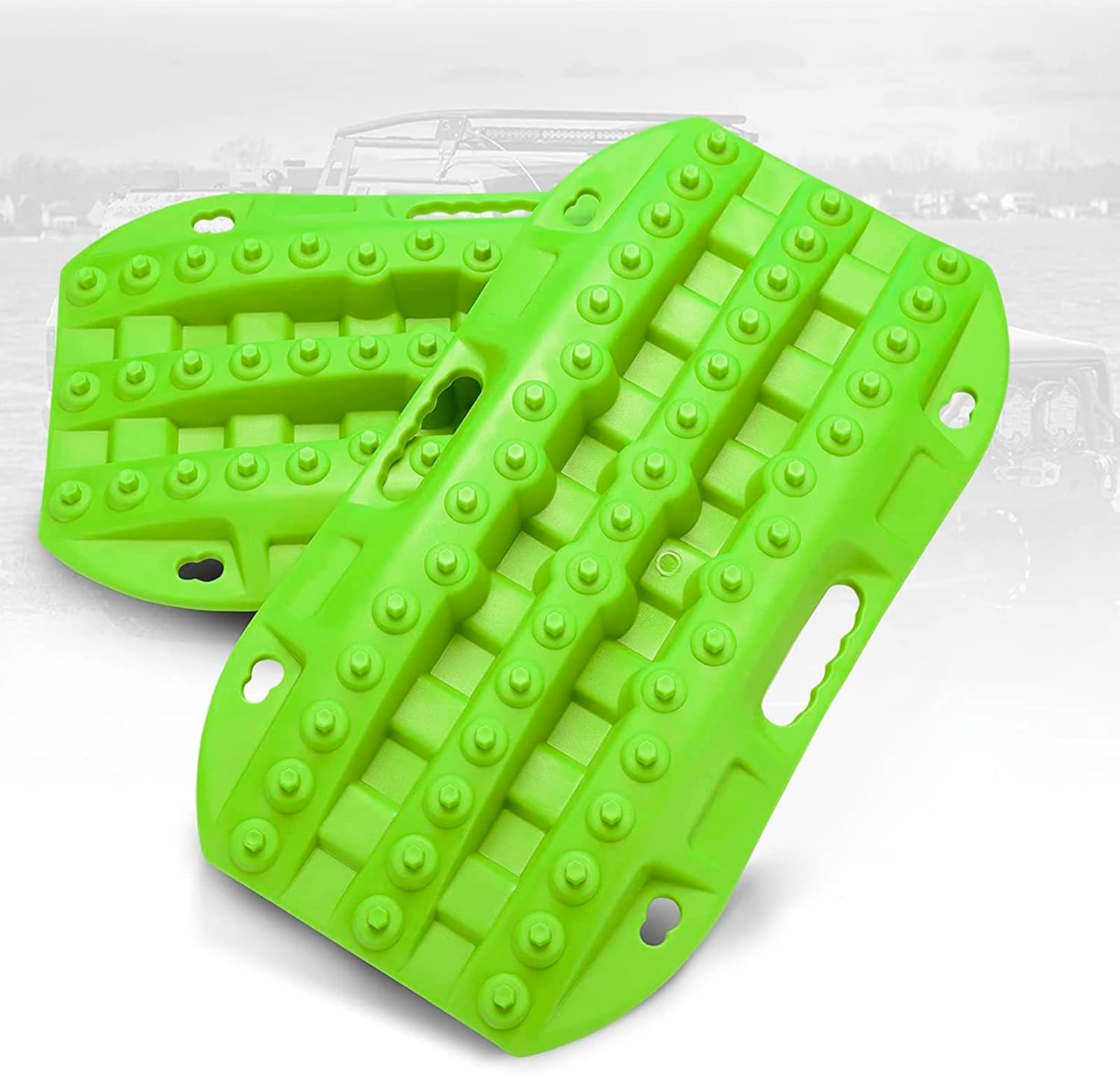
These short recovery traction boards are designed to help ATVs, UTVs, and other off-road vehicles regain grip in mud, sand, and snow. Built with strengthened teeth and a durable polypropylene construction, they provide reliable traction, easy handling, and year-round performance in tough conditions. Their nested, space-saving design and integrated shovels make them practical for carrying and using on remote adventures.
Used 4WD Inspection Checklist
- Confirm Transfer Case Type: Inspect the transfer case shifter/dial labels (2H-4H-4L vs. H4F-H4L-L4L vs. 2H-4A-4H-4L) and verify against the VIN build sheet.
- Test Mode Engagements: Shift through 2H, 4H, and 4L on a loose dirt/gravel surface. Confirm that actuators engage smoothly without excessive clunking or flashing dash indicators.
- Listen for Binding & Crow Hop: On a loose dirt surface, turn the steering wheel to near-lock at low speed in 4H. Resistance is normal, but severe metal-on-metal banging indicates worn CV joints or stretched transfer case drive chains.
- Check Low-Range Neutral Shift: Verify that 4LO engages only when the transmission is in Neutral at a complete stop.
- Inspect Underside & Fluids: Check transfer case and differential housings for leaking pinion seals or cracked output housings. Pull fluid fill plugs to verify clean oil free of metallic glitter or milky water contamination.
- Verify Matched Tires: Check all four tires for identical brand, model, size, and tread wear depth.
- Diagnostic Module Scan: Connect an OBD-II scanner capable of reading 4WD control modules, transfer case shift motors, ABS sensors, and differential lock solenoids.
Frequently Asked Questions
What is the difference between part-time and full-time 4WD?
Part-time 4WD operates in 2WD on dry pavement and mechanically locks front and rear driveshafts at a fixed 1:1 speed ratio when 4H or 4L is selected, requiring slippery terrain to prevent drivetrain binding. Full-time 4WD features an integrated center differential that allows front and rear axles to rotate at different speeds, enabling safe, continuous four-wheel traction on dry and wet pavement.
Can you shift from 2WD to 4WD while driving?
In most modern part-time 4WD vehicles with shift-on-the-fly transfer cases, you can shift between 2H and 4H at highway speeds up to 50–55 mph. However, shifting into 4LO strictly requires bringing the vehicle to a complete stop (or under 3 mph) and placing the transmission in Neutral.
Can you use part-time 4WD on dry pavement?
No. You should never operate a traditional part-time 4WD system in locked 4H or 4L on dry asphalt. Cornering causes the front and rear axles to travel along different turning radii; without a center differential, this causes severe driveline binding, crow hop, tire scrubbing, and potential transfer case failure.
Is part-time 4WD good in snow?
Part-time 4WD performs exceptionally well on roads covered in deep, packed snow because the low-friction surface allows tires to slip slightly during turns, relieving driveline stress. However, if the road transitions to patchy dry asphalt, you must shift back to 2H to prevent binding.
Does 4WD help you stop faster on snow or ice?
No. 4WD aids forward acceleration and climbing traction by distributing engine power across all four wheels. Braking and cornering grip rely entirely on tire tread compound, vehicle speed, ABS calibration, and following distance.
Which is better for daily driving: part-time or full-time 4WD?
Full-time 4WD is significantly better for daily driving in regions with variable winter weather (rain, slush, black ice, and dry pavement) because its center differential delivers continuous traction without driver intervention. Part-time 4WD is ideal if you commute in mild climates on dry roads and only need 4WD for occasional off-road trails or heavy snowstorms.
Conclusion
Select part-time 4WD if you primarily commute on dry highways and want rugged, selectable 2H, 4H, and 4L capability for weekend trails, boat launches, and deep winter snow. Select full-time 4WD if you want set-and-forget traction across unpredictable, mixed road conditions without risking driveline binding. Before buying, always inspect the transfer case selector layout, low-range gear reduction ratios, differential locking options, and manufacturer fluid service intervals.
Sources
- Jeep 4×4 FAQ and Glossary — supports definitions for part-time 4WD, full-time 4WD, center differential operation, and driveline binding.
- Toyota: What Types of 4WD Systems Does Toyota Offer? — supports manufacturer drivetrain definitions and transfer case mode selections.
- Ford Four-Wheel-Drive Mode Guidance — supports the distinction between automatic on-demand 4A and locked 4H.
- Toyota USA Newsroom: 2026 4Runner — supports current 4Runner drivetrain availability and Limited/Platinum full-time 4WD specifications.
- Toyota USA Newsroom: 2026 Tacoma — supports current Tacoma 2WD, part-time 4WD, and full-time 4WD availability across trim grades.
- Toyota USA Newsroom: 2027 Land Cruiser — supports full-time 4WD with center and rear locking differentials.
- NHTSA Winter Driving Tips — supports winter braking distances, speed moderation, and tire friction requirements.
- Michelin AWD and Winter Tire Safety Guide — supports acceleration traction versus braking/cornering tire physics.



[…] shafts. They solve different traction problems and are not interchangeable. See the site’s part-time vs full-time 4WD guide for the underlying system […]
[…] Part-time 4WD serves a different purpose. On dry pavement, you normally drive in 2WD. When snow, loose gravel, dirt, sand, mud, or trail conditions allow tire slip, you engage 4WD. For a broader explanation of the two architectures, see part-time vs full-time 4WD. […]
[…] A vehicle needs its left and right wheels to rotate at different speeds while turning, which is why each axle has a differential. A full-time 4WD vehicle also needs to accommodate a speed difference between the front and rear axles. A center differential provides that function. For a broader explanation of the hardware differences, see our part-time vs. full-time 4WD guide. […]