Last updated: July 23, 2026 — Toyota drive-pattern scope, California readiness rules, external references, and repair-cost examples rechecked.
A Toyota Tundra readiness monitor does not become complete simply because a part was replaced or the truck was driven a set number of miles. The ECM must see the required fuel level, temperatures, speed, load, soak period, and fault-free operation. Toyota bulletin EG003-02 maps the 2000–2002 2UZ-FE V8 to catalyst Pattern 3, EVAP Pattern 5, oxygen-sensor Pattern 9, and heater Pattern 11. The bulletin does not verify 2003–2004 Tundra applications, so those years require a VIN-, engine-, and emissions-label-specific Toyota service procedure.
Quick Answer
Scan the Tundra before clearing anything. Record stored and pending codes, identify the incomplete monitor, inspect the gas cap and EVAP hoses, and verify that coolant temperature, fuel trims, and O2 or A/F sensor data are plausible. For a 2000–2002 2UZ-FE V8, use Toyota’s monitor-specific Pattern 3, 5, 9, or 11 rather than one generic drive cycle. For a 2003–2004 truck, confirm the correct pattern through Toyota service information before driving.
Key Takeaways
- Incomplete means the ECM has not finished a self-test. It does not, by itself, prove that a component has failed.
- Toyota Pattern 5 uses a one-half to three-quarter fuel level for faster completion, an eight-hour cold soak or matched intake/coolant temperatures, and a specific 45-mph and 25-mph driving sequence.
- A warmed conventional narrowband O2 sensor normally switches between low and high voltage. Do not apply that voltage test to an air-fuel ratio sensor.
- Clearing codes, disconnecting the battery, or interrupting ECM power resets readiness monitors.
- Under California BAR’s current published criteria, a 2000-or-newer gasoline vehicle may pass with only the evaporative monitor incomplete. Other states can use different rules.
At a Glance
| Time Required | About 30 minutes for basic checks; Pattern 5 also needs an eight-hour cold soak before its roughly 20-minute driving portion |
| Difficulty | Beginner for scan and visual checks; intermediate for electrical tests; professional for controlled EVAP smoke testing |
| Tools Needed | OBD-II scan tool with live data and I/M readiness, flashlight, basic hand tools, digital multimeter, and an approved smoke machine when leak testing is required |
| Cost | Basic inspection may cost nothing if you own a scanner; current estimator examples list $49–$72 for an O2 sensor test and approximately $250–$509 for replacement, depending on year and location |
What EVAP and O2 Sensors Do on a Toyota Tundra
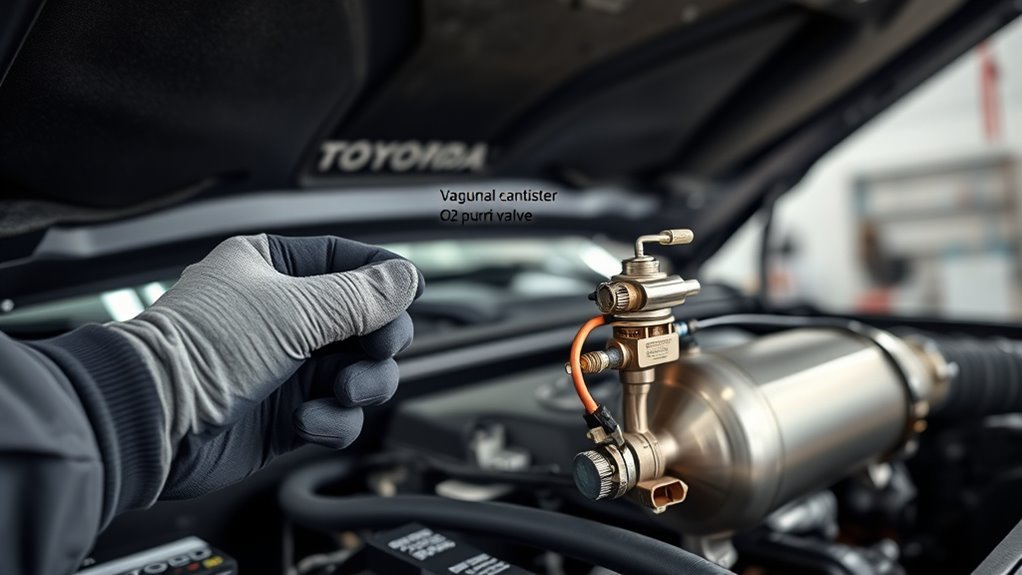
The EVAP system keeps raw fuel vapors from escaping into the air. It stores vapors in a charcoal canister, then the ECM opens the purge valve so those vapors can be burned in the engine under the right conditions. The exact valve, pressure-sensor, and leak-test design varies by model year and emissions calibration.
The oxygen sensors or air-fuel ratio sensors monitor exhaust oxygen so the ECM can adjust fuel trim and verify catalyst performance. Sensor type varies by engine and emissions certification. Check the underhood emissions label and VIN-specific service information before treating every front sensor as a conventional narrowband O2 sensor.
DENSO recommends a systematic diagnosis that includes checking service information, confirming sensor identity, and testing the signal instead of replacing a sensor from a code alone. After warm-up, a conventional narrowband O2 sensor commonly fluctuates between about 0.1 and 0.9 volts. That voltage range does not apply to an air-fuel ratio sensor. DENSO’s O2 and A/F sensor troubleshooting guide explains the distinction and voltage-test method.
Note: A code that names an O2 sensor does not prove that the sensor itself has failed. Vacuum leaks, exhaust leaks, fuel-pressure faults, contamination, wiring damage, and incorrect EVAP purge flow can all distort sensor data.
Why Readiness Monitors Matter for Smog and Registration
Readiness monitors are OBD-II self-tests that show whether the truck has checked its emissions systems since the last code clear, battery disconnect, ECM power loss, or relevant repair. A malfunction indicator lamp can be off while one or more non-continuous monitors remain incomplete.
A scan tool may display each supported monitor as complete, incomplete, passed, failed, or not supported. The inspection result depends on the truck’s model year, fuel type, and local program. Under California BAR’s current published standards, a gasoline vehicle from model year 2000 onward may pass with only the evaporative monitor incomplete. The O2, O2-heater, and catalyst monitors cannot also be incomplete under that allowance. California BAR’s On-Board Diagnostic Test Reference provides the current table.
California has adopted regulations intended to require completion of more monitors where they can reasonably be set. BAR states that implementation will be gradual, data-driven, and announced before individual criteria change. Always check the current rule shortly before testing.
| Scan Result | What It Means | Best Next Step |
|---|---|---|
| MIL on | The ECM has detected an emissions fault | Record and diagnose the codes before inspection |
| EVAP incomplete | The EVAP self-test has not finished | Check the local allowance and verify Pattern 5 conditions where applicable |
| O2 or catalyst incomplete | The sensor or catalyst test has not completed | Use the correct engine-specific pattern and verify live data |
| Pending code present | The ECM detected a possible first-trip fault | Diagnose the condition instead of repeating the drive pattern blindly |
| Not supported | That monitor is not used by the calibration | Do not try to force an unsupported monitor to complete |
| Codes recently cleared | Non-continuous monitors were reset | Complete the required patterns before retesting |
California PDTC note: BAR’s permanent-DTC failure standard applies to model year 2010 and newer. It is not the current PDTC failure criterion for a 2000–2004 Tundra, although stored diagnostic information may still help with troubleshooting. Other states may differ.
Common Symptoms of EVAP or O2 Failures on a Tundra
A persistent check engine light, failed inspection, fuel odor, poor fuel economy, rough idle, hesitation, or hard starting can point toward an EVAP, O2, fuel-trim, or catalyst problem. An incomplete monitor alone may simply mean that the required conditions have not occurred.
- EVAP leak codes: P0442, P0455, P0456, and related codes can indicate a sealing leak at the cap, filler neck, hose, valve, canister, or tank connection.
- Purge-flow codes: P0441 and related Toyota codes can involve incorrect purge flow, a leaking or blocked valve, damaged plumbing, or an electrical fault.
- O2 or A/F sensor codes: Heater, response, lean, or rich codes need wiring, exhaust, fuel-trim, and live-data checks before parts replacement.
- Readiness only: An incomplete EVAP, O2, or catalyst monitor may mean the engine, temperature, fuel-level, speed, load, or soak conditions were not met.
For a cap- and filler-neck-specific procedure, see the Toyota Tundra gas-cap warning guide. For broader code definitions and diagnosis priority, see the Toyota Tundra OBD-II code guide.
Pretest Checklist: Gas Cap, Hoses, Sensors, and Scan Tool
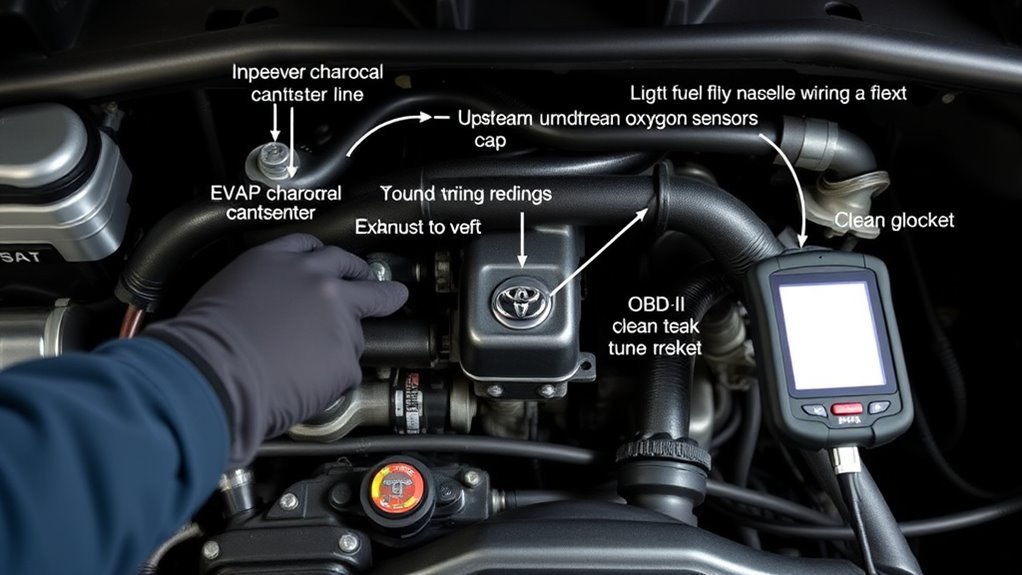
Start with the easiest checks before replacing parts. Record the scan results first because clearing codes erases readiness status and may remove useful freeze-frame clues.
| Item | What to Check | Why It Matters |
|---|---|---|
| VIN and emissions label | Model year, engine, federal/California certification, sensor type | The correct monitor pattern depends on the calibration |
| Fuel cap | Seal, cracks, threads, fit, and ratchet action | A loose or leaking cap can set EVAP codes |
| EVAP hoses | Cracks, hard rubber, loose fittings, damage, or disconnected lines | A small leak can prevent the EVAP monitor from passing |
| Fuel level | For Toyota Pattern 5, use one-half to three-quarters full for faster completion | The monitor may not run outside its enabling range |
| Stored and pending codes | Record the code, status, and freeze-frame data | A returning fault can block or fail a monitor |
| I/M readiness | Identify the exact incomplete monitor | Each non-continuous monitor uses a different test pattern |
| Live data | ECT, IAT, fuel trims, sensor data, purge command, and pressure data if supported | A bad input can prevent the ECM from enabling the test |
Warning: Fuel vapor is flammable. Do not smoke, use open flames, create sparks, or use improvised pressure near the fuel or EVAP system. During a road pattern, obey traffic laws, use a safe route, and have a passenger watch the scan tool when live monitoring is necessary.
Toyota Tundra Drive Cycle: Verified 2000–2002 Patterns and 2003–2004 Caution
The procedures below come from Toyota readiness bulletin EG003-02, revised March 29, 2002. Its application tables cover Tundras through model year 2002. An archived copy of Toyota bulletin EG003-02 is available for reference, but Toyota TIS should be used to confirm current VIN-specific service information.
2003–2004 limitation: EG003-02 does not verify those model years. Before using a numbered pattern on a 2003 or 2004 Tundra, confirm the VIN, engine, underhood emissions label, and Toyota service procedure. Do not assume the 2000–2002 sequence is identical.
| Tundra Application | Catalyst | EVAP | O2/A-F | Heater |
|---|---|---|---|---|
| 2000 5VZ-FE Federal | Pattern 3 | Pattern 5 | Pattern 9 | Pattern 11 |
| 2000 5VZ-FE California | Pattern 4 | Pattern 5 | Pattern 10 | Pattern 11 |
| 2001–2002 5VZ-FE | Pattern 4 | Pattern 5 | Pattern 10 | Pattern 11 |
| 2000–2002 2UZ-FE V8 | Pattern 3 | Pattern 5 | Pattern 9 | Pattern 11 |
| 2003–2004 | Not covered by EG003-02; verify through VIN-specific Toyota service information | |||
How Do You Run Toyota EVAP Pattern 5?
Pattern 5 is the internal-pressure, non-intrusive EVAP procedure assigned to the 2000–2002 Tundra applications in EG003-02. The cold soak is a precondition; it does not replace the driving portion.
- Check for faults: The MIL must be off. Record pending codes and readiness status before starting.
- Set the fuel level: Keep the tank between one-half and three-quarters full for faster completion.
- Warm and soak: Warm coolant to at least 176°F, then park the truck for eight hours or until intake-air temperature and coolant temperature differ by less than 13°F.
- Confirm restart conditions: Before starting, coolant and intake-air temperatures should each be between 40°F and 95°F, with less than 13°F difference. The bulletin lists an altitude precondition of 7,800 feet or less.
- Release tank pressure: With the engine off and away from ignition sources, remove and reinstall the fuel cap.
- First drive: Start the engine and, as soon as safely possible, drive at approximately 45 mph for five minutes.
- Second drive: Drive at approximately 25 mph for 15 minutes and include at least two stops of about 30 seconds each.
- Keep the key on: Do not switch the ignition off until the driving pattern is complete.
- Recheck the scanner: If EVAP remains incomplete, confirm every precondition and check for a pending fault before repeating the pattern from the cold soak.
How Do You Run O2 Pattern 9 on a 2000–2002 2UZ-FE?
- Verify the MIL is off and connect the scan tool.
- Idle for at least two minutes.
- Drive at 25 mph or faster for at least 50 seconds while keeping engine speed above 900 rpm.
- Stop and idle for at least 40 seconds.
- Repeat the driving and idle steps ten times.
- Recheck O2 readiness. If it remains incomplete, look for a pending code, sensor-heater problem, exhaust leak, or implausible sensor data before repeating the sequence.
How Do You Run Catalyst Pattern 3 on a 2UZ-FE?
- Meet the preconditions: The MIL must be off, coolant must be at least 176°F, and intake-air temperature must be at least 14°F.
- First cruise: Drive at 40–55 mph for seven minutes if startup intake-air temperature was below 50°F, or three minutes if it was above 50°F.
- Second cruise: Drive between 35 and 45 mph for about seven minutes.
- Use smooth throttle: Avoid abrupt acceleration and closed-throttle deceleration where traffic conditions allow.
- Recheck catalyst readiness and inspect pending codes if it does not complete.
How Do You Run O2 or A/F Heater Pattern 11?
- Verify the MIL is off.
- Idle the engine for nine minutes.
- Drive at 25 mph or faster for at least two minutes.
- Recheck the heater monitor. If it remains incomplete, diagnose heater power, ground, resistance, wiring, and pending codes.
Pro Tip: Mileage does not set readiness by itself. A truck can travel 100 miles without completing EVAP if the required fuel level, temperature window, soak, speed, or fault-free conditions never occur.
Using a Live-Data Scan Tool: PIDs, Temps, and Readiness Flags
A live-data scan tool helps distinguish a missing enabling condition from a failed component. Start by identifying the exact incomplete monitor. Then compare coolant temperature, intake-air temperature, fuel trims, O2 or A/F sensor activity, heater status, purge command, EVAP pressure data, and pending codes where supported.
[Products Worth Considering]

The BLCKTEC 440 Bluetooth OBD2 scanner helps drivers and DIY mechanics quickly read and clear trouble codes, monitor live data, and check emissions readiness with confidence. Its color display, graphing capabilities, and battery and charging system testing make it a versatile diagnostic tool for OBD-compliant vehicles. Designed for plug-and-play convenience, it runs directly from your vehicle and includes support for report sharing and ongoing updates.

This oxygen O2 sensor set is designed for select Toyota Camry and RAV4 models with 2.4L engines, providing upstream and downstream replacement coverage in one package. Built to OEM specifications for plug-and-play installation, it helps improve fuel efficiency, support accurate air-fuel monitoring, and restore reliable engine performance. The stainless steel and heat-resistant construction is made for long-lasting durability and stable operation.

AutoLine Pro HyperSmoke is a professional automotive smoke tester designed to quickly find EVAP, vacuum, intake, boost, exhaust, and other leak sources with thick visible smoke. It features adjustable pressure, built-in air compressor motor, instant warmup, and OEM approved smoke fluid for safe, accurate diagnostics across a wide range of vehicles and systems. The kit includes essential accessories and is backed by a full coverage warranty for dependable shop or garage use.
Live Data PIDs
- Coolant temperature: Confirm that the engine warms normally and reaches the threshold required by the selected pattern. A thermostat or temperature-sensor fault can prevent completion.
- Intake-air temperature: Use IAT with ECT to verify cold-soak conditions for Pattern 5 and to choose the correct catalyst cruise time.
- Short-term and long-term fuel trim: Large positive values can suggest unmetered air, low fuel pressure, or an exhaust leak. Large negative values can suggest rich operation, incorrect purge flow, or leaking injectors.
- O2 or A/F sensor data: Identify the sensor type before interpreting voltage, current, equivalence ratio, or response.
- EVAP command and pressure data: If the calibration and scanner support them, compare commanded purge or vent operation with pressure response.
- I/M readiness: Recheck after each documented pattern instead of repeating random highway trips.
Mode $06 and Monitor Results
Mode $06 may show test results for non-continuous monitors such as catalyst, O2, and EVAP. Depending on the scan tool, it can display test identifiers, component identifiers, measured values, and pass/fail limits. Toyota-specific labels are easier to interpret with Techstream or a scanner that correctly decodes the calibration.
Do not condemn a part from an unlabeled Mode $06 number. First confirm that the monitor ran, identify the test definition, compare the value with its correct limit, and check whether a pending code has been stored.
EVAP Trouble Spots: Purge Valve, Canister, Valves, and Vapor Lines
Test the system before replacing the largest or most expensive part. Begin with the fuel cap, filler neck, visible hoses, purge valve, canister, electrical connectors, and the model-specific vent or pressure-control components. Toyota changed EVAP designs across years, so do not assume that every first-generation Tundra uses the same pump module or valve layout.
[Products Worth Considering]

The FOXWELL NT301 is a plug-and-play OBD2 code reader designed to help drivers and home mechanics diagnose check engine light issues with ease. It reads fault codes, clears emissions-related warnings, displays live sensor data in graph form, and shows I/M readiness so you can quickly check vehicle status before an emissions test. With broad compatibility across many OBD2 vehicles and a clear color screen, it offers a practical, user-friendly way to monitor and troubleshoot engine performance.

FOXWELL NT201 is an easy-to-use OBD2 scanner designed to help drivers quickly read and clear check engine codes, view live engine data, and check emissions readiness. Its color screen, one-key I/M readiness test, and broad compatibility with most gasoline vehicles since 1996 make it a practical tool for everyday diagnostics and maintenance. With plug-and-play operation and lifetime free updates, it offers a simple way to understand vehicle issues without expensive shop visits.

This plug-and-play OBD2 scanner helps drivers quickly read and clear engine error codes while providing live data, freeze frame information, I/M readiness, and MIL status for more confident troubleshooting. It adds a built-in voltage test and clear status indicators to support electrical checks and faster diagnostics, making it a practical choice for home users, car enthusiasts, and repair professionals. Compatible with most OBDII vehicles since 1996 and designed with an easy-to-use interface, it offers broad coverage and simple operation in one compact tool.
Purge Valve Failures
The purge valve controls vapor flow from the charcoal canister to the intake. If it leaks when commanded closed, it can contribute to rough idle, hard starting after refueling, rich or lean fuel trims, and incorrect EVAP pressure behavior. If it does not open when commanded, the ECM may not see the expected flow or pressure change.
- Scan first: Record stored and pending codes, freeze-frame data, fuel level, and monitor status.
- Verify the circuit: Check connector fit, power, control, and wiring condition with the proper diagram.
- Command the valve: Use a capable scan tool when the calibration supports an active test.
- Check unwanted flow: Confirm that a commanded-closed valve does not leak.
- Replace only after failure is confirmed.
Vapor and Vacuum Line Leaks
Small cracks, hardened hose ends, damaged fittings, filler-neck leaks, or poor seals can stop the EVAP system from passing. Inspect accessible lines without bending brittle hoses aggressively. A controlled smoke test is the preferred method for locating small leaks that are not visible.
| EVAP Area | Best Test | Likely Response |
|---|---|---|
| Fuel cap | Seal inspection and approved cap test | Replace only if fit, seal, or ratchet action fails |
| Filler neck and hoses | Visual inspection and controlled smoke test | Repair the confirmed leak or damaged connection |
| Purge valve | Circuit, command, and leak test | Repair wiring or replace a valve that fails testing |
| Vent or pressure-control component | VIN-specific active test and pressure response | Repair the verified circuit or component fault |
| Charcoal canister | Smoke, blockage, saturation, and housing inspection | Replace only when damage or blockage is confirmed |
O2 Sensor Checks: Upstream vs Downstream and Expected Voltages
Sensor 1 is upstream of the catalytic converter and provides mixture feedback. Sensor 2 is downstream and contributes to catalyst monitoring. Bank 1 is the side containing cylinder 1; verify the engine diagram instead of assuming left or right.
On a fully warmed conventional narrowband O2 system, the upstream signal commonly moves between about 0.1 and 0.9 volts. A downstream sensor is normally less active than the upstream sensor after the catalyst is hot. Closely matching waveforms can point toward catalyst efficiency, an exhaust leak, wiring trouble, or a sensor fault, but waveform interpretation must be combined with fuel trims and operating conditions.
Do not judge an air-fuel ratio sensor by narrowband voltage. If the scan tool displays A/F current, lambda, equivalence ratio, or a manufacturer-scaled voltage, follow the Toyota procedure for that sensor and calibration.
- Confirm sensor identity: Verify engine, bank, position, and sensor type.
- Reach closed loop: Test only after the engine and sensor have warmed normally.
- Check the heater: Heater power or control faults can keep readiness incomplete.
- Inspect wiring: Look for heat damage, corrosion, poor terminal tension, and previous repairs.
- Check exhaust leaks: Outside air entering ahead of a sensor can create a false lean signal.
- Compare fuel trims: Decide whether the sensor is reporting an engine problem or creating an incorrect signal.
- Confirm response before replacement: A code is the beginning of diagnosis, not proof of the failed part.
A sensor code is a test direction, not a parts order. Confirm sensor type, wiring, heater operation, exhaust integrity, fuel trims, and response before replacing an O2 or A/F sensor.
[Products Worth Considering]

This replacement gas cap is designed to restore a tight fuel-tank seal, helping reduce vapor leaks, prevent check engine light issues, and maintain proper fuel system performance. Built in OE-style form for a wide range of Toyota and Lexus vehicles, it offers a direct DIY fix with durable materials for reliable, long-lasting use.

The Autel MaxiCOM MK900BT is a professional bidirectional diagnostic scan tool built for modern vehicles with advanced system coverage and fast, accurate troubleshooting. It supports 3000+ active tests, 40+ service functions, all-system diagnostics, Auto VIN, pre/post scan reports, and newer vehicle protocols for broad compatibility. Designed for technicians and serious DIY users, it delivers efficient maintenance, smarter diagnostics, and expanded service capabilities across a wide range of makes and models.

This replacement gas cap is designed for a wide range of Toyota and Lexus models, offering a direct-fit solution for restoring a proper seal at the fuel tank. It helps address check engine light issues related to the fuel cap while providing easy installation and dependable performance. Built from durable materials and rigorously tested before shipping, it is a practical replacement for worn or damaged fuel caps.
Estimated Repair Costs for Common Emission Parts
Repair cost depends on the model year, engine, emissions certification, sensor position, rust, labor rate, location, and the amount of diagnostic work required. The figures below are current estimator examples, not guaranteed quotes.
| Service | Current Published Example | How to Use It |
|---|---|---|
| Basic scan and visual inspection | $0 if you already own the tools | Record codes and readiness before authorizing parts |
| Tundra oxygen-sensor test | $49–$72 RepairPal estimate | Taxes, fees, location, and related repairs may change the total |
| 2004 Tundra O2 replacement example | $250–$362 in RepairPal’s San Diego example | A location-specific example, not a nationwide fixed price |
| Broad Tundra O2 replacement average | $447–$509 RepairPal estimate | The correct sensor and local quote may be higher or lower |
| EVAP smoke diagnosis | Shop-specific quote required | Ask whether diagnostic time includes valve commands and post-repair verification |
| Valve, hose, canister, or wiring repair | VIN- and fault-specific quote required | Approve replacement only after the failed item is identified |
When to Get Shop Help and How Dyno Completion Works
Get professional help when a monitor remains incomplete after its verified preconditions and pattern have been met, when a pending code returns, when controlled smoke testing is required, or when the scanner cannot correctly identify Toyota-specific data. A technician with Toyota-capable equipment can run active tests, inspect wiring diagrams, interpret Mode $06 results, and compare commanded valve operation with pressure response.
A dynamometer can help reproduce steady speed and load when the documented pattern cannot be performed safely in traffic. It does not force a failed monitor to pass. The ECM still requires functioning components and the correct temperature, speed, pressure, load, and timing conditions.
Frequently Asked Questions
How long does a Toyota Tundra readiness drive cycle take?
It depends on the incomplete monitor. For a 2000–2002 Tundra using Pattern 5, the driving portion takes about 20 minutes after an eight-hour cold soak or equivalent temperature equalization. O2 Pattern 9 requires an initial two-minute idle followed by ten drive-and-idle repetitions. Traffic, pending faults, and unmet temperatures can make the process take longer.
What fuel level is needed for the Toyota Tundra EVAP monitor?
Toyota Pattern 5 specifies a fuel level between one-half and three-quarters full for faster completion. That guidance applies to the applications assigned Pattern 5 in EG003-02. Verify the model-specific procedure before applying it to a 2003–2004 Tundra or another EVAP design.
Why is the EVAP monitor still incomplete after 100 miles?
Mileage alone does not complete a readiness monitor. The ECM must see the required fuel level, coolant and intake-air temperatures, cold soak, speed, engine load, and fault-free operation. A truck can travel well over 100 miles without meeting one of those conditions.
Can a 2000–2004 Tundra pass with the EVAP monitor incomplete?
It depends on the inspection program. Under California BAR’s current published criteria, a model-year 2000-or-newer gasoline vehicle may pass with only the evaporative monitor incomplete. The MIL must meet inspection standards, and other required non-continuous monitors cannot also be incomplete. Check the current rule in your state before testing.
Does replacing an O2 sensor reset readiness monitors?
The physical replacement does not complete the monitors. Clearing codes, disconnecting the battery, or interrupting ECM power during the repair resets readiness to incomplete. After the repair, the truck must complete the appropriate fault-free monitor patterns.
Does an O2 sensor affect the EVAP system?
Not directly. The EVAP system controls fuel-vapor storage, purge flow, venting, and leak detection. An O2 or A/F sensor problem can affect fuel trim, set a separate emissions code, or keep another monitor incomplete, but it does not create a physical EVAP leak.
How much does a Toyota Tundra oxygen sensor cost to replace?
Current RepairPal examples vary substantially. Its broad Toyota Tundra average is $447–$509, while its location-specific 2004 Tundra example for San Diego is $250–$362. Taxes, fees, sensor position, rust, local labor, and related repairs can change the final quote.
Conclusion
Start with the scanner, not a parts order. Record the codes and readiness flags, identify the incomplete monitor, verify the VIN and emissions calibration, inspect the cap and EVAP plumbing, and check temperature, fuel-trim, and sensor data.
For a 2000–2002 2UZ-FE V8, Toyota bulletin EG003-02 assigns catalyst Pattern 3, EVAP Pattern 5, O2 Pattern 9, and heater Pattern 11. Use the pattern for the monitor that is actually incomplete. For a 2003–2004 Tundra, obtain the correct VIN-specific procedure before attempting the drive cycle. If the monitor still will not complete after every precondition is met, diagnose the pending fault or have a Toyota-capable shop perform controlled testing.
Sources
- Archived Toyota readiness bulletin EG003-02 — supports the 2000–2002 Tundra application tables and Patterns 3, 4, 5, 9, 10, and 11. Confirm VIN-specific information through Toyota TIS.
- Toyota Technical Information System — official source for VIN-specific service procedures, emissions labels, wiring information, and later-model drive patterns.
- California Bureau of Automotive Repair — On-Board Diagnostic Test Reference — supports current incomplete-monitor, MIL, communication, and permanent-DTC standards.
- California BAR — New OBD Readiness Monitor Regulations Explained — supports the gradual, data-driven implementation of newer readiness requirements.
- DENSO Auto Parts — O2 and A/F Sensor Troubleshooting — supports sensor identification, narrowband voltage testing, and alternative fault checks.
- U.S. EPA — Vehicle Emissions Inspection and Maintenance Policy and Technical Guidance — supports the purpose and framework of emissions inspection programs.
- RepairPal — Toyota Tundra Oxygen Sensor Test Cost — supports the current $49–$72 estimator example.
- RepairPal — Toyota Tundra Oxygen Sensor Replacement Cost — supports the current broad Tundra replacement estimate.
- RepairPal — 2004 Toyota Tundra Oxygen Sensor Replacement Cost in San Diego — supports the location-specific 2004 estimate example.