How you reduce or turn off traction control on a Toyota GR Supra depends on the car’s production date and control interface. Earlier Mk5 (A90/A91) models use a single press of the center-console VSC OFF button for Traction mode and a 3-to-5-second press-and-hold action for full VSC OFF. On later-production models, pressing the button opens an on-screen Vehicle Stability Control menu where you select TRACTION or VSC OFF. Always confirm the selected state via the instrument-cluster message and keep VSC active during normal street driving.
Written by Automotive Technical Staff · Reviewed for accuracy · Last updated: July 22, 2026
Quick Answer
The VSC OFF button is located on the center console to the left of the gear selector. On the physical interface, press once to activate Traction mode (allows wheel slip, keeps yaw stability) or press and hold for 3 to 5 seconds until VSC OFF appears in the cluster. If your vehicle uses the menu interface, press the button and select TRACTION or VSC OFF on the Control Display. To restore full stability control, press the button again or select VSC ON.
Key Takeaways
- Traction mode permits straight-line wheelspin by disabling engine throttle cut, but retains lateral stability and yaw intervention.
- VSC OFF deactivates stability intervention, engine torque reduction, and yaw corrections entirely during acceleration and cornering.
- On 6-speed manual GR Supras, selecting VSC OFF automatically disables iMT (intelligent Manual Transmission) rev-matching.
- Holding the VSC OFF button requires 3 to 5 seconds until the instrument cluster displays “VSC OFF” and the warning chime sounds.
- Never pull fuses or modify vehicle wiring; dyno testing and competition use require factory software procedures.
At a Glance: Supra Stability Control Modes
| Setting | Earlier Interface (Physical) | Later Interface (iDrive Menu) | Cluster Indicator & System Behavior |
|---|---|---|---|
| VSC ON (Default) | Default on startup or press button once | Select VSC ON | No warning lights; full engine power cut and individual-wheel brake intervention active. |
| Traction Mode | Press button once briefly | Select TRACTION from menu | TRACTION message appears; wheel slip permitted, lateral yaw control remains active. |
| VSC OFF | Press and hold button for 3–5 seconds | Select VSC OFF from menu | VSC OFF light illuminates; all stability intervention disabled (iMT disabled on manuals). |
How Do You Turn Off Traction Control on a GR Supra?
Bring the vehicle to a complete stop before modifying stability control settings. The VSC OFF button is located on the center-console switch bank directly to the left of the gear selector lever (marked with a skidding vehicle icon and “OFF”). Depending on the model year and software build, the Supra uses either a direct physical button sequence or an on-screen iDrive-based interface.
[Products Worth Considering]

This AstroAI clamp meter delivers accurate electrical testing for AC/DC voltage, AC current, resistance, capacitance, continuity, diode checks, and live wire detection in one compact tool. Its auto-ranging design, backlit LCD, flashlight, data hold, and audible/visual alerts make it practical for both home and industrial troubleshooting. Built with enhanced safety standards and non-contact voltage detection, it helps users diagnose electrical issues with greater confidence and convenience.

The KONNWEI KW208 is a versatile 12V battery tester designed to quickly analyze battery health, cranking performance, and charging system status for cars, trucks, boats, motorcycles, and more. It supports multiple battery types and provides clear guidance on whether a battery should be recharged or replaced, helping you diagnose issues before they become failures. With plug-and-play use, high accuracy, and multilingual support, it offers a convenient way to test batteries in-vehicle or out-of-vehicle.

This cordless hand siphon pump is designed for fast, dependable liquid transfer without electricity or batteries. It delivers high-flow performance for gasoline, oil, coolant, transmission fluid, water, and more, while the long flexible hoses and leak-resistant connections make it easy to reach deep tanks and barrels. With simple tool-free assembly and a dual-use inflation adapter, it is a versatile solution for home, garage, yard, and farm tasks.
Earlier Press-and-Hold Interface (2020–2022 and Select Later Builds)
- Activate Traction Mode: Press the center-console VSC OFF button once.
- Verify Cluster Feedback: Confirm that the text TRACTION displays in the digital instrument cluster and the dynamic stability indicator illuminates.
- Fully Deactivate VSC: Press and hold the VSC OFF button for approximately 3 to 5 seconds.
- Confirm VSC OFF: Release the button when the audible chime sounds and the yellow VSC OFF warning light illuminates continuously.
- Reactivate Normal Systems: Press the VSC OFF button once briefly. Confirm that all warning messages and amber cluster icons clear.
Later On-Screen Menu Interface (Select 2023–2026 Builds)
- Press the center-console VSC OFF button once to trigger the stability control menu on the central Control Display.
- Using the rotary iDrive controller or touchscreen, select TRACTION for dynamic slip or VSC OFF for complete system deactivation.
- Confirm the active selection on the instrument cluster display.
- To restore standard stability control, press the console button again or navigate to the menu and select VSC ON.
Always rely on the instrument cluster message rather than guessing the duration of a button press. Consult the Toyota GR Supra Owner’s Manual specific to your vehicle identification number (VIN) for production-specific software nuances.
Safety Warning
Deactivating VSC removes critical active yaw control and engine throttle limits on a high-torque rear-wheel-drive platform. Full VSC deactivation should be reserved exclusively for closed-course track driving, skid pads, or autocross environments with adequate runoff.
What Is the Difference Between Traction Mode and VSC OFF?
Traction mode (equivalent to BMW’s Dynamic Traction Control or DTC) is an intermediate calibration. It raises the allowable wheel-slip threshold by disabling aggressive engine-throttle cuts during straight-line acceleration. This allows the rear tires to spin slightly to maintain momentum in loose surfaces (sand, slush, deep snow) while keeping lateral yaw intervention active to catch an uncommanded slide.
VSC OFF eliminates all electronic stability control intervention. The engine management system will not cut power when the drive wheels lose grip, and individual corner brakes will not automatically actuate to correct oversteer or understeer. Vehicle trajectory is placed entirely in the hands of the driver.
Neither mode disables hardware safety systems such as Anti-Lock Braking (ABS) or the active electronically controlled rear differential. To understand how the torque-vectoring rear differential interacts with stability management, read our breakdown on how Toyota Supra stability control works.
Does Sport Mode Turn Off Traction Control?
No. Selecting Sport Mode sharpens throttle response, firms adaptive damper damping, adjusts transmission shift mapping, opens the active exhaust valve, and weights the electric power steering. However, it does not alter the fundamental VSC engagement threshold. Traction mode or VSC OFF must be activated independently using the dedicated console switch.
For configuring custom powertrain and chassis profiles, see our detailed guide on how to use Sport mode in a Toyota Supra.
Which Supra Models Does This Guide Cover?
This technical guide applies to modern fifth-generation (Mk5 / A90 / A91) Toyota GR Supras manufactured from 2020 through 2026, equipped with either the 2.0L inline-4 (B48) or 3.0L inline-6 (B58) turbocharged engines.
Special Note for 6-Speed Manual (A91-MT) Models: On manual-transmission Supras introduced for the 2023 model year onward, selecting VSC OFF automatically disables iMT (intelligent Manual Transmission) downshift rev-matching. Drivers must execute manual heel-and-toe downshifts when driving with stability control completely disabled.
Older Mk4 (A80) and earlier generation Supras use legacy analogue throttle-plate TRAC switches and completely different ECU logic. Reference the 2026 Toyota GR Supra Brochure for generational specifications.
Why Should You Avoid Pulling the VSC or TRC Fuse?
Modern vehicles run stability management across a synchronized high-speed CAN-bus network. Removing the VSC/ABS fuse disrupts communication across the engine control unit (ECU), transmission control module (TCM), electronic differential (e-diff), and electric power steering (EPS).
Pulling fuses can cause the following vehicle faults:
- Immediate limp-mode or powertrain torque limitations.
- Loss of electronic brake-force distribution (EBD), causing uncontrollable rear-brake lockup.
- Deactivation of the active electronic limited-slip differential.
- Permanent diagnostic trouble codes (DTCs) that require dealer-level OBD-II clear tools.
If running a vehicle on a 2WD dynamometer, activate official factory Dyno Mode (Roller Bench Mode) via diagnostic software rather than disconnecting hardware fuses.
What Changes When Traction or Stability Intervention Is Reduced?
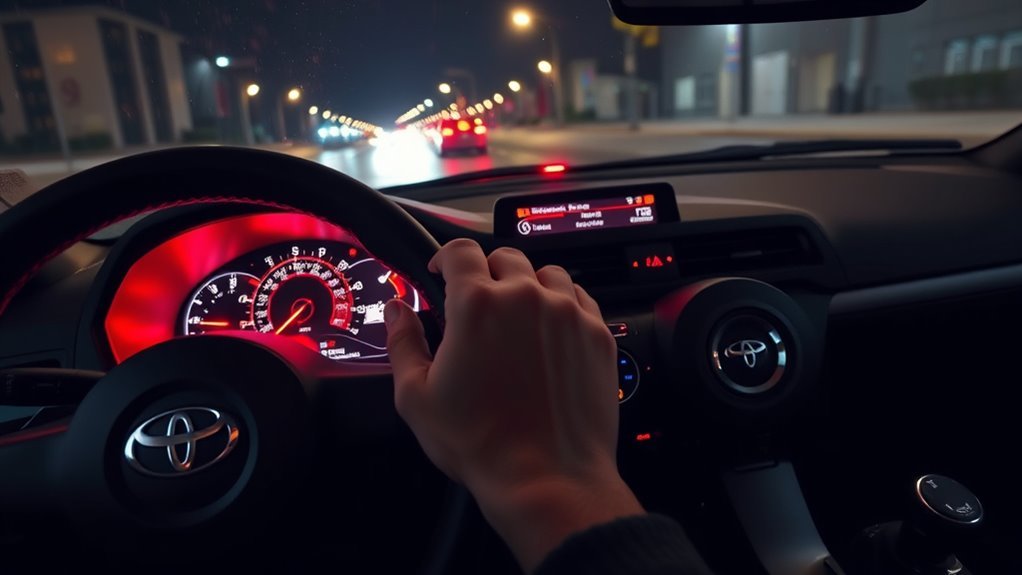
In standard VSC ON operation, yaw-rate and steering-angle sensors constantly compare driver steering input against actual vehicle direction. When slip is detected, the ECU cuts throttle plate angle and pulses individual front or rear calipers within milliseconds.
When VSC is turned off:
- Throttle Response: Engine torque is delivered uninhibited without protective ECU ignition retard or throttle closure.
- Yaw Control: No corrective brake torque is applied to outside or inside wheels to arrest oversteer or snap-oversteer.
- Differential Behavior: The active rear differential continues locking based on mechanical load and throttle position, which can accelerate rotational inertia during corner exit.
Explore mechanical rear-axle lockup characteristics in our guide to Supra electronic differential control.
When Should You Use Traction Mode?
Traction mode is engineered specifically for low-friction surface extraction where controlled wheelspin is necessary to clear tire tread voids. Recommended use cases include:
- Extracting the vehicle from deep snow or unplowed driveways.
- Navigating gravel roads, loose dirt, or muddy terrain.
- Driving with tire chains installed where wheel speed differential is expected.
- Controlled straight-line acceleration on slippery drag-strip surfaces.
Return to full VSC ON as soon as the vehicle reaches paved, free-flowing road conditions.
[Products Worth Considering]

This automatic 12V charger and maintainer delivers a full charge before switching to float mode to help keep powersports batteries ready for storage and regular use. Its four-step charging program is designed for lead-acid, flooded, AGM, and gel cell batteries, helping prevent overcharging while supporting longer battery life. Compact and easy to use, it includes both ring terminal and alligator clip connections plus smart safety features for dependable charging.

This ignition coil and spark plug set is designed to restore reliable starting, smooth engine performance, and efficient combustion for compatible Toyota, Lexus, Scion, and Pontiac models. Built with durable materials and engineered to meet or exceed OE design standards, it offers dependable fitment and long-lasting operation. The package includes four ignition coils and four double iridium spark plugs for a complete tune-up solution.

Dimensions (Each): 55.9 cm (L) x 17.8 cm (W) x 1.1 cm (H). Pack of 2.
Safety Practices for Performance Driving
Electronic stability systems assist driver control but cannot defy the physical adhesion limits of the tire contact patch. As documented in NHTSA electronic stability control studies, active stability aids significantly mitigate loss-of-control collisions on wet and uneven surfaces.
Street vs. Track Protocol
Maintain full VSC engagement during all public-road driving. Cold tire compounds, road surface variations, standing water, and road debris present unpredictable hazards where electronic intervention prevents catastrophic spins.
Controlled Closed-Course Progression
When driving on a sanctioned track or autocross course, progress systematically through drive modes:
- Session 1: Drive in standard VSC ON to establish baseline braking markers and chassis balance.
- Session 2: Switch to Traction Mode to allow mild corner-exit rotation while preserving a safety margin against major spins.
- Session 3: Transition to VSC OFF only once smooth throttle modulation and car control are established.
For optimized standing-start acceleration on closed courses, follow our technical walkthrough for using launch control on a Toyota Supra.
How Do Tires and Setup Affect Stability-Control Intervention?
The Supra’s dynamic stability control algorithms are calibrated around specific rolling tire circumferences and grip coefficients. Deviating from standard wheel and tire geometry directly impacts when and how aggressively VSC intervenes.
[Products Worth Considering]
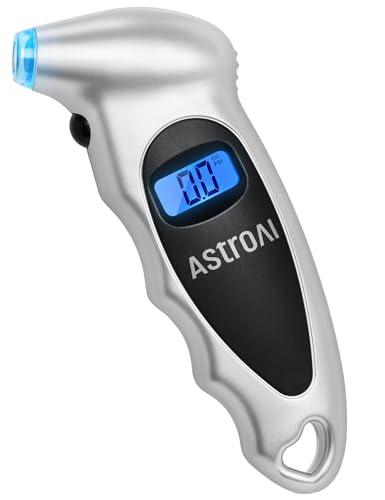
Accurate, Dependable Readings: Factory‑calibrated to ±1 PSI, so you can confidently match your vehicle’s recommended PSI (check the door jamb sticker). Ideal for monthly checks and road trips — consistent results every time, cold or warm.

PROCESS LEVEL ACCURACY: Each ETENWOLF’s digital tire pressure gauge is calibrated manually to ANSI B40.7 Grade 2A(plus-minus 1 PSI).Presta valve adapter not included, if used for bicycles, it must be purchased separately

RUGGED DESIGN: The stainless steel components prevent rust and corrosion while the precision-crafted nozzle seamlessly seals onto the valve stems for highly accurate readings (±2% span). We also provide 4 valve stem caps for convenient replacement.
Tire Section Width and Grip Limits
Installing wider aftermarket tires without matching compound, wheel width, and offset can alter rotational rolling diameter. If front-to-rear tire height ratios deviate by more than 2–3%, wheel-speed sensors can trigger premature traction control intervention or phantom ABS pulses during cornering.
Tire Pressure and Chassis Alignment
Improper tire pressures alter the contact patch compliance. Maintain factory baseline pressures for street use, as outlined in our manual for setting correct tire pressures on the Supra. On track, monitor hot pressures to avoid center-tread crowning that can induce sudden, non-linear breakaway characteristics.
How Do You Troubleshoot a VSC or Traction Warning?
If a stability warning indicator remains illuminated when not selected by the driver, perform the following troubleshooting protocol:
- Command Reactivation: Press the console VSC button once or select VSC ON in the central display.
- Cycle Ignition: Park the car, turn off the engine, wait 60 seconds for the CAN-bus modules to enter sleep mode, and restart the engine.
- Verify Tire Pressures: Check cold tire pressures across all four corners; low pressure in a single tire can disable stability control.
- Inspect Wheel Speed Sensors: Debris or brake dust on the ABS tone rings can interrupt wheel speed signals.
- Scan OBD-II Modules: Use an advanced diagnostic scanner capable of reading Toyota/BMW chassis fault codes across the ABS/DSC control module.
Why Did VSC Turn Back On Automatically?
The GR Supra will automatically override a manual VSC deactivation and restore full VSC ON under specific operating conditions:
- Radar Cruise Control: Activating Dynamic Radar Cruise Control forces full stability engagement.
- Pre-Collision Intervention: Detection of an imminent collision by Toyota Supra Safety systems overrides manual mode selections.
- Tire Pressure Loss: A rapid pressure loss trigger from the TPMS system automatically restores full stability protection.
- Ignition Cycle: By default, the vehicle reverts to VSC ON every time the engine is restarted.
Frequently Asked Questions
How long do you hold the Supra traction control button to turn it completely off?
On the physical press-and-hold interface, you must press and hold the center-console VSC OFF button for approximately 3 to 5 seconds. Hold the button until the cluster chimes and the amber “VSC OFF” light illuminates continuously.
Does pressing the Supra’s VSC OFF button once turn traction control fully off?
No. A single quick press activates Traction mode (Dynamic Traction Control). Traction mode allows wheels to slip during straight-line acceleration but maintains lateral stability intervention to catch high-angle oversteer slides.
Does turning VSC off disable automatic rev-matching on manual Supras?
Yes. On 6-speed manual GR Supra (A91-MT) models, selecting VSC OFF completely disables the iMT (intelligent Manual Transmission) rev-matching feature, requiring the driver to manually heel-and-toe on downshifts.
Why does the VSC OFF button open a menu on some Supras?
Toyota updated the vehicle control software on select later-production models to integrate stability modes into the central display. Pressing the button summons the Vehicle Stability Control menu, where you select TRACTION, VSC OFF, or VSC ON.
How do I turn VSC back on in a GR Supra?
On vehicles with the earlier physical interface, press the VSC OFF button once briefly. On menu-equipped models, open the stability menu and select VSC ON. Confirm that the amber cluster warning light turns off.
Does Sport mode turn off traction control on the Supra?
No. Sport mode adjusts throttle sensitivity, steering weight, transmission shift timing, and suspension stiffness, but it does not deactivate traction or stability control. Stability settings must be adjusted independently via the VSC OFF control.
Does VSC OFF also turn off ABS?
No. Anti-Lock Braking (ABS) and Electronic Brake-Force Distribution (EBD) remain active as core safety systems even when VSC and traction control are completely disabled.
Can I permanently disable Supra traction control by pulling a fuse?
No. Pulling stability fuses interrupts high-speed CAN-bus communication, which can trigger engine limp mode, disable the electronic differential, compromise brake balance, and store persistent ECU fault codes.
Conclusion
Managing traction control on the Toyota GR Supra requires understanding the two-stage factory system: a single press activates Traction mode for controlled slip in low-friction conditions, while a 3-to-5-second hold fully activates VSC OFF for track driving. Always verify your current mode via the digital instrument cluster, keep stability systems fully engaged on public roads, and respect the increased chassis rotation demands when operating in manual modes.
Sources
- Toyota GR Supra Owner’s Manual — Production Technical Guide
- Toyota 2020 GR Supra Quick Reference Guide
- Toyota 2024 GR Supra Quick Reference Guide
- Toyota 2026 GR Supra Model Lineup Brochure
- NHTSA Vehicle Safety & Electronic Stability Control Dynamics