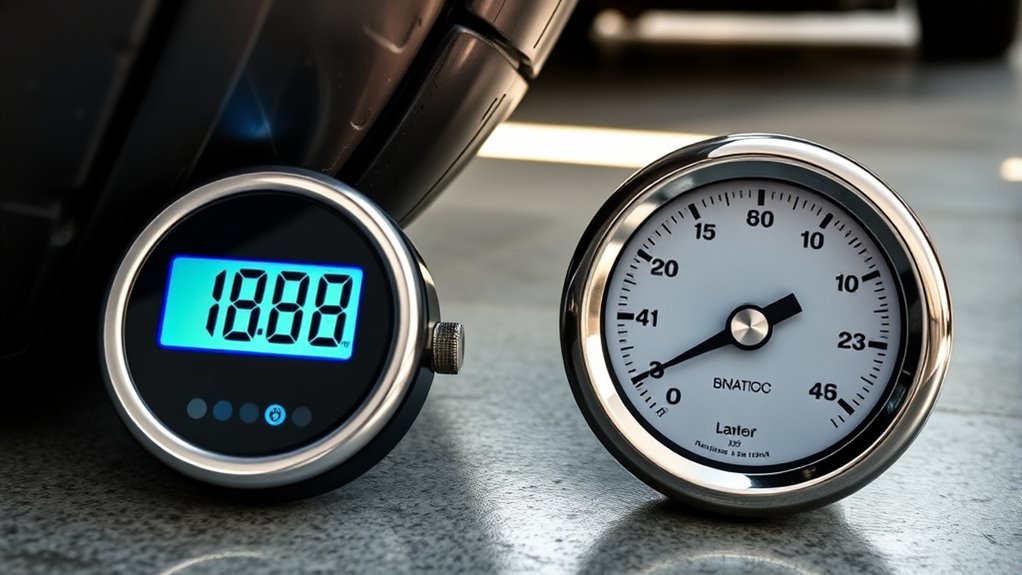
Digital vs. analog tire pressure gauge accuracy depends more on calibration, pressure range, condition, and valve-stem sealing than on the display type. Neither type wins by default: a quality digital gauge is usually easiest to read, and a quality analog dial gauge can be just as dependable without batteries. Pencil gauges remain useful as compact backups, but their sliding scales may be harder to read in fine increments.
Last updated: July 23, 2026.
Quick Answer
Neither digital nor analog tire pressure gauges are automatically more accurate. For most drivers, a quality digital gauge is easiest to read, especially in low light. A calibrated analog dial gauge is a strong battery-free choice. Compare the published accuracy tolerance, useful pressure range, repeatability, and valve-stem seal instead of choosing by display type alone.
Key Takeaways
- Choose a digital gauge if you want the easiest reading, backlighting, and simple unit conversion.
- Choose a dial-style analog gauge if you want a battery-free tool with a large, clearly marked scale.
- A pencil gauge can be an effective compact backup, but its sliding scale may be harder to read in small increments.
- Check tire pressure when the tires are cold and use the PSI on the driver-side placard or in the owner’s manual.
- Do not rely on the dashboard TPMS light alone; it warns about significant underinflation and does not replace monthly checks.
At a Glance
| Time Required | 5–10 minutes for all four tires |
| Difficulty | Easy |
| Tools Needed | Digital, dial, or pencil tire pressure gauge; air source if inflation is needed; safe place for the valve caps |
| Best Selection Rule | Prioritize a published accuracy tolerance, suitable pressure range, repeatable readings, and a chuck that seals cleanly |
How this guide was evaluated: This article compares gauge design, published accuracy concepts, official tire-safety guidance, and practical use. It does not claim laboratory testing of specific gauge models.
Why Tire Pressure Gauges Matter
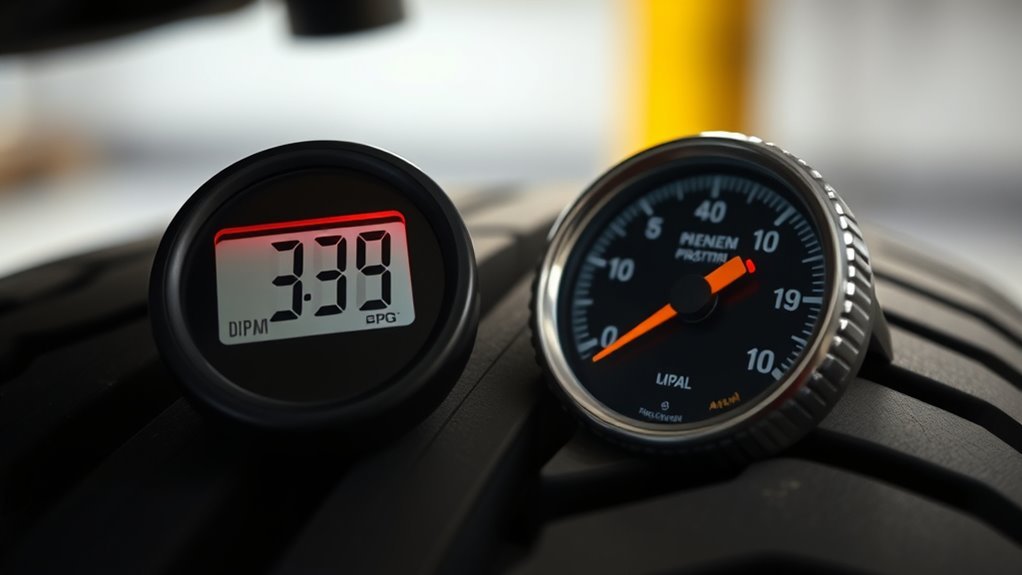
A tire pressure gauge confirms whether each tire matches the cold pressure recommended by the vehicle manufacturer. Tire pressure affects braking, steering response, tread wear, fuel economy, ride comfort, and heat buildup inside the tire.
The National Highway Traffic Safety Administration recommends keeping a tire gauge in the vehicle and checking pressure monthly. Use the pressure printed on the driver-side door placard or listed in the owner’s manual. The pressure molded into the tire sidewall is not the normal inflation target for the vehicle.
According to FuelEconomy.gov, properly inflated tires can improve gas mileage by 0.6% on average and up to 3% in some cases. It also estimates that underinflation can reduce gas mileage by about 0.2% for every 1 PSI drop in the average pressure of all tires.
The best gauge is therefore not the one with the most decimal places. It is the gauge that provides repeatable readings, seals cleanly on the valve stem, covers the required pressure range, and is used consistently.
Which Is More Accurate: Digital or Analog Tire Pressure Gauges?
Neither type is inherently more accurate. A digital gauge converts pressure into an electronic reading shown on a screen. An analog dial gauge moves a needle across a printed scale, while a pencil gauge pushes out a marked sliding bar. The quality of the sensor or mechanical element, the published tolerance, and the condition of the gauge matter more than the display.
Digital gauges reduce reading error because the result appears as a number. Dial gauges may require you to judge where the needle sits between markings, and viewing the dial from an angle can create parallax error. Pencil gauges can be accurate, but their sliding scales may offer less readable detail.
| Gauge Type | Best For | Main Strength | Main Accuracy Risk |
|---|---|---|---|
| Digital | Most everyday drivers | Clear numerical reading, often backlit | Weak battery, sensor drift, moisture, or a poor valve seal |
| Analog dial | Drivers who want a battery-free tool | Large scale, simple operation, and no electronic power requirement | Parallax, pointer damage, sticking movement, or shock damage |
| Pencil or stick | Compact emergency backup | Small, inexpensive, and battery-free | The sliding scale can be harder to read in fine increments, and quality varies |
Note: A digital gauge can display pressure to the nearest 0.1 PSI and still have an accuracy tolerance of ±1 PSI or more. Display resolution is not the same as verified accuracy.
[Products Worth Considering]
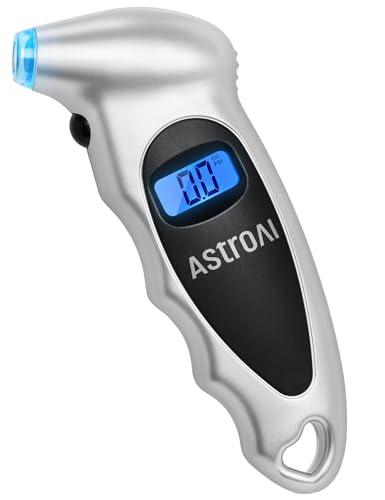
Accurate, Dependable Readings: Factory‑calibrated to ±1 PSI, so you can confidently match your vehicle’s recommended PSI (check the door jamb sticker). Ideal for monthly checks and road trips — consistent results every time, cold or warm.

PRO ACCURACY - mechanic recommended, performance tested, & calibrated accurate to professional ANSI 2A standards - with dual pressure sensors certified to ±0.50% FS (0.50 PSI), offering reliable readings up to 100 PSI w/ precise readout resolution of 0.10 PSI - so you can now maintain your tires with a shop-grade mechanic trusted tool

Enhanced Visibility in Low Light: Features a green backlit LCD screen and integrated flashlight, allowing for clear reading of tire pressure even in dark or dimly light conditions.
How Do Analog Tire Pressure Gauges Work?
Analog tire pressure gauges use a mechanical element to turn air pressure into movement. A dial gauge moves a needle across a printed PSI scale. A pencil gauge uses pressure to push a marked bar out of the body.
Mechanical Operation Principles
When you press the gauge onto the valve stem, air enters the gauge and moves its measuring element. The needle or sliding bar stops at the pressure reading. The system needs no battery, but it still depends on clean internal parts and an airtight connection.
A hard drop, dirt in the chuck, moisture, a leaking hose, or pressure beyond the rated range can affect the result. A dial can also be misread when the markings are crowded or the needle is viewed from an angle.
Pressure Measurement Mechanics
Many analog gauges state accuracy as a percentage of the full scale or span. The scale therefore matters. A gauge designed for a much higher pressure than your tires may technically meet its tolerance while providing less readable detail around normal passenger-car pressure.
How to Read a Tire-Gauge Accuracy Specification
Accuracy specifications are commonly stated as an absolute pressure tolerance or as a percentage of the gauge’s full scale. Apply the stated tolerance before comparing products.
- Absolute tolerance: A gauge rated ±1 PSI may read one PSI above or below the reference pressure within the conditions defined by the manufacturer.
- Percentage of full scale: A 0–100 PSI gauge rated ±1% of full scale has a calculated tolerance of ±1 PSI.
- Narrower scale example: A 0–60 PSI gauge rated ±2% of full scale has a calculated tolerance of ±1.2 PSI.
- Accuracy zones: Some specifications apply different tolerances to the middle and outer portions of the scale. Read the complete specification rather than relying on the headline percentage.
The ASME B40.100-2022 pressure gauge standard consolidates guidance for dial and digital pressure-indicating gauges, including terminology, construction, installation, safety, and test procedures. For a consumer tire gauge, the practical rule is to choose a reputable product with a published tolerance and a range that fits the pressures you measure.
Calibration and Maintenance Needs
An analog gauge can drift if the mechanism bends, wears, sticks, or becomes contaminated. Check it after a hard drop, when the pointer no longer returns to zero, or when readings suddenly differ from their normal pattern.
Most home users perform an accuracy comparison rather than a laboratory calibration. Compare repeated readings against a recently verified reference gauge. If you want independent verification, most tire shops and fleet-maintenance facilities can check your gauge against a certified master gauge on request. The dedicated tire pressure gauge calibration guide explains the full comparison and replacement process.
- Store the gauge in a dry case or protected glove-box pocket.
- Do not leave it loose with heavy tools.
- Keep the chuck clean so it seals tightly on the valve stem.
- Check for a leaking hose, damaged lens, or sticking needle.
- Replace the gauge if damage prevents stable, repeatable readings.
When Is an Analog Tire Pressure Gauge the Better Choice?
An analog gauge is a strong choice when battery-free operation, a large dial, or a flexible hose matters more than backlighting and digital unit conversion.
Pros of Analog Gauges
- No battery required: The gauge is available without checking electronic power.
- Clear mechanical feedback: A large dial can make pressure changes easy to follow while using a bleeder valve.
- Useful chuck options: Hoses, angled heads, and swivel chucks can improve access to recessed valve stems.
- Long service potential: A well-protected gauge can remain useful for years.
Cons of Analog Gauges
- Scale interpretation: Closely spaced markings make small differences harder to judge.
- Parallax: Viewing the needle from an angle can shift the apparent reading.
- Shock sensitivity: A drop can damage or shift the internal mechanism.
- Limited low-light visibility: Many dial gauges do not have active illumination.
Pro Tip: Choose a dial gauge with a swivel chuck, a controlled bleeder valve, and a pressure range that places your normal tire pressure in an easy-to-read part of the scale.
What Makes Digital Tire Pressure Gauges Easier to Use?

A digital gauge shows the result as a number instead of requiring you to estimate a needle position. This reduces reading error and is especially helpful at night, in a dim garage, or when the valve stem is difficult to reach.
Available features vary by model, but may include:
- Backlit display: Improves visibility in low light.
- Automatic shutoff: Reduces unnecessary battery drain.
- Unit conversion: Switches between PSI, BAR, kPa, or kg/cm².
- Bleeder valve: Releases air in controlled amounts.
- Illuminated or angled chuck: Helps align the gauge with the valve stem.
- Reading hold: Keeps the measurement visible after the gauge is removed.
The trade-off is reliance on electronics. A weak battery may dim the screen, prevent startup, or contribute to unstable operation depending on the design. Moisture and rough storage can also damage electronic components.
When Is a Digital Tire Pressure Gauge the Better Choice?
A quality digital gauge is usually the easiest option for monthly checks because it minimizes scale-reading guesswork and is simple to use in poor lighting.
[Products Worth Considering]

PROCESS LEVEL ACCURACY: Each ETENWOLF’s digital tire pressure gauge is calibrated manually to ANSI B40.7 Grade 2A(plus-minus 1 PSI).Presta valve adapter not included, if used for bicycles, it must be purchased separately

ULTIMATE PRECISION: Calibrated to ANSI B40.7 Grade 2A standards for ±0.5% accuracy. Features a 0-200 PSI range, perfect for cars, SUVs, trucks & motorcycles
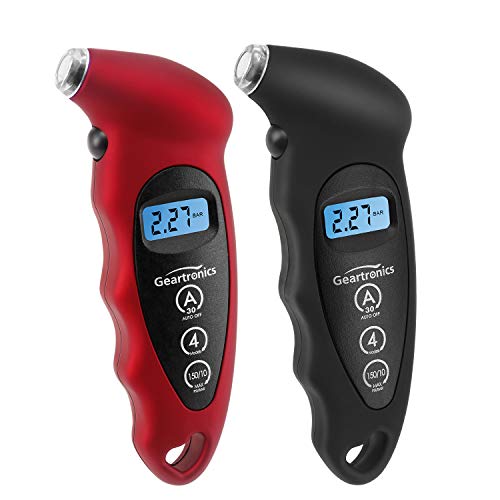
TIGHT SEAL NOZZLE AND BACKLIGHT LED: Backlight LED show you exact reading data clearly even at night or any dark place when you need to test tire pressure. Tight nozzle that easily slides onto valve stems, creating an airtight sealant to precision and accuracy. Lightweight, compact size, and portable, this gadget can easily be carried on you while bike riding, dirt biking, mountain biking, or off-roading.
Advantages of Digital Gauges
- Easy numerical reading: You do not need to interpret a needle between scale marks.
- Low-light visibility: Many models include a backlit screen or illuminated tip.
- Fine display resolution: Small changes can be shown clearly, subject to the gauge’s actual tolerance.
- Convenient functions: Unit switching and reading hold can simplify repeated checks.
Disadvantages of Digital Gauges
- Battery dependence: The gauge cannot operate normally with a dead battery.
- Electronic sensitivity: Water, excessive heat, and impacts may shorten its useful life.
- Variable product quality: A precise-looking display does not prove the sensor is accurate.
- Hidden drift: A drifting sensor may continue showing a convincing numerical result.
How Accurate Are Analog vs. Digital Tire Pressure Gauges?
A well-made digital, dial, or pencil gauge can provide useful tire-pressure readings. Digital models usually have the readability advantage. Dial and pencil models have the battery-free advantage. Accuracy still depends on the published tolerance, pressure range, condition, temperature, valve seal, and measuring technique.
Do not interpret “reads in 0.1 PSI increments” as “accurate within 0.1 PSI.” The first statement describes resolution. Only the manufacturer’s tolerance or a comparison with a verified reference addresses accuracy.
Repeatability is another practical test. If the same cold tire reads 34, 34, and 34.5 PSI, the readings are reasonably consistent for routine maintenance. If the results jump from 31 to 36 to 33 PSI, check the seal, valve, battery, zero position, and gauge condition before trusting the measurement.
Accuracy vs. Resolution: Do Not Confuse Them
Accuracy describes how close a reading is to the reference pressure. Resolution describes the smallest increment displayed or marked. Repeatability describes whether the gauge produces similar results under the same conditions.
| Term | Meaning | Why It Matters |
|---|---|---|
| Accuracy | How close the reading is to the reference pressure | Determines how closely the reading represents the actual pressure |
| Resolution | The smallest displayed or marked increment | Affects how detailed the result appears, not necessarily its correctness |
| Repeatability | How closely repeated readings agree | Helps reveal a bad seal, unstable gauge, or inconsistent technique |
| Tolerance | The maximum error permitted by the published specification | Lets you compare gauges using more than display type or decimal places |
Why Do Two Tire Pressure Gauges Show Different Readings?
Two gauges may disagree because one is out of tolerance, one did not seal correctly, the tire lost air between checks, the digital battery is weak, or the analog pointer no longer rests at zero. Different tolerances can also allow two working gauges to show slightly different numbers.
As a practical benchmark, if two gauges checking the same cold tire agree within about 1–2 PSI of each other, both are probably close enough for routine driving use. A gap of 3 PSI or more on the same valve stem means one gauge — or the seal, technique, or battery — needs attention before you trust either reading.
- Use the same cold tire and the same valve stem for both gauges.
- Take three readings with the first gauge, then three with the second.
- Reseat the chuck whenever you hear continuous air leakage.
- Check a digital gauge’s battery and an analog gauge’s zero position.
- If a meaningful difference remains, compare both with a recently verified reference gauge.
- Replace a gauge that remains erratic or falls outside its published tolerance.
What Impacts Tire Pressure Gauge Accuracy?

Display type is only one part of the measurement. Temperature, pressure range, calibration condition, valve-stem sealing, storage damage, battery condition, and reading technique can all affect the result.
When Should You Check Gauge Accuracy?
Check the gauge periodically, after a hard drop, after water exposure, or whenever its readings change unexpectedly. Also investigate if a digital screen becomes dim, an analog pointer stops returning to zero, or repeated measurements no longer agree.
- Take at least three readings on the same cold tire.
- Use a recently verified reference gauge for comparison.
- Check the chuck and hose for leaks before blaming the measuring element.
- Replace weak batteries before evaluating a digital gauge.
- Replace a damaged gauge that cannot be adjusted or verified.
How Does Temperature Affect Tire Pressure?
Tire pressure changes as temperature changes. The U.S. Tire Manufacturers Association states that inflation pressure may rise or fall by about 1 to 2 PSI for every 10°F change in temperature. “ It recommends checking tires at least monthly when they have been parked for at least three hours.
NHTSA also advises checking pressure when the vehicle has not been driven for at least three hours. Driving heats the tire and temporarily raises its pressure, which can hide a low cold reading.
Warning: Do not bleed air from a hot tire merely because its pressure is above the cold placard value. Recheck and adjust after the tire cools unless the vehicle or tire manufacturer gives a different procedure.
How Digital and Mechanical Gauges Can Drift
Mechanical gauges may be affected by friction, bent internal parts, a sticking pointer, damaged hoses, contaminated pistons, or parallax. Digital gauges may be affected by weak batteries, electronic sensor drift, moisture, damaged contacts, or display failure.
Both types can give a poor result when the chuck is not pressed squarely onto the valve stem. A brief hiss while positioning the gauge is normal. Continuous leaking means the seal is incomplete, so remove the gauge and try again.
Pressure Range and Scale Design
Choose a range that safely covers the highest pressure you need to measure while still providing useful detail near the vehicle’s normal pressure. A passenger-car gauge does not need the same range as a heavy-duty truck, RV, trailer tire, high-pressure temporary spare, or low-pressure off-road setup.
On a dial gauge, accuracy is typically best in the middle third of the printed scale. A practical rule of thumb is to choose a maximum range roughly double the pressure you are measuring — so a car running 32–35 PSI reads most accurately on a 0–60 or 0–80 PSI dial, not a 0–160 PSI dial built for truck tires. Always verify that the gauge can safely measure every tire and spare you plan to check.
Valve Stem Condition
A dirty, worn, bent, or cracked valve stem can prevent a clean seal and may also cause a slow leak. If the gauge will not seal after several careful attempts, inspect the valve stem and valve core. Replace missing caps because they help keep dirt and moisture away from the valve core.
How to Use and Care for a Tire Pressure Gauge
Use the same careful process for digital, dial, and pencil gauges. Consistent technique makes it easier to identify a real pressure change instead of a measuring error.
Step-by-Step: How to Check Tire Pressure
- Find the recommended PSI. Read the driver-side door placard or owner’s manual. Do not use the tire sidewall maximum as the normal target.
- Check the tires cold. Measure before driving or after the vehicle has been parked for at least three hours.
- Remove the valve cap. Put it in a pocket, tray, or cup holder so it does not roll away.
- Press the gauge straight onto the valve stem. Use firm, even pressure until continuous hissing stops.
- Read the pressure. Let a digital number stabilize, view a dial straight on, or read the pencil scale at the point where it exits the body.
- Add air when pressure is low. Inflate in short bursts and recheck.
- Release air when pressure is high. Use a bleeder valve or briefly press the valve core, then measure again.
- Replace the valve cap. Repeat for every road tire and check the spare according to the owner’s manual.
Use this maintenance schedule as a practical inspection guide:
| Action | When | Purpose |
|---|---|---|
| Compare with a verified reference | Periodically, after impact, or after suspicious readings | Identify meaningful accuracy drift |
| Inspect for damage and leaks | Before use | Prevent unstable readings and air loss |
| Store in a protected, dry place | After each use | Limit impact, dirt, heat, and moisture damage |
| Replace digital batteries | When the display dims or operation becomes unstable | Restore normal electronic operation |
If you add air with a portable compressor, pause the compressor before taking the final reading when the built-in display fluctuates. The 12V tire inflator safety guide explains connection, duty-cycle, and final-pressure checks.
Do You Still Need a Gauge If Your Car Has TPMS?
Yes. TPMS is an important warning system, but it does not replace routine pressure checks. The warning light is designed to react to significant underinflation rather than serve as a monthly maintenance tool.
In a 2023 study, AAA Automotive Engineering tested 11 model-year 2022–2024 vehicles equipped with direct TPMS. Average absolute differences between displayed and measured pressure were 1.2%–1.5%, and the largest difference was 3.3%. “
Warning-light behavior varied. Five of the 11 vehicles illuminated the warning immediately when the tires were reduced to 75% of placard pressure. Five more required one tire to be reduced an additional 0.8–2.9 PSI. One vehicle did not illuminate the light even when one tire reached 65% of placard pressure. “
Federal Motor Vehicle Safety Standard No. 138 requires covered vehicles to warn when one or more tires reach the applicable threshold at or below 25% under the recommended cold placard pressure. A tire can therefore be meaningfully low before the dashboard light appears.
Use the TPMS display or warning light as a safety aid. Use a dependable handheld gauge to verify cold pressure and detect smaller losses before they reach the warning threshold.
How Do You Choose the Right Tire Pressure Gauge?
Start with the required pressure range and published tolerance. Then compare readability, valve access, battery needs, storage conditions, and whether you need a bleeder valve.
[Products Worth Considering]

CLEAR DIGITAL READINGS: Check tire pressure up to 150 PSI with a bright backlit LCD and four selectable units. This digital tire pressure gauge makes routine checks easier in daylight, at night or during roadside stops

EXPERT-GRADE CALIBRATION: Each AstroAI Tire Pressure Gauge is calibrated with professional-grade tools, ensuring quick and accurate measurement results within plus-minus 1PSI. Stay prepared for any roadside emergency and travel with peace of mind.

PROCESS LEVEL ACCURACY: Each ETENWOLF’s digital tire pressure gauge is calibrated manually to ANSI B40.7 Grade 2A(plus-minus 1 PSI).Presta valve adapter not included, if used for bicycles, it must be purchased separately
Choose a Digital Gauge If…
- You want the clearest numerical reading.
- You often check tires at night or in a dim garage.
- You want unit conversion or a reading-hold function.
- You are willing to monitor and replace the battery.
Choose an Analog Dial Gauge If…
- You want a battery-free gauge.
- You prefer a large scale and visible needle movement.
- You want a hose or swivel chuck for awkward valve positions.
- You can protect the gauge from drops and read it straight on.
Choose a Pencil Gauge If…
- You need a compact, inexpensive backup.
- You want a gauge with no battery or screen.
- You can read its scale clearly within the pressure range you use.
- You understand that quality and scale detail vary between models.
Match the Pressure Range to the Use Case
- Passenger cars and crossovers: Use a range that comfortably covers the placard pressure and provides readable detail around the normal operating range.
- Trucks, RVs, trailers, and high-pressure spares: Confirm that the gauge’s maximum rating exceeds the highest pressure you need to measure.
- Low-pressure off-road tires: A lower-range gauge may provide more useful detail during airing down and reinflation.
- Multiple vehicles: Choose a range broad enough for every tire you maintain, or keep separate gauges for significantly different pressure ranges.
Features Worth Paying For
- Published accuracy tolerance: Compare an actual tolerance, not only the number of decimal places.
- Suitable pressure range: Match the scale to the tires and spares you check.
- Bleeder valve: Allows controlled pressure reduction.
- Swivel chuck or flexible hose: Improves access to recessed or awkward valves.
- Backlight: Helps with nighttime checks.
- Protective case: Limits impact, dirt, and moisture exposure.
- Replaceable battery: Extends the useful life of a digital gauge.
Common Tire Pressure Gauge Mistakes to Avoid
Even a well-made gauge can produce an unhelpful result when it is used under the wrong conditions. Avoid these errors:
- Adjusting hot tires to the cold placard pressure: Driving heat temporarily raises pressure.
- Using the tire sidewall number as the normal target: Use the vehicle placard or owner’s manual instead.
- Confusing resolution with accuracy: A 0.1 PSI display does not prove ±0.1 PSI accuracy.
- Ignoring continuous hissing: A leaking chuck is not properly seated.
- Trusting one unusual result: Repeat the measurement before adding or releasing a large amount of air.
- Using a range that is too broad or too low: The gauge must safely cover the pressure while remaining readable.
- Ignoring the spare: Check it according to the vehicle manufacturer’s instructions.
- Leaving valve caps off: Caps help keep contamination away from the valve core.
- Keeping a damaged gauge: Replace a cracked, leaking, sticking, or erratic tool.
Frequently Asked Questions
Are analog or digital tire gauges more accurate?
Neither type is automatically more accurate. A digital gauge is usually easier to read, while a quality analog dial gauge can provide equally useful readings without batteries. Compare the published tolerance, pressure range, repeatability, condition, and valve-stem seal.
What type of tire pressure gauge is most accurate?
The most accurate consumer choice is a well-made digital, dial, or pencil gauge with a published tolerance and a range suited to the tires being measured. Do not judge accuracy by display type or decimal places alone.
Are analog or digital gauges better?
Digital gauges are generally better for quick reading and low-light use. Analog dial gauges are better when battery-free operation, a large scale, or a flexible hose matters. The better choice is the one with the right range and tolerance for your use.
What is the most accurate way to measure tire pressure?
Use a dependable gauge on cold tires before driving or after the vehicle has been parked for at least three hours. Press the gauge squarely onto the valve stem, repeat an unusual reading, and adjust to the PSI listed on the driver-side placard or in the owner’s manual.
How often should I check tire pressure?
Check tire pressure at least once a month and before long trips, towing, or carrying a heavy load. Check again after major temperature changes or whenever a tire appears low or the TPMS warning activates.
Can I rely on my car’s TPMS instead of a tire pressure gauge?
No. TPMS is a warning system for significant underinflation. It may not alert you to a smaller pressure loss, and warning behavior varies between vehicles. Use a handheld gauge for routine cold-pressure checks.
Conclusion
Digital gauges are usually the easiest choice for everyday drivers because their numerical displays reduce reading guesswork. Analog dial gauges remain excellent battery-free tools, and a well-made pencil gauge can serve as a compact backup. None of the three designs guarantees accuracy by itself.
Choose a gauge with a published tolerance and a range suited to your tires. Protect it from drops and moisture, verify it when readings become suspicious, and check every tire cold at least once a month. Use the vehicle placard pressure, not the tire sidewall maximum, and do not wait for the TPMS warning light before correcting a low tire.
Sources
- National Highway Traffic Safety Administration TireWise — tire safety, inflation guidance, and monthly pressure checks.
- NHTSA Tire Safety Month guidance — cold-pressure checks and tire-maintenance recommendations.
- FuelEconomy.gov maintenance tips — fuel-economy effects associated with proper tire inflation.
- U.S. Tire Manufacturers Association Tire Care Essentials — cold checks, monthly inspections, TPMS limits, and temperature-related pressure changes.
- AAA Automotive Engineering TPMS accuracy report — direct-TPMS display accuracy and warning-light testing on 11 vehicles.
- ASME B40.100-2022 Pressure Gauges and Gauge Attachments — pressure-gauge terminology, construction, safety, installation, and testing.
- NHTSA FMVSS No. 138 — federal tire-pressure-monitoring-system performance requirements.