A tire inflator is one of the simplest tools you can keep in your car, but it solves a problem that affects safety, tire wear, fuel economy, and convenience. Instead of waiting for a gas-station air pump or driving on a low tire, you can top off pressure at home, in a parking lot, or before a road trip.
Quick Answer
You need a tire inflator because tires naturally lose air over time, and low tire pressure can hurt handling, braking, fuel economy, and tire life. A portable inflator lets you restore the correct cold PSI quickly, as long as you follow the vehicle placard and the inflator’s safety instructions.
Key Takeaways
- Use the tire pressure listed on your driver-door placard or owner’s manual, not the maximum PSI stamped on the tire sidewall.
- Check pressure when tires are cold for the most accurate reading.
- Keeping tires properly inflated can improve gas mileage by 0.6% on average and up to 3% in some cases, according to FuelEconomy.gov.
- Automatic shutoff, a readable gauge, a long power cord, a long air hose, and a clear duty-cycle rating make an inflator easier and safer to use.
- A tire inflator is for topping off low tires; if a tire will not hold air, has sidewall damage, or is very flat, stop driving and get professional help.
At a Glance
| Time Required | About 3–10 minutes per tire, depending on tire size, how low the tire is, and inflator power |
| Difficulty | Easy for routine top-offs; use extra caution during roadside emergencies |
| Tools Needed | Tire inflator, separate tire pressure gauge, valve-stem caps, and your vehicle’s recommended cold PSI |
| Cost | Usually a one-time purchase; exact cost depends on power type, speed, gauge quality, and accessories |
What Is a Tire Inflator and How Does It Work?

A tire inflator is a compact air compressor made to add pressurized air to a tire. Most portable models use an electric motor, piston, and cylinder to compress air, then push that air through a hose connected to the tire’s valve stem.
Depending on the model, a tire inflator may plug into a 12V vehicle outlet, connect directly to a battery, run from a rechargeable battery pack, or plug into a household wall outlet. Smaller portable tire inflators are usually slower than large shop compressors, but they are much more convenient for routine tire-pressure checks and emergency top-offs.
The best way to use one is to inflate each tire to the vehicle manufacturer’s recommended cold tire pressure. You can usually find that number on the driver-side door placard, inside the fuel door, or in the owner’s manual. Do not use the maximum PSI printed on the tire sidewall as your normal inflation target.
Note: A tire pressure monitoring system is helpful, but it is not a replacement for regular checks. Under U.S. federal rules, TPMS must warn when pressure is at or below 25% under the recommended cold pressure or a specified minimum threshold, whichever is higher, so a tire can be low before you see a warning light. Source: 49 CFR 571.138.
Key Benefits of Owning a Portable Tire Inflator
Owning a portable tire inflator gives you control over a small maintenance task that has a big effect on your car. Tires lose air naturally, and NHTSA notes that tires lose about 1 PSI per month, so monthly pressure checks are worth making a habit.
| Benefit | Why It Matters |
|---|---|
| Quick Inflation | Top off a low tire at home or on the road instead of searching for an air pump. |
| Better Tire Maintenance | Monthly checks help prevent underinflation, uneven wear, heat buildup, and poor handling. |
| Automatic Shutoff | A preset shutoff can help prevent overinflation when the gauge is accurate and the hose is sealed properly. |
| Emergency Convenience | A portable inflator can help you reach a safer location if a tire is only slightly low and still holds air. |
Why Tire Pressure Matters for Safety and Performance
Tire pressure affects how much of the tire contacts the road, how much heat builds up in the tire, and how the vehicle steers, brakes, and rides. NHTSA’s TireWise guidance recommends measuring tire pressure when tires are cold or adjusting carefully if they are warm.
Underinflated tires can flex more than they should. That extra flex creates heat, increases rolling resistance, and can speed up wear. NHTSA research has also found that even a few PSI below the manufacturer’s recommendation can affect handling and stopping distance.
Keeping tires inflated to the proper pressure can improve gas mileage by 0.6% on average and up to 3% in some cases, according to FuelEconomy.gov.
Pressure also changes with time and temperature. A tire that was correct last month can be low today, especially during seasonal temperature swings. That is why checking all four tires—and the spare if your vehicle has one—once a month is a smart routine.
How to Save Money With a Tire Inflator

A tire inflator can save money in three realistic ways: helping reduce fuel waste, helping tires wear more evenly, and reducing trips to paid or unreliable air pumps. It is not a magic tool, but it makes good tire maintenance easier to do consistently.
Prevent Costly Repairs
Maintaining the correct tire pressure helps reduce uneven tread wear. Underinflated tires tend to wear more on the shoulders, while overinflated tires can wear more in the center. Either condition can shorten tire life and make replacement come sooner than it should.
A tire inflator also helps you catch slow leaks early. If one tire repeatedly needs air while the others stay stable, the problem may be a nail, damaged valve stem, cracked wheel, or bead leak. In that case, do not just keep adding air—have the tire inspected.
Improve Fuel Efficiency
Fuel economy is one of the clearest money-saving benefits. FuelEconomy.gov says underinflated tires can lower gas mileage by about 0.2% for every 1 PSI drop in the average pressure of all tires. Keeping tires at the proper pressure can improve mileage by 0.6% on average and up to 3% in some cases.
The actual savings depend on fuel price, vehicle type, how low the tires were, and how much you drive. The important point is simple: a tire inflator makes it easier to keep pressure where it belongs, so you waste less fuel from avoidable rolling resistance.
Want to Save Money? Here’s How a Tire Inflator Helps

How can a tire inflator contribute to your savings? By helping you maintain the recommended cold PSI instead of waiting until a tire is visibly low or the TPMS light comes on.
- Prevent uneven tire wear: Better pressure control helps tires wear more evenly, which can extend useful tire life.
- Boost fuel efficiency: Proper inflation reduces rolling resistance, which helps the engine work more efficiently.
- Avoid emergency inconvenience: A small top-off before a trip is easier than handling a low tire on the shoulder.
- Skip unreliable public air pumps: Your own inflator and gauge let you check pressure on your schedule.
For the best results, pair the inflator with a separate tire pressure gauge. Built-in gauges are convenient, but a separate gauge gives you a second check before you drive.
Why You Need a Tire Inflator Handy
Having a tire inflator handy is useful because low pressure is common, gradual, and easy to miss. A tire can look normal while still being several PSI below the recommended pressure.
A portable inflator is especially helpful before long trips, during cold-weather pressure drops, after your TPMS light turns on, or when you notice one tire is lower than the rest. It also helps in rural areas or late at night when a working air pump may be hard to find.
Warning: A tire inflator is not a fix for a damaged tire. Do not drive on a tire with sidewall bulges, deep cuts, exposed cords, severe cracking, or pressure that drops again immediately after inflation. Move to a safe place and get roadside or professional help.
Must-Have Features in a Tire Inflator
When you’re choosing a tire inflator, focus on features that make the tool accurate, safe, and easy to use with your vehicle.
- Readable pressure gauge: Digital gauges are easy to read, but any gauge should be checked against a separate tire pressure gauge occasionally.
- Automatic shutoff: Lets you set a target PSI and helps prevent overinflation when the sensor is working correctly.
- Long hose and power cord: Make sure the inflator can reach all four tires, especially on trucks, SUVs, and vans.
- Correct power source: Choose 12V plug-in, direct battery clamps, cordless battery, or wall-power models based on where you will use it.
- Duty-cycle rating: Look for a clear run-time and cooldown rating. Small inflators often need a rest after several minutes of use.
- LED work light: Helpful for nighttime roadside use, but it should not replace hazard lights or a safe parking location.
- Adapters: Ball needles and inflatable nozzles are useful extras, but tire performance should come first.
- Storage and build quality: A case, protected cord routing, solid chuck, and replaceable fuse are practical everyday benefits.
Pro Tip: For larger truck or SUV tires, check more than max PSI. Inflation speed, duty cycle, hose reach, and whether the unit connects directly to the battery can matter more than a high PSI number on the box.
[Products Worth Considering]
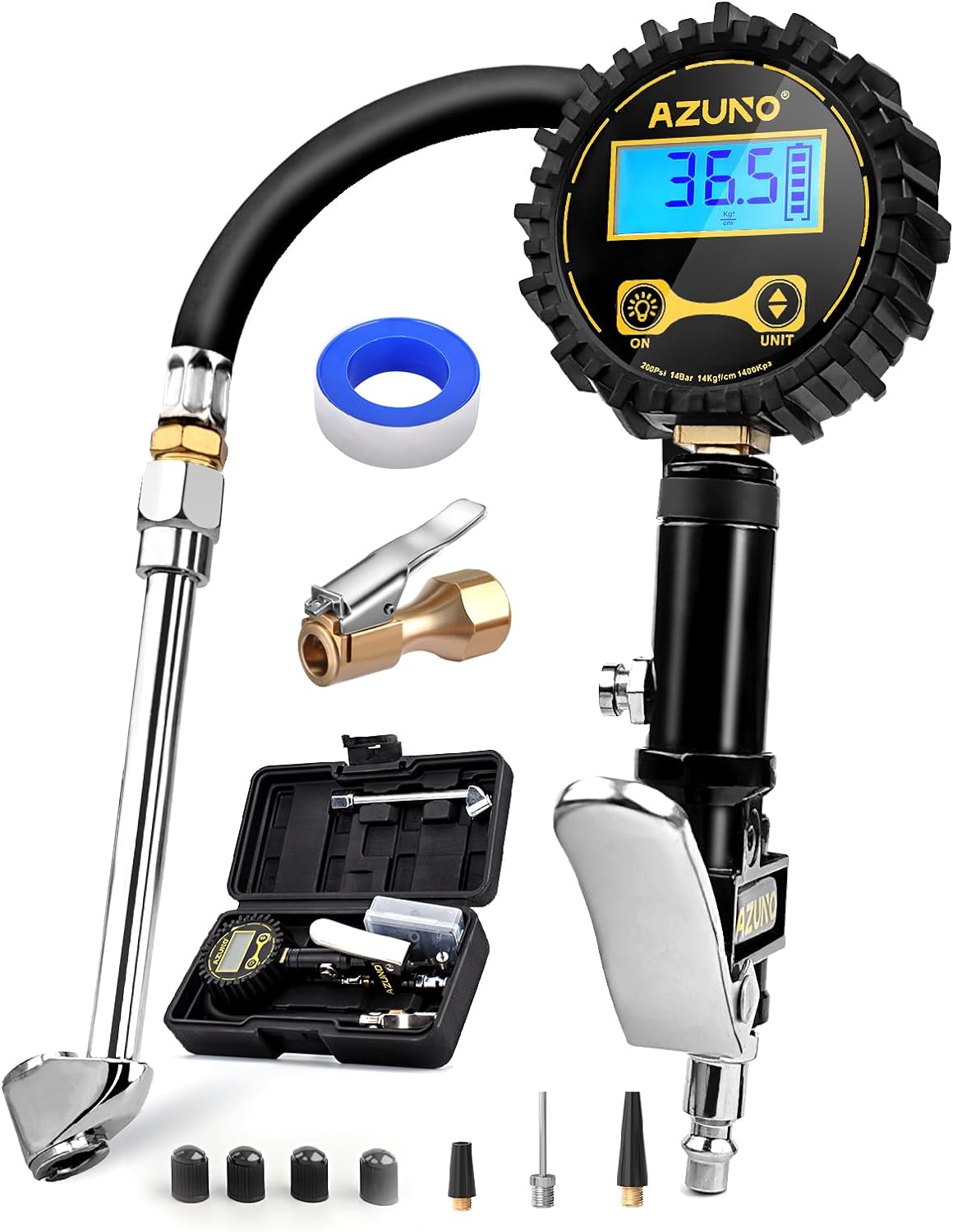
This digital tire inflator delivers accurate, easy-to-read pressure measurements with a bright backlit LCD and precise 0.1 resolution for confident inflation. Designed for single-handed use, it makes it simple to inflate or deflate tires while staying organized in the included portable carrying box. Built for a wide range of vehicles, it is a practical air compressor accessory for cars, trucks, SUVs, motorcycles, and more.

The Drymate XL Oil Spill Mat is designed to trap and contain messy liquid leaks while protecting your garage floor from stains and damage. Its absorbent surface wicks away moisture, and the waterproof, slip-resistant backing helps keep motor oil, brake fluid, gasoline, and coolant from soaking through. Reusable, durable, and easy to clean, it offers a practical long-term solution for garage and shop spill protection.

This upgraded Dorman OE FIX oil filter housing replaces failure-prone plastic on select Chrysler, Dodge, Jeep, and Ram vehicles with a durable aluminum design. It includes the oil cooler, filter element, cap, and required gaskets to help deliver a complete repair and updated fitment. Engineered for reliable sealing and long-term leak resistance, it is designed to help solve recurring oil filter housing failures.
How to Effectively Use Your Tire Inflator
To effectively use your tire inflator, start with the correct pressure target, connect the hose securely, inflate in short controlled steps, and recheck pressure after the compressor stops.
[Products Worth Considering]

This portable tire inflator delivers fast, convenient inflation for cars, bikes, motorcycles, and balls with dual power options from a rechargeable battery or a 12V car cord. Its digital LCD pressure gauge and automatic shutoff help prevent over-inflation, while multiple preset modes and a custom setting make it easy to use for different inflation tasks. Built-in flashlight and USB power ports add extra emergency utility on the road.

The AstroAI S8 is a compact 12V lithium jump starter designed to get gas and diesel vehicles back on the road quickly, even from low or fully drained batteries. It combines powerful starting performance with smart boost mode, built-in safety protections, and a versatile 5-in-1 design that also works as a power bank and flashlight for everyday emergencies and travel.

RAPID INFLATION & ROAD-READY PORTABILITY: Powerful 120W motor delivers up to 35L/min airflow—inflates a standard car tire (195/65 R15) from 30 to 36 PSI in under 1 minute under ideal operating conditions. Weighs only 2.2 lbs and fits glove compartments or trunks for daily commutes, road trips, and emergencies. Plugs into standard 12V DC car outlet with 15A fuse protection. AIRUN H features its cordless counterpart H2 Pro.
Locate Tire Valve Stem
The valve stem is the small rubber or metal stem sticking out from the wheel. It is usually covered by a plastic cap. Remove the cap and put it somewhere safe so it does not roll away.
- Park on a flat, safe surface away from moving traffic.
- Find the recommended cold PSI on the driver-door placard or owner’s manual.
- Remove the valve-stem cap.
- Press or screw the inflator chuck firmly onto the valve stem to create an airtight seal.
- Listen for leaks. If air hisses loudly at the connection, remove the chuck and reconnect it straight.
Monitor Tire Pressure Regularly
Check tire pressure at least once a month and before long trips. For the most accurate reading, check when the vehicle has been parked long enough for the tires to cool. AAA recommends checking after the car has sat for at least four hours because even a short drive can warm the tires and affect the reading.
Inflate to the recommended cold PSI, not above it “just in case.” After the inflator shuts off, wait a moment, then verify pressure with a separate gauge. Replace the valve cap when finished because it helps keep dirt and moisture out of the valve.
Limit Continuous Use Time
Small inflators can overheat if they run too long. The safe run time depends on the model, so read your manual and follow the stated duty cycle. If your inflator feels very hot, slows down, smells like overheated plastic, or shuts off, turn it off and let it cool on a hard, clean surface.
- Use the inflator only within its rated run time.
- Keep the air hose straight and kink-free.
- Do not leave the inflator unattended while it is running.
- Let it cool before storing it in a bag or trunk compartment.
Use the Right Power Source Safely
Power instructions vary by inflator. Some manufacturers tell you to keep the engine off. Others recommend running the engine for stronger 12V power, but only outdoors or in a well-ventilated area. Follow your inflator’s manual, and never run a vehicle engine inside a garage or enclosed space because of carbon monoxide risk.
If your inflator plugs into a 12V outlet, make sure the outlet’s fuse rating can handle the inflator. If the unit uses direct battery clamps, connect the clamps exactly as instructed in the manual. If it is cordless, charge the battery before road trips and avoid storing it fully drained for long periods.
What to Do If the Tire Will Not Inflate
If the inflator runs but the tire pressure does not rise, stop and troubleshoot before continuing.
- Air leaking at the valve: Reconnect the chuck straight and tighten it if it is a screw-on type.
- No power: Check the vehicle outlet, inflator fuse, battery charge, or cord connection.
- Very slow inflation: The tire may be too large for the inflator, the hose may be kinked, or the unit may be overheating.
- Pressure drops again quickly: The tire likely has a puncture, valve leak, bead leak, or wheel issue.
- Sidewall damage or severe flat: Do not attempt to “save” the tire with air. Use the spare, a repair kit approved by your vehicle manufacturer, or roadside assistance.
What Are the Best Maintenance Tips for Your Tire Inflator?
To keep your tire inflator reliable, treat it like emergency equipment. Store it clean, dry, and ready to use.
- Let it cool after use: Heat shortens motor and hose life.
- Inspect the hose and chuck: Replace the unit or parts if you see cracks, looseness, or air leaks.
- Check the power cord: Do not use a cord with exposed wire, melted insulation, or a damaged plug.
- Protect cordless batteries: Recharge them periodically and follow the battery-storage instructions.
- Keep adapters together: Store ball needles, nozzles, and spare fuses in the case.
- Clean vents or filters if equipped: Some models have air vents or filters that should stay clear of dirt and lint.
- Keep the manual: It contains the duty cycle, fuse rating, power instructions, and pressure limits for your exact unit.
When to Replace Your Tire Inflator?
Replace your tire inflator when it becomes unreliable or unsafe. A weak inflator can waste time in your driveway and become a bigger problem during an emergency.
- Repeated overheating: If it overheats quickly even during normal top-offs, the motor may be wearing out.
- Inaccurate gauge: If the built-in gauge is consistently far from a trusted gauge, do not rely on it.
- Damaged hose or connector: Cracks, leaks, or a loose chuck can prevent proper inflation.
- Power problems: Melted plugs, blown fuses, frayed cords, or failing batteries are safety concerns.
- Loss of inflation power: If it can no longer reach the recommended PSI for your tires, it is no longer dependable.
Do not wait until the inflator fails during a roadside situation. Test it occasionally at home so you know it works before you need it.
[Products Worth Considering]

Accurate: Spurtar tire inflator air pressure gauges with rubber hose are performance-tested and calibrated to the ANSI B40.1 Grade B (2%) international accuracy standard. This device allows you to measure your tire pressure accurately and inflate your tires without the need to drive to a gas station or garage. Easily use the tire pressure gauge with an air pump or compressor to inflate your tires efficiently

Specifications: 21’’ Tire Inflator Gauge Hose with locking chuck
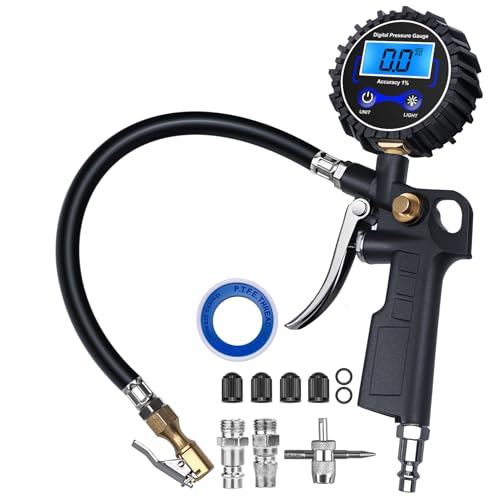
【Accuracy】The digital tire pressure gauge has 4 different measurement units: PSI, KPA, BAR, KG/CM². It reads within 1% of the exact tire pressure, with a resolution of 0.1 PSI and the measuring range is 3-250 PSI (0.2-17.2 Bar; 20-1724 Kpa; 0.2-17.5 kg/cm^2)
Frequently Asked Questions
Why do you need a tire inflator?
You need a tire inflator because tires naturally lose pressure over time, and low pressure can reduce fuel economy, increase tire wear, and affect vehicle handling. A portable inflator lets you correct low pressure quickly instead of waiting for a gas-station air pump.
What is the function of a tire inflator?
A tire inflator compresses air and pushes it through a hose into the tire valve stem. Its job is to raise tire pressure to the recommended cold PSI listed by your vehicle manufacturer.
Can I run my car while using a tire inflator?
Follow your inflator’s manual. Some 12V inflators instruct you to keep the engine off, while other models recommend running the engine for better power. If the manual says to run the engine, do it only outdoors or in a well-ventilated area, never inside a garage or enclosed space.
Do cordless tire inflators really work?
Yes, cordless tire inflators work well for routine top-offs and light emergency use. Their limits are battery life, inflation speed, heat buildup, and tire size. For large truck tires or frequent use, a stronger 12V or direct-to-battery inflator may be a better choice.
Should I inflate my tires to the PSI on the tire sidewall?
No. The PSI on the tire sidewall is usually the maximum cold pressure for that tire, not the recommended pressure for your vehicle. Use the driver-door placard, fuel-door label, glove-box label, or owner’s manual.
How often should I check tire pressure?
Check tire pressure at least once a month and before long trips. Tires can lose about 1 PSI per month, and temperature changes can make pressure rise or fall faster.
Can a tire inflator fix a flat tire?
A tire inflator can add air, but it cannot repair a puncture, sidewall cut, bad valve stem, or damaged wheel. If the tire will not hold pressure, stop driving and have it inspected or repaired properly.
Conclusion
A tire inflator is worth keeping in your vehicle because it makes proper tire pressure easier to maintain. That helps with safety, fuel economy, tire life, and day-to-day convenience. The key is to use it correctly: check tires cold, follow the vehicle placard PSI, respect the inflator’s duty cycle, and never ignore a tire that keeps losing air.
Choose a quality inflator with the right power source, a readable gauge, automatic shutoff, enough hose reach, and clear safety instructions. Then test it at home before you need it on the road.
Sources
- NHTSA TireWise — tire pressure, cold-pressure checks, and tire safety basics.
- FuelEconomy.gov: Keeping Your Vehicle in Shape — fuel economy effects of proper tire inflation.
- NHTSA Tires in the Garage Infographic — monthly PSI loss and routine tire-maintenance guidance.
- 49 CFR 571.138 Tire Pressure Monitoring Systems — TPMS low-pressure warning threshold.
- AAA: How to Check and Correct Tire Pressure — monthly checks, cold-tire readings, and pressure-location guidance.
- Slime Tire Inflator FAQ — example of model-specific engine-off inflator guidance.