The right tire pressure for your car is not a guess, and it is not the number molded into the tire sidewall. It is the vehicle manufacturer’s recommended cold tire pressure, usually listed on the tire information placard inside the driver’s door jamb, glove box, fuel door, or in the owner’s manual.
Quick Answer
Most passenger cars are commonly around 30–35 PSI, but the correct tire pressure is the cold PSI printed on your vehicle’s tire placard or owner’s manual. Check it when the tires are cold, before driving, and do not use the maximum PSI printed on the tire sidewall.
Key Takeaways
- Use the vehicle placard or owner’s manual for the correct cold tire pressure.
- Check tires when they are cold, meaning they have not been driven on for at least three hours.
- The sidewall PSI is the tire’s maximum pressure rating, not your car’s recommended pressure.
- Temperature changes affect PSI, so recheck pressure during cold snaps, heat waves, and seasonal changes.
- Do not wait for the TPMS light; it may not turn on until pressure is significantly low.
At a Glance
| Time Required | 5–10 minutes |
| Difficulty | Easy |
| Tools Needed | Tire pressure gauge and air compressor |
| Cost | Usually free at many gas stations; tire gauges are often inexpensive |
Understanding Tire Pressure: What Is PSI?
PSI stands for pounds per square inch. It measures the air pressure inside your tires. Correct tire pressure helps the tires support the vehicle’s weight, keep the tread in proper contact with the road, and maintain predictable braking, steering, ride comfort, and fuel economy.
For many passenger cars, the recommended pressure is often around 30–35 PSI, but that range is only a general reference. Your vehicle may need a different pressure in the front and rear tires, and some vehicles require a higher PSI depending on tire size, load rating, or manufacturer design.
The most reliable source is your vehicle’s tire information placard or owner’s manual. The National Highway Traffic Safety Administration explains that the manufacturer’s recommended tire inflation pressure is the proper PSI when the tire is cold.
What’s the Right Tire Pressure for My Car?
The right tire pressure for your car is the cold PSI listed by the vehicle manufacturer. Look for it in these places:
- Driver’s side door jamb tire placard
- Owner’s manual
- Glove box or fuel door on some vehicles
- Manufacturer service information for special tire or load setups
Warning: Do not use the maximum PSI printed on the tire sidewall as your normal inflation target. That number is the tire’s maximum cold pressure rating, not the vehicle manufacturer’s recommended operating pressure.
The U.S. Department of Energy’s FuelEconomy.gov also notes that the proper tire pressure is usually found on the driver’s side door jamb, glove box, or owner’s manual, and warns drivers not to use the maximum pressure printed on the tire sidewall.
| Where You Look | What It Means | Use It? |
|---|---|---|
| Door placard or owner’s manual | Vehicle manufacturer’s recommended cold tire pressure | Yes |
| Tire sidewall | Maximum cold pressure the tire is rated to hold | No, not as your normal target |
| Dashboard TPMS reading | Live or recent pressure estimate, depending on the system | Helpful, but confirm with a gauge |
[Products Worth Considering]

The JACO ElitePro Digital Tire Pressure Gauge delivers shop-grade accuracy with a clear digital readout, making it easy to maintain proper tire pressure for safer driving and better performance. Built with rugged brass and steel components, a protective guard, and a flexible air hose, it is designed for reliable use across cars, trucks, motorcycles, bikes, RVs, and trailers. The lock-on display, built-in bleeder valve, and bright backlit screen add convenience in any lighting condition.

Restore cloudy, yellowed vehicle lenses with this easy-to-use headlight restoration kit from 3M. It includes sanding discs, a disc pad holder, masking tape, and a clear coat protectant to help improve clarity on headlights, taillights, and other plastic lenses. Designed to remove haze and buildup without damaging the lens surface, it offers a practical way to refresh appearance and avoid costly replacement.

The ETENWOLF T300 digital tire pressure gauge delivers accurate readings for cars, trucks, RVs, bikes, and heavy-duty vehicles with a wide pressure range and reliable calibration. It is built to perform in extreme temperatures, includes an LED light for dark conditions, and uses replaceable AAA batteries for long-term convenience. Its durable design and automatic shut-off make it a practical, dependable tool for everyday tire maintenance.
Why Regular Tire Pressure Checks Are Essential for Safety and Performance
Proper tire pressure helps your vehicle steer, brake, and ride as designed. Underinflated tires flex more, build more heat, wear unevenly, and can reduce fuel economy. Overinflated tires can ride harshly, reduce the tire’s contact patch, and wear more quickly in the center of the tread.
FuelEconomy.gov reports that underinflated tires can lower gas mileage by about 0.2% for every 1 PSI drop in the average pressure of all tires.
Regular pressure checks also help you catch slow leaks, punctures, valve-stem problems, or seasonal pressure drops before they become safety problems. Check tire pressure at least monthly, before long trips, when carrying heavy loads, and whenever the tire pressure warning light comes on.
How to Accurately Check and Adjust Your Tire Pressure for Optimal Performance
For the most accurate reading, check tire pressure when the tires are cold. NHTSA defines a cold tire as one that has not been driven on for at least three hours. If you have already driven, the tires may read several PSI higher because driving heats the air inside them.
Pro Tip: Check tire pressure first thing in the morning before the sun heats one side of the vehicle. Sunlight can warm tires unevenly and make readings less consistent.
[Products Worth Considering]
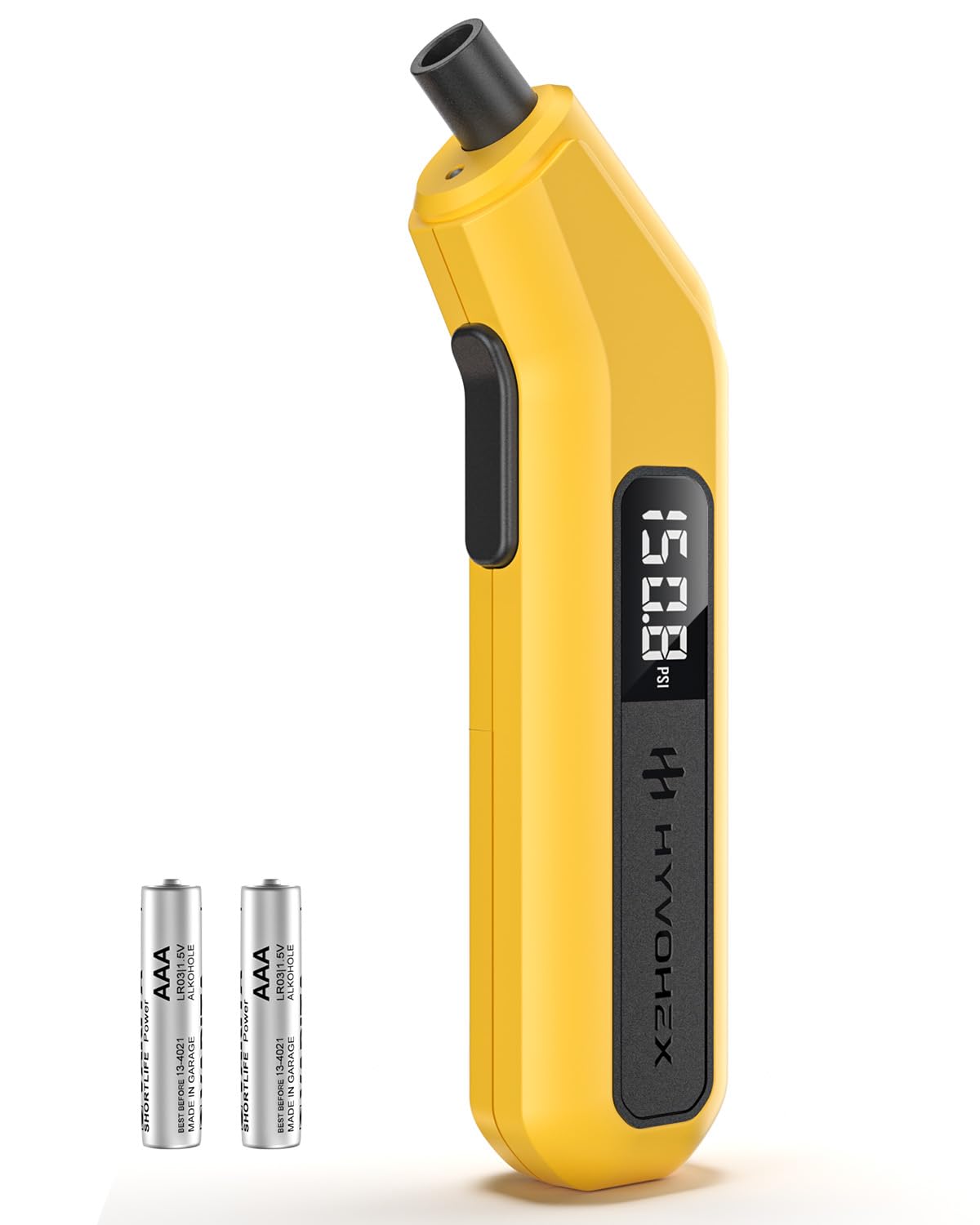
HYVOHEX digital tire pressure gauge delivers fast, accurate readings with an easy-to-read LED backlit display and a high-sensitivity sensor for reliable tire checks. Its valveless one-click operation, rotating valve head, and broad compatibility make it a practical tool for cars, bikes, and trucks. Built with a durable rubber shell and aluminum nozzle, it is compact enough to keep in your glove box or tool bag.

This heavy-duty digital tire pressure gauge delivers quick, accurate readings with a clear backlit LCD and built-in flashlight for easy use in low light. Designed for RVs, trucks, cars, motorcycles, and bicycles, it features a durable stainless steel build, ergonomic grip, multiple unit options, and auto shut-off for convenience.
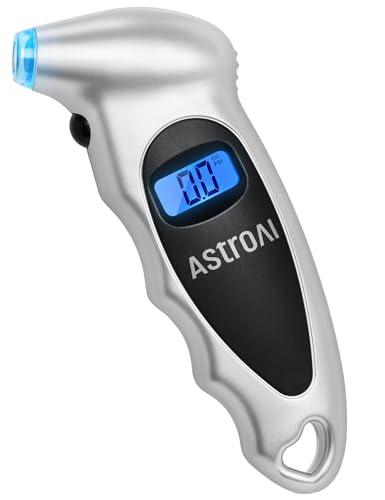
Accurate, Dependable Readings: Factory‑calibrated to ±1 PSI, so you can confidently match your vehicle’s recommended PSI (check the door jamb sticker). Ideal for monthly checks and road trips — consistent results every time, cold or warm.
Importance of Tire Pressure
Correct tire pressure keeps the tire’s tread working evenly across the road surface. That improves handling, braking, comfort, and tire life. A tire that is too low can overheat and wear on the outer shoulders. A tire that is too high can wear more in the center and may feel harsh over bumps.
| Pressure Problem | Common Effect |
|---|---|
| Too low | Poor handling, extra heat, lower fuel economy, shoulder wear, higher risk of tire damage |
| Too high | Harsh ride, reduced grip on rough roads, center tread wear |
| Uneven between tires | Pulling, uneven braking feel, inconsistent handling |
Steps to Measure Pressure
- Find the recommended cold PSI on the tire placard or in the owner’s manual.
- Make sure the tires are cold before checking.
- Remove the valve cap from one tire.
- Press the tire gauge firmly onto the valve stem until the hissing stops.
- Read the PSI and compare it with the recommended pressure.
- Repeat for all four tires, and check the spare tire if your vehicle has one.
- Replace each valve cap securely after checking.
Adjusting Air for Accuracy
If the tire pressure is low, add air in short bursts, then recheck with your gauge. If the pressure is too high, release air slowly by pressing the valve stem pin, then recheck. The goal is to match the vehicle manufacturer’s recommended cold PSI.
If your front and rear tires have different recommended pressures, follow the placard for each axle. Do not make all four tires the same unless the placard says all four should be the same.
Note: If you must inflate warm tires after driving, use the placard PSI as a temporary target, then recheck and fine-tune the pressure when the tires are cold.
What Happens When Tire Pressure Is Too Low?
Low tire pressure can make your vehicle feel sluggish, unstable, or less responsive. It can also increase stopping distance, reduce fuel economy, and make the tire run hotter than intended. Over time, underinflation can cause uneven tread wear and may contribute to tire failure.
| Effect of Low Tire Pressure | Why It Matters |
|---|---|
| Poor handling | The tire sidewall flexes more, which can make steering feel slow or unstable. |
| Longer stopping distance | A poorly inflated tire may not keep the tread working evenly on the road. |
| Uneven tire wear | The shoulders of the tire can wear faster, shortening tire life. |
| Lower fuel economy | More rolling resistance means the engine has to work harder. |
If one tire is repeatedly low while the others stay normal, inspect it for a nail, screw, cracked valve stem, bent wheel, bead leak, or sidewall damage. Have it checked by a tire professional if the pressure keeps dropping.
The Risks of Overinflating Your Tires
Overinflating your tires can also cause problems. A tire with too much air can become stiff, which may make the ride harsh and reduce traction on rough or uneven pavement. Over time, the center of the tread may wear faster than the edges.
Never inflate beyond the limit shown on the tire sidewall, and do not exceed the vehicle manufacturer’s recommended pressure unless your owner’s manual gives a specific loaded-vehicle or towing pressure. If you accidentally add too much air, release it slowly and recheck with a gauge until the tire matches the placard PSI.
How Weather Affects Tire Pressure

Temperature has a direct effect on tire pressure because air expands when heated and contracts when cooled. Tire Rack notes that the recommended pressure in the owner’s manual or tire placard is the vehicle’s recommended cold tire inflation pressure, and it should be checked before driving or before temperature and sunlight affect the tires.
As a practical rule, tire pressure often changes about 1 PSI for every 10°F change in temperature. A cold snap can make a correctly inflated tire look low the next morning, while a hot day or highway driving can make pressure read higher than it does when cold.
Do not add a blanket 3–5 PSI just because winter arrives. Instead, check the tires cold and inflate them to the pressure listed on your vehicle placard. If your manual gives a separate pressure for winter tires, towing, or heavy loads, follow that specific guidance.
Why Does Your Tire Pressure Light Matter and What to Do About It?
Your tire pressure monitoring system, or TPMS, warns you when one or more tires are significantly underinflated or when the system has a fault. Under federal safety standard FMVSS 138, covered vehicles must warn drivers when pressure in one or more tires is at or below 25% below the vehicle manufacturer’s recommended cold inflation pressure, or the standard’s minimum activation pressure, whichever is higher.
[Products Worth Considering]

【Wide Application】The Masoll M13 Tyre Pressure Monitoring System commonly used on the vehicles with 4 tires include but no limited to Sedan, SUV, Pick-up truck, RV, Travel Trailer less than 38ft. When the trailer is longer than 38ft, a Masoll signal booster recommended to install to enhance the transmission signal.

**Professional 24/7 Real-Time Tire Pressure Monitoring System** Our professional tire pressure monitoring system (TPMS) provides 24/7 real-time tire safety with 2 PSI / 3°F high precision. Military-grade TPMS sensor units refresh every 0.3 seconds (3x faster than standard systems), tracking pressure and temperature simultaneously. The LCD updates every 6 seconds for instant leak & overheating alerts, making it a reliable trailer tire pressure monitoring system for RVs, trucks and highway towing. It supports PSI/BAR unit switching for universal compatibility, ideal for drivers seeking steady tymate tire pressure monitoring system performance.

【Precision Monitoring & Ultra-Fast Real-Time Response】Professional tire pressure monitoring with ±1.5 PSI high accuracy within a 0–144 PSI range. The tire sensors update data in just 0.3 seconds—3x faster than standard TPMS—enabling simultaneous real-time tracking for all 6 tires. The LCD screen refreshes every 6 seconds and provides instant alerts for air leaks or sudden pressure drops, making it essential for heavy-duty loads and long-haul towing.
Understanding Tire Pressure Alerts
A solid tire pressure light usually means one or more tires are low. A blinking TPMS light often points to a system malfunction, such as a failed sensor or a communication problem. Check your owner’s manual because warning behavior can vary by vehicle.
Immediate Actions Required
- Pull over safely if the vehicle feels unstable or a tire looks very low.
- Check all four tires with a gauge when safe to do so.
- Inflate low tires to the placard PSI.
- Inspect for visible damage, punctures, or sidewall bulges.
- Reset or recalibrate the TPMS only if your owner’s manual instructs you to do so.
- If the light stays on after correct inflation, have the tire or TPMS system inspected.
Long-Term Safety Implications
Do not rely on the TPMS light as your only tire-pressure check. A TPMS warning may not appear until pressure is already far below the recommended level. Manual checks help you catch gradual pressure loss earlier and keep your tires closer to the correct operating range.
Tips for Maintaining Proper Tire Pressure Year-Round
- Check tire pressure at least once a month.
- Check before long trips or highway driving.
- Check after major temperature swings.
- Use a quality tire pressure gauge, not only the gas-station compressor gauge.
- Check tires when cold whenever possible.
- Check the spare tire if your vehicle has one.
- Replace missing valve caps to help keep dirt and moisture out of the valve stem.
- Have a tire inspected if it loses pressure again within a few days.
Keeping tire pressure correct is one of the simplest maintenance habits you can build. It takes only a few minutes and can improve safety, tire life, handling, and fuel economy.
Frequently Asked Questions
Should my tires be 32 or 35 PSI?
Use whichever pressure your vehicle placard or owner’s manual lists. Many cars fall near 32–35 PSI, but the correct number depends on the vehicle, tire size, axle, and load. If the placard says 32 PSI, use 32. If it says 35 PSI, use 35.
Is 40 PSI good tire pressure for a car?
Forty PSI is good only if your vehicle manufacturer recommends it for your tire size and load. It is too high for some cars and normal for others. Do not use 40 PSI just because it appears on the tire sidewall unless your vehicle placard or manual calls for it.
What is the 5 PSI rule?
There is no universal 5 PSI rule that replaces your vehicle’s recommended tire pressure. A difference of 5 PSI can be significant on many passenger vehicles, so treat it as a warning to recheck the placard, inspect the tire, and adjust pressure when the tires are cold.
Is 30 PSI good for car tires?
Thirty PSI may be correct for some cars, but it may be too low for others. Check the driver’s door placard or owner’s manual. If your vehicle recommends 30 PSI cold, it is good. If the placard recommends 35 PSI, then 30 PSI is low.
Should I check tire pressure hot or cold?
Cold is best. Check tire pressure before driving or after the vehicle has been parked for at least three hours. Hot tires can read higher because driving warms the air inside them.
Why did my tire pressure light come on when it got cold?
Cold air can lower tire pressure because the air inside the tire contracts. Check all tires when cold and inflate them to the placard pressure. If one tire is much lower than the others, inspect it for a leak.
Conclusion
The best tire pressure for your car is the cold PSI listed on the vehicle placard or in the owner’s manual. For many passenger cars, that number is often around 30–35 PSI, but your vehicle’s recommendation is the only number that matters. Check pressure monthly, before long trips, and when temperatures change. A few minutes with a tire gauge can help protect your tires, fuel economy, handling, and safety.
Sources
- NHTSA TireWise: Tire Safety Ratings and Awareness — cold tire pressure, tire safety, and blowout guidance.
- FuelEconomy.gov: Keeping Your Vehicle in Shape — fuel economy impact and door-placard guidance.
- 49 CFR § 571.138: Tire Pressure Monitoring Systems — TPMS performance requirements and warning threshold.
- AAA: How to Check and Correct Tire Pressure — monthly checking guidance and tire pressure checking steps.
- Tire Rack: How Temperature Change Affects Tire Air Pressure — temperature effects and cold inflation guidance.
- Goodyear: Tire Air Pressure — placard pressure versus sidewall maximum pressure.