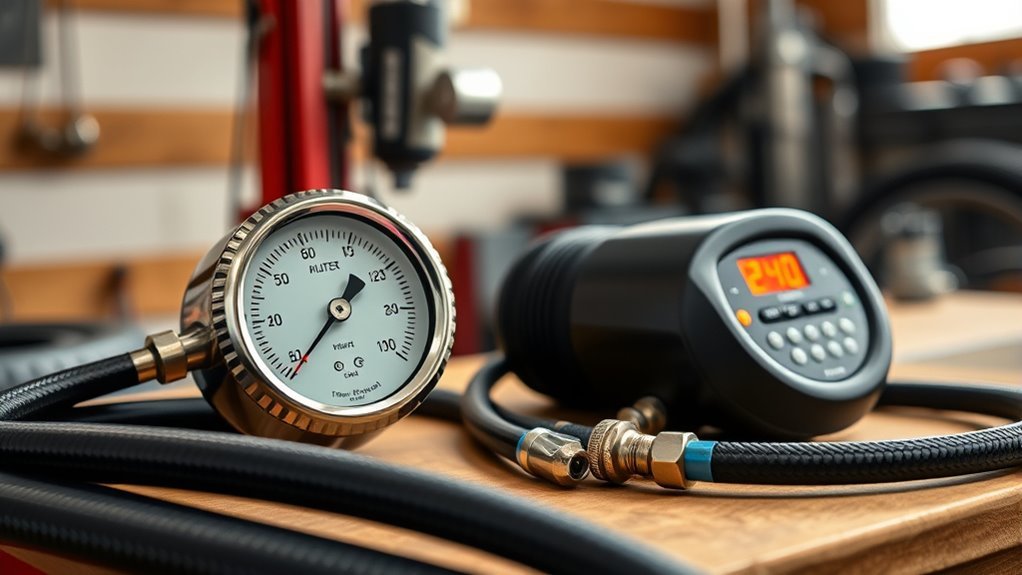
An analog tire inflator is a battery-free mechanical device that measures and inflates tire pressure using a Bourdon tube. Its durable design guarantees long-lasting performance in various environments. While analog inflators provide real-time readings on a dial, they can be less accurate than digital models, potentially deviating by up to 4 PSI. Digital inflators, on the other hand, offer precision readings and enhanced features, but they require batteries. Discover how to choose the best inflator for your needs!
What Is an Analog Tire Inflator?

An analog tire inflator is a mechanical device designed to measure and inflate tire pressure accurately, using a straightforward and reliable system. It typically features a Bourdon tube that bends in response to pressure changes, providing you with real-time tire pressure readings displayed on a dial. With a needle indicator moving along a scale, you can easily read the pressure in PSI without needing batteries or electronic components. Known for their durability, analog inflators are constructed from robust materials, making them suitable for various environments. While calibration is necessary for accuracy, many models include handy features like an air bleed button for quick deflation, ensuring you have a reliable tool that meets your tire maintenance needs.
Advantages of Using Analog Tire Inflators
Using an analog tire inflator offers several advantages that make it a preferred choice for many users. These devices combine reliability with simplicity, ensuring you get the job done without hassle. Here are some key benefits:
Analog tire inflators combine reliability and simplicity, making them a favored choice for hassle-free tire maintenance.
- Durability: Built from robust materials, analog inflators resist damage from drops better than their digital counterparts.
- Easy Visibility: The large dial display provides quick, clear readings in any lighting.
- Battery-Free Operation: You won’t need batteries or electronic screens to worry about.
- Low Maintenance: Analog gauges don’t require frequent calibration, making them user-friendly.
- Precision Adjustments: The air bleed button allows for easy deflation and precise tire pressure adjustments.
With these advantages, analog tire inflators are a dependable choice for tire maintenance.
Common Limitations of Analog Tire Inflators
While analog tire inflators offer a straightforward design, they come with notable limitations that can impact your experience. You’ll find that their accuracy can be limited, often requiring regular calibration to guarantee correct readings. Additionally, factors like temperature sensitivity can further complicate their reliability, making it essential to understand these constraints when choosing the right inflator for your needs.
Limited Accuracy Range
When it comes to monitoring tire pressure, the limited accuracy range of analog tire inflators often proves to be a significant drawback. These devices can deviate by up to 4 PSI, which isn’t ideal for precise pressure monitoring. Here are key points to take into account:
- Mechanical components may introduce calibration errors.
- Performance consistency is less than digital inflators, which provide +/- 1 PSI accuracy.
- Readability can be compromised by poor lighting and viewing angles.
- Regular recalibration may be necessary to guarantee reliability.
- Misinterpretation of displayed PSI is possible, affecting your tire health.
Understanding these limitations helps you make informed choices about your tire maintenance tools, guaranteeing safety and efficiency on the road.
Calibration Needs Regularly
For peak performance, you need to be aware that analog tire inflators require regular calibration to guarantee their accuracy. Unlike digital inflators that self-correct, analog models rely on mechanical components, which can lead to calibration errors. These inaccuracies can be off by up to 4 PSI, making it essential to check against a known standard periodically. Calibration involves adjusting the gauge to align with reference pressure, a manual process that can be time-consuming. Additionally, frequent exposure to extreme temperatures and moisture may further affect their functionality. To maintain ideal performance, you must commit to this routine calibration, ensuring your readings remain reliable and your tires stay properly inflated. Embrace the knowledge for a smooth ride!
Sensitivity to Temperature Changes
Regular calibration is essential for maintaining the accuracy of your analog tire inflator, but that’s not the only limitation to take into account. Temperature changes can greatly impact the performance of these devices. Here’s what you should know:
- Analog gauges can be off by up to 4 psi in extreme temperatures.
- The Bourdon tube mechanism is sensitive to heat and cold fluctuations.
- Readings may vary if the gauge was exposed to temperature extremes before use.
- Allow time for the gauge to stabilize for accurate readings.
- Regular calibration is necessary, especially in extreme climates.
How Digital Tire Inflators Work

Digital tire inflators revolutionize the way you maintain tire pressure, utilizing electronic sensors to measure and display accurate readings on an LCD screen. Unlike traditional analog models, these inflators provide precision measurements within +/- 1 PSI, with some advanced versions even displaying readings to 0.1 PSI. You can easily switch between pressure units, adapting to your preferences. Many models come with programmable settings, allowing you to set your desired PSI; they automatically stop inflating once that target is reached, ensuring peak tire performance. Plus, backlit displays offer visibility in low-light conditions, making it easier to check readings anytime. While they rely on batteries or rechargeable sources, the convenience and accuracy of digital inflators can’t be overlooked.
Benefits of Choosing Digital Tire Inflators
When considering tire maintenance, opting for a digital tire inflator offers numerous advantages that enhance both convenience and performance. Here are some key benefits that make digital models stand out:
- Improved Accuracy: Digital tire pressure gauges measure within +/- 1 PSI, ensuring ideal tire pressure.
- Backlit LCD Screens: These screens enhance readability in low-light conditions, unlike their analog counterparts.
- Programmable Settings: Many digital inflators come with additional features for enhanced functionality, like preset pressure levels.
- Durability: With static electronic sensors, digital inflators resist damage from drops better than mechanical analog models.
- Fuel Efficiency & Safety: Maintaining precise tire pressure can lead to improved fuel economy and safer driving conditions.
Investing in a digital tire inflator is a smart choice for any vehicle owner.
Drawbacks of Digital Tire Inflators Compared to Analog
While digital tire inflators offer advanced features and precise readings, they come with some notable drawbacks that may affect your overall experience. For starters, digital models often rely on batteries, risking failure when you need them most. In contrast, using analog inflators eliminates this dependency. You’ll find analog options are generally more durable, crafted from robust materials that can withstand the rigors of everyday use. Additionally, their straightforward functionality makes them easy to operate—no complex features to navigate. Calibration can also be a hassle for digital inflators, whereas an analog gauge is perfect at maintaining accuracy with minimal maintenance. Plus, analog inflators provide clear readings, unaffected by lighting conditions, ensuring you can always check your tire pressure with confidence.
How to Choose Between Analog and Digital Tire Inflators?
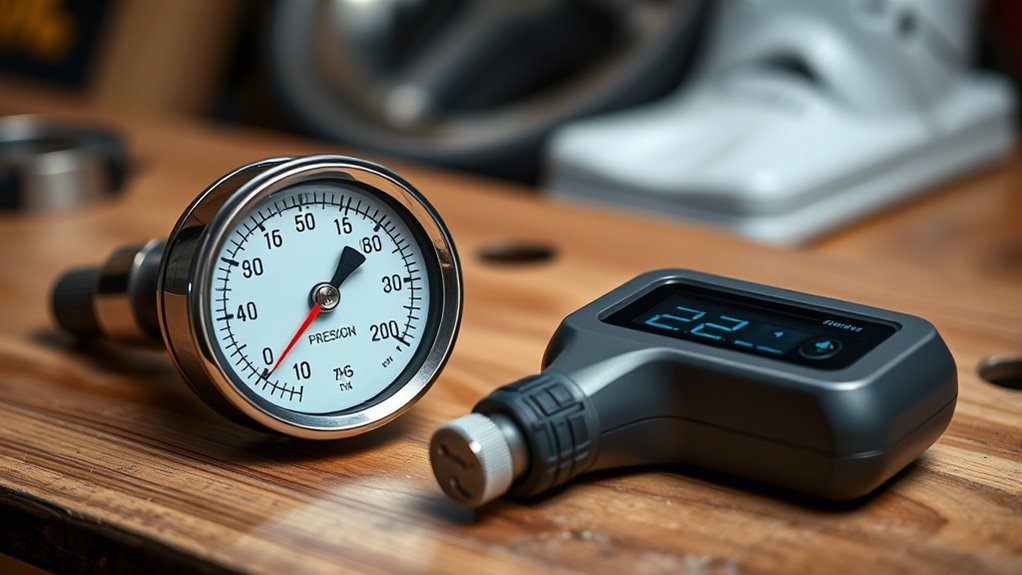
When choosing between analog and digital tire inflators, you should first consider your accuracy needs; digital models offer precise readings, while analog provides reliable, though less exact, measurements. Next, evaluate the durability factors, as analog inflators typically withstand varying conditions better than their digital counterparts. Finally, assess your user preferences, including ease of use and maintenance, to find the inflator that best suits your lifestyle.
Consider Accuracy Needs
Choosing between analog and digital tire inflators hinges considerably on your accuracy needs. If precision is your priority, digital models can provide impressive accuracy, often within +/- 1 psi. In contrast, analog inflators have a variance of up to 4 psi. Here are some key considerations:
- Gauge Readability: Digital models feature easy-to-read LCD screens.
- Programmable Settings: Many digital inflators let you set desired pressures.
- Lighting Conditions: Digital displays often include backlighting for low-light use.
- Durability: Analog inflators typically withstand drops better.
- Frequency of Use: Consider how often you’ll need precise readings.
Ultimately, your choice should align with your specific accuracy requirements and usage scenarios.
Evaluate Durability Factors
As you evaluate durability factors in tire inflators, it is essential to recognize the significant differences between analog and digital models. Analog inflators boast robust construction with mechanical components, making them more durable against drops and impacts. Without electronic parts, they don’t rely on batteries, thereby reducing maintenance needs and enhancing longevity. On the other hand, digital inflators deliver precision, often measuring within ±1 PSI, but they can be prone to battery issues and screen fading over time. Frequent use in harsh conditions can impact both types, yet analog gauges typically maintain performance better under stress. If durability is your main concern, analog inflators generally outperform digital ones, while digital options excel in ease of use and precise readings.
Assess User Preferences
Determining the right tire inflator for your needs hinges on several key factors. When faced with the choice between analog and digital, consider the following:
- Accuracy: Digital gauges offer precision within +/- 1 PSI, while analog can vary by up to 4 lbs.
- Ease of Use: Digital models feature clear LCD screens; analog requires direct needle viewing.
- Durability: Digital inflators often come in rugged cases; analogs can break if dropped.
- Maintenance: Analog needs calibration and moisture protection, while digital may require battery changes.
- Budget: Basic analogs are cheaper, but investing in a high-quality digital can enhance safety and fuel efficiency.
Carefully weighing these factors will guarantee you choose the best inflator for your needs.
Top Maintenance Tips for Tire Inflators
To guarantee your analog tire inflator remains reliable and accurate, regular maintenance is essential. Start by storing your inflator in a clean, dry place to prevent moisture buildup, which can compromise its accuracy. Regularly inspect the inflator for any signs of wear or damage, particularly on the hose and gauge, to ensure it performs effectively. Keep it away from extreme temperatures and direct sunlight, as these can lead to incorrect pressure readings and damage internal components. Periodically calibrate your inflator according to the manufacturer’s instructions to maintain accuracy. Finally, clean the nozzle and gauge with a soft cloth to remove dust and debris that could interfere with functionality. Taking these steps will help you achieve ideal tire pressure and prolong your inflator’s lifespan.
Conclusion: Making the Right Choice for Your Tire Maintenance
Choosing the right tire inflator is vital for maintaining ideal tire pressure and guaranteeing your vehicle’s performance. When selecting between analog and digital models, consider the following factors:
Selecting the appropriate tire inflator is essential for optimal tire pressure and overall vehicle performance.
- Accuracy: Digital inflators offer readings within ±1 PSI, while analog can be off by up to 4 PSI.
- Durability: Analog models are built from robust materials, providing long-lasting reliability.
- Ease of Use: Digital inflators often feature user-friendly LCD displays for better visibility.
- Calibration: Regular calibration is essential for analog gauges; many digital options come with programmable settings.
- Price Point: Basic analog inflators are budget-friendly, but investing in a quality digital gauge can enhance safety and fuel savings.
Choose wisely, and guarantee your tires remain a reliable component of your journey.
Frequently Asked Questions
Which Is Better, a Digital or an Analog Tire Pressure Gauge?
For precision, you’ll appreciate digital convenience, offering accuracy within +/- 1 PSI. However, if you value durability and simplicity, analog gauges can serve you well, despite potential inaccuracies. Choose based on your needs and preferences.
What Is an Analogue Tyre Inflator?
An analog tire inflator’s your trusty sidekick for manual operation, using a mechanical system for pressure measurement. With its reliable dial, it simplifies checking tire pressure, providing a durable, battery-free solution for your needs.
What Is the Difference Between Analog and Digital Pressure Gauges?
Analog gauges tend to have lower gauge accuracy, often displaying pressure readings that can be off by several pounds. In contrast, digital gauges offer improved precision and clarity, making them easier to read and rely on.
How to Use an Analog Tire Inflator?
When using an analog tire inflator, guarantee a clean valve, attach it securely, and check pressure with the gauge. Avoid common mistakes like not checking after inflation. Master the proper technique for ideal tire health.
Conclusion
In the end, choosing between an analog and digital tire inflator boils down to your personal preference and needs. If you appreciate the simplicity and reliability of a classic design, an analog inflator might be your go-to. However, if you crave precision and advanced features, a digital model could be your best bet. Whichever you choose, keeping your tires properly inflated is essential for safety and efficiency—just like how the Wright brothers revolutionized flight, the right inflator can elevate your driving experience.