Using the correct coolant in your Toyota RAV4 protects the engine from overheating, corrosion, freezing, and expensive cooling-system damage. The safest choice for most modern RAV4 models is Toyota Super Long Life Coolant, but the exact mixture, service interval, and checking procedure should match your model year, market, and owner’s manual.
Quick Answer
Most Toyota RAV4 models use Toyota Super Long Life Coolant or a similar high-quality ethylene glycol-based, non-silicate, non-amine, non-nitrite, non-borate coolant with long-life hybrid organic acid technology. In the U.S., Toyota Super Long Life Coolant is a 50/50 coolant and deionized-water mixture.
Key Takeaways
- Use Toyota Super Long Life Coolant or a coolant that clearly meets Toyota’s required chemistry.
- For many newer RAV4 models, the first engine coolant replacement is at 100,000 miles or 120 months, then every 50,000 miles or 60 months afterward.
- Check the coolant level only when the engine is cold, and keep it between the “FULL” and “LOW” marks.
- Do not choose coolant by color alone; confirm the formula and Toyota compatibility before topping off.
- Never open a hot radiator or coolant reservoir cap, and dispose of used coolant through an approved recycling or hazardous-waste facility.
At a Glance
| Time Required | 5–10 minutes to check the level; longer for a full drain and refill |
| Difficulty | Easy for checking and topping off; moderate to advanced for a full coolant replacement |
| Tools Needed | Owner’s manual, correct coolant, gloves, funnel, clean rag, drain pan for coolant service |
| Cost | Usually low for topping off; higher if a shop performs a flush or drain-and-fill service |
What Is Toyota Coolant and Why Is It Essential for Your RAV4?
Toyota coolant is the fluid that moves heat away from your RAV4’s engine and helps protect metal, rubber, and aluminum cooling-system parts from corrosion. Without enough coolant, the engine can overheat quickly, which may damage the head gasket, cylinder head, water pump, radiator, hoses, or engine block.
For many RAV4 model years, Toyota specifies Toyota Super Long Life Coolant or a similar high-quality ethylene glycol-based coolant that is non-silicate, non-amine, non-nitrite, and non-borate with long-life hybrid organic acid technology. Toyota also notes that U.S. Toyota Super Long Life Coolant is a 50% coolant and 50% deionized water mixture, while Canada-market coolant may use a 55/45 mixture for colder protection.
Note: Toyota’s recommendations can vary by model year, engine, hybrid system, and market. Always verify the coolant specification in your RAV4 owner’s manual or maintenance guide before adding or replacing coolant.
How to Choose the Right Coolant for Your Toyota RAV4
Choosing coolant is not just about matching the color in the reservoir. The formula matters more than the shade. The best approach is to start with your owner’s manual, then choose genuine Toyota Super Long Life Coolant or an equivalent product that clearly states it meets Toyota’s required chemistry.
[Products Worth Considering]

This spill-proof radiator coolant filling funnel kit helps you refill cooling systems cleanly while reducing trapped air pockets that can affect heater and engine performance. It includes a 5-inch extension bar and 45-degree elbow for easier access under shrouds or at awkward angles. Color-matched caps for dedicated adapters make setup simpler and more organized.

Antifreeze Coolant

[Vehicle Fitment]: Compatible with Toyota RAV4 2009-2012 L4 2.5L, RAV4 2013-2015 L4 2.5L (Without Tow Package)---Built in USA
Coolant Specifications Overview
The recommended coolant for many modern RAV4 models is Toyota Super Long Life Coolant. It is designed for long service life and corrosion protection in Toyota cooling systems. If you use an aftermarket coolant, it should match Toyota’s core requirements rather than simply saying “universal” on the label.
| Property | Recommended Specification | Why It Matters |
|---|---|---|
| Coolant Type | Toyota Super Long Life Coolant or equivalent | Matches Toyota’s cooling-system chemistry |
| Base | Ethylene glycol-based | Provides heat transfer and freeze protection |
| Additive Chemistry | Long-life hybrid organic acid technology | Helps prevent corrosion over long intervals |
| Toyota Requirements | Non-silicate, non-amine, non-nitrite, non-borate | Reduces risk of deposits or incompatibility |
| U.S. Mixture | 50% coolant / 50% deionized water | Provides protection to about -31°F / -35°C |
| Canada Mixture | 55% coolant / 45% deionized water | Provides protection to about -44°F / -42°C |
Mixing Different Coolant Types
Mixing coolants with different additive packages can reduce corrosion protection, shorten coolant life, or create deposits in the cooling system. If you are not sure what coolant is already in the system, do not guess. Have the system inspected, drained, and refilled with the correct coolant.
- Do not mix coolant types just because the colors look similar.
- Avoid universal coolant unless the label clearly confirms compatibility with Toyota’s specifications.
- Do not use plain water alone except in a true emergency, and replace it with the correct coolant mixture as soon as possible.
- If the coolant looks rusty, oily, sludgy, or contaminated, schedule a proper cooling-system service instead of topping off.
Warning: Never remove the radiator cap or coolant reservoir cap while the engine is hot. Hot coolant is pressurized and can spray out, causing serious burns.
Recommended Coolant Brands
The safest choice is Genuine Toyota Super Long Life Coolant, especially if you want to avoid compatibility questions. Some aftermarket “Asian vehicle” coolants may be suitable, but only if the product label or data sheet clearly matches Toyota’s required ethylene glycol-based, non-silicate, non-amine, non-nitrite, non-borate, long-life hybrid organic acid technology specification.
Before buying, check three things:
- Model-year fit: Confirm the coolant is correct for your RAV4’s year and engine.
- Mixture: Most Toyota Super Long Life Coolant sold for U.S. vehicles is already premixed 50/50 and should not be diluted further.
- Compatibility wording: Look for Toyota-specific compatibility, not just a generic “works with all colors” claim.
When to Change Your RAV4 Coolant?
For many newer Toyota RAV4 models using Genuine Toyota Super Long Life Coolant, Toyota’s maintenance guide calls for the first engine coolant replacement at 100,000 miles or 120 months, then every 50,000 miles or 60 months after that. If another coolant type is used, the replacement interval may be different.
[Products Worth Considering]

Replacement Part Numbers: 16671-25010, 16671 25010, 1667125010

It is aftermarket replacement parts for Toyota Avalon 2013-2019; Camry 2013-2019; Celica 2000-2005; C-HR 2018-2019; MR2 Spyder 2000-2005; Prius 2010-2012; RAV4 2006-2017 ;Lexus ES300h 2013-2019; GS F 2016-2019; GS350 2016-2019; RC F 2016-2019; RC350 2016-2019; GS460 2008-2011; IS F 2008-2014; LS460 2007-2017; LS600h 2008-2012; RX450h 2010-2015;Scion tC 2011-2015; xB 2008-2014.
Recommended Change Intervals
Follow the maintenance schedule for your exact RAV4. For a typical modern RAV4 using Toyota Super Long Life Coolant, use this as a general guide:
- Every routine service: Inspect and adjust fluid levels as recommended in the maintenance log.
- 100,000 miles or 120 months: Replace the engine coolant for the first time on many newer RAV4 models.
- Every 50,000 miles or 60 months afterward: Replace the engine coolant again.
- Any time contamination appears: Inspect the system and service it sooner if coolant is rusty, oily, sludgy, diluted, or mixed with the wrong fluid.
Toyota states in the 2024 RAV4 Warranty & Maintenance Guide that the listed coolant replacement intervals are based on Genuine Toyota Super Long-Life Coolant or a similar high-quality coolant. That is why using the correct formula matters for both protection and service timing.
Signs of Coolant Issues
Check the cooling system soon if you notice any of these warning signs:
- Coolant level at or below the “LOW” mark when the engine is cold
- Temperature gauge rising higher than normal
- Steam from under the hood
- Sweet or burning odor near the engine bay
- Coolant puddles under the vehicle
- Cabin heater blowing cold air when the engine is warm
- Rust, sediment, oil film, or sludge in the coolant reservoir
- Coolant level dropping again soon after you refill it
Importance of Regular Checks
Regular coolant checks help catch leaks, low fluid, contamination, and overheating risks early. Toyota’s owner information says the coolant level is satisfactory when it is between the “FULL” and “LOW” lines on the reservoir with the engine cold. If the level is on or below “LOW,” add the correct coolant up to the “FULL” line.
Pro Tip: Check coolant when the RAV4 has been parked long enough for the engine to cool completely. A cold-engine reading is more accurate and safer.
How to Check and Top Off RAV4 Coolant Safely
You do not need advanced tools to check coolant level, but you do need to be careful. Coolant is toxic, slippery, and dangerous when hot.
- Park on level ground. Turn the RAV4 off and let the engine cool completely.
- Open the hood. Locate the coolant reservoir. Hybrid models may have more than one coolant reservoir, such as one for the engine and one for the power control unit.
- Check the level. The coolant should sit between the “FULL” and “LOW” marks when cold.
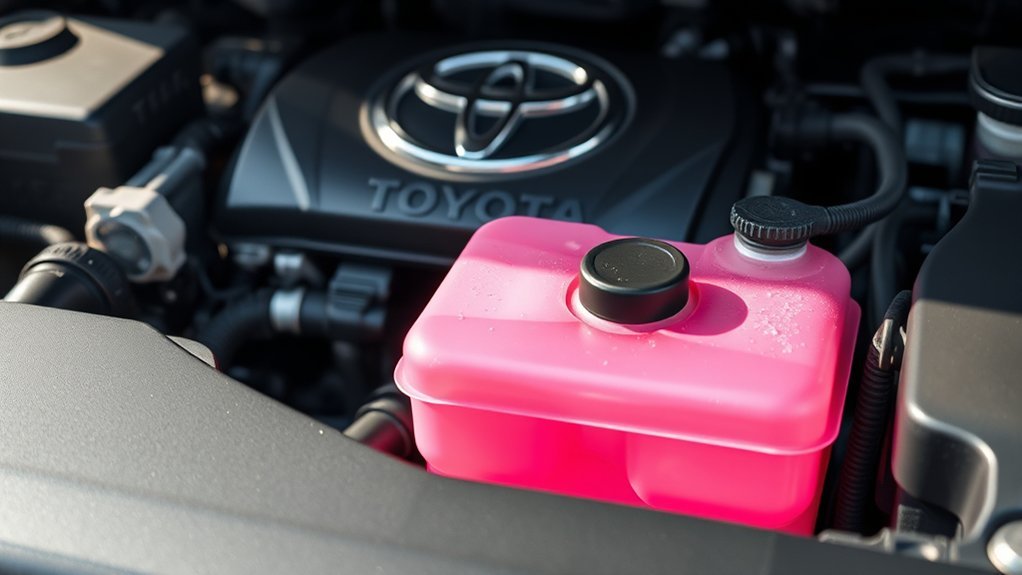
- Inspect the fluid. Healthy Toyota Super Long Life Coolant is usually pink. Look for rust, sludge, oil, cloudiness, or debris.
- Add coolant if needed. Use the correct Toyota-approved coolant and fill only to the “FULL” line.
- Recheck after driving. If the level drops again quickly, do not keep topping it off. Have the system checked for leaks.
Note: Hybrid RAV4 models can have separate cooling circuits. Use your owner’s manual to identify the correct reservoir before adding coolant.
Signs That Your RAV4 Needs a Coolant Flush

A full coolant flush is not always needed at every service. In many cases, Toyota’s scheduled service is a drain and refill with the correct coolant. However, a flush or deeper cooling-system service may be appropriate if the coolant is contaminated or the system has been filled with the wrong fluid.
| Sign | What It May Mean | Best Next Step |
|---|---|---|
| Rusty or muddy coolant | Corrosion or degraded coolant | Schedule a cooling-system inspection |
| Oily film in coolant | Possible internal engine or gasket issue | Stop guessing and get a professional diagnosis |
| Overheating | Low coolant, air pockets, thermostat, fan, radiator, or pump issue | Pull over safely and let the engine cool |
| Heater not warming properly | Low coolant, trapped air, or restricted flow | Check coolant level and inspect for leaks |
| Coolant level keeps dropping | External or internal leak | Have the system pressure-tested |
| Wrong coolant was added | Possible additive incompatibility | Drain, refill, and inspect as needed |
The best coolant service is not the most aggressive one; it is the one that matches Toyota’s specification, the coolant’s condition, and your RAV4’s maintenance schedule.
[Products Worth Considering]

Include two clamps, multiple tees, a garden hose adapter, an elbow and a cap

And Vehicle Specific

[ Replaces Part Number ]: 16671-25010, 16671 25010, 1667125010
What Types and Colors of Coolant Should You Know About?
Coolant color can help identify what is in the reservoir, but it is not a guarantee of compatibility. Toyota Super Long Life Coolant is commonly pink, yet other coolants can also be pink while using a different formula. Always confirm the specification.
- IAT coolant: Older inorganic additive technology coolant, often associated with conventional green coolant. It is not the usual choice for modern RAV4 models that require Toyota Super Long Life Coolant.
- OAT coolant: Organic acid technology coolant used in many modern vehicles, but formulas differ by manufacturer.
- HOAT coolant: Hybrid organic acid technology coolant. Toyota’s Super Long Life Coolant is a long-life hybrid organic acid technology formula designed for Toyota systems.
- Asian-vehicle coolant: Some aftermarket products are designed for Toyota, Lexus, Scion, Honda, Nissan, and other Asian vehicles, but you still need to verify the Toyota specification.
The main rule is simple: match the chemistry, not just the color. If the coolant bottle does not clearly say it is compatible with Toyota’s required coolant type, choose a product that does.
What Happens If Your Toyota RAV4 Runs Out of Coolant?
If your Toyota RAV4 runs out of coolant, the engine can overheat within minutes. Overheating can warp metal parts, damage gaskets, crack components, and leave the vehicle unsafe to drive. Low coolant can also prevent the heater from working properly and may allow air pockets to form inside the cooling system.
If the temperature gauge climbs into the danger zone, the warning light comes on, or steam appears from under the hood, pull over safely, turn the vehicle off, and let it cool. Do not keep driving to “see if it improves.” Continuing to drive while overheating can turn a minor leak into a major engine repair.
Coolant Safety and Disposal
Most engine coolant contains ethylene glycol, which is toxic if swallowed. It can also be attractive to pets because of its sweet taste. Keep new and used coolant away from children and animals, clean spills immediately, and store coolant in a sealed, clearly labeled container.
Used antifreeze may contain dissolved metals and other contaminants, so do not pour it into a drain, storm sewer, septic system, yard, or street. Take used coolant to an approved recycling center, hazardous-waste facility, or auto-service location that accepts used antifreeze.
Warning: Coolant is not safe to taste, siphon, dump, or leave in an open drain pan. If a person or pet may have swallowed coolant, contact emergency services, Poison Control, or a veterinarian immediately.
Frequently Asked Questions
What color is Toyota factory coolant?
Toyota Super Long Life Coolant is typically pink. However, color alone does not prove compatibility because different brands may use similar colors with different additive packages. Always check the coolant specification on the bottle and in your owner’s manual.
Does it really matter what type of coolant I use?
Yes. The wrong coolant can reduce corrosion protection, shorten coolant life, cause deposits, or create compatibility issues. Use Toyota Super Long Life Coolant or a coolant that clearly matches Toyota’s ethylene glycol-based, non-silicate, non-amine, non-nitrite, non-borate long-life hybrid organic acid technology requirement.
Why do Toyotas need pink coolant?
Many Toyota vehicles use pink Toyota Super Long Life Coolant because it is formulated for Toyota cooling systems and long service intervals. The color is helpful for identification, but the real reason to use it is the coolant chemistry, not the dye.
Can I add water to Toyota Super Long Life Coolant?
In most U.S. applications, Toyota Super Long Life Coolant is already premixed at 50% coolant and 50% deionized water, so you should not dilute it further. If you are using concentrate or servicing a Canada-market vehicle, follow the exact mixture specified by Toyota.
Can I drive my RAV4 with low coolant?
You should not keep driving with low coolant. Low coolant can lead to overheating and severe engine damage. If the level is low when the engine is cold, top it off with the correct coolant and check for leaks. If the level drops again, have the system inspected.
Is a coolant flush the same as a coolant change?
Not exactly. A coolant change or drain-and-fill replaces much of the old coolant with fresh coolant. A flush is more involved and is usually used when the coolant is contaminated, the wrong coolant was added, or the system needs deeper cleaning. Follow Toyota’s maintenance schedule and the condition of the coolant.
Conclusion
The right coolant for most Toyota RAV4 models is Toyota Super Long Life Coolant or a true Toyota-compatible equivalent. Use the correct ethylene glycol-based long-life formula, check the level when the engine is cold, avoid mixing random coolant types, and follow the 100,000-mile initial replacement interval and 50,000-mile follow-up interval when they apply to your model. A few minutes of coolant maintenance can prevent overheating, corrosion, and expensive engine repairs.
Sources
- Toyota Owners — 2024 RAV4 Engine Compartment — coolant selection, mixture, cold-level checking, and reservoir guidance
- Toyota 2024 RAV4 Warranty & Maintenance Guide — engine coolant replacement intervals and coolant specification notes
- Toyota — How Often to Change Engine Coolant — general coolant function, overheating warnings, and coolant/antifreeze basics
- CDC/ATSDR — Ethylene Glycol Public Health Statement — ethylene glycol use in antifreeze and health-safety background
- U.S. EPA — How Do I Dispose of Used Antifreeze? — used antifreeze recycling and disposal guidance