
PSI tells you how much air pressure is inside a tire. It matters because tire pressure affects how your vehicle steers, brakes, rides, carries weight, and uses fuel. The correct number is not the maximum pressure printed on the tire sidewall; it is the cold inflation pressure listed on your vehicle’s tire placard or in the owner’s manual.
Quick Answer
PSI means pounds per square inch. For tires, it measures the air pressure pushing against the inside of the tire. Many passenger cars are around 30–35 PSI, but the right number is always the cold tire pressure on your driver-side door placard or owner’s manual.
Key Takeaways
- Use the vehicle’s recommended cold PSI, not the maximum PSI molded into the tire sidewall.
- Check tire pressure when tires are cold, ideally before driving or after the vehicle has been parked for at least three hours.
- Underinflation can increase heat, wear, fuel use, and tire-failure risk.
- Overinflation can reduce ride comfort, shrink the tire’s contact patch, and cause uneven center tread wear.
- A TPMS warning is helpful, but it does not replace checking all tires with a gauge.
At a Glance
| Time Required | 5–10 minutes |
| Difficulty | Easy |
| Tools Needed | Tire pressure gauge, air pump or compressor, valve caps |
| Cost | Usually free to a few dollars at an air pump; about $5–$20 for a basic gauge |
What Does PSI Mean for Your Tires?
PSI stands for pounds per square inch. On a tire, it tells you how much air pressure is inside the tire. That pressure helps the tire keep its shape, support the vehicle’s weight, maintain road contact, and manage heat.
The correct PSI depends on the vehicle, tire size, load, and axle position. Many passenger cars use a cold pressure around 30–35 PSI, but trucks, SUVs, EVs, performance cars, and vehicles carrying heavy loads may need different pressures. Always follow the cold inflation pressure listed on the vehicle tire information placard or owner’s manual.
Note: The PSI printed on the tire sidewall is usually the tire’s maximum permissible pressure, not the recommended everyday pressure for your vehicle.
Why Tire Pressure Matters for Safety, Fuel Economy, and Tire Life
Proper tire pressure helps your tires make the right amount of contact with the road. That affects steering response, braking, traction, ride comfort, heat buildup, and tread wear. It also affects fuel economy because underinflated tires create more rolling resistance.
According to FuelEconomy.gov, under-inflated tires can lower gas mileage by about 0.2% for every 1 PSI drop in the average pressure of all tires.
Correct pressure also helps tires wear more evenly. A tire that is consistently too low or too high can wear out faster, ride poorly, and respond less predictably in emergency maneuvers.
How Underinflation Affects Vehicle Safety and Performance
Underinflation means the tire has less air pressure than the vehicle manufacturer recommends. This is one of the most common tire-maintenance problems, and it can become serious because the tire flexes more than it should while driving.
Increased Tire Wear
An underinflated tire tends to run hotter and flex more at the sidewall. It may also wear heavily on the outer edges of the tread. Over time, that can shorten tire life and increase the chance of tire damage.
Reduced Braking and Traction
Low tire pressure can reduce handling and stopping performance, especially in wet conditions or during emergency braking. Even a few PSI below the recommended pressure can change how the tire contacts the road, so it is worth checking pressure before it becomes visibly low.
Reduced Vehicle Handling
Underinflated tires can make steering feel slow, heavy, or unstable. They can also increase heat buildup, which raises the risk of tire failure during highway driving, hot weather, or heavy-load use.
Warning: Do not keep driving on a tire that looks flat, has a visible bulge, or loses pressure quickly. Pull over safely, use the spare if your vehicle has one, or call roadside assistance.
Overinflation Risks: How Too Much PSI Affects Handling and Safety
Overinflation means the tire has more air pressure than recommended for normal driving. A tire with too much pressure can feel harsh over bumps and may have a smaller contact patch with the road. That can reduce grip and make the vehicle feel less settled.
Overinflation Effects on Handling
When pressure is too high, the tire can become stiffer than intended. This can cause:
- Harsher ride quality: The tire absorbs less road impact.
- Uneven center tread wear: The middle of the tread may wear faster.
- Reduced grip: Less tread may contact the road under some conditions.
- Greater impact sensitivity: Potholes and road debris can be harder on the tire and wheel.
Safety Risks of Overinflation
Do not inflate tires above the pressure recommended for your vehicle unless the owner’s manual specifically tells you to do so for a certain load or driving condition. Also, never exceed the maximum pressure shown on the tire sidewall.
How to Find Your Vehicle’s Recommended Tire Pressure
The safest place to find the correct PSI is your vehicle, not the tire sidewall. Look for the recommended cold tire pressure in these places:
- Driver-side door jamb: Most vehicles have a tire and loading information placard near the door latch or door frame.
- Owner’s manual: The manual may include normal, fully loaded, towing, or spare-tire pressure guidance.
- Fuel door, glove box, trunk lid, or door edge: Some vehicles place the placard in another location.
- Spare tire label: Compact spares often require a much higher PSI than the main tires, so check the manual or spare label.
Some vehicles list different front and rear PSI values. If yours does, follow the front and rear numbers exactly instead of setting all four tires to the same pressure.
When Should You Check Your Tire Pressure?
Check tire pressure at least once a month, before long road trips, before towing or carrying a heavy load, and when outside temperatures change sharply. Tires naturally lose some air over time, and pressure also changes with temperature.
The best time to check PSI is when the tires are cold. NHTSA defines cold tire pressure as pressure measured before driving or after the vehicle has been parked for at least three hours.
Pro Tip: Check tire pressure in the morning before driving. If you must add air after driving because a tire is low, inflate it to the placard pressure, then recheck and fine-tune it when the tire is cold.
Steps to Properly Check and Inflate Your Tires
You do not need special mechanical experience to check tire pressure. A reliable gauge and an air pump are enough for most drivers.
[Products Worth Considering]

This versatile sanding and polishing kit provides a complete progression of grits for smoothing, refinishing, and restoring a wide range of surfaces. Designed for wet or dry use, it includes sanding discs, backing pads, and buffing accessories that make it easy to move from aggressive sanding to fine polishing. The quick hook-and-loop attachment and reusable components help deliver efficient results on cars, wood, metal, glass, resin, and more.

Fix-A-Flat provides a quick emergency solution for temporary flat tire repair and inflation, helping drivers get back on the road without a jack, spare tire, or tools. Its formula seals small tread punctures in seconds, is safe for tires and TPMS systems, and offers an eco-friendly alternative for roadside emergencies. Designed for standard tires, it is easy to keep in the trunk for dependable peace of mind.

This smart color coded tire tread depth gauge makes it easy to check tread wear at a glance with clear red, yellow, and green ranges. Calibrated from 0 to 1 inch in 1/32 inch increments, it helps you quickly assess tire condition for safer driving and timely replacements. The pocket clip design makes it convenient to carry and use on trucks, motorcycles, cars, and other passenger vehicles.
Gather Necessary Tools
- Tire pressure gauge: Digital, dial, or stick gauges all work if they are accurate and easy to read.
- Air compressor or pump: Use a gas-station air pump, portable compressor, or shop compressor.
- Valve stem caps: Keep them installed after checking pressure to protect the valve from dirt and moisture.
- Your PSI target: Read the cold pressure from the placard or owner’s manual before adding air.
Follow the Proper Procedure
- Park the vehicle on level ground and let the tires cool if possible.
- Find the recommended cold PSI on the tire placard or in the owner’s manual.
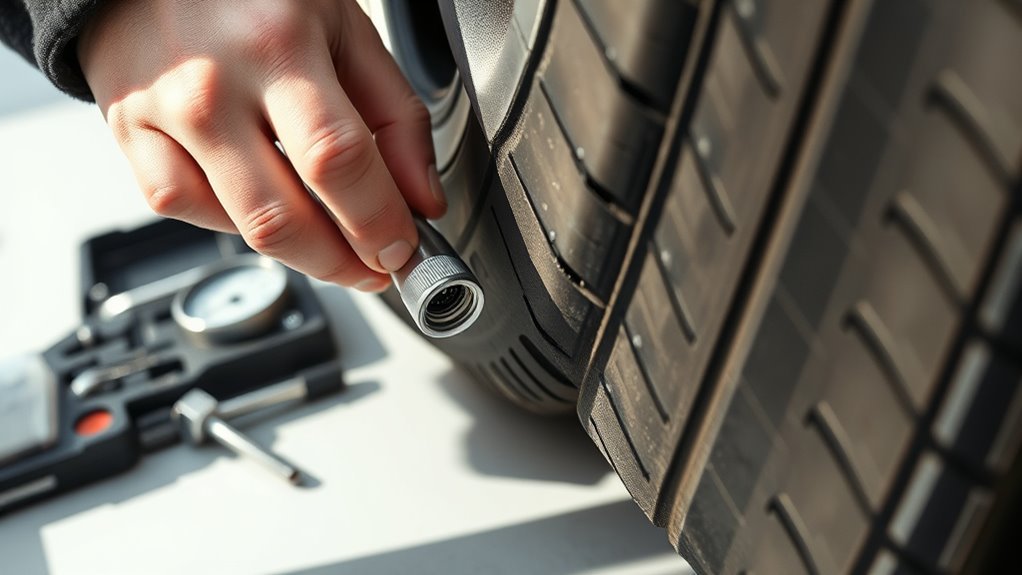
- Remove the valve cap from one tire.
- Press the tire gauge firmly onto the valve stem until the hissing stops.
- Read the PSI and compare it with the recommended number.
- If the tire is low, add air in short bursts and recheck.
- If the tire is too high, release a small amount of air and recheck.
- Replace the valve cap and repeat the process for all tires, including the spare if accessible.
Tire Pressure Maintenance Mistakes to Avoid
Small tire-pressure mistakes can lead to poor ride quality, uneven wear, and avoidable safety risks. Avoid these common problems:
- Using the sidewall max PSI as the target: The sidewall number is not usually the correct daily driving pressure.
- Checking only when the TPMS light comes on: TPMS is a warning system, not a routine maintenance gauge.
- Bleeding air from warm tires down to the cold placard number: Warm tires read higher after driving, so adjust cold whenever possible.
- Ignoring temperature swings: As a rule of thumb, tire pressure can change by about 1 PSI for every 10°F temperature change.
- Forgetting the spare: A spare tire is not helpful if it is flat when you need it.
- Not checking after a repair: If a tire keeps losing air, have it inspected for nails, valve-stem leaks, rim damage, or bead leaks.
Using TPMS for Tire Pressure Monitoring
A Tire Pressure Monitoring System, or TPMS, warns you when one or more tires are significantly underinflated. In the United States, Federal Motor Vehicle Safety Standard No. 138 sets TPMS performance requirements for many light vehicles. The system is designed to warn when a tire is 25% or more below the recommended placard pressure, or below the minimum activation pressure specified in the standard, whichever is higher.
There are two common TPMS types:
| TPMS Type | How It Works | What to Know |
|---|---|---|
| Direct TPMS | Uses pressure sensors mounted in or near each wheel. | Can provide more direct pressure information, depending on the vehicle. |
| Indirect TPMS | Uses wheel-speed data to infer when a tire may be low. | May need recalibration after inflation, rotation, or tire replacement. |
| Solid warning light | Usually means one or more tires are low. | Check all tires with a gauge as soon as it is safe. |
| Flashing warning light | Often points to a TPMS malfunction. | Check the owner’s manual and have the system inspected. |
TPMS is useful, but it does not replace a manual gauge check. A tire can be a few PSI low before the warning appears, and TPMS may not warn you about overinflation.
[Products Worth Considering]

The ETENWOLF T300 digital tire pressure gauge delivers accurate readings for cars, trucks, RVs, bikes, and heavy-duty vehicles with a wide pressure range and reliable calibration. It is built to perform in extreme temperatures, includes an LED light for dark conditions, and uses replaceable AAA batteries for long-term convenience. Its durable design and automatic shut-off make it a practical, dependable tool for everyday tire maintenance.

This POWOXI solar battery maintainer helps keep 12V batteries charged and protected with intelligent charging and built-in safety features. Its durable tempered glass construction, scratch-resistant frame, and easy installation make it a practical solution for cars, motorcycles, boats, tractors, ATVs, and other battery-powered equipment. An LED indicator helps show charging status at a glance, while the waterproof design supports low-maintenance use.
What to Do When the Tire Pressure Light Comes On
When the tire pressure light turns on, do not ignore it. Take these steps:
- Slow down and look for obvious problems: If the vehicle pulls, shakes, or a tire looks flat, stop safely.
- Check all four tires with a gauge: Do not assume the visibly low tire is the only one that needs air.
- Inflate to the placard PSI: Add air to match the vehicle’s recommended cold pressure.
- Recheck after driving: If the light stays on, follow the reset procedure in the owner’s manual.
- Inspect repeated pressure loss: A tire that keeps losing air may have a puncture, valve leak, rim leak, or damaged bead.
[Products Worth Considering]

TRUSTED BY OVER 3 MILLION USERS: Based in Garden Grove, California, AstroAI serves customers in more than 15 countries worldwide. Known for professional-grade accuracy and durable construction, this digital tire inflator with gauge is a trusted choice for drivers, mechanics, and DIYers who rely on dependable tools.

Advanced accuracy: Professionally calibrated tire pressure gauges for cars. Accurately measures from 0-100 PSI with a resolution of +/-1 PSI.
Bar, kPa, and PSI: What the Numbers Mean
Some tire gauges and owner’s manuals show pressure in bar or kilopascals instead of PSI. The units are different ways to measure pressure. As a practical conversion, 1 bar is about 14.5 PSI, so 2.5 bar is about 36 PSI. Many placards also show kPa next to PSI.
If your gauge uses a different unit from your vehicle placard, switch the gauge unit if possible or use a reliable conversion before inflating.
Frequently Asked Questions
How much PSI should I inflate my tires to?
Inflate your tires to the vehicle manufacturer’s recommended cold pressure. You can usually find it on the driver-side door placard or in the owner’s manual. Many passenger cars are around 30–35 PSI, but your vehicle may need a different number.
What does 2.5 mean in tire pressure?
In tire-pressure contexts, 2.5 usually means 2.5 bar, not 2.5 PSI. Since 1 bar is about 14.5 PSI, 2.5 bar is about 36 PSI. If you are unsure which unit your gauge is showing, check the unit label before inflating.
Is 40 PSI too high for a tire that recommends 35 PSI?
Usually, yes. If your vehicle placard recommends 35 PSI cold, 40 PSI is 5 PSI above the target. That can make the ride harsher and may cause uneven wear. Set the tire to the placard pressure when cold unless the owner’s manual gives a different load-specific recommendation.
Is PSI the same as bar?
No. PSI and bar are different pressure units. One bar is about 14.5 PSI. Some gauges display both, so make sure you are reading the same unit shown on your vehicle placard or owner’s manual.
Should I use the PSI on the tire or the door sticker?
Use the door sticker or owner’s manual. The tire sidewall usually shows the maximum pressure the tire can safely hold, not the pressure your vehicle was designed to use for everyday driving.
Why does my tire pressure light come on when it gets cold?
Air pressure drops as temperature drops. A common rule of thumb is about 1 PSI for every 10°F change. If your tires were barely at the correct pressure during warm weather, a cold morning can push them low enough to trigger the TPMS warning.
Conclusion
PSI is a simple number, but it has a big effect on how your tires perform. The best habit is to check tire pressure monthly, before long trips, and during major temperature changes. Use the cold PSI on your vehicle placard or owner’s manual, check with a reliable gauge, and correct low or high pressure before it causes uneven wear, poor handling, or a warning light.
Sources
- NHTSA TireWise — recommended cold tire pressure, tire placard guidance, cold tire checks, and tire safety.
- FuelEconomy.gov: Gas Mileage Tips — fuel economy impact of proper tire inflation.
- eCFR 49 CFR § 571.138 — U.S. tire pressure monitoring system performance requirements.
- Tire Rack: How Do I Set My Tire Air Pressure? — temperature-related tire pressure adjustment guidance.
- NIST Guide to the SI: Conversion Factors — pressure unit conversion background.



[…] filter itself does not set your tire pressure, but slow fill times and heat-related shutdowns can make inflation less convenient and easier to […]