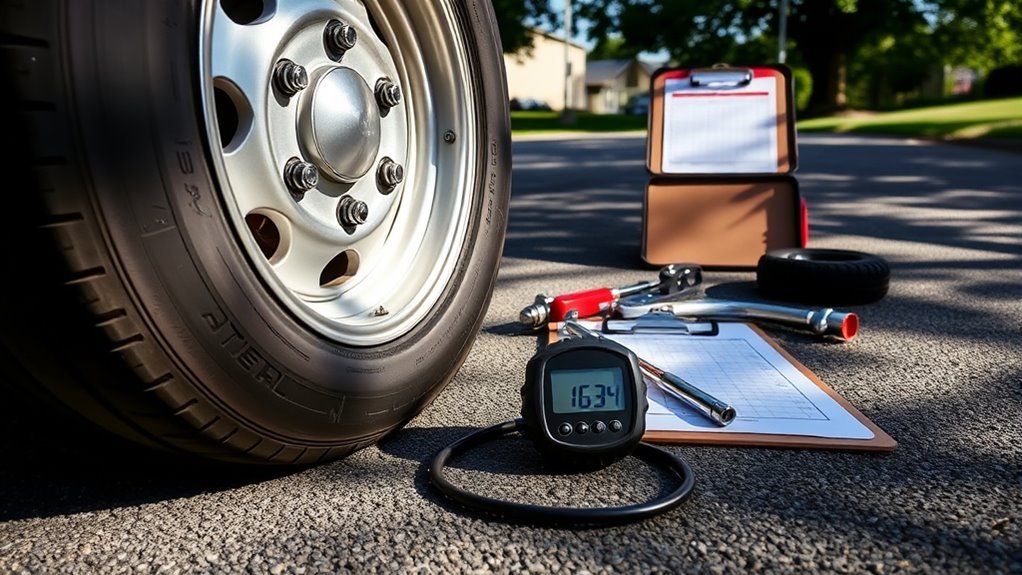
If your tire inflator gauge is reading wrong, stop the airflow before diagnosing it. A reading that is high, low, or unstable only while pumping usually comes from back pressure or restriction in the hose, chuck, fittings, or valve. A reading that remains wrong after the number settles points more strongly to a poor chuck seal, hose leak, calibration bias, warm tire, weak battery, wrong pressure unit, or comparison with the compressor tank or regulator gauge.
Editorial Team · Reviewed for accuracy · Last updated July 31, 2026
Method: Source-based troubleshooting guide for consumer automotive tire inflators and gauges. No specific inflator model was laboratory-tested for this article.
Quick Answer
Check the tire cold with the compressor stopped. Reconnect the chuck straight, take three settled readings, and compare them immediately with a reference gauge that has a stated accuracy. A stable offset suggests calibration bias; scattered readings suggest a seal, hose, mechanical, or electronics problem; and a mismatch that appears only during pumping points to hose-side back pressure. Use the vehicle placard pressure, not the tire sidewall maximum.
Key Takeaways
- Read the inflator after airflow stops. Hose pressure can differ from settled tire pressure while the compressor is running.
- Check tires cold and use the pressure on the vehicle placard, not the maximum pressure molded into the tire sidewall.
- Consistent readings can still share the same calibration error. Compare the inflator with a gauge that has a known accuracy specification.
- A hissing chuck, damaged hose, dirty valve connection, or warm tire can create a misleading reading even when the gauge sensor still works.
- TPMS is a warning and monitoring system. It does not replace a manual pressure check with a dependable gauge.
30-Second Diagnosis
| Reading Pattern | Most Likely Explanation | First Check |
|---|---|---|
| High or pulsing only while pumping | Hose-side back pressure or a restriction at the chuck, fitting, or valve | Stop airflow and read after the number settles |
| Low reading with a steady hiss | Chuck is crooked, worn, dirty, or not opening the valve correctly | Reconnect straight and inspect the chuck seal |
| Same offset on repeated checks | Calibration bias or an inaccurate comparison gauge | Compare with a reference that lists its accuracy tolerance |
| Different result every connection | Poor repeatability from a leak, sticking mechanism, damaged hose, or unstable electronics | Take three static readings under the same conditions |
| Higher after driving than before | Normal temperature-related pressure rise may be involved | Recheck after the tire has cooled for at least three hours |
Why Is My Tire Inflator Gauge Reading Wrong?

A tire inflator can display a misleading number when you read it during airflow, attach the chuck at an angle, compare it with a different part of the compressor system, or check a warm tire. Test the simple causes before assuming the pressure sensor has failed.
1. You Are Reading While Air Is Moving
Many inflator gauges show a different pressure while the compressor is actively pushing air. The pump must create enough pressure in the hose to move air through the fittings, valve core, and chuck. Restrictions in that path can make the hose-side reading pulse or rise above the tire’s settled pressure. This temporary difference is commonly called hose back pressure.
Stop the compressor or release the inflation trigger, wait for the pressure to settle, and then read the gauge. Do not diagnose gauge accuracy from the live pumping number unless the inflator manufacturer specifically instructs you to do so.
2. The Chuck Is Not Sealing on the Valve Stem
A steady hiss means air is escaping before the gauge can settle. The display may jump, fall slowly, or read lower than the tire’s actual pressure.
Remove the chuck and press it straight onto the valve stem. Check for dirt inside the chuck, a worn rubber seal, a loose fitting, a bent valve stem, or a damaged valve core. On a locking chuck, engage the lock only after the chuck is fully seated; a partially opened valve can leave the gauge reading trapped hose pressure instead of tire pressure. Replace a chuck or hose that cannot hold a stable seal.
3. The Gauge Has Lost Accuracy or Repeatability
Accuracy describes how close a reading is to the true pressure. Repeatability describes whether the gauge gives nearly the same result each time under the same conditions. A gauge can repeatedly show 34 PSI when the actual pressure is 36 PSI, so repeatability alone does not prove accuracy.
Drops, vibration, moisture, contamination, internal wear, or sensor damage can affect a gauge. Compare it with a reference gauge that has a known accuracy specification. A single disagreement between two ordinary gauges does not prove which one is wrong, and there is no universal 1- or 2-PSI failure limit for every gauge. Judge the result against the manufacturer’s published tolerance and the reference gauge’s uncertainty. As a rough starting point only, many consumer gauges are commonly considered close enough for everyday driving if two units agree within about 1–2 PSI at typical passenger-car pressures — but always defer to the manufacturer’s stated tolerance over any general rule.
On lower-volume, higher-pressure tires, the small amount of air that fills the hose and gauge chamber when you connect the chuck can also measurably lower the reading compared to the tire’s true pressure. This effect is larger on narrow, high-pressure tires than on large-volume ones, and it compounds slightly with each repeated check.
For a deeper explanation of approved adjustment methods and professional verification, see the tire pressure gauge recalibration guide.
4. The Tire Is Warm From Driving
Pressure rises as the tire heats during driving. Bridgestone defines a cold tire as one that has been parked for at least three hours or driven less than one mile at a moderate speed. Check under those conditions when possible.
A warm reading can be several PSI higher than the placard pressure without indicating a faulty gauge. Do not release air solely because a recently driven tire reads above the cold recommendation.
5. The Gauge Range, Resolution, or Unit Does Not Fit the Tire
A gauge with a very wide pressure range may display coarser increments at ordinary passenger-car pressures. A 0–250 PSI gauge may suit truck or RV work, while a narrower-range gauge can be easier to interpret around 30–40 PSI. Range alone does not determine accuracy; the published tolerance and display resolution are separate specifications.
Confirm that both devices use the same unit, such as PSI, bar, or kPa. Read an analog dial straight on to reduce parallax error, and make sure a digital gauge has not been switched to another unit. As a sanity check, passenger-tire pressures are typically 30–40 PSI, 2–2.8 bar, or 200–280 kPa — a reading far outside these ranges on a normal car tire usually signals a unit mismatch rather than a real pressure problem.
6. The Digital Display Battery Is Weak
Replace the battery when a digital display is dim, slow, flickering, or shutting off. Then compare the gauge again under stable conditions. A fresh battery can correct a display-power problem, but it will not repair a damaged pressure sensor, hose, or chuck.
Scope: This guide covers consumer automotive tires and common portable or shop inflators. Commercial-truck, racing, aviation, and other high-pressure or specialty applications may require calibrated equipment and procedures specific to that use.
Note: If every dependable gauge shows the same tire losing pressure again, investigate the tire instead of the gauge. A puncture, leaking valve core, damaged valve stem, wheel-bead leak, or cracked wheel can cause repeated pressure loss. Do not continue driving on a visibly damaged, rapidly deflating, or severely underinflated tire.
Which Pressure Reading Should You Trust?
First identify what each display is measuring. A compressor can have several gauges, and their numbers are not supposed to match in every operating condition.
| Pressure Source | What It Measures | How to Use It |
|---|---|---|
| Compressor tank gauge | Pressure stored inside the compressor tank | Do not use it as the tire-pressure reading |
| Regulator or outlet gauge | Pressure supplied to the hose before the chuck | Use it to control outlet pressure, not to set the tire precisely |
| Inflator gauge | Pressure near the chuck or inside the inflator hose | Read after airflow stops and the number settles |
| Handheld tire gauge | Static pressure at the valve stem | Use as an independent comparison when its accuracy is known |
| Dashboard TPMS | Direct sensor pressure or an indirect underinflation estimate, depending on the vehicle | Use as a warning or secondary display, then confirm according to the owner’s manual |
[Products Worth Considering]
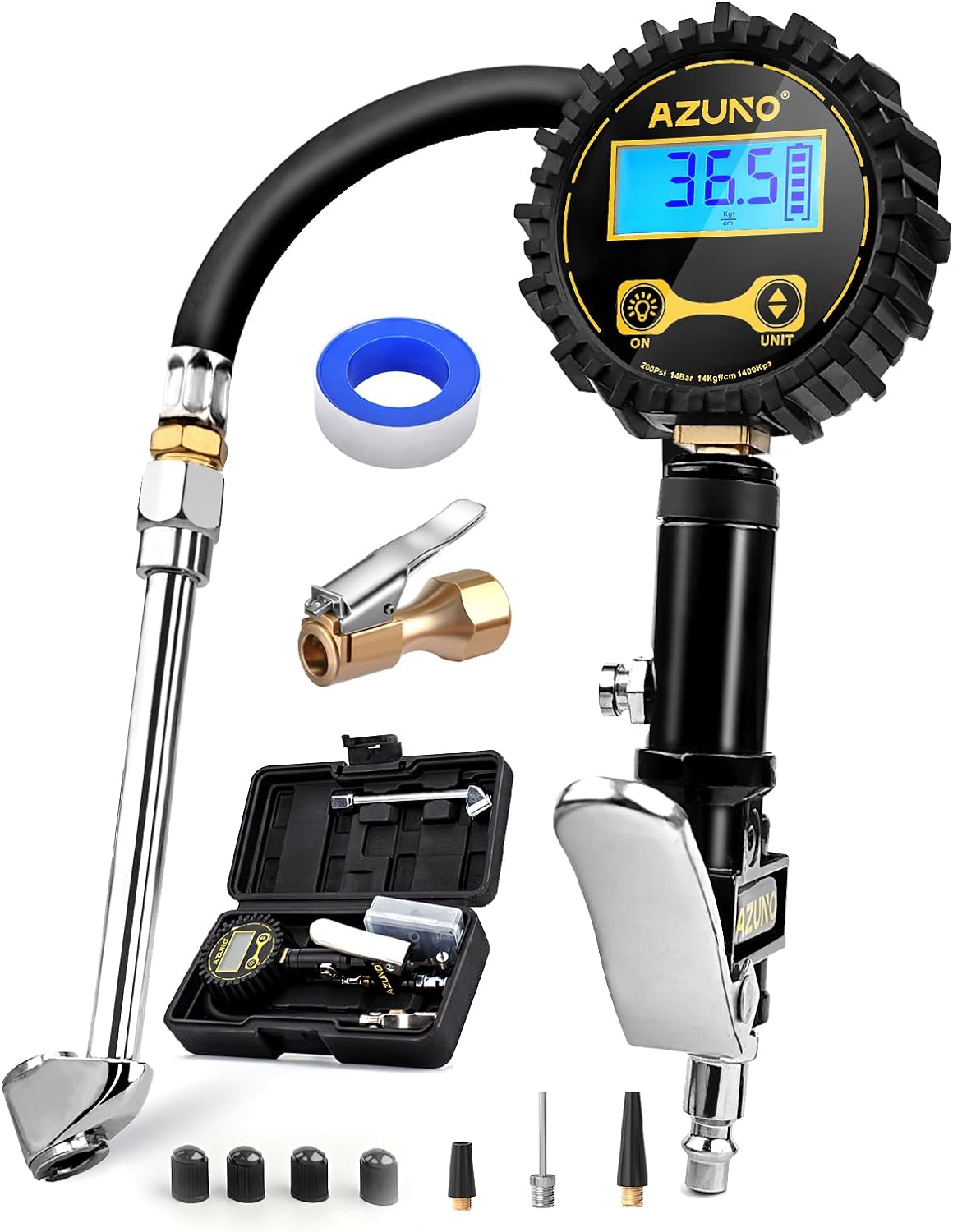
This digital tire inflator delivers accurate, easy-to-read pressure measurements with a bright backlit LCD and precise 0.1 resolution for confident inflation. Designed for single-handed use, it makes it simple to inflate or deflate tires while staying organized in the included portable carrying box. Built for a wide range of vehicles, it is a practical air compressor accessory for cars, trucks, SUVs, motorcycles, and more.

The JACO ElitePro Digital Tire Pressure Gauge delivers shop-grade accuracy with a clear digital readout, making it easy to maintain proper tire pressure for safer driving and better performance. Built with rugged brass and steel components, a protective guard, and a flexible air hose, it is designed for reliable use across cars, trucks, motorcycles, bikes, RVs, and trailers. The lock-on display, built-in bleeder valve, and bright backlit screen add convenience in any lighting condition.

This MagSafe car mount charger keeps your phone securely in view with ultra-strong N55 magnets and auto-alignment for reliable hands-free navigation, calls, and music playback. It delivers 15W wireless charging with enhanced heat dissipation to help maintain performance on long drives, while the adjustable arm and multiple mounting options make it easy to fit dashboards, vents, or windshields. Included magnetic rings and accessories support broad compatibility with MagSafe and non-MagSafe phones alike.
How Does Temperature Affect Tire Pressure Readings?
Temperature can change the reading even when no air has leaked from the tire. As a practical rule, pressure changes by about 1 PSI for each 10°F change in temperature, although the exact amount varies with the tire and conditions. Michelin’s current cold-weather guidance uses the same approximate relationship.
A temperature-related pressure change does not automatically mean the gauge is wrong. Compare readings when the tire and surrounding conditions are similar.
For the most consistent result, check before driving or after the vehicle has been parked for at least three hours. Use the recommended cold tire pressure on the vehicle placard or in the owner’s manual.
Warning: Do not bleed air from a hot tire merely because it reads above the cold placard pressure. Recheck after the tire cools. Removing air while it is hot can leave it underinflated later.
How Do You Test a Tire Inflator Gauge for Accuracy?
The practical home test is a cold-tire comparison performed with airflow stopped. The goal is to check both repeatability and agreement with a more dependable reference.
- Let the tires cool. Park for at least three hours when possible.
- Find the correct cold pressure. Read the tire information placard on the driver-side door edge or door jamb. The door-jamb tire pressure guide explains how to identify the correct number.
- Inspect the valve and chuck. Wipe away dirt and check the hose and fittings for visible damage.
- Take a static inflator reading. Attach the chuck straight, stop the compressor, and wait for the display or needle to settle.
- Repeat once or twice. Closely grouped results show repeatability. Widely scattered results suggest a sealing, mechanical, hose, or electronic problem.
- Compare with a dependable reference gauge. Use a gauge with a stated accuracy specification or ask a tire shop to perform a reference comparison.
- Interpret the pattern. A consistent offset suggests calibration bias. Random readings suggest poor repeatability. A mismatch that appears only during pumping suggests airflow or hose pressure.
- Restore the correct pressure. Repeated checks release a little air, especially from small-volume tires, so top off the tire when the test is complete.
What Counts as a Dependable Reference Gauge?
Use a gauge with a stated accuracy specification, recent calibration or verification record, and a pressure range suited to the test. For formal calibration work, Fluke recommends a reference instrument meaningfully more accurate than the device being tested. Most drivers will not own that equipment, so a tire shop or calibration service is the practical choice when two consumer gauges disagree and the result matters.
Stop relying on the inflator as your only gauge when its confirmed error exceeds the manufacturer’s published tolerance, when readings vary under stable conditions, or when no accuracy specification is available and it repeatedly disagrees with a qualified reference. Do not apply a universal 1- or 2-PSI cutoff across all gauges.
Pro Tip: Keep your reference gauge protected in a case rather than loose in a toolbox. Recheck it after a hard drop, moisture exposure, battery problem, or implausible reading.
How Do You Use a Tire Inflator Gauge Correctly?
A dependable gauge can still mislead you when the chuck leaks or you read it during active airflow. Use this routine for normal inflation.
- Start with cold tires. Use the front and rear pressures listed on the vehicle placard.
- Remove and protect the valve cap. Keep dirt away from the open valve stem.
- Attach the chuck straight. Reposition it if you hear a continuous hiss.
- Add air in short bursts. Avoid overshooting the target pressure.
- Stop the airflow before the final reading. Allow the number to settle.
- Confirm the result. Disconnect and take one final static reading.
- Check the other tires and spare. Front, rear, and spare pressures may differ.
- Reinstall the valve caps. They help keep moisture and debris away from the valve cores.
NHTSA TireWise recommends checking tires regularly with an accurate gauge and treating TPMS as a backup rather than a replacement for tire maintenance.
Why Do TPMS and Your Tire Gauge Show Different Readings?
TPMS and a handheld gauge may measure pressure at different times or may not use the same measurement method. A small mismatch does not automatically mean either device has failed.
A direct TPMS uses pressure sensors inside the wheels. An indirect TPMS generally uses wheel-speed information to infer that a tire may be underinflated and may not measure PSI at all. Your owner’s manual should identify the system and explain its reset or relearn process.
In a 2023 test of 11 passenger vehicles from model years 2022–2024 with direct TPMS, AAA reported average displayed-versus-actual pressure differences of about 1.2%–1.5%, depending on tire position. The largest observed difference was 3.3%. AAA still recommended regular manual checks because not every system displays individual tire pressures.
Federal rules require TPMS to warn of significant underinflation rather than to replace precise maintenance checks. Under 49 CFR § 571.138, the warning threshold is tied to pressure at or below 25% under the manufacturer’s recommended cold pressure or the applicable minimum threshold in the regulation, whichever is higher.
If the dashboard number and handheld gauge disagree, compare them under similar temperature conditions. Some direct systems update only after the vehicle moves, while an indirect system may need a reset after pressure adjustment or tire rotation.
[Products Worth Considering]

The S ZEVZO ET03 is a powerful 12V jump starter designed to revive gas and diesel vehicles quickly, including cars, trucks, motorcycles, lawnmowers, and boats. It also doubles as a portable power bank with USB charging ports, a bright LED flashlight, and an LCD display for added convenience during roadside emergencies. Built with multiple safety protections and included carrying case, it offers dependable backup power whenever you need it.

This heavy-duty car ramp set provides a stable, reliable lift for routine maintenance like oil changes, tire rotations, brake work, and undercarriage inspections. Built from high-impact poly with a non-skid tread and rubber feet, it helps keep vehicles secure while offering a lightweight, corrosion-resistant alternative to steel ramps. The wide, gradual design supports a broad range of vehicles, from compact cars to trucks, SUVs, and vans.

🌟KEEP YOUR TIRES IN TOP SHAPE: VXDAS GM TPMS Relearn Tool Plus is a 2 in 1 tool that resets your sensor and maintains tire pressure. Works for GM vehicles (Chevy / Buick / GMC / Opel /Cadillac etc)equipped with 315/433 MHz.
When Should You Replace a Tire Pressure Gauge?
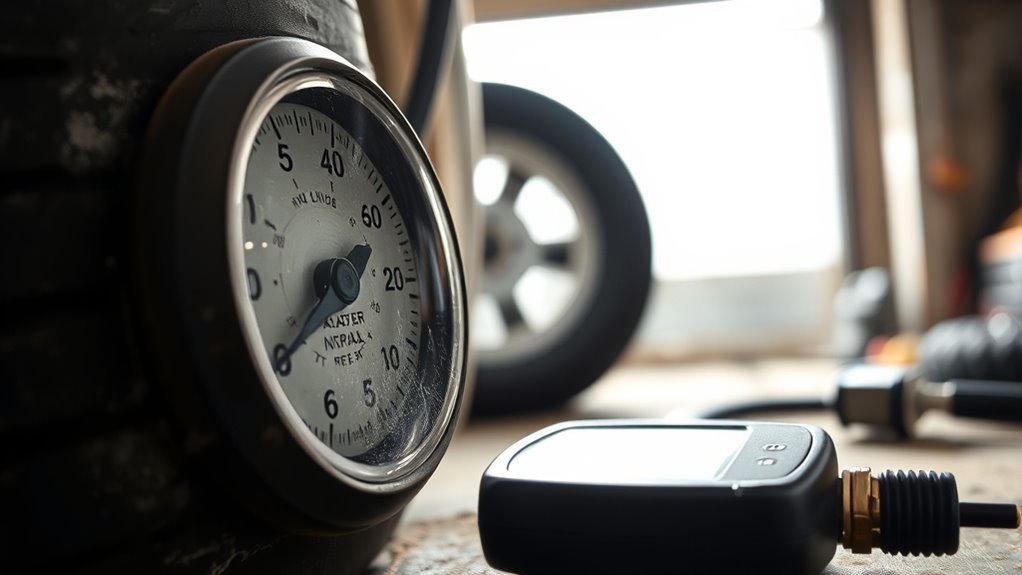
Replace or service a gauge when its confirmed error exceeds its published tolerance and no approved recalibration procedure is available. Physical damage, unstable readings, and persistent leakage are also stronger replacement signs than one isolated disagreement.
Stop using the gauge if you notice any of these signs:
- Repeated readings vary widely on the same cold tire under stable conditions.
- The needle does not return to zero on an unloaded analog gauge.
- The display flickers, fades, or shuts off after a fresh battery is installed.
- The chuck continuously leaks on more than one known-good valve stem.
- The hose is cracked, kinked, loose, or leaking near a fitting.
- The gauge changed behavior after a hard drop or moisture exposure.
- Its confirmed error exceeds the manufacturer’s stated tolerance.
- No accuracy specification is available and qualified reference checks show a material disagreement.
Do not knowingly set tire pressure with an unreliable gauge. Underinflation can increase tire flex and heat, affect wear and handling, and increase rolling resistance. FuelEconomy.gov currently estimates that proper tire inflation can improve gas mileage by about 0.6% on average, and by as much as 3% in some cases, under its modeling assumptions.
[Products Worth Considering]
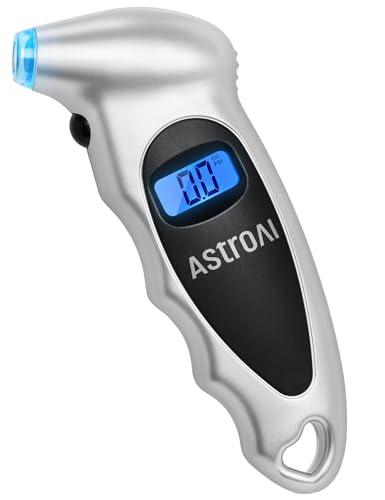
Accurate, Dependable Readings: Factory‑calibrated to ±1 PSI, so you can confidently match your vehicle’s recommended PSI (check the door jamb sticker). Ideal for monthly checks and road trips — consistent results every time, cold or warm.

For pneumatic, air pressure measuring, typical for tire gauge, tire inflator, air pressure system etc.

Enhanced Visibility in Low Light: Features a green backlit LCD screen and integrated flashlight, allowing for clear reading of tire pressure even in dark or dimly light conditions.
How Can You Keep a Tire Pressure Gauge Accurate?
Treat the gauge as a measuring instrument. Protection from impact, dirt, moisture, sealant, and extreme heat helps preserve both repeatability and useful service life.
- Store it in a dry case. Avoid leaving it loose where it can be dropped or crushed.
- Release trapped pressure after use. Follow the manufacturer’s storage instructions.
- Protect it from extreme heat. Do not leave a digital gauge against a hot windshield or dashboard.
- Keep the chuck clean. Wipe away dirt, moisture, and tire sealant.
- Use valve caps. They help keep contamination away from the valve core.
- Compare the gauge periodically. Check after an impact, unusual reading, battery problem, or before high-load use.
- Use an appropriate pressure range. Match the gauge to passenger tires, truck tires, RV tires, trailers, motorcycles, or bicycles as needed.
Quick Troubleshooting Chart
| Symptom | Likely Cause | What to Do |
|---|---|---|
| Reading is high only while pumping | Pressure drop or restriction across the hose, fittings, chuck, or valve | Stop airflow, wait for the pressure to settle, and read again |
| Tank gauge and tire gauge disagree | The gauges measure different parts of the compressor system | Use a static reading at the tire valve, not the tank-pressure gauge |
| Gauge reads consistently high or low | Calibration bias or inaccurate reference gauge | Compare with a qualified reference and check the published tolerance |
| Gauge jumps up and down | Poor chuck seal, pulsing airflow, damaged hose, or weak repeatability | Stop airflow, reconnect straight, and inspect the hose and fittings |
| Digital display fades or shuts off | Weak battery or failing electronics | Install a fresh battery and repeat the comparison |
| Needle does not return to zero | Mechanical damage or internal wear | Stop using the gauge and arrange service or replacement |
| TPMS and gauge disagree | Temperature, update delay, direct-versus-indirect TPMS, reset status, or gauge error | Check cold pressure with a dependable gauge and follow the owner’s manual |
| The same tire becomes low again | Puncture, valve leak, bead leak, or wheel damage | Inspect the tire and arrange repair instead of blaming the gauge |
Frequently Asked Questions
Why does my tire inflator show a higher PSI while the compressor is running?
The pump creates pressure in the hose to move air through the fittings, chuck, and valve core. Restrictions can make the hose-side reading pulse or rise above the tire’s settled pressure. Stop the compressor, wait for the number to stabilize, and use the static reading unless the manufacturer gives different instructions.
Should I trust the inflator gauge, a handheld gauge, or TPMS?
Use a dependable handheld or inflator gauge to set cold tire pressure at the valve stem. Read an inflator after airflow stops. Use TPMS as a warning or secondary display because some systems update later and indirect TPMS may not measure PSI. When two ordinary gauges disagree, compare them with a qualified third reference.
Why is my tire pressure sensor reading incorrectly?
The tire may be warm, a direct TPMS sensor may not have updated, an indirect system may need a reset, or the handheld comparison gauge may be inaccurate. Check the tires cold and follow the vehicle owner’s manual. A TPMS light that flashes for roughly 60–90 seconds and then stays on usually indicates a system malfunction rather than ordinary low pressure.
Why do I get a different pressure every time I reconnect the gauge?
A crooked chuck, leaking seal, dirty valve connection, sticking mechanism, damaged hose, or unstable electronics can reduce repeatability. Reconnect the gauge straight with airflow stopped. Remember that every check releases a little air, so repeated tests can also lower pressure in a small-volume tire.
How much PSI difference between two gauges is normal?
There’s no single number that applies to every gauge, but as a rough starting point, two consumer gauges that agree within about 1–2 PSI at typical passenger-car pressures are usually considered close enough for everyday driving. Weigh this against the manufacturer’s published tolerance rather than treating it as a fixed rule, and use a qualified reference gauge to settle a persistent disagreement.
How do I recalibrate a tire pressure gauge?
First verify the gauge against a more accurate reference. Recalibrate it only when the manufacturer provides an approved adjustment or service procedure. Many consumer gauges are not user-adjustable. Replace or service a gauge whose confirmed error exceeds its published tolerance.
Is a digital tire pressure gauge more accurate than an analog gauge?
Not automatically. Digital gauges use an electronic pressure sensor, while analog (mechanical) gauges use a needle mechanism such as a Bourdon tube; either type can be accurate when it has a suitable range, a clear accuracy specification, and no damage. Digital gauges are easy to read but require batteries. Analog gauges avoid batteries but can lose accuracy after an impact or internal wear.
How often should I check tire pressure and gauge accuracy?
Check tire pressure at least monthly, before long trips, after large temperature changes, and whenever the TPMS warning appears. Gauge-verification intervals vary by manufacturer, so follow the product instructions and compare it immediately after a hard drop, moisture exposure, battery problem, or implausible reading.
Conclusion
Start with one cold tire and take three readings with the compressor stopped. If the readings group closely but differ from a qualified reference, suspect calibration bias. If they scatter, inspect the chuck, valve connection, hose, battery, and gauge mechanism. If the mismatch appears only while pumping, use the settled static reading instead of the live hose-pressure number.
Restore the tire to the vehicle placard pressure when the test is complete. Stop using a gauge that leaks, behaves inconsistently, is physically damaged, or falls outside its published accuracy tolerance.
Sources
Editorial method: Updated July 31, 2026, by cross-checking current consumer tire-pressure, TPMS, inflator-support, and gauge-verification guidance from NHTSA, the eCFR, AAA, Michelin, Bridgestone, Black+Decker, Fluke, and FuelEconomy.gov. It does not claim laboratory testing of a specific inflator model.
- NHTSA TireWise: Tire Safety Ratings and Awareness — TPMS warnings, malfunction-light behavior, manual pressure checks, and tire-safety guidance.
- eCFR: 49 CFR § 571.138 — federal TPMS purpose, detection thresholds, and malfunction requirements.
- Bridgestone: How to Check Tire Pressure — cold-tire definition, placard pressure, valve connection, and inflation steps.
- Bridgestone: What Is TPMS and How Does It Work? — direct and indirect TPMS differences.
- AAA: Tire Pressure Monitoring System Test — displayed-versus-actual pressure findings from 11 direct-TPMS vehicles.
- Michelin: Winter Tire Timing and PSI Tips — approximate temperature-related pressure change and monthly checking guidance.
- FuelEconomy.gov: Keeping Your Vehicle in Shape — proper inflation, vehicle placard guidance, and modeled fuel-economy benefit.
- Black+Decker: Why an Inflator Gauge Can Shoot Up While Inflating — locking-chuck seating and false high readings.
- Fluke: Hand Pumps and Pressure Test Gauges — reference-gauge accuracy guidance for formal comparison testing.