Your Toyota Tundra’s tire information label is the fastest place to confirm the factory tire size and recommended cold tire pressure, but it is not the only place you need to look. The door-jamb placard, tire sidewall, certification label, and owner’s manual work together: one gives the factory pressure, another gives DOT date and tire markings, and the others help you confirm load, towing, and replacement requirements.
Quick Answer
Read your Tundra tire label by checking the driver-side door-jamb placard for factory tire size and cold PSI, then confirm the tire sidewall for load index, speed rating, DOT date, M+S/3PMSF winter markings, XL or load range, and rotation direction before buying replacements.
Key Takeaways
- Use the Tundra door-jamb label for the original tire size and recommended cold tire pressure, not the maximum PSI molded on the tire sidewall.
- Use the sidewall to decode tire size, load index, speed rating, DOT date, winter symbols, XL/load range markings, and rotation direction.
- Replacement tires should match or exceed Toyota’s specified size, load rating, speed symbol, and load range, but higher-rated tires do not increase your Tundra’s payload or towing rating.
- A solid TPMS light usually means check pressure now; a light that flashes for about a minute and then stays on points to a TPMS system malfunction that needs diagnosis.
At a Glance
| Time Required | 5–10 minutes |
| Difficulty | Easy |
| Tools Needed | Tire pressure gauge, flashlight, phone camera, tread-depth gauge or penny |
| Cost | $0 if you already have a gauge; usually $5–$15 for a basic tire pressure gauge |
Quick Overview: What the Tundra Tire Label Tells You
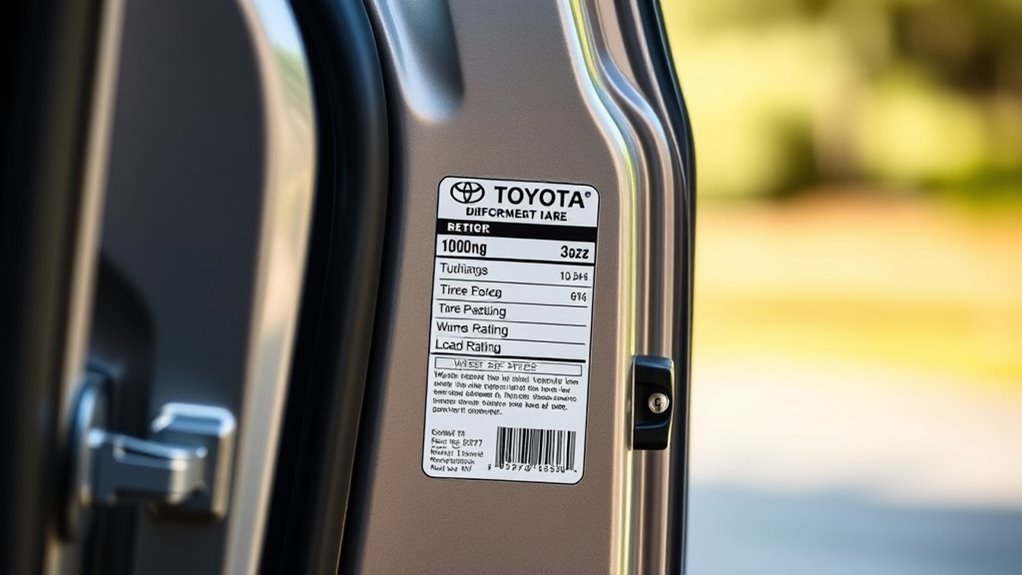
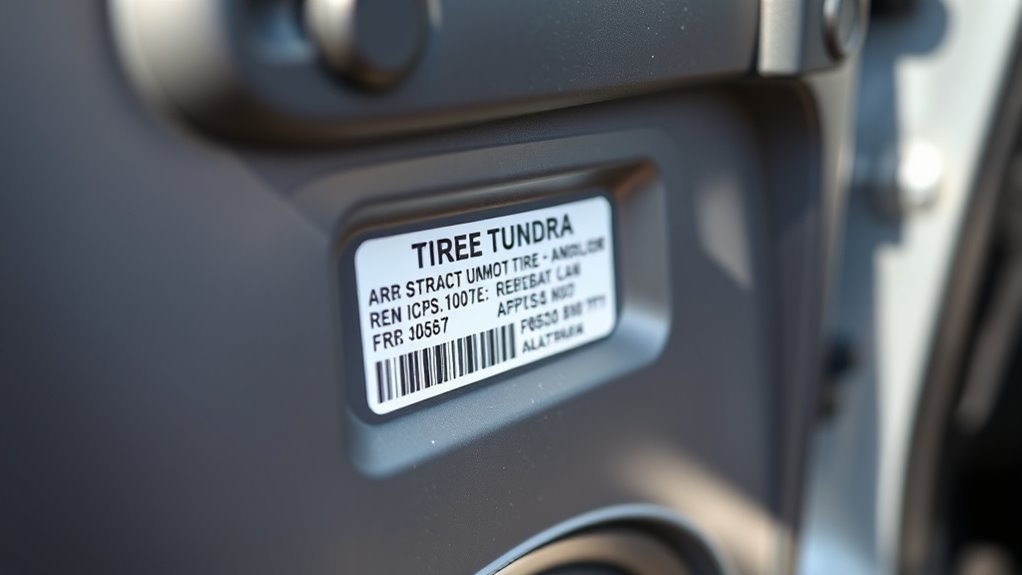
The Tundra’s door-jamb tire label is your starting point. Toyota’s owner information says the recommended cold tire inflation pressure and tire size are displayed on the tire and loading information label. That means the placard helps you choose the correct factory-size tire and set the right pressure before driving, when the tires are cold.
Do not stop at the placard, though. The tire sidewall carries the DOT Tire Identification Number, manufacture date, load index, speed rating, winter symbols, treadwear/traction/temperature grades, and construction markings. The certification label and owner’s manual help you confirm weight limits, axle ratings, towing limits, and model-specific instructions.
| Where to Look | What It Tells You | How to Use It |
|---|---|---|
| Driver-side tire and loading label | Factory tire size, recommended cold PSI, seating/cargo information | Set pressure and verify replacement size |
| Tire sidewall | Size code, load index, speed rating, DOT date, M+S/3PMSF, XL/load range, rotation markings | Confirm tire capability and age |
| Certification label and owner’s manual | GVWR, GAWR, payload guidance, Toyota tire warnings, towing limits | Check that tires, wheels, cargo, and trailer tongue weight stay within vehicle limits |
NHTSA reported 511 traffic fatalities in tire-related crashes in 2024, which is why pressure, tread, load rating, and tire age checks are more than routine maintenance.
Where to Find Tire and Label Info on Your Toyota Tundra
Open the driver’s door and look at the door edge, door post, or B-pillar area. That is where the Tire and Loading Information Label is normally located. On late-model vehicles, NHTSA says the proper tire inflation pressure is found on the Tire and Loading Information Label on the driver’s side door edge or in the owner’s manual.
Next, inspect the sidewall of each tire. You may need to turn the front wheels or use a flashlight because the full DOT Tire Identification Number is sometimes molded on only one side of the tire. Check all four tires, plus the spare if your Tundra has one.
Note: A “cold” tire is not about outdoor temperature. It means the Tundra has been parked for at least three hours or driven only a very short distance before you check pressure.
How to Read Tundra Tire Size Codes Like 265/70R18
A Tundra tire size code looks complicated, but it breaks down cleanly. Use a modern truck-style example such as 265/70R18:
- 265 = tire section width in millimeters.
- 70 = aspect ratio, meaning the sidewall height is 70% of the tire width.
- R = radial construction.
- 18 = wheel diameter in inches.
You may also see Tundra sizes such as 265/60R20, 245/75R18, or 285/65R18, depending on trim, model year, package, and whether Toyota-approved accessories are installed. Always match your own door placard and owner’s manual instead of copying a tire size from another Tundra.
Some tires also include a prefix or service type. A P prefix means passenger-type sizing. LT means light-truck sizing and may use load range letters such as C, D, or E. Do not switch between P-metric and LT tires, or between standard load and higher load-range tires, unless the load rating, wheel compatibility, clearance, speed rating, ride quality, and pressure requirements are verified by Toyota information or a qualified tire professional.
Warning: The PSI molded on the tire sidewall is a maximum tire limit, not the recommended pressure for your Tundra. Set pressure from the door-jamb label or owner’s manual when the tires are cold.
Tundra Tire Load Index and Speed Rating for Towing/Payload
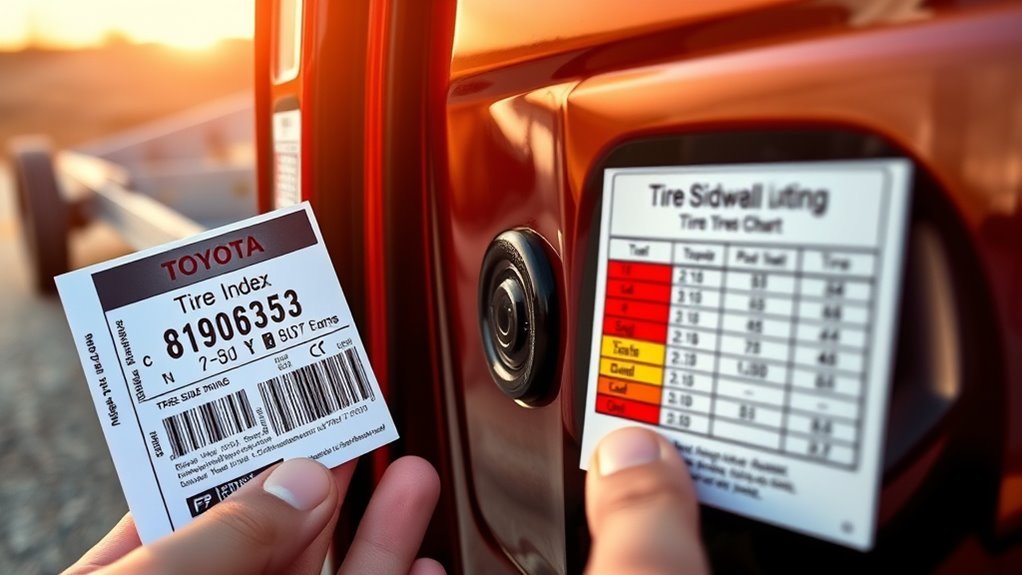
The load index is the number in the tire’s service description that tells you how much weight one tire can carry when properly inflated. The speed rating is the letter beside it, such as T, H, or V, that tells you the tire’s tested maximum sustained speed under specified conditions.
For example, a service description may look like 112T. The number is the load index; the letter is the speed rating. T, H, and V ratings are common speed-symbol examples: T is up to 118 mph/190 km/h, H is up to 130 mph/210 km/h, and V is up to 149 mph/240 km/h. Use those as decoding examples only. Your Tundra’s required rating is the one Toyota specifies for your exact configuration.
- Match or exceed Toyota’s rating: Replacement tires should meet or exceed the load rating, speed symbol, and load range specified on the tire pressure label or owner’s manual.
- Check axle limits: Tire capacity must support the load, but the truck is still limited by its Gross Axle Weight Ratings, payload rating, wheel rating, and towing rating.
- Understand XL and load range: XL tires have reinforced construction for higher load at higher pressure. LT tires may use load range letters. Match what Toyota specifies unless a professional confirms a safe alternative.
- Count trailer tongue weight: When towing, tongue weight adds to the truck’s payload. Passengers, cargo, hitch equipment, and tongue weight all count against payload.
Pro Tip: Take a clear photo of the tire label and each tire sidewall before shopping. It prevents ordering a tire with the right size but the wrong load index, speed rating, load range, or OE marking.
[Products Worth Considering]

The JACO ElitePro Digital Tire Pressure Gauge delivers shop-grade accuracy with a clear digital readout, making it easy to maintain proper tire pressure for safer driving and better performance. Built with rugged brass and steel components, a protective guard, and a flexible air hose, it is designed for reliable use across cars, trucks, motorcycles, bikes, RVs, and trailers. The lock-on display, built-in bleeder valve, and bright backlit screen add convenience in any lighting condition.

TOVASTY rear brake pads are designed for a wide range of Toyota and Lexus models, delivering dependable braking performance with a carbon ceramic formula. They help reduce brake dust, promote quieter operation, and support consistent stopping power with improved heat resistance for everyday driving confidence.
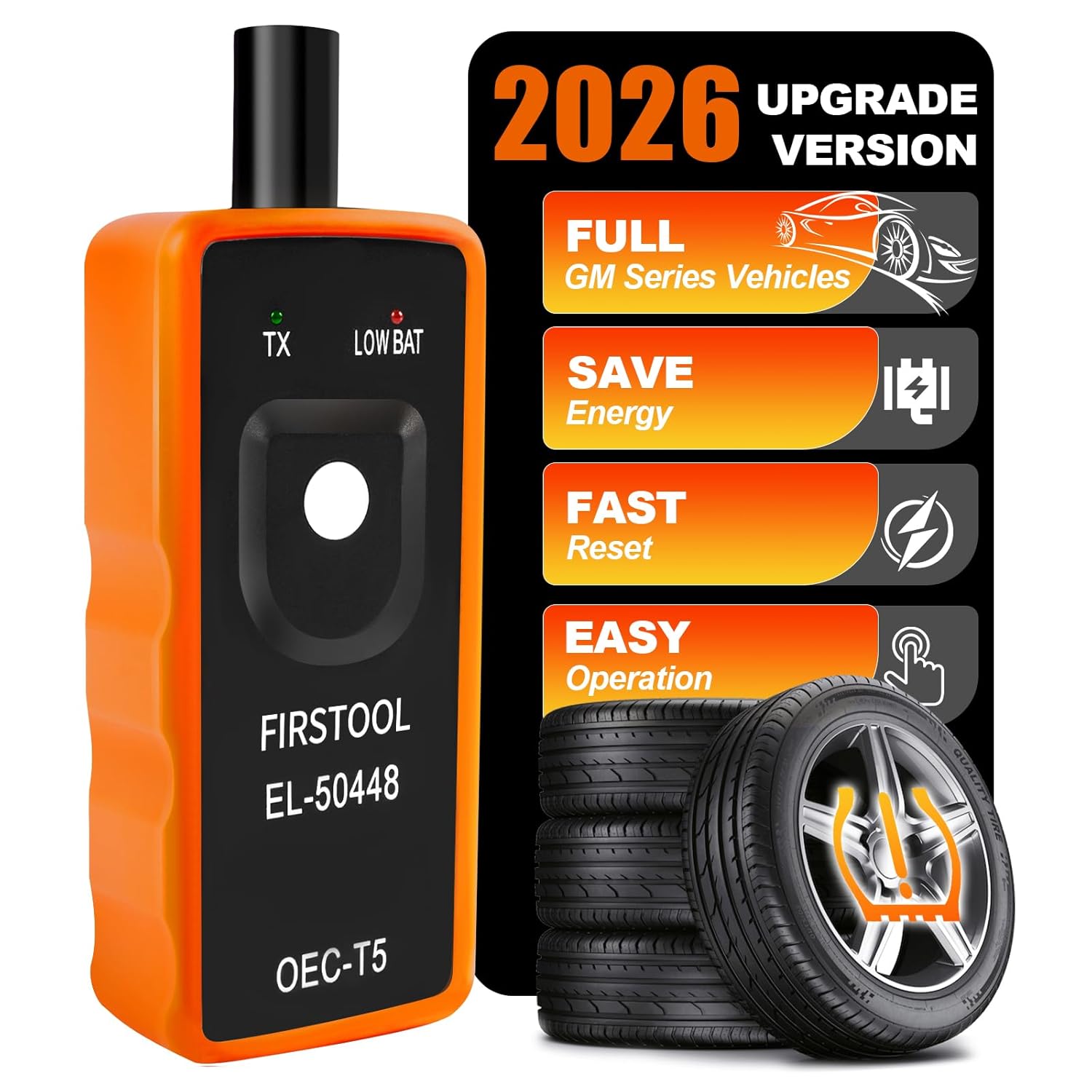
This EL-50448 TPMS relearn tool helps quickly activate and reset tire pressure sensors so your vehicle’s monitoring system stays accurate after tire rotations, sensor replacement, or seasonal tire changes. Designed for many GM-related vehicles and compatible with common 315 and 433 MHz TPMS systems, it offers simple one-button operation and reliable performance for clearing warning lights and relearning sensor positions.
Reading Date Codes, Winter Symbols, and Rotation Arrows
The DOT Tire Identification Number begins with “DOT.” For tires made since 2000, the last four digits show the week and year of manufacture. For example, 3219 means the tire was made in the 32nd week of 2019. NHTSA notes that some vehicle and tire manufacturers recommend replacing tires that are six to 10 years old regardless of treadwear, so age matters even when tread looks decent.
Winter and all-season markings need careful reading:
- M+S, M/S, or M&S: indicates mud and snow capability, but it does not prove severe-snow performance by itself.
- Three-Peak Mountain Snowflake (3PMSF): identifies tires that meet severe snow performance criteria. USTMA describes the symbol as a mountain with a snowflake, used with M+S-type markings on tires that meet the severe-snow definition.
- Rotation arrows: directional tires must roll in the arrow direction. Mounting them backward can hurt wet or winter performance.
- Inside/outside labels: asymmetric tires must be mounted with the correct side facing outward.
Also check tread depth. NHTSA says tires are not safe and should be replaced when tread is worn to 2/32 inch. A tread-depth gauge is best, but the penny test can help: insert a penny into the tread with Lincoln’s head upside down. If you can see the top of Lincoln’s head, the tire is at or below the replacement point.
Using the Label to Pick Replacement Tires
Start with the Tundra’s door-jamb placard, then confirm the sidewall and owner’s manual. The goal is not just to buy a tire that “fits.” The goal is to buy a tire that fits the wheel, carries the load, matches Toyota’s rating, clears the body and suspension, works with TPMS, and keeps handling predictable.
- Match the tire size: Use the exact placard size unless Toyota or a qualified tire professional confirms another size is safe.
- Match the service description: Confirm load index and speed rating meet or exceed the original specification.
- Match load type: Do not replace an XL, LT, or specific load-range tire with a lower-capacity standard-load tire.
- Match tire model when replacing one tire: If you are replacing only one tire, match the same brand, model, size, load rating, speed rating, and OE marking when possible to avoid uneven handling.
- Use UTQG correctly: Treadwear, traction, and temperature grades help compare passenger tires, but treadwear is relative and not a mileage guarantee.
- Check production date: Avoid buying “new” tires that have been sitting for years unless the tire professional explains the age and warranty clearly.
- Verify wheel and TPMS compatibility: Aftermarket wheels can change fitment, sensor compatibility, offset, and load rating.
Note: If the tire currently installed on your Tundra does not match the door-jamb label, do not assume the installed tire is correct. Compare it with the owner’s manual and ask a tire professional to verify size, load rating, speed rating, wheel fitment, and clearance.
[Products Worth Considering]

The KONNWEI KW208 is a versatile 12V battery tester designed to quickly analyze battery health, cranking performance, and charging system status for cars, trucks, boats, motorcycles, and more. It supports multiple battery types and provides clear guidance on whether a battery should be recharged or replaced, helping you diagnose issues before they become failures. With plug-and-play use, high accuracy, and multilingual support, it offers a convenient way to test batteries in-vehicle or out-of-vehicle.

These battery terminal anti-corrosion washers help protect battery connections from buildup and extend battery life in 6V and 12V systems. The set includes color-coded red and green rings for easy positive and negative identification, plus a removable inner ring to fit larger terminals when needed.
Tundra TPMS & Dashboard Warnings: Common Causes and Fixes
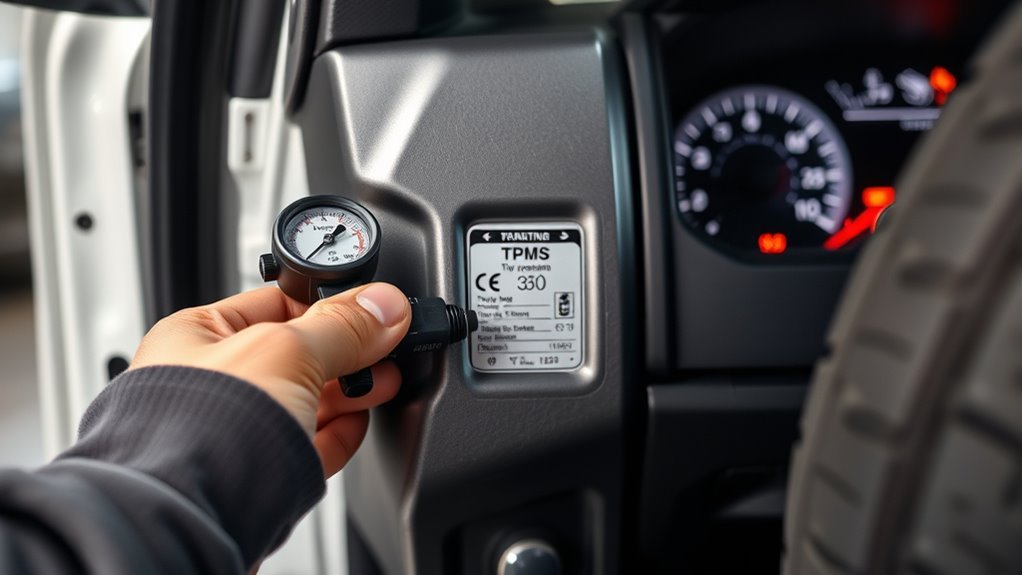
Your Tundra’s Tire Pressure Monitoring System is a warning system, not a replacement for checking pressure with a gauge. NHTSA explains that TPMS warns when tire pressure is significantly underinflated, and that underinflated tires can be hard to detect visually. Start with a manual pressure check before assuming a sensor is bad.
| Symptom | Likely Meaning | What to Do |
|---|---|---|
| TPMS light stays solid | At least one tire may be significantly underinflated | Stop safely, check all tires cold with a gauge, inflate to placard PSI, and inspect for damage |
| Light comes on in cold mornings, then turns off | Pressure may be near the warning threshold and rises as tires warm | Check and adjust cold pressure; do not ignore repeated alerts |
| Light flashes for about 60–90 seconds, then stays on | TPMS malfunction, sensor issue, registration issue, wiring issue, or system fault | Have the system scanned and repaired; sensor IDs may need registration after tire/wheel work |
| Light appears after tire rotation, new wheels, or sensor replacement | Sensor relearn/registration may be incomplete | Use the Toyota procedure for your model year or have a shop register the sensors |
Warning: Do not keep towing or driving at highway speed on a TPMS warning without checking pressure. Underinflation builds heat, shortens tire life, and can lead to tire failure.
[Products Worth Considering]

✿IMPORTANT NOTE: ❶ GM VEHICLES ONLY: ONLY for Chevrolet, GMC, Cadillac and Buick, Check Compability List before buying. NOT support Ford, Toyota, Nissan, Honda and other non-GM brands; ❷ SENSOR REQUIREMENTS: Optimized for OE/OEM sensors. Most aftermarket sensors can work BUT some may fail if their frequency or parameters do not match the OEM original. NOT for UNIVERSAL TPMS sensors.❸ Requires a 9V battery for operation BUT NOT included.❹NOTE: If one or some sensors can't be activated after multiple attempts (because they were dead, low power or damaged, not our tool's not work), please replace them with new sensors then try again.
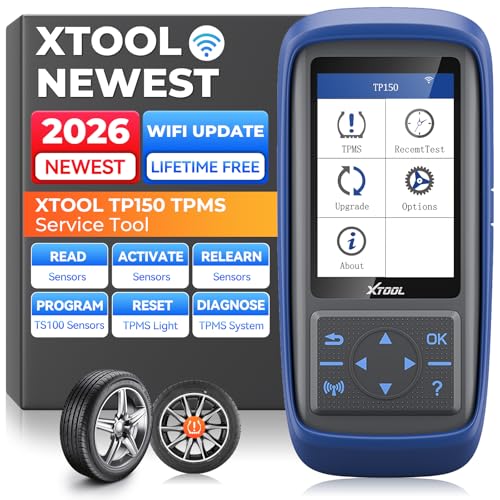
Why XTOOL TP150 TPMS Relearn Tool Stands Out: Perfect for DIYers and professional technicians, the XTOOL TP150 TPMS Reset Tool combines TPMS diagnostics, sensor activation, relearn, reset and sensor programming with XTOOL TS100 Sensors in one portable tool, making common TPMS service easier in one device. Its durable physical button interface is easy to operate with greasy gloves, making it ideal for garages, workshops, or roadside use. Check tire pressure, reset TPMS warning lights, and simplify sensor service with simple, easy-to-use controls. Supports the newest car models with frequent lifetime software updates and 13+ languages. 𝐍𝐎𝐓𝐄: TPMS Programming for XTOOL Sensors Only.

【CUSTOMIZED for FORD】This TPMS Sensor Training Tool is customized for all Ford Lincoln Mercury vehicles that has a Tire Pressure Sensor. Train the TPMS sensors and activate Tire Pressure Programming on new vehicles or after a tire rotation(Tip: You can refer to the second vehicle compatibility diagram and the A+ content to check if your vehicle is compatible with this reset tool.)
Common Mistakes to Avoid
- Using sidewall max PSI as the recommended pressure: The Tundra placard or owner’s manual gives the recommended cold pressure.
- Buying by size only: Size alone is not enough. Check load index, speed rating, load range, and tire type.
- Assuming a higher load index increases towing capacity: It does not. Toyota’s payload, GAWR, GVWR, hitch, and towing limits still apply.
- Ignoring tire age: Old rubber can harden and crack even when tread remains.
- Mixing tire models or tread depths: Uneven tires can affect braking, stability, and four-wheel-drive behavior.
- Skipping the spare: Check spare tire pressure and age if your Tundra is equipped with one.
Frequently Asked Questions
How do you read a Toyota Tundra tire label?
Open the driver’s door and read the tire and loading information label for the original tire size and recommended cold PSI. Then check the tire sidewall for the full size code, load index, speed rating, DOT date, winter symbols, XL/load range markings, and rotation direction.
How do you read Toyota Tundra tire size?
In a size like 265/70R18, 265 is the tire width in millimeters, 70 is the sidewall height as a percentage of width, R means radial construction, and 18 is the wheel diameter in inches. Always use the size listed for your exact Tundra, not a size copied from another trim.
Is the PSI on the tire sidewall the pressure I should use?
No. The PSI molded on the sidewall is the tire’s maximum inflation limit under normal conditions. Use the recommended cold tire pressure on the Tundra door-jamb label or in the owner’s manual.
Can I use a higher load index tire on my Tundra?
Usually, using a tire with a higher load index is acceptable if the size, wheel fitment, speed rating, load range, and pressure requirements are correct. However, a higher load index does not raise your Tundra’s payload, GAWR, GVWR, or towing rating.
What does it mean if my Tundra TPMS light flashes and then stays on?
A TPMS light that flashes for about 60–90 seconds and then stays illuminated usually means the tire pressure monitoring system has a malfunction. Check tire pressure first, then have the sensors, sensor registration, wiring, and system codes inspected.
What is the difference between M+S and the three-peak mountain snowflake?
M+S means the tire has mud and snow capability, but it is not the same as a severe-snow certification. The three-peak mountain snowflake symbol identifies tires that meet severe-snow performance criteria.
Conclusion
The Tundra tire label is not a mystery once you know what each marking does. Use the door-jamb label for factory tire size and cold PSI. Use the sidewall for load index, speed rating, DOT date, winter symbols, XL/load range, and rotation markings. Use the certification label and owner’s manual for payload, axle, and towing limits. When those details match, replacement tires are safer, TPMS warnings are easier to diagnose, and your truck keeps the handling Toyota intended.
Sources
- Toyota Owners — 2025 Tundra Tire Inflation Pressure — supports cold tire pressure and tire label guidance.
- Toyota Owners — 2025 Tundra Tires — supports replacement tire safety, load rating, speed symbol, and tire rotation guidance.
- NHTSA TireWise — supports tire pressure, tread depth, label location, TPMS behavior, tire aging, and tire safety guidance.
- Michelin — Tire Load Rating and Speed Rating — supports load index, speed rating, XL tire, and replacement tire explanations.
- U.S. Tire Manufacturers Association — Severe Snow Conditions Bulletin — supports M+S and three-peak mountain snowflake guidance.
- eCFR — FMVSS No. 138 Tire Pressure Monitoring Systems — supports federal TPMS warning-system requirements.