
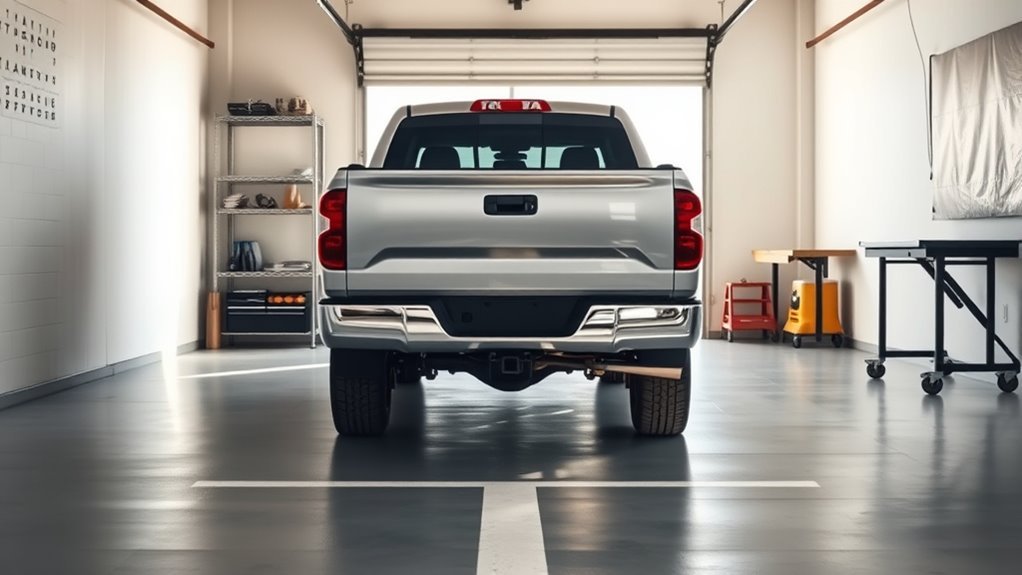
A 2019 Toyota Tundra CrewMax can fit in many home garages, but the answer depends on three measurements: the truck’s true length, its total height with any lift or roof gear, and the clear space inside your garage bay. Stock CrewMax models are about 228.7 inches long, usually rounded to 229 inches, and about 75.6 to 76.0 inches tall before you add larger tires, a lift kit, racks, light bars, or antennas.
Quick Answer
A stock 2019 Toyota Tundra CrewMax is about 229 inches long and roughly 76 inches tall, so it can fit in many 20- to 24-foot garages. Measure your exact bay, door opening, opener rails, and ceiling storage first. Add any lift, tire-size increase, and roof accessory height before driving in.
Key Takeaways
- Use 229 inches as the practical length number for a 2019 Tundra CrewMax.
- Use about 76 inches as the stock height baseline, then add lift, tire changes, and roof-mounted gear.
- Keep at least 2 inches between your measured truck height and the lowest garage obstruction.
- Many residential garage doors are 7 or 8 feet tall, but opener rails, headers, lights, and ceiling storage can sit lower.
- ADA van-accessible parking routes require 98 inches of vertical clearance, but not every public garage route or level offers that much space.
At a Glance
| Time Required | 15 to 30 minutes for a careful home-garage check |
| Difficulty | Easy, but measure twice before pulling in |
| Tools Needed | 25-foot tape measure, helper, notepad, painter’s tape or chalk, tennis ball and string if you want a parking guide |
| Cost | Usually $0 if you already own a tape measure; under $10 for a simple tennis-ball guide |
What’s in This Article
- Quick Fit Check: Will Your Tundra Fit?
- What You’ll Need
- Measure Your Tundra: Height, Lift, and Tires
- Measure the Garage Bay, Door, and Opener
- Check Garage Clearances: Signs and Common Limits
- Calculate Total Vehicle Height With Margin
- Home Garage Fit Tests: Length and the Tennis-Ball Trick
- Parking Garage Tactics for Lifted Tundras
- Garage Design and Door Specs That Work for Tundras
- Maximize Two-Car Garage Space: Layout and Storage Tips
- What to Do If Your Tundra Does Not Fit
- Frequently Asked Questions
Quick Fit Check: Will Your Tundra Fit?
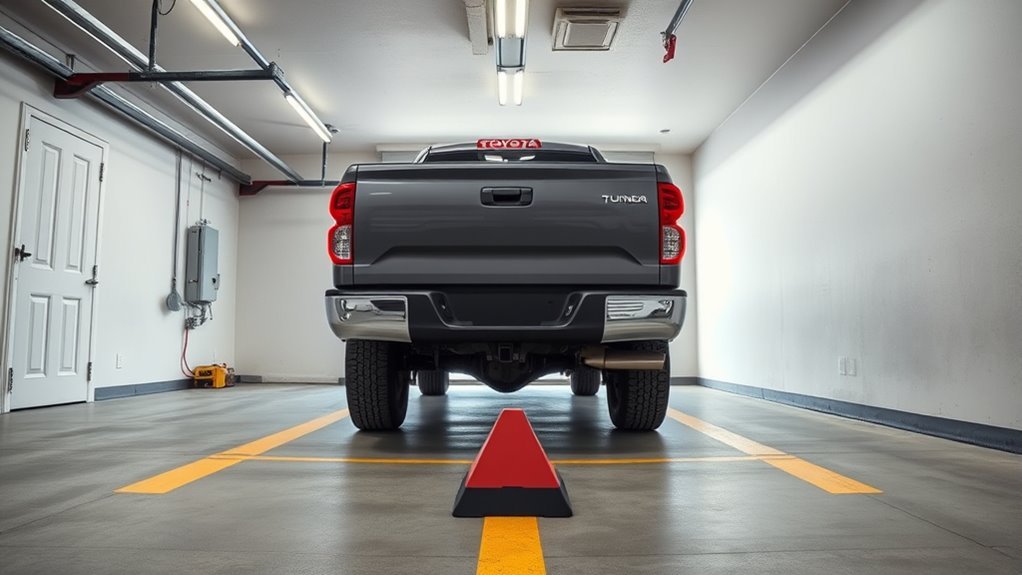
Start by comparing your Tundra’s 229-inch practical length to the usable depth of your garage bay. Do not measure only from the closed garage door to the back wall if you have shelves, a freezer, bikes, a workbench, or wall-mounted tools taking up space. Measure the clear parking path the truck will actually use.
A 20-foot bay gives you 240 inches before you subtract door thickness, wall storage, bumper clearance, and walking room. That can work for a stock CrewMax in a tight setup, but it leaves little room for error. A 24-foot bay is much easier because it gives space to close the door, walk around the truck, and open the tailgate when needed.
Also check width. The Tundra is a full-size truck, so a narrow single door, bulky mirrors, and stored items along the side walls can create a problem even when the length works. Fold the mirrors if needed and leave enough side clearance to open the driver’s door safely.
Note: A garage can be long enough but still fail the fit test because of opener rails, low lighting, ceiling racks, a hanging bike, or a storage shelf near the bumper.
[Products Worth Considering]

This custom 3-piece floor mat set is designed specifically for Toyota Tundra CrewMax Cab models from 2022 through 2026, delivering a precise fit with full front and rear coverage. Made from durable all-weather TPE, it helps protect your cabin from mud, snow, rain, sand, and everyday spills while staying securely in place and easy to clean.

These heavy-duty running boards are designed to improve access to your Toyota Tundra CrewMax while maintaining ground clearance for off-road use. Built from durable aluminum with a high weight capacity, they provide stable step-up support for daily driving, cargo loading, and outdoor adventures. The no-drill installation makes setup simple, and the included customer support adds extra peace of mind.

Designed for Toyota Tundra CrewMax Cab models, these custom-fit all-weather floor mats use 3D scanning for precise coverage and raised edges to help protect the interior from rain, slush, snow, mud, and spills. Made from premium unscented TPE, they are durable, flexible, easy to clean, and built to stay in place without curling or deforming. They also come with a lifetime warranty for added peace of mind.
What You’ll Need
- A tape measure, at least 25 feet long
- A helper to hold the tape at the vehicle’s highest point
- Pen and paper or a notes app to record each measurement
- A tennis ball and string for the ceiling parking guide, optional
- Chalk or floor tape to mark stopping lines, optional
- A step ladder to check opener rails, ceiling lights, and hanging storage
Measure on level ground with normal tire pressure and your normal daily setup. If you usually carry tools, a bed cover, a rack, recovery boards, or a roof box, measure the truck with those items installed.
Measure Your Tundra: Height, Lift, and Tires
Use the stock height only as a starting point. A stock 2019 Tundra CrewMax sits around 76 inches tall, but your real number can change with drivetrain, trim, tires, suspension, roof accessories, and cargo setup. Measure from the ground to the highest fixed point on the truck, not just to the cab roof.
[Products Worth Considering]

These heavy-duty running board side steps are designed to improve access to your Toyota Tundra without reducing ground clearance. Built for Double Cab and CrewMax front door applications, they offer practical convenience for everyday entry, roof loading, and off-road use. The durable iron construction and easy no-drill installation make them a reliable upgrade for rugged driving.

This front bumper license plate bracket is designed for Toyota Camry and Camry Hybrid models from 2018 to 2026, offering a secure and street-legal way to mount your plate. Built from durable, rust-proof plastic with included screw bolts and a wrench, it helps protect your bumper paint while making installation straightforward. The bracket fits US and Canada plates and is made to keep your license plate and registration sticker visible.

These all-weather floor liners are designed for Toyota Tundra CrewMax Cab models, providing a precise fit for the first and second rows. Made from durable TPE material, they help protect your interior from mud, water, dirt, and everyday messes while offering a non-slip surface for added driving confidence. Raised edges and easy-clean construction make them a practical choice for keeping your truck floorboard cleaner in every season.
Measure Overall Vehicle Height
Park on level ground and run the tape from the pavement to the highest fixed point. Include antennas, light bars, roof racks, roof tents, cargo boxes, and any tall bed rack that rises above the cab. If the antenna flexes, remove or fold it before measuring, then confirm the truck still clears the garage with the antenna in its normal driving position.
Compare that number against the lowest real obstruction in your garage. The lowest point may be the open door, door opener rail, crossbar, header trim, ceiling rack, garage light, or hanging storage. Keep at least a 2-inch margin between the truck and that lowest point.
Account for Lift Height
Record your stock height, then add the real lift gain after installation. Do not rely only on the lift kit’s advertised number because final height can vary with spring preload, tire weight, trim, bumper weight, and settling. Measure again after the suspension has been installed and driven.
A 6-inch lift puts a stock-height CrewMax close to 82 inches before tire changes or roof accessories. That is already near a 7-foot opening, which gives only about 2 inches of clearance before any larger tire or rack.
Calculate Tire Diameter Impact
Tire size changes affect height by half the diameter increase. For example, moving from a 33-inch tire to a 35-inch tire adds 2 inches of tire diameter, but only about 1 inch of ride height. Add that tire-radius gain to your lift height and accessory height.
Keep a minimum 2-inch clearance margin versus the lowest garage obstruction. Uneven pavement, a sloped apron, snow buildup, and suspension movement can reduce usable clearance even when the truck looks fine on flat ground.
| Setup | Baseline | Lift | Tire Gain | Estimated Truck Height | Minimum Recommended Clearance |
|---|---|---|---|---|---|
| Stock CrewMax | 76″ | 0″ | 0″ | 76″ | 78″ |
| 4-inch lift with 1-inch tire-radius gain | 76″ | 4″ | 1″ | 81″ | 83″ |
| 6-inch lift with 35-inch tires replacing 33-inch tires | 76″ | 6″ | 1″ | 83″ | 85″ |
Measure the Garage Bay, Door, and Opener
Measure the garage like you measure the truck: use the space that actually matters. Start with interior bay depth from the closed garage door to the nearest wall, shelf, freezer, workbench, or stored item. Then measure the door opening height and width.
Next, open the garage door fully and measure the lowest point under the open door, opener rail, opener arm, torsion hardware, ceiling light, and overhead storage. Many owners only measure the door opening and miss a lower obstruction behind it.
- Depth: Aim for at least 240 inches for a tight fit and 288 inches or more for a much easier daily fit.
- Door height: Check the actual open-door clearance, not just the advertised door size.
- Door width: Leave mirror clearance on both sides, especially if you enter at an angle.
- Ceiling obstructions: Measure opener rails, racks, shelves, lights, hooks, and bikes.
- Floor slope: Check the driveway apron and garage entrance because a slope can change clearance as the truck moves through the opening.
[Products Worth Considering]

Protect your Toyota Tundra CrewMax with custom-fit floor mats designed for precise coverage and everyday durability. Built from flexible TPE with a high-wall design, these liners help contain rain, snow, mud, and spills while offering a secure, non-slip fit. They are easy to remove and clean, making them a practical upgrade for keeping your truck’s interior neat and protected.

This front license plate bracket is a direct replacement for compatible Toyota RAV4 models, offering an easy way to restore a damaged or missing front plate holder. Built from durable ABS material with the same dimensions as the original, it installs without modification and helps maintain a clean factory look.

This front bumper license plate bracket is designed for Toyota vehicles from 2000 to 2026, offering a secure and street-legal way to mount your plate without covering important registration details. Made from durable, rust-proof materials, it helps protect your car’s finish while providing a clean, stable fit. The kit includes mounting hardware and a wrench for easier installation, making it a practical accessory for drivers who want a reliable plate holder solution.
Check Garage Clearances: Signs and Common Limits
Check the entrance height signs before you enter any public garage. Do not assume the posted height applies to every ramp, turn, beam, pipe, sign, sprinkler head, or interior level. Some structures have lower points after the entrance.
For home garages, many residential garage doors are 7 or 8 feet tall, but the door size alone does not guarantee the truck will clear. The open door, opener rail, and overhead storage can reduce the real usable height.
Entrance Height Signs
Read the posted clearance sign at the garage entrance and compare it to your truck’s measured overall height. Include roof accessories, lift height, larger tires, and removable gear. Keep at least a 2-inch margin because ramps, snow, and uneven surfaces can reduce effective clearance.
If your modified Tundra is close to the posted limit, use a surface lot instead. A public garage repair bill can be much more expensive than the inconvenience of parking outside.
Typical Clearance Limits
Many residential doors are 7 or 8 feet tall. ADA standards require van-accessible parking spaces, access aisles, and the vehicular routes serving them to provide at least 98 inches of vertical clearance, which equals 8 feet 2 inches. That rule helps explain why some van-accessible routes feel taller, but it does not mean every public garage path will fit a lifted truck.
Measure your truck with all accessories installed and check every sign you pass. When in doubt, stop before the entrance and choose open-air parking.
Calculate Total Vehicle Height With Margin
Add your Tundra’s stock height, actual lift height, half the tire diameter increase, and any permanent roof-mounted gear. That gives you a working maximum height. Then add at least 2 inches to set your minimum safe garage clearance.
For example, a stock-height CrewMax at about 76 inches with a 6-inch lift and a tire-radius gain of 1 inch reaches about 83 inches before roof gear. With a 2-inch buffer, you should look for at least 85 inches of clear space. A standard 84-inch opening would be too tight for that setup.
Pro Tip: Write your measured truck height on a small card and keep it in the glove box. Update it after every lift, tire change, roof rack, light bar, antenna, or bed-rack change.
Home Garage Fit Tests: Length and the Tennis-Ball Trick
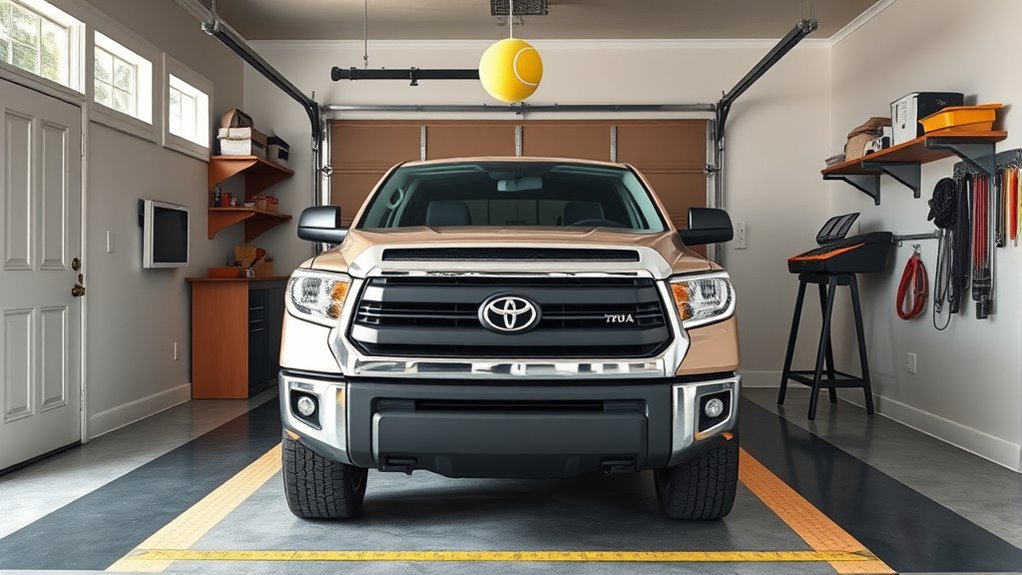
The CrewMax stretches to about 19 feet 1 inch, so daily garage parking works best when you make the stopping point repeatable. Measure bay depth, clear storage from the bumper zone, confirm the garage door can close, and set a physical guide.
For the tennis-ball guide, hang a ball from the ceiling on a string so it touches a consistent spot on the windshield or dash when the truck reaches the correct stop point. Back in slowly until the ball touches that spot. Then mark a floor stop line with tape or chalk as a backup reference.
Warning: A bay under 20 feet deep gives a CrewMax very little usable room after you account for the garage door, wall storage, bumper clearance, and walking space. Measure carefully before trusting it for daily parking.
If you park nose-in, make sure the front bumper, tow hooks, grille guard, and license plate bracket clear the wall. If you back in, check hitch receivers, bumper steps, and bed accessories. A removable hitch ball mount can save several inches.
Parking Garage Tactics for Lifted Tundras
If your home garage fit tests are tight, treat public parking garages with extra caution. A few extra inches from suspension and larger tires can push a Tundra near common limits. Calculate your overall height first, then look for at least a 2-inch buffer under the posted garage limit.
Approach ramps matter. A truck that clears a flat sign bar may still come close to a beam or pipe on a steep ramp transition. Drive slowly, stay centered, and stop if you cannot see the next clearance sign or overhead obstruction.
Remove roof-mounted accessories before entering a low garage when possible. Light bars, awnings, traction boards, roof tents, and cargo boxes can turn a safe clearance into a scrape. If the posted clearance is close to your measured height, use a surface lot.
Garage Design and Door Specs That Work for Tundras
When designing a garage for a Toyota Tundra, plan around the truck’s 19-foot-plus length and possible future modifications. Target at least 24 feet of interior depth. A 26- to 30-foot depth gives you room to open the tailgate, walk around the truck, and store gear without pulling the vehicle out.
For width, plan more than the minimum vehicle width. A single-vehicle bay feels much better with a wide door and clear wall space. A two-car layout works best with 24 to 26 feet of width, especially if the second bay also holds a daily driver.
Specify doors at least 9 feet wide, with 10 feet preferred for a full-size truck if the design allows it. Door height should run no less than 7 feet for a stock truck, but 8 feet works better if you plan to lift the Tundra, add larger tires, or install roof gear. Also leave enough ceiling height for opener hardware, lighting, storage, and future service work.
Maximize Two-Car Garage Space: Layout and Storage Tips
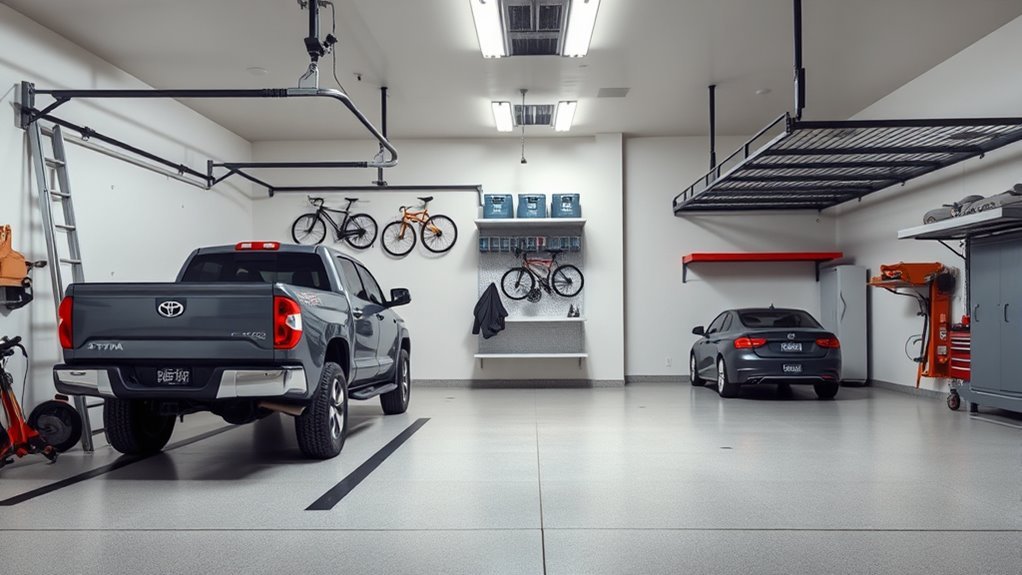
Treat your two-car garage as a modular workspace. Keep the Tundra’s parking lane clear from the garage door to the back wall. Put tools, hoses, sports gear, and chargers on the opposite wall or above bumper height only when they do not reduce clearance.
Plan vertical zones: keep the floor clear for vehicle access, use a midwall band around 48 to 60 inches high for hooks and pegboards, and place seasonal storage high enough that it cannot contact the roof, antenna, rack, or raised tailgate.
- Install wall-mounted rails and pegboards in the midwall band.
- Use high shelving only where it does not overlap the truck’s roof path.
- Fit rolling cabinets under the workband so you can move them before parking.
- Use a parking stop, floor line, or tennis-ball marker for repeatable positioning.
- Remove hitch ball mounts when you need extra rear clearance.
What to Do If Your Tundra Does Not Fit
If the length is the problem, remove wall storage, relocate bikes, switch to slim cabinets, remove the hitch mount, or back in so the truck uses the bay shape more efficiently. If the door still will not close, use the garage for storage and park the truck outside instead of forcing a risky fit.
If height is the problem, remove roof accessories, fold or remove antennas, relocate ceiling racks, or talk with a qualified garage-door professional about higher tracks, opener changes, or a taller door. Do not cut structural framing or modify a garage header without proper code review and professional help.
If width is the problem, fold mirrors, clear the side walls, add a parking guide, and enter slowly at the straightest possible angle. A tight width fit can damage mirrors, door edges, wall trim, or another vehicle in the next bay.
Frequently Asked Questions
How do I tell if my 2019 Tundra CrewMax will fit in the garage?
Measure the truck’s length, width, and total height. Then measure the garage bay depth, door width, door height, opener rails, ceiling lights, hanging storage, and the lowest obstruction with the door open. Add a 2-inch height buffer before you drive in.
What is the stock height of a 2019 Toyota Tundra CrewMax?
A stock 2019 Tundra CrewMax is roughly 76 inches tall, with slight variation by drivetrain and trim. Any lift kit, larger tire, roof rack, light bar, cargo box, or antenna can raise the total height, so measure your own truck before entering a garage.
How long is a 2019 Tundra CrewMax?
A 2019 Tundra CrewMax with the 5.5-foot bed is about 228.7 inches long, commonly rounded to 229 inches or 19 feet 1 inch. Add space for wall storage, a hitch, bumper clearance, and the garage door before assuming it will fit.
What should I do if my lifted Tundra is too tall for a parking garage?
Use a surface lot or open-air parking. If you must use a garage, remove roof-mounted accessories first and compare your measured height to the posted limit with at least a 2-inch buffer. Do not enter if the clearance is close.
How much garage depth do I need for a Tundra CrewMax?
A 20-foot bay can be tight but possible if it is clear. A 24-foot bay works much better for daily parking. A 26- to 30-foot garage gives you room to walk around the truck, close the door easily, and open the tailgate when needed.
Will a 6-inch lifted Tundra fit under a 7-foot garage door?
Usually not with a comfortable margin. A stock CrewMax around 76 inches plus a 6-inch lift reaches about 82 inches before larger tires or roof gear. A 7-foot opening is 84 inches, leaving very little clearance before you add tire height or accessories.
Conclusion
Fitting a 2019 Tundra CrewMax in your garage comes down to careful measuring, not guessing. Use about 229 inches for length and about 76 inches for stock height, then adjust for your own lift, tires, racks, lights, antennas, storage, and garage hardware.
For a tight home garage, measure the bay depth, the open-door height, the opener rail, the ceiling storage, and the side clearance. Then mark a repeatable stopping point with tape, a parking stop, or a tennis-ball guide. For public garages, trust your measured height and leave a buffer. If the clearance is close, choose open-air parking.
Sources
- Toyota Tundra official model page — manufacturer source for Toyota Tundra model reference
- 2010 ADA Standards for Accessible Design — 98-inch vertical clearance requirement for van-accessible parking routes
- Guide to Garage Door Sizes — residential garage door height and full-size pickup garage-depth planning guidance



[…] Towing and heavy payloads increase engine load before a long trip. […]