Last updated: July 15, 2026
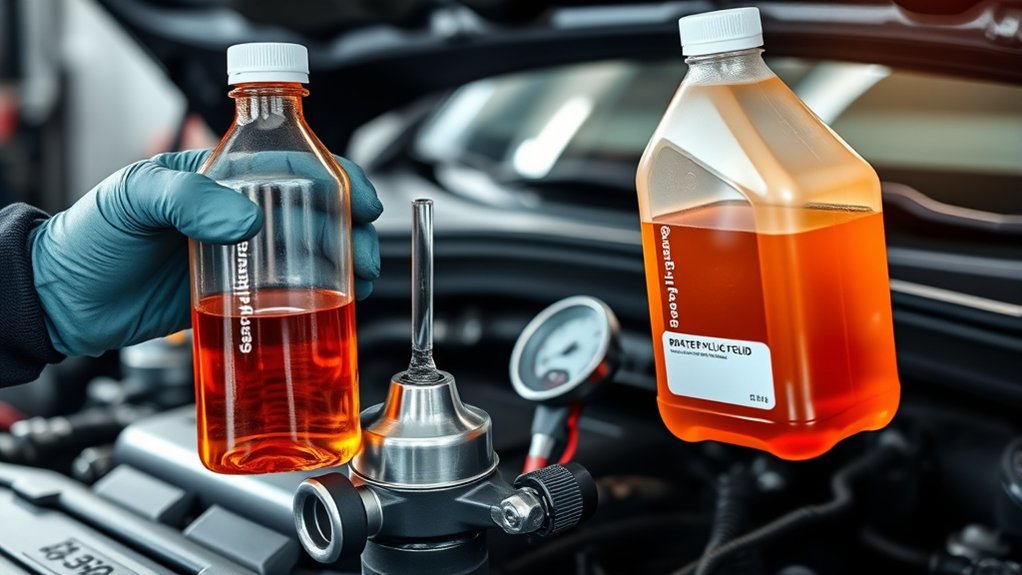
Choose DOT 3 vs DOT 4 brake fluid by the exact specification on the reservoir cap or in the owner’s manual. DOT 3 is correct when the vehicle specifies it. DOT 4 has higher federal minimum dry and wet boiling points, so it provides more heat margin when the vehicle requires or approves it. ABS alone does not automatically mean you need DOT 4. Some modern systems instead require DOT 4 LV because low-temperature viscosity matters to fast electronic valve operation.
Quick Answer
Use DOT 3 when your vehicle specifies DOT 3. Use DOT 4 when the cap or manual specifies DOT 4, or when the manufacturer approves it for higher-heat use. Use DOT 4 LV only when that low-viscosity subtype is required or approved. DOT 3 and DOT 4 are generally miscible, but chemical compatibility does not make them approved substitutes. A mixed fluid may no longer meet the vehicle’s required boiling-point or viscosity specification.
Key Takeaways
- DOT 4 handles more heat: its federal minimum dry and wet boiling points are higher than DOT 3.
- ABS does not choose the grade: follow the exact fluid specification; some systems require DOT 4 LV for low-temperature flow.
- Compatible is not the same as approved: DOT 3 and DOT 4 can mix physically, but the blend may not meet the required performance.
- Moisture lowers boiling performance: glycol-based brake fluids absorb water during service.
- The manufacturer specification wins: never downgrade a DOT 4 or DOT 4 LV system to DOT 3 for routine service.
Which Brake Fluid Should I Choose?
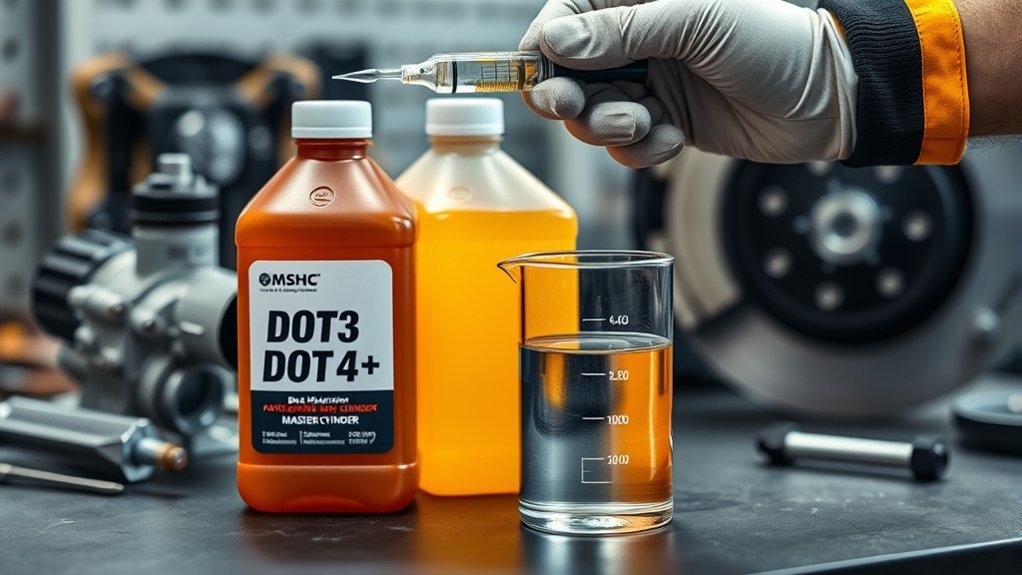
Use a three-step decision rule. First, read the exact grade and subtype on the reservoir cap or in the maintenance manual. Second, check whether the specification includes a low-viscosity requirement such as DOT 4 LV. Third, consider heat demand only within the fluids the manufacturer approves.
Boiling point and viscosity answer different questions. A higher boiling point helps during towing, mountain descents, repeated hard stops, or performance use. Low-temperature viscosity affects how quickly some ABS, stability-control, and traction-control hydraulic valves can respond. Do not use the presence of ABS as a shortcut for choosing the fluid.
Warning: Brake fluid is safety-critical. Do not guess, use fluid from an old open bottle, or allow dirt, water, engine oil, power-steering fluid, or petroleum products to enter the brake system.
| Situation | Correct starting choice | Why |
|---|---|---|
| Reservoir cap or manual specifies DOT 3 | DOT 3 | It meets the system’s stated requirement. Use DOT 4 only if the manufacturer or approved product documentation permits it. |
| Reservoir cap or manual specifies DOT 4 | DOT 4 | It preserves the designed boiling-point performance. |
| System specifies DOT 4 LV or another low-viscosity fluid | The exact low-viscosity specification | Standard DOT 4 does not automatically meet the required low-temperature viscosity. |
| Towing, mountain driving, track use, or repeated heavy braking | An approved fluid with suitable published boiling points | Higher heat margin can reduce the risk of vapor formation, but it does not override the required grade or subtype. |
| Fluid level is below MIN, the pedal feels abnormal, or a warning light is on | Inspect the brake system before driving | Low fluid can indicate pad wear or a leak. Topping off does not repair the cause. |
[Products Worth Considering]
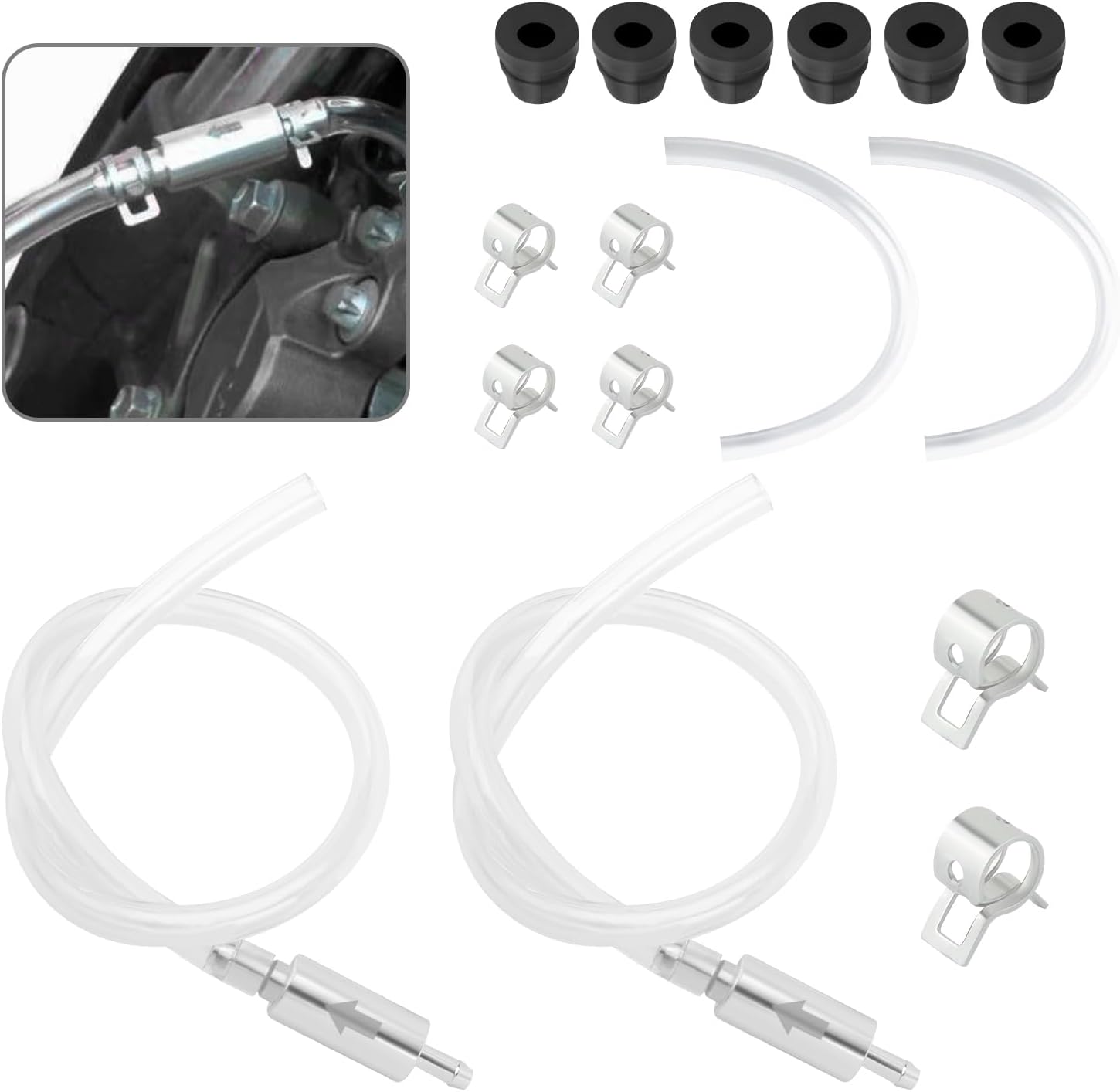
This brake bleeder kit helps make hydraulic brake bleeding easier on motorcycles, cars, and bikes with a simple one-way valve setup that helps prevent air and contamination from entering the system. It includes multiple hoses, clamps, and dust-proof screw caps for a cleaner, more controlled bleeding process. Durable rubber tubing and rust-resistant valves support repeated use and flexible installation around different brake layouts.

This universal brake bleeder kit makes one-person brake and clutch line bleeding simple by using compressed air to create stable vacuum-assisted fluid flow. Its extra-large 3L tank helps complete full-system flushes with fewer interruptions, while the included refill bottle, flexible hose, and universal adapter support clean, efficient use on standard and ABS brake systems.

This universal brake bleeding kit lets you flush brake, clutch, and other hydraulic systems by yourself with fast, efficient vacuum-assisted operation. Built with a durable aluminum alloy pump, silicone tubing, and secure fittings, it helps maintain a tight seal for cleaner, easier service. The included blow-molded case keeps every part organized for convenient storage and transport between jobs.
What Are the DOT 3 vs DOT 4 Differences?
The main DOT 3 vs DOT 4 difference is boiling-point performance. Under FMVSS 116, DOT 4 must meet higher minimum dry and wet boiling points than DOT 3. However, regular DOT 4 is not automatically a low-viscosity fluid, so a higher DOT number does not replace an exact DOT 4 LV requirement.
| Fluid type | Base family | Minimum dry boiling point | Minimum wet boiling point | Maximum viscosity at -40°C | Best fit |
|---|---|---|---|---|---|
| DOT 3 | Non-silicone, glycol-based | 401°F / 205°C | 284°F / 140°C | 1,500 mm²/s | Vehicles that specify DOT 3 |
| DOT 4 | Non-silicone, glycol-based | 446°F / 230°C | 311°F / 155°C | 1,800 mm²/s | Vehicles that specify DOT 4 and approved higher-heat use |
These are federal minimums from FMVSS 116, the U.S. motor-vehicle brake-fluid standard. A product may exceed them, but the bottle’s published performance does not override the grade and subtype required by the vehicle.
[Products Worth Considering]

The Mityvac MV8500 Silverline Elite is a versatile automotive service kit for brake and clutch bleeding, diesel fuel priming, and vacuum or pressure testing. Its dual-capability pump streamlines diagnostics and maintenance across motorcycles, cars, trucks, and SUVs, while the ergonomic design supports comfortable use during longer jobs. Built with a durable zinc-aluminum die-cast body and a 4.5oz fluid reservoir, it delivers reliable performance for professional and DIY repair work.
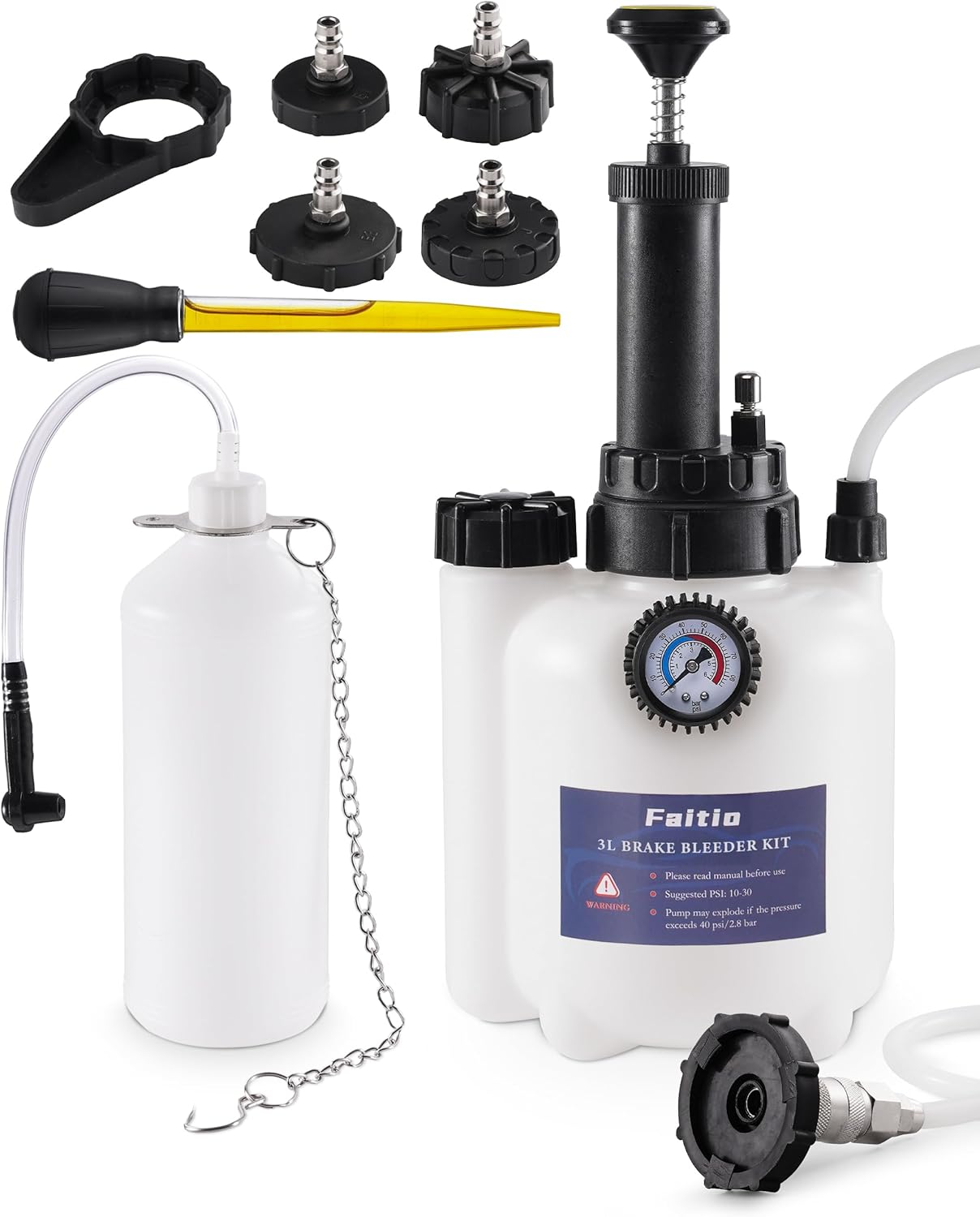
This one-man brake bleeding kit helps flush old brake fluid and remove trapped air for firmer, more responsive braking without the hassle of a second person. Its improved sealing and translucent catch bottle help prevent leaks while making fluid level checks easy during use. With multiple adapter sizes for many vehicle makes, it is a practical tool for clean, efficient brake system maintenance.

Mixes well with conventional fluids
Chemical Composition Differences
DOT 3 and DOT 4 are non-silicone, glycol-based brake-fluid categories. Their formulations and additive packages differ by product. FMVSS 116 sets performance, compatibility, labeling, and safety requirements rather than one universal chemical recipe for every fluid in a grade.
Do not confuse them with DOT 5, which is silicone-based and must not be added to a system designed for DOT 3 or DOT 4. DOT 5.1 is a non-silicone category despite the similar name. Use either only when the vehicle documentation permits it.
What Do Dry and Wet Boiling Points Mean?
Dry boiling point measures fresh fluid. Wet boiling point measures fluid after a controlled humidification procedure. In the NHTSA compliance test, the reference fluid reaches 3.70% ± 0.05% water by weight before the wet boiling-point result is measured. That laboratory condition creates a repeatable comparison between products; it is not a universal “replace at this exact moisture level” rule for every vehicle.
DOT 4’s federal minimum wet boiling point is 311°F, compared with 284°F for DOT 3. The 27°F difference is a minimum grade gap, not proof that every DOT 4 product is correct for every brake system.
How Does Moisture Affect DOT 3 and DOT 4?
Both DOT 3 and DOT 4 absorb moisture during service. As water content rises, boiling performance falls and corrosion protection can deteriorate. Under heavy braking, overheated fluid can form compressible vapor, which reduces hydraulic pressure and changes pedal feel.
Do not use color alone to measure moisture. New DOT 3, DOT 4, and non-silicone DOT 5.1 fluids must be colorless to amber under FMVSS 116, but used fluid can darken for several reasons. Follow the vehicle’s service schedule and use a vehicle-appropriate professional test when the schedule or symptoms call for inspection.
Note: A brake-fluid tester is a screening tool, not permission to ignore the manufacturer’s time-based schedule. Test method, fluid formulation, service history, and vehicle procedure all matter.
Can You Mix DOT 3 and DOT 4?
DOT 3 and DOT 4 are generally miscible because both are non-silicone, glycol-based fluids. FMVSS 116 also includes compatibility testing. However, chemical compatibility does not mean the mixture is an approved substitute. Adding DOT 3 to a DOT 4 system can lower the blend’s boiling-point margin, while mixing standard fluid into a DOT 4 LV system can also change low-temperature viscosity.
If the reservoir is below the minimum mark, first consider why. Pad wear can lower the reservoir level gradually, while a leak can make it drop unexpectedly. If the pedal is soft or sinking, a warning light is on, or fluid is visibly leaking, do not drive the vehicle. Towing is safer than trying to solve a brake-system fault with an improvised top-off.
If an emergency top-off is unavoidable, use only a fluid that the vehicle manufacturer permits and arrange a proper inspection and service as soon as possible. If DOT 3 has been added to a system that specifies DOT 4 or DOT 4 LV, restore the exact required specification using the factory-approved procedure.
Warning: Do not mix DOT 5 silicone brake fluid with DOT 3 or DOT 4. DOT 5 belongs to a different fluid family.
A low brake-fluid level can indicate worn brake pads or a leak. Inspect the brake system instead of repeatedly topping it off.
Which Vehicles and Driving Conditions Need DOT 3 vs DOT 4?
The vehicle specification decides the acceptable fluid family. Driving conditions then help you choose among the approved options. Brake heat rises with vehicle mass, speed, repeated stops, long downhill grades, towing, and performance use. Electronic brake controls can add a separate low-temperature viscosity requirement.
[Products Worth Considering]
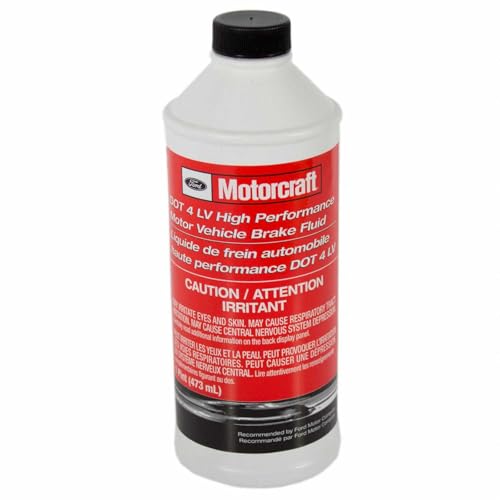
New low viscosity formulation, faster response at lower temperatures

Brake Fluid DOT 4 – Reliable Performance: STP Synthetic DOT 4 brake fluid is designed to help protect brake systems and support consistent braking performance in a wide range of driving conditions
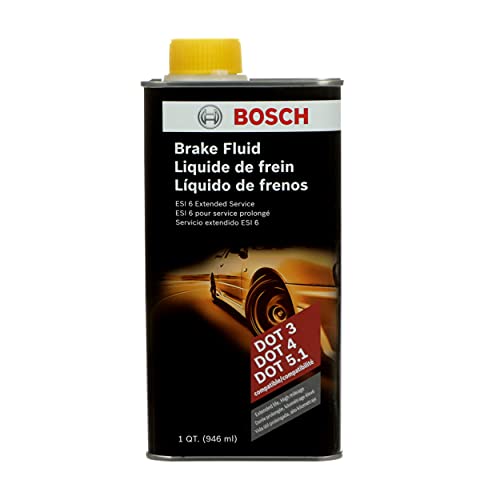
[NEXT GENERATION FLUID] - Bosch ESI6 is a next generation brake fluid designed for today's modern braking systems and is the first fluid to simultaneously combine both low viscosity and high wet boiling point (365 Degrees Fahrenheit)
What Is Best for Daily Commuting?
For a daily commuter that specifies DOT 3, DOT 3 is usually the correct choice. It meets the federal requirements for its grade and is suitable when the vehicle was designed and approved for it.
Use DOT 4 when the owner’s manual specifies it. Do not upgrade or downgrade by habit. The safest choice is the exact specification the brake-system seals, hydraulic unit, and service procedure were designed to use.
Does ABS Require DOT 4 or DOT 4 LV?
No. ABS alone does not determine whether a vehicle needs DOT 3, DOT 4, or DOT 4 LV. The reservoir cap and service information decide. Some newer vehicles specify low-viscosity fluid because ABS, ESC, traction-control, and electronic brake-force systems use fast hydraulic valves, especially in cold conditions.
Brembo recommends DOT 4 Low Viscosity for newer vehicles with electronic braking and stability systems such as ABS, ESP, ASR, TCS, and EBD. Treat that as product guidance, then confirm the exact requirement in your vehicle manual.
What Is Best for Performance and Track Use?
DOT 4 is a common starting category for higher-heat use when the vehicle approves it. Compare the product’s published dry and wet boiling points, not just the DOT label. A premium fluid can exceed the federal minimum by a wide margin.
Track use can require a shorter service interval and a vehicle-specific bleeding procedure. Follow the brake-fluid manufacturer’s instructions, the vehicle service manual, and the rules of the event or sanctioning body.
What Is Best for Towing and Mountain Driving?
Towing, hauling, and long downhill grades can put sustained heat into the brake system. Use the exact grade the vehicle requires. If the manufacturer approves more than one fluid, choose the approved option with adequate published wet boiling-point performance for the service.
Use engine braking where appropriate, avoid riding the brake pedal on long descents, and stay within the vehicle’s load limits. Brake fluid cannot compensate for overloaded brakes, worn pads, overheated rotors, or poor driving technique.
How Does Water in Brake Fluid Affect Braking?
Brake fluid transfers pedal force through hydraulic pressure. Liquid compresses very little, so a clean, full, properly bled system can transmit pressure consistently. Vapor compresses much more, which is why overheated or boiling fluid can make the pedal feel soft and reduce braking response.
Moisture lowers the fluid’s boiling point. During repeated heavy braking, fluid near the calipers can become hot enough to form vapor bubbles. Those bubbles compress when you press the pedal, increasing pedal travel and reducing the pressure delivered to the brakes.
Signs that need brake-system inspection include:
- Soft, spongy, or sinking brake pedal
- Brake fade after repeated stops
- Brake warning light or unexpectedly low fluid level
- Visible fluid leakage near a wheel, hose, line, master cylinder, or ABS unit
- Longer stopping distance or changing pedal feel under heat
- A pedal that feels abnormal after brake service
Warning: A soft or sinking pedal can also indicate air, a hydraulic leak, a failing master cylinder, or another mechanical fault. Do not assume a fluid change alone will fix it.
Pro Tip: Brake fluid begins absorbing moisture after the container is opened. Use fluid from a fresh sealed container and keep both the bottle and reservoir closed whenever you are not actively filling.
How Do You Check and Replace DOT 3 or DOT 4 Brake Fluid?
At a Glance
| Inspection | Check the required specification, reservoir level, visible condition, warning lights, and leaks. |
| Replacement difficulty | Varies by vehicle; some ABS systems require a scan tool and a factory bleed sequence. |
| Basic supplies | Correct fresh brake fluid, gloves, eye protection, clean lint-free rags, and the vehicle service procedure. |
| Stop condition | Do not drive if the pedal is soft or sinking, a leak is visible, or the brake warning remains on. |
A reservoir inspection is simple. A full flush is not always a basic DIY job. Letting the reservoir run dry, using the wrong bleed order, damaging a bleeder screw, or failing to cycle ABS valves can leave air in the system and reduce braking performance.
- Confirm the exact specification. Check the reservoir cap and owner’s or service manual for DOT 3, DOT 4, DOT 4 LV, DOT 5.1, or another stated requirement.
- Inspect the level without opening the cap unnecessarily. The fluid should be between the minimum and maximum marks. A low level needs diagnosis.
- Check for warning signs. Look for leaks, damaged hoses, wet calipers, a brake warning light, or abnormal pedal feel.
- Assess service history. Follow the manufacturer’s replacement schedule. Use a suitable professional test as supporting information, not as a replacement for the schedule.
- Use only fresh, correct fluid. Keep the container tightly closed and do not use fluid from an old open bottle.
- Follow the factory bleed procedure. Use the specified wheel order, pressure or vacuum limits, and scan-tool steps where required.
- Protect paint, eyes, and skin. Brake fluid can damage paint. Follow the product label and clean spills immediately using the stated procedure.
- Verify the repair before driving. The pedal must feel normal and the warning light must be off. If not, stop and have the system inspected.
Warning: Use a qualified technician if the vehicle requires an ABS scan-tool bleed, if bleeder screws are seized, or if the pedal feels abnormal after service. Brake-service errors can cause loss of stopping power.
Why Do Manufacturer Specifications Matter?
The best brake fluid is not simply the one with the highest DOT number. It is the product that meets the vehicle’s required grade, viscosity, and manufacturer approvals. A vehicle designed for DOT 3 may not gain a practical benefit from an unapproved change, while a vehicle that specifies DOT 4 or DOT 4 LV should not be downgraded.
The FMVSS 116 standard covers brake-fluid performance, compatibility, packaging, labeling, and safety warnings. It requires container warnings that tell users to follow the vehicle manufacturer’s recommendation and keep brake fluid clean and dry.
No single replacement interval applies to every vehicle. Follow the maintenance schedule for your model and market. Brembo generally recommends replacement after 2–3 years because moisture reduces boiling performance, but that supplier guidance does not override a different interval or inspection procedure from the vehicle manufacturer.
Common Brake Fluid Mistakes to Avoid
- Using DOT 3 in a DOT 4 or DOT 4 LV system for routine service: the fluid or blend may not meet the required boiling point or viscosity.
- Assuming ABS automatically requires DOT 4: ABS does not replace the cap or manual specification.
- Assuming all DOT 4 is low-viscosity: use DOT 4 LV only when that exact subtype is required or approved.
- Confusing DOT 5 with DOT 5.1: DOT 5 is silicone-based; DOT 5.1 is non-silicone.
- Using old opened fluid: opened glycol-based brake fluid absorbs moisture from air.
- Using color as the only service test: appearance cannot measure boiling point or confirm the cause of abnormal pedal feel.
- Ignoring a low level: low fluid can point to worn pads or a hydraulic leak.
- Getting fluid on paint: brake fluid can damage painted surfaces.
Frequently Asked Questions
Can I use DOT 3 instead of DOT 4?
Do not use DOT 3 as a routine substitute when the vehicle specifies DOT 4. DOT 3 has lower federal minimum dry and wet boiling points. If the system is low or the pedal feels abnormal, towing and diagnosis are safer than improvising. After an unavoidable emergency mix, inspect and restore the exact required fluid specification.
Can I use DOT 4 instead of DOT 3?
Only when the vehicle manufacturer or approved product documentation allows it. DOT 4 has higher minimum boiling points, but that does not automatically make every DOT 4 formulation correct for every DOT 3 system. Check the cap and manual first.
Is DOT 4 always better than DOT 3?
DOT 4 has higher federal minimum boiling points, but “better” depends on the required specification. DOT 3 can be the correct fluid for a vehicle designed for it. DOT 4 or DOT 4 LV is correct when the vehicle specifies or approves that exact fluid.
What is DOT 4 LV brake fluid?
DOT 4 LV means DOT 4 Low Viscosity. It is designed to flow more easily at low temperatures and may be specified for modern vehicles with ABS, stability control, traction control, and other electronic brake-control systems. Standard DOT 4 is not automatically DOT 4 LV.
Does ABS require DOT 4 brake fluid?
Not by itself. Vehicles with ABS can specify different brake-fluid grades and subtypes. Read the reservoir cap and service information. Some newer systems require DOT 4 LV because low-temperature viscosity affects electronic valve response.
What does wet boiling point mean?
Wet boiling point is a standardized laboratory result measured after controlled moisture exposure. In the NHTSA FMVSS 116 procedure, the reference fluid reaches 3.70% ± 0.05% water by weight before testing. It allows grade and product comparison, but it is not a universal field replacement threshold.
How often should DOT 3 or DOT 4 brake fluid be changed?
Follow the vehicle’s maintenance schedule. No universal interval fits every model. Climate, towing, track use, service history, and the manufacturer’s inspection method can change the timing. Some brake suppliers use 2–3 years as general guidance, but the vehicle schedule controls.
Why does old brake fluid make the pedal feel soft?
Moisture can lower the fluid’s boiling point. Under high heat, vapor bubbles can form and compress under pedal pressure, increasing pedal travel. A soft or sinking pedal can also indicate air, a leak, a master-cylinder fault, or another brake problem, so inspect the system before assuming fluid age is the only cause.
Conclusion
For DOT 3 vs DOT 4 brake fluid, the reservoir cap and owner’s manual decide the grade. DOT 4 has higher minimum boiling points, while DOT 4 LV adds a separate low-viscosity requirement for some electronic brake systems. Do not select fluid by DOT number, ABS presence, or driving style alone. Use fresh fluid that matches the exact specification, investigate low fluid or abnormal pedal feel, and follow the factory service procedure.
Sources
- eCFR — 49 CFR § 571.116, Standard No. 116; Motor Vehicle Brake Fluids — federal boiling-point minimums, viscosity limits, compatibility testing, labeling, color, and safety warnings.
- NHTSA — Laboratory Test Procedure for FMVSS 116 Motor Vehicle Brake Fluids — official dry and wet ERBP procedures, controlled humidification, pass/fail limits, and compliance testing.
- Brembo — Brake Fluid Solutions for Cars — manufacturer guidance on vehicle-manual selection, DOT 4 LV, electronic brake controls, and general replacement timing.
- Brembo Parts — Brake Fluid: When Changing It Saves the Whole Team — hygroscopic behavior, boiling-point decline, and handling cautions.