
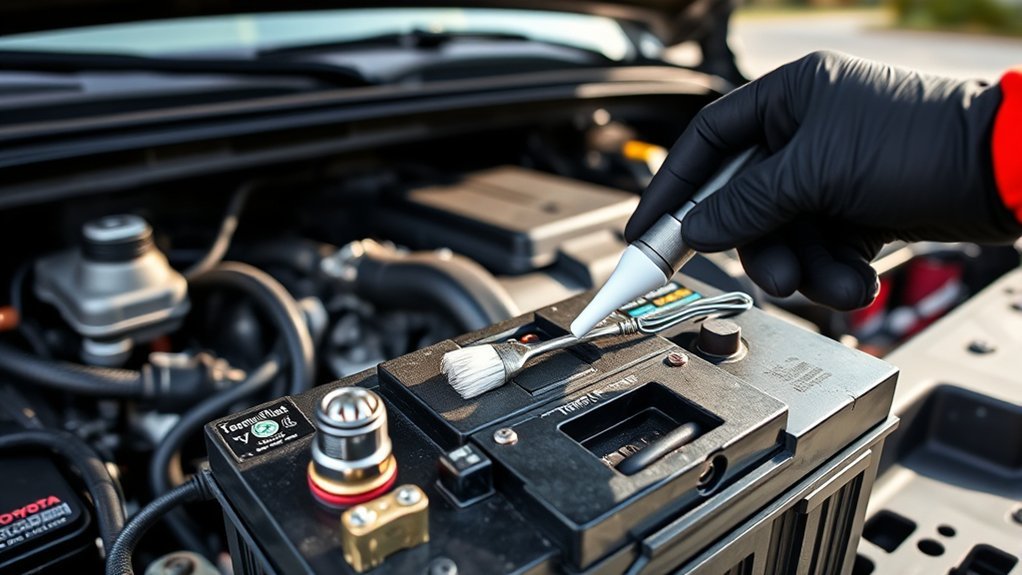
Toyota Tundra battery maintenance starts with four checks: keep the 12V battery secure and corrosion-free, confirm its state of charge, test whether it can supply cranking current, and investigate the charging system or key-off drain if it repeatedly goes flat. A rested lead-acid battery near 12.6V is generally well charged, but open-circuit voltage alone does not prove battery health. Battery access also differs by powertrain: Toyota’s 2025 instructions place the non-hybrid 12V battery in the right-rear of the engine compartment and the Tundra Hybrid 12V battery under the rear seat on the driver’s side. This guide covers the low-voltage 12V battery, not the hybrid traction battery.
Last updated: August 31, 2026 — charging-system ranges, current-generation battery location, source links, and troubleshooting scope rechecked.
Quick Answer
Inspect the battery during routine service and before temperature extremes, keep the terminals and hold-down clean and tight, and recharge before judging a battery that rests below about 12.4V. If cranking is slow, the truck needs repeated jumps, or the battery will not stay charged, use a proper conductance or load test. Toyota’s 5,000-mile/six-month schedule is a convenient inspection reminder, not a battery-specific replacement interval.
Key Takeaways
- Use Toyota’s 5,000-mile/six-month scheduled-maintenance cadence as a practical time for a visual battery check; it is not a universal battery replacement interval.
- Always disconnect the negative terminal first and reconnect it last to reduce short-circuit risk.
- A rested 12V lead-acid battery near 12.6V is generally well charged, but recharge a low battery before judging its health and use a load or conductance test when starting performance is weak.
- Do not use 13.8–14.4V at idle as a universal Tundra alternator pass/fail range; Toyota charging specifications and test conditions vary by model year and powertrain.
- Battery size, chemistry, location, and access vary by year, trim, start-stop system, and hybrid/non-hybrid model, so confirm fitment by VIN or owner’s manual before replacement.
At a Glance
| Time Required | Varies by battery access, corrosion, and whether you are inspecting, cleaning, or diagnosing a fault |
| Difficulty | Beginner for visual checks; intermediate for electrical testing |
| Tools Needed | Safety glasses, gloves, correctly sized wrench/socket, battery brush, approved cleaner or baking-soda paste, rags, multimeter, terminal protector |
| Cost | Varies by supplies, battery type, and local testing or service charges |
Warning: A 12V automotive battery can contain corrosive sulfuric acid and may release flammable hydrogen gas. Work in a ventilated area, wear eye protection and gloves, keep flames and sparks away, and do not service a cracked, swollen, leaking, frozen, or foul-smelling battery. On a Tundra Hybrid, disconnect only the 12V system as Toyota directs and do not touch orange high-voltage cables or hybrid components.
How this guide was checked: Maintenance timing and 12V safety guidance were cross-checked against Toyota owner and maintenance information; Toyota Genuine battery warranty terms were checked against current Toyota parts information; battery-life and roadside-call context was checked against AAA; and the load-test benchmark was checked against Discover Battery. This article does not claim hands-on testing on every Tundra model year or powertrain.
Where Is the 12V Battery on a Toyota Tundra?
Battery location depends on the truck. Toyota’s 2025 accessory instructions place the non-hybrid Tundra 12V battery at the right-rear of the engine compartment. On the 2025 Tundra Hybrid, the 12V battery is under the rear seat on the driver’s/left-hand side. The hybrid 12V battery is separate from the high-voltage traction battery.
| Configuration | 12V battery location | Service note |
|---|---|---|
| 2025 Tundra non-hybrid | Right-rear of engine compartment | Turn the truck fully off and follow the model-year disconnect procedure |
| 2025 Tundra Hybrid | Under rear seat, driver/left side | Service only the 12V battery; do not touch high-voltage components |
| Other model years | Varies by generation and configuration | Confirm with the owner’s manual, VIN, or Toyota parts/service information |
How to Safely Disconnect Your Tundra’s Battery
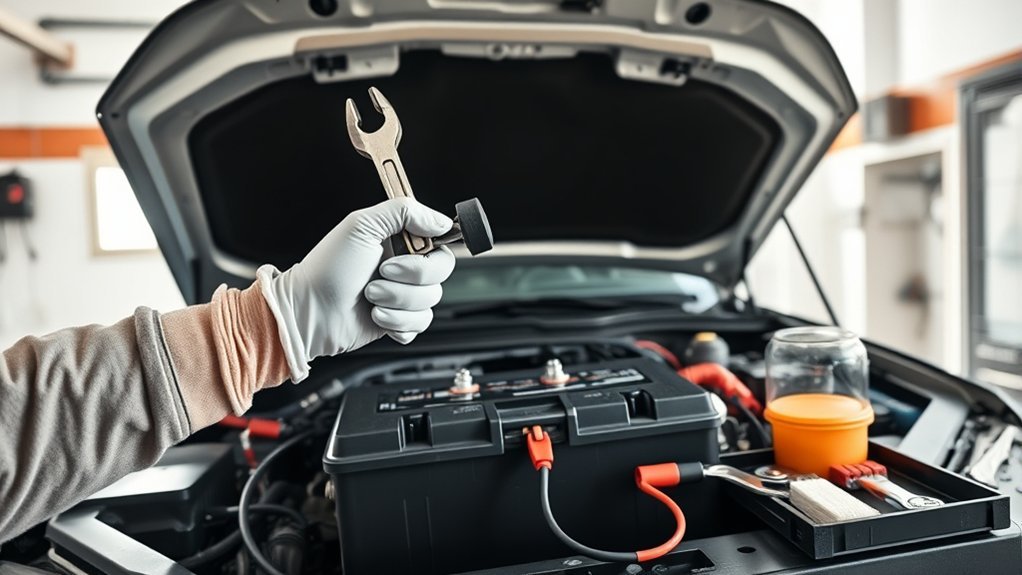
Before touching the terminals, park on a level surface, turn the truck off, remove the key or keep the smart key away from the cabin, and allow the electrical system to power down. Follow the access procedure for your exact model year; Toyota’s 2025 instructions use rear-seat access for the hybrid 12V battery and under-hood access for the non-hybrid battery.
Loosen the negative terminal first with the correctly sized wrench or socket. Toyota’s 2025 accessory procedure shows a 10mm negative-terminal nut, but confirm the hardware on your truck before turning it. The negative cable is marked with a minus sign (-). Removing it first reduces the chance of a short circuit if a tool touches body metal while you work near the positive side.
- Loosen the negative clamp and move the cable away from the battery post.
- Lift the positive terminal cover, then loosen and remove the positive clamp.
- Keep both cable ends from springing back onto the posts.
- Avoid placing tools across the battery terminals or between the positive terminal and body metal.
If a clamp is stuck, do not pry aggressively on the battery post. Use a battery-terminal puller or apply a small amount of penetrant only to the clamp hardware, then work it loose gently. Excess force can damage the post or crack the case.
Quick Visual Check: What to Inspect at a Glance
Check the battery during routine service, before long trips, and before temperature extremes. Toyota’s 2025 maintenance guide recommends scheduled maintenance every 5,000 miles or six months, whichever comes first. The guide does not make that a universal battery-replacement interval; use it as a convenient reminder to inspect the battery case, cables, terminals, and hold-down.
| What to check | What it means | What to do |
|---|---|---|
| White, green, or bluish crust on terminals | Corrosion can increase resistance and cause slow starts | Clean and protect the terminals |
| Loose clamps or moving battery | Vibration can shorten battery life and loosen connections | Tighten clamps and hold-down hardware |
| Swollen, cracked, wet, or leaking case | Battery may be unsafe or failing | Do not charge or jump it; replace professionally |
| Rotten-egg odor | Possible overcharging or internal battery failure | Stop driving if severe and have the charging system checked |
| Slow crank after sitting | Low charge, weak battery, poor cable connection, or parasitic drain | Test voltage, clean terminals, and load-test the battery |
Note: If your Tundra has a maintenance-free, AGM, or EFB battery, do not try to open sealed caps. If your older battery has removable caps, inspect electrolyte only if the owner’s manual allows it and you know how to handle battery acid safely.
How to Clean Corroded Battery Terminals
Corrosion is one of the easiest battery problems to fix, but the cleaning process must be done in the correct order. Use a dedicated battery terminal cleaner or a paste made from baking soda and water. Keep the cleaner out of battery cells and electrical connectors.
Tools You’ll Need
- Safety glasses and chemical-resistant gloves
- Correctly sized wrench or socket; Toyota’s 2025 procedure shows a 10mm negative-terminal nut
- Wire brush or battery terminal brush
- Battery cleaner or baking-soda-and-water paste
- Clean water, rags, and a small tray or towel to catch residue
- Battery terminal protector spray or felt washers
- Multimeter for a quick voltage check after cleaning
Step-by-Step Cleaning
- Turn the truck off and make sure all lights and accessories are off.
- Disconnect the negative terminal first, then disconnect the positive terminal.
- Apply cleaner to the corroded clamps and posts. Let it foam or sit briefly according to the product directions.
- Scrub the metal contact surfaces with a wire brush until the posts and clamps are clean.
- Wipe away residue, rinse lightly if needed, and dry the area completely. Do not leave moisture around terminals or connectors.
- Reconnect the positive terminal first, then reconnect the negative terminal.
- Tighten the clamps snugly so they do not rotate by hand, but do not over-tighten and damage the posts.
- Apply terminal protector after the connections are clean, dry, and tight.
Pro Tip: Take a photo before disconnecting anything. It gives you a quick reference for cable routing, terminal covers, and hold-down position during reassembly.
Reinstall Terminals Correctly to Prevent Problems
When reinstalling the cables, connect the positive terminal first and the negative terminal last. Make sure each clamp sits fully down on the battery post. A clamp that only grips the top of the post can create intermittent no-start problems, low-voltage warning lights, and charging issues.
- Confirm the positive terminal cover is back in place.
- Route cables away from sharp edges, hot components, and moving parts.
- Check that the hold-down bracket is secure so the battery cannot bounce or slide.
- Start the truck and look for warning lights or unusual idle behavior.
- After a short drive, recheck that the clamps are still tight.
Battery disconnection can require initialization or reset steps for some vehicle functions. Do not assume the same relearn procedure applies to every Tundra year or powertrain. After reconnection, follow the owner’s manual if a warning message appears or a feature does not operate normally, and use Toyota repair information if initialization is required.
What Voltage Should a Toyota Tundra Battery Read?
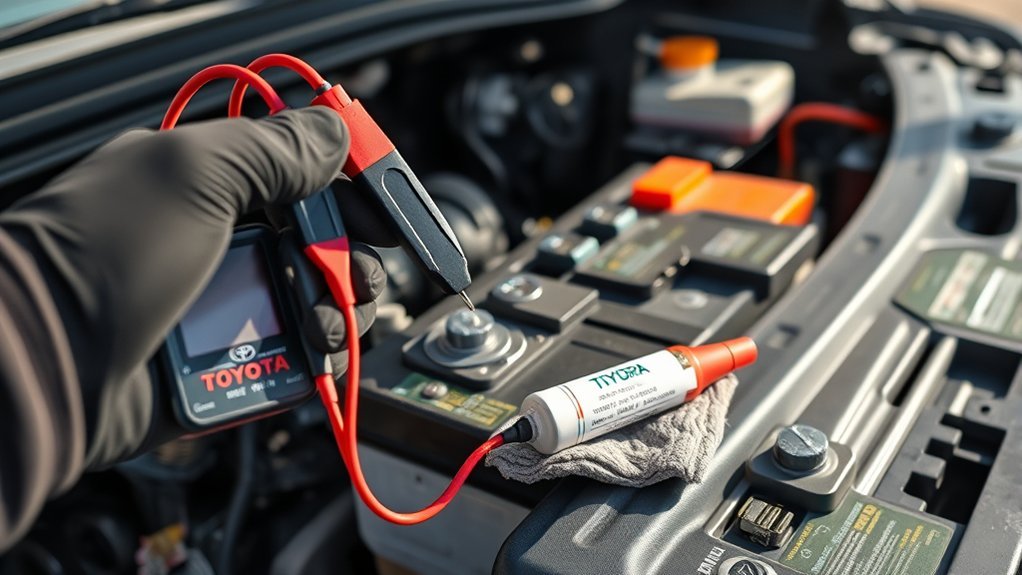
A multimeter tells you the battery’s state of charge, not its full health. A weak battery can show decent voltage at rest and still fail under starter load. For the most accurate result, charge the battery first if it is low, let surface charge settle, then test voltage and perform a professional load or conductance test.
[Products Worth Considering]

This Snap & Zap towing mirror set adds expanded rear visibility for safer towing on compatible Toyota Tundra and Sequoia models. The clip-on design installs easily with no tools or drilling, fits over the factory mirrors, and still allows the mirrors to fold without removal. It includes both driver and passenger side extensions and is molded to match the original mirror shape for a secure, OE-style fit.

This smart automatic battery charger and maintainer helps keep automotive batteries charged and ready by delivering a full charge before switching to float mode for long-term maintenance. It supports 6V and 12V batteries with broad compatibility for lead-acid, AGM, gel, and lithium types, while built-in safety features like reverse polarity detection and spark-proof connection help ensure reliable use. Compact construction, included connection cables, and indicator lights make it a convenient choice for cars, SUVs, trucks, and storage maintenance.

This battery terminal care kit helps clean corroded connections and protect them from future buildup, making routine maintenance simpler for cars, marine batteries, and RVs. It includes two dual-ended terminal cleaners plus color-coded anti-corrosion fiber washers for positive and negative terminals. The kit is compatible with top post and side terminal batteries and is designed for quick, practical cleaning and protection.
Resting Voltage Guide
| Resting voltage | General lead-acid reference | Next step |
|---|---|---|
| 12.6–12.8V | Generally well charged at rest | Continue routine checks; voltage alone does not prove capacity |
| 12.4–12.5V | Partly discharged | Recharge before judging battery health |
| 12.2–12.3V | Low state of charge | Recharge, let surface charge settle, then retest |
| Below 12.2V | Significantly discharged | Recharge safely; if it will not recover or hold charge, perform a proper battery test |
Toyota-specific point: A generic state-of-charge chart is not the same as Toyota’s model-year service specification. Toyota repair information for 2022–2024 gasoline Tundras checks battery voltage after removing surface charge and lists 12.3V or higher at 20°C (68°F) as the standard for that procedure. Use the repair information for your exact year and powertrain.
How to Check Voltage With a Multimeter
- Turn the truck off and let it sit long enough for surface charge to settle.
- Set the multimeter to DC volts.
- Touch the red probe to the positive terminal and the black probe to the negative terminal.
- Record the reading with the date and mileage.
- Start the engine and check charging voltage at the terminals if you suspect alternator trouble.
What Charging Voltage Is Normal on a Tundra?
Do not use 13.8–14.4V at idle as a universal alternator pass/fail rule. Toyota repair information for 2022–2024 gasoline Tundras checks the charging circuit at 2,000 rpm and lists 12.7–15.3V as the standard voltage under that procedure. Other years and hybrid systems can use different strategies and specifications. If the battery warning light is on or charging seems abnormal, use the model-year test procedure and inspect the generator/alternator circuit, wiring, grounds, fuses, and battery-state sensing before replacing parts.
Load-Test Basics
A load test checks whether the battery can hold voltage while supplying high current. Discover Battery’s published procedure uses a 15-second test at one-half of the battery’s CCA rating and calls for voltage to stabilize above 9.6V. Temperature, tester type, battery rating, battery chemistry, and state of charge affect interpretation, so follow the tester and battery manufacturer’s procedure. If the battery is low, recharge it first; if it cranks slowly after charging or repeatedly loses charge, have it tested with a proper conductance or load tester.
Warning: Do not load-test, jump-start, or charge a visibly damaged, leaking, swollen, or frozen battery. Replace it safely instead.
How Can You Tell If a Tundra Battery Is Dying?
A weak battery can look like a starter, charging, ground, or electronics problem. Use the symptoms below to choose the next test before replacing parts. If the truck will not crank or start at all, use the dedicated Tundra no-start troubleshooting checklist so battery maintenance does not turn into guesswork.
| Symptom | Likely cause | Next check |
|---|---|---|
| Slow engine crank | Weak battery, dirty terminals, poor ground, or starter draw | Clean terminals, check resting voltage, then load-test |
| Clicking when starting | Low current to starter or starter/relay issue | Battery load test and starter voltage-drop test |
| Dim lights at idle | Charging system weakness or poor connections | Alternator output and cable inspection |
| Battery warning light | Charging system fault, not always the battery itself | Test alternator, belt, wiring, and battery condition |
| Dead after sitting overnight | Weak battery or parasitic drain | Charge/load-test battery, then test key-off current draw |
Slow Engine Crank
A slow crank is one of the most common early signs of a weak battery. It is especially noticeable after the truck sits for a day or two, during cold starts, or in extreme heat. Start with the simple checks: corrosion, loose clamps, loose hold-down hardware, and resting voltage.
If resting voltage looks reasonable but cranking is still slow, test battery capacity and inspect loaded voltage drop in the starter and ground circuits. A worn starter or high-resistance cable can mimic a bad battery; the Tundra no-start guide covers the deeper starter-circuit path.
Dashboard Warning Lights
A battery-shaped warning light usually points to the charging system, not necessarily a dead battery. The alternator, belt, wiring, battery sensor, or ground connection may be the real cause. Do not ignore the light; continued driving with a charging fault can drain the battery and leave the truck unable to restart.
Electrical Accessory Failure
Slow power windows, flickering interior lights, weak headlights, infotainment glitches, and random accessory resets can all happen when voltage is low or unstable. Check the battery first, then inspect grounds, charging voltage, and aftermarket accessories such as light bars, winches, dash cams, audio amplifiers, or trailer-brake wiring.
When to Replace: Toyota TrueStart vs. Aftermarket Batteries
AAA says conventional car batteries commonly last about 3–5 years, but heat, vibration, frequent short trips, long storage, deep discharges, and corrosion can shorten that life. Once a battery reaches about three years, testing becomes more useful than age alone. Replace it sooner if it fails the correct battery test, needs repeated jumps, swells, leaks, or cannot hold a charge.
Toyota TrueStart batteries are Toyota Genuine replacement batteries. Toyota’s current warranty information lists 24 months of free exchange, followed by prorated coverage for the battery for up to 84 months. That is more precise than treating “84 months” as 84 months of full free replacement. A quality aftermarket battery can also work, but it must match the truck’s required size, chemistry, capacity, terminal layout, and venting.
| Replacement factor | What to verify |
|---|---|
| Battery size/group | Match the correct BCI/LN size for your year, engine, trim, and start-stop/hybrid system |
| Chemistry | Use the required flooded, EFB, or AGM type; do not downgrade a start-stop battery |
| CCA and reserve capacity | Meet or exceed Toyota’s specified cold-cranking amps and reserve capacity |
| Terminal layout and venting | Make sure posts, vent tube provisions, and cable reach match the original layout |
| Hold-down fit | Battery must clamp securely without movement |
Note: Toyota’s replacement battery charts show different Tundra battery applications across older V8 models, 2022+ trucks, hybrid models, and start-stop models. Use your VIN, owner’s manual, existing battery label, or a Toyota parts counter to confirm fitment before buying.
[Products Worth Considering]

This battery terminal maintenance kit helps remove corrosion fast and adds ongoing protection for cleaner, more reliable electrical connections. The dual-ended brushes restore terminal contact surfaces while the color-coded anti-corrosion washers help prevent future buildup on cars, trucks, RVs, boats, and other 6V or 12V batteries.

This battery terminal cleaner kit helps remove corrosion, dirt, and debris from automotive and marine battery terminals for better electrical contact and easier starting. It includes dual-head cleaning brushes and fiber washers that help protect terminals from acid damage while supporting longer battery life. Designed for cars, trucks, vans, and boats, it is a practical maintenance tool for keeping battery connections clean and reliable.

This battery terminal cleaning and repair kit helps restore worn or damaged top-post battery connections for cars, RVs, boats, and other vehicles. It includes lead shims for improving fit, stainless steel brushes for removing corrosion and debris, and fiber washers to help reduce future buildup and maintain a reliable electrical connection.
Preventive Battery Protection: Terminal Spray, Washers, and Smart Chargers
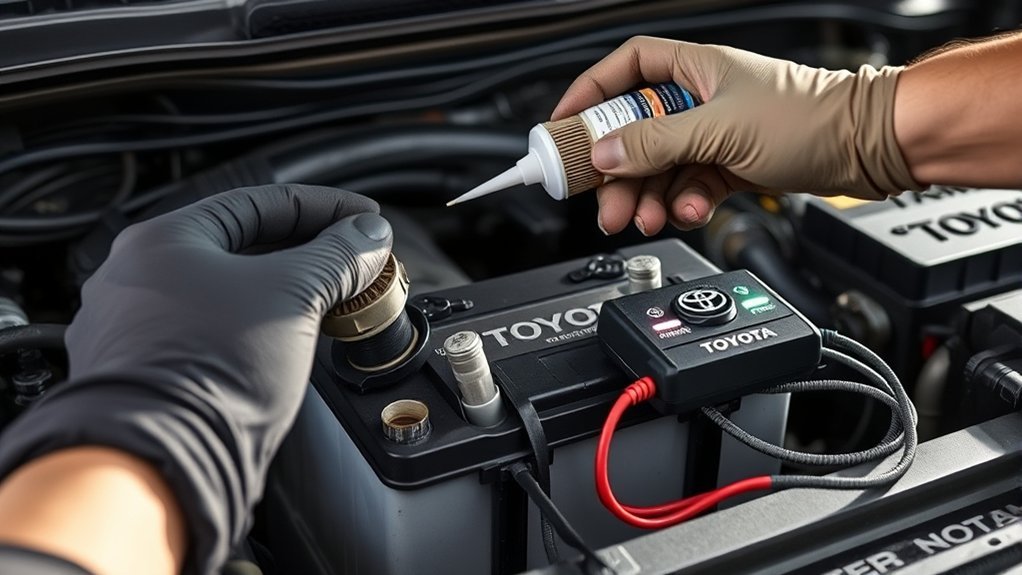
Moisture, road salt, heat, and vibration are hard on a truck battery. After cleaning the terminals, use preventive protection to slow future corrosion and keep voltage stable.
- Terminal protector spray: Apply after the terminals are clean, dry, and tightened.
- Felt washers: Install around the posts if they fit your battery style and terminal design.
- Smart maintainer: Use a battery maintainer if the truck sits for weeks at a time.
- Better cable routing: Replace cracked, stiff, or corroded battery cables instead of repeatedly cleaning them.
- Secure hold-down: A tight hold-down reduces vibration, which can shorten battery life.
For stored trucks, a smart maintainer is usually better than repeated jump-starting. Choose a charger/maintainer that matches your battery chemistry, especially if your Tundra uses an AGM or EFB battery.
[Products Worth Considering]

The TOPDON BT100 helps you quickly check the health and charge status of 12V lead-acid batteries with clear analytical results, including state of health, state of charge, voltage, and cranking performance. It supports a wide range of battery types and vehicles, making it a practical tool for diagnosing starting and charging issues at home or in the shop. Compact and easy to use, it provides fast, reliable testing without needing to charge the device first.

The V500 Pro is an all-in-one automotive electrical diagnostic tool that combines circuit testing, wire tracing, oscilloscope analysis, multimeter functions, injector testing, relay and fuse checks, and component activation in one device. It helps technicians and DIY users quickly find open circuits, short circuits, broken wires, and current leaks while reducing disassembly and guesswork. With a rotating screen, built-in flashlight, and adjustable low-voltage power supply, it is designed to speed up troubleshooting in tight and low-light work areas.

These battery terminal anti-corrosion washers help protect battery connections from buildup and extend battery life in 6V and 12V systems. The set includes color-coded red and green rings for easy positive and negative identification, plus a removable inner ring to fit larger terminals when needed.
When the Battery Is Not the Problem
If a new or fully charged battery keeps going dead, the fault may be charging, wiring, a starter circuit problem, or a key-off electrical drain. Keep this maintenance page focused on first-line checks; for the full isolation sequence, use the Tundra battery-keeps-dying diagnostic guide before replacing another battery.
Alternator Output Testing
Measure charging voltage only under the test conditions specified for your model year. On 2022–2024 gasoline Tundras, Toyota repair information checks the circuit at 2,000 rpm and uses 12.7–15.3V under that procedure. A single idle reading outside a generic 13.8–14.4V range is not enough to condemn the generator/alternator.
If charging is suspect, inspect the drive belt where applicable, major power and ground connections, fuses, wiring, and battery-state sensing. Follow the exact repair-manual test before replacing the generator/alternator.
Starter and Wiring Inspection
A failing starter can draw too much current and make a good battery look weak. If the battery passes a load test but the truck still cranks slowly, inspect:
- Battery ground cable and body/engine ground straps
- Positive cable to the starter
- Starter relay and solenoid behavior
- Voltage drop while cranking
- Heat damage, loose terminals, or green corrosion inside cable ends
Parasitic Drain Diagnosis
A parasitic drain is current draw that continues after the truck is shut off. Some key-off draw is normal because alarms, memory circuits, and control modules remain active or take time to sleep. That is why an immediate current reading or a universal milliamp threshold can be misleading on a modern truck.
- Fully charge and test the 12V battery before chasing a drain.
- Turn off accessories and let the truck’s modules enter sleep mode before measuring key-off current.
- Use a suitable clamp meter or connect an ammeter in series only if you understand the meter’s current limits and the vehicle procedure.
- Do not crank the truck or wake high-current loads through a meter connected in series.
Common drain sources include interior lights, aftermarket electronics, trailer wiring, stuck relays, dash cams, audio equipment, and modules that do not enter sleep mode. The dedicated Tundra battery-drain guide covers fuse isolation and deeper testing without making this maintenance article compete for the same search intent.
Twice-Yearly Maintenance Checklist: Every 6 Months or 5,000 Miles
Use this checklist during your regular service interval, before harsh weather, and before a long towing or road trip.
| Task | Pass condition |
|---|---|
| Inspect terminals | Clean, tight, and free of heavy corrosion |
| Inspect case | No swelling, cracks, leaks, or odor |
| Check hold-down | Battery cannot slide or bounce |
| Measure resting voltage | About 12.6–12.8V when fully charged |
| Check charging system | Meets the Toyota test specification for the exact model year and powertrain; do not use a universal idle-voltage cutoff |
| Review age | Test annually after year three; plan replacement near years three to five if performance drops |
| Record results | Write date, mileage, voltage, cleaning, and symptoms in a maintenance log |
AAA reported roughly 7 million battery-related roadside calls in the United States in 2024, making battery care one of the simplest ways to reduce no-start surprises.
What to Do If Your Tundra Sits Unused
If your Tundra sits for weeks, the 12V battery can discharge even when nothing appears to be on. Security systems, keyless-entry modules, memory circuits, and aftermarket electronics can all contribute to key-off draw. If the battery repeatedly goes flat despite being fully charged and tested, use the Tundra battery-drain diagnosis rather than assuming storage alone is the cause.
- Use a smart battery maintainer matched to the battery type.
- Drive long enough for the charging system to recover the battery; short idle sessions may not be enough.
- Unplug accessories from always-on power outlets.
- Keep the smart key away from the vehicle to reduce wake-up activity.
- If disconnecting the battery for storage, check your owner’s manual first because some systems may need initialization afterward.
Battery Recycling and Disposal
Do not put an automotive battery in household trash. Lead-acid batteries are recyclable and contain hazardous materials. Return the old battery to a Toyota dealer, auto-parts store, service shop, or approved battery recycler. Many retailers also charge a refundable core fee to encourage proper recycling.
Frequently Asked Questions
How long should a Toyota Tundra battery last?
Most Toyota Tundra 12V batteries last about 3–5 years. Hot climates, frequent short trips, off-road vibration, long storage, deep discharges, corrosion, and high accessory loads can shorten that life. Test the battery at least annually after the three-year mark.
How do I keep my Tundra battery healthy?
Keep the terminals clean and tight, secure the hold-down, avoid deep discharges, use a smart maintainer when the truck sits, test voltage before extreme weather, and replace the battery with the correct size and chemistry when it fails a proper battery test or can no longer hold charge.
What voltage should a Toyota Tundra battery read?
A well-charged conventional 12V lead-acid battery commonly rests near 12.6V, but open-circuit voltage alone does not prove battery health. Around 12.4–12.5V usually indicates partial discharge, while lower readings call for charging before further diagnosis. Toyota service thresholds and charging-system test ranges vary by model year and powertrain, so use the exact Toyota procedure for the truck.
How do I prevent my Tundra battery from dying when not in use?
Use a smart battery maintainer matched to the battery chemistry, unplug unnecessary accessories, keep the smart key away from the truck, and make sure lights are off. If the battery still dies after sitting, fully charge and test it before diagnosing a parasitic drain from modules, relays, trailer wiring, or aftermarket electronics.
Can I replace a Toyota Tundra battery myself?
Many non-hybrid Tundra owners can replace the 12V battery with basic tools, but the replacement must match the required size, chemistry, capacity, terminal layout, and venting. Hybrid and start-stop configurations may have additional access or battery requirements, so follow the owner’s manual for the exact truck or use a qualified service provider if you are unsure.
Why does my Tundra battery keep dying after I replaced it?
If a new battery keeps dying, look beyond the battery. Common causes include a charging-system fault, loose or corroded cables, poor grounds, a starter-circuit problem, parasitic drain, aftermarket accessories, trailer wiring faults, or a battery that is not the correct type for the truck.
Where is the 12V battery on a Tundra Hybrid?
Toyota’s 2025 instructions place the Tundra Hybrid 12V battery under the rear seat on the driver’s/left-hand side. It is separate from the high-voltage traction battery. Battery access varies by model year, so follow the owner’s manual for your exact truck and do not service orange high-voltage components.
Is 13.8–14.4V always the correct Tundra charging voltage?
No. Charging strategy and test conditions vary by model year and powertrain. Toyota repair information for 2022–2024 gasoline Tundras checks the charging circuit at 2,000 rpm and lists 12.7–15.3V under that procedure. Use the exact Toyota service specification for your truck instead of judging the alternator from one generic idle-voltage range.
Conclusion
Good Toyota Tundra battery maintenance comes down to condition, connections, and correct testing. Use Toyota’s routine service cadence as an inspection reminder, keep corrosion and looseness from adding resistance, recharge a low battery before judging it, and use a capacity test when cranking performance is weak. Match any replacement to the exact year and powertrain, and use model-specific charging specifications instead of a generic alternator-voltage rule. If a healthy battery still goes flat, move to the Tundra battery-drain diagnostic guide; if the truck will not crank or start, use the Tundra no-start checklist.
Sources
- Toyota Owners — 2025 Tundra Hybrid 12-volt battery — battery location, hydrogen-gas warning, recharging precautions, and terminal inspection points.
- Toyota Owners — Tundra discharged battery procedure — battery-disconnection safety guidance.
- Toyota Tundra/Sequoia 2025 accessory installation instructions — non-hybrid and hybrid 12V battery locations.
- Toyota 2025 Tundra Warranty & Maintenance Guide — 5,000-mile/six-month scheduled-maintenance cadence and general-maintenance guidance.
- Toyota 2025–2026 TrueStart Batteries guide — 84-month warranty structure and replacement-battery information.
- Toyota Auto Parts — TrueStart 12V Battery Limited Warranty — 24-month free exchange and prorated coverage up to 84 months.
- Toyota Tundra service-manual mirror — gasoline charging-system on-vehicle inspection — 12.3V battery check and 12.7–15.3V charging-circuit procedure for 2022–2024 gasoline trucks.
- AAA Automotive — How long do car batteries last? — typical 3–5-year automotive battery life and heat/vibration context.
- AAA Newsroom — 2024 roadside service calls — approximately 7 million battery-related roadside calls.
- Discover Battery — Load testing your battery — 15-second, one-half-CCA, 9.6V load-test guidance.



[…] Clean and tighten the terminals, then measure voltage drop while the circuit is loaded. A connection can look clean and still develop enough resistance to stop the starter. For preventive care, see the Tundra battery maintenance guide. […]