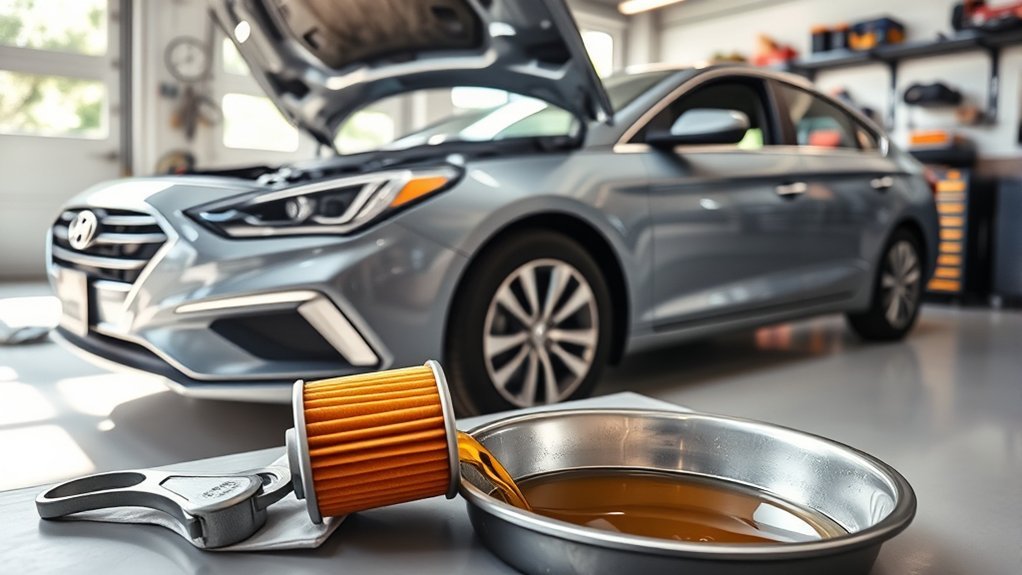
Changing your Hyundai Sonata’s oil and filter is one of the most useful maintenance jobs you can do yourself, but the details matter. Oil capacity, viscosity, filter fitment, and service interval vary by model year and engine, so this guide focuses on practical Sonata oil-change steps while calling out the current 2026 gas-engine specs where they apply.
Quick Answer
For a 2026 gas Hyundai Sonata, current owner-manual data lists about 6.13 U.S. quarts (5.8 L) with a filter change. The Smartstream 2.5L GDI uses full synthetic SAE 0W-20, while the 2.5L turbo GDI uses full synthetic SAE 0W-30. Always confirm by engine, VIN, oil cap, and owner’s manual before filling.
Key Takeaways
- Use the oil viscosity and specification listed for your exact Sonata engine, not a generic Sonata chart.
- Replace the oil filter every time you change the oil.
- Support the vehicle with ramps or jack stands; never work under a car held only by a hydraulic jack.
- After refilling, check for leaks, verify the dipstick level, reset the oil-life reminder, and record the service.
- Recycle used oil and the drained oil filter through an approved collection center.
At a Glance
| Time Required | 30–60 minutes for a careful DIY oil and filter change |
| Difficulty | Beginner to moderate |
| Tools Needed | Drain-plug socket, ratchet, oil-filter wrench, drain pan, funnel, gloves, rags, ramps or jack stands, and a torque wrench if available |
| Cost | Varies by oil brand, filter choice, local prices, and whether you already own tools |
Why Regular Oil and Filter Changes Matter

Engine oil lubricates moving parts, helps control heat, carries contaminants to the filter, and protects internal engine surfaces. As oil ages, it becomes contaminated and its protective additives wear down. That is why Hyundai tells owners to follow the vehicle’s maintenance schedule and to service the oil and filter more often when the car is used in severe conditions.
Good oil maintenance can help protect fuel economy, reduce engine wear, and preserve warranty documentation. It also gives you a chance to inspect for leaks, damaged underbody panels, loose fasteners, and low fluid levels before small issues become expensive repairs.
Note: This guide is for general Sonata oil-change help and highlights 2026 gas Sonata specs. Hybrid models, older Sonata engines, and non-U.S. market vehicles may use different oil capacities, filters, and intervals. Confirm the final spec in the Hyundai owner’s manual for your exact vehicle.
Best Oil Type for a Hyundai Sonata Oil Change
The best oil is the oil that matches your Sonata’s engine, viscosity, and performance specification. For current 2026 gas Sonata models, use full synthetic oil that meets the required API or ILSAC category. Look for the certification information on the bottle, and compare it with the oil cap and owner’s manual before pouring.
| Sonata Engine | Oil Capacity With Filter | Recommended Oil | Oil Standard |
|---|---|---|---|
| 2026 Smartstream G2.5 GDI | About 6.13 U.S. qt. / 5.8 L | Full synthetic SAE 0W-20 | API SN PLUS/SP or ILSAC GF-6 |
| 2026 Smartstream G2.5 T-GDI | About 6.13 U.S. qt. / 5.8 L | Full synthetic SAE 0W-30 | API SN PLUS/SP or ILSAC GF-6 |
| Older Sonata or Sonata Hybrid | Varies by engine | Varies by model year and engine | Check the owner’s manual, oil cap, and VIN-specific parts data |
[Products Worth Considering]

6X better wear protection on critical engine parts than industry standards**

3X Stronger than the leading full synthetic*

Advanced protection against the four main causes of engine breakdown: wear friction heat and deposits
Recommended Oil Viscosity Grades
Oil viscosity is not one-size-fits-all. A 2026 Sonata with the naturally aspirated 2.5L engine and a 2026 Sonata N Line with the turbocharged 2.5L engine do not use the same viscosity. Using the wrong viscosity can reduce protection, affect cold-start lubrication, or create warranty problems if the oil does not meet Hyundai’s specification.
Before buying oil, check three places: the oil filler cap, the owner’s manual, and the oil bottle’s certification label. The American Petroleum Institute explains the current API and ILSAC gasoline-engine oil categories, including API SP and ILSAC GF-6.
Synthetic vs. Conventional Oils
For 2026 gas Sonata engines, choose full synthetic oil that meets the required API or ILSAC standard. Conventional or semi-synthetic oil may be cheaper, but it may not meet the current specification for your engine. If your manual requires full synthetic, treat that as the baseline, not an upgrade.
| Oil Type | Best Use | Sonata Guidance |
|---|---|---|
| Full synthetic | Modern engines, high heat, cold starts, turbo engines, longer manufacturer intervals | Recommended for current 2026 gas-engine specs when it meets the required grade |
| Synthetic blend | Some older vehicles where the manual allows it | Do not use for 2026 gas Sonata unless your manual specifically allows it |
| Conventional | Older engines with older specifications | Not the right default for modern Sonata engines that require full synthetic |
Manufacturer Specifications Compliance
Do not shop by viscosity alone. The bottle also needs the correct oil category, such as API SN PLUS/SP or ILSAC GF-6 when your manual calls for it. Also use a quality oil filter that matches your Sonata by VIN, engine, and model year. A filter that physically screws on is not automatically the correct filter.
Pro Tip: Buy one extra quart beyond the listed capacity. Add the final amount slowly and use the dipstick to finish the level. This helps prevent overfilling.
How to Change Oil in Your 2026 Sonata: A Step-by-Step Guide
Before you start, park on a level surface and gather everything you need. A careful oil change is not just “drain and fill.” The job includes safe lifting, replacing the filter, replacing the drain-plug washer if equipped, checking for leaks, confirming the final dipstick level, and resetting the oil reminder.
Gathering Your Oil Change Tools: What You Need
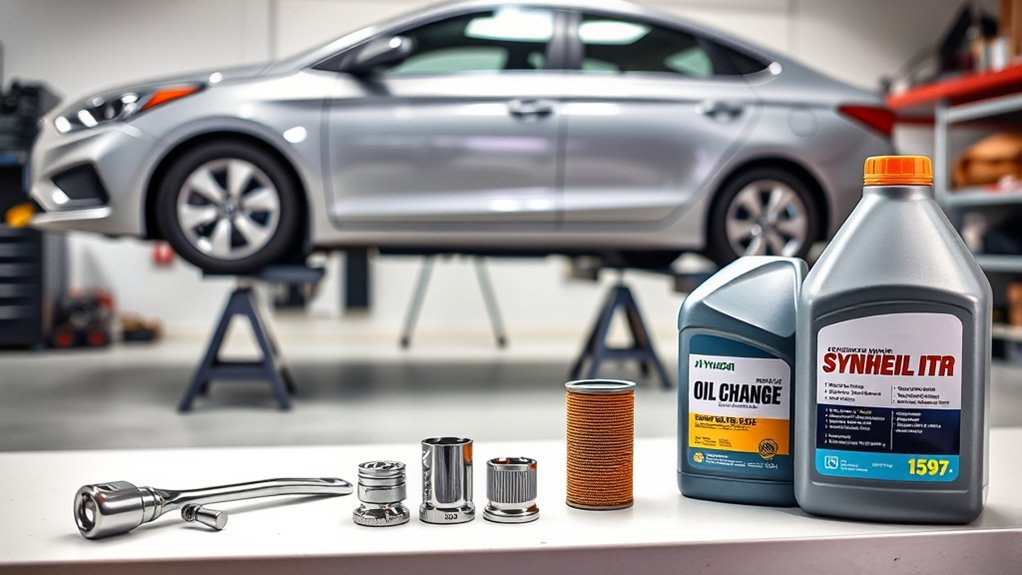
- Correct full synthetic oil: Use the viscosity and specification for your exact engine.
- Correct oil filter: Use an OEM or high-quality filter matched by VIN, engine, and model year.
- Drain-plug socket and ratchet: Many Sonata drain plugs use a metric socket, but confirm the size before starting.
- Oil-filter wrench: Helpful if the filter is tight or hard to grip.
- Oil drain pan: Choose one that holds more than the full oil capacity.
- Funnel: Prevents spills while refilling.
- New drain-plug washer or crush washer: Replace it if your vehicle uses one.
- Ramps or jack stands: Use them on solid, level ground.
- Gloves, eye protection, and rags: Used oil can irritate skin and make surfaces slippery.
- Torque wrench: Best for tightening the drain plug to the specification in service data or the owner’s manual.
Warning: Never work under a vehicle supported only by a hydraulic jack. Use ramps or properly rated jack stands on a solid, level surface. Let the oil cool enough to avoid burns, and wash your hands after handling used oil.
[Products Worth Considering]

Spill-Free and Hands-Free: This unique threaded funnel can be directly screwed into the engine oil cap thread, eliminating oil leakage and drips. You no longer need to hold the funnel by hand as you can easily invert the oil canister into the funnel, freeing up your hands for a more convenient operation

No More Messy Oil Filter Changes: Orion Motor Tech's 10pc oil filter wrench set helps you remove and install oil filter caps quickly and easily with a 3/8" drive rachet wrench and 9 oil cap sockets in the most commonly needed sizes (24, 27, 29, 30, 32, 36, 38, 64, & 64.5 mm)

Complete Oil Filter Solution: Orion Motor Tech’s 9pc oil filter wrench set includes 4 swivel-handle steel band wrenches (2-3/4" to 5-1/4"), 9" and 12" adjustable pliers, a 3-jaw wrench, and a 64mm socket for easy oil changes at home or in the shop
Step-by-Step: Oil Drain and Replacement
- Warm the engine briefly, then shut it off. Warm oil drains more easily, but it should not be scalding hot. Let it cool if the car was just driven hard.
- Park on level ground. Set the parking brake. If you lift the car, support it securely with ramps or jack stands.
- Open the hood and remove the oil fill cap. This helps the oil drain smoothly and reminds you not to start the engine during service.
- Position the drain pan. Place it under the drain plug with enough room for the oil stream to move as pressure drops.
- Remove the drain plug. Use the correct socket and keep your hand clear of the oil stream.
- Let the oil drain completely. Wait until the stream slows to an occasional drip.
- Inspect the drain plug and washer. Replace the crush washer or gasket if equipped. Clean the plug threads.
- Reinstall the drain plug. Thread it by hand first to avoid cross-threading, then tighten to the correct specification. Do not overtighten.
- Remove the old oil filter. Keep the drain pan underneath because more oil will spill from the filter area.
- Check the old filter gasket. Make sure it did not stick to the engine. A double-gasketed filter can cause a major leak.
- Prep the new filter. Lightly coat the new rubber gasket with fresh oil. Install the filter according to the filter instructions, usually hand-tight plus the specified additional turn.
- Add fresh oil. Pour in slightly less than the listed capacity at first. For a 2026 gas Sonata, that means starting below the 6.13-quart figure, then topping off carefully.
- Reinstall the oil fill cap. Start the engine and let it idle for 30–60 seconds while checking underneath for leaks.
- Shut the engine off and wait a few minutes. Let oil drain back into the pan, then check the dipstick on level ground.
- Top off only as needed. Add oil in small amounts until the level is between the dipstick marks. Do not overfill.
- Reset the oil-life reminder. Use the infotainment or vehicle settings menu as described in your owner’s manual.
- Record the service. Note the date, mileage, oil type, oil quantity, filter used, and any leaks or issues found.
Common Mistakes to Avoid During an Oil Change
Most DIY oil-change problems come from rushing. Take your time and check each step before moving on.
Skipping Oil Filter Replacement
Do not leave the old filter in place. The filter traps debris, sludge, and wear particles. Reusing it sends fresh oil through a dirty filter and can reduce oil flow if the filter is restricted.
Using Incorrect Oil Type
Do not assume all Sonata engines use the same oil. A 2026 2.5L GDI and a 2026 2.5L turbo GDI use different viscosity grades. Older Sonata engines and hybrids may differ again. Always verify the specification before buying oil.
Overlooking Drain Plug Tightness
A loose drain plug can leak, while an overtightened drain plug can strip threads or damage the oil pan. Start the plug by hand, replace the washer if required, and tighten to the proper specification.
Overfilling the Engine
Too much oil can cause foaming, leaks, and pressure-related problems. Add the last quart slowly and rely on the dipstick, not just the number printed in a chart.
Forgetting the Oil-Life Reset
If your Sonata has an Oil Life Management System or oil-change reminder, reset it after the oil and filter are changed. Otherwise, the reminder may show an inaccurate remaining oil life.
Why Frequency Matters: How Often Should You Change Your Oil?

Follow the maintenance schedule for your exact Sonata, and change oil sooner if your driving counts as severe use. Hyundai notes that repeated short trips, long idling, dusty roads, heavy traffic, mountain driving, towing, rapid acceleration, stop-and-go driving, and using oil that does not meet the recommended specification can require more frequent service.
Hyundai also explains that driving habits can make more frequent oil changes appropriate, and that owners should check the manual for the correct grade, viscosity, and frequency. You can also use Hyundai’s official maintenance schedule tool and oil-change guidance from Hyundai Owners.
The right interval is not just a mileage number. It depends on oil specification, driving conditions, engine type, and whether the vehicle’s oil-life system calls for service sooner.
Essential Tips for Keeping Your Sonata’s Engine Running Smoothly
- Check the oil level regularly. Do this on level ground after the engine has been off for a few minutes.
- Use the correct oil specification. Match viscosity and API/ILSAC category, not just brand preference.
- Replace the filter every time. A fresh filter helps keep contaminants out of circulation.
- Watch for leaks. Check the drain plug, filter area, and underbody after the first short drive.
- Keep records. Receipts and mileage logs help with maintenance planning and resale confidence.
Troubleshooting After a Sonata Oil Change
| Problem | Likely Cause | What to Do |
|---|---|---|
| Oil dripping after service | Loose drain plug, damaged washer, loose filter, or double gasket | Shut the engine off, inspect safely, correct the leak, and recheck the level. |
| Oil level above full mark | Overfilled crankcase | Drain a small amount or have a technician correct it before driving far. |
| Oil light stays on | Low oil pressure, low level, wrong filter, or mechanical issue | Stop the engine immediately and diagnose before driving. |
| Burning oil smell | Oil spilled on exhaust or an active leak | Wipe spills once cool and inspect for leaks. |
| Reminder still shows service due | Oil-life reminder was not reset | Reset it through the vehicle settings menu according to the owner’s manual. |
How to Dispose of Used Oil and Filter
Pour used oil into a clean, sealed container and take it to a recycling center, auto-parts store, service shop, or municipal collection site that accepts used motor oil. Do not pour oil on the ground, into a drain, or into household trash. The U.S. Environmental Protection Agency explains that used oil can be re-refined, processed into fuel oils, or reused as petroleum-industry feedstock.
Drain the old oil filter according to local rules and recycle it where accepted. Many oil collection centers accept drained filters along with used oil.
Where to Find More Sonata Maintenance Resources
For the most reliable Sonata maintenance information, start with your vehicle’s owner’s manual, oil cap, VIN-specific parts lookup, and Hyundai dealer service department. The Hyundai digital owner’s manual is the best place to confirm oil type, capacity, warning-light behavior, and oil-life reset instructions for your exact vehicle.
Use online videos only as visual support. A video may show the same general process, but the oil quantity, drain-plug location, filter style, underbody panels, and torque specs may differ by year and engine.
Frequently Asked Questions
How often does a Hyundai Sonata need an oil change?
Follow the maintenance schedule and oil-life reminder for your exact Sonata. Severe use, such as frequent short trips, heavy traffic, dusty roads, mountain driving, long idling, or towing, can require more frequent oil and filter changes.
What does an oil and filter change include?
A complete oil and filter change includes draining the old oil, replacing the drain-plug washer if required, installing a new oil filter, refilling with the correct oil, checking for leaks, verifying the dipstick level, resetting the oil-life reminder, and recycling the used oil and filter.
How many quarts of oil do I need to change the oil and filter on a 2026 Hyundai Sonata?
Current 2026 gas Sonata owner-manual data lists about 6.13 U.S. quarts, or 5.8 liters, with a filter change for both the Smartstream G2.5 GDI and G2.5 T-GDI engines. Add slightly less at first, then top off carefully using the dipstick.
How many quarts of oil do I need to change the oil and filter on a 2019 Hyundai Sonata?
A 2019 Sonata oil capacity depends on the engine. Many 2019 2.4L models are commonly listed around 5.1 quarts with the filter, while other engines can differ. Check the 2019 owner’s manual, oil cap, and VIN-specific parts data before filling.
Can I use 5W-30 in a 2026 Hyundai Sonata?
Do not use 5W-30 in a 2026 Sonata unless the owner’s manual for your exact engine and market allows it. Current 2026 gas-engine data points to SAE 0W-20 for the 2.5L GDI and SAE 0W-30 for the 2.5L turbo GDI.
Do I have to use a Hyundai oil filter?
You should use an OEM Hyundai filter or a high-quality aftermarket filter that is specifically matched to your Sonata by VIN, engine, and model year. Correct fit, bypass-valve behavior, gasket size, and filtration quality matter.
Conclusion
A Hyundai Sonata oil and filter change is a manageable DIY job when you use the correct engine-specific oil, replace the filter, lift the vehicle safely, and finish with leak checks and a dipstick verification. For 2026 gas Sonata models, do not rely on older generic Sonata oil charts. Confirm the oil viscosity, capacity, and filter by engine and owner’s manual, then document the service so your maintenance history stays clean.
Sources
- Hyundai Digital Owner’s Manual — vehicle-specific oil specifications, oil-life reset guidance, and maintenance instructions
- Hyundai USA Maintenance Schedule — official maintenance schedule lookup
- Hyundai Owners Oil Change Guidance — oil-change frequency and severe-use considerations
- American Petroleum Institute Oil Categories — API SP and ILSAC GF-6 oil-standard information
- U.S. EPA Used Oil Recycling — used motor oil and oil filter recycling guidance