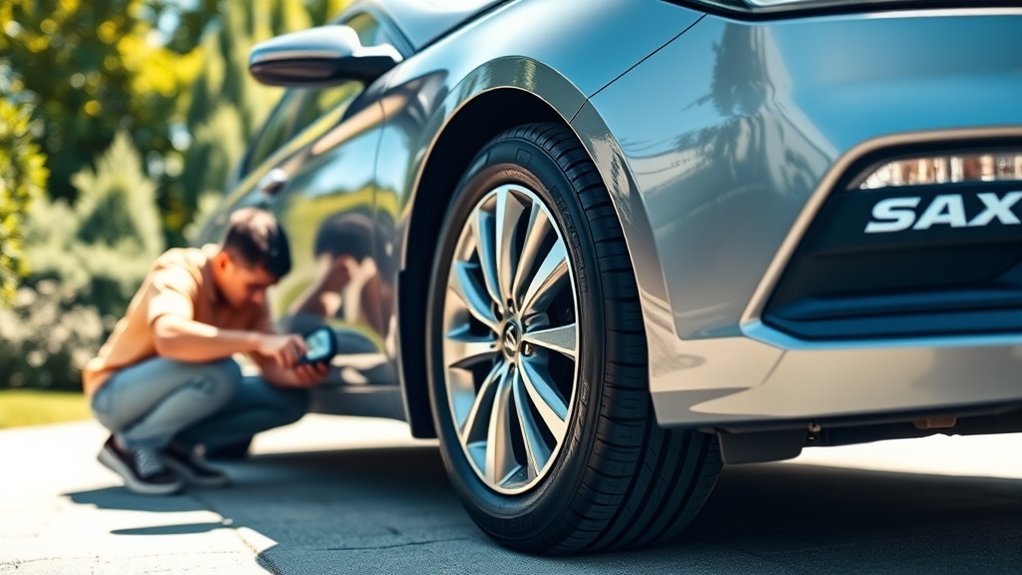
Keeping the tires on your Hyundai Sonata at the right pressure helps the car ride, brake, handle, and wear its tires the way Hyundai intended. The safest starting point is not the number printed on the tire sidewall. Use the tire and loading information label on the driver-side center pillar, then confirm the pressure with a quality tire gauge while the tires are cold.
Quick Answer
To check Hyundai Sonata tire pressure, find the recommended cold PSI on the driver-side center-pillar label, check each tire with a gauge before driving, add or release air as needed, then use the TPMS display to confirm readings after a few minutes of driving. Reset TPMS only when your Sonata’s manual or cluster menu instructs you to.
Key Takeaways
- Use the PSI on the Sonata’s tire label, not the maximum PSI printed on the tire sidewall.
- Check pressure when tires are cold: before driving, after the car has been parked for about 3 hours, or after driving less than 1 mile.
- The TPMS display is helpful, but a manual tire gauge is still the best way to set exact pressure.
- A low-pressure warning means you should slow down, avoid hard braking or sharp turns, and check all four tires as soon as it is safe.
- If the TPMS light flashes or stays on after correct inflation, the system may need a proper reset or professional diagnosis.
At a Glance
| Time Required | 5–10 minutes |
| Difficulty | Easy |
| Tools Needed | Tire pressure gauge, air pump or compressor, valve caps |
| Cost | Usually free to a few dollars if using a gas-station air pump |
Why Tire Pressure Matters for Your Hyundai Sonata
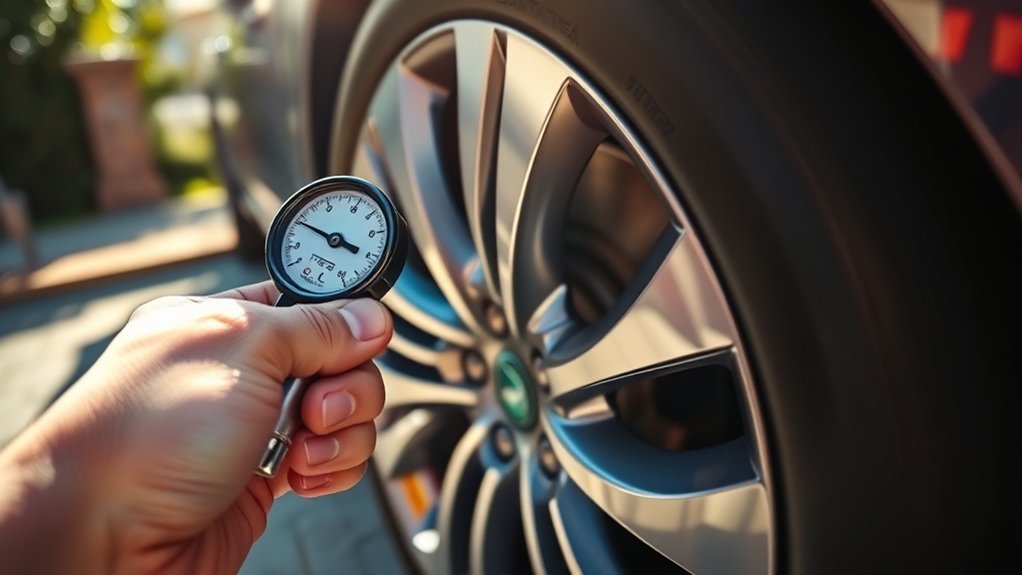
Correct tire pressure helps your Sonata keep stable contact with the road. That affects braking, steering response, ride comfort, tread wear, and fuel use. Underinflated tires flex more than they should, which builds heat and can shorten tire life. Overinflated tires can wear faster in the center of the tread and may make the ride harsher.
Fuel economy is another reason to stay on top of inflation. FuelEconomy.gov says proper tire inflation can improve gas mileage by 0.6% on average and up to 3% in some cases. It also notes that underinflated tires can reduce gas mileage by about 0.2% for every 1 PSI drop in the average pressure of all tires.
Your Sonata’s Tire Pressure Monitoring System (TPMS) is a backup warning system, not a replacement for routine checks. TPMS usually warns only after a tire is significantly low, so a tire can be a few PSI under the recommended pressure before you see a warning light.
Find the Correct PSI Before You Add Air
The correct tire pressure for your Hyundai Sonata is listed on the tire and loading information label. On Hyundai vehicles, this label is located on the driver’s side center pillar and gives the recommended tire pressures for the vehicle’s original tire setup. You can also confirm the value in the owner’s manual for your model year.
Warning: Do not inflate your Sonata’s tires to the maximum PSI printed on the tire sidewall unless the vehicle label or owner’s manual specifically calls for it. The sidewall number is the tire’s maximum pressure rating, not the vehicle’s recommended cold tire pressure.
If your Sonata has replacement tires in a different size than the original label lists, ask a Hyundai dealer or tire professional for the correct pressure. The original placard is still your starting point, but non-original tire sizes may require confirmation.
[Products Worth Considering]

This smart color coded tire tread depth gauge makes it easy to check tread wear at a glance with clear red, yellow, and green ranges. Calibrated from 0 to 1 inch in 1/32 inch increments, it helps you quickly assess tire condition for safer driving and timely replacements. The pocket clip design makes it convenient to carry and use on trucks, motorcycles, cars, and other passenger vehicles.
These custom-fit floor mats and cargo liner are designed for select Toyota 4Runner models and provide full-coverage protection for your interior. Made from durable TPE material with raised edges and non-slip buckles, they help contain dirt, spills, snow, and debris while staying securely in place. The waterproof design is easy to clean, making them a practical all-weather upgrade for everyday driving.

The AICEL TPMS Relearn Tool helps quickly reset and relearn tire pressure sensors on compatible GM vehicles after tire rotation, sensor replacement, or warning light issues. Designed for easy handheld use, it works with most cars, SUVs, and pickup trucks and can save time by eliminating unnecessary trips to the auto store. Its durable ABS housing and simple activation process make it a practical tool for keeping the tire pressure monitoring system operating properly.
How to Check and Adjust Tire Pressure
For the most accurate reading, check tire pressure when the tires are cold. Hyundai defines a cold tire as one that has not been driven for about 3 hours or has been driven less than 1 mile. Hot tires read higher because driving warms the air inside the tire.
- Park on level ground. Check the tires before driving whenever possible.
- Find the recommended PSI. Use the label on the driver-side center pillar.
- Remove the valve cap. Keep it in your hand or pocket so it does not roll away.
- Press the gauge firmly onto the valve stem. A brief hiss is normal, but a long hiss means the gauge is not sealed properly.
- Compare the reading to the label. Add air if the tire is low. Release air if it is over the recommended pressure.
- Recheck after each adjustment. Small changes matter, especially when a tire is only 1–3 PSI off.
- Reinstall the valve cap. A missing cap can let dirt or moisture into the valve core and contribute to air loss.
- Repeat for all four tires. Check the spare too if your Sonata is equipped with one.
If you use a gas-station air pump, set the pump to the target PSI if it has a digital preset. If the pump has a built-in gauge, still confirm with your own gauge when possible because public pumps can be inaccurate or heavily used.
Pro Tip: Keep a small digital or pencil-style tire gauge in the glove box. The TPMS display is helpful, but Hyundai notes that displayed values may differ from a manual gauge reading.
[Products Worth Considering]

The MOTOPOWER MP0514A makes it easy to check battery and charging system health with simple plug-and-test operation. Its digital LCD display and LED indicators provide clear voltage readings and alternator status, while built-in reverse connection and over-voltage protection help support safe use. Compact and portable, it is a practical tool for drivers and mechanics who want quick, reliable diagnostics.
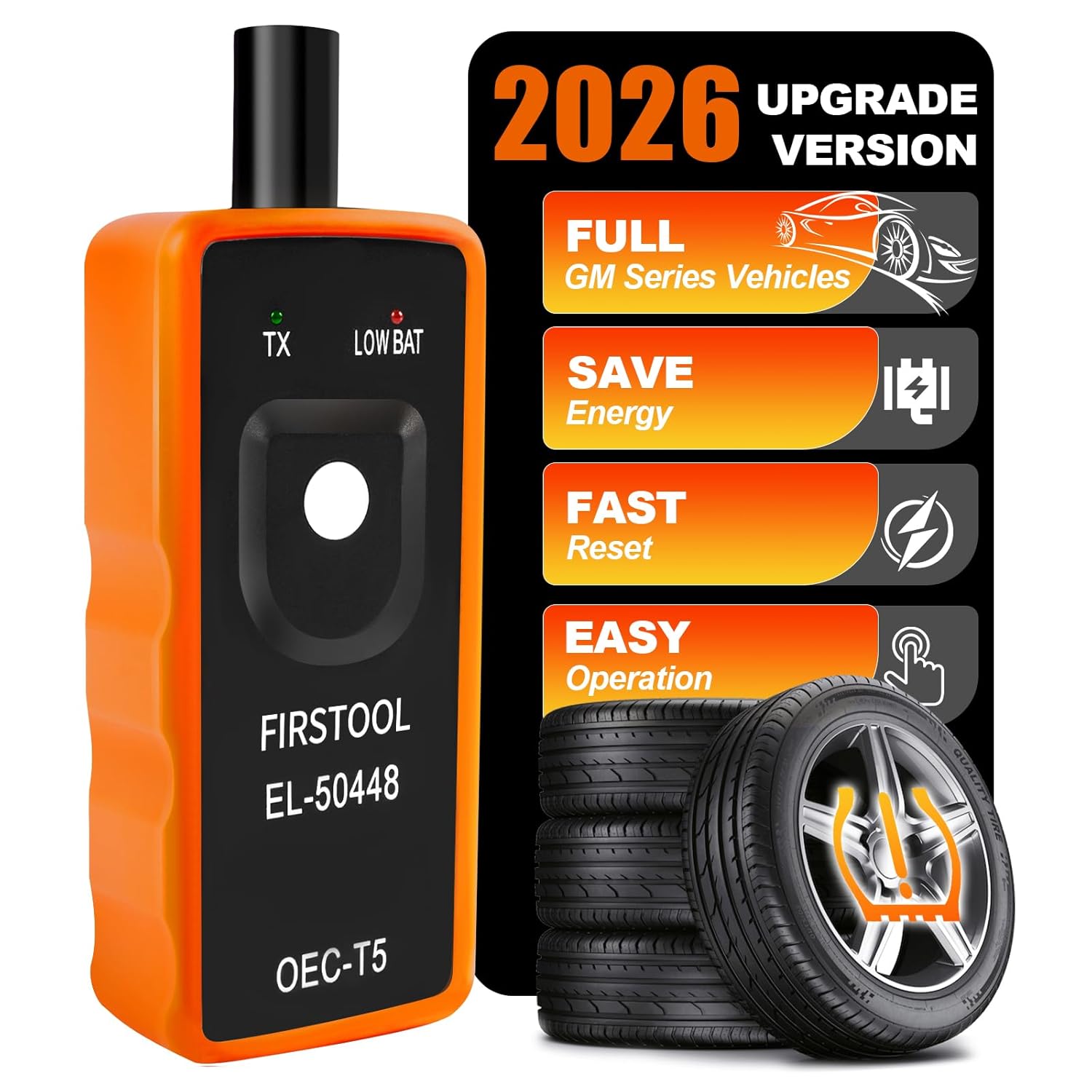
This EL-50448 TPMS relearn tool helps quickly activate and reset tire pressure sensors so your vehicle’s monitoring system stays accurate after tire rotations, sensor replacement, or seasonal tire changes. Designed for many GM-related vehicles and compatible with common 315 and 433 MHz TPMS systems, it offers simple one-button operation and reliable performance for clearing warning lights and relearning sensor positions.
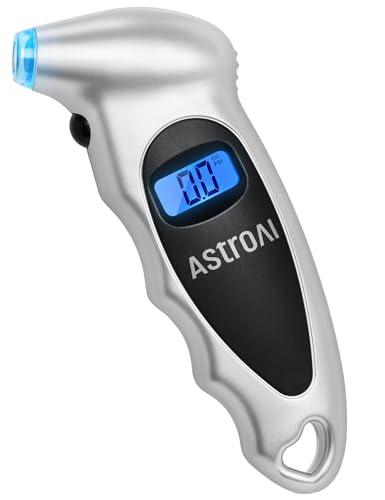
Accurate, Dependable Readings: Factory‑calibrated to ±1 PSI, so you can confidently match your vehicle’s recommended PSI (check the door jamb sticker). Ideal for monthly checks and road trips — consistent results every time, cold or warm.
How Your Hyundai’s Tire Pressure Monitoring System Works
Your Sonata’s TPMS monitors tire pressure and warns you when one or more tires are significantly underinflated. On many Sonata models, you can also view tire pressures in the Utility view mode on the instrument cluster.
After a few minutes of driving, the tire pressure values should appear on the cluster display. If the car is stopped and the system has not gathered a current reading yet, you may see a “Drive to display” message. This is normal; the sensors need driving time before the display updates.
To view or change the tire pressure unit, use the infotainment settings. Hyundai’s current menu path is typically Setup > General > Unit > Tire Pressure Unit > psi/kPa/bar. Menu wording can change after infotainment software updates, so check your owner’s manual or the infotainment user guide if the path looks different.
[Products Worth Considering]

QUALITY - Designed for long service life under harsh conditions,high-Strength materials used for long, trouble-free service life, designed and manufactured to meet or exceed OE performance in compliance with all SAE2657 specifications

[VEHICLE FITMENT]: Compatible with Hyundai Creta 2021-2024, For Elantra N 2022-2024, Nexo 2019-2024, Palisade 2020-2024, Santa Fe 2019-2024, Santa Fe Sport 2018-2022, Sonata 2015-2019, Tucson 2016-2021; Compatible with Kia EV6 2022-2024, EV9 2023-2024, K900 2019-2023, Niro 2023-2024, Sedona 2019-2021, Telluride 2019-2024; Compatible with Genesis GV60 2022-2024
Responding to Low-Pressure Alerts
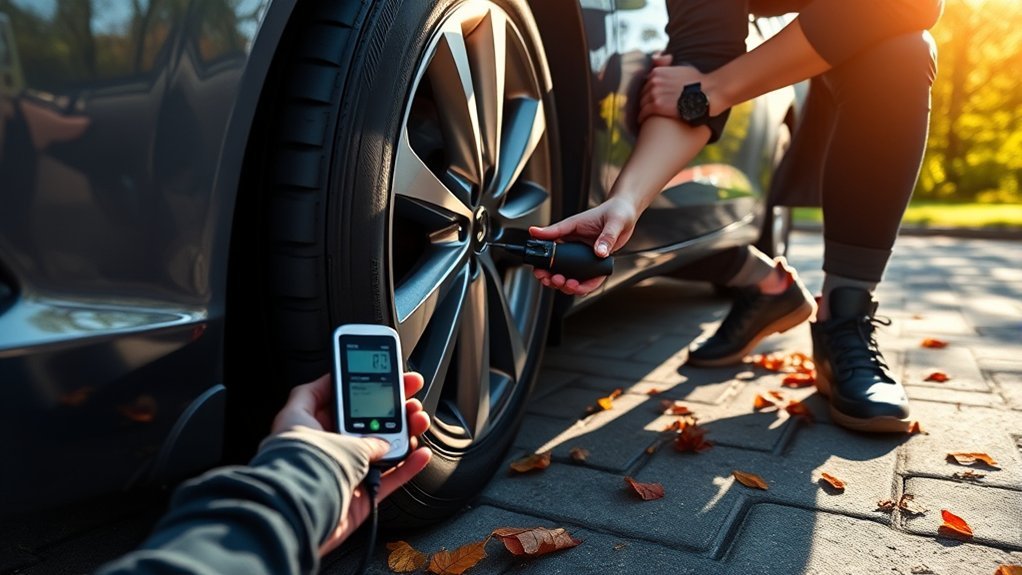
When the low-pressure warning light comes on, slow down and avoid hard cornering, sudden braking, and aggressive acceleration. Find a safe place to stop and inspect the tires. If one tire looks flat, shredded, bulged, or damaged, do not keep driving on it. Use roadside assistance, a spare tire if equipped and safe to use, or a tire repair service.
If the tires look safe, check all four pressures with a gauge and inflate each tire to the recommended cold pressure from the vehicle label. The affected tire may not look low by eye, so do not rely on appearance alone.
Note: A TPMS warning after a cold night often means the air pressure dropped with the temperature. AAA notes that tire pressure changes by about 1 PSI for every 10°F change in temperature.
How to Reset Your TPMS After Adjusting Tire Pressure
TPMS reset steps vary by Sonata model year and equipment, so use your owner’s manual as the final authority. For applicable Hyundai systems with a cluster reset menu, the process is usually:
- Inflate all four tires to the recommended cold tire pressure.
- Park the vehicle safely.
- Use the steering-wheel controls to open the tire pressure screen in the cluster.
- Select Tire Pressure using the up/down controls.
- Press and hold OK, then select Set if prompted.
- Confirm the warning light blinks for about 4 seconds or that the cluster confirms the pressures were stored.
Reset TPMS after adjusting tire pressure, rotating tires, repairing or replacing a tire or wheel, or when your owner’s manual instructs you to do so. If your Sonata does not show this menu, do not search blindly for a hidden button. Check the model-year manual or contact a Hyundai dealer.
Warning: Do not reset TPMS to silence a warning before correcting tire pressure. Resetting at the wrong pressure can make the system less useful and may delay the next warning.
Changing Tire Pressure Units in Your Infotainment System
You can display Sonata tire pressure in psi, kPa, or bar. In the U.S., psi is the most familiar unit and matches most tire gauges. To change the unit, open the infotainment system and look for:
Setup > General > Unit > Tire Pressure Unit > psi/kPa/bar
| Unit | Best For | Note |
|---|---|---|
| psi | Most U.S. drivers | Matches most U.S. tire gauges and placards. |
| kPa | Metric pressure readings | Common in many markets outside the U.S. |
| bar | European-style pressure readings | Less common for U.S. vehicle labels. |
If your infotainment system was recently updated and the unit changed, return to the same settings area and select your preferred unit again.
Tire Pressure Maintenance Tips for Year-Round Safety
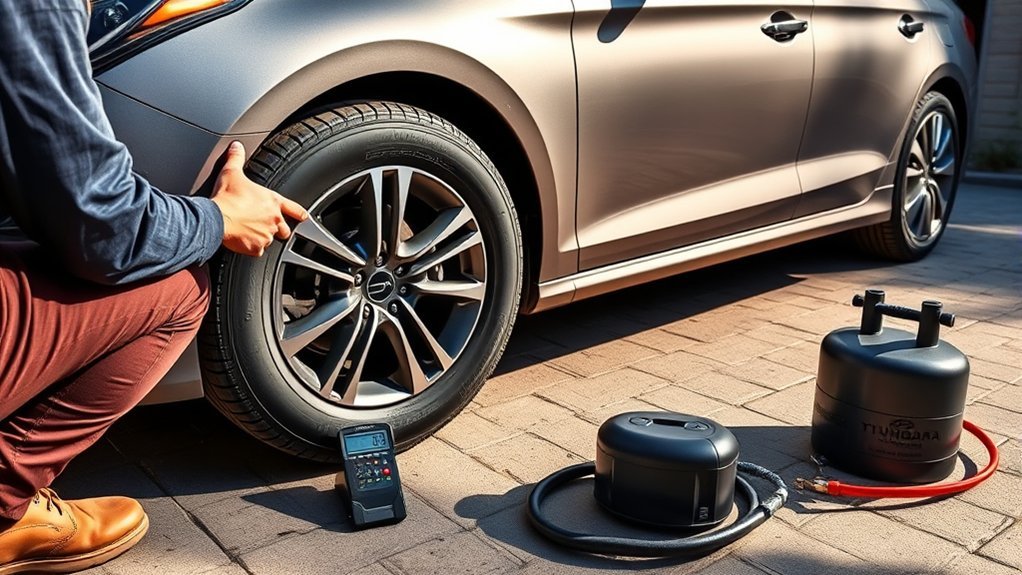
Check your Sonata’s tire pressure at least once a month and before long trips. Also check it after big temperature swings, especially in fall and winter. A tire that was correct on a warm afternoon may be low after a cold night.
Do not bleed air from a hot tire just because the display or gauge reads slightly high after driving. Heat from driving temporarily raises pressure. Let the tires cool, then check again against the cold PSI on the vehicle label.
A monthly tire-pressure check takes only a few minutes, but it can improve tire life, fuel economy, ride quality, and safety.
Identifying and Understanding Tire Pressure Measurement Discrepancies
It is normal for the Sonata’s TPMS display and your hand gauge to show slightly different numbers. The display may update after driving, while your gauge reads the tire at the moment you check it. Temperature, recent driving, sun exposure, gauge quality, and sensor timing can all affect the number you see.
Use this simple rule: set pressure with a good manual gauge when the tires are cold, then use the TPMS display as a convenient monitor while driving.
Why the TPMS Light Stays On After Inflating
If the TPMS light does not go out after you inflate the tires, do not assume the system is broken right away. Work through the likely causes first:
| Symptom | Likely Cause | What to Do |
|---|---|---|
| Light stays on after adding air | One tire is still low, pressure was checked hot, or TPMS needs a proper reset | Recheck all four tires cold, inflate to the label PSI, then follow the model-specific reset procedure. |
| Light comes back after a day or two | Slow leak, nail, damaged valve stem, or wheel leak | Have the tire inspected and repaired before the leak worsens. |
| Light flashes, then stays on | Possible TPMS malfunction | Check the manual and schedule service if the pattern repeats. |
| Pressure reads differently on the cluster and gauge | Timing, temperature, or gauge variation | Set pressure with a quality gauge while cold and use the cluster as a monitor. |
| Warning appears after tire rotation or wheel replacement | TPMS relearn/reset needed or incompatible sensor | Reset according to the manual or have a Hyundai dealer/tire shop verify the sensors. |
When to Consult a Professional for Tire Issues
Get professional help if the warning light remains on after all tires are correctly inflated and reset, if the warning flashes, or if one tire keeps losing pressure. You should also have the tire inspected if you see bulges, cracks, punctures, exposed cords, sidewall damage, or uneven tread wear.
Uneven wear can point to alignment, suspension, tire-balance, or inflation problems. A Hyundai dealer or trusted tire shop can inspect the tires, scan the TPMS, verify sensor operation, and repair leaks safely.
Frequently Asked Questions
How often should I check my Hyundai Sonata tire pressure?
Check it at least once a month and before long trips. Also check after major temperature changes, after tire service, or whenever the TPMS warning appears.
What tools do I need to check tire pressure?
You need a good tire pressure gauge and access to an air pump or compressor. A digital gauge is easy to read, while a pencil-style gauge is inexpensive and compact.
Can I use a gas-station air pump?
Yes. Set the pump to the recommended PSI if it has a preset. Because public pump gauges can be inaccurate, recheck with your own gauge when possible.
How does temperature affect tire pressure?
Tire pressure usually drops when outside temperature falls and rises when temperature increases. A common rule of thumb is about 1 PSI for every 10°F change, which is why TPMS warnings often appear during cold snaps.
What happens if I overinflate my tires?
Overinflation can cause a harsher ride, faster center tread wear, and less comfortable handling. If a cold tire is above the recommended PSI, release small amounts of air and recheck with a gauge.
Should I reset TPMS every time I check the tires?
No. Routine checking does not always require a reset. Reset TPMS after adjusting pressure, tire rotation, tire or wheel replacement, or when your Sonata’s manual or cluster display tells you to reset it.
Why does my Sonata say “Drive to display”?
The TPMS display may need a few minutes of driving before it shows current tire pressures. If the message continues after driving, check the owner’s manual or have the system inspected.
Conclusion
Checking your Hyundai Sonata’s tire pressure is simple, but it matters. Use the driver-side center-pillar label for the correct cold PSI, check all four tires with a quality gauge, add or release air carefully, and use the TPMS display as a helpful monitor. If a warning light stays on, flashes, or returns after inflation, treat it as a sign to inspect the tires or have the TPMS checked professionally.
Sources
- Hyundai Owner’s Manual — Tire specification and pressure label — supports the driver-side center-pillar label guidance.
- Hyundai Owner’s Manual — Check tire inflation pressure — supports gauge use, monthly checks, and valve-cap guidance.
- Hyundai Owner’s Manual — Check tire pressure — supports Utility view, “Drive to display,” display differences, and pressure-unit settings.
- Hyundai Owner’s Manual — Resetting TPMS — supports model-aware reset steps and cold-tire definition.
- Hyundai Owner’s Manual — Low tire pressure light — supports safe response to TPMS warnings.
- FuelEconomy.gov — Gas mileage maintenance tips — supports the fuel-economy benefit of proper inflation.