
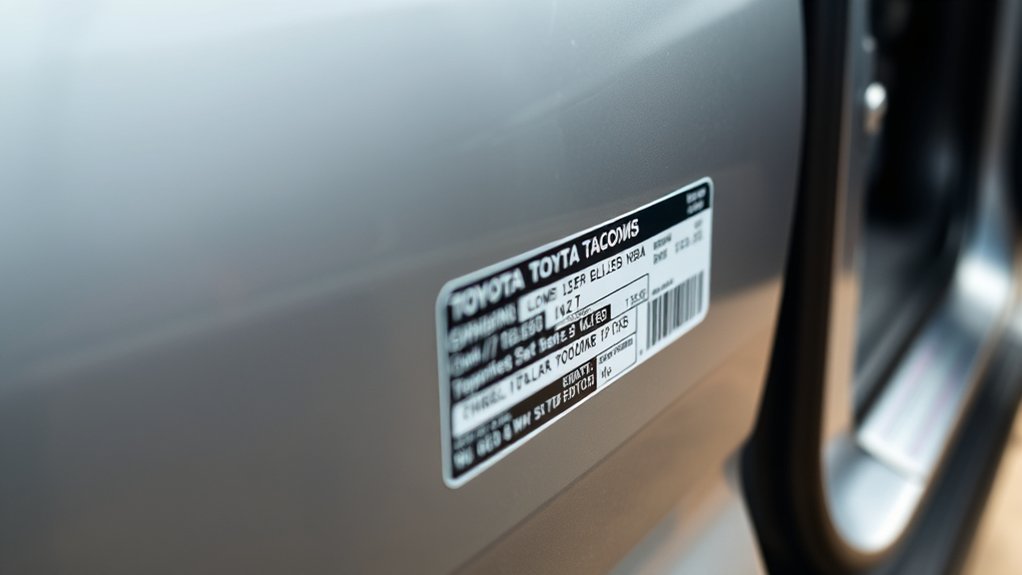
Your Toyota Tacoma’s driver-side door opening usually contains two different label types. The vehicle certification label identifies the truck and lists its manufacture date, VIN, vehicle type, Gross Vehicle Weight Rating (GVWR), and front and rear Gross Axle Weight Ratings (GAWR). The nearby Tire and Loading Information placard lists the combined occupant-and-cargo limit, seating capacity, original tire sizes, and recommended cold tire pressures. Use these labels for identification, payload, axle limits, and tire pressure. Use Toyota’s VIN-specific information and owner’s manual for trim, engine, transmission, towing capacity, and Gross Combined Weight Rating (GCWR).
Last updated: July 23, 2026
Quick Answer
Read the two label functions separately. Use the certification label for the VIN, manufacture date, GVWR, front GAWR, rear GAWR, and federal certification statement. Use the Tire and Loading Information placard for the combined weight of occupants and cargo, original tire sizes, and recommended cold tire pressures. The labels do not give you a complete Tacoma towing capacity or GCWR.
Key Takeaways
- Look for both the certification label and the Tire and Loading Information placard in the driver-side door opening.
- Use the line stating that the combined weight of occupants and cargo should never exceed a listed amount as the starting payload limit for your Tacoma as built.
- Follow the recommended cold tire pressure on the placard, not the maximum pressure molded into the tire sidewall.
- Meet GVWR, front GAWR, rear GAWR, tire, hitch, and towing limits at the same time.
- Use the full VIN with Toyota and NHTSA tools to verify specifications and open recalls.
At a Glance
| Source | What It Usually Shows | Best Use |
|---|---|---|
| Vehicle certification label | Manufacturer, manufacture month/year, VIN, vehicle type, GVWR, front and rear GAWR, tire/rim information associated with axle ratings, and certification statement | Vehicle identity, total-weight limit, axle limits, registration questions, and used-truck inspection |
| Tire and Loading Information placard | Combined occupant-and-cargo limit, seating capacity, original tire sizes, recommended cold pressures, and spare-tire information | Payload planning, tire inflation, and original tire-fitment reference |
| VIN lookup and owner information | Model year, technical specifications, options, recalls, service information, and configuration-dependent limits | Trim, engine, transmission, parts fitment, towing capacity, GCWR, and recall checks |
What’s in This Article
- What Is the Door Jamb Sticker and Where to Find It?
- How to Decode Your Toyota Tacoma’s VIN
- Why Is the Door Jamb Sticker Important for Owners?
- How to Interpret Make and Model Information on the Door Jamb Sticker
- What Does the Trim Level Tell You?
- Key Manufacturing Details: Date, Engine, Transmission
- Does Your Tacoma Meet Safety Standards?
- Toyota Tacoma Door Jamb Sticker: Understanding GAWR and GVWR
- How to Use the Door Jamb Sticker for Maintenance
- What Tire Information Is on the Door Jamb Sticker?
- What the Door Jamb Sticker Does Not Tell You
- What to Do if the Sticker Is Missing or Damaged
- Frequently Asked Questions
What Is the Door Jamb Sticker and Where to Find It?
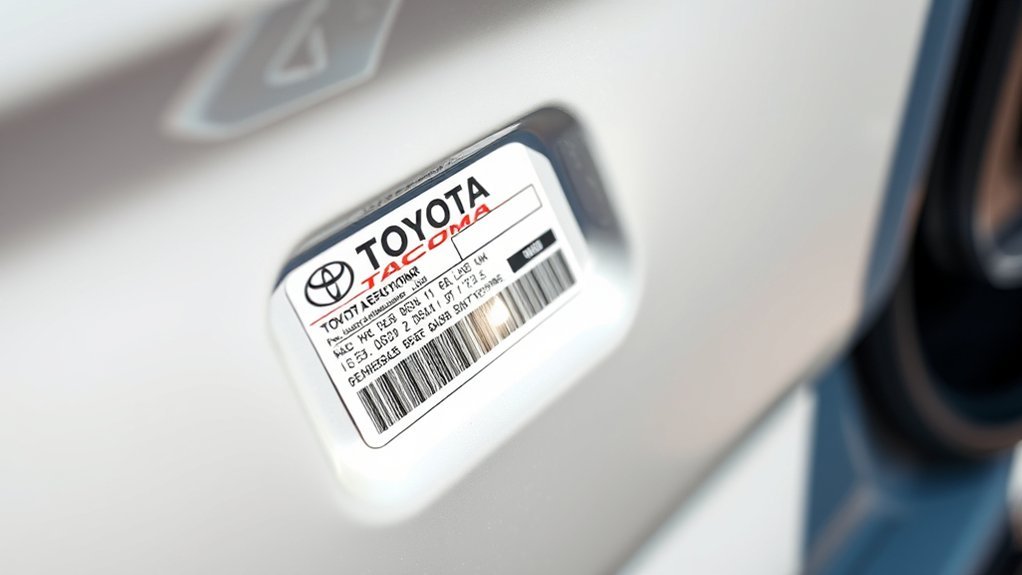
“Door jamb sticker” is an informal name for the labels placed in the driver-side door opening. On a Tacoma, you may find the labels on the hinge pillar, door-latch post, door edge, or adjacent body pillar. Federal certification rules permit the certification label in these driver-side locations and require it to remain readable without moving anything except an outer door. See 49 CFR 567.4.
The labels serve different purposes:
- Certification label: Identifies the manufacturer and vehicle, records the manufacture month and year, states GVWR and GAWR, and confirms that the vehicle was certified to the applicable federal standards in effect when it was manufactured.
- Tire and Loading Information placard: States how much combined occupant and cargo weight the truck was designed to carry, how many seating positions it has, and which original tire sizes and cold pressures apply.
- Additional Toyota identification information: Label design varies by Tacoma generation, model year, manufacturing plant, and market. Do not assume every Tacoma label has the same layout or optional codes.
The certification label is the correct source for the truck’s factory GVWR and axle ratings. The Tire and Loading Information placard is the correct starting point for factory tire pressure and payload planning. A deeper Toyota Tacoma payload guide can help when passengers, accessories, cargo, or trailer tongue weight use a large share of the placard limit.
How to Decode Your Toyota Tacoma’s VIN
A modern Toyota Tacoma VIN contains 17 characters. Some positions have standardized functions, but the exact meaning of manufacturer-defined characters must be checked with a full decoder rather than guessed from a badge or an isolated character.
| Position | General Function |
|---|---|
| 1–3 | World Manufacturer Identifier, which identifies the manufacturer and vehicle type or division |
| 4–8 | Manufacturer-defined vehicle attributes, which may describe the line, body, restraint system, engine, or other characteristics |
| 9 | Check digit used to validate the VIN’s character sequence |
| 10 | Model-year code; codes repeat across model-year cycles, so use the complete VIN and vehicle context |
| 11 | Assembly-plant code |
| 12–17 | Production sequence or manufacturer-assigned identification characters |
Use the NHTSA VIN decoder to view information encoded in the number, including manufacturer-reported plant data. For Toyota-specific specifications and installed options, use Toyota’s VIN specification lookup. The Toyota tool may provide information such as the vehicle’s year, color, technical specifications, and optional equipment.
A VIN decoder is useful, but it is not a substitute for the owner’s manual, service information, or direct parts-fitment verification. For a more detailed explanation of Tacoma-specific VIN fields, see the Toyota Tacoma VIN build-sheet guide.
Why Is the Door Jamb Sticker Important for Owners?
The labels give you configuration-specific information that generic online specifications cannot provide. Two Tacomas with the same model year and trim name can have different payload, tire, axle, cab, bed, drivetrain, or option details.
Read the Labels in This Order
- Match the VIN. Compare the certification-label VIN with the lower windshield VIN and ownership documents.
- Record the manufacture date. Use it with the VIN when a part, recall, or service procedure changes during a production run.
- Record GVWR and both GAWR values. These are factory weight limits for the complete truck and each axle.
- Find the combined occupant-and-cargo limit. This is the most direct payload starting point for the truck as originally completed.
- Record tire sizes and cold pressures. Use the Tire and Loading Information placard as the factory baseline.
Verify the VIN and Certification Statement
The certification statement records that the manufacturer certified the Tacoma to the federal standards applicable on the manufacture date. It does not certify the truck’s current mechanical condition or prove that later repairs and modifications were completed correctly.
Use the VIN with Toyota’s recall lookup and the NHTSA recall search. A VIN search can identify unrepaired safety recalls, but it may not display repaired recalls, every service campaign, or every recently announced recall immediately.
Use the Label as a Starting Point, Not a Parts Catalog
The VIN and manufacture date help a dealer or parts supplier narrow fitment, but the label itself does not identify every replaceable component. Confirm high-consequence parts through Toyota service information or a VIN-aware catalog before ordering brakes, suspension components, drivetrain parts, electronic modules, or safety equipment.
| Information | Use It For | Do Not Assume |
|---|---|---|
| VIN | Vehicle identity, recalls, specifications, and parts research | That every free decoder will return the marketed trim or every installed option |
| Manufacture date | Production changes, campaigns, and date-sensitive fitment | That it is the same as the model year |
| GVWR and GAWR | Total and axle weight checks | That adding the axle ratings creates a higher usable GVWR |
| Tire placard | Factory tire sizes, cold pressures, seating, and occupant/cargo limit | That the original pressure automatically applies to every modified tire setup |
How to Interpret Make and Model Information on the Door Jamb Sticker
The federal certification label identifies the manufacturer and vehicle type, but it may not print “Tacoma,” the marketed trim name, or the complete option package in plain language. The VIN connects the physical truck to Toyota’s specification records.
When inspecting a used Tacoma, compare these sources:
- VIN on the driver-side dashboard near the windshield
- VIN on the certification label
- VIN on the title or registration
- VIN on the insurance record
- VIN shown in Toyota’s specification or owner account
If the VINs do not match, stop the transaction or repair process until the discrepancy is explained. A mismatch can result from damaged paperwork or a replaced door, but it can also indicate an identification, theft, title, or prior-repair problem. Follow the vehicle-inspection procedure required by your state rather than relying on a seller’s explanation.
What Does the Trim Level Tell You?
A Tacoma’s trim can affect its suspension, wheels, interior, drivetrain availability, cab and bed combinations, technology, towing equipment, and replacement parts. The marketed trim is not a required field on the federal certification label, so confirm it through Toyota’s VIN records, original sales documents, or equipment list.
For the 2026 Tacoma lineup, Toyota lists SR, SR5, TRD PreRunner, TRD Sport, TRD Off-Road, Limited, i-FORCE MAX variants, Trailhunter, and TRD Pro. Older generations use different lineups and equipment combinations. Review the current Toyota Tacoma model information only for the applicable model year.
Do not identify the trim from exterior badges alone. Badges, wheels, suspension parts, seats, bumpers, and decals can be changed. For a full trim comparison separate from label decoding, see the Toyota Tacoma trim-level guide.
Key Manufacturing Details: Date, Engine, Transmission
The certification label is the correct source for the month and year in which the truck’s main assembly was completed. It does not have to list the marketed trim, engine, transmission, or option package.
Manufacture Date Versus Model Year
| Field | What It Means | Why It Matters |
|---|---|---|
| Manufacture month/year | When main assembly was completed | Production changes, recalls, service campaigns, and date-dependent parts |
| VIN model-year code | The vehicle’s assigned model year | Manual selection, model-year specifications, registration, and catalog searches |
A truck can be assembled during one calendar year and assigned to the following model year. Use both fields when Toyota divides a repair procedure or part number by production date.
How to Confirm the Engine
Use Toyota’s VIN specification lookup, the applicable owner’s manual, emissions information, and service records to identify the engine. Do not order engine, cooling, ignition, fuel, exhaust, or electronic parts from a trim badge alone.
The current 2026 Tacoma range uses turbocharged 2.4-liter powertrains, including available i-FORCE MAX hybrid versions, but that information does not apply to earlier Tacoma generations. Always verify the exact truck rather than transferring a current-model specification to an older vehicle.
How to Confirm the Transmission
Confirm the transmission through Toyota’s VIN records, owner information, and a physical or service inspection. The current Tacoma lineup can include an eight-speed automatic or six-speed manual, depending on configuration, but prior generations use different transmissions.
- Confirm automatic or manual before ordering clutch, shifter, cooling, or driveline parts.
- Use the exact owner’s manual or Toyota service information for fluid type and service procedure.
- Check the manufacture date when a component changed during a model year.
- Do not assume a transmission from the trim name alone.
- Verify drivetrain and cab configuration when selecting related parts.
Does Your Tacoma Meet Safety Standards?
The certification statement means the manufacturer certified the Tacoma to the applicable federal motor vehicle safety standards in effect on the manufacture date. It does not mean the truck remains mechanically safe after years of wear, collision repairs, corrosion, overloading, or modification.
During a used-truck inspection, check that the certification label is legible, permanently attached, and consistent with the dashboard VIN and paperwork. Then inspect the truck’s current condition and search the VIN for unrepaired recalls. Original certification and present-day roadworthiness are separate questions.
Toyota Tacoma Door Jamb Sticker: Understanding GAWR and GVWR
GVWR is the maximum permitted weight of the complete loaded Tacoma. The truck’s actual weight includes the vehicle, occupants, cargo, accessories, and the portion of a trailer’s weight carried by the hitch. GAWR is the maximum permitted load on an individual axle, normally identified as front and rear on the certification label.
Warning: Meet every applicable limit at the same time. Staying below both axle ratings does not allow you to exceed GVWR, and staying below GVWR does not guarantee that the rear axle, tires, hitch, or trailer combination is within its limit.
Key Weight Terms
- GVWR: Maximum permitted weight of the loaded truck.
- Front GAWR: Maximum permitted load on the front axle.
- Rear GAWR: Maximum permitted load on the rear axle.
- Occupant-and-cargo limit: The placard amount available for people and cargo when the truck was completed, subject to later equipment and loading.
- Trailer tongue weight: The downward trailer load carried by the truck and counted against payload.
- GCWR: Maximum combined rating for the truck and trailer; this is not normally supplied by the door certification label.
How to Calculate Remaining Payload
Start with the Tire and Loading Information placard line stating that the combined weight of occupants and cargo should never exceed the printed amount. Subtract the weight of passengers, in-cab cargo, bed cargo, permanently added accessories, removable accessories being carried, hitch hardware, and trailer tongue weight.
Remaining payload = placard occupant-and-cargo limit − people − cargo − added equipment − hitch hardware − trailer tongue weight.
This calculation is a planning tool. A public vehicle scale gives a more reliable check when the Tacoma is heavily loaded or towing.
How to Check the Truck on a Scale
Weigh the Tacoma in the condition in which it will travel, including passengers, cargo, accessories, hitch equipment, and the connected trailer when applicable. Compare:
- The loaded truck’s total weight with GVWR
- The front axle weight with front GAWR
- The rear axle weight with rear GAWR
- The tire loads and pressures with the installed tire requirements
- The truck-and-trailer combination with Toyota’s configuration-specific GCWR
- The trailer and tongue loads with trailer and hitch ratings
For a fuller explanation of how the limits interact, see the Tacoma towing-capacity versus payload guide.
How to Use the Door Jamb Sticker for Maintenance
Use the labels as reference data during tire service, parts research, loading, alignment checks, suspension work, and used-vehicle inspections.
- Photograph both labels before the printing fades or is damaged.
- Record the VIN and manufacture date when ordering configuration-sensitive parts.
- Use the original tire sizes and cold pressures as the factory baseline.
- Recalculate remaining payload after adding bumpers, sliders, racks, campers, winches, toolboxes, or other equipment.
- Check the VIN for recalls before major service or a long trip.
- Use a scale when the truck operates near a weight limit.
NHTSA advises drivers to use the recommended cold pressure shown on the vehicle placard or certification information rather than treating the tire sidewall maximum as the vehicle’s normal pressure target. Check the tires before driving or after they have cooled. See NHTSA TireWise.
For the full pressure-check procedure, TPMS guidance, and cold-pressure timing, use the dedicated Toyota Tacoma tire-pressure guide.
[Products Worth Considering]

This dual filter kit helps keep your vehicle running and riding cleaner by replacing both the engine air filter and cabin air filter at the same time. It is designed for a range of Toyota and Lexus hybrid models, helping support engine performance while reducing odors and airborne particles inside the cabin. Built with high-quality filtration materials, it offers a convenient maintenance solution for routine filter replacement.

These tricolor door sill protectors help guard your vehicle’s entry points from scratches, scuffs, and everyday wear while adding a bold color accent. Made from abrasion-resistant, waterproof PU leather, they are designed for easy peel-and-stick installation and a clean finish that helps protect the original paint.
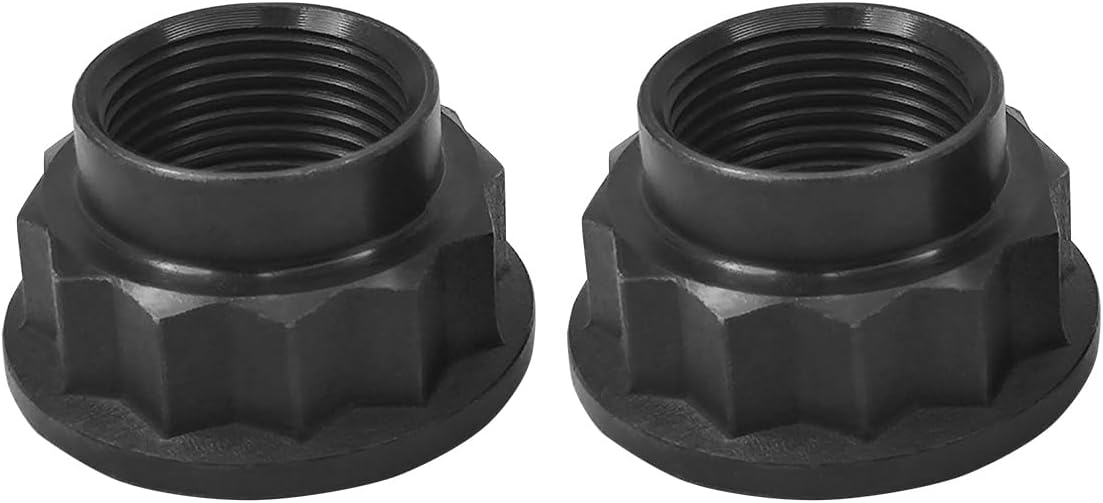
This pair of front axle shaft nuts is designed to secure CV joints and wheel bearings on compatible Toyota and Lexus front drive axles. Built from heat-treated carbon steel for durability and corrosion resistance, it helps maintain proper torque and reliable power transfer. It is a direct replacement for several factory part numbers and is recommended for paired replacement.
What Tire Information Is on the Door Jamb Sticker?
The Tire and Loading Information placard provides the factory tire and loading baseline for your Tacoma. Under federal requirements for vehicles within the applicable weight class, the placard includes the following information:
- Combined occupant-and-cargo limit: The maximum listed weight for people and cargo.
- Designated seating capacity: Total seating positions and their front/rear distribution.
- Original tire size: Size designation for the front and rear tires installed for the first retail sale.
- Recommended cold tire pressure: Factory pressure for the front, rear, and spare when applicable.
- Spare-tire information: Spare size and pressure, “see above,” or “none,” as applicable.
- Owner’s-manual direction: A statement directing the driver to the manual for additional information.
The certification label may also associate tire and rim information with the front and rear GAWR values. Read both labels rather than expecting one sticker to contain every field.
If you change tire size, wheel size, load range, suspension height, or wheel offset, the original placard still records the factory setup. It does not automatically determine the safe pressure or clearance for every modification. Have a qualified tire professional confirm load capacity, pressure, wheel compatibility, clearance, and handling.
[Products Worth Considering]

These aluminum alloy tire valve stem caps provide durable, corrosion-resistant protection for your vehicle’s valve stems while helping maintain stable tire pressure. The rubber seal design helps block dust, moisture, and debris, reducing the risk of air leakage and valve damage. Easy to install and styled for a clean look, they fit a range of cars, SUVs, trucks, and motorcycles.

These grille retainer clips provide a reliable replacement for the OEM Toyota 90467-12040 part number, helping restore secure body panel attachment on compatible vehicles. Designed for a tight push-in fit, they are made from durable black nylon to resist wear, corrosion, and cracking during everyday use. This set of 10 is ideal for keeping spare clips on hand for grille and trim repairs.

This custom-designed cargo net helps keep the rear trunk of a 2026 Toyota RAV4 neat, secure, and organized. Its stretchable elastic mesh construction helps prevent groceries, tools, and sports gear from sliding around, while the built-in bottom pocket and smart clips add extra storage control. A top pull tab makes installation and removal quick and easy for everyday convenience.
What the Door Jamb Sticker Does Not Tell You
The labels provide factory identity, certification, loading, and tire information. They do not provide a complete report on the truck’s current condition or every configuration-dependent specification.
| Not Reliably Shown by the Door Labels | Where to Check Instead |
|---|---|
| Complete towing capacity and GCWR | Toyota owner’s manual, towing information, and configuration-specific specifications |
| Marketed trim and every installed option | Toyota VIN specification lookup and original sales documents |
| Exact engine and transmission service requirements | VIN-specific owner and service information |
| Current truck weight or remaining payload after modifications | Weight calculation and a public vehicle scale |
| Accident history, hidden frame damage, or repair quality | History records and a physical inspection by a qualified professional |
| Tire age, internal damage, tread condition, or suitability of modified tires | Physical tire inspection, DOT date codes, and professional fitment review |
| Every repaired recall or service campaign | Toyota service history, dealer records, and recall tools |
Use the labels as authoritative factory references for the information they actually contain. Do not extend them into a complete build sheet, towing guide, inspection report, or maintenance schedule.
What to Do if the Sticker Is Missing or Damaged
A missing, unreadable, loose, painted-over, or altered certification label should be investigated, especially during a purchase, collision repair, registration inspection, or parts-identification problem.
- Photograph the label area and any remaining text.
- Compare the dashboard VIN with the title, registration, insurance record, and available service documents.
- Enter the VIN into Toyota’s specification and recall tools.
- Contact an authorized Toyota dealer with proof of ownership and clear photos.
- Ask whether Toyota can supply the required information or an approved replacement for that vehicle.
- Follow your state’s VIN-verification or inspection process if any identifying numbers conflict.
Replacement-label availability, required evidence, and legal procedures can vary. Do not apply an unofficial reproduction containing unverified VIN, weight, tire, or certification data.
[Products Worth Considering]

This plug-and-play AC button switch is designed to replace a faulty factory air conditioner switch in compatible Toyota vehicles. It installs easily without tools and is made to match the original part for a seamless fit and reliable operation. Built from durable ABS plastic, it offers a dependable replacement backed by warranty support and fitment guidance.
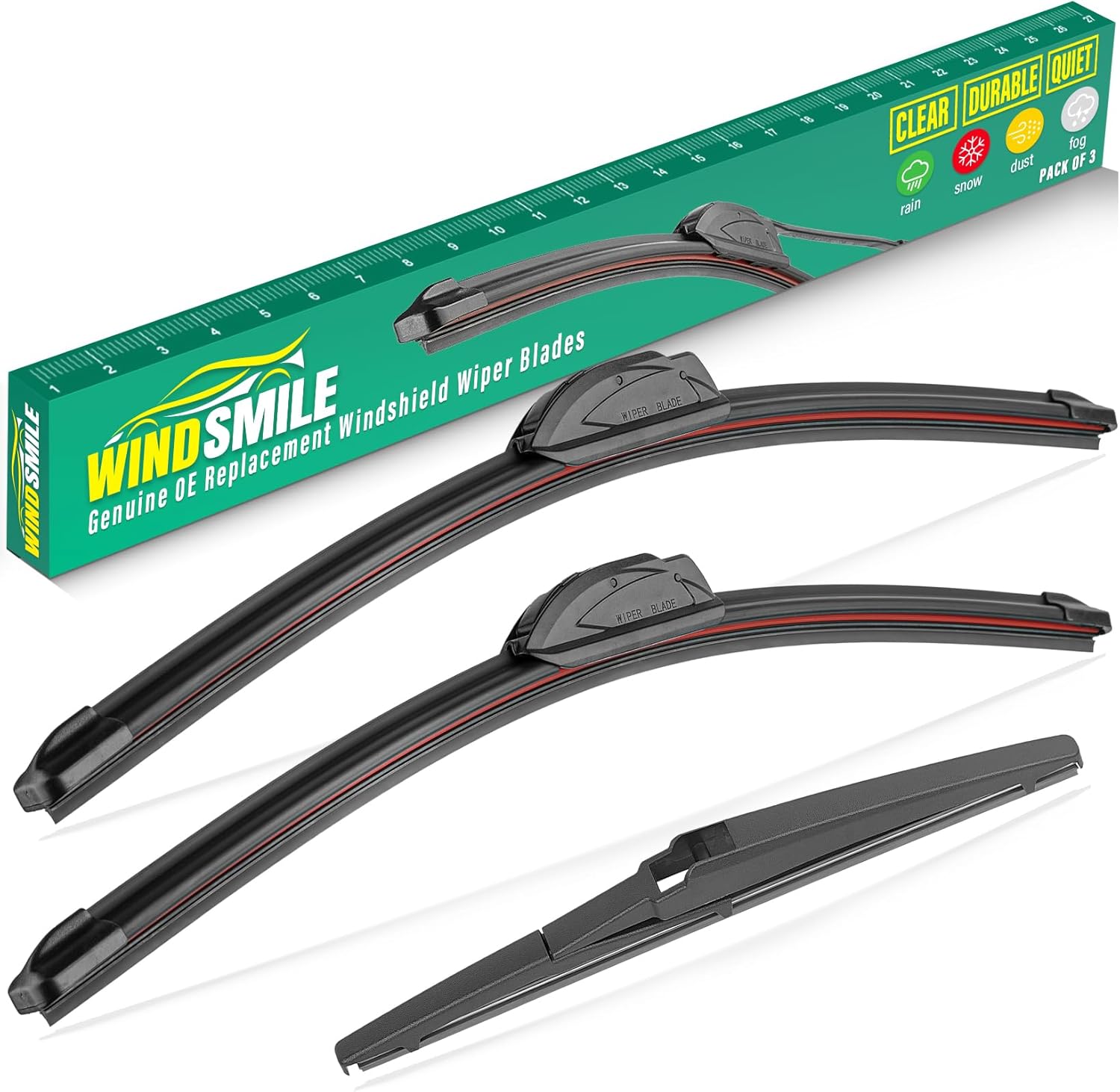
This replacement windshield wiper blade set is designed for Toyota RAV4 models from 2006 to 2012, offering a complete front and rear fit for dependable all-weather visibility. The premium rubber blades help deliver streak-free, quiet wiping while the aerodynamic design reduces wind lift and noise for smoother performance. Built for easy installation and long service life, it is a convenient upgrade for restoring clear driving vision.

This car document holder keeps registration, insurance cards, and other essential paperwork neatly organized and easy to access when needed. Its clear inner sleeves help you quickly identify documents, while the hidden magnetic closure keeps everything secure and protected in a compact, glove-box-friendly design.
Frequently Asked Questions
How do you read a Toyota Tacoma door sticker?
First identify the certification label and the Tire and Loading Information placard. Match the VIN, record the manufacture date, GVWR, front GAWR, and rear GAWR, then read the placard’s combined occupant-and-cargo limit, original tire sizes, and recommended cold pressures.
Is the door jamb sticker the same as the tire pressure label?
Not necessarily. “Door jamb sticker” is a general phrase owners use for labels in the door opening. The certification label provides VIN, manufacture, certification, GVWR, and GAWR information. The Tire and Loading Information placard provides payload, seating, tire-size, and cold-pressure information.
Where is the Toyota Tacoma payload number?
Look on the Tire and Loading Information placard for the statement that the combined weight of occupants and cargo should never exceed a printed amount. Subtract passengers, cargo, accessories, hitch hardware, and trailer tongue weight from that amount to estimate remaining payload.
Can you find a Tacoma’s towing capacity on the door sticker?
The door labels do not provide the complete towing capacity or GCWR. They provide payload, GVWR, GAWR, tire, and inflation limits that still affect towing. Use Toyota’s configuration-specific owner information for towing capacity and GCWR.
Should you use tire sidewall pressure or door sticker pressure?
For the factory tire setup and normal operation, use the recommended cold pressure on the Tire and Loading Information placard or in the owner’s manual. The sidewall number is a tire limit, not Toyota’s normal pressure target for the truck.
What should you do if a Tacoma door label is missing?
Compare the dashboard VIN with the title, registration, insurance record, and service documents. Photograph the label area and contact an authorized Toyota dealer with proof of ownership. If the VINs conflict, follow your state’s vehicle-identification inspection process before buying, registering, or repairing the truck.
Safety Disclaimer: This article provides general vehicle information only and does not replace your Tacoma owner’s manual, Toyota service information, configuration-specific towing data, tire-manufacturer guidance, or advice from a qualified technician. Confirm weight, tire, towing, fitment, and repair decisions with the official information for your VIN before driving.
Conclusion
Read your Toyota Tacoma’s door labels in a set order: match the VIN, record the manufacture date, note GVWR and both GAWR values, find the combined occupant-and-cargo limit, and record the original tire sizes and cold pressures. Photograph both labels for your records. Use Toyota’s VIN tools for specifications and recalls, and use the owner’s information for towing capacity and GCWR. When the truck carries a heavy load or trailer, verify the total and axle weights on a scale instead of relying on a visual estimate.
References
- 49 CFR 567.4: Requirements for Manufacturers of Motor Vehicles, Electronic Code of Federal Regulations, accessed July 23, 2026
- 49 CFR 571.110: Tire Selection, Rims, and Vehicle Placard Requirements, Electronic Code of Federal Regulations, accessed July 23, 2026
- NHTSA VIN Decoder, National Highway Traffic Safety Administration, accessed July 23, 2026
- Tire Safety Ratings and Awareness, National Highway Traffic Safety Administration, accessed July 23, 2026
- Check for Recalls, National Highway Traffic Safety Administration, accessed July 23, 2026
- Toyota Safety Recall and Service Campaign Lookup, Toyota, accessed July 23, 2026
- Toyota VIN Specification Lookup, Toyota, accessed July 23, 2026
- 2026 Toyota Tacoma Models and Features, Toyota, accessed July 23, 2026


[…] Toyota’s official manuals and warranty guides are available through Toyota Owners Manuals and Warranties. For a broader explanation of the other labels in the same door opening, see the Toyota Tacoma door-jamb sticker guide. […]
[…] The fastest method is to read the two labels in the driver-side door opening. The Tire and Loading Information label gives the occupant-and-cargo limit. The certification label gives GVWR and front and rear GAWR. For a full explanation of every field, see this Toyota Tacoma door-jamb sticker guide. […]
[…] Do not confuse this placard with the nearby vehicle certification label. The tire placard is the one you use for the recommended cold inflation pressure, original tire size, seating capacity, and combined occupant-and-cargo limit. The certification label is used for items such as GVWR and GAWR. For a broader explanation of both stickers, see the Toyota Tacoma door-jamb sticker guide. […]