
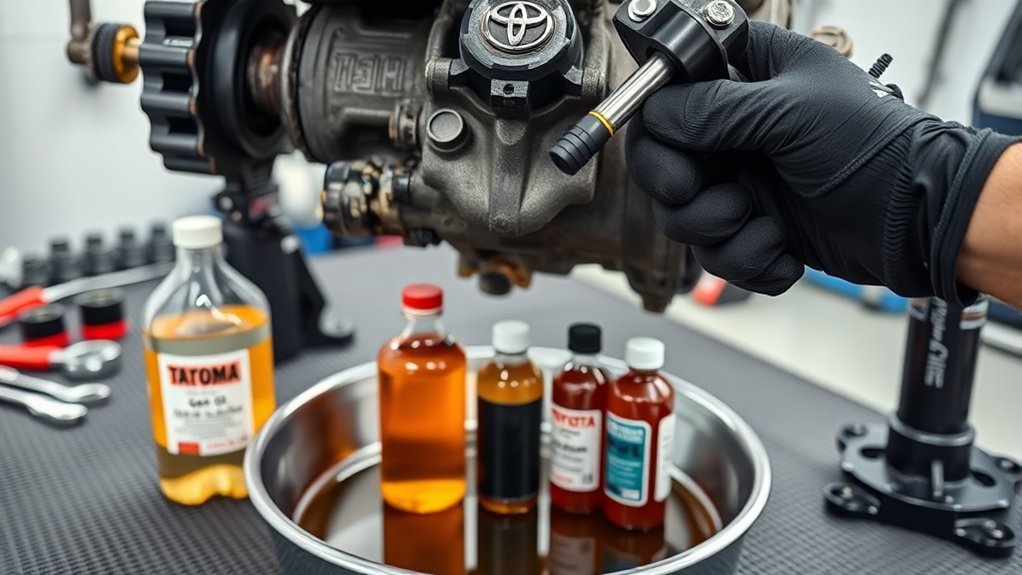
Your Toyota Tacoma’s differential fluid choice depends on the component and the model year. The safest rule is simple: use the exact Toyota fluid specification listed in your owner’s manual or maintenance guide, then match the API/GL rating, viscosity, and capacity before you open a drain plug. In general, Tacoma differentials use GL-5 hypoid gear oil, while the transfer case and manual transmission may require different Toyota-specific fluids.
Quick Answer
Most Toyota Tacomas use 75W-85 GL-5 gear oil in the front and rear differentials. Do not assume the same fluid works in the transfer case or manual transmission: many newer 4WD Tacomas call for Toyota Transfer Gear Oil LF 75W, and manuals often need GL-4-type synchronizer-safe fluid.
Key Takeaways
- Differentials: use Toyota Genuine Differential Gear Oil LT 75W-85 GL-5 or a true equivalent when your manual lists that spec.
- Transfer case: do not choose by GL-5 alone; many newer Tacomas use Toyota Transfer Gear Oil LF 75W, while some older models list 75W-90 gear oil.
- Manual transmission: avoid generic differential GL-5 unless Toyota specifically approves it for your transmission.
- Service interval: inspect driveline fluids on schedule and replace sooner for towing, deep water, mud, dust, or frequent off-road use.
- DIY rule: always remove the fill plug before the drain plug so you know the case can be refilled.
At a Glance
| Time Required | About 45-90 minutes per axle or transfer case for a careful DIY service |
| Difficulty | Moderate; basic tools, safe lifting, and correct fill-level technique are required |
| Tools Needed | Drain pan, fluid pump, correct sockets/hex bits, torque wrench, gloves, shop towels, and new plug gaskets or crush washers |
| Cost | Varies by model, fluid capacity, and whether you use Toyota OEM fluid or an equivalent |
Toyota Tacoma Differential & Transfer Case Fluid Specs

For the front and rear differentials, the common Toyota specification for modern Tacomas is Toyota Genuine Differential Gear Oil LT 75W-85 GL-5 or an equivalent oil of matching quality. GL-5 matters because Tacoma axle gears are hypoid-style gears that operate under high sliding contact and heavy load. SAE’s J2360 gear-lubricant standard describes GL-5-type gear oils as intended for hypoid automotive gear units under high-speed shock load and low-speed high-torque operation.
The transfer case is where many articles get too broad. Some older Tacomas list 75W-90 gear oil for the transfer case, but many newer 4WD Tacomas call for Toyota Genuine Transfer Gear Oil LF 75W or an exact equivalent. That fluid is not automatically interchangeable with 75W-90 differential oil. Use the transfer-case specification from your year-specific owner’s manual or ask a Toyota parts counter to confirm by VIN.
| Component | Typical Tacoma Fluid Guidance | What to Verify |
|---|---|---|
| Front differential | 75W-85 GL-5 differential gear oil on many late-model Tacomas | Capacity, plug gasket, and exact torque spec for your year |
| Rear differential | 75W-85 GL-5 differential gear oil on many late-model Tacomas | Open vs. locking rear differential and fill quantity |
| Transfer case | Toyota LF 75W on many newer 4WD models; 75W-90 gear oil on some older models | Model year, 2WD/4WD system, and Toyota fluid part number |
| Manual transmission | Synchronizer-safe manual transmission gear oil, often GL-4-type chemistry | Exact Toyota M/T fluid spec; do not substitute axle oil blindly |
Warning: Do not put differential oil into the manual transmission just because the viscosity looks similar. A hypoid GL-5 axle oil can have the wrong friction behavior for synchronizers unless the product and Toyota spec explicitly allow that use.
[Products Worth Considering]

The Scepter AM07029 Oil Drain Pan makes oil changes cleaner and easier by helping contain spills and reducing mess in the garage or driveway. Its lidded opening, removable drain screen, and gasketed pour spout support convenient collection, transport, and disposal of fluids. Built from durable high-density polyethylene, it resists rust, dents, and corrosion for reliable use with engine oil, transmission fluid, hydraulic fluid, and antifreeze.

These genuine Toyota oil drain plug gaskets are designed to help maintain a reliable seal during oil changes, reducing the chance of leaks and supporting proper engine maintenance. With an OEM fit and trusted Toyota quality, they are a practical choice for routine service on compatible vehicles. The convenient quantity pack is ideal for keeping multiple maintenance intervals covered.

This 12-pack oil filter and drain plug washer set is designed for a wide range of Toyota and Scion vehicles, helping support clean oil flow and dependable engine performance. It replaces several common OE part numbers and offers an easy-fit solution for routine maintenance. Built with corrosion-resistant materials and efficient filtration, it helps keep engine contaminants out and supports longer service life.
Why GL-4 vs GL-5 Matter for Your Tacoma
GL-4 and GL-5 are not simple “good” and “better” labels. They describe different gear-oil service categories. GL-5 is built for severe hypoid-gear service, which is why it belongs in Tacoma differentials when Toyota lists GL-5. GL-4 is commonly used in synchronized manual transmissions because it can provide the friction characteristics that brass or bronze synchronizers need for clean shifts.
The concern with using the wrong oil is not just corrosion. Shift quality can suffer if the oil is too slippery for the synchronizers, and long-term wear may increase if the additive package is wrong for the component. Some modern oils are marketed as safe for both GL-4 and GL-5 applications, but you should still match the Toyota specification for the exact part you are servicing.
Note: The Tacoma’s differentials, transfer case, automatic transmission, and manual transmission are separate systems. A correct fluid for one system can be wrong for another.
Recommended Gear Oil Weights for Tacoma: 75W, 75W-85, and 75W-90
Gear-oil viscosity tells you how the oil flows when cold and how much film strength it provides when hot. For many Tacoma differentials, the key number is 75W-85 GL-5. A 75W-90 GL-5 oil may be common on store shelves and may be listed for some older applications, but it is not automatically the correct substitute for every Tacoma axle or transfer case.
- Use 75W-85 GL-5 when your Tacoma manual lists Toyota Differential Gear Oil LT or an equivalent 75W-85 GL-5 oil.
- Use Toyota LF 75W when your transfer case specification calls for Toyota Genuine Transfer Gear Oil LF 75W or an exact equivalent.
- Use 75W-90 only when listed by your manual or a verified Toyota service source for your model year and component.
- Avoid “universal” guessing on manual transmissions, transfer cases, and electronic 4WD systems.
If you tow, crawl off-road, run oversized tires, or drive through water, fluid condition matters as much as the label. Milky oil means water contamination. Burnt odor, heavy metal paste, or large metal chips on the magnet mean the driveline needs closer inspection.
Match fluid by component first, viscosity second, and brand third. The best gear oil is the one that meets the Toyota spec for the exact Tacoma system you are servicing.
[Products Worth Considering]

This flexible oil funnel is designed to make fluid changes cleaner and easier by guiding oil around obstacles like skid plates and crossmembers. Its shape-retaining core and silicone body can be molded for custom positioning, while the heat-resistant, leak-proof design helps prevent spills during draining and filter removal. Reusable and easy to clean, it works well for cars, trucks, motorcycles, and other hard-to-reach fluid fill or drain applications.

This brake bleeder bottle is designed to make fluid bleeding easier for one-person use with a built-in check valve and magnetic mount. The flexible hose fits most bleeder valves and helps reduce the chance of air entering the system during service. With a practical fluid capacity and universal fit, it is a handy tool for brake maintenance and repair.

CHAPIN’s low-profile oil drain pan is designed to slide under low-clearance vehicles and equipment, making fluid changes easier in tight spaces. The large splash-free target area helps reduce mess while the molded carry handles support easier lifting, pouring, and storage. Built for draining oil, coolant, and other automotive fluids, it offers a practical high-capacity solution for routine maintenance.
Choosing Compatible Gear Oil: API/GL Labels & Equivalents
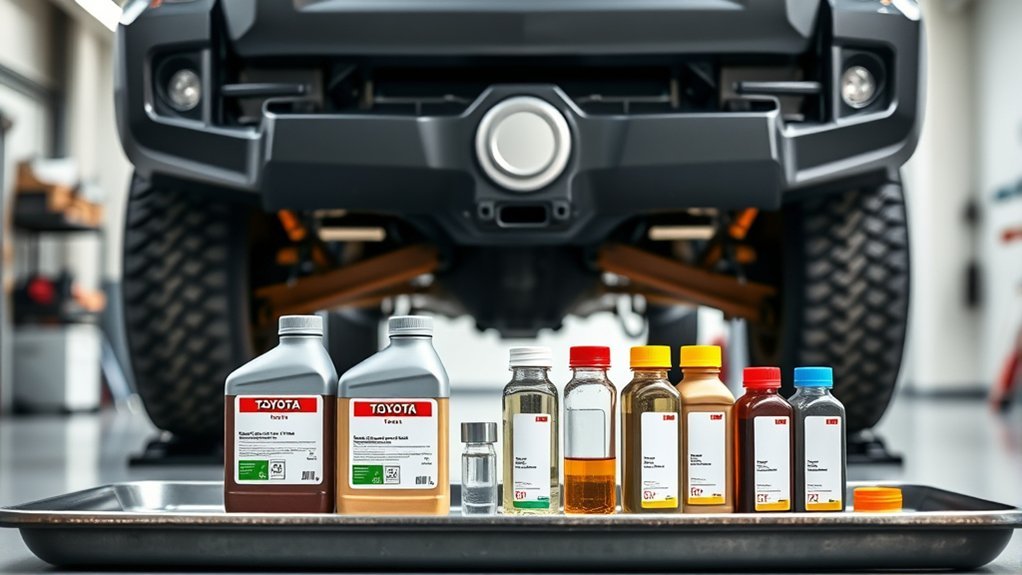
When choosing differential oil, look for three things on the bottle: the SAE viscosity, the API/GL rating, and a statement that the oil is suitable for the Toyota specification you need. For Tacoma differentials, that usually means 75W-85 GL-5 or a Toyota-approved equivalent. API Publication 1560 is the industry reference for gear-lubricant service designations used in manual transmissions, transaxles, and axles.
For transfer cases and transmissions, avoid relying on the API/GL label alone. Toyota low-friction transfer oil and Toyota manual transmission oils are designed around friction behavior, pumpability, temperature range, and internal component materials. A product that protects hypoid axle gears may still be wrong for a synchronized gearbox or transfer case that requires a specific Toyota LF fluid.
[Products Worth Considering]

The Funnel King 32950 Oil Drain Pan is a compact fluid catch basin designed for clean, easy draining during routine maintenance. Its open shape and pour edge help transfer used oil, coolant, and other shop fluids with less mess, while the lightweight polypropylene construction stands up to common automotive chemicals. Sized to fit under many cars and small engines, it is a practical choice for garages, workshops, and DIY oil changes.

Castrol EDGE 0W-20 advanced full synthetic motor oil is engineered for drivers seeking strong wear protection, excellent viscosity control, and thermal stability. It delivers superior performance in critical engine areas, including fuel economy, high-temperature protection, sludge control, and wear defense. Designed for extended oil-change intervals, it helps keep modern engines running smoothly under demanding conditions.

Castrol GTX Full Synthetic 5W-30 motor oil is designed to deliver maximum engine protection in severe driving conditions. It helps fight wear, control sludge, and resist viscosity breakdown while supporting longer intervals between oil changes. Formulated to meet or exceed key industry and vehicle manufacturer specifications, it offers dependable performance for modern engines.
Synthetic vs. Conventional Gear Oil
Synthetic gear oil usually offers better cold flow, oxidation resistance, and shear stability than conventional oil. That makes it a strong choice for towing, heavy loads, long highway trips, and cold starts. Conventional gear oil can still work when it meets the exact Toyota specification, but do not choose conventional oil only to save money if it lacks the required GL rating or viscosity.
Limited-Slip Additives and Locking Differentials
Most Tacoma owners should not add a separate limited-slip friction modifier unless Toyota or the oil manufacturer specifically requires it. Many Tacomas use open differentials, brake-based traction control, or an electronic locking rear differential rather than a clutch-type limited-slip unit. Extra friction modifier can change how the oil behaves and may not help a non-clutch differential.
Pro Tip: Buy new fill and drain plug washers before the job. Reusing crushed or damaged washers is one of the easiest ways to create a slow leak after an otherwise clean fluid change.
Service Guide: Change Intervals, DIY Fill/Drain, Troubleshooting
Toyota’s maintenance schedule should be your baseline. Many Tacoma schedules call for regular inspection of differential and transfer-case oil, with more frequent replacement under severe use such as towing, heavy loading, repeated short trips, dusty roads, mud, water crossings, or frequent off-road driving. If your truck works hard, waiting for a noise or leak is too late.
Before You Start
- Park on a level surface and use safe lifting practices if the truck must be raised.
- Confirm the fluid type, capacity, plug washer type, and torque specification for your exact year and drivetrain.
- Make sure you can remove the fill plug before the drain plug.
- Use a clean drain pan so you can inspect the old oil for metal, water, or burnt odor.
- Keep differential oil, transfer-case oil, ATF, and manual transmission fluid clearly separated.
Basic Differential Fluid Change Steps
- Warm the drivetrain with a short drive, then park level and set the parking brake.
- Clean around the fill and drain plugs so dirt does not enter the housing.
- Remove the fill plug first. If it is stuck, stop and solve that before draining the housing.
- Place the drain pan, remove the drain plug, and let the oil drain fully.
- Inspect the drain plug magnet. Fine gray paste is common; chunks, flakes, or sharp debris are not.
- Install the drain plug with a new washer and torque it to the Toyota spec for your model.
- Pump in the correct GL-5 differential oil until the fluid reaches the specified fill level, often near the lower edge of the fill opening when the truck is level.
- Install the fill plug with a new washer, torque it correctly, wipe the housing clean, and check for leaks after a short drive.
Transfer Case Service Tips
The transfer case follows the same fill-before-drain logic, but the fluid spec can be much more model-year-sensitive. Use Toyota LF 75W when your manual calls for it. Do not “upgrade” to thicker 75W-90 because you tow or off-road unless Toyota allows that substitute for your transfer case. A heavier fluid can change cold flow and internal lubrication behavior.
Troubleshooting After Service
- Leak at plug: recheck washer condition, plug seating, and torque.
- Whine or growl: verify fluid level and confirm the correct viscosity and GL rating were used.
- Milky fluid: water entered the housing; drain, refill, inspect breathers, and service soon after water crossings.
- Metal chunks: stop guessing and have the differential inspected for bearing, ring gear, pinion, or locker damage.
- Hard shifting after transmission service: confirm the manual transmission fluid spec, not just viscosity.
Warning: Never crawl under a Tacoma supported only by a jack. Use rated jack stands on solid ground, chock the wheels, and keep the truck level so the final fill level is accurate.
Frequently Asked Questions
What kind of differential fluid does a Toyota Tacoma take?
Most late-model Toyota Tacomas use 75W-85 GL-5 gear oil in the front and rear differentials, commonly Toyota Genuine Differential Gear Oil LT or an equivalent. Always verify by model year, drivetrain, and owner’s manual because fluid specifications can vary by market and generation.
Can I use 75W-90 instead of 75W-85 in a Tacoma differential?
Use 75W-90 only when your Tacoma manual or a verified Toyota service source allows it for that component. Many modern Tacoma differentials list 75W-85 GL-5, and the best practice is to match Toyota’s viscosity and GL-5 requirement rather than choosing a thicker oil by habit.
Is GL-5 safe for a Toyota Tacoma manual transmission?
Do not use generic GL-5 differential oil in a Tacoma manual transmission unless Toyota specifically lists that fluid for your exact transmission. Manual gearboxes often need synchronizer-safe fluid with the correct friction behavior, and many owners should look for the Toyota-specified manual transmission gear oil or GL-4-type equivalent.
What is the difference between Toyota CVT Fluid TC and FE?
Toyota CVT Fluid TC and Toyota CVT Fluid FE are fluids for continuously variable transmissions, not Tacoma differentials. They should not be used as differential oil or transfer-case oil unless an official Toyota manual for that exact vehicle says so. For Tacoma axles, look for the listed differential gear oil spec instead.
What differential oil does Toyota use for many modern Tacomas?
Toyota commonly lists Toyota Genuine Differential Gear Oil LT 75W-85 GL-5 or an equivalent for Tacoma differentials. The “equivalent” oil must match the required viscosity, GL-5 performance category, and quality level.
How often should Tacoma differential fluid be changed?
Follow the Toyota maintenance guide for your exact model year. Inspect the fluid on schedule and replace it sooner if you tow, carry heavy loads, drive in mud or water, off-road often, or see contamination. Many owners service hardworking Tacoma differentials around 30,000-mile intervals, but the official schedule and severe-service notes come first.
What are the different types of rear differential fluid?
Rear differential fluids can be conventional, synthetic blend, or full synthetic, and they come in different SAE viscosities such as 75W-85 and 75W-90. For a Tacoma, the base-oil type matters less than meeting the correct Toyota viscosity and API GL-5 requirement.
Conclusion
The right Tacoma differential fluid is not simply “any GL-5.” For most modern Tacoma differentials, start with 75W-85 GL-5 that matches Toyota Genuine Differential Gear Oil LT or an approved equivalent. For the transfer case and manual transmission, verify the separate Toyota fluid spec before buying oil. Use clean tools, new washers, the correct fill level, and a torque wrench, and your Tacoma’s driveline will stay quieter, cooler, and better protected.
Sources
- Toyota Owners: Tacoma Manuals and Warranties — official Toyota owner manual and warranty access by model year.
- Toyota Owners: 2026 Tacoma Maintenance Requirements — official Toyota maintenance guidance and service-reference hub.
- American Petroleum Institute Publication 1560 — API gear lubricant service designations for manual transmissions, transaxles, and axles.
- SAE J2360 Automotive Gear Lubricants — gear lubricant standard covering GL-5-type hypoid gear service.
- ASTM D7450-24 — standard specification for rear axle gear lubricants intended for API Category GL-5 service.
- Toyota Genuine Differential Gear Oil LT 75W-85 GL-5 — OEM Toyota differential gear oil reference for the 75W-85 GL-5 specification.



[…] began after lift work or changes during normal, owner-manual-permitted 4WD use, then inspect the front differential and CV axle area before replacing a […]