
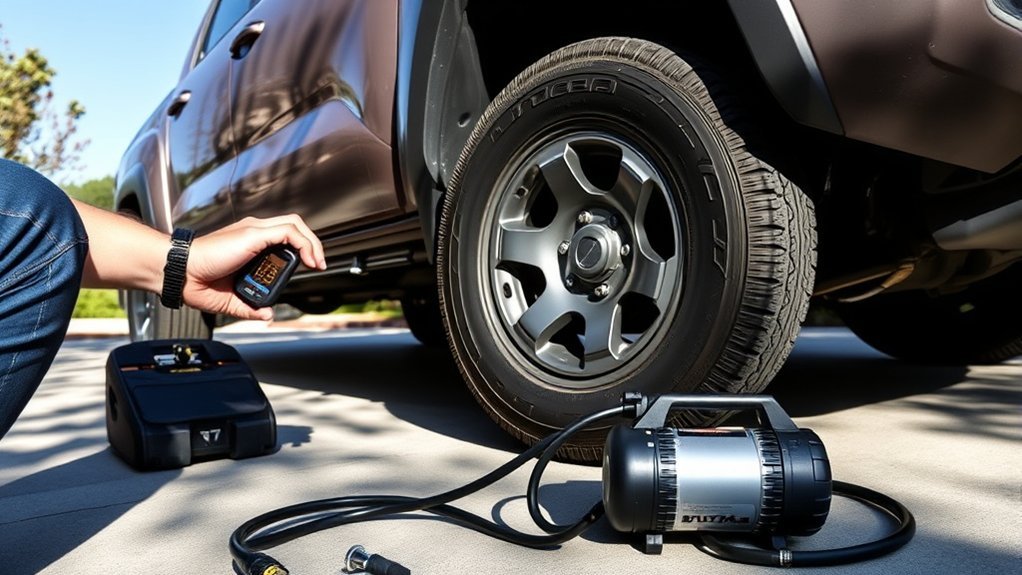
Toyota Tacoma tire pressure should be set to the front and rear cold PSI on the driver-side Tire and Loading Information label. There is no universal Tacoma PSI: factory configurations span 29 to 32 PSI on earlier generations and 30, 32, or 35 PSI on 2024+ models, making a generic chart unreliable. Check every tire before driving or after the truck has been parked for at least three hours, adjust in short bursts, and recheck with a reliable gauge. Never use the maximum PSI molded into the tire sidewall as your daily target.
Last updated: August 30, 2026. Added generation-specific TPMS reset procedures, expanded multi-generation factory PSI baselines, under-bed spare tire access steps, and trail reinflation parameters.
How this guide was prepared: This is a source-based maintenance guide checked against Toyota owner information, NHTSA TireWise, FuelEconomy.gov, and the current federal TPMS standard (FMVSS No. 138). It does not claim hands-on testing across every Tacoma model year, trim, wheel package, or aftermarket tire setup.
Quick Answer
Park the Tacoma until the tires are cold, read the front and rear PSI on the driver-side door placard, and check every tire with a reliable gauge. Add or release air in short bursts, recheck each reading, and reinstall the valve caps snugly by hand. If one tire drops pressure faster than the others, inspect it for a puncture, bead leak, or valve issue rather than repeatedly resetting the TPMS.
Key Takeaways
- Always follow the Tacoma’s driver-side door placard for cold PSI—never the maximum pressure molded into the tire sidewall.
- Check pressure when tires are cold: parked for at least 3 hours or driven less than 1 mile (1.5 km).
- Tacoma factory specifications vary: 2nd and 3rd Gens typically use 29–32 PSI, while 4th Gen (2024+) trucks use 30, 32, or 35 PSI depending on trim and tire size.
- Remember the under-bed spare tire; it shares the road tire pressure specification and requires regular checks.
- TPMS triggers only after a ~25% drop below recommended pressure, making manual monthly checks essential.
- A simultaneous drop on all four tires indicates seasonal temperature contraction; an isolated drop signals a leak.
At a Glance
| Time Required | 5–10 minutes |
| Difficulty | Easy |
| Target Reference | Driver-side Tire and Loading Information placard |
| Cold Definition | Parked for ≥3 hours or driven <1 mile (1.5 km) |
| Warm Tire Protocol | Never bleed warm tires down to placard cold target; let them cool first |
| Tools Needed | Accurate tire gauge, 12V/garage inflator, replacement valve caps, spare tire lowering rod (if checking spare) |
| Cost | Free at home; minimal coin-op fees at public pumps |
What Tire Pressure Should a Toyota Tacoma Use?
A Toyota Tacoma does not have a single, universal PSI setting. The proper setting depends entirely on the model year, cab configuration, drivetrain, factory wheel diameter, and original equipment (OE) load rating. Always follow the front and rear cold tire inflation pressure printed on your truck’s driver-side door jamb placard.
Front and rear recommendations may be identical or staggered depending on the truck’s weight distribution and payload ratings. For a full breakdown of label fields, see our Tacoma tire pressure placard guide.
[Products Worth Considering]

This smart color coded tire tread depth gauge makes it easy to check tread wear at a glance with clear red, yellow, and green ranges. Calibrated from 0 to 1 inch in 1/32 inch increments, it helps you quickly assess tire condition for safer driving and timely replacements. The pocket clip design makes it convenient to carry and use on trucks, motorcycles, cars, and other passenger vehicles.
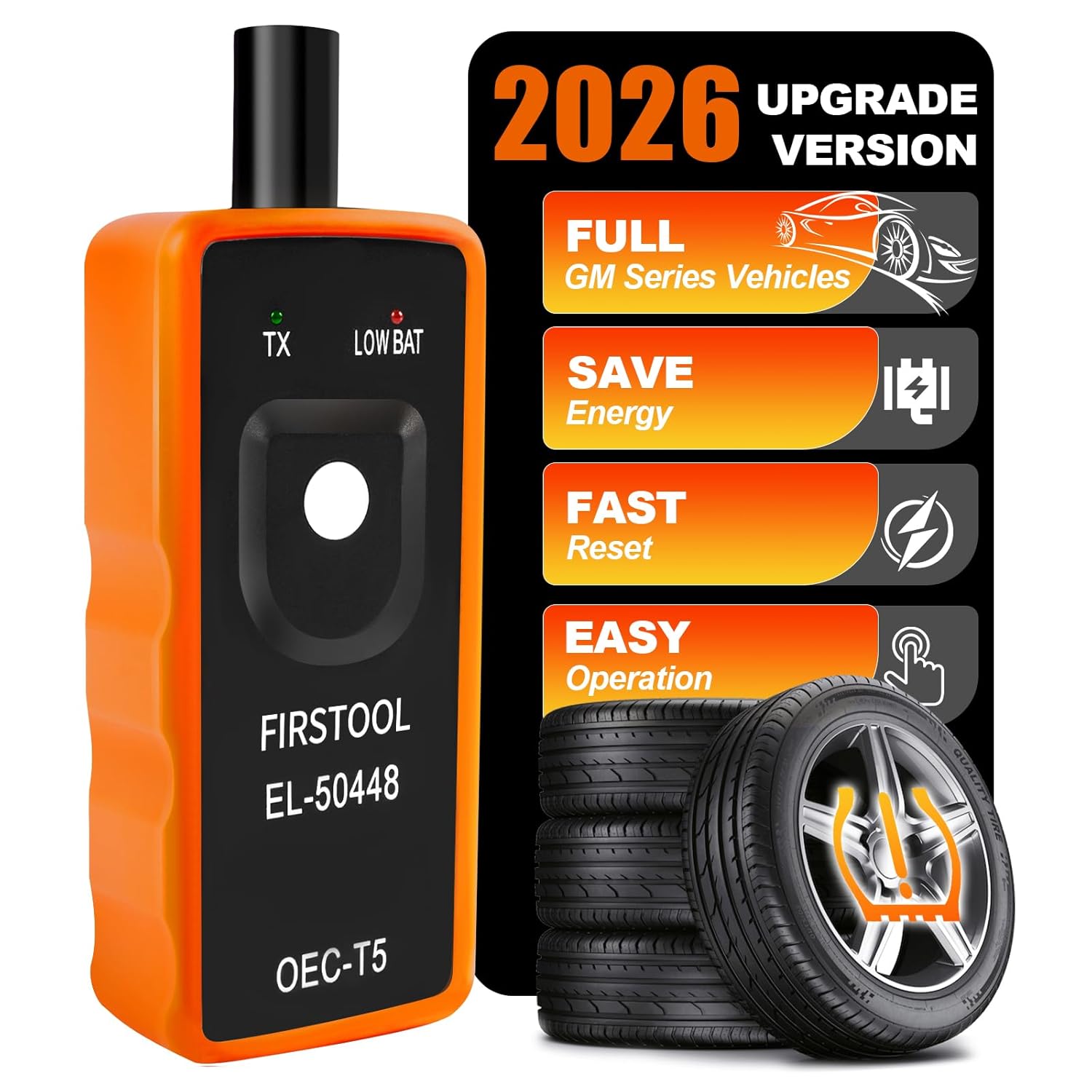
This EL-50448 TPMS relearn tool helps quickly activate and reset tire pressure sensors so your vehicle’s monitoring system stays accurate after tire rotations, sensor replacement, or seasonal tire changes. Designed for many GM-related vehicles and compatible with common 315 and 433 MHz TPMS systems, it offers simple one-button operation and reliable performance for clearing warning lights and relearning sensor positions.

This automotive circuit tester checks low-voltage DC systems from 3-65V, making it useful for diagnosing headlights, taillights, fuses, sockets, and other vehicle wiring issues. The digital backlit display provides clear voltage readings with fine accuracy, while the bidirectional polarity indicator helps you test from either ground or positive. Built with a durable probe, insulated tip, and extra-long spring wire, it is designed for dependable everyday use in automotive and household electrical work.
Tacoma Factory Tire Pressure Examples by Generation
Because factory specifications change across generations and wheel packages, copying a setting from another truck can compromise handling, fuel economy, and tire life.
| Generation & Tire Size Example | Typical Factory Cold PSI | Configuration Context |
|---|---|---|
| 2nd Gen (2005–2015) — P245/75R16 / P265/70R16 | 29–30 PSI (Front/Rear) | Standard SR5 and TRD Off-Road OE configurations |
| 3rd Gen (2016–2023) — P265/65R17 / P265/70R16 | 30–32 PSI (Front/Rear) | Standard TRD Sport, TRD Off-Road, and Limited packages |
| 4th Gen (2024+) — 265/70R17 (Type C/D) | 30 PSI (Front/Rear) | Standard 17-inch all-terrain tire package |
| 4th Gen (2024+) — 265/65R18 (Type A/B) | 32 PSI (Front/Rear) | Standard 18-inch alloy road tire package |
| 4th Gen (2024+) — 245/70R17 (Type A/B) | 35 PSI (Front/Rear) | Base utility / fleet standard configuration |
Important: These figures are reference baselines. Your exact vehicle placard takes absolute precedence. Trim, cab style, bed length, and factory options modify final axle weight ratings.
Why Tire Pressure Matters for Your Tacoma
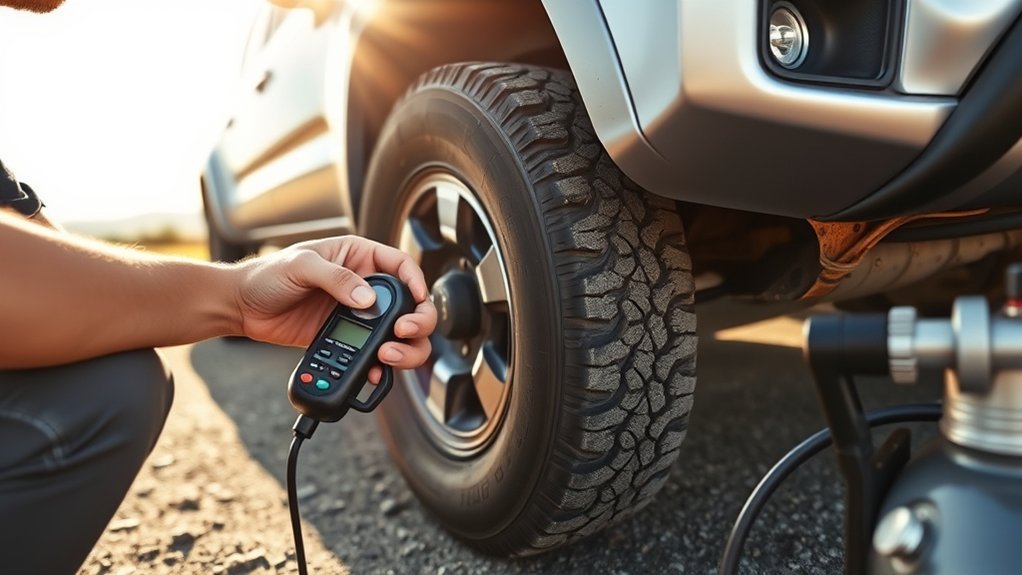
Correct tire inflation directly affects how your Tacoma corners, brakes, handles wet pavement, supports heavy payload, and manages fuel consumption. Underinflation increases tire casing flex and internal heat build-up, accelerates outer-shoulder tread wear, and increases rolling resistance. Overinflation reduces the contact patch, stiffens ride quality over bumps, degrades off-road and wet traction, and wears down the center tread prematurely.
The safest reference is the cold inflation pressure specified by Toyota for your exact truck. Official specifications are detailed in the 2025 Tacoma Owner’s Manual and 2024 Tacoma Maintenance Specifications.
NHTSA TireWise advises checking every tire—including the spare—at least once a month when cold. The federal agency emphasizes that built-in TPMS monitors are not maintenance tools because they trigger warnings only after severe underinflation has already occurred.
The correct Tacoma tire pressure is the vehicle manufacturer’s recommended cold PSI on the door placard, not the maximum pressure molded into the tire sidewall.
How Do You Find the Correct Tacoma Tire Pressure?
Your Tacoma’s recommended tire pressure is customized to its specific chassis and factory tire equipment. Always confirm the exact specification before adding or releasing air.
[Products Worth Considering]

This oil filter wrench set makes removing and installing canister oil filter caps faster and cleaner with a 3/8-inch drive wrench and multiple common-size sockets. The low profile design helps reach tight engine spaces, while clear size markings simplify selection for quick service. Built from durable steel and aluminum with corrosion-resistant coating, it is designed for reliable use across a wide range of compatible vehicles.
This GUNHYI full exterior car cover is designed to protect coupe and sedan vehicles from sun, rain, dust, snow, pollen, bird droppings, and other harsh outdoor conditions. It features reflective stripes, an elastic hem, windproof straps, and double-stitched construction for a secure fit and added durability. Suitable for select sports cars and compact sedans up to the specified length, it is ideal for both indoor and outdoor storage.

🚲 HIGH QUALITY: This is a set of 4 tire valve stem covers made of aluminum alloy, they also help protect the valve stem from wear and have a beautifully anodized finish that gives it a long lasting finish.
Check the Driver-Side Door Sticker First
Open the driver’s door and locate the yellow-and-white Tire and Loading Information label affixed to the B-pillar or door jamb. This placard lists the original equipment tire sizes and the precise cold inflation pressure for both the front and rear axles, along with maximum cargo capacity.
Use the Owner’s Manual as a Backup
If the door placard is missing or unreadable, check the “Specifications” section of your Tacoma owner’s manual. If you have installed non-factory tires or upgraded to Light Truck (LT) load-range tires, refer to our guide on Tacoma tire load index, load range, and speed rating to determine load-inflation equivalence.
Do Not Use the Sidewall PSI as Your Target
The number molded into the rubber sidewall (often 44, 50, or 80 PSI on LT-rated tires) represents the tire’s maximum permissible cold inflation pressure at maximum rated load. It is not Toyota’s vehicle-specific recommendation. Inflating to the sidewall maximum causes harsh ride quality, increased stopping distances, and accelerated center tread wear.
Warning: Never exceed the maximum PSI molded on the tire sidewall. If running aftermarket wheel dimensions or higher load ranges (such as Load Range E), consult tire manufacturer load-inflation tables rather than guessing.
How Do You Check Toyota Tacoma Tire Pressure With a Gauge?
Accurate pressure checks require three conditions: fully cold tires, an accurate gauge, and an airtight seal on the valve stem. Digital, dial, and pencil gauges all work well, but you should take two consecutive readings on each wheel to ensure consistency.
[Products Worth Considering]
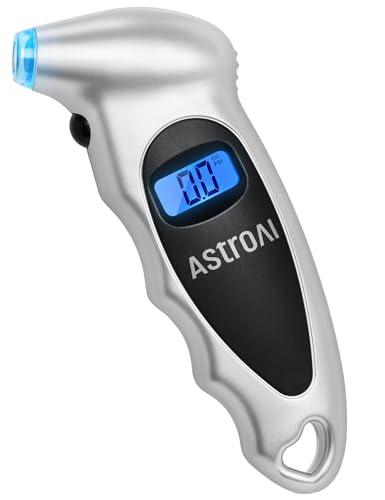
Accurate, Dependable Readings: Factory‑calibrated to ±1 PSI, so you can confidently match your vehicle’s recommended PSI (check the door jamb sticker). Ideal for monthly checks and road trips — consistent results every time, cold or warm.

PROCESS LEVEL ACCURACY: Each ETENWOLF’s digital tire pressure gauge is calibrated manually to ANSI B40.7 Grade 2A(plus-minus 1 PSI).Presta valve adapter not included, if used for bicycles, it must be purchased separately

HIGH ACCURACY: Every ETENWOLF's pencil tire gauge is calibrated to ANSI B40.1 Grade B, it is accurate to 2% of span in the middle 50% of range and 3% of span in the lower and upper 25% of range. Each ETENWOLF pencil tire pressure gauge is manually calibrated and has its unique calibration number printed on the pencil
Choosing the Right Gauge
Select a quality gauge that reads accurately within the 0–60 PSI range. Digital gauges provide clear readouts in poor lighting, dial gauges offer mechanical durability, and pencil gauges serve as compact backups. Avoid relying solely on gas station air-pump gauges, which are frequently dropped and miscalibrated.
Proper Gauge Usage Steps
- Park on level ground and confirm the truck has been stationary for at least three hours.
- Unscrew the valve stem cap and set it on a clean surface.
- Press the gauge straight onto the valve stem firmly until all hissing stops.
- Record the PSI reading immediately.
- Compare the value against your door jamb placard target.
- Add air in short pulses if low, or depress the valve pin briefly if high.
- Recheck the reading after each adjustment until exact.
- Check for slow stem leaks by dabbing a small amount of soapy water over the valve core; look for expanding bubbles.
- Screw the valve cap back on securely by hand to keep out moisture and road grit.
Pro Tip: Keep an accurate digital or dial gauge inside your glove compartment. Checking pressure at home before driving provides a true cold reading that gas station visits cannot match.
Interpreting Pressure Readings
If your reading is below the door placard specification, add only the required difference. For instance, if your placard indicates 30 PSI and your gauge reads 27 PSI, add 3 PSI and recheck.
If a cold tire reads higher than the placard target, release air in short bursts using the bleeder valve on your gauge or by depressing the center valve core pin. Recheck until the pressure matches the placard specification.
Note: Never bleed air from a warm tire down to the cold placard PSI. Friction naturally raises pressure by 3–5 PSI during driving. Bleeding a warm tire will cause dangerous underinflation once the tire cools down.
How Do You Add or Release Air Safely?
Adjusting pressure safely is simple once you have established your cold baseline.
How to Add Air
- Connect your compressor chuck or portable 12V inflator straight onto the valve stem.
- Inflate in 5-to-10 second bursts rather than running continuously.
- Detach the chuck and verify pressure with your standalone gauge.
- Repeat until the reading matches your door placard.
- Reinstall the valve stem cap snugly.
How to Release Air
- Press the center pin in the valve stem with your gauge’s deflator nub or bleed button.
- Release air in brief 3-second bursts.
- Recheck with the gauge between bursts.
- Stop immediately once the target pressure is reached.
Check All Tires, Including the Under-Bed Spare
Always check all four road tires during every maintenance cycle. Do not neglect the spare tire mounted beneath the rear bed. The Tacoma spare uses a full-size or temporary wheel that must be kept at the specified road tire cold PSI.
Because the spare is winched upside down under the truck bed, road dirt often coats the valve stem. If the valve stem is hard to reach, use your Tacoma’s jack extension rods (located behind or under the rear seats) to slightly lower the spare carrier winch, inspect the pressure, and crank it securely back against the frame.
When Should You Check Tacoma Tire Pressure?
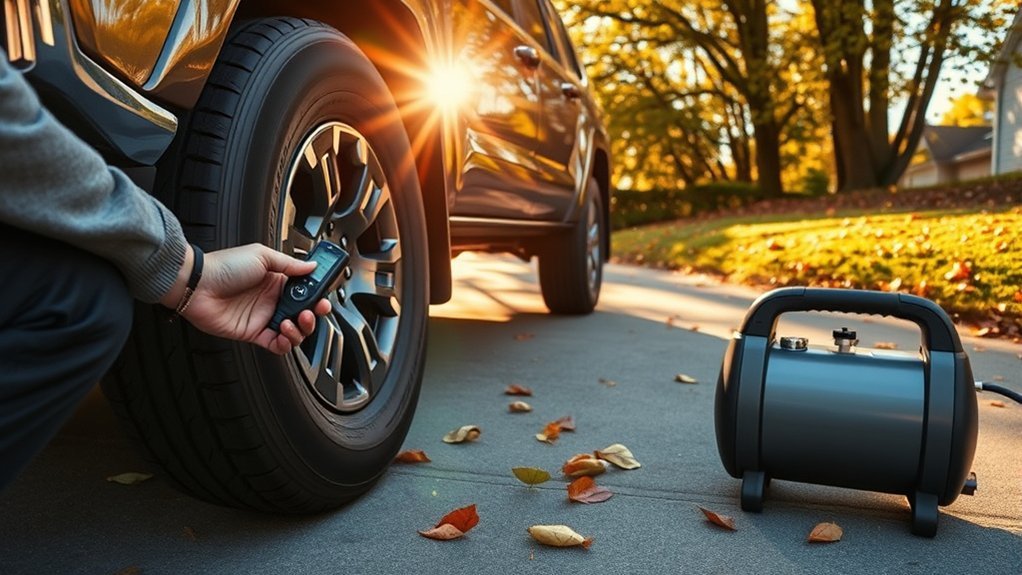
Check your Tacoma’s tire pressure at least once a month and prior to long highway trips. Additional checks are necessary during seasonal temperature swings, after tire rotations, and before towing or hauling heavy payloads.
According to the National Highway Traffic Safety Administration, a tire is considered cold when the vehicle has been parked for at least three hours or driven under 1 mile at moderate speeds. Driving heats the air inside the tire casing, causing thermal expansion that yields artificially high readings.
Best Times to Check Tacoma Tire Pressure
- Early in the morning before the vehicle has been driven
- After the truck has been parked in the shade for at least three hours
- Before hauling cargo, hitching a trailer, or embarking on a road trip
- Immediately following tire rotations, alignments, or tire replacements
- Whenever the TPMS warning light illuminates
- Following significant seasonal temperature drops
How Does Weather Affect Tacoma Tire Pressure?
Ambient temperature changes cause tire pressure to fluctuate naturally without any physical leak. When air cools, its molecules contract, lowering overall internal pressure. When ambient air warms, pressure rises proportionally. This thermal behavior explains why TPMS warning lamps frequently illuminate on the first cold morning of autumn.
The 10-Degree Temperature Rule: As documented by AAA, tire pressure shifts by approximately 1 to 2 PSI for every 10°F (5.6°C) change in ambient temperature.
Is It Temperature Change or a Tire Leak?
| Pressure Loss Pattern | Probable Cause | Corrective Action |
|---|---|---|
| All 4 tires drop 2–4 PSI simultaneously after a cold front | Ambient thermal contraction | Inflate all tires back to door placard cold PSI while cold. |
| A single tire drops 5+ PSI while the other three remain stable | Puncture (nail/screw), leaking valve core, or bead corrosion | Inspect tread for foreign objects and check valve stem with soapy water. |
| One tire repeatedly loses air every 1–2 weeks | Slow puncture, rim bead leak, or micro-crack in wheel | Have a professional tire shop dismount, inspect, and patch or re-seal. |
Pro Tip: Re-inflate your tires to the placard cold PSI during seasonal cold snaps. Do not intentionally overinflate past the placard target in anticipation of cold weather.
What Does the Tacoma TPMS Light Mean?
The Tire Pressure Monitoring System (TPMS) warns the driver when one or more monitored tires drop significantly below normal operating thresholds or when a system fault occurs. It serves as an active safety warning rather than a substitute for routine gauge inspections.
Under federal safety regulations (49 CFR § 571.138), TPMS warning lamps must illuminate when tire pressure drops 25% or more below the manufacturer’s recommended cold placard value. On a 30 PSI placard truck, the light may not trigger until a tire reaches approximately 22.5 PSI—a level already low enough to cause increased tread wear and reduced handling responsiveness.
What the TPMS Light Usually Means
| TPMS Indicator Status | Diagnostic Meaning | Immediate Action |
|---|---|---|
| Solid amber warning icon | One or more tires are underinflated by ≥25% | Check all tires cold with a gauge and inflate to placard PSI. |
| Light on in morning, turns off after driving | Borderline pressure dropping cold, rising when warmed by driving | Top off cold tires to placard PSI so they remain above threshold cold. |
| Flashes for 60–90 seconds, then stays solid | TPMS system malfunction, dead sensor battery, or lost sensor ID | Verify pressure manually; have TPMS sensors and receiver diagnosed. |
| Dash display shows dashes (—) instead of PSI | Sensor communication error, unlinked sensor, or initialization in progress | Drive at ≥25 mph for 10–20 minutes; if unresolved, perform initialization. |
Can You See Individual Tire Pressures on the Tacoma Dash?
Individual digital tire pressure readouts vary by Tacoma generation and trim. Most 3rd Gen (2016–2023) and 4th Gen (2024+) models equipped with the color Multi-Information Display (MID) can display real-time numeric PSI for all four tires. Base trims and older 2nd Gen models feature only the standard instrument cluster warning lamp. Always rely on a physical gauge when adjusting pressure.
How Do You Reset the Tacoma Tire Pressure Light?
Never reset or initialize the TPMS simply to extinguish an active warning light. Always set every tire to the placard cold PSI and inspect for leaks first. During initialization, the system records the current tire pressures as the new baseline reference; initializing while tires are underinflated will program an incorrect safety threshold.
Method A: Physical Reset Button (2005–2017 Tacomas)
- Park the truck on level ground and let the tires cool for at least 3 hours.
- Inflate all road tires (and spare, if sensor-equipped) to the exact door placard cold PSI.
- Turn the ignition switch to the “ON” position (engine off).
- Locate the physical TPMS SET button on the lower instrument panel beneath the steering column or inside the glove box.
- Press and hold the SET button until the TPMS warning light on the instrument cluster flashes slowly 3 times.
- Release the button and leave the ignition “ON” for several minutes to allow the ECU to store values.
- Drive the truck at 25 mph or faster for 15–30 minutes to complete sensor calibration.
Method B: Multi-Information Display / Digital Cluster (2018–2024+ Tacomas)
- Confirm all tires are inflated to the exact placard cold PSI while cold.
- Turn the ignition switch to “ON” or press the Power button twice without touching the brake.
- Use the steering wheel meter control switches to navigate to the Settings (Gear Icon) menu on the instrument cluster display.
- Select Vehicle Settings, then scroll to TPMS / Tire Pressure Warning System.
- Select Tire Inflation Pressure Setting or Initialize Pressure Setting.
- Press and hold the “OK” button on the steering wheel until the TPMS indicator light flashes 3 times or a confirmation message appears.
- Drive the vehicle at speeds above 25 mph for 10–20 minutes until numeric pressure readings register on the cluster.
Diagnostic Warning: If the warning lamp flashes continuously for 60 to 90 seconds before staying solid, the system has detected an internal fault (such as an expired sensor battery or lost signal). An initialization procedure will not clear hardware faults; sensor diagnostics with a TPMS scan tool are required.
When Should You Not Reset TPMS?
- Do not reset the system while any tire is visibly low or losing air.
- Do not use initialization to bypass a slow puncture, valve core leak, or bead failure.
- Do not expect an initialization reset to register brand-new replacement TPMS sensor IDs.
Is TPMS Reset the Same as Registering New Sensors?
No. TPMS Reset/Initialization re-calibrates the baseline pressure threshold for sensors that the truck already recognizes. Sensor Registration (ID Coding) is the process of programming new 7- or 8-digit sensor identification codes into the truck’s TPMS receiver module after installing new wheels or sensors. Adding air or holding the reset button will not register unrecognized sensors.
Common Mistakes With Tire Pressure to Avoid
Avoiding these common tire pressure mistakes will maximize tread life, enhance fuel economy, and maintain vehicle stability.
- Checking warm tires and adjusting down: Tires heated by highway driving read 3–5 PSI higher; venting air from a warm tire causes underinflation when cold.
- Inflating to the sidewall maximum PSI: The sidewall PSI is a maximum design threshold, not Toyota’s chassis recommendation.
- Assuming all Tacomas use 30 or 35 PSI: Model year, factory package, and cab style dictate different requirements across generations.
- Ignoring rear tire axle loading: Carrying cargo or towing requires strict adherence to rear placard specifications.
- Treating the TPMS warning light as a maintenance alert: TPMS triggers only after significant underinflation; check monthly with a gauge.
- Neglecting the under-bed spare tire: An unmaintained spare will be flat when needed on the roadside.
- Initializing TPMS before setting pressure: Resetting TPMS on low tires programs an unsafe threshold into the truck’s computer.
- Ignoring isolated pressure drops: Continually adding air to one specific tire overlooks slow punctures that can lead to highway blowouts.
How to Maintain Optimal Tire Pressure Year-Round
Incorporate cold tire pressure inspections into your monthly vehicle maintenance schedule. Trucks regularly subjected to off-road terrain, towing loads, or heavy payload duty require more frequent checks.
Maintaining proper tire pressure also preserves fuel efficiency. According to FuelEconomy.gov, keeping tires properly inflated can improve gas mileage by up to 3%. Conversely, underinflation reduces fuel economy by approximately 0.2% for every 1 PSI drop across all four tires while increasing tread wear.
Monthly Tacoma Tire Pressure Checklist
- Measure all four road tires cold with a trusted gauge.
- Inspect the under-bed spare tire pressure and valve condition.
- Verify readings against the driver-side door placard.
- Inspect tread surfaces for uneven wear, feathering, cracking, or punctures. If the vehicle pulls or shows shoulder wear, review our guide to Tacoma wheel-alignment warning signs.
- Ensure all four valve stem caps are clean, undamaged, and securely finger-tightened.
- Record monthly PSI readings to identify slow valve or bead leaks early.
Before Towing, Hauling, or Off-Roading
Before towing heavy trailers or loading the bed to payload capacity, verify that rear tires meet the cold door placard pressure precisely. For off-road trail driving, airing down to 15–20 PSI increases the tire footprint and mechanical traction over rocks and sand. However, airing down is strictly a temporary low-speed trail setting; always reinflate to the door placard cold PSI before returning to paved roads or highway speeds. For deeper terrain setups, consult our Tacoma off-road tire traction guide.
Note: If running oversized Light Truck (LT) tires (e.g., Load Range C, D, or E), do not guess pressures or use the tire sidewall maximum. Consult the tire manufacturer’s official Tire & Rim Association (TRA) load-inflation conversion tables to match original factory load capacity.
Frequently Asked Questions
How do I reset the tire pressure light on a Toyota Tacoma?
First, set every tire to the cold PSI on the driver-side placard and inspect for leaks. On 2005–2017 models, hold the physical TPMS SET button under the steering column until the light flashes 3 times. On 2018+ models, use the steering wheel buttons to navigate to Settings > Vehicle Settings > TPMS on the cluster display and initialize. Drive at 25+ mph to complete calibration.
What PSI should Toyota Tacoma tires be?
Use the front and rear cold PSI printed on your driver-side door jamb placard. Depending on generation, trim, and tire size, factory recommendations typically range between 29 and 32 PSI on 2nd/3rd Gen models, and 30, 32, or 35 PSI on 2024+ 4th Gen models.
Is 35 PSI too high for a Tacoma?
Not necessarily. While 35 PSI is the official cold specification for certain 2024+ factory configurations (such as 245/70R17 utility setups), it may be slightly high for older 2nd or 3rd Gen models where 29–30 PSI is recommended. Always cross-reference your door placard.
Should I check Tacoma tire pressure hot or cold?
Always check and adjust tire pressure cold. A tire is considered cold when the truck has been stationary for at least three hours or driven less than 1 mile. Driving heats the tire air, increasing pressure readings by 3–5 PSI.
Why did my Tacoma TPMS light come on after a cold night?
Cold weather causes air to contract, lowering tire pressure by roughly 1 to 2 PSI for every 10°F temperature drop. If your tires were already borderline low, this drop triggers the TPMS. Check and re-inflate all four tires to placard PSI while cold.
Can I use the maximum PSI on the tire sidewall?
No. The sidewall number is the maximum pressure the tire can safely hold under maximum load capacity. It is not Toyota’s vehicle handling recommendation. Inflating to the sidewall maximum causes harsh ride quality, decreased braking performance, and rapid center wear.
Why does one Tacoma tire keep losing pressure?
An isolated pressure drop points to a slow puncture (nail/screw), a corroded wheel bead, or a leaking valve stem core. Do not simply keep topping it off; have the tire dismounted and repaired with an internal patch-plug by a qualified tire technician.
Why did all four Tacoma tires lose pressure at once?
A uniform drop across all four tires is almost always caused by a seasonal temperature drop rather than simultaneous leaks. Verify the cold PSI on all four wheels and inflate them back to your door placard target.
Conclusion
Maintaining proper Toyota Tacoma tire pressure is a straightforward task that directly protects vehicle safety, handling dynamics, and tire longevity. Always use the cold PSI listed on your driver-side door placard as your baseline, inspect all five tires (including the under-bed spare) at least once a month, and distinguish between normal seasonal pressure loss and isolated slow leaks. Keep an accurate gauge in your truck, never bleed warm tires, and follow your generation’s specific TPMS reset steps only after setting correct cold pressures.
Sources
- Toyota Owners — 2025 Tacoma Tire Inflation Pressure — supports cold inflation procedures, door placard primacy, and digital cluster reset navigation.
- Toyota Owners — 2024 Tacoma Maintenance Data — supports 30, 32, and 35 PSI factory baseline configurations.
- Toyota — How to Check Tire Pressure — supports checking before driving or after a 3-hour cooling interval.
- NHTSA TireWise — Tire Safety — supports cold inflation standards, monthly routine inspections, and TPMS warning parameters.
- FuelEconomy.gov — Keeping Your Vehicle in Shape — supports fuel economy benefits and underinflation consumption penalties.
- 49 CFR § 571.138 — Tire Pressure Monitoring Systems — supports federal 25% underinflation warning threshold requirements.
- Toyota Owners — 2025 Tacoma Manuals and Warranties — supports model-year specific TPMS display calibration and initialization protocols.
- AAA — Tire Pressure and Temperature Change — supports the 1–2 PSI per 10°F ambient temperature rule.

[…] Check the tires before driving or after the SUV has been parked for at least three hours. Do not use the pressure information on the tire sidewall as the vehicle’s operating target, and do not bleed a warm tire down to the cold placard value. For a model-specific example, see how to check and set tire pressure on a Toyota Tacoma. […]