By: Auto Review Nest Editorial Team · Last updated: August 31, 2026
What’s in This Article
- Toyota Tacoma Catalytic Converter Replacement: 5-Step Overview
- How to Confirm the Converter Needs Replacement
- Before You Begin: Legal, Fitment, and Safety Checks
- Tools and Parts You’ll Need for a Tacoma Converter Swap
- How to Support the Tacoma and Exhaust Safely
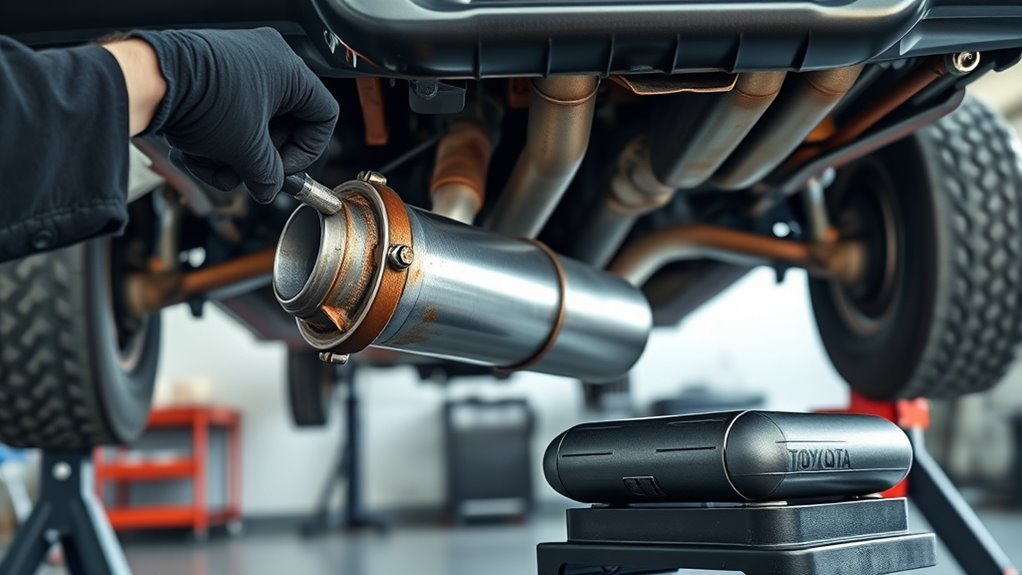
- Remove the Tacoma Catalytic Converter
- Install the New Converter
- Torque, Leak Test, and Final Checks
- Common Mistakes That Cause Leaks or Inspection Problems
- When to Call a Mechanic
- Frequently Asked Questions
Toyota Tacoma catalytic converter replacement is a reasonable DIY job only when the failed unit is a reachable, bolt-in direct-fit section. Before removing anything, confirm the converter is actually faulty, match the replacement to the truck’s year, engine, emissions label, and original converter location, and check the emissions rules where the truck is registered. Also check applicable emissions-warranty coverage and any Toyota service campaign for the VIN before paying for a replacement. Use a qualified exhaust shop when the converter is welded in, integrated into an exhaust manifold, surrounded by severe corrosion, or attached with broken studs.
Quick Answer
To replace a bolt-in Toyota Tacoma catalytic converter, support the truck with rated jack stands, support the exhaust separately, disconnect any oxygen sensors that block removal, remove the old converter, clean the sealing surfaces, and install the correct direct-fit unit with the specified gaskets and hardware. Tighten every fastener to the service information for your exact model, then inspect for leaks without placing your hands near hot exhaust parts. Do not replace the converter based on a P0420 or P0430 code alone; exhaust leaks, sensor faults, misfires, and fuel-control problems can trigger similar symptoms or damage the new converter. Before buying the part, check federal emissions-warranty eligibility and any applicable Toyota campaign for the VIN.
Key Takeaways
- Confirm the converter failed and correct the cause before installing a replacement.
- Use a converter that matches your Tacoma’s year, engine, emissions label, converter position, and legal application.
- Check federal emissions-warranty coverage before paying for an aftermarket converter.
- If you have a certain 2010–2014 Tacoma with the 2TR-FE engine, check the VIN for Toyota Special Service Campaign F0U before buying parts.
- Support the truck with rated jack stands and support the exhaust before loosening flange hardware.
- Replace crushed gaskets, damaged hardware, and worn hangers, but do not assume every hanger or oxygen sensor needs replacement.
- Use model-specific torque values and perform a visual, listening, or low-pressure smoke leak test before driving.
| What You Find | DIY Suitability | Best Next Step |
|---|---|---|
| Accessible bolt-in converter, solid flanges, and manageable corrosion | Possible for an experienced DIYer | Verify fitment, gather service data, and follow the steps below |
| Converter integrated into the exhaust manifold or welded into the pipe | Usually a shop repair | Use a qualified mechanic or exhaust specialist |
| P0420 or P0430 with no mechanical diagnosis | Do not order a converter yet | Check leaks, misfires, fuel control, sensor data, and engine condition first |
| Truck may still be within the federal emissions warranty | Do not buy an aftermarket unit yet | Check eligibility for catalytic-converter warranty coverage first |
| Certain 2010–2014 Tacoma with the 2TR-FE engine | Campaign status must be checked first | Have the VIN checked for Toyota Special Service Campaign F0U |
| Broken studs, stripped oxygen-sensor threads, cracked pipes, or heavy rust | High risk for driveway repair | Use a shop with a lift, extraction tools, and welding capability |
Time and difficulty: A clean bolt-in replacement may take several hours. Severe rust, damaged wiring, welded sections, or manifold-integrated converters can turn it into a longer professional repair. There is no reliable all-years Tacoma labor time because converter layout and access vary by generation, engine, emissions package, and converter position.
Research basis: This guide is based on current EPA and California Air Resources Board emissions guidance, Toyota service-campaign documentation hosted by NHTSA, current repair-cost data, and vehicle-specific service considerations. It does not claim hands-on testing of every Tacoma generation or converter layout.
Toyota Tacoma Catalytic Converter Replacement: 5-Step Overview
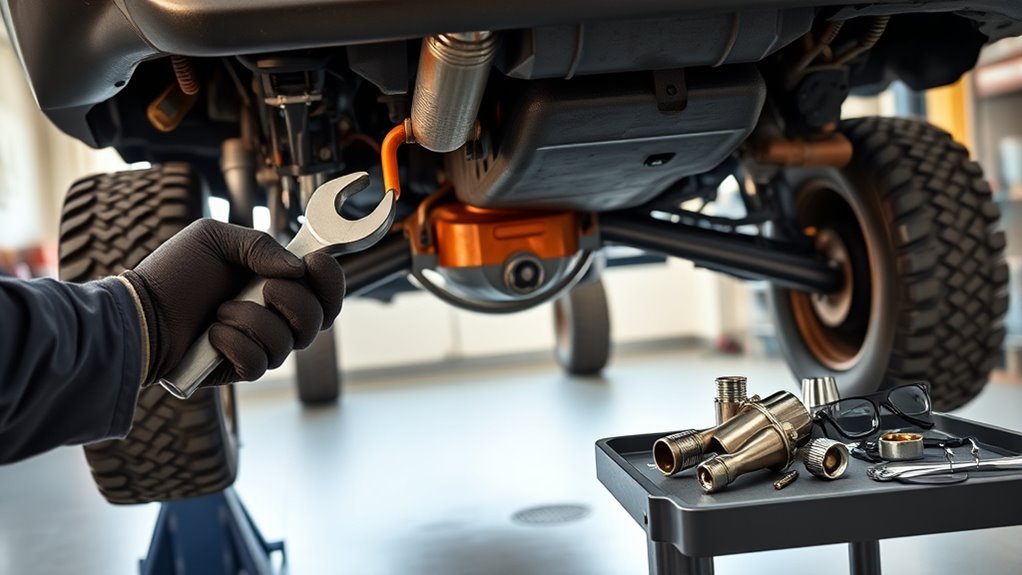
These steps apply to a direct-fit converter that bolts into the exhaust. Confirm the converter design and service procedure for your exact Tacoma before starting.
- Diagnose and match the part. Confirm the converter needs replacement, check applicable warranty or campaign coverage, then match the new unit to the year, engine, emissions certification, and converter position.
- Support the truck and exhaust. Chock the wheels, use rated jack stands at approved support points, and hold the exhaust with a strap or exhaust stand.
- Remove the old unit. Let the exhaust cool, soak corroded hardware, disconnect obstructing oxygen sensors, and remove the converter without loading nearby pipes or wiring.
- Prepare and install. Clean the sealing faces, fit the specified new gaskets and serviceable hardware, align the assembly naturally, and hand-start every fastener.
- Torque and test. Tighten to model-specific specifications, check sensor routing and heat shields, then inspect every joint for leaks.
[Products Worth Considering]

This silicone key fob cover is designed to fit select Toyota Camry and Corolla Crown 4-button key fobs, helping protect them from scratches, wear, and everyday pocket damage. Made from food-grade silicone, it offers a soft, comfortable feel while keeping all buttons accessible and the signal unaffected. The fluorescent white buttons also make it easier to identify controls at night, and the set includes two covers with matching key chains.

The LEXIVON 3/8-Inch Drive Click Torque Wrench is built for accurate, reliable fastening across a wide range of automotive and mechanical tasks. It arrives pre-calibrated for dependable use, with a clear dual-range scale for easy reading and a reversible ratchet head for added convenience. The hardened steel construction and corrosion-resistant finish help deliver long-lasting performance and comfort in everyday use.

The OXILAM jump starter delivers powerful emergency starting performance for gas engines and up to 12L diesel engines, helping revive dead batteries in seconds. It also doubles as a portable power bank and LED flashlight, with USB and Type-C ports for convenient device charging. Built with multiple safety protections, a clear LED display, and a rugged portable design, it is a reliable roadside companion for cars, trucks, motorcycles, and more.
How Do You Confirm the Tacoma Converter Needs Replacement?
A catalyst-efficiency code does not prove that the converter itself is the only fault. Scan and record all diagnostic trouble codes and freeze-frame data before clearing anything. Look for misfire codes, fuel-trim problems, oxygen-sensor faults, and evidence of an exhaust leak ahead of or near the converter.
If you need a deeper explanation of converter operation, sensor roles, and diagnostic codes before starting the repair, see how a Toyota Tacoma catalytic converter works.
Check for engine problems that can quickly damage a new converter. Common concerns include repeated misfires, an overly rich fuel mixture, oil burning, coolant entering the combustion chambers, damaged sensor wiring, and unmetered air or fuel-control faults. The EPA’s aftermarket-converter guidance says proper vehicle tuning and the correct converter application are critical to converter life and performance.
- If the truck has major power loss, test for excessive exhaust backpressure before ordering parts.
- If you hear a rattle, separate a loose heat shield from a broken converter substrate.
- If soot appears around a flange, repair the exhaust leak before judging converter efficiency.
- If live oxygen-sensor data looks abnormal, test the sensors and wiring instead of replacing them automatically.
Fix the root cause first. RepairPal also warns that an unresolved engine or fuel problem can quickly ruin a replacement converter.
Before You Begin: Legal, Fitment, and Safety Checks
[Products Worth Considering]

K&N Advantage Plus Engine Air Filter is designed to deliver long-lasting engine protection with easy factory air box installation and compatibility across a wide range of Toyota, Lexus, and Mitsubishi vehicles. Its premium filter media provides up to 99% filtration efficiency, helping protect your engine while extending service intervals up to 18,000 miles under normal driving conditions. Built with durable materials and backed by a limited warranty, it is a practical replacement choice for drivers who want reliable performance and reduced maintenance.

This 9-piece torque wrench set gives DIYers and professionals a versatile way to tighten fasteners with confidence across bikes, motorcycles, cars, trucks, and industrial equipment. It includes three click torque wrenches, multiple adapters, dual-scale measurement, and clear audible feedback to help prevent overtightening. Built with durable materials and stored in a portable case, it is designed for precise, organized, and reliable use.

1.VEHICLE FITMENT: Catalytic Convertor fit for 2005-2015 Toyota Tacoma 2.7L Catalyst Converter, Interchange Part Number: 54702
Check Federal Emissions-Warranty Coverage First
Before buying an aftermarket converter, check whether the vehicle may still have applicable emissions-warranty coverage. The EPA identifies catalytic converters as specified major emissions-control components covered by the federal emissions warranty for 8 years or 80,000 miles, whichever comes first, subject to the warranty’s conditions. A potentially covered failure should be checked through an authorized manufacturer representative before you pay for an aftermarket replacement.
Check Toyota Campaign Status on Certain 2010–2014 2TR-FE Tacomas
Toyota issued Special Service Campaign F0U for the exhaust pipe and front catalytic converter on certain 2010–2014 Tacoma vehicles equipped with the 2TR-FE engine. Toyota’s technical instructions state that internal converter components could deteriorate, begin to rattle, become dislodged, restrict exhaust flow, illuminate the check-engine light, and reduce engine power. If your truck falls into this model-year and engine group, have the VIN checked for campaign status before ordering a converter. See the Toyota F0U technical instructions hosted by NHTSA.
Verify the Exact Converter Application
Check your Tacoma’s Vehicle Emission Control Information (VECI) label, VIN, engine size, model year, and converter location before ordering parts. The EPA guidance for aftermarket catalytic converters directs installers to use the proper application, install the same converter type in the original location, and retain all converters the vehicle originally required unless the replacement manufacturer states in writing that one unit replaces more than one.
Before You Order a Converter
- Record the VIN and exact model year.
- Confirm the engine and drivetrain configuration.
- Read the VECI label, including the emissions/test-group information needed for legal application matching.
- Identify exactly which converter position has failed instead of assuming every converter on the truck needs replacement.
- Check warranty, Toyota campaign status, and the emissions rules where the Tacoma is registered.
Do not replace a working converter simply to install a cheaper part. EPA guidance limits aftermarket replacement to legitimate situations, including a missing, damaged, poisoned, plugged, or otherwise failed converter, and it excludes repairs that should be handled under an applicable warranty or recall. Commercial installers also have documentation and record-retention duties, so keep the invoice, application information, and reason for replacement.
California requires approved aftermarket converters for applicable vehicles. The California Air Resources Board aftermarket converter database can be searched by vehicle information or Executive Order number. CARB states that correct application matching uses information including the make, model, model year, engine size, and test group or engine family. Verify the exact approved application and the current emissions rules where the Tacoma is registered before purchase.
Warning: Never work under a Tacoma supported only by a jack. Let the exhaust cool fully, use rated jack stands on a flat solid surface, and follow the jacking and support points in the owner’s manual for your model year.
Tools and Parts You’ll Need for a Tacoma Converter Swap
Gather the tools and service information before loosening the first fastener. Socket and fastener sizes vary by model year, engine, converter position, and previous repairs, so inspect the truck instead of assuming one universal size.
- Floor jack, rated jack stands, and wheel chocks
- Exhaust stand or rated support strap for the pipe assembly
- Six-point sockets, ratchet, extensions, and breaker bar
- Oxygen-sensor socket or crowfoot if sensor removal is required
- Calibrated torque wrench that covers the specified range
- Penetrating oil, wire brush, and gasket scraper
- Safety glasses, gloves, work light, and hearing protection when cutting tools are used
- Rubber-safe lubricant recommended for exhaust hangers
For parts, get the exact direct-fit converter, the specified gasket for each joint, and the correct replacement bolts, nuts, springs, or washers used by that flange design. Replace a rubber hanger only when it is cracked, stretched, hardened, or heat-damaged. Keep reusable oxygen sensors unless testing, damaged wiring, seized threads, or the service procedure gives a reason to replace them.
Choose original equipment, an appropriate OEM-equivalent part, an EPA-compliant aftermarket application, or a CARB-approved application as required. Do not install an untested used converter. EPA guidance permits qualifying remanufactured used converters only when they meet its testing, application, labeling, and other policy requirements.
[Products Worth Considering]

FITMENT:ZonCar Catalytic Converter Replacement for 2005-2010 Toyota Tacoma 4.0L 4WD, 2011-2015 Toyota Tacoma 4.0L Rear Left/Rear Right 52451/50352

Protect What Thieves Target Most: Heavy-duty 14-gauge steel creates a strong physical barrier around your catalytic converter, helping deter theft on city streets, job sites, and high-risk parking areas.
How to Support the Tacoma and Exhaust Safely
Park on a flat, solid surface, set the parking brake, place the transmission in Park or in gear as appropriate, and chock the wheels that remain on the ground. Lift only at approved points, then lower the truck onto rated jack stands before going underneath. Keep the work area well lit and leave a clear exit path.
Support the Exhaust Assembly
Support the pipe or muffler assembly before removing converter fasteners. Hold it close to its installed position so its weight does not pull on hangers, heat shields, oxygen-sensor wiring, flex sections, or nearby flanges.
Use an exhaust stand or rated strap that supports the pipe without crushing it. Gently test the assembly before loosening hardware. If it shifts, changes angle, or loads a nearby joint, reposition the support.
Check the Work Area Before Removal
Keep your face away from falling rust and dirt when working overhead. Inspect the converter area for fuel or brake lines, damaged heat shields, loose wiring, oil contamination, and severe corrosion before using high force or cutting tools.
- Confirm every jack stand sits flat, locks correctly, and contacts a proper support point.
- Confirm the wheel chocks prevent movement in both directions.
- Verify the exhaust is cool enough to touch before handling sensors or flanges.
- Keep electrical connectors, fuel lines, and combustible material away from sparks and heat.
Stop and use a professional shop if safe access requires a torch, welding, or aggressive cutting near fuel, brake, or electrical components.
Remove the Tacoma Catalytic Converter (Rusted Bolts and Gaskets)
Apply penetrating oil to corroded flange hardware and allow the product’s recommended soak time. Inspect the old gasket area for cracks, crushed sections, corrosion, and soot. Soot at a joint often indicates leakage, but confirm the source because exhaust can travel along nearby surfaces.
Disconnect oxygen sensors only when access or converter design requires it. Mark the connector and position for each sensor, unplug the harness without pulling the wires, and use the proper sensor tool. Avoid twisting the harness as the sensor turns.
How to Handle Rusted Converter Bolts
Use a correctly fitting six-point socket and steady force from a breaker bar. Support the exhaust before applying leverage, and do not rock the truck on the stands. If a fastener rounds, a stud begins to pull from the flange, or the pipe flexes excessively, stop before the repair becomes a broken-flange job.
- Clean exposed threads before adding more penetrant.
- Use controlled force and keep your body clear of the tool’s release path.
- Replace cut, stretched, rounded, or deeply corroded hardware.
- Use a shop when safe removal requires heat, welding, or extraction equipment you do not have.
Do not reuse a fastener that cannot provide reliable clamping force after repeated exhaust heat cycles.
Clean and Inspect the Gasket Surfaces
Remove the old gasket and clean both sealing faces with a wire brush and gasket scraper. Remove rust scale, carbon, and gasket residue without gouging the flange or sending debris into an open pipe.
Match the replacement gasket to the converter and joint design. Tacoma exhaust joints may use different gasket shapes and materials depending on the year, engine, and converter position. Dry-fit the gasket and converter to confirm bolt-hole alignment and natural pipe position.
Use anti-seize, thread locker, or exhaust sealant only when the Toyota service information or the replacement hardware and converter manufacturer specifically allows it. Lubricated threads can change clamp load at a stated torque, while excess sealant can interfere with oxygen sensors or sealing surfaces.
Install the New Converter: Hangers, Gasket, Hardware, and Seals
Position the converter so the flow direction, sensor bungs, heat shields, and flange angles match the original assembly. If the converter uses rubber hangers, apply only a rubber-safe lubricant recommended for the hanger material. Seat each specified gasket flat and centered.
- Confirm the converter part number and emissions application before installation.
- Route oxygen-sensor wiring away from hot pipes, moving parts, and sharp shield edges.
- Hand-start every bolt or nut before applying tool pressure.
- Align the exhaust with its supports instead of pulling mismatched flanges together with bolts.
Snug the fasteners in small, even steps so the flange seats without cocking the gasket. Stop if the assembly must be forced sideways or upward. Forced alignment can crack a weld, preload a flex section, distort a flange, or create an immediate leak.
Reinstall oxygen sensors in their original positions using the service procedure for your Tacoma. Do not contaminate the sensing tip, and do not add anti-seize unless the sensor or service information calls for it. Some replacement sensors arrive with the correct compound already applied to the threads.
Torque, Leak Test, and Final Checks
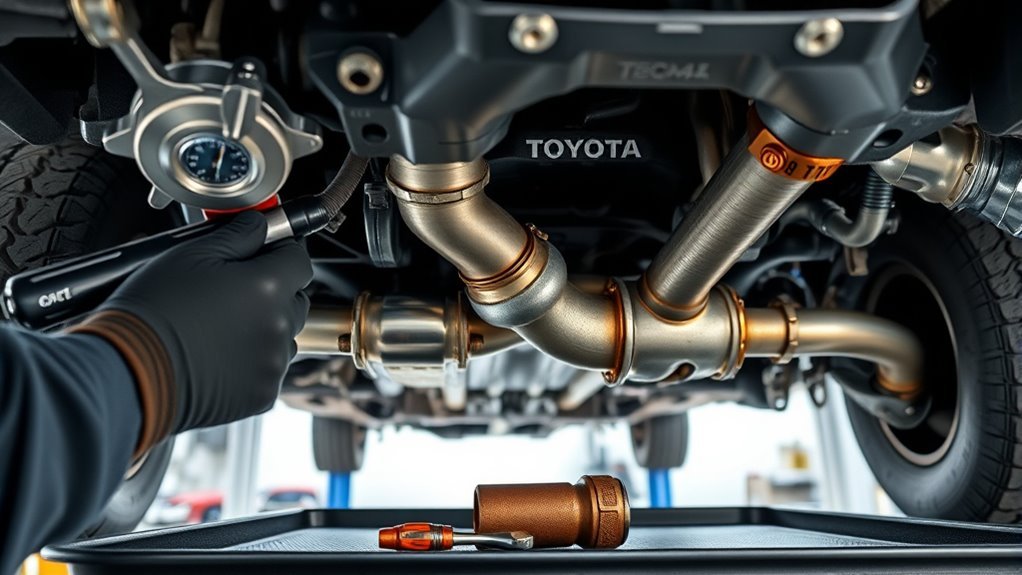
Tighten all fasteners to the published values for the exact model year, engine, converter position, and hardware design. Use a calibrated torque wrench, tighten in stages, and follow the specified sequence. Do not publish or rely on a generic Tacoma torque value for every converter joint.
Before starting the engine, confirm that tools are clear, oxygen-sensor connectors are locked, wiring is clipped away from heat, heat shields are secure, and the exhaust has adequate clearance from the frame, body, and driveline. Remove the separate exhaust support only after the assembly is fully secured.
Start the engine in a well-ventilated area and listen for ticking or puffing at each joint. Look for fresh soot and movement at the flanges without touching hot parts. A professional low-pressure smoke test is the most useful way to locate a small leak that is difficult to hear or see.
After a complete heat cycle and full cool-down, inspect the gaskets, hardware, sensor wiring, and shields again. Retorque only when the service information or hardware manufacturer requires it. Scan for returning codes and diagnose them before replacing more parts.
Common Mistakes That Cause Leaks or Inspection Problems
Installation errors and missed engine faults can cause exhaust noise, a check engine light, repeat converter damage, or a failed emissions inspection.
- Replacing the converter based only on P0420 or P0430 without checking leaks, sensors, misfires, and fuel control
- Buying a converter that does not match the year, engine, VECI label, converter position, or required emissions approval
- Buying a converter before checking applicable emissions-warranty or Toyota campaign coverage
- Reusing a crushed gasket or hardware that is stretched, rounded, or deeply corroded
- Pulling misaligned flanges together with bolts
- Twisting oxygen-sensor wiring or routing it close to the exhaust
- Applying unapproved sealant, anti-seize, or thread locker
- Skipping the leak test and the underlying-cause diagnosis
If the light returns, scan the diagnostic trouble codes and review freeze-frame and live data before replacing another converter or sensor.
When to Call a Mechanic
Use a qualified mechanic or exhaust shop when the converter is integrated into the exhaust manifold, welded into the pipe, or blocked by components that require major disassembly. Professional help is also the safer choice for broken studs, stripped oxygen-sensor threads, cracked flanges, severe corrosion, damaged theft-cut wiring, or repairs that require welding.
Do not keep driving when the Tacoma has severe power loss, a glowing or overheating converter, repeated misfires, black exhaust smoke, a strong raw-fuel smell, or excessive exhaust heat under the floor. Shut the engine off and arrange a tow. These symptoms can indicate a restricted or overheated converter and an engine fault that may damage the replacement.
Use a licensed emissions repair shop when the converter application, documentation, or inspection rules are unclear. A shop can match the part to the emissions label, diagnose the cause, and document the repair.
Frequently Asked Questions
How Much Does It Cost to Replace the Catalytic Converter on a Toyota Tacoma?
There is no useful single price for every Tacoma because current estimates vary sharply by model year. RepairPal’s year-specific table, updated August 7, 2026, lists examples of about $238 to $340 for several 2016–2023 model years, about $1,479 to $1,542 for 2013–2015, and about $3,053 to $3,172 for 2024–2025. Its estimates exclude taxes and fees and can change with location and related repairs. Your actual quote also depends on the engine, converter position, OEM versus aftermarket choice, federal versus CARB application, corrosion, sensor or flange damage, and how many components require replacement. Use the exact model year and location when requesting an estimate rather than relying on a Tacoma-wide average.
How Many Catalytic Converters Does a Toyota Tacoma Have?
The number and location vary by model year, engine, drivetrain, and emissions package. Some Tacoma configurations use manifold-integrated converters plus downstream exhaust components, while others use different front-pipe or underbody layouts. Use the VIN, VECI label, Toyota parts catalog, and an underbody inspection to identify every required converter before ordering.
Can You Drive a Tacoma With a Bad Catalytic Converter?
Do not drive if the truck has major power loss, repeated misfires, black smoke, a raw-fuel smell, excessive exhaust heat, or a glowing converter. Arrange a tow because a restricted or overheated converter can create a fire risk or damage nearby components. If the truck only has a catalyst-efficiency code and otherwise runs normally, limit driving and schedule diagnosis promptly.
Do You Need to Replace the Oxygen Sensors Too?
No. Replace an oxygen sensor only when testing shows it is faulty, its wiring or connector is damaged, its threads are unusable, or it cannot be removed from the old assembly without damage. A converter replacement alone does not prove the sensors are bad.
Will an Aftermarket Converter Pass Emissions?
It can pass when the converter is the correct application, the engine has no unresolved fault, the exhaust has no leak, and the part meets the rules where the truck is registered. Federal aftermarket applications may be acceptable where federal rules apply. California requires an approved CARB application, and the Executive Order must match the specific vehicle application.
Does P0420 Mean the Tacoma Needs a New Catalytic Converter?
Not by itself. P0420 means the engine computer detected catalyst efficiency below its expected threshold, but an upstream exhaust leak, incorrect fuel control, repeated misfires, oxygen-sensor faults, or wiring problems can affect the readings. Diagnose those causes and review live sensor data before condemning the converter.
How Long Does a Toyota Tacoma Catalytic Converter Replacement Take?
There is no reliable all-years repair time because Tacoma converter layouts differ by model year, engine, emissions package, and converter position. A clean, accessible bolt-in underbody section may be a several-hour DIY job. A manifold-integrated converter, welded section, seized hardware, broken studs, damaged sensor threads, or heavy rust can add substantial time and may require a professional exhaust shop.
Should You Use a Direct-Fit or Universal Catalytic Converter on a Tacoma?
A direct-fit converter is the practical choice for the bolt-in DIY procedure described in this guide because its pipe shape, flange locations, sensor bungs, and mounting points are designed for a specific application. A universal converter normally requires cutting, fabrication, or welding and is better handled by an exhaust professional. In either case, the converter must be legally approved for the exact vehicle application where the Tacoma is registered.
Safety Disclaimer: This article provides general information and does not replace Toyota service information or professional repair advice. Work under a vehicle only when you have the correct support equipment, tools, and experience. Stop and hire a qualified mechanic whenever rust, heat, welding, electrical damage, or limited access makes the repair unsafe.
Conclusion
A successful Tacoma catalytic converter replacement starts with diagnosis, not parts shopping. Confirm the converter failed, correct the engine or exhaust problem that caused it, and match the replacement to the truck’s emissions application and converter position. Before paying for a part, check applicable federal emissions-warranty coverage and any Toyota campaign affecting the VIN. For a true bolt-in unit, use stable vehicle support, support the exhaust separately, install the specified gaskets and hardware, follow model-specific torque data, and complete a careful leak check. Use an exhaust shop for integrated, welded, heavily rusted, or damaged assemblies.
References
- What You Should Know About Using, Installing, or Buying Aftermarket Catalytic Converters — U.S. Environmental Protection Agency.
- Tampering and Aftermarket Defeat Devices — U.S. Environmental Protection Agency Clean Air Northeast.
- Aftermarket Catalytic Converter Database — California Air Resources Board.
- Toyota Tacoma Catalytic Converter Replacement Cost — RepairPal.
- Don’t Be a Jackass With Jacks — Australian Competition and Consumer Commission.
- Toyota Catalytic Converter With Integrated Exhaust Manifold — Longo Toyota Parts.
- Frequent Questions Related to Transportation, Air Pollution, and Climate Change — U.S. Environmental Protection Agency.
- Special Service Campaign F0U Technical Instructions: Exhaust Pipe Replacement for Catalytic Converter, Certain 2010–2014 Tacoma 2TR-FE Vehicles — Toyota technical instructions hosted by NHTSA.