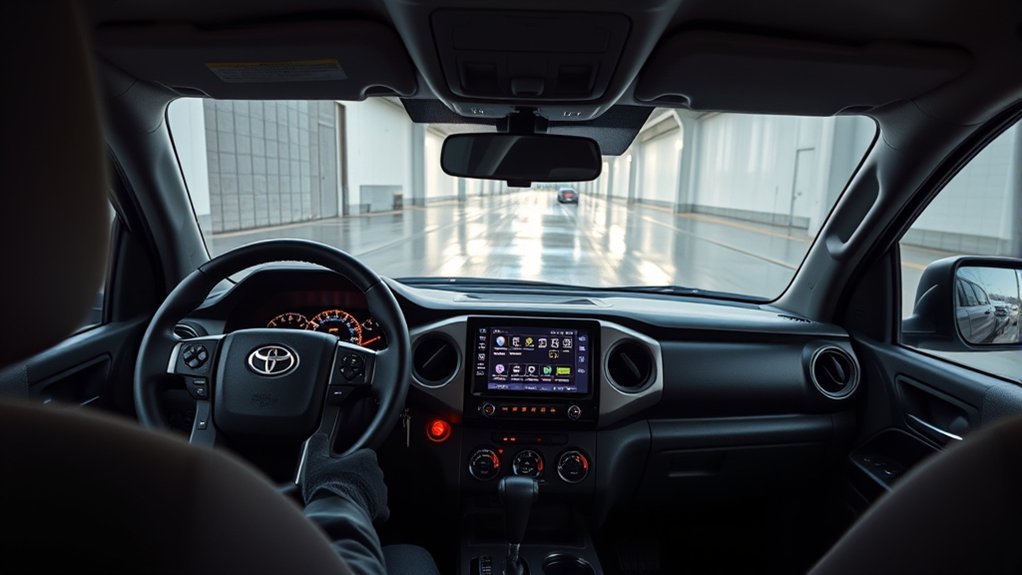
For most 2024 Toyota Tacoma 4WD models, use 2H on normal dry roads, 4H on loose or slippery surfaces, and 4L for slow terrain that needs low-range gearing. First, read the labels on your 4WD selector. A selector marked 2H, 4H, and 4L is the part-time system. The 2024 Limited equipped with i-FORCE MAX instead uses full-time 4WD with H4F, H4L, and L4L. Do not apply the part-time instructions to that full-time selector.
Last updated: July 23, 2026. Procedures checked against Toyota’s 2024 Tacoma owner information and quick reference guide.
Quick Answer
On a part-time 4WD Tacoma, reduce speed below 62 mph before changing between 2H and 4H. Use 4H only where the tires can slip, such as snow, ice, mud, gravel, sand, or an off-road trail. To select 4L, start in 4H, stop completely, hold the brake, and shift an automatic transmission to Neutral or depress and hold the clutch on a manual model. Then select 4L and wait for the 4LO indicator to remain on before moving.
Key Takeaways
- Check the selector first: 2H/4H/4L identifies the part-time system, while H4F/H4L/L4L identifies the Limited i-FORCE MAX full-time system.
- Use 2H for normal dry pavement on part-time models. Use H4F for normal driving on a full-time Limited i-FORCE MAX.
- Reduce speed below 62 mph before changing between 2H and 4H. This number is the mode-change threshold, not a blanket maximum speed for remaining in 4H.
- Use 4L or L4L only after a complete stop and the correct Neutral or clutch procedure.
- Never change modes while the wheels are spinning, and do not use a locked center driveline on dry, high-traction pavement.
- Toyota says to drive in four-wheel drive for at least 10 miles each month to lubricate the front drive components.
At a Glance
| Time Required | Usually a few seconds; allow longer if an indicator flashes or the system cannot engage immediately |
| Difficulty | Easy after you identify the selector and follow the correct shift sequence |
| Tools Needed | None |
| Cost | Free unless a warning, leak, noise, or vibration requires professional diagnosis |
Which 4WD System Does Your 2024 Tacoma Have?
Identify the system by reading the labels on the selector rather than assuming every hybrid or every Limited uses the same setup. Most 2024 Tacoma 4WD models, including most i-FORCE MAX grades, use part-time 4WD. The full-time system is used on the Limited when it is equipped with i-FORCE MAX.
| Selector Labels | System | Normal-Road Mode |
|---|---|---|
| 2H / 4H / 4L | Part-time 4WD | 2H on normal dry, hard-surfaced roads |
| H4F / H4L / L4L | Full-time 4WD on the Limited i-FORCE MAX | H4F for normal paved-road driving |
On the full-time system, H4F is high-range full-time 4WD with the center differential free to accommodate different front and rear wheel speeds. H4L is high range with the center differential locked for loose or slippery surfaces. L4L combines low range with the locked center differential for slow technical terrain. Review the Toyota full-time 4WD manual section before using H4L or L4L.
Important: A hybrid badge alone does not identify the full-time system. Read the selector labels and confirm the grade and powertrain in the vehicle records or by VIN before following either procedure.
How Does The 2024 Toyota Tacoma 4WD System Work?
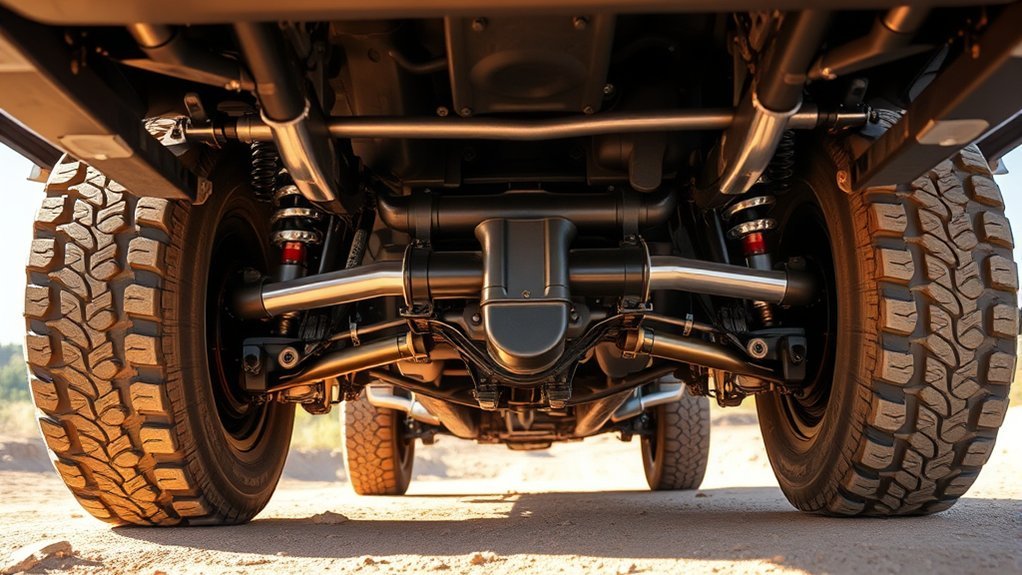
The part-time 2024 Tacoma system changes how the transfer case sends power to the axles. Toyota identifies 2H as the normal mode for dry, hard-surfaced roads because it provides greater economy, a quieter ride, and less wear. Review the exact operating limits in the official Toyota Owners manual.
| Mode | Best Use | What It Does |
|---|---|---|
| 2H | Normal dry roads and ordinary paved-road driving | Uses two-wheel drive for better efficiency, a quieter ride, and less driveline wear. |
| 4H | Snow, ice, mud, gravel, sand, and off-road surfaces that allow tire slip | Engages high-range four-wheel drive for added traction while retaining normal-range gearing. |
| 4L | Steep grades, deep mud or snow, rocks, ruts, hard pulling, and slow technical terrain | Uses low-range gearing for greater torque multiplication and low-speed control. |
Note: The Limited with i-FORCE MAX uses the H4F/H4L/L4L full-time system. Leave that truck in H4F for normal paved-road driving and use the locked modes only under the conditions described in its owner’s manual.
How Do You Engage 4H In A 2024 Tacoma?
Use 4H when you need more traction but do not need low-range gearing. Suitable surfaces include snow, ice, gravel, mud, sand, and off-road tracks where the tires can release driveline stress by slipping slightly.
To change from 2H to 4H in a part-time 2024 Tacoma, reduce speed to less than 62 mph, keep the truck moving steadily, then push and turn the 4WD selector to 4H. The 4HI indicator should remain on when the change is complete.
- Reduce speed to below 62 mph.
- Keep the truck moving straight and steadily.
- Make sure the wheels are not slipping or spinning.
- Push and turn the 4WD selector to 4H.
- Wait for the 4HI indicator to remain on.
- If the indicator flashes, continue straight while gently accelerating or decelerating until the change completes.
What the 62 mph limit means: Toyota instructs you to reduce speed below 62 mph before changing between 2H and 4H. That number is the mode-change threshold. It is not stated as a blanket maximum speed for remaining in 4H, although you must always reduce speed for snow, ice, loose gravel, poor visibility, and other hazardous conditions.
Rain alone does not automatically require 4H. Stay in 2H when paved roads are merely wet and still provide normal traction. Use 4H when snow, slush, ice, standing mud, gravel, or another loose surface allows the tires to slip. See the related guide on using Tacoma 4WD in rain for a narrower wet-road explanation.
Warning: Never change from 2H to 4H while the wheels are slipping or spinning. Regain control and stop the wheelspin first. Changing modes during wheelspin can shock the driveline or prevent complete engagement.
[Products Worth Considering]

This dial type tire tread depth gauge helps you quickly check tread wear on motorcycles, cars, trucks, and buses with easy-to-read 1/32-inch increments. Its colorful zone markings make it simple to assess tire condition for safer driving in different weather, while the durable zinc cast body and legible dial provide dependable everyday use.

This digital tire tread depth gauge helps you check tire wear quickly and accurately with fractional inch, decimal inch, and millimeter readouts. Its large LCD screen, zero reset function, and automatic shutoff make it easy to use for cars, motorcycles, SUVs, trucks, and pickups. Designed for clear readings and dependable measurement, it is a practical tool for routine tire safety checks.

These off-road traction boards are designed to help vehicles recover from mud, sand, and snow with reliable grip and easier ramp-up. Their double-sided diamond construction, cross-shaped teeth, and contoured ramps improve traction while the durable polypropylene build stays flexible in harsh conditions. Convenient mounting points, ergonomic handles, and a visible leash make them practical to carry, store, and retrieve when recovery is needed.
When Should You Use 4H Instead Of 4L?
Choose 4H when you need traction at ordinary off-road or low-traction road speeds. Choose 4L when you need low-range gearing, very slow control, and steady torque for a steep or difficult obstacle. Low range is about gearing and control, not simply adding more driven wheels.
- Use 4H for: snow-covered roads, ice, gravel, sand, shallow mud, forest roads, and mild trails.
- Use 4L for: steep climbs or descents, rock crawling, deep ruts, deep mud, deep snow, hard pulling, and slow recovery maneuvers.
- Stay in 2H for: normal dry pavement, routine commuting, good-traction highway driving, and tight turns on hard surfaces.
- Use H4F on the full-time system for: normal paved-road driving in a Limited i-FORCE MAX.
- Use H4L or L4L on the full-time system for: loose or slippery conditions where locking the center differential is appropriate.
Pro Tip: Select the appropriate mode before the surface becomes difficult. A clean shift with the tires rolling steadily is safer and easier on the driveline than waiting until the truck is already spinning its wheels.
[Products Worth Considering]

This LUMITECO tire tread depth gauge set makes it easy to monitor tire wear and maintain safer driving performance. The color-coded scale provides quick, easy-to-read measurements, while the compact pocket-size design and included clip make it convenient to keep in your vehicle or toolbox. Suitable for cars, trucks, motorcycles, and more, it offers a simple reusable way to check tread depth whenever needed.

The Masoll M13 Tire Pressure Monitoring System helps monitor tire pressure for sedans, SUVs, pickup trucks, RVs, and travel trailers with four tires. It features automatic reference pressure calibration, alerting you when pressure changes fall outside the set range, while solar charging and auto wake-up support convenient everyday use. With precise pressure detection, an easy-to-read color LCD, and adaptive backlighting, it is designed to improve driving safety and help protect tire life.
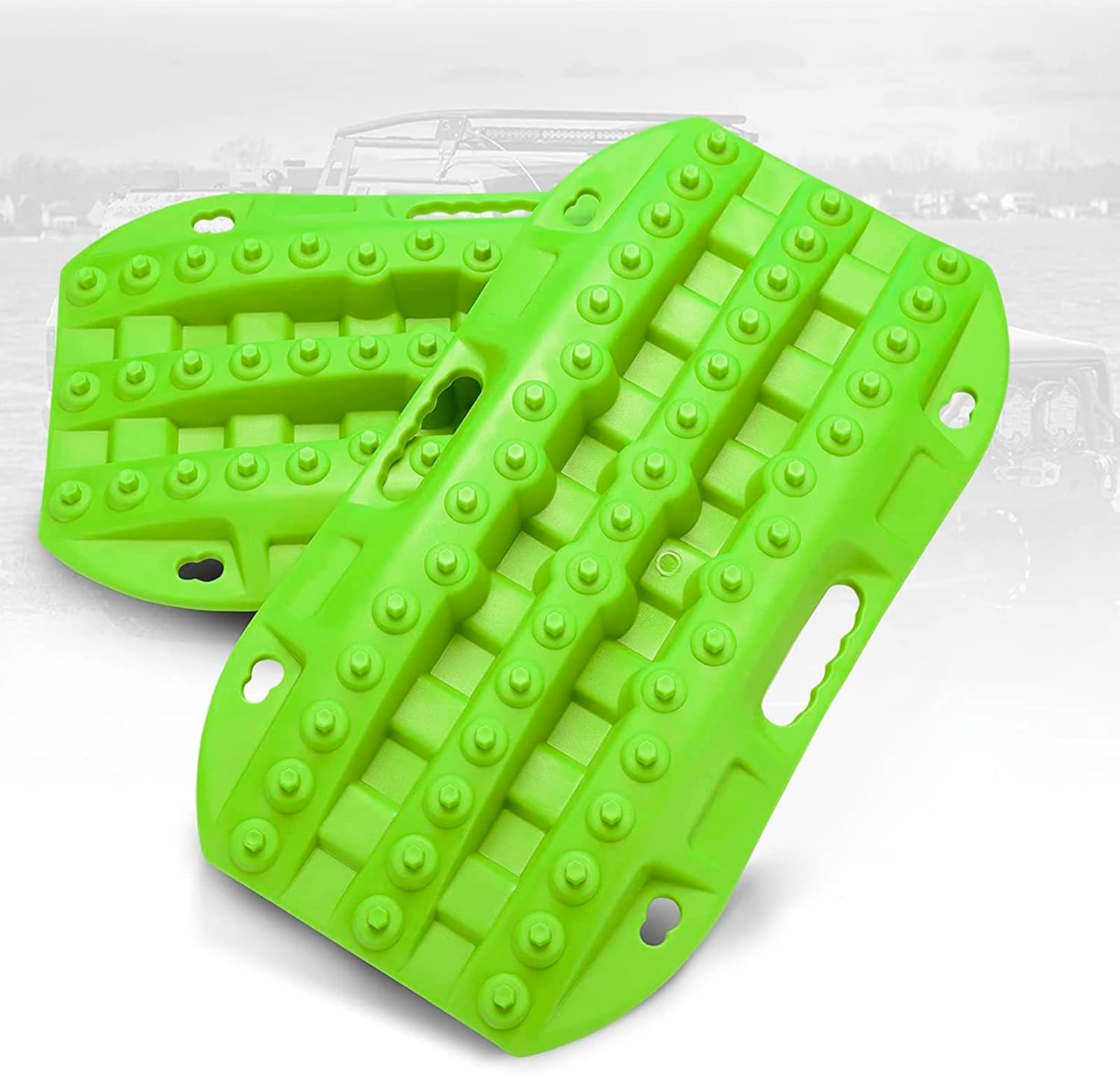
These short recovery traction boards are designed to help ATVs, UTVs, and other off-road vehicles regain grip in mud, sand, and snow. Built with strengthened teeth and a durable polypropylene construction, they provide reliable traction, easy handling, and year-round performance in tough conditions. Their nested, space-saving design and integrated shovels make them practical for carrying and using on remote adventures.
How Do You Safely Shift A 2024 Tacoma Into 4L?
Four Low is for slow control and low-range torque. On an automatic Tacoma, you must stop completely, hold the brake, shift to Neutral, then select 4L. On a manual-transmission Tacoma, stop completely, hold the brake, depress and hold the clutch pedal, then select 4L.
- Make sure the part-time system is already in 4H.
- Bring the Tacoma to a complete stop.
- Keep the brake pedal pressed.
- On an automatic, shift the transmission to N.
- On a manual, depress and hold the clutch pedal.
- Push and turn the 4WD selector to 4L.
- Wait for the 4LO indicator to remain on and the 4HI indicator to go off.
- Select the driving gear and proceed slowly.
Critical safety warning: Keep the brake applied until the transfer-mode change is complete. During an incomplete 4H-to-4L or 4L-to-4H change, the transfer mechanism can temporarily disconnect the driveshafts. The truck may then roll even if an automatic transmission is placed in Park. Wait for the indicator change to finish before selecting Park or releasing the brake.
Warning: Do not use 4L on dry pavement or another high-traction surface. A locked part-time driveline cannot absorb the normal difference between front and rear wheel speeds during a turn, which can cause binding, tire hopping, difficult steering, vibration, or component stress.
Cold-weather note: Immediately after a cold start, some part-time hybrid models may temporarily prevent a change between 4H and 4L because the transmission fluid is cold. Follow the message in the multi-information display, allow the system to warm, and try the procedure again.
How Do You Disengage 4L Safely?
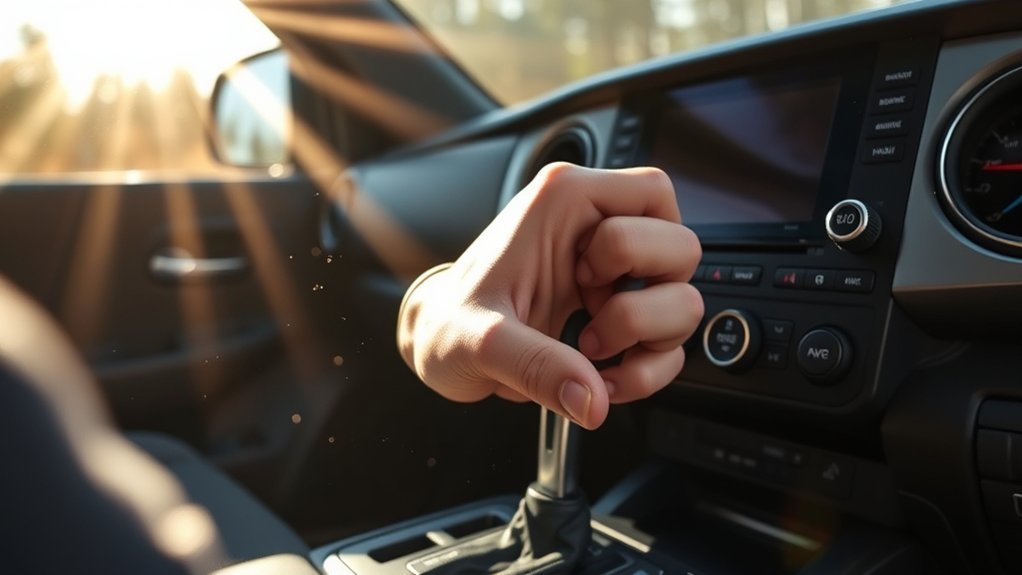
To change from 4L back to 4H, use the same stopped procedure. Keep the brake applied until the indicators confirm that the transfer-mode change is complete.
Proper Stopping Procedure
- Stop the vehicle completely.
- Keep the brake pedal pressed.
- On an automatic, shift the transmission to N.
- On a manual, depress and hold the clutch pedal.
- Push and turn the 4WD selector to 4H.
- Wait for the 4LO indicator to go off and the 4HI indicator to remain on.
- Select the driving gear and continue slowly.
What If The Indicator Keeps Flashing?
If the 4HI or 4LO indicator flashes, the transfer-mode change has not finished. Follow the condition-specific instructions in the owner’s manual. Toyota may direct you to drive straight while gently accelerating or decelerating, reverse briefly when safe, or select Drive or Reverse and move slowly before stopping and repeating the Neutral procedure.
If a buzzer sounds, confirm that the vehicle is completely stopped and the automatic transmission is in Neutral. Rapid flashing of both indicators can signal a 4WD-system malfunction and requires inspection by a Toyota dealer or qualified technician.
How Does Multi-Terrain Select Help Off Road?
If equipped, Multi-Terrain Select adjusts vehicle controls to better match an off-road surface. Toyota says the 2024 Tacoma system can operate in both 4WD High and 4WD Low and offers settings intended to help control wheelspin on terrain such as Mud, Dirt, and Sand. Review the exact controls in the official Multi-Terrain Select manual section.
- Mud: Adjusts vehicle response for a soft, slippery surface where wheelspin may occur.
- Dirt: Helps manage traction on loose soil and unpaved tracks.
- Sand: Helps the truck maintain useful drive force on a surface where it can bog down.
- Other displayed modes: Availability can vary. Use only a mode shown by your truck and follow the corresponding manual instructions.
Note: Multi-Terrain Select cannot create traction that the tires and surface do not provide. Confirm that the requested mode indicator is illuminated, keep your speed low, and remain ready to brake or stop.
[Products Worth Considering]

This color coded tire tread depth gauge helps you quickly check tire wear and monitor when replacement is needed. Calibrated in easy-to-read 32nds with clear red, yellow, and green ranges, it offers fast visual results for cars, trucks, motorcycles, and other passenger vehicles. The pocket clip makes it simple to keep on hand for routine maintenance and safety checks.

This smart color coded tire tread depth gauge makes it easy to check tread wear at a glance with clear red, yellow, and green ranges. Calibrated from 0 to 1 inch in 1/32 inch increments, it helps you quickly assess tire condition for safer driving and timely replacements. The pocket clip design makes it convenient to carry and use on trucks, motorcycles, cars, and other passenger vehicles.

This 50-pack of tire tread depth gauges offers a simple way to check tire wear quickly and accurately. Color-coded reading zones make it easy to see tread condition at a glance, while the compact design and pocket clip support convenient everyday carry. Built for repeated use, these gauges help drivers monitor tire safety with confidence.
What Does Downhill Assist Control Do?
If equipped, Downhill Assist Control helps limit the Tacoma’s speed during a steep descent. Toyota describes it as an available off-road feature that helps the driver navigate descents by controlling vehicle speed. See Toyota’s overview in the official 2024 Tacoma pressroom release.
How It Helps On A Slope
On a steep grade, the system reduces the amount of continuous brake modulation the driver must provide. You remain responsible for steering, choosing a safe path, monitoring obstacles, and stopping when conditions become unsafe.
- Helps maintain a controlled low speed on a descent.
- Reduces the need for constant brake-pedal modulation.
- Supports smoother progress over loose or uneven ground.
- Allows more attention to be directed toward steering and wheel placement.
- Operates only when its required conditions are met.
How To Descend Safely
Choose a safe line before beginning the descent. Keep the speed low, avoid abrupt steering, leave room for the suspension to settle after obstacles, and do not assume the system can overcome poor tire grip. If the expected indicator does not appear or a warning is displayed, stop relying on the feature and consult the owner’s manual.
What Is The Difference Between CRAWL Control And Downhill Assist?
If equipped, CRAWL Control manages throttle and braking at a selectable low speed so the driver can concentrate on steering through difficult terrain. Toyota describes the 2024 system as a low-speed off-road cruise control with five selectable speeds. Downhill Assist Control has a narrower job: limiting vehicle speed during a descent. Toyota’s support material provides additional background on Multi-Terrain Select and CRAWL Control.
| Feature | Main Job | Best Situation |
|---|---|---|
| CRAWL Control | Automatically manages throttle and braking at a selected low speed | Technical obstacles where steady crawl speed and careful steering matter |
| Downhill Assist Control | Helps limit vehicle speed on a descent | Steep downhill sections that require controlled progress |
| Multi-Terrain Select | Adjusts vehicle response for the selected terrain | Mud, dirt, sand, and other modes displayed by the equipped vehicle |
Which Tacoma 4WD Myths Cause The Most Problems?
Most avoidable 4WD problems begin with confusing a part-time system with full-time all-wheel drive or changing modes without meeting Toyota’s operating conditions.
- Myth: Every 2024 Tacoma hybrid has full-time 4WD. Only the Limited with i-FORCE MAX uses the H4F/H4L/L4L full-time system.
- Myth: Part-time 4WD should be used all the time. Use 2H for normal dry pavement on a part-time truck.
- Myth: 4H is only for off-road trails. It is also appropriate on snow, ice, mud, gravel, and other surfaces that allow tire slip.
- Myth: Rain always requires 4H. Ordinary wet pavement may still provide enough traction for 2H. Do not lock a part-time driveline merely because the road is wet.
- Myth: 62 mph is the maximum possible speed in 4H. Toyota uses 62 mph as the maximum speed for changing between 2H and 4H. Safe driving speed still depends on the surface and visibility.
- Myth: 4L provides better control at any speed. Low range is for slow driving that requires torque multiplication and precise control.
- Myth: 4WD makes the truck stop sooner. Four-wheel drive helps the truck move, but it does not shorten the tire-limited braking distance on snow, ice, mud, or gravel.
Identify the selector, choose the mode for the surface, and complete the shift before the terrain forces the decision.
How Can You Prevent Vibration Or Binding In 4WD?
Vibration, hopping, or difficult steering in a part-time 4WD mode can result from driveline bind on a high-traction surface. Other possible causes include uneven tire wear, incorrect pressure, mismatched rolling diameters, wheel imbalance, worn driveline joints, incomplete engagement, or damage after off-road use.
If the symptom began immediately after using 4H or 4L on dry pavement, return to the correct road mode as soon as it is safe, drive straight briefly, and allow the driveline to release. Stop and arrange an inspection if the mode will not disengage or the vibration, noise, warning, or fluid leak remains.
Why Tire Condition Matters
The Tacoma’s driveline works best when all four tires have compatible size, construction, inflation pressure, and rolling diameter. The National Highway Traffic Safety Administration recommends checking cold tire pressure at least monthly and following the vehicle manufacturer’s rotation guidance.
- Use the cold pressures on the driver-door Tire and Loading Information label.
- Rotate tires according to Toyota’s maintenance schedule and the installed tire configuration.
- Use Toyota-approved tire sizes and compatible load ratings.
- Avoid large tread-depth or rolling-circumference differences between the four tires.
- Inspect for cuts, bulges, punctures, cupping, and other irregular wear.
- Check wheel balance and alignment if vibration appears at a repeatable road speed.
Why A Part-Time Driveline Binds
In a part-time 4WD mode, the front and rear drivelines are mechanically linked. During a turn, the front and rear axles normally travel different distances. Loose ground lets the tires slip enough to release that difference. Dry pavement may not, so stress builds until the tires scrub, hop, or make the truck resist the turn.
| Component | Possible Vibration Cause | What To Check |
|---|---|---|
| Tires | Mismatched size or tread depth, low pressure, damage, cupping | Placard pressure, tread depth, rotation history, and physical condition |
| Transfer case | Incomplete engagement, a fluid leak, actuator problem, or internal fault | Indicator behavior, warning messages, leaks, and service history |
| Differentials | Fluid leak, wear, binding, or incorrect locked-mode use | Leaks, abnormal noise, impact damage, and service history |
| Driveshafts and joints | Worn joints, imbalance, impact damage, or changed angles after modification | Play, clunks, dents, missing weights, and vibration after a lift or impact |
How Do You Maintain The Tacoma 4WD System?
Correct use, matched tires, periodic operation, and scheduled inspections do most of the maintenance work. Toyota says to drive in four-wheel drive for at least 10 miles each month so the front drive components remain lubricated.
- Drive at least 10 miles in 4WD each month on a suitable surface that permits tire slip.
- Confirm that 4H engages fully rather than leaving the indicator flashing.
- Periodically operate 4L using the complete stopped procedure so you know the selector and actuator work before a difficult trip.
- Maintain correct cold tire pressures and compatible tire sizes and tread depths.
- Inspect the transfer case, differentials, axles, driveshafts, and underbody after off-road impacts.
- Check for fluid leaks after rocks, deep mud, or water crossings.
- Follow Toyota’s scheduled maintenance guide for the exact model, powertrain, and driving conditions.
- Clean packed mud and sand from the brakes, wheels, skid plates, and underbody after a trail trip.
Pro Tip: Use a straight gravel road, snowy road, or suitable unpaved surface for the monthly 4WD exercise. A dry parking lot with tight turns can create driveline bind.
What Do Flashing 4HI Or 4LO Lights Mean?
A flashing 4HI or 4LO indicator usually means the requested transfer-mode change has not finished. The correct response depends on which indicators are on, which are flashing, whether a buzzer sounds, and whether the truck is moving.
- 4HI flashes during a 2H/4H change: Drive straight while gently accelerating or decelerating. Reverse briefly only when it is safe and the manual directs you to do so.
- 4LO continues to flash: Stop completely, keep the brake pressed, select Neutral on an automatic, and repeat the procedure.
- A buzzer sounds during a low-range request: The vehicle may still be moving, or an automatic transmission may not be in Neutral.
- A cold hybrid displays a temporary shift restriction: Follow the display, allow the system to warm, and retry.
- Both indicators flash rapidly: Toyota identifies this as a possible four-wheel-drive-system malfunction. Arrange an inspection.
- The selected mode remains uncertain: Do not continue into difficult terrain until the indicator is steady and the system’s status is clear.
Common Driver Mistakes To Avoid
The most preventable Tacoma 4WD problems come from using the wrong instructions or interrupting the shift sequence. Avoid these errors:
- Assuming every hybrid Tacoma uses the H4F/H4L/L4L full-time selector.
- Using part-time 4H or 4L during tight turns on dry pavement.
- Changing from 2H to 4H while one or more wheels are spinning.
- Trying to select 4L without first entering 4H on a part-time system.
- Forgetting Neutral on an automatic or the clutch pedal on a manual.
- Releasing the brake or selecting Park before the low-range indicator change is complete.
- Treating 4WD as a substitute for winter tires, cautious speed, safe braking distance, or careful steering.
Frequently Asked Questions
What are the different 4WD modes available in the Tacoma?
Most 2024 Tacoma 4WD models use the part-time 2H, 4H, and 4L system. Use 2H for normal dry roads, 4H for surfaces that allow tire slip, and 4L for slow low-range driving. The Limited equipped with i-FORCE MAX instead uses full-time H4F, H4L, and L4L. H4F is its normal paved-road setting.
Can I use 4WD on pavement?
Use 2H on normal dry pavement in a part-time Tacoma. Use 4H on pavement only when snow, ice, slush, or another condition allows tire slip. A Limited i-FORCE MAX with full-time 4WD can remain in H4F on paved roads, but its locked H4L and L4L modes are not normal dry-pavement settings.
How fast can I shift into 4H in a 2024 Tacoma?
Reduce speed below 62 mph before changing between 2H and 4H. The 62 mph figure is the mode-change threshold, not a blanket maximum speed for remaining in 4H. Keep the truck steady and do not change modes while the wheels are slipping or spinning.
How do I shift into 4L?
Start in 4H and stop completely. Keep the brake pressed. On an automatic, shift to Neutral. On a manual, depress and hold the clutch pedal. Select 4L and wait until the 4LO indicator remains on before selecting a driving gear or releasing the brake.
What should I do if the 4WD indicator light stays on or keeps flashing?
Follow the indicator-specific procedure in the owner’s manual. A flashing 4HI light may clear while you drive straight and gently accelerate or decelerate. For a low-range shift, stop and confirm Neutral or clutch operation. Rapid flashing of both indicators can indicate a malfunction that requires inspection.
Does 4WD help with braking?
Four-wheel drive helps the Tacoma move by sending drive force through both axles, but it does not shorten the tire-limited braking distance on ice, snow, mud, or gravel. Reduce speed, leave more stopping room, and make smooth steering and braking inputs.
Are there towing restrictions with 4WD engaged?
Engaging four-wheel drive does not increase the Tacoma’s rated towing capacity. Use the normal road mode for good-traction towing, a high-range four-wheel-drive mode only when traction requires it, and low range only for very slow maneuvering. Follow the towing rating and procedures for the exact VIN and installed equipment.
How often should I use 4WD if I do not off-road?
Toyota says to drive in four-wheel drive for at least 10 miles each month to keep the front drive components lubricated. Use a suitable snowy, gravel, or unpaved surface that permits tire slip, and avoid tight turns in a locked mode on dry pavement.
Conclusion
Start by reading the labels on your 2024 Tacoma’s selector. Use 2H, 4H, and 4L instructions only on the part-time system. A Limited equipped with i-FORCE MAX uses H4F for normal paved-road driving and reserves H4L or L4L for conditions that justify a locked center differential. Reduce speed below 62 mph before a 2H/4H change, stop and use Neutral or the clutch for low range, and wait for the indicators to confirm every shift. Correct mode selection, matched tires, cautious speed, and monthly 4WD operation will protect the driveline and make the truck easier to control.
Sources
- Toyota Owners: 2024 Tacoma Four-Wheel Drive System — official part-time 2H, 4H, and 4L operating information.
- Toyota Owners: 2024 Tacoma Hybrid Part-Time Four-Wheel Drive System — shift procedures, indicator behavior, cold-temperature guidance, and monthly usage instructions.
- Toyota Owners: 2024 Tacoma Hybrid Full-Time Four-Wheel Drive System — H4F, H4L, and L4L operating information.
- Toyota 2024 Tacoma Quick Reference Guide — selector labels and automatic/manual shift summaries.
- Toyota Owners: Multi-Terrain Select — operating guidance for equipped Tacoma models.
- Toyota Support: Multi-Terrain Select and CRAWL Control — Toyota’s overview of terrain-response and low-speed control features.
- Toyota Pressroom: 2024 Tacoma Off-Road Features — official information on full-time 4WD availability, Multi-Terrain Select, CRAWL Control, and Downhill Assist Control.
- NHTSA Tire Safety — tire-pressure, tread, rotation, balance, alignment, and tire-size guidance.
- Toyota 2024 Tacoma Warranty & Maintenance Guide — official maintenance and warranty guidance.