
Toyota Supra tire sizes depend heavily on the generation, model year, trim, market, and wheel package. Older Celica Supra models used narrow 14-inch tires, MK3 and MK4 cars moved into 16- and 17-inch performance fitments, and the modern GR Supra uses staggered 18- or 19-inch summer tire setups. Use this guide as a fast reference, then confirm the exact size on your driver-door tire placard or owner’s manual before buying replacements.
Quick Answer
Most Toyota Supra tire sizes are staggered by generation: MK1–MK2 cars commonly use 195/70R14 or 225/60R14, MK3 cars often use 225/50R16, MK4 cars use 225/50R16 and 245/50R16 or Turbo 235/45ZR17 and 255/40ZR17, and modern GR Supra models use 255/40ZR18 with 275/40ZR18 or 255/35ZR19 with 275/35ZR19.
Key Takeaways
- Always match the tire size, load index, speed rating, and inflation pressure shown on your Supra’s tire placard first.
- MK4 Twin Turbo models are commonly listed with 235/45ZR17 front and 255/40ZR17 rear tires; non-turbo cars commonly use 16-inch staggered sizes.
- 2021–2024 GR Supra 2.0 models use 255/40ZR18 front and 275/40ZR18 rear; 3.0 models use 255/35ZR19 front and 275/35ZR19 rear.
- For 2025 and 2026 U.S. GR Supra models, Toyota lists the 3.0 lineup with Michelin Pilot Super Sport summer tires sized 255/35ZR19 front and 275/35ZR19 rear.
Toyota Supra Tire Sizes: Quick Answer by Generation
Across the Supra family, tire sizing evolved from comfort-focused touring tires to wider, lower-profile performance tires. The safest way to buy replacements is to start with the factory size for your exact model year and trim, then compare any alternative size against the original rolling diameter, wheel width, brake clearance, load rating, and speed rating.
| Generation | Common Model Years | Common OEM Tire Sizes | Notes |
|---|---|---|---|
| MK1–MK2 / Celica Supra | 1979–1986 | 195/70R14, 225/60R14; late 1986 listings may show 205/55R16 or 225/50R16 depending on market/trim | Best for restoration buyers who want period-correct sizing. |
| MK3 / A70 | 1986.5–1992 | 225/50R16 is common on U.S. base and Turbo listings; some markets show 15-inch and staggered alternatives | Verify market-specific fitment because JDM, European, Canadian, and U.S. specs can differ. |
| MK4 / A80 | 1993–1998 U.S.; later in some markets | Base: 225/50R16 front with 245/50R16 or 245/45R16 rear; Turbo: 235/45ZR17 front and 255/40ZR17 rear | The Twin Turbo staggered 17-inch setup is the most searched MK4 performance fitment. |
| MK5 / A90-A91 GR Supra | 2020–2026 U.S. | 2.0: 255/40ZR18 front, 275/40ZR18 rear; 3.0: 255/35ZR19 front, 275/35ZR19 rear | The 2.0 trim was offered through 2024 in the U.S.; 2025–2026 U.S. models are 3.0-based. |
Warning: Do not mix tire sizes, speed ratings, or tire types at random. A mismatch can affect ABS, stability control, speedometer accuracy, handling balance, and braking performance.
1979–1986 Supra Tire Sizes (MK1–MK2)
Early Celica Supra models used taller-sidewall 14-inch tires. Common listings for L-Type cars show 195/70R14, while P-Type variants commonly show 225/60R14. These tires fit the character of the early Supra: comfortable, balanced, and period-correct rather than ultra-low-profile.
- L-Type: commonly 195/70R14 for a narrower touring-style setup.
- P-Type: commonly 225/60R14 for a wider performance-oriented setup.
- Late transition years: some 1986 Supra listings show 205/55R16 or 225/50R16, so confirm your trim and market before ordering.
Note: Vintage tire availability changes often. If you are restoring an MK1 or MK2 Supra, check both the factory placard and the wheel size stamped on the wheel before choosing modern replacements.
1986–1998 Supra Tire Sizes and Common Staggered Setups (MK3 and MK4)
MK3 and MK4 Supras moved into wider 16- and 17-inch performance tire sizes. Many MK3 U.S. listings show 225/50R16 for both base and Turbo models, while some international or modified setups use staggered alternatives. MK4 cars are more clearly split: non-turbo/base cars commonly use 16-inch staggered tires, while Twin Turbo models commonly use 17-inch staggered tires.
| Model / Trim | Front Tire | Rear Tire | Best Use |
|---|---|---|---|
| MK3 U.S. Base / Turbo | 225/50R16 | 225/50R16 | Factory-style street replacement |
| MK4 Base, 1993–1996 commonly listed | 225/50R16 | 245/50R16 | OEM-style non-turbo fitment |
| MK4 Base, 1997–1998 commonly listed | 225/50R16 | 245/45R16 | Late A80 non-turbo fitment |
| MK4 Twin Turbo | 235/45ZR17 | 255/40ZR17 | Factory-style performance fitment |
For modified MK3 and MK4 cars, 17-, 18-, and 19-inch wheel packages are common, but they should be chosen by measuring wheel width, offset, brake clearance, fender clearance, suspension travel, and overall tire diameter. Staying close to the factory rolling diameter helps preserve gearing, speedometer accuracy, and electronic system behavior.
2020–2026 GR Supra Tire Sizes and OEM Fitments (MK5/A90)
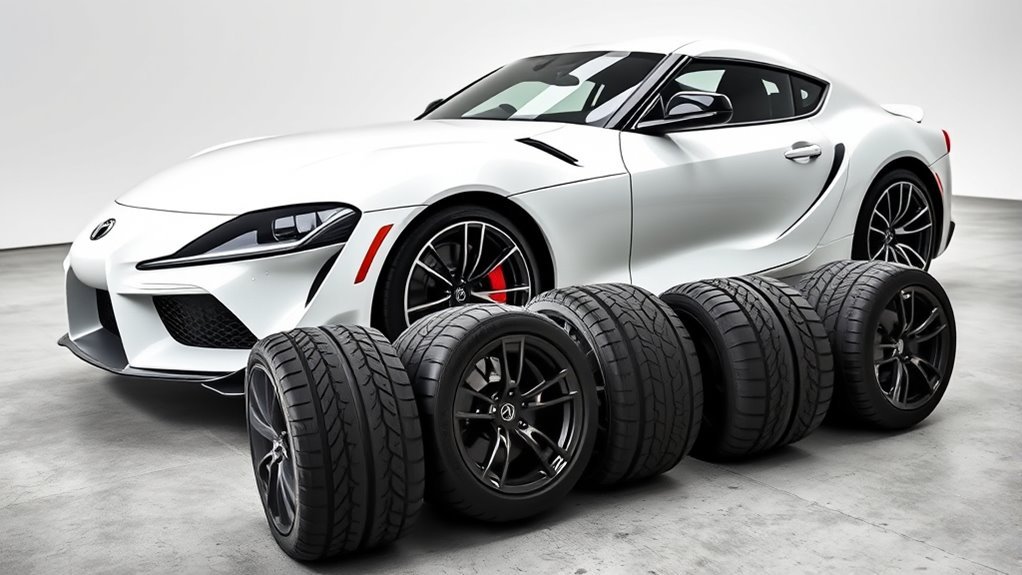
The modern GR Supra uses a staggered setup, meaning the rear tires are wider than the front tires. Toyota’s 2024 GR Supra brochure lists the 2.0 model with high-performance Michelin Pilot Super Sport summer tires sized 255/40ZR18 front and 275/40ZR18 rear, while 3.0, 3.0 Premium, and 45th Anniversary models use 255/35ZR19 front and 275/35ZR19 rear. Toyota’s 2025 brochure lists the U.S. 3.0 and 3.0 Premium models with 255/35ZR19 front and 275/35ZR19 rear tires.
| Model Year / Trim | Front Tire | Rear Tire | Wheel Size |
|---|---|---|---|
| 2021–2024 GR Supra 2.0 | 255/40ZR18 | 275/40ZR18 | 18 x 9 front, 18 x 10 rear |
| 2020–2024 GR Supra 3.0 / 3.0 Premium / special editions | 255/35ZR19 | 275/35ZR19 | 19 x 9 front, 19 x 10 rear |
| 2025 GR Supra 3.0 / 3.0 Premium | 255/35ZR19 | 275/35ZR19 | 19 x 9 front, 19 x 10 rear |
| 2026 GR Supra 3.0 / 3.0 Premium / MkV Final Edition | 255/35ZR19 | 275/35ZR19 | 19-inch forged alloy wheels on Toyota’s current U.S. lineup |
Pro Tip: The GR Supra’s factory tires are summer performance tires. If you drive in cold temperatures, snow, or ice, choose a properly sized winter or all-season performance tire instead of relying on summer tires year-round.
How to Pick Replacement Tires: Size, Load and Speed Ratings
Start with the tire information placard on the driver’s door jamb. That placard gives the original tire size and cold inflation pressure for your exact vehicle. Your owner’s manual and Toyota’s manual portal are also useful references, especially if the car has been modified or the original placard is missing.
- Confirm the exact size: match front and rear sizes to your model year, trim, and wheel package.
- Match or exceed the load index: do not install a tire with a lower load capacity than the original specification.
- Match or exceed the speed rating: Supras use performance-rated tires; replacing them with lower-rated tires can reduce capability and may be unsafe.
- Keep diameter close to OEM: large diameter changes can affect gearing, ABS, traction control, and speedometer readings.
- Choose the right tire category: summer, all-season, winter, track, or touring tires behave very differently.
The most important tire size is the one printed on your Supra’s own tire placard. Model-year charts are helpful, but the placard confirms what Toyota specified for that exact car when equipped as built.
[Products Worth Considering]
![DieCast Hotwheels '20 Toyota GR Supra - HW Speed Graphics 5/10 [White] 178/250 for unisex, children](https://m.media-amazon.com/images/I/512srWPcmdS._SL500_.jpg)
Authentic Design: Meticulously crafted die-cast model of the 2020 Toyota GR Supra featuring precise details and authentic styling in stunning white finish
![Hot Wheels '20 Toyota GR Supra, [Yellow] 178/250 Speed Graphics 5/10](https://m.media-amazon.com/images/I/51QYXmunWFL._SL500_.jpg)
GR Supra Wheel Fitment Essentials: Bolt Pattern, Offsets and Minimum Wheel Size
The modern GR Supra uses a BMW-derived wheel fitment pattern, so it does not share the same bolt pattern as older MK3 and MK4 Supras. The GR Supra commonly uses a 5×112 bolt pattern, while MK3 and MK4 Supra models commonly use 5×114.3. Early Celica Supra models commonly use 4×114.3. Mixing wheels across generations is not a simple swap.
- GR Supra bolt pattern: commonly 5×112.
- MK3/MK4 bolt pattern: commonly 5×114.3.
- Early Celica Supra bolt pattern: commonly 4×114.3.
- Brake clearance: modern GR Supra brake packages require careful spoke and barrel clearance checks.
- Offset: changing offset affects scrub radius, fender clearance, wheel-bearing load, and steering feel.
Before buying aftermarket wheels, confirm bolt pattern, center bore, lug-seat type, wheel width, offset, brake clearance, and tire load rating. A wheel that “bolts on” can still rub, vibrate, or change handling if the offset and tire size are wrong.
[Products Worth Considering]

Available in 15” 16” 17” and 18” diameters with various widths and off-sets

Replacement Center Cap: Part Number: MRCAP-S1R -or- ASIN:0

Important Note: For more specific models and years, please CHECK FITMENT above amazon filter to make sure these wheel spacers fit your vehicle. Not adapter, only widen the wheels, do not change bolt pattern.
Aftermarket Wheel and Tire Examples: 18-, 19- and 20-Inch Setups
Aftermarket Supra fitment depends on your suspension height, alignment, wheel offset, brake package, and tire brand. Tires from different manufacturers can measure wider or narrower even when the printed size is the same, so test fitment matters.
| Setup | Common Direction | Best For | Watch Out For |
|---|---|---|---|
| 18-inch | More sidewall, often used for track-focused setups | Ride compliance, track tires, lower tire cost | Brake clearance and offset |
| 19-inch | Closest to GR Supra 3.0 factory sizing | Balanced street and performance use | Rear fender clearance on wider tires |
| 20-inch | Lower-profile appearance-focused setup | Show-style stance and visual impact | Ride quality, pothole damage, rubbing, tire cost |
For street cars, a conservative 19-inch staggered setup is usually the easiest path. For track cars, many owners prefer more sidewall and more tire availability. For show builds, 20-inch setups can look aggressive, but they demand more care with ride height, offsets, and fender clearance.
[Products Worth Considering]

Product Overview: The RoyalBlack Racing Trac is a 285/40R19 107Y XL-Extra Load, 4 Ply Rated High Performance Tire Manufactured For Trucks & SUVs

Product Overview: The Fullway HP108 are 235/50R19 103W XL-Extra Load, 4 Ply Rated High Performance Tires Manufactured For Trucks & SUVs

Compatible With 2020-2026 Toyota GR Supra A90 A91 & 2020-2025 Toyota Supra
When to Replace Supra Tires and Maintenance Tips
Supra tires should be inspected regularly because performance tires can wear quickly, especially with aggressive driving, track days, low tire pressure, poor alignment, or high-horsepower modifications. The National Highway Traffic Safety Administration’s TireWise guidance emphasizes tire pressure checks, rotation, tread inspection, and tire aging awareness as core tire-safety habits.
Tire Age and Replacement
Replace tires immediately if they show cords, bubbles, cracks, puncture damage that cannot be safely repaired, or tread worn to the legal minimum. In the U.S., 2/32 inch is the common minimum tread-depth threshold, but wet-road performance can decline before that point. Performance drivers should plan replacement earlier if wet grip, braking, or steering response drops.
- Check tread depth: use a tread-depth gauge, not just a visual glance.
- Inspect sidewalls: look for cracks, bulges, cuts, and weathering.
- Read the DOT date code: old tires can age out even when tread remains.
- Inspect after track use: check for heat cycling, shoulder wear, chunking, and pressure-related damage.
Routine Pressure and Rotation
Check pressure when tires are cold, ideally monthly and before long drives. Staggered Supra setups usually cannot be rotated front-to-rear unless the wheels and tires are the same size, so maintenance often focuses on pressure, alignment, balancing, and left/right checks where tire direction and wheel design allow.
| Action | Interval | Purpose |
|---|---|---|
| Pressure check | Monthly and before long trips | Protects handling, tread life, and fuel economy |
| Tread-depth check | Monthly or at every wash/service | Catches wear before traction becomes unsafe |
| Alignment check | After impacts, suspension changes, or uneven wear | Prevents inside-edge wear and pulling |
| Replacement | At unsafe tread depth, visible damage, age concerns, or major grip loss | Maintains braking, cornering, and wet-weather safety |
Frequently Asked Questions
What size tires are on a Toyota Supra?
Toyota Supra tire sizes vary by generation and trim. Common examples include 195/70R14 on early L-Type cars, 225/60R14 on early P-Type cars, 225/50R16 on many MK3 cars, 235/45ZR17 front and 255/40ZR17 rear on MK4 Twin Turbo models, and 255/35ZR19 front with 275/35ZR19 rear on modern GR Supra 3.0 models.
What size tires are on a 1996 Toyota Supra?
A 1996 Toyota Supra Base model is commonly listed with 225/50R16 front and 245/50R16 rear tires. A 1996 Supra Twin Turbo is commonly listed with 235/45ZR17 front and 255/40ZR17 rear tires. Always verify against the door placard because wheels may have been changed over time.
What size are stock Supra wheels?
Stock Supra wheel sizes vary by generation. Early cars used 14-inch wheels, many MK3 cars used 16-inch wheels, MK4 models used 16- or 17-inch wheels depending on trim, and modern GR Supra 3.0 models use 19 x 9-inch front and 19 x 10-inch rear wheels.
What size tires are on the 2019 Supra?
In the U.S., the revived GR Supra arrived as a 2020 model-year vehicle. Early GR Supra 3.0 models use a staggered setup with 255/35ZR19 front and 275/35ZR19 rear tires. Some non-U.S. references may label early A90 cars differently, so check the vehicle placard for the exact size.
Can I put the same tire size on all four corners of a Supra?
A square setup can work on some modified Supras when the wheels, offsets, clearances, and tire diameters are chosen correctly. However, many Supras were engineered with staggered tires, so changing to a square setup can alter handling balance. Consult a performance alignment or tire professional before making the switch.
Can I use all-season tires on a GR Supra?
Yes, if you choose the correct size, load index, and speed rating. All-season performance tires can be better for cooler climates and daily driving, while summer tires offer stronger warm-weather grip. Do not use summer tires in snow or freezing conditions.
Conclusion
The right Toyota Supra tire size depends on the exact year, trim, wheel package, and market. Use the chart above to narrow the search, then confirm the final size on your tire placard or owner’s manual before ordering. For best results, keep the original rolling diameter close, match or exceed OEM load and speed ratings, maintain cold tire pressure, and inspect tread and sidewalls often. Good tires protect what makes a Supra special: sharp steering, strong braking, rear-drive balance, and confident grip.
Sources
- Toyota 2024 GR Supra eBrochure — backs up 2024 GR Supra 2.0 and 3.0 tire sizes, wheel sizes, and model-trim details.
- Toyota 2025 GR Supra eBrochure — backs up 2025 GR Supra 3.0 and 3.0 Premium tire sizes, wheel sizes, and Michelin Pilot Super Sport fitment.
- Toyota 2026 GR Supra Official Page — backs up the current U.S. GR Supra lineup and 19-inch forged alloy wheel information.
- Toyota Owners Manuals and Warranties — supports checking the official owner’s manual and Toyota documentation for exact tire and maintenance information.
- NHTSA TireWise — supports tire safety guidance for pressure checks, tread inspection, tire aging, and tire maintenance.
- U.S. Tire Manufacturers Association Tire Care Essentials — supports tire-care guidance, tread-depth awareness, and monthly inspection habits.




[…] page covers the full wheel-and-tire fitment decision. For a year-by-year OEM tire lookup, use the Toyota Supra tire size chart. For bolt pattern, center bore, wheel-bolt, and hub-ring details, use the Supra bolt pattern and […]
[…] unsure which tire size is factory-correct for your car, check the placard and compare it with this Toyota Supra tire-size guide before adjusting […]