For a stock 2026 U.S. Toyota GR Supra with 255/35ZR19 front and 275/35ZR19 rear tires, the current reference is 38 psi cold at both axles. Always confirm the driver-side Tire and Loading Information label before inflating because your own vehicle placard is the final authority. Earlier model years, other markets, and alternate approved tire setups can use different pressures. Cold weather does not create a separate permanent “winter PSI”; it lowers the pressure already in the tire, so the goal is to restore the tire to the correct cold specification.
Last updated: September 16, 2026. Rechecked against Toyota’s current 2026 U.S. GR Supra lineup and owner resources, NHTSA tire-safety guidance, USTMA tire-care guidance, and Michelin GR Supra fitment data. This guide is source-based and does not claim independent tire testing.
For the general year-round procedure, see how to set the correct tire pressure on a Supra. This page focuses specifically on cold-weather pressure changes, winter checks, and the numbers that can cause confusion in current Supra references.
Quick Answer
For a stock 2026 U.S. GR Supra on its 19-inch 255/35ZR19 front and 275/35ZR19 rear setup, use 38 psi cold front and rear unless your driver-door placard specifies otherwise. Check after the car has been parked for at least three hours. As temperature falls, pressure can drop roughly 1–2 psi per 10°F, so recheck the tires and restore them to the placard value rather than adding a permanent winter-pressure offset.
Key Takeaways
- For the current stock 2026 U.S. 19-inch setup, 38 psi cold front and rear is the current reference; confirm your own driver-door placard before adding air.
- Check tires when cold, ideally before driving or after the vehicle has been parked for at least three hours.
- Cold weather lowers actual tire pressure. Restore the tire to its listed cold PSI rather than automatically adding extra PSI above the specification.
- TPMS is a warning and monitoring system, not a substitute for a quality gauge. Check pressures manually at least monthly and before long trips.
- Do not use a 32-psi number from another Supra year, market, wheel package, or manual table unless it matches an approved setup for your specific car.
At a Glance
| Time Required | 5–10 minutes |
| Difficulty | Easy |
| Tools Needed | Accurate tire pressure gauge, air compressor, valve-stem caps |
| Cost | Varies by gauge, inflator, and local air access |
What “Cold” Tire Pressure Means for Your Supra
“Cold” tire pressure means you are checking the tire before driving heat has materially raised the reading. NHTSA recommends checking after the vehicle has not been driven for at least three hours. A morning check before your first drive is usually the simplest way to get a repeatable reading.
You are not trying to match the pressure shown after a highway run, spirited drive, or warm afternoon. For street use, your baseline is the recommended cold inflation pressure for your vehicle and tire setup.
Note: Do not use the PSI molded into the tire sidewall as your Supra’s normal street target. Use the vehicle manufacturer’s cold-pressure specification on the Tire and Loading Information label or matching owner information.
What Cold PSI Should a Toyota Supra Use?
For the current U.S. 2026 GR Supra, Toyota lists the 3.0, 3.0 Premium, and MkV Final Edition. The standard current setup uses 19-inch wheels with 255/35ZR19 front and 275/35ZR19 rear tires. Michelin’s current GR Supra fitment data lists that combination at 38 psi front and 38 psi rear.
| Supra setup | Tire size / situation | Cold-pressure guidance |
|---|---|---|
| 2026 U.S. GR Supra stock 19-inch setup | 255/35ZR19 front 275/35ZR19 rear |
38 psi front / 38 psi rear; confirm your door placard |
| Earlier MkV / other market / alternate approved setup | May use a different approved tire size | Use that vehicle’s placard and matching owner information |
| Aftermarket or non-OE tire size | Different size, load index, or construction | Do not guess from wheel diameter; confirm load/inflation requirements with the tire manufacturer or a qualified tire professional |
Toyota’s 2026 owner-documentation family can contain tire tables for configurations beyond the current U.S. retail lineup, and Toyota currently publishes more than one 2026 Supra owner’s manual for different production periods. That is why a 32-psi value found in a table should not automatically be applied to a current U.S. 2026 car. Match the information to your vehicle, production period, approved tire setup, and door placard.
Michelin’s Supra fitment information also lists certain 18-inch Supra combinations at 32 psi. That does not make 32 psi a universal 18-inch or winter setting. Apply it only when that specific fitment is approved for your vehicle and matches the relevant vehicle/tire guidance.
[Products Worth Considering]

The JACO ElitePro Digital Tire Pressure Gauge delivers shop-grade accuracy with a clear digital readout, making it easy to maintain proper tire pressure for safer driving and better performance. Built with rugged brass and steel components, a protective guard, and a flexible air hose, it is designed for reliable use across cars, trucks, motorcycles, bikes, RVs, and trailers. The lock-on display, built-in bleeder valve, and bright backlit screen add convenience in any lighting condition.

Veepeak OBDCheck BLE+ is a Bluetooth OBD-II scanner designed to help drivers read and clear check engine codes, view freeze frame data, check readiness monitors, and monitor live sensor data. It works with compatible third-party apps on iOS and Android, making it a versatile tool for standard vehicle diagnostics and routine car health checks. Advanced features may be available through supported apps on select vehicles, but special service functions are not supported.

The TOPDON BT100 helps you quickly check the health and charge status of 12V lead-acid batteries with clear analytical results, including state of health, state of charge, voltage, and cranking performance. It supports a wide range of battery types and vehicles, making it a practical tool for diagnosing starting and charging issues at home or in the shop. Compact and easy to use, it provides fast, reliable testing without needing to charge the device first.
How Does Cold Weather Change Supra Tire Pressure?
As ambient temperature falls, tire pressure falls with it. USTMA states that inflation pressure can change by roughly 1–2 psi for every 10°F of temperature change, while Michelin commonly uses an average rule of about 1 psi per 10°F. Treat these figures as reminders to recheck the tire, not as a substitute for measuring it.
A 30°F temperature drop can produce a several-PSI change even when there is no puncture. Measure the tires cold and restore them to the vehicle’s specified cold pressure.
Do not intentionally lower your Supra below its specified cold pressure to create “more winter traction.” Underinflation increases tire flex and heat and can affect handling, wear, and load-carrying capability.
Warning: Never bleed a normally heated tire down to the cold placard number just because its pressure rose while driving. If you release that heat-related pressure, the tire can be underinflated after it cools.
Door Sticker vs TPMS: Which Pressure Should You Use?
Use the driver-side Tire and Loading Information label as your vehicle-specific street baseline. On equipped MkV Supras, Toyota Supra Command can also display the Tire Pressure Monitor status through My Vehicle > Vehicle Status > Tire Pressure Monitor, including current pressure information and intended values when supported by the configured tire setup.
TPMS is useful for spotting pressure loss, but it should not replace manual checks. USTMA notes that TPMS warnings are designed around significant underinflation, commonly summarized as about 25% below the recommended value. That is too large a margin to use the warning lamp as your routine pressure gauge.
[Products Worth Considering]

This smart color coded tire tread depth gauge makes it easy to check tread wear at a glance with clear red, yellow, and green ranges. Calibrated from 0 to 1 inch in 1/32 inch increments, it helps you quickly assess tire condition for safer driving and timely replacements. The pocket clip design makes it convenient to carry and use on trucks, motorcycles, cars, and other passenger vehicles.

Restore cloudy, yellowed vehicle lenses with this easy-to-use headlight restoration kit from 3M. It includes sanding discs, a disc pad holder, masking tape, and a clear coat protectant to help improve clarity on headlights, taillights, and other plastic lenses. Designed to remove haze and buildup without damaging the lens surface, it offers a practical way to refresh appearance and avoid costly replacement.

TPMS RELEARN TOOL FOR GM: This tire pressure monitor system relearn tool is compatible with most General Motors equipped with 315 MHz or 433 MHz sensor, including Chevy, Buick, GMC, Opel, Cadillac, etc, from 2006-2024, Cars, SUV, Pickup, Not for Heavy Truck
Why Does the Door Sticker Take Priority?
The vehicle placard is tied to the vehicle manufacturer’s approved tire and loading specification. It should take priority over forum averages, a generic internet chart, or the maximum-pressure information molded into the tire sidewall.
If your TPMS warning appears after a cold snap, check all four tires with a gauge before trying to reset anything. Correct each tire to the proper cold pressure first and inspect any tire that is losing substantially more pressure than the others.
What Should You Do After Correcting Supra TPMS Pressure?
TPMS readings can move with both ambient temperature and heat generated by driving. A tire set correctly at 38 psi cold will normally show a higher reading after highway driving. That alone is not a reason to release air.
- Confirm the correct cold pressure from the vehicle placard or matching Toyota information.
- Measure all four tires cold with an accurate gauge.
- Add or release air only as needed to reach the proper cold value.
- Drive briefly if needed for the displayed pressure to update.
- For ordinary pressure correction, do not re-enter tire details unnecessarily. Reconfigure or reset TPM when the mounted tire setup is not recognized or Toyota Supra Command instructs you to do so.
Quick Steps: Check and Set Supra Tires in Cold Weather
Use this routine when the car is cold. The goal is to return each tire to the manufacturer’s specified cold pressure, not to add a fixed amount of winter air.
[Products Worth Considering]
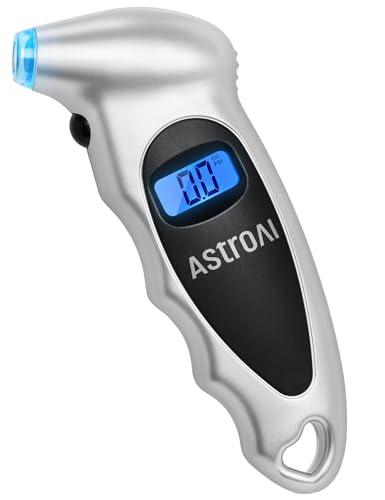
Accurate, Dependable Readings: Factory‑calibrated to ±1 PSI, so you can confidently match your vehicle’s recommended PSI (check the door jamb sticker). Ideal for monthly checks and road trips — consistent results every time, cold or warm.

PROCESS LEVEL ACCURACY: Each ETENWOLF’s digital tire pressure gauge is calibrated manually to ANSI B40.7 Grade 2A(plus-minus 1 PSI).Presta valve adapter not included, if used for bicycles, it must be purchased separately

HIGH ACCURACY: Every ETENWOLF's pencil tire gauge is calibrated to ANSI B40.1 Grade B, it is accurate to 2% of span in the middle 50% of range and 3% of span in the lower and upper 25% of range. Each ETENWOLF pencil tire pressure gauge is manually calibrated and has its unique calibration number printed on the pencil
Check Cold Tire Pressure
- Park the Supra for at least three hours, preferably overnight.
- Find the Tire and Loading Information label on the driver-side door area.
- Remove the valve cap and press the gauge squarely onto the valve stem.
- Record the left-front, right-front, left-rear, and right-rear readings.
- Compare each reading with the specified cold pressure for your setup.
If one tire is several PSI lower than the others or repeatedly loses pressure after correction, treat it as a possible leak. Inspect for a puncture, valve problem, wheel damage, or bead leak and have the tire professionally checked when necessary.
Use a Quality Gauge
A digital or calibrated analog gauge is more reliable than judging pressure by appearance. The Supra’s low-profile tires can appear normal while being meaningfully underinflated.
Gas-station gauges are useful in an emergency, but condition and calibration vary. For consistent readings, use the same reliable gauge for routine checks whenever practical.
Pro Tip: If you must drive to an air pump, note each tire’s cold reading before leaving. Do not bleed a warmed tire to the cold target. If a warm tire is clearly low, add air for safety and verify the final pressure again after the tire has cooled.
Adjust for Temperature
After a sharp temperature drop, all four tires can read lower even without a leak. Add air until the cold reading matches the vehicle’s specified value. For example, if your verified target is 38 psi and the tire reads 34 psi cold, add air until it reaches 38 psi cold.
- Inflate in short bursts to avoid overshooting.
- Recheck with your gauge after each adjustment.
- Replace valve caps to help keep dirt and moisture away from the valve core.
- Check again after the next major temperature swing.
Troubleshooting: Drops, Uneven Wear, and TPMS Quirks
An even seasonal drop across all four tires can be consistent with colder ambient temperatures. One tire repeatedly losing substantially more pressure than the others deserves a leak inspection.
| Symptom | Possible cause | What to do |
|---|---|---|
| All four tires drop after a cold front | Normal temperature-related pressure change | Measure cold and restore each tire to its specified PSI |
| One tire drops repeatedly | Puncture, valve leak, bead leak, or wheel damage | Inspect and repair the cause instead of repeatedly topping it off |
| Center tread shows abnormal wear | Possible sustained overinflation, alignment/suspension condition, tire construction, or use pattern | Verify cold PSI and have abnormal wear inspected rather than diagnosing by tread pattern alone |
| Outer shoulders show abnormal wear | Possible underinflation, alignment condition, or repeated hard cornering | Correct pressure and inspect alignment, suspension, and tread condition |
| TPMS lamp flashes and then remains on | Possible TPMS system or sensor malfunction | Confirm actual tire pressure with a gauge and have the TPMS diagnosed |
Do not rely on the dashboard display alone immediately after adding air. The displayed pressure may require a short drive to update.
Winter Tires, Aftermarket Wheels, and Track Use
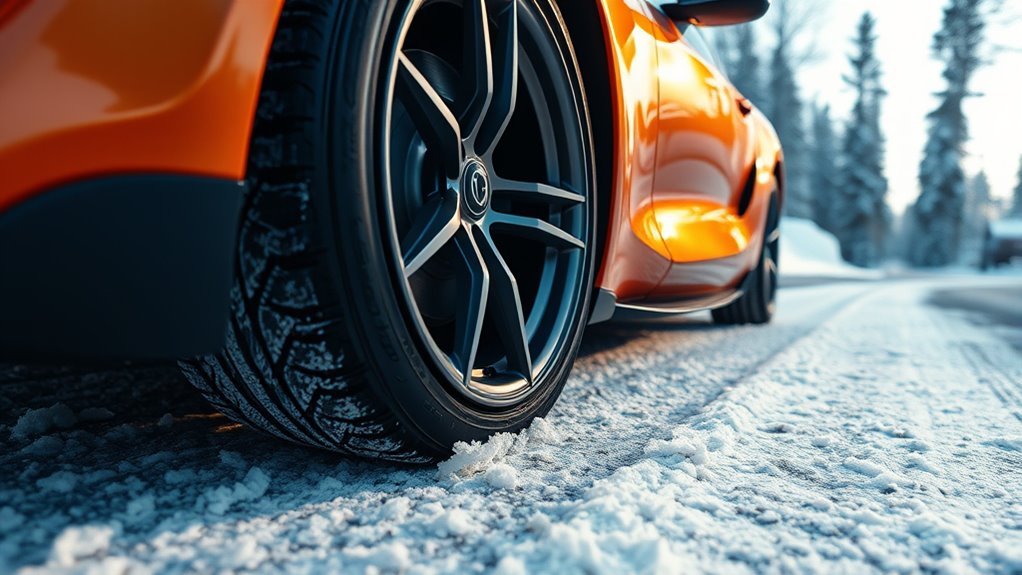
Correct tire pressure does not turn a summer-performance tire into a winter tire. If your Supra is still on summer tires, follow the tire manufacturer’s temperature and weather limitations and use an appropriate winter setup when road conditions require it. NHTSA notes that summer tires are not designed for snow, ice, or below-freezing operation.
If you install a different approved winter wheel-and-tire package, confirm the correct tire size, load rating, speed rating, brake clearance, and pressure requirements. For a non-OE tire size or load rating, do not choose a pressure merely because its wheel diameter is close to the original setup. Confirm the replacement tire’s load/inflation requirements with the tire manufacturer or a qualified tire professional.
For track use, do not use this cold-weather street guide as a track-pressure setup. Track pressures depend on the specific tire, alignment, surface temperature, driving pace, and the tire maker’s hot-pressure guidance. Street pressure should be restored before normal road use.
Warning: Summer-performance tires lose cold-weather capability as temperatures fall. Correct PSI cannot compensate for a tire compound that is unsuitable for the temperature, snow, or ice. Follow the tire manufacturer’s specific cold-weather limits.
Seasonal Schedule: When Should You Recheck Supra Tire Pressure?
NHTSA recommends checking tire pressure at least once a month when the tires are cold and before long trips. In winter, also recheck after a major temperature drop, after tire service, whenever the TPMS warning appears, or whenever one tire begins losing pressure faster than the others.
- At least monthly: Check cold PSI, tread depth, valve stems, and visible sidewall damage.
- After a major cold snap: Recheck all four tires once they are cold.
- Before long trips: Check pressure before loading the car and leaving.
- After tire or wheel service: Confirm the pressure and verify that Supra Command recognizes the installed setup.
- After repeated pressure loss: Inspect the tire instead of treating continual air loss as normal seasonal change.
A simple pressure log can help separate a weather-related change from a slow leak. Record the date, ambient temperature, cold readings, and any air added.
Frequently Asked Questions
What is the best PSI for a 2026 Toyota Supra?
For a stock 2026 U.S. GR Supra with 255/35ZR19 front and 275/35ZR19 rear tires, the current reference is 38 psi cold front and rear. Confirm your driver-side Tire and Loading Information label before inflating because the vehicle placard is the final authority.
Does a 2026 Toyota Supra use 32 psi?
Do not assume 32 psi applies to a current U.S. 2026 Supra simply because a Supra manual or fitment table contains that number. Toyota’s current U.S. 2026 lineup uses 3.0-based grades with the stock 19-inch setup, for which the current reference is 38 psi front and rear. Other model years, markets, or approved wheel-and-tire combinations can use different pressures, so verify your own placard.
Is 30 psi too low for winter tires on a Supra?
Compare 30 psi with the cold pressure specified for your exact vehicle and tire setup. If your placard calls for 38 psi, 30 psi is 8 psi below the specified value. If an approved setup calls for 32 psi, 30 psi is still below its target. Correct the pressure cold and inspect for a leak if one tire repeatedly drops.
Should I add extra PSI to my Supra in winter?
Do not add a permanent winter-pressure offset by default. Cold weather lowers the actual pressure in the tire, so measure it cold and add only enough air to restore the vehicle’s specified cold PSI. Recheck after major temperature changes.
Can I trust the Supra TPMS instead of using a gauge?
Use TPMS to monitor pressure and warn about significant loss, but still check the tires with a gauge. NHTSA recommends manual cold-pressure checks at least monthly because TPMS is not a replacement for regular tire maintenance.
Why is my Supra tire pressure higher after driving?
Driving heats the tire and the air inside it, so pressure normally rises. Do not bleed a normally heated tire down to the cold placard value. Let the vehicle sit and verify the final pressure when the tires are cold.
Conclusion
For a stock 2026 U.S. GR Supra on its standard 19-inch 255/35ZR19 front and 275/35ZR19 rear setup, 38 psi cold front and rear is the current reference, with your own driver-door placard taking final priority. When temperatures fall, measure the tires cold and restore them to the specified pressure rather than inventing a higher or lower winter setting. Use TPMS to monitor changes, verify readings with a gauge, and investigate any tire that loses pressure faster than the others.
Sources
- Toyota 2026 GR Supra Owner Information — tire-pressure monitoring, inflation checking, and vehicle tire-pressure guidance.
- Toyota — 2026 GR Supra — current U.S. trim lineup and vehicle configuration.
- Michelin USA — Toyota GR Supra Tire Pressures and Sizes — current Supra fitment sizes and pressure references.
- NHTSA TireWise — Tires — cold-tire definition, monthly checks, tire placard guidance, and TPMS limitations.
- U.S. Tire Manufacturers Association — Tire Care Essentials — temperature-related pressure changes, monthly pressure checks, and TPMS guidance.
- Michelin USA — How to Properly Inflate Your Tires — cold-versus-warm pressure checking and adjustment guidance.