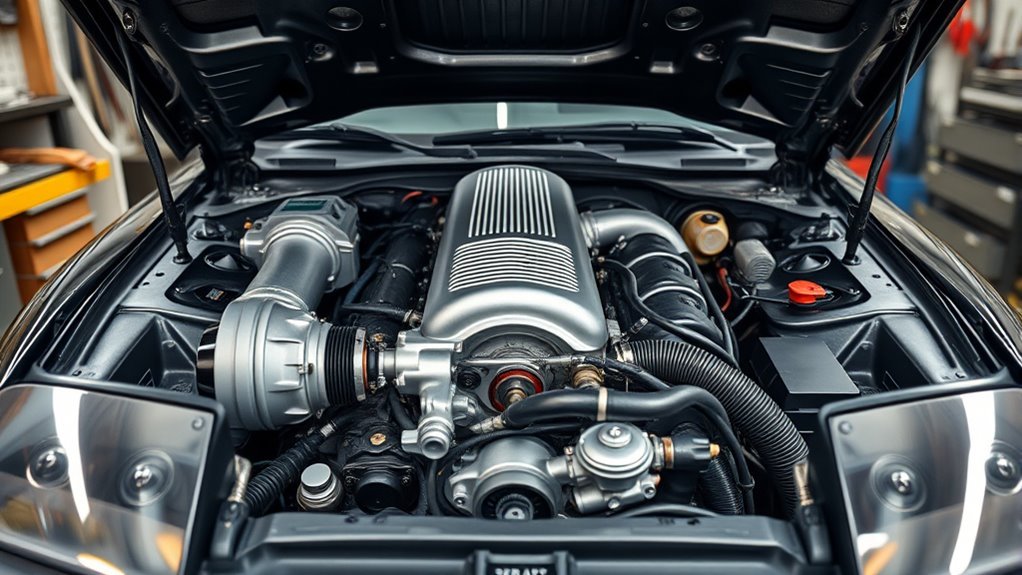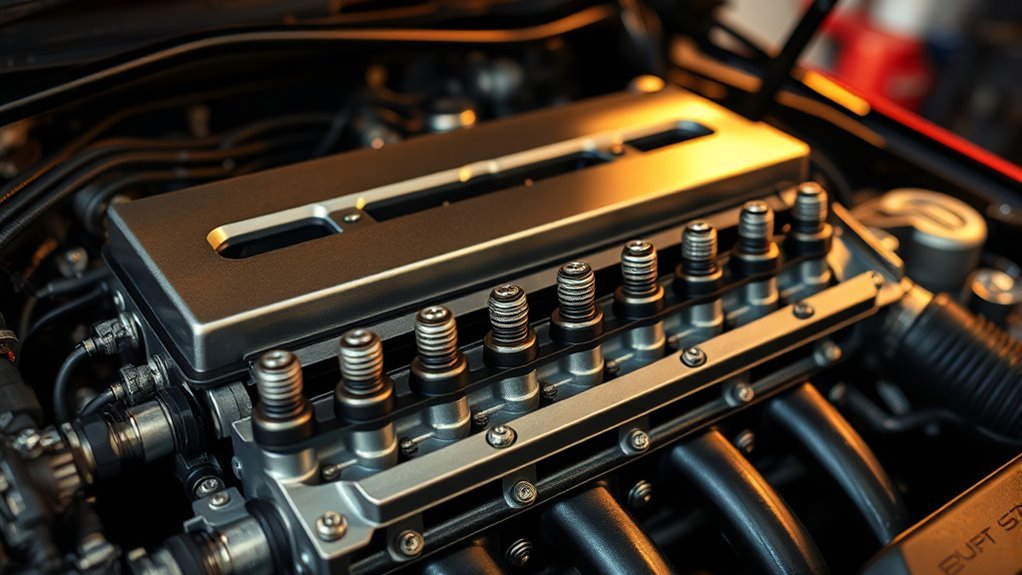
The modern Toyota GR Supra uses high-pressure gasoline direct injection: fuel is sprayed directly into the combustion chamber rather than into the intake port. On the MkV, that supports precise fuel control, charge cooling, and knock resistance under boost, but it also means the intake valves are not continuously washed by gasoline. For owners, the practical issues are carbon-deposit diagnosis, high-pressure fuel-system safety, and making sure modified cars can maintain commanded fuel pressure under load.
Last updated: September 16, 2026.
Quick Answer
The U.S.-market MkV Supra uses high-pressure gasoline direct injection rather than Toyota’s D-4S dual-injection system. DI gives the engine precise fuel control and useful charge cooling under boost, but it does not wash the intake valves with fuel. Stock owners mainly need correct fuel, routine maintenance, and diagnosis if symptoms appear; modified cars also need rail-pressure and mixture logging before more boost or ethanol is added.
Key Takeaways
- U.S.-market MkV GR Supras use BMW-derived turbo engines with direct fuel injection; earlier MkV years also offered a direct-injected 2.0-liter four-cylinder.
- BMW’s B58TU training material specifies a 350-bar high-pressure system for that engine family. Treat that as an engine-family reference, not a universal service value for every Supra year or market.
- Direct injection supports precise fueling and knock control, but gasoline does not flow across the backs of the intake valves.
- Toyota D-4S is a separate dual-injection strategy that combines direct and port injectors; it is not the fuel-system label for the U.S.-market MkV Supra.
- For ethanol, larger turbos, or higher boost, log rail pressure and commanded versus actual mixture before choosing HPFP, injector, low-pressure, or supplemental port-injection upgrades.
How Toyota Supra Direct Injection Works
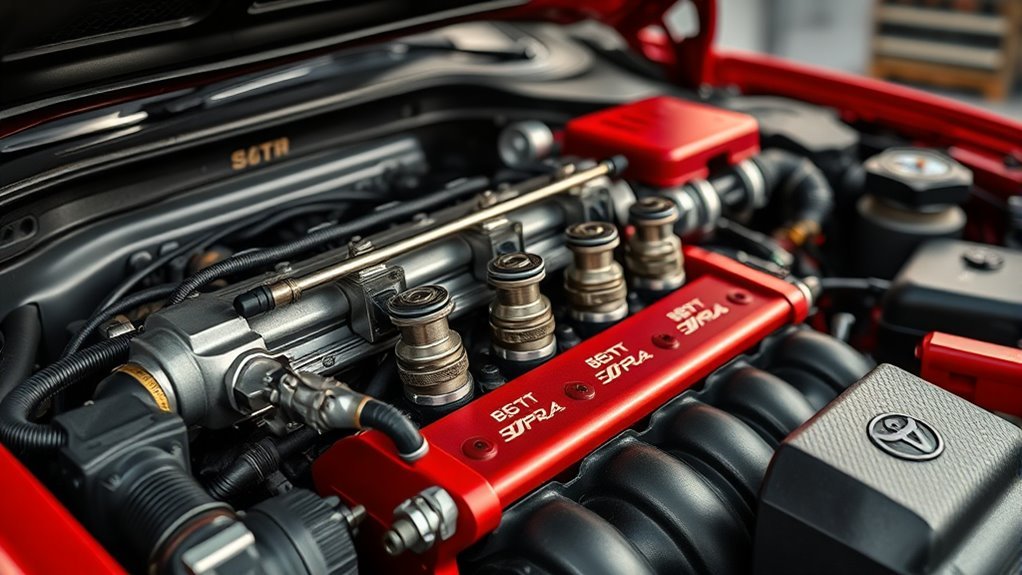
In a direct-injection gasoline engine, the injector sprays fuel straight into the cylinder instead of spraying it into the intake port. That lets the engine control fuel timing, spray pattern, and mixture formation very precisely.
On the modern GR Supra, that precision supports the car’s turbocharged power delivery. Toyota lists the 2026 U.S. model with a 3.0-liter turbocharged inline-six. BMW’s B58TU technical material specifies a revised high-pressure pump and injectors designed for 350 bar of fuel-injection pressure, roughly 5,100 psi. That 350-bar figure is best treated as a B58TU engine-family specification; use service information for the exact model year and engine when diagnosing or repairing a specific Supra.
Why the pressure matters: High injection pressure improves atomization and mixture preparation, while in-cylinder fuel evaporation provides charge cooling that can increase knock margin under boost.
Direct injection helps the Supra in four main ways:
- Finer atomization: High pressure breaks fuel into small droplets so it mixes faster with air.
- Charge cooling: Fuel vaporizing inside the cylinder absorbs heat, which helps reduce knock risk.
- Precise timing: The ECU can adjust injection timing based on load, boost, rpm, temperature, and emissions needs.
- Cleaner power control: The system can support strong torque without relying on overly rich fueling in normal operation.
Model-year scope: This article focuses on the U.S.-market MkV GR Supra. Toyota’s 2020 product information identifies direct injection for the launch-year 3.0, and Toyota later described the MkV 2.0 as using direct fuel injection. The 2026 U.S. lineup is 3.0-liter only, and Toyota announced that MkV production would end in spring 2026. Older A70/A80 Supras used port-injected engine families, so their fuel-system behavior and carbon-deposit concerns are different.
Evidence note: This is a source-based technical guide, not a claim of instrumented testing on a specific car. Factory specifications are tied to Toyota and BMW technical material; modification advice should be confirmed with logs from the exact vehicle, fuel, hardware, and calibration.
Supra DI: HPFP, Rail, and Injector Design
The Supra’s direct-injection system has three core high-pressure parts: the high-pressure fuel pump, the direct rail, and the injectors. The low-pressure pump moves fuel from the tank toward the engine. The high-pressure fuel pump then raises that fuel to the pressure needed for direct injection.
| Component | What It Does | Why It Matters |
|---|---|---|
| Low-pressure fuel supply | Moves fuel from the tank to the high-pressure pump | Can become part of the fuel-delivery limit on very high-demand builds |
| High-pressure fuel pump | Raises fuel pressure for direct injection | Becomes a common limit with more boost, ethanol, or a larger turbo |
| Direct rail | Stores and distributes high-pressure fuel | Helps stabilize pressure during fast changes in load |
| Direct injectors | Spray fuel directly into the combustion chamber | Control fuel quantity, spray shape, atomization, and combustion quality |
| ECU calibration | Controls injection timing, pulse width, pressure targets, and safety strategy | Keeps the engine safe when hardware or fuel changes |
[Products Worth Considering]

This custom-fit car cover is designed for Toyota Supra and GR Supra models, offering dependable all-weather protection for both indoor and outdoor use. Built with durable Oxford fabric and a soft cotton lining, it helps shield your vehicle from rain, sun, snow, dust, and UV exposure while protecting the paint finish. Windproof straps, dual air vents, reflective details, and included security accessories add convenience and peace of mind.

This 2-piece oil control variable valve timing solenoid set is designed to help restore proper VVT operation and engine performance across a wide range of Toyota, Lexus, Scion, and Pontiac applications. Built to meet or exceed OE performance, it uses quality seals for reliable oil control and helps reduce issues caused by improper oil flow. It is a practical replacement choice for maintaining smooth engine timing and dependable drivability.

This ignition coil and spark plug set is designed to restore reliable starting, smooth engine performance, and efficient combustion for compatible Toyota, Lexus, Scion, and Pontiac models. Built with durable materials and engineered to meet or exceed OE design standards, it offers dependable fitment and long-lasting operation. The package includes four ignition coils and four double iridium spark plugs for a complete tune-up solution.
HPFP Capacity Limits
The high-pressure fuel pump is one of the first fuel-system data points to watch on a modified Supra, but it is not the only possible bottleneck. At stock power, the factory system is calibrated as a complete package. As boost, torque demand, rpm, or ethanol content rises, the high-pressure side, injectors, or low-pressure supply can run out of margin depending on the exact setup.
When the high-pressure side cannot meet demand, logs may show rail pressure falling below target, actual lambda moving leaner than commanded, injector on-time approaching the calibration’s usable window, torque intervention, or high-load misfires. Those signs are not interchangeable, so diagnose them together with low-pressure supply, boost, ignition, fuel quality, and fault codes before blaming one component.
Warning: Do not loosen direct-injection fuel lines or remove high-pressure fuel parts without the factory service procedure. DI systems can hold dangerous pressure, and spilled fuel near a hot turbo engine is a fire risk.
Injector Spray Patterns
Injector design is not only about how much fuel can flow. It is also about where the fuel goes. Direct injectors must place the spray inside a fast-moving combustion chamber without causing wall wetting, poor mixture formation, or soot.
Good spray control helps the Supra’s engine maintain stable combustion during cold starts, light-load cruising, hard acceleration, and transient throttle changes. The injector’s hole pattern, cone angle, opening speed, and pulse timing all influence how the air-fuel mixture forms before ignition.
- Spray angle affects how fuel avoids the piston crown and cylinder wall.
- Droplet size affects evaporation speed and mixture quality.
- Rail-pressure stability keeps injector behavior repeatable.
- Calibration balances power, emissions, cold-start quality, and knock resistance.
Why Supra’s DI Improves Fuel Economy and Performance
Direct injection improves the Supra’s performance by giving the ECU more control over combustion. Instead of fueling earlier in the intake port, the engine can inject fuel directly into the cylinder at carefully chosen times.
Cooler Combustion Temperatures
When fuel vaporizes inside the combustion chamber, it absorbs heat. This cooling effect reduces the chance of knock, which is especially valuable on a turbocharged engine. Less knock risk means the calibration can run stronger boost and ignition timing targets while still protecting the engine.
That does not mean direct injection makes the engine immune to knock. Fuel quality, intake-air temperature, spark plugs, deposits, calibration, and boost pressure still matter. Follow the owner’s manual for the exact model year and engine. As one model-year example, Toyota’s 2024 U.S. brochure specifies 91 AKI or higher for the 2.0 and 93 AKI or higher for the 3.0; do not assume one octane requirement applies to every market or model year.
Precise Fuel Metering
Direct injection allows accurate fuel delivery for each cylinder event. The ECU can adjust injector timing and duration based on operating conditions. This helps the engine stay smooth at idle, efficient during cruise, and responsive when the turbo builds boost.
Be careful with broad claims like “20% better fuel economy.” Direct injection can improve efficiency compared with older fuel systems, but the exact gain depends on engine design, emissions rules, gearing, tires, vehicle weight, and driving style. Toyota lists the 2026 GR Supra 3.0 at an estimated 22 mpg city and 29 mpg highway, which is strong for a 382-hp rear-drive sports coupe but not proof of a universal DI-only percentage gain.
Higher Effective Compression
The Supra’s turbo engine uses direct injection, variable valve control, turbocharging, charge cooling, and ECU strategy together. The benefit is not simply “more compression.” The real advantage is that the engine can manage cylinder pressure and temperature more precisely.
Direct injection helps the engine tolerate higher load before knock becomes a problem. Under boost, that gives the calibration more room to make torque. Under cruise, it helps the engine run efficiently without wasting fuel. The result is the Supra’s mix of quick throttle response, strong midrange torque, and daily-drivable fuel economy.
Does the MkV Supra Use Toyota D-4S or Port Injection?
No—not in general U.S.-market MkV coverage. Toyota D-4S combines direct and port injection, while Toyota’s MkV Supra product information identifies direct fuel injection for the Supra engine. Aftermarket supplemental port injection can be added to modified cars, but that does not make the factory system Toyota D-4S.
Toyota describes D-4S on the GR86 as a twin-injector system that controls direct injection into the combustion chamber and port injection into the intake port according to driving conditions. That is a different architecture from the factory MkV Supra fuel system discussed here. If you are researching a non-U.S. car, verify the exact market, engine, and model year before transferring a fuel-system label from another Toyota model.
Note: The current U.S. GR Supra is generally discussed as a BMW-derived direct-injection turbo platform. Toyota D-4S is a Toyota dual-injection system used on other Toyota engines, including models such as the GR86, but it is not the key fuel-system label for the MkV Supra.
| System | Fuel Delivery | Main Strength | Main Tradeoff |
|---|---|---|---|
| Port injection | Fuel sprays into the intake port | Helps wash intake valves and is simpler to service | Less charge-cooling and cylinder-level timing control |
| Direct injection | Fuel sprays into the combustion chamber | Strong knock resistance, atomization, and fuel control | Can build intake-valve deposits because fuel does not wash the valves |
| Toyota D-4S | Uses both direct and port injectors | Blends DI performance with PI valve-washing benefits | More parts and more complex control strategy |
| Aftermarket supplemental port injection | Adds extra fuel through the intake side | Supports high-power or ethanol-heavy builds | Requires careful tuning and may not be emissions legal for street use |
Does Supra Direct Injection Cause Intake-Valve Carbon Buildup?
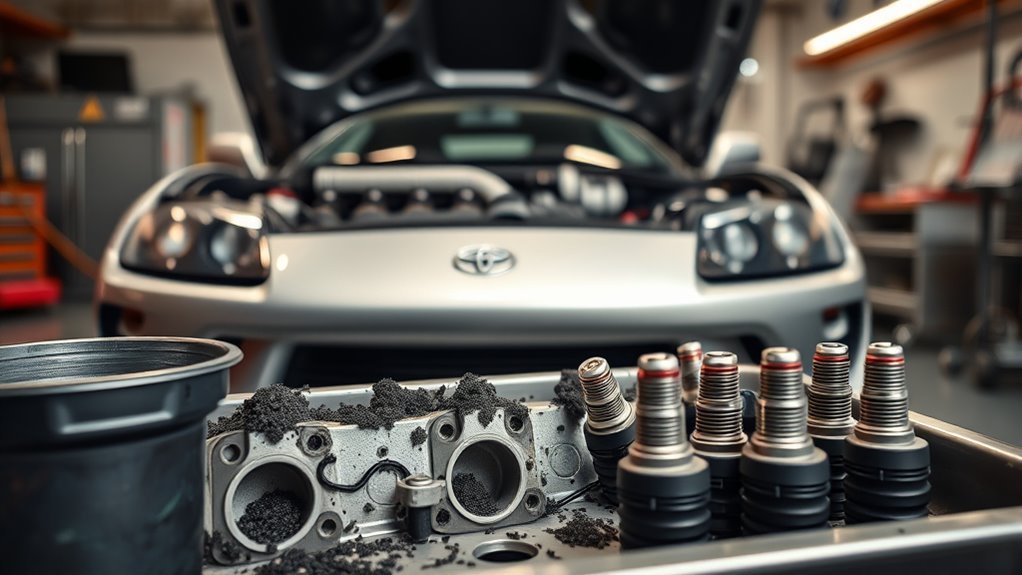
Direct injection can allow intake-valve deposits to accumulate because gasoline is injected inside the cylinder rather than across the back of each intake valve. Oil mist and other crankcase vapors reaching the intake can contribute to deposits over time. That is different from injector deposits: a fuel-system cleaner that reaches the injector does not automatically clean the intake valve on a DI-only engine.
There is no verified universal mileage at which every Supra needs intake-valve cleaning. Deposit rate varies with engine condition, crankcase ventilation, operating pattern, oil control, calibration, and other factors. Clean the valves because inspection and diagnosis support it—not because the odometer reached an arbitrary number.
What Symptoms Can Intake-Valve Deposits Cause?
Possible signs include the symptoms below, but none proves carbon buildup by itself. Spark plugs, ignition coils, injectors, air leaks, fuel-pressure problems, sensors, or calibration faults can produce similar behavior.
- Rough idle: The engine feels uneven, especially during cold-start or low-load operation.
- Hesitation: Throttle response becomes dull or inconsistent.
- Misfires: Airflow disturbance can contribute to cylinder-specific or random misfire faults.
- Reduced power: Heavy deposits can restrict airflow or worsen combustion quality.
- Fuel-economy change: A worsening trend can accompany combustion or mixture-control problems.
- Hard cold starts: Severe deposits can make cold combustion less stable.
What Actually Helps Prevent Carbon Buildup
Fuel-system cleaners can help keep injectors clean, but they do not magically wash the intake valves on a DI-only engine. That is because the fuel never flows over the back of the valves in normal operation.
- Use the specified fuel: Follow the owner’s manual for the correct octane and fuel requirements.
- Follow the oil-service schedule: Correct oil and timely service support crankcase ventilation and overall engine condition, but an oil change is not an intake-valve cleaning method.
- Repair abnormal oil or PCV problems: Excess oil entering the intake can worsen deposit formation.
- Avoid diagnosing by mileage alone: Short-trip use can complicate engine condition, but it does not establish that the valves need cleaning.
- Inspect when symptoms and data point that way: A borescope can confirm whether deposits are actually present.
- Clean only when justified: Walnut blasting or an approved professional intake-cleaning procedure can remove confirmed deposits; fuel-tank additives do not directly wash the back of the intake valves on a DI-only engine.
Pro Tip: Before paying for intake-valve cleaning, scan for codes and review cylinder misfires, fuel trims, boost behavior, and fuel pressure. A plug, coil, injector, air leak, fuel-delivery problem, or calibration issue can mimic carbon symptoms.
Diagnose Before Cleaning or Upgrading
| What You Find | Best Next Step | Do Not Assume |
|---|---|---|
| Visible heavy intake-valve deposits plus matching symptoms | Use an approved professional cleaning method and correct any oil/PCV fault contributing to deposits | A fuel-tank additive will wash the valves clean |
| Rail pressure falls below the tune’s target under load | Review HPFP demand, low-pressure supply, injectors, fuel content, and calibration with the tuner | The HPFP alone is definitely the failed part |
| Misfire with normal fuel pressure | Check codes, plugs, coils, injector behavior, air leaks, compression, and deposits | Carbon buildup is automatically the cause |
| No symptoms and normal logs | Continue the factory maintenance schedule and monitor trends | Preventive walnut blasting is required at a fixed mileage |
Tuning and High-Power Builds: DI Limits and Upgrade Strategies
The Supra’s direct-injection system is strong for factory power and moderate upgrades, but it is not unlimited. Once you add more boost, ethanol blends, larger turbochargers, or aggressive torque targets, fuel demand rises quickly.
The tuning challenge is not just peak horsepower. It is maintaining commanded fuel pressure and mixture control during high torque, high boost, rising rpm, and transient throttle changes. Ethanol blends also increase required fuel volume for a given energy output, so a setup that has margin on gasoline may have less margin as ethanol content rises.
[Products Worth Considering]

KUST Custom Fit Trunk Mat is designed for 2020-2026 Toyota GR Supra models to help protect the cargo area from dirt, spills, and daily wear. Its TPE construction offers a fresh, odor-free feel, while the raised-edge design adds extra coverage for all-weather protection. Lightweight and easy to remove, it makes cleaning simple and helps keep the trunk neat and protected.

The KZYEE KS40 helps diagnose weak spark plugs, ignition coil problems, and misfires by simulating real engine conditions under load. With adjustable RPM testing and dual-port comparison, it makes it easier to spot hidden ignition faults quickly and accurately. Its enclosed spark-proof design supports safer testing for both professionals and DIY users across a wide range of 12V gasoline engines.

This ignition coil and iridium spark plug set is designed to restore smooth engine performance and reliable starts for compatible Toyota, Lexus, Scion, and Pontiac vehicles. It features durable coil construction for dependable electrical connection and long-lasting iridium plugs for extended service life. The set includes four matched coils and plugs, making it a convenient replacement solution backed by a one-year warranty.
Signs the Fuel System Is Running Out of Room
- Fuel rail pressure drops below target during wide-open throttle.
- Lambda or air-fuel ratio trends leaner than commanded.
- Injector pulse width or duty approaches the tuner’s safe limit.
- The ECU closes throttle or reduces torque to protect the engine.
- Misfires appear under high load.
- Timing corrections increase when fuel quality or mixture control gets worse.
Upgrade Paths for Modified Supras
There is no single “best” fuel upgrade for every Supra. The right choice depends on power goal, fuel type, emissions requirements, turbo setup, and whether the car is a daily driver, street car, or track build.
| Build Goal | Fuel-System Focus | Important Caution |
|---|---|---|
| Stock or mild tune | Healthy stock HPFP, good fuel, correct plugs, safe calibration | Do not assume all off-the-shelf maps fit every fuel quality or climate |
| Pump-gas bolt-ons | Rail-pressure logging, injector margin, knock control | Heat and poor fuel can reduce safety margin |
| Ethanol blend | Higher fuel-volume demand and accurate ethanol-content control | Ethanol needs more fuel volume than gasoline for the same energy output |
| Big turbo | Use logs to determine whether the build needs HPFP, injector, low-pressure, supplemental port-injection, or staged-fueling changes | Fueling, cooling, transmission, and engine limits must be planned together |
| Track use | Fuel pressure stability, heat management, oil control, conservative mapping | A dyno-safe tune may still need track-specific safety margin |
Warning: Supplemental port injection, catalyst changes, and some fuel-system upgrades may violate emissions laws on public roads. Confirm local rules before modifying a street-driven Supra.
Maintenance Checklist and Aftermarket Upgrade Options for Supra DI
A direct-injection Supra rewards careful maintenance. You do not need to over-service the car, but you should avoid treating the fuel system like a simple old port-injected setup.
Maintenance at a Glance
| Best First Step | Follow the Toyota owner’s manual and maintenance schedule for your exact model year. |
| Owner Difficulty | Basic checks are easy; high-pressure fuel work should be left to trained technicians. |
| Tools Needed | OBD scanner, data-logging app, basic inspection tools, and professional diagnostic tools for deeper issues. |
| Cost Range | Low for routine checks; moderate to high for injector diagnosis, walnut blasting, HPFP upgrades, or custom tuning. |
[Products Worth Considering]

This set of four ignition coils is designed to restore smooth engine performance and reliable starting for compatible Toyota, Scion, and Lexus applications. Built to meet or exceed OE specifications, these coil packs help reduce misfires, hesitation, and check engine light issues while supporting stronger ignition output. The direct-fit design makes installation straightforward, and the package includes a warranty for added peace of mind.

This upgraded engine oil funnel kit makes oil changes cleaner and easier with a spill-proof design, flow control valve, and transparent body for precise filling. Built from durable polycarbonate and equipped with 12 adapters, two 45-degree elbows, and a debris filter, it fits a wide range of vehicles and works well in tight engine spaces. The secure, hands-free setup helps reduce mess while improving control during oil filling and fluid transfers.

This MotoRad fuel tank cap is designed as a direct replacement for a wide range of Toyota, Honda, Mazda, Subaru, Nissan, Chevy, and more applications. It helps restore a secure seal at the fuel neck, supporting proper fuel system performance and dependable everyday driving. Use fitment verification to confirm compatibility with your specific vehicle before purchase.
Routine DI Maintenance Checklist
- Use the correct fuel: Use the octane listed in your Supra’s owner’s manual. Turbo DI engines are sensitive to poor fuel quality.
- Change oil on time: Fresh oil helps reduce sludge, vapor, and deposit formation.
- Inspect spark plugs: Worn plugs can cause misfires that look like fuel-system problems.
- Watch fuel trims: Large trim changes can point to leaks, injector issues, or sensor problems.
- Log rail pressure under load: Especially after a tune, ethanol blend, or hardware change.
- Check for carbon symptoms: Rough idle, misfires, or reduced response may justify intake inspection.
- Keep software matched to hardware: Never install fuel upgrades without calibration support.
Aftermarket Upgrade Options
For modified Supras, fuel-related upgrades can include a higher-capacity HPFP, higher-flow direct injectors, ethanol-content monitoring, supplemental port injection, a stronger low-pressure supply, and calibration changes. Do not buy the whole list by default: the right path depends on what the logs show, the power target, the fuel, and the hardware already installed.
Before buying parts, ask your tuner which data proves the upgrade is needed. A good plan starts with logs, not guesses. Rail pressure, lambda, injector pulse width, boost, knock correction, and fuel quality tell you what the system is actually doing.
Real-World Effects: MPG, Emissions, and Daily Driveability

For the 2026 U.S. GR Supra, Toyota lists a 3.0-liter turbocharged inline-six, a 0–60 mph time of 3.9 seconds with the automatic transmission, and a manufacturer-estimated 22/29 mpg city/highway rating. Toyota also announced that the 2026 model year would be the MkV’s final production run, with fifth-generation production ending in spring 2026.
Emissions are more nuanced than “DI is cleaner” or “DI is dirtier.” An EPA HERO-listed review found that gasoline direct-injection engines can produce higher engine-out particle-number emissions than port-injected engines because mixture formation is less homogeneous. Actual tailpipe emissions depend on calibration, operating conditions, emissions standards, and aftertreatment, so the review should not be read as a single tailpipe-emissions number for the Supra.
For owners, the practical takeaway is simple: direct injection is not something to avoid, but it is something to maintain properly. A stock or lightly tuned Supra can be very livable. A heavily modified Supra needs a fuel-system plan, professional tuning, and honest maintenance habits.
Frequently Asked Questions
Should I avoid GDI engines?
No. You should not automatically avoid gasoline direct-injection engines. GDI can improve power, efficiency, and knock control, which is why many modern turbo engines use it. Just understand the tradeoffs: intake-valve carbon buildup, higher fuel-system pressure, more expensive components, and tighter tuning requirements.
Does the modern Toyota Supra use Toyota D-4S?
No, not in general U.S.-market MkV coverage. Toyota D-4S combines direct and port injection, while Toyota’s MkV Supra product information describes direct fuel injection for the Supra engine. Aftermarket port injection can be added to modified cars, but that is separate from the factory Toyota D-4S system.
How does Toyota’s D-4S dual-injection system work?
Toyota D-4S uses two types of injectors: direct injectors that spray into the combustion chamber and port injectors that spray into the intake port. Toyota describes the GR86’s D-4S system as controlling both injection types according to driving conditions to improve response, efficiency, and combustion quality.
What are the downsides of direct injection?
The main tradeoffs are the possibility of intake-valve deposits, high-pressure fuel-system complexity and safety requirements, particulate-emissions concerns, and less fueling margin as modified engines demand more fuel. These issues should be diagnosed with inspection and data rather than fixed by mileage-based parts replacement.
How does direct injection work?
Direct injection sprays high-pressure fuel directly into the combustion chamber. The ECU controls when and how much fuel is injected. This improves atomization, helps cool the cylinder charge, supports stronger knock resistance, and gives the engine more precise control over combustion.
What fuel pressure does the MkV Supra direct-injection system use?
BMW’s B58TU technical material specifies a high-pressure pump and injectors designed for 350 bar, or about 5,100 psi. Use that as an engine-family reference rather than a universal service value: verify the exact Supra model year, engine, market, operating condition, and service information before diagnosis.
Do fuel additives clean Supra intake valves?
Fuel additives can help clean injectors and parts of the fuel system, but they do not directly wash the intake valves on a DI-only engine. If the intake valves are heavily carboned, professional intake cleaning, often walnut blasting or an approved cleaning method, is usually more effective.
Conclusion
The MkV Supra’s direct-injection system supports precise fueling, in-cylinder charge cooling, and strong knock control under boost. For a stock car, the practical plan is simple: use the specified fuel, follow the maintenance schedule, and diagnose symptoms before paying for cleaning or parts. For a modified car, log commanded versus actual fuel pressure and mixture before adding more boost, ethanol, or fueling hardware.
The key distinction is that the U.S.-market MkV Supra should not be labeled a Toyota D-4S car. D-4S is Toyota’s combined port-and-direct-injection strategy used on models such as the GR86. The MkV Supra discussed here is a high-pressure direct-injection turbo platform, and any supplemental port injection on a modified car is an aftermarket fueling strategy rather than factory D-4S.
Sources
- Toyota GR Supra official model page — 2026 U.S. engine, trim, performance, and fuel-economy information.
- Toyota USA Newsroom: GR Supra MkV Final Edition — 2026 specifications and Toyota’s statement that fifth-generation production would end in spring 2026.
- Toyota USA Newsroom: 2020 Supra product information — Toyota’s direct-injection designation for the launch-year 3.0-liter Supra.
- Toyota USA Newsroom: 2021 GR Supra — revised 3.0-liter engine and introduction of the 2.0-liter turbo model.
- Toyota 2024 GR Supra brochure — model-year fuel requirements and specifications.
- BMW B58TU technical-training manual mirror — B58TU fuel-system layout and 350-bar direct-injection design specification.
- Toyota Global Newsroom: GR86 D-4S description — official explanation of Toyota D-4S direct and port injection.
- EPA HERO: review of particulate-number emissions from GDI engines — engine-out GDI particulate-emissions context and control factors.