
To prevent hydroplaning in a Toyota Supra, slow down before standing water, keep the tires at the correct cold pressure, replace rain-worn tires before tread gets too shallow, avoid cruise control, and use smooth steering, throttle, and braking. If the car begins to hydroplane, ease off the accelerator, look where you want to go, keep steering inputs gentle, and avoid sudden braking until the tires regain firm contact with the road.
Last updated: September 16, 2026. Safety guidance rechecked against Toyota owner resources, AAA wet-weather guidance and tire research, FHWA rain-safety data, and Bridgestone tire guidance.
Quick Answer
To reduce hydroplaning risk in a Supra, replace tires at about 4/32 inch tread if you regularly drive in rain, set cold tire pressure to the door-jamb placard, slow down before pooled water, avoid cruise control, and make smooth steering and braking inputs. If hydroplaning starts, ease off the throttle, look where you want to go, steer gently, and avoid sudden braking until grip returns.
Key Takeaways
- Hydroplaning happens when water pressure lifts the tire away from the road, cutting steering and braking grip.
- Speed, standing water, worn tread, low tire pressure, wide tires, and poor road drainage all raise the risk.
- For regular rainy driving, AAA recommends replacing tires at 4/32 inch tread rather than waiting for the lower legal minimum used in many U.S. states.
- Check cold tire pressure against the Supra’s door placard or Toyota owner information, not the maximum pressure printed on the tire sidewall.
- If the car starts to hydroplane, reduce inputs: ease off the throttle, look where you want to go, steer gently, and let the tires regain contact.
At a Glance
| Time Required | 10-15 minutes for a pre-rain tire and safety check |
| Difficulty | Easy |
| Tools Needed | Tire pressure gauge, tread depth gauge or quarter, washer fluid, flashlight |
| Cost | Usually $0 if you already own the basic tools; tire, brake, wiper, or alignment service varies by need |
Why Is a Toyota Supra Vulnerable to Hydroplaning?

Hydroplaning happens when a layer of water builds between the tire and the pavement. Once that water pressure becomes strong enough, the tire rides on the water instead of gripping the road. Steering response fades, braking distance grows, and the car can feel light or disconnected.
The Supra deserves extra respect in rain because it is a powerful rear-wheel-drive sports car and many versions use wide, staggered performance tires. Hydroplaning risk still depends on the complete setup: water depth, vehicle speed, tread depth, tire pressure, tire design, pavement texture, and tire width all affect how well the contact patch can clear water.
Low-profile performance tires also give crisp feedback on dry pavement, but wet grip depends heavily on tread pattern, compound, tire temperature, and remaining tread depth. A dry-grip tire that is excellent on warm pavement may not be the best choice for heavy rain, cold rain, or daily driving in a wet climate.
Warning: Stability control, ABS, traction control, and driver skill cannot create grip if the tires are riding on water. Keep the Supra’s traction and stability systems on for wet public-road driving.
This guide focuses on hydroplaning prevention and recovery. For broader visibility, floodwater, and storm-driving precautions, see the Toyota Supra heavy-rain safety guide.
At What Speed Can a Toyota Supra Hydroplane?
Hydroplaning is not tied to one fixed speed. It depends on water depth, tire tread, tire pressure, tire width, pavement texture, vehicle load, and speed. AAA notes that even new tires can lose some road contact at speeds as low as 35 mph when water is present. That is a caution point, not a safe-speed guarantee: slow down before puddles, wheel-track ruts, or shiny pooled water.
FHWA reports that 75% of weather-related crashes occur on wet pavement and 47% happen during rainfall. Those figures describe weather-related crashes broadly, not Supra-specific hydroplaning, but they show why wet-road speed and visibility margins matter.
Is 35 mph a Hydroplaning Threshold?
Use 35 mph as a practical caution point, not as a guarantee. Below that speed, you can still lose grip if the water is deep enough or the tires are worn. Above that speed, the tires must push water away faster, so your margin shrinks quickly.
In a Supra, be especially smooth with throttle. Sudden acceleration can unload or overwhelm the rear tires, and sudden braking can upset the car’s balance. Slow early, keep both hands steady, and give the tire tread time to clear water.
Road and Rain Factors
The first rain after a dry spell can be nasty because water mixes with built-up oil, dirt, grease, and grime. Caltrans warns that this first-rain mixture can leave roads extremely slippery. Heavy rain adds another risk: standing water that overwhelms the tire’s grooves.
| Condition | Why It Matters | What to Do |
|---|---|---|
| Light rain after dry weather | Oil and grime rise to the surface | Slow early and leave extra space |
| Heavy rain | Standing water can overwhelm tread grooves | Avoid puddles and low lanes |
| Worn pavement or ruts | Water collects where tires travel | Move out of pooled water when safe |
| Poor drainage near shoulders | Deeper water forms at road edges | Favor the drier lane position |
How Much Tread Does a Supra Need for Wet Roads?
Tread depth is your water-evacuation system. Deep grooves give water somewhere to go. As tread wears down, the grooves hold less water, the tire floats more easily, and wet braking gets worse.
Do not treat 2/32 inch as a wet-weather target. Laws vary by jurisdiction, and wet performance deteriorates well before a tire is fully worn out. In AAA testing, passenger-car tires worn to 4/32 inch needed an average of 87 additional feet to stop from highway speed on wet pavement and showed a 33% reduction in handling ability compared with new tires.
For regular wet-weather driving, use 4/32 inch as a replacement point, not a reason to wait for the wear bars.
For a Supra, tire selection matters as much as tread depth. Look for tires with strong wet-traction reviews, deep circumferential grooves, and a compound meant for your climate. In warm climates, an ultra-high-performance summer tire can work well in rain if it has enough tread and is within its temperature range. In colder wet climates, a performance all-season or seasonal tire may be the safer daily choice.
Pro Tip: Use a tread depth gauge instead of guessing. The quarter test is a fast backup: if you can see the top of Washington’s head when the quarter is inserted upside down into the groove, the tire is around 4/32 inch or less and is getting shallow for wet roads.
[Products Worth Considering]

Fix-A-Flat provides a quick emergency solution for temporary flat tire repair and inflation, helping drivers get back on the road without a jack, spare tire, or tools. Its formula seals small tread punctures in seconds, is safe for tires and TPMS systems, and offers an eco-friendly alternative for roadside emergencies. Designed for standard tires, it is easy to keep in the trunk for dependable peace of mind.

This smart color coded tire tread depth gauge makes it easy to check tread wear at a glance with clear red, yellow, and green ranges. Calibrated from 0 to 1 inch in 1/32 inch increments, it helps you quickly assess tire condition for safer driving and timely replacements. The pocket clip design makes it convenient to carry and use on trucks, motorcycles, cars, and other passenger vehicles.

The NOCO Boost GB70 is a compact yet powerful jump starter designed to safely revive dead 12V batteries in seconds. It combines UltraSafe spark-proof protection, a built-in power bank, and a bright LED flashlight in a rugged, portable design that fits easily in a glove box or emergency kit. Built for cars, trucks, SUVs, boats, motorcycles, and more, it delivers dependable emergency starting power whenever you need it.
What Tire Pressure Should You Use in Rain?
Correct tire pressure helps the tire keep its intended shape, contact patch, and water-channeling ability. Do not lower tire pressure in the rain hoping for more grip. Underinflation can make the tire flex more, run hotter, respond slower, and shed water less predictably.
[Products Worth Considering]
This adjustable trailer hitch ball mount is built for secure, versatile towing with a standard 2 inch receiver, a 2 inch ball, and both drop and rise adjustment for better fitment. Rated for heavy-duty towing and designed with anti-theft locking pins, it helps keep your trailer secure while resisting harsh weather and road conditions. The pre-assembled design makes installation fast and tool-free, so you can get hooked up and ready to tow with confidence.

This retractable car charger delivers fast, organized charging for multiple devices on the road with built-in retractable cables, USB-C and USB-A ports, and support for both 12V and 24V vehicles. A voltage display and multiple protection features help keep charging safe while the 180° rotating design improves fit and convenience in most cars. It is compatible with a wide range of phones, tablets, wearables, and gaming devices, making it a practical travel companion for families and commuters.
Tire Pressure Recommendations
Check pressure when the tires are cold, before driving or after the car has been parked long enough for the tires to cool. Use the pressure listed on the driver’s door-jamb placard or the Toyota owner information for your exact year, trim, tire size, and load. The number printed on the tire sidewall is the tire’s maximum cold pressure, not the Supra’s recommended operating pressure.
Measure pressure at least monthly, before long trips, and before a forecasted heavy-rain drive. Ambient temperature changes can move tire pressure, so recheck after a big weather swing.
Scheduled Tire Inspections
Use this wet-weather tire routine:
- Check cold tire pressure monthly and before road trips.
- Measure tread depth across the inner, center, and outer grooves of each tire.
- Inspect sidewalls for cuts, bubbles, cracks, or exposed cords.
- Look for uneven wear that may point to alignment, suspension, or inflation problems.
- Replace tires at or before 4/32 inch if the car sees regular rain.
- Have alignment checked if the car pulls, the steering wheel is off-center, or the tires show feathering or inner-edge wear.
Be careful with generic tire-rotation advice. Many Supra models use staggered front and rear tire sizes, and some performance tires are directional. That can limit or eliminate normal front-to-rear rotation. Follow the tire maker’s rules and your service shop’s guidance for your exact tire setup.
Note: If your Supra is on aftermarket wheels, a square setup, track alignment, or non-OE tire sizes, the factory rotation and pressure assumptions may not apply. Confirm fitment and pressure with a qualified tire professional.
How Should You Drive a Supra to Avoid Hydroplaning?
The best hydroplaning recovery is prevention. Once the tire floats, you have fewer choices. In rain, drive the Supra like every input is being judged: throttle, brake, and steering should all be smooth and separated.
- Reduce speed before water. Slow down before puddles, dips, shiny patches, and freeway ruts.
- Increase following distance. Wet pavement can take much longer to stop on, and worn tires add even more distance.
- Use small steering inputs. Sharp steering can turn a small slide into a bigger one.
- Avoid hard braking. Brake earlier and more gently. Let ABS work if hard braking becomes unavoidable.
- Drive in the tracks ahead when safe. The vehicle in front may have displaced some standing water.
- Skip deep puddles. Besides hydroplaning, deep water can damage brakes, electronics, wheel bearings, underbody parts, or the engine intake path.
Keep your eyes high and scan for changes in surface texture. A glossy patch, spray from other cars, or water flowing across the lane is your signal to slow down before you get there.
Cruise Control in Rain: Why to Avoid It and How to Control Speed
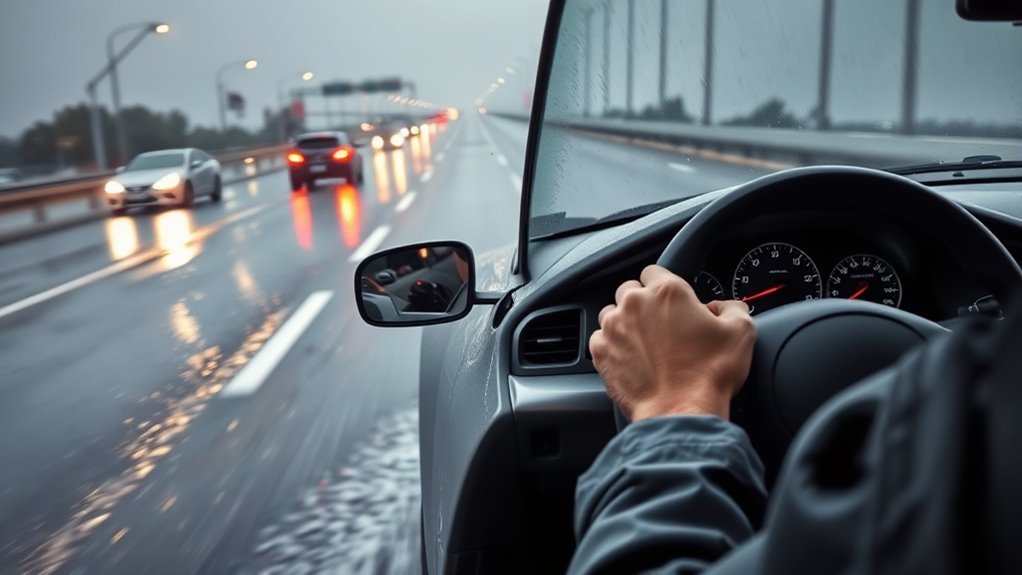
Cruise control is convenient on dry roads, but it is the wrong tool for wet conditions. AAA advises avoiding cruise control in wet weather because the driver may need to reduce speed quickly by lifting off the accelerator, and cruise control can delay that natural response.
| Situation | Risk | Better Move |
|---|---|---|
| Cruise control is engaged | You may react slower to traction loss | Turn it off before rain or standing water |
| Speed is too high for water depth | Tires cannot clear water fast enough | Ease down to a safer speed |
| The car hits sudden standing water | A driven wheel may lose contact | Hold steady and lift gently |
| Traffic slows ahead | Wet stopping distance increases | Brake early and progressively |
Manual speed control keeps you connected to the road. Use light throttle, watch the surface, and reduce speed before the car forces you to.
What Should You Check Before Driving a Supra in Heavy Rain?
Before driving a Supra in serious rain, make the car prove it is ready. This takes a few minutes and can prevent a bad surprise.
| Check | What to Look For | Why It Matters |
|---|---|---|
| Tires | 4/32 inch or more tread for rain, no bubbles, no cords, correct cold PSI | Tires are your only contact with the road |
| Wipers | No streaking, skipping, splitting, or chatter | Visibility drops fast in spray and heavy rain |
| Washer fluid | Reservoir full; no clogged nozzles | Road grime can blind the windshield |
| Lights | Low beams, brake lights, turn signals, and hazards working | Other drivers need to see you early |
| Brakes | Firm pedal feel and straight, smooth stopping | Wet roads leave less margin for brake problems |
| Alignment | No pull, vibration, or uneven tire wear | Uneven contact makes wet grip less predictable |
Use low-beam headlights in rain. High beams can reflect off spray and make visibility worse, especially at night or in heavy traffic.
What Should You Do If Your Supra Starts to Hydroplane?
If the Supra starts to hydroplane, the steering may suddenly feel light, the car may drift with little response, or engine speed may change as a driven tire loses firm contact. The goal is to reduce inputs until the tires reconnect with the pavement.
- Ease off the accelerator. Do not snap off the throttle if it will unsettle the car; just reduce power smoothly.
- Steer gently toward the safe path. Keep corrections small; do not keep adding steering angle if the car is not responding.
- Do not slam the brakes. Hard braking can upset the chassis while grip is already low.
- Look down the road. Your hands tend to follow your eyes, so look at the safe path, not the puddle or barrier.
- Wait for grip to return. When the tires reconnect, steering weight and road feel should come back.
- Then slow down more. After recovery, reduce speed and continue with extra distance.
If emergency braking becomes unavoidable and the tires have enough contact for ABS to work, press the brake firmly and steadily while steering toward the safest available path. Let ABS pulse; do not pump the pedal.
Which Changes Improve a Supra’s Wet-Weather Margin?

Long-term hydroplaning prevention starts with the tires, but it does not stop there. A Supra with great tires, poor alignment, and worn suspension parts still will not behave well in standing water.
Choose Tires for Real Weather
Pick tires for the rain you actually drive in, not just the dry-road grip you want. Check wet braking, hydroplaning resistance, treadwear, and temperature range. If you drive year-round in cool wet weather, do not assume a max-performance summer tire is always the best daily option.
Keep Alignment Street-Friendly
Aggressive track alignment can increase inner-edge tire wear. That may leave the inside grooves shallow while the outside still looks fine. For a street-driven Supra, use an alignment that preserves predictable wet contact and even wear.
Service Suspension and Brakes
Weak dampers, worn bushings, or uneven brake behavior can make the car harder to settle when grip changes. If the Supra bounces, wanders, pulls, or wears tires oddly, fix that before chasing upgrades.
Get Wet-Weather Driver Training
A defensive driving course or performance school with a wet skidpad can teach you what traction loss feels like at low risk. That experience is valuable because panic is what turns many hydroplaning moments into crashes.
Frequently Asked Questions
What is the best technique to avoid hydroplaning?
The best technique is to slow down before standing water, keep both hands steady, avoid cruise control, increase following distance, and use smooth throttle, brake, and steering inputs. Tire condition matters just as much: for regular wet driving, replace tires at about 4/32 inch tread and set cold pressure to the door-jamb placard.
Does AWD help prevent hydroplaning?
No. AWD can help a vehicle accelerate when the tires have grip, but it cannot prevent hydroplaning once water lifts the tires away from the road. A factory GR Supra is rear-wheel drive, so your best defenses are tire tread, correct pressure, lower speed, and smooth inputs.
Should you brake when your car hydroplanes?
Avoid sudden or forceful braking while the tires are riding on water. Ease off the accelerator, look where you want to go, and steer gently until grip returns. If emergency braking becomes unavoidable after the tires regain enough contact, use firm, steady pressure and let ABS work.
Can a Supra hydroplane at low speed?
Yes, especially in deep standing water, with worn tires, or during the first slick minutes of rain after a dry spell. Lower speed reduces risk, but it does not erase the physics. If you cannot judge water depth, slow down more or avoid the puddle completely.
Should I lower tire pressure for more wet grip?
No. Use the cold tire pressure listed on the Supra’s door-jamb placard or owner information. Underinflation can reduce steering precision, increase heat, wear the tire unevenly, and make water evacuation less predictable.
At what speed can a Supra hydroplane?
There is no single hydroplaning speed. Water depth, tread, pressure, tire design, pavement, and speed all matter. AAA notes that even new tires can lose some road contact at about 35 mph when water is present, so treat 35 mph as a caution point rather than a guaranteed safe threshold.
Are summer performance tires safe in rain?
They can be safe in warm rain if they have enough tread and are designed with good wet traction. They become a poor choice when worn, cold, or mismatched to your climate. For frequent cold rain, consider a performance all-season or seasonal tire suited to local conditions.
Conclusion
Hydroplaning prevention in a Supra comes down to tire condition, correct cold pressure, lower speed, and smooth inputs. Replace rain-worn tires before they reach the wear bars, slow down before pooled water, and leave cruise control off on wet roads. If the car starts to float, ease off the throttle, look toward the safe path, steer gently, and avoid sudden braking until the tires regain contact.
Sources
- Toyota Owners: GR Supra Manuals and Warranties — supports using official Toyota owner information and tire placard guidance for model-specific tire pressure and maintenance details.
- AAA Exchange: Wet Weather Driving Tips — supports avoiding cruise control in rain, slowing down, increasing following distance, and recognizing hydroplaning risk around standing water.
- AAA Newsroom: Worn Tires Put Drivers at Risk — supports the 4/32 inch wet-weather replacement guidance and AAA wet stopping-distance findings.
- Bridgestone: How to Check Tire Tread Depth — supports tread depth measurement methods, the penny test, the quarter test, and 4/32 inch wet-weather awareness.
- Caltrans: Rain-Slick Roadway Safety — supports first-rain oil and grime risk, extra following distance, hydroplaning response, headlights, and wiper checks.
- FHWA: Rain & Flooding — supports the national wet-pavement and rainfall crash statistics used to frame wet-road risk.
- Texas A&M Transportation Institute: Automobile Tire Hydroplaning Study — supports the role of speed, water depth, tire inflation pressure, tire tread depth, pavement texture, and tire width in hydroplaning behavior.