
Last updated: July 23, 2026
Toyota RAV4 OBD-II trouble codes are diagnostic clues, not instructions to replace the part named in a scanner description. Scan every accessible module, save the code status and freeze-frame data, confirm the RAV4’s model year and powertrain, and then use live readings and physical tests to identify the root cause. Prioritize flashing check-engine lights, overheating, stalling, brake or steering warnings, and hybrid-system faults before minor EVAP problems.
Quick Answer
To troubleshoot Toyota RAV4 DTCs, scan all accessible modules, record which module stored each code, save stored, pending, permanent, and freeze-frame data, and confirm the definition for the exact model year, engine, market, and hybrid or gasoline powertrain. Inspect simple causes first and verify the repair with live data and a completed monitor or drive cycle. Do not replace sensors or a catalytic converter until testing confirms the failed part.
Key Takeaways
- A RAV4 trouble code identifies a system or test failure; it does not automatically identify the bad part.
- Verify the code against the VIN, model year, powertrain, module, status, and any information or sub-code before diagnosing it.
- Prioritize misfires, overheating, brake or steering warnings, hybrid warnings, stalling, and no-start problems before minor EVAP leaks.
- For P0171/P0174, test for unmetered air, MAF errors, exhaust leaks, and low fuel delivery before replacing an oxygen or air-fuel-ratio sensor.
- For P0420/P0430, check exhaust leaks, fuel-trim problems, misfires, oil or coolant consumption, and the correct sensor data before condemning the catalytic converter.
- Hybrid high-voltage faults require a Toyota-capable scan and may require a hybrid-qualified technician.
At a Glance
| Time Required | About 15 minutes for a basic scan; targeted diagnosis may take several hours |
| Difficulty | Beginner for reading codes; intermediate for live-data and circuit testing; advanced for hybrid and CAN faults |
| Tools Needed | Compatible scan tool, flashlight, multimeter, basic hand tools, and a smoke tester or fuel-pressure gauge when the code path requires one |
| Cost | Varies by scanner capability, diagnostic time, model year, emissions specification, parts choice, and the confirmed failure |
Confirm the Exact RAV4 Before Using a Code Definition
Before diagnosing a manufacturer-specific or hybrid code, record the following:
- VIN, model year, market, engine, and gasoline, hybrid, or plug-in-hybrid powertrain
- Complete five-character DTC and any information, INF, detail, or sub-code
- Module that stored the code, such as ECM, skid-control ECU, hybrid-control ECU, or battery ECU
- Whether the code is current, stored, pending, history, or permanent
- Freeze-frame conditions and every related code from other modules
What Does This RAV4 Trouble-Code Guide Cover?

This guide is for Toyota RAV4 owners, DIYers, and service writers who want a clear way to interpret OBD-II trouble codes before spending money on parts. It covers engine, fuel, emissions, EVAP, cooling, sensor, network, chassis, and hybrid-system faults.
If you have not connected the scanner yet, use the RAV4 OBD-II port location guide. A basic reader may retrieve generic engine codes, while a Toyota-capable tool may be required for ABS, airbag, hybrid, battery, body, and communication modules.
Modern RAV4 models use onboard diagnostics to monitor emissions-related systems and alert the driver when a malfunction is detected. Toyota’s owner information also explains that some emissions-inspection programs use OBD checks and that the malfunction indicator lamp can come on when the system detects an emissions-control issue. Review the manual for your exact model year; Toyota’s 2024 RAV4 OBD-system information and the EPA’s overview of on-board diagnostics provide general background.
The process is: identify the exact vehicle and module, save the evidence, determine which fault is primary, test the likely causes, repair the confirmed problem, and verify that the responsible monitor passes.
How Should You Triage Toyota RAV4 Trouble Codes?
When a warning light comes on, avoid guessing or clearing the evidence. Follow this order:
- Check the warning behavior and symptoms. A steady check-engine light usually calls for diagnosis soon. A flashing light with rough running can indicate an active misfire that may damage the catalytic converter; reduce load and stop as soon as safely possible.
- Scan every accessible module. Record the module name beside each DTC. Basic readers may show only powertrain codes, while enhanced scanners can access ABS, airbag, hybrid, body, and network modules.
- Save stored, pending, history, and permanent codes. Pending codes can capture an intermittent fault before the light remains on.
- Record freeze-frame data. Note RPM, coolant temperature, vehicle speed, calculated load, fuel trims, fuel level, and whether the fault happened cold, hot, at idle, during cruise, or under acceleration.
- Check system-wide causes first. Loose battery terminals, low 12-volt voltage, bad grounds, intake leaks, disconnected connectors, low fuel, and recent repair work can produce several secondary codes.
- Do not clear codes before documenting them. Clearing removes useful data and resets readiness monitors, which may delay an emissions inspection.
- Test, repair, and verify. Recreate the freeze-frame conditions when safe, recheck pending codes and live data, and confirm the responsible monitor completes.
Pro Tip: When several codes appear together, start with the most severe or system-wide fault and the code that set earliest. A weak 12-volt battery, failed ground, unmetered-air leak, communication fault, or active misfire can create secondary warnings.
[Products Worth Considering]

The ANCEL AD410 PRO combines engine diagnostics and 12V battery testing in one easy-to-use tool, helping you read and clear check engine codes while checking battery health, cranking, and charging performance. It also provides live data, freeze frame details, and I/M readiness checks to help you diagnose issues faster and prepare for emissions testing. With plug-and-play operation, a clear screen, and broad vehicle compatibility, it is a practical solution for home mechanics and everyday drivers.

The ANCEL AD410 helps drivers quickly read and clear engine-related fault codes, view live data, and understand why the check engine light is on before heading to a repair shop. With built-in code definitions, readiness checks, and support for common OBD2 functions, it makes basic diagnostics straightforward for beginners and DIY users. Powered directly from the vehicle and easy to use with no app required, it offers practical value for everyday vehicle troubleshooting.

Masoll’s TPMS sensor set includes four advanced sensors and a relearn tool to help GM vehicle owners replace factory tire pressure sensors at home. Designed for broad compatibility with GM vehicles after 2006, it supports dual-frequency operation for easier fitment across Chevy, GMC, Buick, Cadillac, Pontiac, and select trucks. With low power use, high accuracy, and DIY installation, it offers a convenient way to clear TPMS warnings and restore proper tire pressure monitoring.
What Should You Do First Based on the Symptoms?
| Warning or Symptom | Immediate Action | Diagnostic Priority |
|---|---|---|
| Flashing check-engine light, shaking, fuel smell, or severe power loss | Reduce load and stop driving as soon as safely possible | Active misfire, ignition, fueling, mechanical condition, catalyst protection |
| Overheating, red oil-pressure warning, stalling, or no-start | Stop safely and avoid restarting when continued operation could cause damage | Cooling, lubrication, engine control, electrical supply, and mechanical faults |
| Brake, steering, airbag, or serious hybrid warning | Limit driving or arrange professional inspection based on vehicle behavior | Scan the affected chassis, restraint, steering, and hybrid modules |
| Steady check-engine light with normal operation | Drive gently only as needed and scan promptly | Save data, identify primary code, inspect simple causes, then test |
| EVAP-only code with no drivability symptoms | Schedule diagnosis; check the cap and visible hoses first | Cap seal, filler neck, purge valve, vent valve, canister, and smoke test |
| Many U-, C-, B-, and P-codes after a dead or weak battery | Test the 12-volt battery, charging system, terminals, and grounds first | Power supply and network integrity before sensor or module replacement |
What Do Toyota RAV4 DTC Prefixes Mean?
Most OBD-II diagnostic trouble codes use one letter followed by four numbers. The first letter identifies the broad system:
| Prefix | System | Examples |
|---|---|---|
| P | Powertrain: engine, transmission, emissions, and hybrid propulsion | P0300, P0171, P0420, P3000 |
| C | Chassis: ABS, stability control, steering, and related systems | C1201 and wheel-speed-sensor codes |
| B | Body: airbags, climate, lighting, doors, and seats | Airbag and body-control codes |
| U | Network communication between modules | U0073, U0100, U0121 |
The character immediately after the letter also matters. A 0 usually identifies an SAE-defined code. A 1, and some ranges beginning with 2 or 3, may be manufacturer-specific. Always verify the complete definition against Toyota service information for the exact model year, engine, market, and module.
Toyota-specific note: On applicable Toyota systems, C1201 may be stored because the skid-control ECU received an engine-control malfunction signal. Check accompanying powertrain codes before assuming C1201 identifies a failed wheel-speed sensor or ABS component.
Which RAV4 Trouble Codes Should You Diagnose First?
Start with codes that can affect drivability, engine damage, catalyst damage, or inspection results. Three important examples are P0300, P0171, and P0420, but the primary code is the one that best explains the full scan and symptoms—not automatically the first code displayed by a basic reader.
| Code | Meaning | Common Causes | First Tests |
|---|---|---|---|
| P0300 | Random or multiple-cylinder misfire | Spark plugs, coils, injectors, unmetered air, fuel delivery, or compression faults | Misfire counters, plug and coil inspection, controlled coil swap, fuel checks, and compression or leak-down testing |
| P0171 | System too lean, bank 1 | Post-MAF air leaks, MAF error, low fuel delivery, injector problems, or exhaust leaks ahead of the sensor | Fuel trims at idle and load, smoke test, MAF data, exhaust inspection, and fuel-pressure or delivery testing |
| P0420 | Catalyst system efficiency below threshold, bank 1 | Aging catalyst, exhaust leak, sensor or wiring fault, unresolved misfire, fuel-control fault, or oil/coolant contamination | Related-code diagnosis, exhaust-leak inspection, correct A/F and O2 sensor PIDs, fuel trims, and catalyst tests |
How Can One Fault Trigger Several Codes?
Misfires can send unburned fuel into the catalytic converter. Lean or rich operation can move fuel trims outside their expected range and change catalyst-monitor results. A weak battery or bad ground can interrupt communication and create several module codes at once.
Do not jump to the most expensive component. Inspect ignition coils, RAV4 spark plugs, intake hoses, vacuum lines, fuel delivery, injector operation, wiring, grounds, and exhaust leaks before replacing sensors or the catalytic converter.
Warning: Do not keep driving a RAV4 with a flashing check-engine light, severe misfire, strong raw-fuel smell, or major power loss. Continued operation can damage the catalytic converter or leave you stranded.
What Is the Correct Diagnostic Sequence?
- Identify the vehicle and scan every module. Record the VIN, powertrain, module, full DTC, status, and any sub-code.
- Save freeze-frame and supporting data. Note the conditions under which the fault set.
- Check for system-wide clues. Review recent maintenance, battery events, low fuel, rough idle, difficult starting, poor fuel economy, or work near the intake, wiring, or exhaust.
- Use live data. Watch fuel trims, misfire counters, coolant temperature, MAF data, commanded states, and the correct A/F or O2 sensor PIDs.
- Inspect before replacing parts. Look for cracked hoses, loose clamps, oil or coolant contamination, rodent damage, damaged terminals, and corroded grounds.
- Test the suspected system. Use controlled swaps, smoke testing, electrical measurements, pressure testing, waveform analysis, or mechanical testing as the code path requires.
- Repair the confirmed root cause. Fix the leak, wiring, power supply, mechanical problem, or failed component.
- Clear and verify. Recreate the relevant operating conditions and confirm that the code and pending fault do not return.
What Should You Fix First?
Use safety and damage risk before convenience or price. A small component can be urgent if its failure causes a severe misfire, overheating, stalling, loss of assist, or high-voltage warning. A more expensive EVAP repair may be less urgent when the vehicle otherwise runs normally.
Which Systems Are Safety-Critical?
Address brake, steering, airbag, overheating, low oil pressure, severe misfire, stalling, no-start, and serious hybrid-system warnings before minor EVAP or convenience-system codes. If ABS, steering assist, or stability-control warnings appear, scan the chassis modules instead of relying only on a basic engine-code reader.
Check for open recalls when a safety warning appears. Toyota provides a Toyota recall lookup, and NHTSA provides a broader VIN-based recall search.
What Determines the Repair Cost?
Repair costs cannot be estimated reliably from a DTC alone. The final amount depends on the exact vehicle, diagnostic time, component access, parts choice, local labor, emissions certification, and whether another fault caused secondary damage.
| Repair Category | Typical Priority | Main Cost Drivers |
|---|---|---|
| Gas cap, hose, connector, or small EVAP leak | Usually low to medium unless inspection is due or fuel vapor is present | Smoke-test time, access, cap or hose condition, valve or canister involvement |
| Spark plug, ignition coil, or injector-related misfire | High when the engine is actively misfiring | Cylinder access, number of affected parts, plug-well contamination, wiring, fuel, and compression testing |
| Air-fuel-ratio or oxygen sensor circuit | Medium; test the circuit and sensor type first | Sensor position, seized threads, harness damage, exact emissions specification, and OEM-equivalent part requirements |
| Catalytic converter | High when failure is confirmed | Model year, emissions certification, converter design, exhaust condition, labor, and the cause of the original failure |
| Hybrid or high-voltage repair | High; requires complete Toyota-capable diagnosis | Information code, battery-ECU DTCs, isolation testing, cooling condition, wiring, module involvement, and high-voltage safety procedures |
How Do You Diagnose P0171, P0174, and P0101?
P0171 and P0174 indicate a lean condition. P0101 indicates a mass-airflow range or performance fault. On four-cylinder RAV4 engines, bank 1 is the only cylinder bank. Bank 2 codes such as P0174 apply to engines with two banks, including older RAV4 V6 applications.
Symptoms may include a check-engine light, rough idle, hesitation, cold-start stumble, reduced power, and increased fuel use. These symptoms do not prove that the MAF or oxygen sensor has failed.
[Products Worth Considering]

This automotive circuit tester checks low-voltage DC systems from 3-65V, making it useful for diagnosing headlights, taillights, fuses, sockets, and other vehicle wiring issues. The digital backlit display provides clear voltage readings with fine accuracy, while the bidirectional polarity indicator helps you test from either ground or positive. Built with a durable probe, insulated tip, and extra-long spring wire, it is designed for dependable everyday use in automotive and household electrical work.
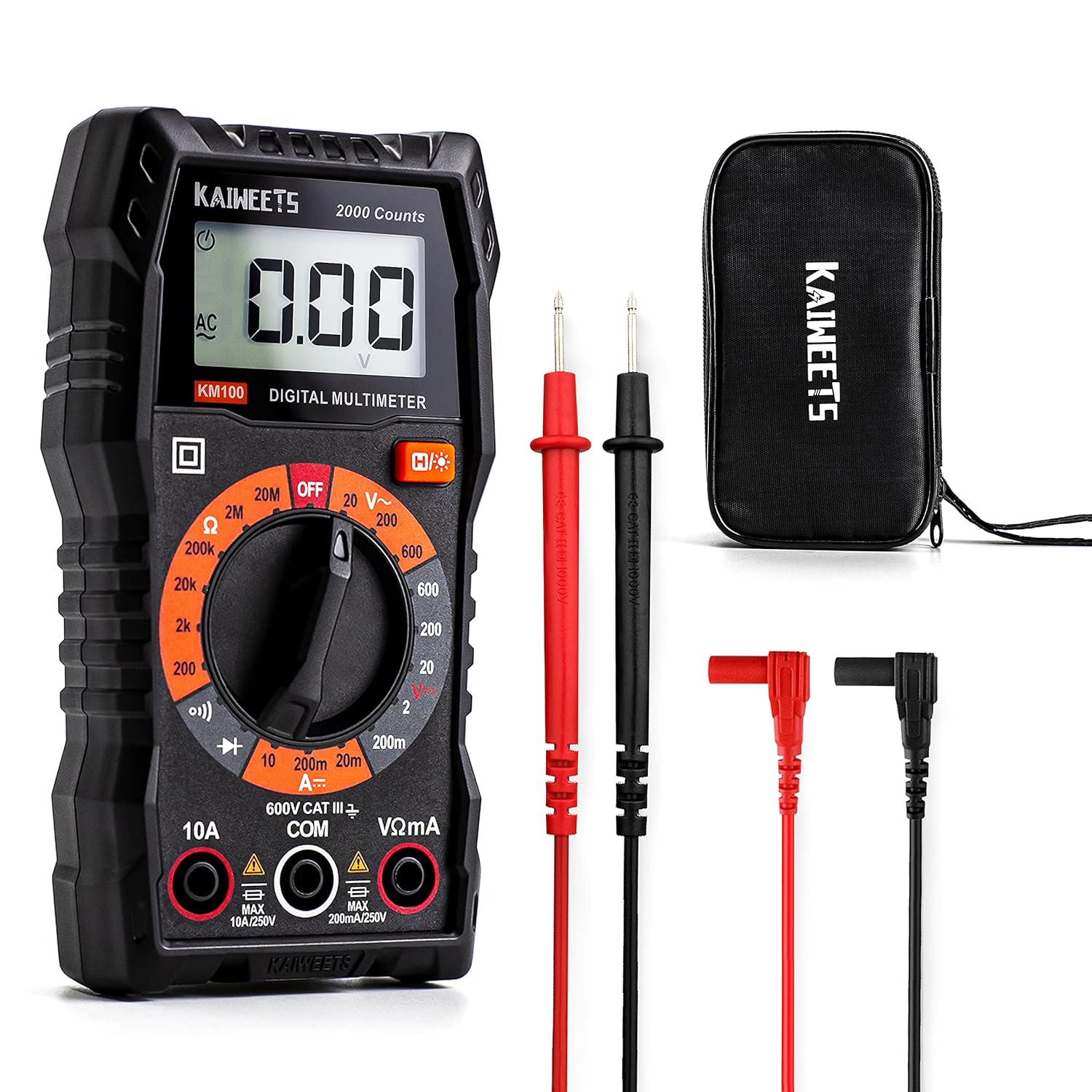
This KAIWEETS digital multimeter is a versatile tool for measuring AC/DC voltage, DC current, resistance, continuity, and diodes in home, automotive, and electrical applications. It includes pre-installed batteries, a carrying case, test leads, data hold, backlight, and overload protection for easier and safer everyday testing. Built with double fuses and rated for broad household and light professional use, it helps users diagnose electrical issues with confidence.
What Should You Check First for a Lean Code?
- Unmetered air after the MAF: cracked intake boot, loose clamps, disconnected vacuum lines, leaking PCV hose, purge-flow problem, or intake-gasket leak.
- Dirty or inaccurate MAF data: contamination, damaged wiring, incorrect air-filter installation, or an incompatible sensor.
- Low fuel delivery: weak pump, restricted pickup or strainer, pressure-control fault, or injector problem.
- Exhaust leak before the upstream sensor: outside oxygen entering the exhaust can make the reported mixture appear lean.
- Electrical faults: corrosion, damaged wiring, loose terminals, missing power, or poor ground.
How Should You Interpret Fuel Trims?
- Warm the engine fully and watch short-term fuel trim and long-term fuel trim.
- If positive trims are high mainly at idle and improve as RPM rises, unmetered air or an intake leak moves higher on the list.
- If trims remain high at idle and under load, investigate fuel delivery, MAF under-reporting, injector flow, and exhaust leaks.
- Smoke-test the intake tract and connected vacuum circuits.
- Clean a serviceable MAF only with the correct cleaner and procedure; do not touch the sensing element.
- Test fuel delivery when air leaks and electrical faults have been ruled out.
- After repair, verify the trims during idle, cruise, and controlled acceleration rather than checking only one operating point.
Note: A lean code does not automatically mean the upstream sensor is bad. The sensor may be correctly reporting extra air, inadequate fuel, or oxygen entering through an exhaust leak.
How Do You Test P0420 or P0430 Before Replacing the Converter?
P0420 means catalyst-system efficiency is below threshold on bank 1. P0430 is the corresponding bank 2 fault and applies to engines with two cylinder banks. Most four-cylinder RAV4 applications have only bank 1, while older V6 applications have two banks.
Neither code proves the catalytic converter is defective by itself. The monitor evaluates catalyst behavior using sensor data and defined operating conditions. Exhaust leaks, misfires, lean or rich operation, oil burning, coolant contamination, incorrect sensors, wiring faults, and software or monitor conditions can affect the result.
For a code-specific walkthrough, see the Toyota RAV4 P0420 diagnosis guide.
[Products Worth Considering]

CEL Doctor: The ANCEL AD310 is one of the best-selling OBD II scanners on the market and is recommended by Scotty Kilmer, a YouTuber and auto mechanic. It can easily determine the cause of the check engine light coming on. After repairing the vehicle's problems, it can quickly read and clear diagnostic trouble codes of emission system, read live data & hard memory data, view freeze frame, I/M monitor readiness and collect vehicle information

Multi-Functions - Practical Multi-Functions OBD2 code reader features built-in OBD2 DTC lookup library, which help you to determine the cause of the engine light, read code, erase code, view freeze frame, I/M ready, vehicle information, data flow, real-time curve, get vehicle speed information, calculate load value, engine coolant temperature, get engine speed.
What Should You Test Before Replacing the Converter?
- Repair related codes first. Diagnose misfire, lean, rich, coolant-temperature, fuel-delivery, and sensor-circuit faults before judging catalyst efficiency.
- Inspect the exhaust. Look for leaking flanges, cracks, rust holes, missing gaskets, damaged flex sections, or loose hardware ahead of and near the sensors.
- Identify the sensor types. Determine whether the upstream device is an air-fuel-ratio sensor or a conventional oxygen sensor. Use the correct Toyota PIDs and specifications for the model year; do not apply generic narrowband switching-voltage rules to a wideband A/F sensor.
- Compare upstream and downstream behavior. Graph the correct data only after the engine and converter reach the required operating conditions.
- Look for the cause of catalyst damage. Misfires, excessive oil consumption, coolant entry, prolonged rich operation, and incorrect fueling can damage a replacement converter.
- Confirm failure with the appropriate test. Depending on the application, a shop may use monitor data, temperature testing, exhaust analysis, or backpressure testing.
Do not replace a catalytic converter until exhaust leaks, misfires, fuel-control faults, oil or coolant contamination, and sensor or wiring problems have been ruled out.
How Do You Diagnose P0441, P0442, and P0455?
The EVAP system stores fuel vapors instead of releasing them into the atmosphere. EVAP codes often do not cause immediate drivability problems, but they can illuminate the check-engine light, create refueling or starting symptoms, and prevent an emissions-inspection pass.
| Code | Meaning | Likely Areas |
|---|---|---|
| P0441 | Incorrect purge flow | Purge valve, hoses, electrical circuit, restriction, or incorrect flow |
| P0442 | Small EVAP leak | Cap seal, small hose crack, canister connection, vent valve, or filler area |
| P0455 | Large EVAP leak | Loose or missing cap, disconnected hose, damaged filler neck, open valve, or large line leak |
What Is the Correct EVAP Test Sequence?
- Confirm that the fuel cap is present, compatible, tightened, and able to seal.
- Inspect the filler neck, cap seal, EVAP hoses, canister, purge valve, vent valve, and electrical connectors.
- For P0441, test or command the purge valve and determine whether it seals and flows when required.
- For P0442 and P0455, use a correctly regulated smoke test to locate the leak instead of replacing parts by trial and error.
- Repair the confirmed hose, cap, valve, canister, filler-neck, wiring, or connector fault.
- Clear the repairable code and operate the vehicle under the enabling conditions needed for the EVAP monitor to rerun.
Pro Tip: If an EVAP code appears immediately after refueling, inspect the cap and filler area first. If the code returns after a confirmed-good cap is installed, smoke-test the system before buying more parts.
How Do You Diagnose P0340, P0115, and P0125?
Camshaft-position and coolant-temperature data affect starting, fuel control, idle quality, emissions, and drivability. Diagnose these faults before chasing secondary fuel-trim, catalyst, or misfire symptoms.
What Does P0340 Mean?
P0340 identifies a camshaft-position-sensor circuit fault. Symptoms may include extended cranking, difficult starting, rough idle, misfires, reduced power, or stalling.
Inspect the connector and harness, then test power or reference voltage, ground, signal integrity, and the circuit described in the model-year repair information. If electrical tests pass, check timing correlation, the trigger or reluctor, and mechanical timing as the applicable test path requires.
What Do P0115 and P0125 Mean?
P0115 indicates an engine-coolant-temperature sensor circuit fault. P0125 indicates that the engine did not reach the temperature required for closed-loop fuel control within the expected conditions.
Watch live coolant temperature from a fully cold start. Compare it with ambient temperature before startup, then confirm that it rises smoothly. If it jumps, drops out, reads implausibly cold or hot, or remains below the expected operating range, inspect coolant level, leaks, the thermostat, sensor, connector, wiring, and cooling-system condition.
Cooling-system warning: Never remove a pressurized coolant cap from a hot engine. Hot coolant and steam can cause severe burns. Allow the system to cool and follow the exact service procedure.
What Else Can Cause a Rough Idle?
Rough idle does not automatically identify a throttle or idle-control failure. Depending on the RAV4, possible causes include throttle deposits, unmetered air, MAF error, incorrect fuel trims, weak ignition components, low battery voltage, disconnected learned values, or a mechanical condition. Do not force an electronic throttle plate or replace the throttle body without testing the relevant system.
What Do P3000 and P1603 Mean on a Toyota RAV4?

RAV4 Hybrid and plug-in-hybrid systems add high-voltage components, battery cooling, inverter controls, and hybrid-specific ECUs. A basic OBD-II reader may show a parent code while hiding the information code or related battery-ECU fault required for diagnosis. Use a Toyota-capable scanner and verify every definition against the exact vehicle.
For broader warning-message diagnosis, see the RAV4 Hybrid System Malfunction guide.
What Does P3000 Tell You?
On applicable Toyota hybrids, P3000 is generally a parent or companion hybrid-control code. It does not, by itself, prove that the traction battery needs replacement. The diagnostic direction comes from the accompanying information code and all DTCs stored in the HV battery ECU or related modules.
Do not continue component diagnosis from P3000 alone. Retrieve the Toyota information or INF code, battery-ECU DTCs, block or stack data where supported, temperature data, state of charge, cooling-fan commands, and other related codes. Follow the repair information for the exact RAV4 model year and powertrain.
What Does P1603 Tell You?
Toyota service information uses P1603 as an engine-stall-history code on applicable vehicles. The exact detection logic and diagnostic path must be confirmed for the RAV4’s model year, engine, market, and ECU.
Treat it as evidence that the engine may have stopped unexpectedly, not as proof of one failed part. Review freeze-frame data, 12-volt battery condition, fuel level and delivery, related startability or communication codes, recent battery events, and the driver’s description of the stall.
Warning: Do not open, probe, cut, or disconnect orange high-voltage cables, service plugs, inverters, or traction-battery components without the required training, personal protective equipment, insulated tools, and Toyota service procedures. High voltage can cause serious injury or death.
What Hybrid Checks Are Safe to Perform First?
- Record all codes and information codes before clearing anything or disconnecting the 12-volt battery.
- Test the 12-volt battery, terminals, and grounds; low supply voltage can create misleading communication and module faults.
- Confirm that the vehicle has fuel and review the events leading to the warning or stall.
- Inspect only externally accessible battery-cooling inlets or filters described in the owner information; do not open high-voltage assemblies.
- Use a scanner confirmed to access the RAV4’s hybrid-control and battery modules.
- Escalate isolation faults, internal battery faults, inverter faults, and high-voltage circuit work to a hybrid-qualified technician.
How Do You Diagnose U0073 and P0500?
Network and vehicle-speed faults can affect the speedometer, ABS, stability control, transmission behavior, cruise control, and engine management. Diagnose power supply, module communication, wiring, and the source of the speed signal before replacing a sensor or control module.
What Does U0073 Mean?
U0073 indicates a control-module communication-bus problem. Because the CAN network carries data between modules, one power, ground, wiring, connector, or module fault can trigger several warnings.
- Test 12-volt battery condition and charging-system operation first.
- Perform a complete module scan and record which modules communicate and which do not.
- Inspect connectors for water, corrosion, bent terminals, loose locks, or backed-out pins.
- Look for rodent damage, collision repairs, aftermarket wiring, and harness chafing.
- Check module power, ground, CAN voltage, and termination only with the correct wiring diagram and procedure.
- Do not replace a module until its power, ground, network, and applicable software or calibration requirements are confirmed.
What Does P0500 Mean?
P0500 identifies a vehicle-speed-signal fault. Depending on the RAV4 model year and powertrain, the ECM may receive vehicle-speed information from the skid-control ECU, wheel-speed sensors, transmission-related data, or the communication network.
| Code | Likely Area | First Checks |
|---|---|---|
| U0073 | CAN communication bus | Complete module scan, battery voltage, module power and grounds, bus voltage, termination, and harness condition |
| P0500 | Vehicle-speed signal | Compare ECM speed, wheel-speed data, instrument display, related chassis codes, sensor circuits, and network status |
How Should You Check Wiring and Grounds?
Inspect harnesses near the battery, fuse boxes, engine, transmission, wheel wells, and underbody. Look for stretched wires, loose pins, green corrosion, damaged insulation, aftermarket alarm or audio taps, and evidence of previous collision or rodent damage.
- Use a loaded voltage-drop test when the circuit procedure calls for it; a visual inspection alone may miss resistance.
- Check both power and ground sides of the affected circuit.
- Turn the vehicle off and follow the connector procedure before disconnecting or backprobing terminals.
- Clean and repair corrosion before applying any approved terminal protection.
- Use sealed, automotive-grade wire repairs in exposed areas.
How Do You Verify the Repair and Readiness Monitors?
Clearing a DTC does not prove the repair worked. The ECU must rerun the diagnostic monitor under its enabling conditions. Catalyst and EVAP monitors may require particular temperatures, fuel level, speeds, loads, soak time, and drive patterns.
- Save every code, status, module name, and freeze-frame record before clearing.
- Clear repairable stored codes only after the confirmed repair.
- Start the vehicle and check for immediate current or pending-code returns.
- Road-test under conditions similar to the freeze-frame record when it is safe and legal to do so.
- Recheck live data, pending codes, permanent codes, and readiness status.
- Confirm the required monitors before an emissions inspection.
- If a permanent code remains, do not repeatedly clear the ECU. A scan tool normally cannot manually erase a permanent DTC. The responsible monitor must run and confirm that the fault is no longer present before the ECU removes it.
Which Mistakes Cause Repeat RAV4 Repairs?
- Replacing the part named in a scanner description. A sensor-related code can result from wiring, leaks, power, ground, mechanical faults, or another system.
- Using a definition from the wrong model year or engine. Manufacturer-specific codes and information codes must match the exact vehicle and module.
- Clearing codes before saving evidence. This can erase freeze-frame information and reset readiness monitors.
- Ignoring low 12-volt voltage. Weak batteries, loose terminals, and bad grounds can create numerous communication and module codes.
- Skipping the visual inspection. Loose clamps, cracked hoses, disconnected connectors, and damaged wiring are common after repair work or battery service.
- Applying generic O2 voltage rules to an air-fuel-ratio sensor. Identify the sensor and use the correct Toyota PID and specification.
- Installing a converter before fixing a misfire or fuel-control problem. The unresolved cause can damage the replacement.
- Using a scanner that cannot access the necessary module. Hybrid, battery, ABS, airbag, body, and Toyota-enhanced codes may require broader coverage.
Frequently Asked Questions
How do I read a Toyota RAV4 OBD-II fault code?
Connect a compatible scanner, follow its ignition or READY-mode instructions, and read all accessible modules. Save the complete code, module name, status, information or sub-code, and freeze-frame data before clearing anything. Then confirm the definition for the exact model year, engine, market, and powertrain.
What is the most common RAV4 OBD-II code?
There is no single code that applies to every RAV4 model year and powertrain. P0420, P0171, P0300, and EVAP leak codes are examples owners may encounter, but diagnosis must be based on the exact vehicle, module, freeze-frame data, related codes, and symptoms.
Can I drive my RAV4 with the check-engine light on?
If the light is steady and the RAV4 operates normally, you can usually drive gently only as needed to have it scanned. Stop as soon as safely possible if the light flashes, the engine runs rough, the vehicle overheats, stalls, loses substantial power, smells strongly of fuel, or shows serious brake, steering, oil-pressure, or hybrid warnings.
Does P0420 always mean the catalytic converter is bad?
No. P0420 means the catalyst monitor detected efficiency below the expected threshold on bank 1. A failed converter is one possibility, but exhaust leaks, incorrect sensor data, wiring faults, fuel-control problems, misfires, oil burning, or coolant contamination can also affect the result. Test those conditions before replacing the converter.
Why did my RAV4 code return after I replaced the part?
The replaced part may not have been the root cause, the replacement may be incorrect for the application, or a wiring, connector, power, ground, mechanical, leak, or related-system problem may remain. Recheck the complete scan, freeze-frame data, live readings, and the model-year test procedure before replacing another part.
Do I need a Toyota Techstream scanner?
A basic scanner is sufficient for many generic emissions-related engine codes. Toyota-enhanced diagnostics, information codes, hybrid battery data, ABS, airbag, body, active tests, and network faults may require Techstream or another scan tool verified to support the required modules and functions for your RAV4.
Conclusion
Treat Toyota RAV4 diagnostic trouble codes as evidence, not final answers. Save the complete scan report, confirm every definition for the VIN, model year, powertrain, module, and sub-code, and diagnose the most severe or system-wide fault first. Use freeze-frame data, live readings, circuit tests, pressure or smoke testing, and mechanical checks to confirm the cause before replacing parts.
After the repair, recheck pending and permanent codes and confirm that the responsible monitor completes. Escalate flashing misfires, overheating, stalling, brake or steering faults, and high-voltage hybrid diagnosis rather than continuing to drive or guessing at components.
Sources
- Toyota RAV4 Owner’s Manual: OBD System — supports general OBD monitoring and malfunction-indicator guidance; use the manual for the exact model year.
- Toyota RAV4 Hybrid Owner’s Manual: Warning Lights and Indicators — supports hybrid and system-warning cautions.
- U.S. EPA: On-Board Diagnostic Regulations and Requirements — explains the purpose of emissions-related OBD monitoring.
- U.S. EPA: OBD Readiness and Permanent-DTC Guidance — explains that permanent DTCs remain until the responsible monitor confirms that the fault is gone.
- NHTSA Recalls Lookup — provides VIN-based safety-recall checks.
- Toyota Tech Tip: P3000/123 Battery Control DTC Diagnostic Tips — demonstrates Toyota’s parent-code and information-code diagnostic approach; applicability in the bulletin is limited to the listed Prius models, so RAV4 diagnosis must use RAV4-specific service data.
- Toyota Special Service Campaign 22TC07 — provides a Toyota example in which P1603 may be stored after an engine-stall event; the campaign applies to the listed Corolla vehicles, so exact RAV4 applicability must be verified separately.
- Toyota Technical Bulletin: A/F and O2 Sensor Diagnostic Tips — supports identifying and interpreting air-fuel-ratio and oxygen sensors according to the exact application.




[…] gloves, OBD-II scanner, infrared thermometer, coolant compatible with your RAV4, and basic hand […]