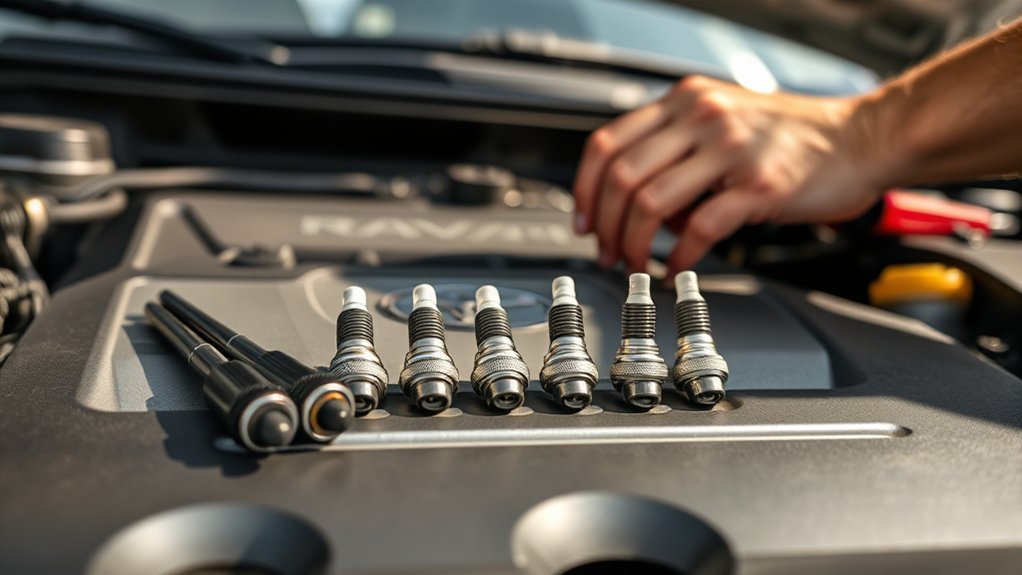
Editorial Team · Reviewed for accuracy · Last updated: July 15, 2026
For most 2019–2025 U.S. Toyota RAV4 and RAV4 Hybrid four-cylinder models, spark plug replacement is a direct coil-on-plug job. Let the engine cool, remove the engine cover and four ignition coils, clean each plug well, remove the old plugs, hand-start the correct replacements, and tighten them to the specification for your engine. A 14 mm thin-wall spark plug socket is common on this generation, and public A25A-FKS repair data lists 20 N·m / 15 ft-lb. However, those values are not universal. The 2026 RAV4 is a new generation, so confirm its plug part number, gap, socket, and torque in current service data before starting.
Quick Answer
To replace Toyota RAV4 spark plugs, work on a cool engine and confirm the specifications by model year, engine code, and VIN. Remove the engine cover, disconnect and remove one ignition coil, clean the plug well, remove the old plug, and compare it with the replacement. Hand-start the new iridium plug, torque it to the correct engine-specific value, reinstall the coil, and repeat one cylinder at a time. Four-cylinder RAV4 models use four plugs; older 3.5L V6 models use six. Many fine-wire iridium plugs are pre-gapped and should not be adjusted.
Key Takeaways
- Match the spark plug by VIN and engine code before relying on a gap, socket, or torque value.
- Toyota’s U.S. 2023 RAV4 guide lists spark plug replacement at 120,000 miles or 144 months. The 2026 U.S. RAV4 Hybrid guide also schedules the service at 120,000 miles.
- A 14 mm thin-wall socket and a 0.8 mm / 0.031 in. gap are common on several 2019–2025 2.5L applications, but they are not universal RAV4 specifications.
- Public A25A-FKS repair data lists 20 N·m / 15 ft-lb for spark-plug installation. Verify the value for your exact engine and plug.
- The 2006–2012 V6 rear bank is a tighter, more advanced job than the four-cylinder procedure.
- Stop if a plug binds, the socket cannot remain straight, or you find oil, coolant, or damaged threads in the plug well.
At a Glance
| Time Required | About 45–90 minutes for an accessible four-cylinder model; older V6 access can take substantially longer |
| Difficulty | Easy to moderate for many four-cylinder models; moderate to advanced for the older V6 rear bank |
| Plug Count | Four on four-cylinder RAV4 models; six on older 3.5L V6 models |
| Tools Needed | Torque wrench, ratchet, extensions, correct spark plug socket, coil-bolt socket, compressed air or vacuum, and an OBD-II scanner if diagnosing a misfire |
| Parts Cost | Varies by plug specification, seller, market, and whether the engine requires four or six plugs |
Before You Start: Confirm Your RAV4 Spark Plug Specs
Do not assume every RAV4 uses the same spark plug or procedure. Toyota has used several four-cylinder engines, a 3.5L V6, conventional hybrid systems, plug-in-hybrid systems, and market-specific configurations. Use your VIN, under-hood emissions label, owner’s manual, current service data, or a trusted Toyota parts lookup before ordering parts.
For more background on plug construction, heat range, and electrode types, see the site’s guide to Toyota RAV4 spark plug types and functions.
| RAV4 Application | Common DIY Considerations | What You Must Confirm |
|---|---|---|
| 2019–2025 2.5L gasoline, including A25A-FKS applications | Four accessible coil-on-plug cylinders; a 14 mm thin-wall plug socket and 8 mm coil-bolt socket are common | Exact plug part number, 0.8 mm gap applicability, and engine-specific torque |
| 2019–2025 2.5L hybrid, including A25A-FXS applications | Four coil-on-plug cylinders; keep the vehicle fully powered off and avoid orange high-voltage components | Hybrid-specific plug application, gap, socket, and torque from current service data |
| 2013–2018 2.5L 2AR-FE | Four accessible cylinders; a 16 mm / 5/8 in. spark plug socket is common | Plug part number, gap, torque, and coil-fastener size for the exact model year |
| 2006–2012 3.5L 2GR-FE V6 | Six plugs; the rear bank has restricted access and may require removal or repositioning of upper components | Engine-specific access procedure, cylinder layout, plug part number, torque, and required gaskets |
| 2026 RAV4 Hybrid or Plug-in Hybrid | New-generation vehicle; do not assume fifth-generation socket, gap, or torque figures carry over | Current 2026 plug application and installation specifications by VIN |
Toyota’s 2023 U.S. RAV4 Warranty & Maintenance Guide lists spark plug replacement at 120,000 miles or 144 months. Toyota’s 2026 U.S. RAV4 Hybrid Warranty & Maintenance Guide also places spark-plug replacement at 120,000 miles. Your market, engine, and operating conditions may differ.
| Item to Confirm | Why It Matters | Common Example, Not a Universal Specification |
|---|---|---|
| Spark plug part number | Reach, seat design, heat range, resistor design, and electrode position must match the engine. | Toyota- or plug-manufacturer-listed long-life iridium plug |
| Plug count | You should replace a complete matched set unless diagnosis calls for another approach. | Four for four-cylinder engines; six for the older 3.5L V6 |
| Gap | An incorrect gap can cause weak ignition, rough running, or misfires under load. | 0.8 mm / 0.031 in. on several 2019–2025 2.5L applications |
| Torque | Too little torque can reduce sealing and heat transfer; too much can damage the plug or cylinder-head threads. | 20 N·m / 15 ft-lb in public A25A-FKS repair data |
| Socket size | The wrong socket may not fit the plug well or may damage the porcelain. | 14 mm on many 2019–2025 models; 16 mm / 5/8 in. on several older applications |
| Replacement interval | Long-life iridium plugs normally remain installed much longer than conventional plugs. | 120,000 miles in the cited 2023 and 2026 U.S. maintenance guides |
Note: A non-U.S. RAV4, diesel model, or market-specific engine may follow a different maintenance schedule and use different components. Diesel engines use glow plugs rather than gasoline-engine spark plugs.
Warning: Remove and install spark plugs only when the engine is cool. Aluminum cylinder heads expand when hot, increasing the risk of thread damage. On hybrid and plug-in-hybrid models, power the vehicle off completely, keep the key away from the vehicle, and do not touch orange high-voltage cables or components.
[Products Worth Considering]

NGK Iridium IX spark plugs are designed to deliver a stable spark, reliable ignition, and long-lasting performance for compatible Toyota Camry 2.5L engines. The fine-wire iridium center electrode helps improve durability and efficient combustion, making these plugs a smart replacement choice for maintaining smooth engine operation. Sold in a convenient four-pack, they are built for consistent performance and dependable fitment.

The PerTronix Flame-Thrower ignition coil delivers stronger spark energy to support improved combustion efficiency, throttle response, and overall engine performance. Designed for 6 and 12 volt electronic ignition systems, it is a versatile upgrade for PerTronix Ignitor setups and many points or electronic inductive distributor ignitions. Its oil-filled canister construction helps manage heat for dependable street use when installed vertically as directed.

This ignition coil pack and iridium spark plug set is designed to restore smooth starting, strong acceleration, and dependable engine performance for a wide range of compatible Toyota, Lexus, Scion, and Pontiac vehicles. Built as a direct OEM replacement, it offers plug-and-play installation and helps reduce misfires while improving fuel economy and overall drivability. The premium iridium plugs and matched coils deliver consistent spark output and long-lasting durability for everyday driving.
When Should You Stop and Use a Repair Shop?
Do not force the job when access or thread condition is uncertain. Stop and arrange professional diagnosis or repair in any of these situations:
- The plug becomes tight after only one or two turns during removal or installation.
- The socket or extension cannot remain straight over the plug.
- The plug well contains standing oil, coolant, or heavy corrosion.
- The old plug has damaged threads, a missing electrode, or broken porcelain.
- You suspect damaged cylinder-head threads or a previous cross-threaded repair.
- The older V6 rear bank requires intake-system work beyond your experience.
- The engine has a flashing check engine light, strong raw-fuel smell, or severe misfire.
Step-by-Step Guide to Replacing Spark Plugs
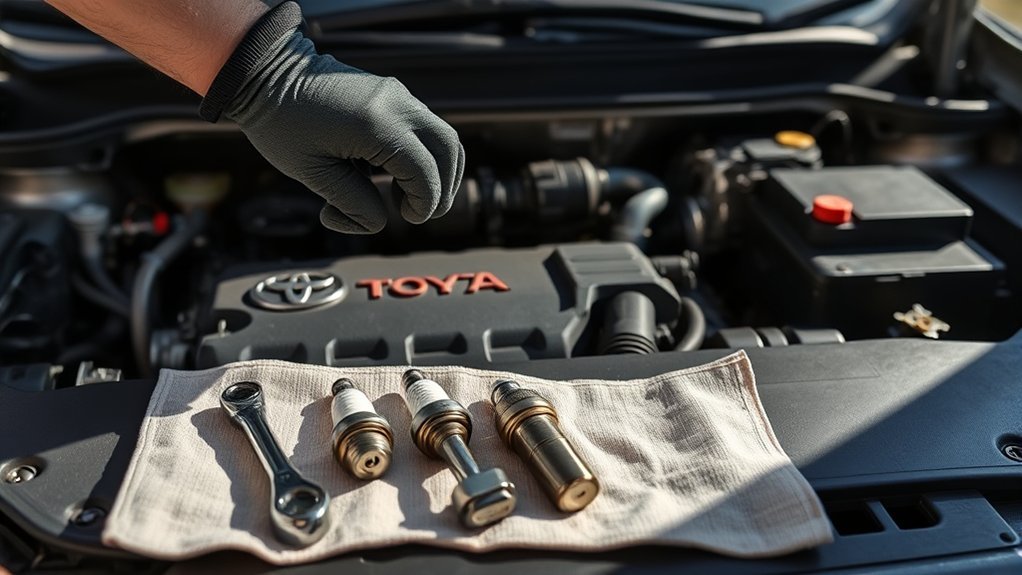
The following procedure describes the general coil-on-plug process used by many four-cylinder RAV4 engines. Engine covers, brackets, coil fasteners, socket sizes, and torque values can differ. Work on one cylinder at a time so every coil, connector, and fastener returns to its original position.
- Park safely and cool the engine. Park on a level surface, select Park, set the parking brake, power the vehicle off, open the hood, and wait until the engine is cool to the touch.
- Confirm the replacement plugs. Compare the box labels with your VIN-based parts information. Check the part number, plug count, seat design, thread reach, and manufacturer installation guidance.
- Record existing trouble codes if needed. If you are diagnosing a misfire, scan and save the codes before disconnecting components. P0301 through P0304 identify individual cylinders on a four-cylinder engine.
- Remove the engine cover. Many late-model covers lift from rubber grommets. Pull evenly and place the cover where dirt cannot collect on its underside.
- Disconnect one ignition coil connector. Release the locking tab without pulling on the wires. Brittle connectors may require extra care.
- Remove the ignition coil bolt. Use the correct socket for your model. An 8 mm socket is common on several late-model applications, while older models may use another size.
- Lift out the ignition coil. Twist the coil gently if the rubber boot is stuck. Inspect the boot and plug well for oil, moisture, cracks, white tracking marks, or carbon lines.
- Clean the plug well. Use compressed air or a vacuum to remove loose dirt before loosening the spark plug. Wear eye protection when using compressed air.
- Remove the old spark plug. Use the correct spark plug socket and extension. Keep the extension straight and apply smooth hand pressure. Stop if the plug binds or requires abnormal force.
- Inspect and compare the plugs. Confirm that the old and new plugs have matching thread length, seat type, electrode position, and overall design. Replace any new plug that was dropped or struck.
- Check the factory gap only when permitted. Fine-wire iridium plugs normally arrive pre-gapped. If the plug manufacturer permits inspection, use a wire-style gauge without pressing on the center electrode.
- Hand-start the new plug. Place the plug in the socket and turn the extension by hand without the ratchet. The plug should thread smoothly for several turns. Back it out immediately if resistance feels uneven.
- Torque the plug to the verified value. Attach a torque wrench, keep it straight, and tighten to the specification for the exact engine and plug. Do not add extra rotation after the wrench signals the set torque.
- Reinstall the ignition coil. Seat the boot fully over the plug, reinstall the coil bolt to its specified torque, and reconnect the electrical connector until it locks.
- Repeat one cylinder at a time. Use the same clean process for every remaining plug.
- Reinstall the engine cover. Align the cover with its grommets or fasteners and press it into place without trapping wiring.
- Start and test the engine. Listen for a smooth idle and check the instrument panel. Scan for codes if the engine shakes, a warning light appears, or acceleration feels abnormal.
Pro Tip: A short piece of clean rubber hose slipped over the porcelain end can help hand-start a plug in a deep well. The hose tends to slip if the plug starts crooked, reducing the chance of forcing the threads.
What Can the Removed Spark Plug Tell You?
A used spark plug can provide diagnostic clues, but its appearance alone does not prove a specific engine fault. Compare all plugs and combine the observation with trouble codes, compression testing, fuel-trim data, and other diagnosis when needed.
| Plug Condition | Possible Meaning | Next Check |
|---|---|---|
| Light tan or gray deposits with even wear | Often consistent with normal combustion and service wear | Compare electrode wear across the complete set |
| Wet with engine oil | Possible plug-well seal leak, valve-cover leak, or internal oil-control problem | Determine whether the oil is outside the plug or on the firing end |
| Black, sooty, or fuel-wet | Possible weak ignition, rich fueling, repeated short trips, or a cylinder that is not firing | Check coil operation, injector control, fuel trims, and stored codes |
| White, glazed, or blistered electrode | Possible overheating, incorrect heat range, lean operation, or abnormal combustion | Verify plug application and diagnose cooling, fueling, and combustion conditions |
| Cracked porcelain or damaged electrode | Physical damage, installation error, foreign-object contact, or severe combustion problem | Do not reinstall it; inspect the cylinder and determine why the damage occurred |
Essential Tools for Replacing Spark Plugs in a RAV4
The correct tools help you keep the socket straight, prevent debris from entering the engine, and tighten the plug accurately. Confirm every socket size before disabling the vehicle.
[Products Worth Considering]

Quality Material: The spark plug removal tool is made of high-performance chrome vanadium steel, with matte nickel-plated rust-resistant surface, resistant to abrasion and corrosion, to ensure that it will not be damaged in long time use

❏ SUPERIOR QUALITY - Our 3/8 inch spark plug socket is forged from integral heat-treated superior CRV steel, high hardness, high torque, polished surface, not easy to rust and deform, and can be used for a long time without damage, we are proud of its quality, it is the ideal professional tool for replacing spark plugs in cars.
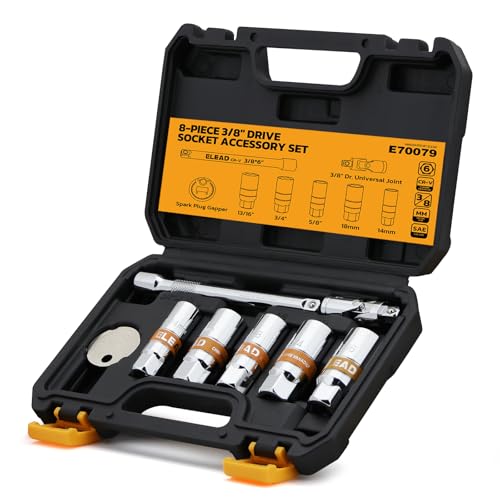
PREMIUM CR-V - Built from heat-treated chrome vanadium steel, this spark plug socket set offers exceptional durability and corrosion resistance. The mirror polish finish ensures easy cleanup and a professional appearance.
Required Socket Sizes
A 14 mm thin-wall spark plug socket is common on 2019–2025 2.5L RAV4 applications. Several older 2.5L applications use a 16 mm / 5/8 in. socket. Plug-well diameter and coil-fastener size also vary, so test the tools against the replacement plug and visible fasteners before beginning.
| Tool | Use | Application Notes |
|---|---|---|
| 14 mm thin-wall spark plug socket | Removing and installing plugs on many 2019–2025 2.5L engines | A magnetic or rubber-retainer design helps retrieve plugs from deep wells. |
| 16 mm / 5/8 in. spark plug socket | Several older RAV4 engine applications | Confirm fit by engine code and plug part number. |
| 8 mm or 10 mm socket | Ignition coil bolts and nearby brackets | Fastener size varies by generation and engine. |
| 3/8 in. ratchet and extensions | Reaching plugs at the bottom of deep wells | Use enough extension to maintain a straight line without placing side load on the plug. |
| Low-range torque wrench | Final tightening of plugs and, when suitable, coil fasteners | The target value should fall comfortably within the wrench’s accurate working range. |
| Compressed air or vacuum | Removing dirt before a plug is loosened | Wear eye protection and prevent loosened debris from entering nearby openings. |
Essential Torque Wrench
Public repair information for the A25A-FKS spark-plug installation lists 20 N·m, equivalent to about 15 ft-lb. That value should be treated as an A25A-FKS example, not as a universal RAV4 torque. Check current service data for an A25A-FXS hybrid, an older 2AR-FE or 2GR-FE, a 2026 model, or any non-U.S. application.
The A25A-FKS installation procedure also warns against installing a plug that has been dropped or struck. Use a torque wrench with an appropriate low range and keep the extension aligned with the plug.
Install plugs dry unless Toyota or the plug manufacturer specifically directs otherwise. Anti-seize or another lubricant changes thread friction and can increase clamping force at the same torque setting.
Ratchet and Extensions Needed
A 3/8 in. ratchet with short and medium extensions provides control on most four-cylinder plug wells. Keep the extension centered over the spark plug. Side loading can crack the porcelain or start the threads crooked.
Warning: Never use an impact wrench to remove or install a spark plug. Use controlled hand pressure, start the new plug by hand, and complete tightening with a torque wrench.
Measuring and Adjusting Spark Plug Gaps
Many modern RAV4 iridium plugs are supplied at their intended gap. A 0.8 mm / 0.031 in. gap is common on several 2019–2025 2.5L RAV4 applications, but it is not a universal value for every RAV4 engine or model year. Confirm the exact plug application first.
[Products Worth Considering]

CTA Tools 3238 Spark Plug Gap Gauge - 9-Wire is designed to accurately measure spark plug gaps. The sizes range from 0.025, 0.030, 0.035, 0.040, 0.044, 0.045, .0.050, 0.055 and 0.060-inches. Heavy-duty construction allows for strength and durability. California Prop 65 - Warning, This product contains chemicals known to the State of California to cause cancer, birth defects or other reproductive harm.

Has a pocket-clip

Wide range of professional automotive specialy tools
Why Does the Correct Spark Plug Gap Matter?
The ignition coil must create enough voltage to jump the space between the center and ground electrodes. An excessive gap can increase the voltage demand and contribute to misfires under load. A gap that is too small can reduce the size of the initial flame kernel. Correct plug selection is safer than attempting to make an incorrect plug fit by changing its gap.
How Should You Check an Iridium Spark Plug Gap?
Follow the plug manufacturer’s instructions. If inspection is allowed, use a wire-style feeler gauge and pass it through the gap without pressing on the fine-wire center electrode. Avoid forcing a coin-style tool between the electrodes because it can bend the ground strap, damage the center electrode, or chip the insulator.
Should You Adjust a Pre-Gapped RAV4 Spark Plug?
Do not adjust a precious-metal plug unless Toyota or the plug manufacturer explicitly allows it. If the gap is far from specification, the electrode is bent, or the plug was dropped, replace or exchange the plug rather than trying to reshape it.
| Gap Situation | Recommended Action |
|---|---|
| Correct pre-gapped iridium plug matches the verified application | Install it without adjustment. |
| Gap appears questionable but the plug manufacturer permits inspection | Check gently with a wire gauge and compare it with the exact service specification. |
| Gap is far from specification or the electrode is damaged | Replace or exchange the plug. |
| Older adjustable plug requires correction | Move only the ground electrode with the manufacturer-approved tool and method. |
Installing New Spark Plugs: Best Practices
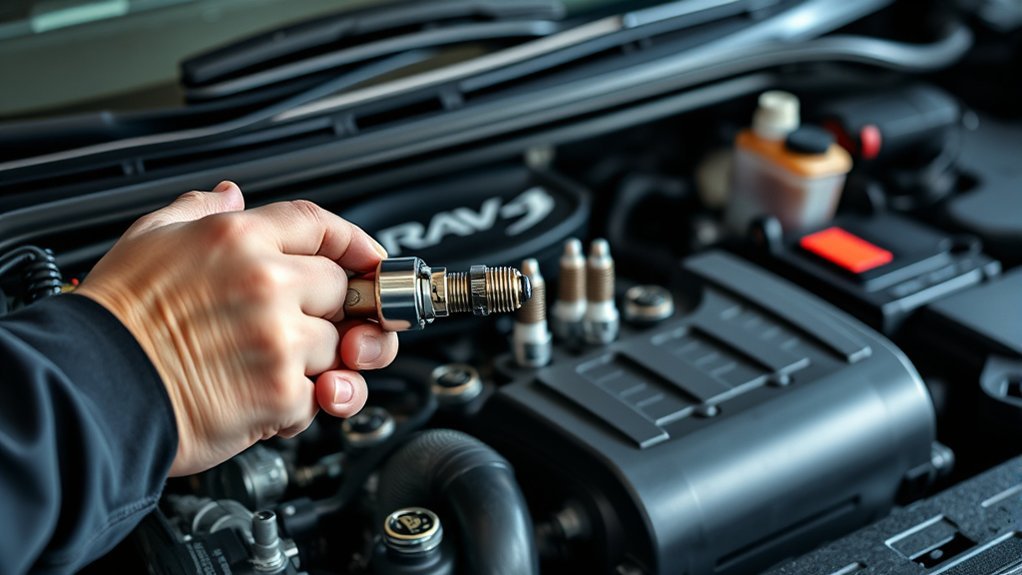
A spark plug must seat squarely against the cylinder head so it can seal the combustion chamber and transfer heat correctly. Dirt, damaged threads, the wrong seat design, lubricant, side loading, or incorrect torque can all interfere with installation.
- Clean before removal. Remove debris while the old plug still seals the cylinder.
- Keep tools straight. Avoid side pressure on the porcelain and threads.
- Compare every new plug. Check the part number, reach, seat, electrode, and terminal before installation.
- Start by hand. The plug should turn smoothly for several rotations before a ratchet or torque wrench is attached.
- Install dry unless instructed otherwise. Do not add anti-seize by habit.
- Use the verified torque. Stop when the torque wrench signals the setting.
- Inspect the coil boot. Replace a cracked, oil-soaked, swollen, or carbon-tracked boot.
- Lock every connector. A disconnected or partially seated coil connector can cause an immediate cylinder misfire.
Note: A small amount of dielectric grease may be placed inside the coil boot when the boot or vehicle manufacturer recommends it. Keep grease away from the spark plug threads, terminal contact surface, and electrodes.
Avoid These Common Spark Plug Replacement Mistakes
| Mistake | Why It Causes Problems | Safer Method |
|---|---|---|
| Using a plug selected only by model name | RAV4 generations and engines use different plug designs and specifications. | Match the plug by VIN, engine code, market, and manufacturer catalog. |
| Applying 2019–2025 specifications to a 2026 model | The 2026 RAV4 begins a new vehicle generation. | Use current 2026 parts and service information. |
| Forcing a gap adjustment on an iridium plug | Fine-wire electrodes and insulators are easily damaged. | Verify gently and exchange an incorrect or damaged plug. |
| Adding anti-seize automatically | Lubricated threads can produce excessive clamping force at the dry torque value. | Install dry unless the manufacturer directs otherwise. |
| Starting the plug with a ratchet | The extra leverage can cross-thread the aluminum cylinder head. | Turn the socket extension by hand until the plug seats. |
| Using an impact wrench | Impact force can crack the plug, strip threads, or hide binding. | Use hand tools and a torque wrench. |
| Skipping plug-well cleaning | Dirt can enter the cylinder or become trapped against the plug seat. | Clean the well before loosening the old plug. |
| Ignoring oil in a plug well | Oil can damage the coil boot and indicate a sealing problem. | Identify and repair the leak rather than installing a plug into a contaminated well. |
| Leaving a coil connector partly attached | The cylinder may not fire, producing a rough idle and warning light. | Confirm that every lock clicks and perform a visual recheck before startup. |
When Should You Replace Toyota RAV4 Spark Plugs?
For the U.S. 2023 RAV4, Toyota lists scheduled spark-plug replacement at 120,000 miles or 144 months. The U.S. 2026 RAV4 Hybrid maintenance chart also lists the service at 120,000 miles. Follow the guide for your exact model year and market because emissions schedules and engine applications can differ.
Earlier replacement may be appropriate when diagnosis confirms a worn, fouled, cracked, contaminated, or incorrect plug. Symptoms can include a cylinder-specific misfire code, rough idle, difficult starting, hesitation, poor acceleration, or increased fuel use. These symptoms do not prove that the spark plug is the cause; coils, injectors, wiring, compression, vacuum leaks, and fuel-control problems can produce similar behavior.
Replace spark plugs according to the schedule or a confirmed diagnosis. Do not replace long-life iridium plugs early merely because a generic service chart recommends a shorter interval.
How Can You Monitor Spark Plug and Ignition Health?

Long-life iridium plugs do not need to be removed repeatedly for casual inspection. Monitor engine behavior, scan warning lights promptly, and inspect coil boots or plug wells when access is already available for related service.
| Inspection | What to Check | What It Can Reveal |
|---|---|---|
| OBD-II scan | P0300 random misfire or P0301–P0304 cylinder-specific codes | Which cylinder or operating condition requires diagnosis |
| Idle and acceleration | Shaking, hesitation, difficult starting, or loss of power | Possible ignition, fueling, air, or mechanical faults |
| Coil boot and plug well | Cracks, oil, water, swelling, white tracking marks, or carbon lines | Insulation failure, moisture entry, or a sealing leak |
| Removed-plug comparison | Uneven wear, oil, soot, cracked porcelain, or electrode damage | A cylinder-specific problem that needs further testing |
| Maintenance records | Installation date, mileage, plug part number, and previous repairs | Whether the scheduled interval has been reached and which parts were installed |
Why Does a RAV4 Run Rough After Spark Plug Replacement?
If the engine runs worse immediately after the job, stop and recheck the work before driving far. The most common post-repair causes are an unlocked coil connector, a coil boot that is not seated, a cracked or incorrect plug, contamination in the well, a damaged connector, or an installation problem.
- Rough idle immediately after startup: Confirm that every coil connector is locked and every coil is fully seated.
- Steady check engine light: Scan the codes and identify whether one cylinder or several cylinders are affected.
- P0301, P0302, P0303, or P0304: Recheck the plug and coil on the identified four-cylinder position.
- Misfire follows a coil swap: The ignition coil or boot is a stronger suspect than the new plug.
- Misfire stays on the same cylinder: Inspect the plug, connector, injector operation, wiring, compression, and possible air leaks.
- Ticking or puffing near a plug well: Shut the engine off and verify the plug is correctly seated and torqued.
- Strong fuel smell or flashing check engine light: Shut the engine off to reduce the risk of catalytic-converter damage.
For a broader diagnostic sequence, see the Toyota RAV4 rough idle troubleshooting guide.
Warning: A flashing check engine light usually indicates an active misfire severe enough to threaten the catalytic converter. Reduce engine load, stop safely, and diagnose the cause before continued driving.
Why Spark Plug Installation Quality Matters
A correctly installed plug seals the combustion chamber, transfers heat into the cylinder head, and provides a controlled spark for combustion. The wrong plug, damaged threads, incorrect torque, contamination, or an unsecured coil can cause misfires, reduced power, warning lights, coil stress, and emissions-system damage.
The safest process is to identify the exact application first, keep the plug well clean, start every plug by hand, use the verified torque, reconnect every coil, and investigate any abnormal engine operation before driving far.
Frequently Asked Questions
How many spark plugs does a Toyota RAV4 have?
A four-cylinder Toyota RAV4 has four spark plugs. Older RAV4 models equipped with the 3.5L V6 have six. Confirm the engine before ordering because plug part numbers and installation specifications differ.
Can you replace Toyota RAV4 spark plugs yourself?
Many four-cylinder RAV4 models are reasonable DIY jobs if you have the correct sockets, a suitable torque wrench, and experience starting threaded parts by hand. The older V6 rear bank has much tighter access and may be better handled by an experienced technician.
In what order should you replace Toyota RAV4 spark plugs?
Replace them one cylinder at a time. Remove one coil, replace that plug, reinstall and reconnect the coil, and then move to the next cylinder. This keeps parts organized and makes it easier to find a loose connection.
What are the basic steps to change a Toyota RAV4 spark plug?
Cool the engine, confirm the plug specifications, remove the engine cover, disconnect one ignition coil, clean the plug well, remove the old plug, compare it with the replacement, hand-start the new plug, torque it correctly, reinstall the coil, and test the engine.
How often should spark plugs be changed on a Toyota RAV4?
Toyota’s U.S. 2023 RAV4 guide lists replacement at 120,000 miles or 144 months. The U.S. 2026 RAV4 Hybrid maintenance guide also schedules spark-plug replacement at 120,000 miles. Check the guide for your exact year and market.
What is the correct Toyota RAV4 spark plug gap?
The correct gap depends on the engine and plug. A 0.8 mm / 0.031 in. gap is common on several 2019–2025 2.5L applications, but it is not universal. Match the plug by VIN and follow the plug manufacturer’s instructions before measuring or adjusting it.
What size spark plug socket does a Toyota RAV4 use?
A 14 mm thin-wall socket is common on many 2019–2025 2.5L RAV4 engines. Several older applications use a 16 mm or 5/8 in. socket. Confirm the replacement plug’s hex size and the available plug-well clearance before starting.
Should you use anti-seize on Toyota RAV4 spark plugs?
Usually not unless Toyota or the plug manufacturer specifically instructs you to use it. Many modern plugs have plated threads, and lubricant changes the relationship between torque and clamping force. Install the plug dry when the published torque assumes clean, dry threads.
Conclusion
Replacing spark plugs in a four-cylinder Toyota RAV4 is manageable when you identify the engine and specifications before removing anything. Confirm the plug by VIN, work on a cool engine, clean each well, keep the socket straight, start every plug by hand, and tighten it with a torque wrench.
Do not transfer 2019–2025 specifications automatically to the redesigned 2026 RAV4 or to an older V6. After installation, verify a smooth idle and investigate any misfire, warning light, ticking sound, or fuel smell before continued driving.
Sources
- Toyota 2023 RAV4 Warranty & Maintenance Guide — supports the U.S. 120,000-mile / 144-month spark-plug replacement schedule.
- Toyota 2026 RAV4 Hybrid Warranty & Maintenance Guide — supports the 120,000-mile spark-plug service point for the U.S. 2026 RAV4 Hybrid.
- Toyota 2026 RAV4 Vehicle Information — supports the new-generation 2026 HEV and PHEV scope.
- Toyota Genuine Spark Plug Application Guide — provides Toyota plug application references across RAV4 engines and model years.
- A25A-FKS Spark Plug Removal and Installation Data — supports the 20 N·m / 15 ft-lb A25A-FKS torque example and dropped-plug caution.
- DENSO Spark Plug Installation Guide — supports clean-thread, hand-start, torque, lubricant, and gapping cautions.
- DENSO Spark Plug Torque and Installation Basics — explains tightening and alignment considerations.
- NGK Spark Plug Installation — supports cool-engine installation, clean plug holes, and correct-torque guidance.
- NGK: 5 Things You Should Know About Spark Plugs — supports fine-wire gapping and anti-seize cautions.