
Rotate a Toyota Camry’s tires every 5,000 miles or 6 months, whichever comes first. Use the rotation diagram in the owner’s manual for the exact model year rather than assuming a generic front-wheel-drive pattern. For the 2025 Camry, Toyota shows each tire moving front-to-rear on the same side, followed by TPWS wheel-position registration.
Regular rotation helps distribute normal wear, creates a useful inspection point, and supports tire-warranty records. Before moving any tire, check its tread depth, age, pressure, sidewalls, and wear pattern. A damaged or replacement-level tire should be evaluated instead of simply moved to another corner.
Last updated: July 31, 2026. This revision was reviewed against Toyota’s 2025 Camry Warranty & Maintenance Guide, the 2025 Camry owner’s manual, Toyota tire-rotation guidance, current ToyotaCare terms, and NHTSA tire-safety guidance.
Affiliate disclosure: This page may contain affiliate links. As an Amazon Associate, AutoReviewNest earns from qualifying purchases. This does not affect the price you pay or the editorial guidance in this article.
Quick Answer
Rotate a Toyota Camry’s tires every 5,000 miles or 6 months, whichever comes first. Use the model-year-specific pattern in the owner’s manual. The 2025 Camry manual shows a same-side front-to-rear exchange rather than a forward cross, and Toyota requires TPWS wheel-position registration after the rotation. Rotate or inspect sooner if wear is uneven, a tire repeatedly loses pressure, or the tire manufacturer sets a stricter warranty interval.
Key Takeaways
- Toyota’s Camry maintenance guide calls for tire rotation at each 5,000-mile / 6-month service interval.
- Do not automatically wait for an oil change; some Camry oil-change intervals can be longer than the tire-rotation interval.
- Use the rotation diagram for the exact model year. The 2025 Camry uses a same-side front-to-rear exchange, not the generic forward-cross pattern often shown for FWD vehicles.
- After rotating a 2025 Camry’s tires, complete the TPWS wheel-position registration through the vehicle settings and required drive cycle.
- Directional, staggered, damaged, severely worn, or incompatible aftermarket tire-and-wheel setups may limit or prevent normal rotation.
- At every rotation, check tread and wear patterns, cold tire pressure and TPMS operation, sidewall condition, valve stems, and tire age.
At a Glance
| Recommended Interval | Every 5,000 miles or 6 months, whichever comes first |
| Time Required | 45–90 minutes for a careful DIY rotation; shop time varies |
| Difficulty | Moderate DIY job; routine service for a qualified tire shop or Toyota dealer |
| Tools Needed | Floor jack, correctly rated jack stands, wheel chocks, lug wrench, torque wrench, tire pressure gauge, and tread-depth gauge |
| Pattern | Use the exact model-year owner’s-manual diagram; do not assume one generic Camry pattern |
| Cost | May be included with an eligible ToyotaCare plan or tire-purchase program; otherwise request current local pricing |
How Often Should You Rotate Toyota Camry Tires?

For a Toyota Camry, rotate the tires every 5,000 miles or 6 months, whichever comes first. Toyota’s 2025 Camry Warranty & Maintenance Guide lists tire rotation at each 5,000-mile maintenance point and states that scheduled maintenance should be performed every 5,000 miles or six months.
You can confirm the interval in Toyota’s official 2025 Camry Warranty & Maintenance Guide. For another model year, select the correct manual and maintenance guide through the Toyota Owners manuals and warranties page.
The time limit matters for cars driven fewer than 5,000 miles in six months. Low annual mileage does not eliminate age, pressure, weather, parking, or position-related wear. The mileage limit matters for drivers who reach 5,000 miles before six months.
Drivers who frequently use dusty roads, make repeated short trips, carry heavy loads, idle extensively, or drive under other demanding conditions should also check the Toyota Camry severe-driving maintenance schedule and inspect the tires more often.
Do not rely only on the oil-change date: Some Camry maintenance schedules permit longer oil-change intervals under normal conditions, while tire rotation remains a 5,000-mile or six-month service item.
Why Does Toyota Specify a 5,000-Mile Rotation Interval?
The tires at each corner do not experience identical loads. Steering, braking, acceleration, road crown, alignment settings, and suspension geometry can produce different wear rates. Moving serviceable tires according to Toyota’s specified pattern helps distribute that normal position-related wear.
A rotation appointment also creates a repeatable inspection point. Before the wheels are reinstalled, check each tire at the inner shoulder, center, and outer shoulder. Inspect the sidewall, tread blocks, valve stem, wheel, and visible brake or suspension components.
- More even normal wear: Rotation reduces the chance that one position will wear far ahead of the others.
- More consistent tread depths: Keeping the four serviceable tires closer in condition supports more predictable wet-road traction and handling.
- Earlier fault detection: Repeated measurements can reveal pressure, alignment, balance, or suspension problems before severe wear develops.
- Better warranty documentation: Many tire treadwear warranties require dated rotation records and mileage history.
Rotation is preventive maintenance, not a cure for every tire complaint. It does not correct an existing imbalance, damaged tire, bent wheel, alignment fault, or worn suspension component. Diagnose vibration, pulling, wobble, noise, or severe irregular wear instead of expecting rotation alone to remove the symptom.
Toyota treats tire rotation as a scheduled 5,000-mile service item. The inspection performed at that interval is as important as moving the tires.
When Should Camry Tires Be Inspected or Rotated Sooner?
Most Camry owners should use the 5,000-mile or six-month schedule as the maximum routine interval. Inspect the tires sooner when the car pulls, vibrates, becomes noisier, repeatedly triggers a pressure warning, or develops visibly different tread depths.
Repeated hard acceleration, hard braking, sharp cornering, heavy loading, pothole impacts, rough roads, incorrect pressure, and alignment faults can accelerate or concentrate wear. Softer performance tires may also wear differently from long-wearing touring tires.
If the Camry has aftermarket tires, read the tire manufacturer’s warranty booklet. A treadwear warranty may require a specific rotation interval, measurement record, or service invoice. When Toyota’s schedule and the tire manufacturer’s warranty requirements differ, follow the shorter interval unless the vehicle or tire manufacturer gives a more specific restriction.
What Tire Rotation Pattern Should a Toyota Camry Use?
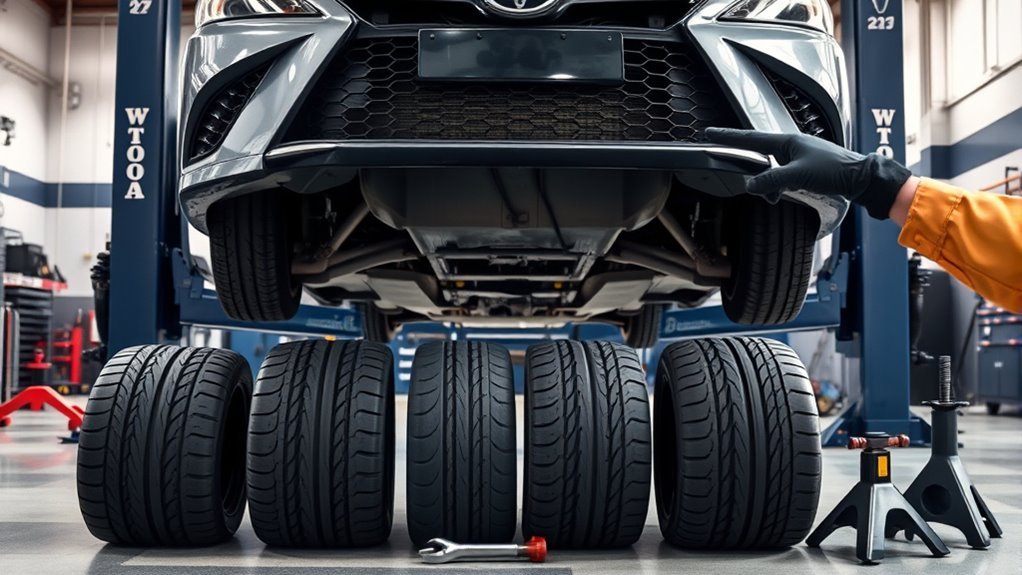
The correct Camry tire rotation pattern depends on the model year, tire construction, front and rear tire sizes, wheel compatibility, and Toyota’s owner’s-manual diagram. Toyota’s vehicle-specific instruction overrides a generic FWD, AWD, or tire-industry chart.
| Tire and Vehicle Setup | Pattern to Use | Important Limit |
|---|---|---|
| 2025 Camry with factory same-size tires and compatible wheels | Exchange front and rear tires on the same side, as shown in Toyota’s manual | Complete TPWS wheel-position registration after rotation |
| Another Camry model year | Use the diagram in that model year’s owner’s manual | Do not import the 2025 pattern or a generic FWD chart without checking |
| Directional tires | Normally front-to-rear on the same side | Do not reverse the marked rolling direction unless the tire is professionally dismounted and remounted |
| Staggered front and rear tire sizes | Rotation may be limited to side-to-side or may not be permitted | Confirm tire direction, wheel width, offset, and manufacturer guidance |
| Aftermarket wheels or different offsets | Use only positions confirmed compatible | Matching appearance does not prove that every wheel fits every position |
| Compact temporary spare | Do not include it | A temporary spare is not a normal fifth rotation tire |
Warning: Do not cross directional tires unless they are dismounted and remounted correctly. Directional tires have an arrow or rotation marking on the sidewall and must roll in the marked direction.
What Pattern Does the 2025 Front-Wheel-Drive Camry Use?
For the 2025 Camry, Toyota’s owner’s-manual diagram shows a same-side front-to-rear exchange:
- Move the front-left tire to the rear-left position.
- Move the rear-left tire to the front-left position.
- Move the front-right tire to the rear-right position.
- Move the rear-right tire to the front-right position.
Do not replace this model-specific instruction with the generic forward-cross pattern commonly shown in general FWD tire charts. Toyota’s general tire-rotation guide also tells owners to follow the vehicle manufacturer’s recommended pattern.
For an older or newer Camry, open the tire-maintenance section of that vehicle’s owner’s manual and use the diagram shown there. Model-year changes, tire type, and wheel configuration can change what is permitted.
Do AWD Camry Models Use a Different Interval?
An AWD Camry still follows Toyota’s scheduled rotation interval unless the exact maintenance guide or tire manufacturer specifies something different. The rotation pattern should come from the owner’s manual for that model year, not from a generic AWD chart.
AWD models deserve close attention to tire matching. Do not mix tires with substantially different size, construction, wear, or remaining tread without qualified guidance. When one tire is damaged beyond repair, ask a Toyota dealer or qualified tire professional whether the replacement can be matched safely or whether additional tires must be replaced.
What About a Custom Rear-Wheel-Drive Camry?
This guide does not assign a generic rotation pattern to a custom drivetrain conversion. A modified Camry may have different wheel sizes, offsets, tire sizes, clearances, and driveline requirements. Follow the conversion builder’s instructions and the tire and wheel manufacturers’ restrictions.
How Do Directional or Staggered Tires Change the Pattern?
- Directional tires: Normally rotate front-to-rear on the same side so the marked rolling direction remains correct.
- Staggered tires: If the front and rear tires are different sizes, they usually cannot trade front and rear positions.
- Directional and staggered tires: Normal rotation may not be possible without professional dismounting and remounting.
- Different wheel offsets: Verify that every wheel is approved for the destination position before moving it.
- Temporary spare tires: Do not include a compact temporary spare in the rotation.
General tire-manufacturer pattern charts can help explain these restrictions, but vehicle-specific instructions remain the final authority. See the Michelin tire-rotation guide and Bridgestone tire-rotation guide for additional tire-type examples.
Does a 2025 Camry Need TPWS Registration After Rotation?
Yes. Toyota’s 2025 Camry owner’s manual says wheel-position registration is necessary after rotating the tires. This is different from merely inflating a low tire or waiting for a warning lamp to turn off.
- Park safely and switch the vehicle off. Leave the vehicle off for at least 15 minutes before beginning the registration procedure.
- Start the hybrid system.
- Open the settings in the multi-information display.
- Select Vehicle Settings.
- Select TPWS setting.
- Select Tire Rotation, then choose Yes.
- Drive the vehicle. Toyota specifies driving at approximately 25 mph or faster for about 10–30 minutes, including occasional left and right turns, until registration completes and the tire-pressure display is available.
Menu wording and required procedures can differ by model year. Follow the tire-pressure monitoring section of the exact owner’s manual when working on another Camry.
How Do You Rotate Toyota Camry Tires Safely?
You can rotate Camry tires at home only when you have suitable lifting equipment, confirmed lifting and support points, a flat work area, the correct pattern, and the ability to torque the wheels accurately. Stop and use a qualified shop when any of those conditions cannot be met.
Tools and Equipment
- Floor jack with adequate capacity
- Jack stands correctly rated for the vehicle
- Wheel chocks
- Lug wrench or breaker bar
- Calibrated torque wrench
- Tire pressure gauge
- Tread-depth gauge
- Gloves, flashlight, and a method for marking starting positions
- Owner’s manual for the exact model year
Warning: Never work around a vehicle supported only by a jack. A jack lifts the vehicle; correctly placed jack stands support it. Use solid, level ground and follow the lifting and support-point instructions for the exact Camry.
Step-by-Step Procedure
- Confirm the pattern first. Check the owner’s manual, tire direction markings, front and rear tire sizes, and wheel compatibility before lifting the vehicle.
- Park safely. Choose a flat, solid surface, shift to Park, set the parking brake, switch the vehicle off, and chock the wheels as required by the lifting sequence.
- Record starting positions. Mark each wheel as left front, right front, left rear, or right rear. Record initial tread depths and pressures.
- Loosen the lug nuts slightly. Break them loose while the tire still contacts the ground. Do not remove them.
- Lift and support the Camry. Use only the specified lifting points and place correctly rated stands at approved support points.
- Remove the wheels. Finish removing the lug nuts and lift each wheel away without damaging the studs or mounting surface.
- Inspect every tire and wheel. Check inner, center, and outer tread depth; punctures; cuts; bulges; exposed cords; cracking; uneven wear; valve stems; wheel damage; and missing balance weights.
- Stop for unsafe conditions. Do not rotate a tire with exposed cords, a bulge, severe structural damage, replacement-level tread, or another condition that makes it unserviceable.
- Move the serviceable wheels. Follow the exact pattern selected before lifting the car.
- Clean and inspect the mounting surfaces. Remove loose debris without applying unapproved lubricant to studs, nuts, or seating surfaces.
- Hand-start every lug nut. Thread each nut by hand to reduce the risk of cross-threading.
- Snug the nuts in a star pattern. Tighten them lightly and evenly while the vehicle remains supported.
- Lower the vehicle carefully. Lower it enough to prevent wheel rotation during final tightening.
- Torque the lug nuts correctly. Use the specification in the owner’s manual for the exact model year and wheel hardware. Many late-model factory Camry applications list 76 ft-lbf / 103 N·m, but do not assume that value applies to aftermarket wheels, replacement studs, or modified hardware.
- Set cold tire pressure. Use the driver-side door placard, not the maximum pressure molded into the tire sidewall.
- Complete TPWS registration when required. For a 2025 Camry, use Vehicle Settings → TPWS setting → Tire Rotation → Yes, then complete the specified drive cycle.
- Test drive carefully. Stop and recheck the vehicle if you notice wobble, new vibration, clunking, pulling, warning messages, or abnormal noise.
- Document the service. Record the date, mileage, positions, tread measurements, pressures, torque procedure, TPWS registration, and any defects found.
Pro Tip: Measure tread at the inner shoulder, center, and outer shoulder of every tire. Position-by-position measurements make developing alignment or pressure problems easier to identify than one tread reading per tire.
What Should a Professional Camry Tire Rotation Include?
A professional rotation should include more than moving four wheels. The technician should inspect the tire-and-wheel assemblies, use the correct model-year pattern, torque the fasteners correctly, set cold pressure, and complete any required TPWS procedure.
Ask whether the service includes:
- Tread measurements at the inner, center, and outer portions of each tire
- Uneven-wear inspection for cupping, feathering, shoulder wear, center wear, or one-sided wear
- Tire-pressure adjustment using the door-placard specification
- Inspection for punctures, cuts, bulges, cracking, or exposed cords
- Valve-stem and TPMS sensor inspection
- Wheel inspection for bends, cracks, corrosion, or damaged mounting surfaces
- Balance diagnosis when vibration or a missing wheel weight is reported
- Alignment and suspension observations when the car pulls or wear is angled or irregular
- Correct wheel-nut torque using a calibrated torque wrench
- TPWS wheel-position registration when required by the model year
- A dated invoice or maintenance record
A trained inspection may identify a tire, wheel, brake, alignment, or suspension problem that would not be corrected by changing tire positions.
[Products Worth Considering]

The SEESII cordless impact wrench delivers high torque for fast tire changes, bolt removal, and demanding automotive or construction tasks. Its brushless motor, variable-speed control, dual batteries, and included socket set help you work longer with less fatigue and greater precision. A compact design, LED work light, and protective carrying case make it a practical all-in-one solution for home garages, roadside repairs, and jobsite use.

This set of four pre-programmed TPMS sensors is designed as a direct-fit replacement for compatible Toyota, Lexus, and Scion vehicles. It helps restore accurate tire pressure monitoring without sensor programming, and each unit is factory-tested for dependable performance. Built for long service life, these sensors offer a convenient solution for replacing worn or failed tire pressure monitors.

This CARORAV TPMS sensor set provides reliable tire pressure monitoring for a wide range of Toyota and Lexus vehicles with 315MHz compatibility. It is pre-programmed for easier setup, but still requires relearning or reset procedures after installation. Designed for accurate real-time pressure tracking, these sensors help support safer driving and long-lasting performance across many model years.
When Should You Inspect the Tires Before the Next Rotation?
The 5,000-mile or six-month interval is the routine maximum, not a reason to ignore warning signs. Inspect the tires immediately when the Camry pulls, vibrates, loses pressure, develops new road noise, or shows visible damage or uneven tread.
What Do Common Camry Tire-Wear Patterns Mean?
- Both outer shoulders wearing: Often associated with prolonged underinflation or repeated heavy cornering.
- Center wearing faster: Can be associated with excessive inflation or an unsuitable pressure history.
- One shoulder wearing: Can indicate an alignment or suspension problem.
- Cupping or scalloping: Can accompany imbalance, tire damage, wheel issues, or worn suspension components.
- Feathering: Often points toward a toe-alignment problem.
- One tire differing sharply from the others: Requires pressure, alignment, wheel, brake, suspension, and tire-condition diagnosis.
Rotation may redistribute mild, serviceable wear, but it does not remove the underlying cause. Severe irregular wear may require Camry alignment diagnosis, balancing, suspension repair, wheel repair, or tire replacement.
Do not rotate and continue driving: Remove a tire from service when it has exposed cords, a bulge, severe cracking, structural damage, an unrepairable puncture, or tread at the replacement limit.
What Should You Do When the TPMS Warning Is On?
A steady tire-pressure warning commonly indicates that at least one tire is below the required pressure. Check all four tires when cold and inflate them to the driver-door placard values. Inspect any repeatedly low tire for a puncture, valve leak, bead leak, or wheel damage.
A flashing warning or a warning that remains after pressures are corrected can indicate a system or sensor problem. Follow the owner’s manual and have the vehicle checked when the cause is not clear.
Do not confuse pressure correction with wheel-position registration. On a 2025 Camry, Toyota requires the TPWS tire-rotation registration procedure after the wheels change positions even when all pressures are correct.
When Is Tread Too Low for Rotation?
The National Highway Traffic Safety Administration says tires should be replaced when tread reaches 2/32 inch. Toyota also instructs owners to inspect the treadwear indicators and replace tires when those indicators are showing.
Measure several points across each tire with a tread-depth gauge. A tire can reach the replacement limit at one shoulder before the center does. Rotation cannot restore tread or make a replacement-level tire safe.
Wet-road performance can decline before the legal replacement limit is reached. Consider weather, water evacuation, tire condition, and manufacturer guidance rather than treating 2/32 inch as a target service life.
Does Tire Age Matter When Tread Still Looks Good?
Yes. Tire age and tread depth are separate concerns. Toyota’s 2025 Camry manual says that any tire more than six years old should be checked by a qualified technician, even when it has seldom or never been used and no obvious damage is visible.
The final four digits of the tire’s DOT identification code identify the manufacturing week and year. For example, a code ending in 2524 indicates the 25th week of 2024. Have old, cracked, hardened, repeatedly repaired, or long-stored tires evaluated instead of relying only on tread depth.
How Do Tire Rotations Affect Maintenance and Warranty Records?

Tire rotations can matter for Toyota maintenance history and for a separate tire manufacturer’s treadwear warranty.
Toyota’s maintenance guide says owners may perform maintenance themselves or use an automotive service provider of their choice. It also explains that damage or failure caused by inadequate maintenance is not covered. Keep records even when the work is performed at home.
For Toyota-related maintenance history, save:
- Date and odometer mileage
- Rotation pattern or final tire positions
- Inner, center, and outer tread-depth measurements
- Cold pressure readings
- Wheel-nut torque procedure
- TPWS registration result, when required
- Photos, parts receipts, or shop invoices
- Notes about damage, vibration, pulling, leaks, or recommended repairs
Tire manufacturers may set their own rotation interval and documentation requirements. Read the warranty booklet supplied with the installed tires and keep the records for the life of the set. For broader coverage information, see the Toyota Camry warranty and maintenance guide.
Do You Need Alignment or Balancing With Every Rotation?
Tire rotation, wheel alignment, and wheel balancing are separate services:
- Rotation changes the tire positions to distribute normal wear.
- Alignment adjusts suspension angles so the wheels meet the road as intended.
- Balancing corrects an uneven distribution of mass in a tire-and-wheel assembly.
Balancing is not automatically required solely because the tires changed positions. Request balance diagnosis when the Camry vibrates, a wheel weight is missing, a tire has been mounted or repaired, or inspection points to an imbalance.
Schedule an alignment inspection when the Camry pulls on a level road, the steering wheel is off-center, or one shoulder or tread block edge is wearing abnormally. Rotation without correcting the alignment can move the symptom to another position while the underlying fault remains.
New vibration after a rotation is not normal. Stop and have wheel seating, torque, pressure, damage, and balance checked.
[Products Worth Considering]

This set of four pre-programmed TPMS sensors is designed to restore accurate tire pressure monitoring for a wide range of Toyota, Lexus, and Scion vehicles. Built to OE-quality standards with long battery life and broad compatibility, these sensors help maintain proper tire pressure, improve safety, and eliminate TPMS warning lights when installed and activated correctly.

The LEXIVON 1/2-inch drive click torque wrench delivers accurate, dependable tightening for automotive and mechanical jobs with pre-calibrated precision. Its dual-range scale, reversible ratchet head, and ergonomic knurled handle make it easy to set, read, and use comfortably in a variety of applications. Built with hardened chrome vanadium steel and a corrosion-resistant finish, it is designed for lasting performance and reliability.

This digital torque wrench delivers precise fastening across a wide torque range with strong accuracy, making it a reliable choice for automotive, motorcycle, and general repair work. Its LED display, buzzer, and vibration alerts help prevent overtightening, while PEAK and TRACE modes plus preset memory and data logging add control and consistency for repeat jobs. Built for comfort and durability, it includes a storage case and batteries for ready-to-use convenience.
Where Can You Schedule a Camry Tire Rotation?
A Toyota dealer, qualified independent repair shop, tire retailer, or properly equipped owner can perform the service. Choose based on plan coverage, tire-warranty requirements, equipment, technical ability, and whether the vehicle needs diagnosis beyond a routine rotation.
[Products Worth Considering]

This DIY toe alignment tool kit helps home mechanics quickly check and adjust front-end toe after suspension, steering, or tire service. Stainless steel toe plates and dual tape measures provide a simple, reliable reference for reducing uneven tire wear and improving straight-line tracking without needing a full alignment machine.

This front stabilizer sway bar link set is designed to restore smooth, controlled handling and reduce clunking noises caused by worn suspension components. Built with a zinc-nickel alloy coating, carbon steel, and reinforced ball studs, it offers strong corrosion resistance and durable performance for a wide range of Toyota, Lexus, and Scion models. It is engineered for straightforward installation and reliable OE-style fitment.

This wheel alignment tool makes it easy to check and adjust toe-in and toe-out at home for better handling, stability, and more even tire wear. Designed for one-person use, it includes tape-measure slots for simple setup and accurate measurements without extra help. Its stainless steel construction and broad vehicle compatibility make it a practical addition to any DIY garage.
Toyota Dealer Service
A Toyota dealer can use the model-year service information, document the visit in its system, inspect related components, and complete the required TPWS procedure.
ToyotaCare terms depend on model year. As of July 31, 2026, Toyota generally lists scheduled-maintenance coverage of 1 year or 10,000 miles for model-year 2027 vehicles. Toyota’s published transition terms state that model-year 2026 and earlier vehicles retain the previous 2-year or 25,000-mile term. Eligibility, location restrictions, included services, and plan status should be confirmed by VIN through the official ToyotaCare page or a Toyota dealer.
Independent Shop or Tire Store
A reputable independent shop or tire retailer can perform the rotation correctly. A retailer may include rotations with a tire-purchase program, but terms vary.
Before authorizing service, ask the shop to:
- Use the model-year-specific pattern
- Measure and record tread at several points
- Set cold pressure to the door-placard values
- Torque the wheel nuts to the correct specification
- Complete TPWS wheel-position registration when required
- Report damage or wear before moving an unsafe tire
- Provide a dated receipt showing mileage and work performed
DIY Rotation
DIY service is reasonable only when you already have safe lifting equipment, suitable support points, a calibrated torque wrench, and the correct service information. The primary tradeoff is responsibility: you must identify restrictions, inspect the tires, support the vehicle safely, torque every fastener correctly, and complete any electronic registration procedure.
Do not treat the emergency jack supplied with a vehicle as a substitute for correctly rated workshop support equipment.
Toyota Camry Tire Rotation Record Template
Complete this record after each rotation. Keep it with tire invoices and other maintenance documents.
| Item | What to Record |
|---|---|
| Date | Month, day, and year of service |
| Mileage | Odometer reading at rotation |
| Starting Positions | Identify each tire or wheel as LF, RF, LR, or RR before moving it |
| Pattern or Final Positions | Record the owner’s-manual pattern or each tire’s final position |
| Tread Depth | Record inner, center, and outer measurements for all four tires in 32nds of an inch |
| Cold Pressure | Record PSI after adjustment to the door-placard specification |
| Wheel-Nut Torque | Record the specification used and that final tightening was completed with a torque wrench |
| TPWS Registration | Record whether wheel-position registration was required and completed |
| Inspection Notes | Record punctures, wear patterns, damage, missing weights, leaks, vibration, pulling, or repair recommendations |
| Service Provider | Shop and invoice number, or “DIY” with receipts and photos retained |
Frequently Asked Questions
How often should I rotate the tires on my Toyota Camry?
Rotate Toyota Camry tires every 5,000 miles or 6 months, whichever comes first. Follow an earlier interval when the tire manufacturer requires it or when inspection reveals uneven wear, pressure loss, or damage.
Is it okay to rotate Camry tires every 10,000 miles?
A routine 10,000-mile interval does not match Toyota’s 5,000-mile or six-month Camry maintenance schedule. Waiting that long can allow position-related wear to develop and may conflict with a tire manufacturer’s warranty requirements.
What tire rotation pattern does a Toyota Camry use?
Use the diagram in the owner’s manual for the exact model year. The 2025 Camry manual shows each front and rear tire exchanging positions on the same side. Do not assume that a generic forward-cross pattern applies to every Camry.
Do AWD Camry models need tire rotation more often?
Follow Toyota’s scheduled interval unless the exact maintenance guide, tire manufacturer, or a qualified technician requires earlier service. AWD models need close tire matching, so have substantial differences in size, construction, wear, or tread depth evaluated promptly.
Does a 2025 Camry need a TPMS reset after tire rotation?
The 2025 Camry requires TPWS wheel-position registration after rotation. After the vehicle has been off for at least 15 minutes, start the hybrid system and select Vehicle Settings → TPWS setting → Tire Rotation → Yes. Then complete Toyota’s specified drive cycle until registration finishes.
Do Camry tires need balancing every time they are rotated?
No. Rotation alone does not automatically require balancing. Have balance checked when the car vibrates, a wheel weight is missing, a tire has been mounted or repaired, or inspection indicates an imbalance.
Should I rotate Camry tires if the tread is already low?
Inspect and measure the tread first. Replace a tire that has reached 2/32 inch, shows its treadwear indicators, has exposed cords, or has structural damage. Rotation cannot restore tread or make an unsafe tire serviceable.
Can I rotate Toyota Camry tires myself?
Yes, when you have correctly rated lifting and support equipment, a flat work area, the model-year-specific pattern, a calibrated torque wrench, and the ability to complete any required TPWS registration. Use a qualified shop when safe support points or procedures cannot be confirmed.
Conclusion
Rotate Toyota Camry tires every 5,000 miles or 6 months, whichever comes first. Before starting, verify the rotation diagram for the exact model year and check whether directional tires, staggered sizes, or aftermarket wheels limit the pattern. Inspect every tire before moving it, use the correct wheel-nut torque and door-placard pressure, and complete TPWS wheel-position registration when Toyota requires it.
Do not use rotation to postpone diagnosis of pulling, vibration, repeated pressure loss, bulges, exposed cords, severe irregular wear, or replacement-level tread. Those conditions need inspection, repair, alignment, balancing, or tire replacement.
Sources
- Toyota 2025 Camry Warranty & Maintenance Guide — official maintenance interval, rotation schedule, maintenance responsibility, and record guidance.
- Toyota 2025 Camry Owner’s Manual and Warranty Library — official rotation diagram, tire inspection guidance, TPWS registration procedure, and model-specific instructions.
- Toyota Tire Rotation Guide — general rotation guidance and owner’s-manual priority.
- NHTSA TireWise Tire Safety — tire pressure, tread-depth, tire-age, and replacement guidance.
- Michelin Tire Rotation Guide — directional, staggered, and manufacturer-instruction guidance.
- Bridgestone Tire Rotation Guide — rotation-pattern factors and tire-configuration limits.
- ToyotaCare Maintenance Plan — current plan information and eligibility guidance.