Last updated: [VERIFY: confirm real update date] · Update notes: Rechecked the U.S. trim specification, TRD suspension note, tire-safety guidance, comparison data, and internal links; added parking-block clearance context. [VERIFY: this article duplicates an existing live page at /toyota-camry-ground-clearance-explained/ — resolve canonical URL before publishing]
The U.S.-market 2023 Toyota Camry has a published ground clearance of 5.7 inches, or about 145 mm, across gas, hybrid, AWD, and TRD trims. That’s enough for normal paved roads, most speed humps, and maintained gravel, but it’s not SUV-level margin: deep ruts, frozen center ridges, tall parking blocks, steep driveway transitions, and loose underbody panels can still cause contact. Below: what the 5.7-inch figure actually covers, what quietly reduces it, and how to check a Camry that’s started scraping.
Quick Answer
Toyota’s U.S. specifications list the 2023 Camry at 5.7 inches of ground clearance, equal to 144.8 mm and normally rounded to 145 mm. The published figure is the same for gas, hybrid, AWD, and TRD trims. It’s a factory reference, not a guarantee that every bumper lip, splash shield, exhaust part, or modified accessory will clear an object that’s 5.7 inches tall.
Key Takeaways
- Toyota lists 5.7 inches of ground clearance for every U.S.-market 2023 Camry trim.
- 5.7 inches converts to 144.8 mm, normally rounded to 145 mm.
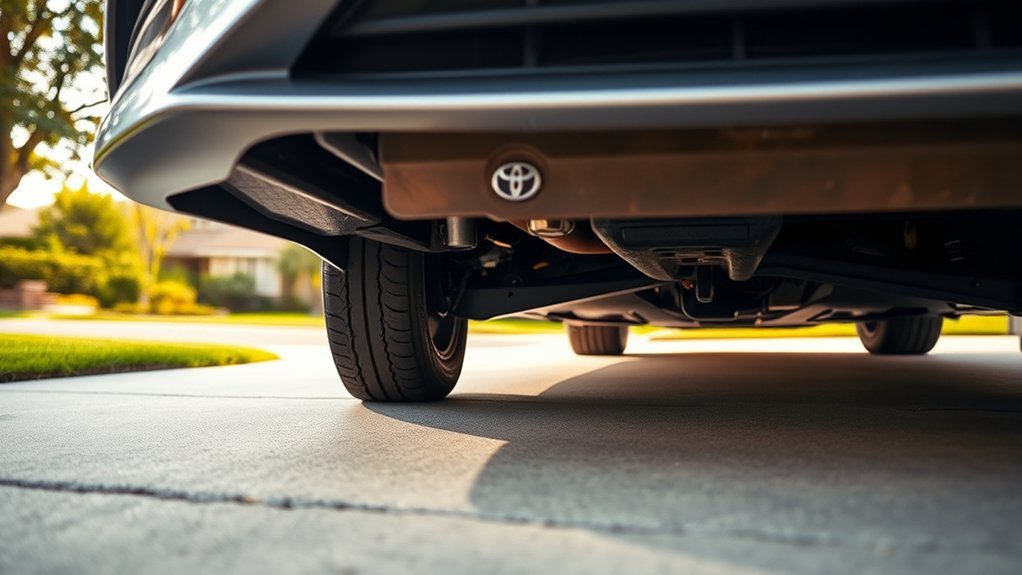
- Published ground clearance does not equal front-bumper, side-skirt, or exhaust clearance at every point.
- Passengers, luggage, worn suspension, incorrect tire size, low tire pressure, and hanging panels can reduce usable clearance.
- Toyota publishes the clearance figure but does not describe the exact load condition or measurement point in the brochure, so a home check is best used to spot change, sag, or damage.
Is 5.7 Inches Low for a Midsize Sedan?
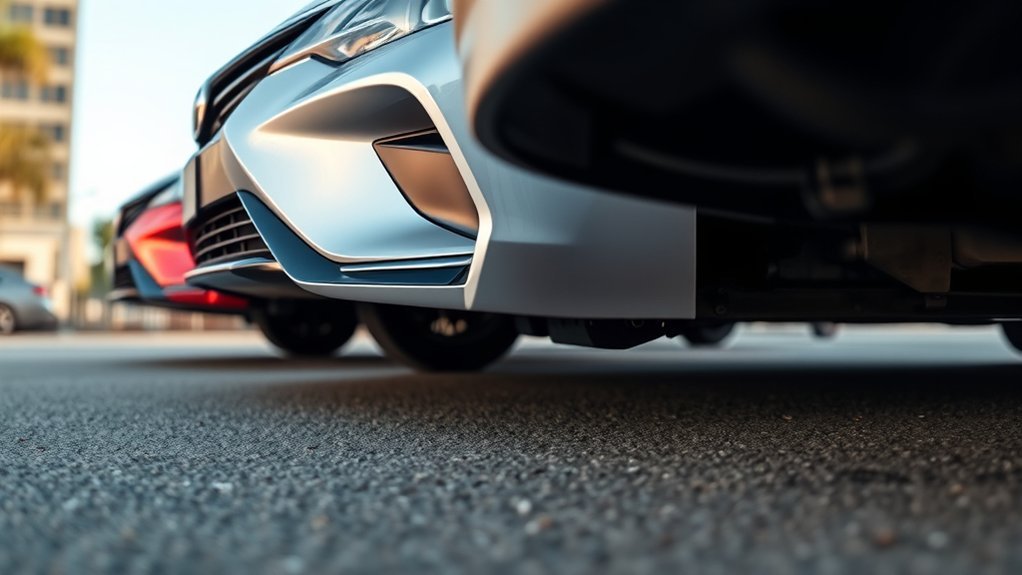
No, 5.7 inches is not unusually low for a road-focused midsize sedan. Common U.S. specification listings put the 2023 Hyundai Sonata and 2023 Kia K5 at 5.3 inches, while the 2023 Camry is listed at 5.7 inches. That gives the Camry a small published advantage, but cross-brand figures remain approximate because measurement points and loading methods may differ.
| 2023 midsize sedan | Published/listed minimum clearance | Source |
|---|---|---|
| Toyota Camry | 5.7 in. | Toyota eBrochure |
| Hyundai Sonata | 5.3 in. | Car and Driver specifications |
| Kia K5 | 5.3 in. | Edmunds specifications |
The Camry’s 5.7-inch clearance is competitive for a midsize sedan, but it does not provide the obstacle margin of a crossover or off-road vehicle.
What Is the 2023 Toyota Camry Ground Clearance?
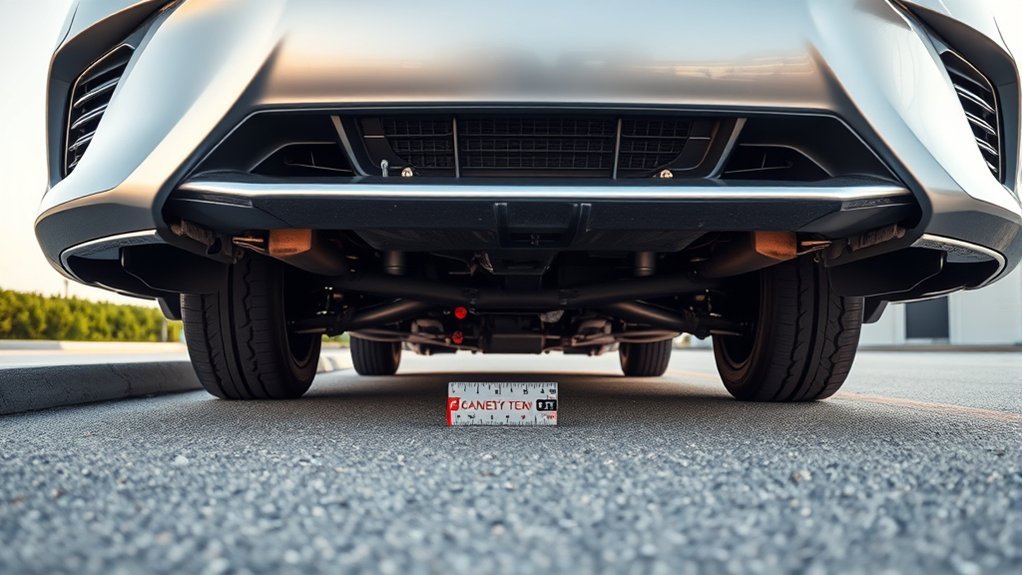
The official 2023 Toyota Camry ground clearance is 5.7 inches. Toyota lists that figure in the exterior-dimensions table of the 2023 Camry eBrochure. The same published number appears for the gas, hybrid, AWD, and TRD versions shown in the U.S. brochure.
In metric terms, 5.7 inches equals 144.8 mm, usually rounded to 145 mm. Toyota’s brochure publishes the number but does not state the exact underbody datum, load condition, or test procedure used for that table. Treat 5.7 inches as the official reference value, not as a promise that the car can pass over every 5.7-inch object. Suspension movement, obstacle shape, wheel position, front and rear overhangs, and added body parts all affect real clearance.
| 2023 Camry model group | Toyota-listed ground clearance | Approx. metric value |
|---|---|---|
| LE, SE, XLE, XSE | 5.7 in. | 145 mm |
| AWD-equipped trims | 5.7 in. | 145 mm |
| Hybrid trims | 5.7 in. | 145 mm |
| TRD | 5.7 in. | 145 mm |
How to Read the 5.7-Inch Number
| Factory reference | 5.7 in. / 145 mm |
| Guaranteed obstacle height | None; obstacle shape and contact location matter |
| Common first contact | Front lip or shield, center underbody, or rear when heavily loaded |
| First checks after new scraping | Cold tire pressure, load, tire size, loose panels, and side-to-side stance |
Model-year note: Do not apply the 2023 figure to a different Camry generation. For the newer model, see the 2026 Camry dimensions and ground-clearance guide. [VERIFY: confirm this internal link target is live]
TRD specification note: Toyota’s brochure states the TRD’s unique coil springs lower the vehicle by 0.60 inches [VERIFY: confirm this figure against a current, fetchable Toyota source], while the same brochure lists 5.7 inches of ground clearance for TRD. Treat 5.7 inches as Toyota’s published clearance figure and the 0.60-inch statement as a separate suspension-height claim. Do not subtract one from the other without a Toyota measurement reference for the exact points involved.
How Is Camry Ground Clearance Measured?
Ground clearance generally means the vertical distance from level ground to the lowest fixed point beneath the vehicle, excluding the tires. On an individual Camry, the lowest visible point may be a shield, brace, exhaust section, or suspension-related structure. Toyota’s 2023 brochure does not identify the exact point or loading condition used for its published 5.7-inch figure.
A home measurement is therefore a screening check, not a factory-spec certification. It can reveal a hanging panel, an uneven stance, or a meaningful loss of ride height. For a deeper explanation of datum points and repeatable measurements, see the ground-clearance measurement guide. [VERIFY: confirm this internal link target is live]
At a Glance
| Time Required | 5–10 minutes |
| Difficulty | Easy visual screening |
| Tools Needed | Tape measure, flashlight, level parking surface, optional straightedge |
| Cost | No added cost if you already have the tools |
DIY Measurement Steps
- Park the Camry on a flat, level surface.
- Remove unnecessary cargo and note how many people are in the car.
- Check cold tire pressure against the driver-side Tire and Loading Information label.
- Use a flashlight to look for the lowest fixed underbody point and any loose panel.
- Measure vertically from the ground to that point without crawling under an unsupported car.
- Repeat near the front, center, rear, and both sides to look for a meaningful difference.
- Record the tire size, pressure, load, and measurement location so you can compare later.
Warning: Never crawl under a car supported only by a jack. If the lowest point cannot be inspected safely from outside, follow the correct Camry jack-point and stand-placement procedure with properly rated equipment on solid, level ground, or have a shop inspect the car on a lift. [VERIFY: confirm this internal link target is live]
What Can a 2023 Camry Clear in Daily Driving?
A 5.7-inch published clearance gives the Camry useful room for ordinary pavement, but it leaves less error margin than a crossover or SUV. The wheels may pass around an obstacle while the center of the car, front overhang, or a low body extension still makes contact.
Everyday Road Clearance
On paved streets, the Camry should handle ordinary road crowns, shallow drainage dips, modest debris, and common driveway transitions when driven slowly. Sharp impacts are different. The suspension compresses as a wheel hits a pothole or abrupt hump, temporarily reducing the space under the car.
- Slow before the obstacle instead of braking hard while the wheels are on it.
- Avoid straddling tall debris because the center of the car may be the lowest path.
- Take a steep driveway lip at a shallow angle only when traffic and curb space allow.
- Listen for new scraping or rattling after pothole, curb, or road-debris contact.
Will a 2023 Camry Clear Speed Bumps?
It should clear many ordinary speed bumps at low speed, but no single height or profile applies to every private lot, garage, or road. Abrupt humps, steep ramp transitions, lowering kits, overloaded rear suspension, and hanging splash shields create the greatest risk. A long wheelbase also means the center of the car can touch a sharp crest even when the front bumper clears it.
Pro Tip: If the Camry scrapes at the same driveway every time, note whether the contact occurs at the front, center, or rear. That location helps separate an overhang problem from a breakover problem or rear suspension sag.
Will a 2023 Camry Clear a Parking Block?
Usually, but with less margin than most drivers expect. Owner discussion on Toyota forums notes that standard parking-block heights typically run about 3.25 to 4 inches, which sits well under the Camry’s published 5.7-inch minimum — but the same discussion describes drivers of current-generation Camrys routinely scraping bumper covers or front lips on cement blocks because the lowest point of the car isn’t the same as the flattest, and pulling in too far concentrates contact at one low front edge rather than spreading it across the full underbody. In practice, this means judging distance by feel and stopping early, not assuming the published clearance number protects the front bumper cover the same way it protects the center underbody.
Is 5.7 Inches Enough for Snow and Gravel?
It is enough for maintained gravel and light, even snow cover, but it is not suitable for deep ruts or a tall frozen ridge between tire tracks. Packed snow can harden under the center of the car and rub a shield or exhaust component. Loose gravel can also strike low panels even when the car does not bottom out.
- Use tires suited to the weather and follow local winter-equipment rules.
- Avoid center ridges that appear close to the lowest part of the underbody.
- Drive slowly on gravel to reduce impact force and stone spray.
- Inspect for loose shields or rattles after a hard scrape.
What Roads and Obstacles Can Damage the Undercarriage?
Damage risk rises when an obstacle is tall, sharp, or positioned between the wheels. Speed also matters because a fast impact compresses the suspension and increases the force transferred to shields, brackets, exhaust parts, wheels, and suspension components.
- Deep potholes: The wheel can move sharply upward while the tire, wheel, alignment, or suspension takes the impact.
- Abrupt speed humps: A sharp crest can contact the center of the car.
- Steep driveway lips: The front bumper, lower air deflector, or splash shield may touch first.
- Rocky or washed-out roads: Raised rocks and ruts can hit fixed underbody parts.
- Frozen snow ridges: A hard center ridge can scrape continuously under the car.
- Parking blocks and curbs: Pulling too far forward can catch a bumper cover or low extension.
| Where you hear or see contact | Likely situation to check first |
|---|---|
| Front edge | Driveway approach, curb, parking block, front lip, loose splash shield |
| Center of the car | Sharp speed hump, road crown, center snow ridge, breakover contact |
| Rear when loaded | Cargo weight, passengers, weak rear springs, steep departure angle |
| One corner repeatedly | Uneven tire pressure, spring or strut issue, bent component, previous impact damage |
Warning: If a scrape is followed by leaking fluid, a burning smell, steering pull, a dangling shield, tire rubbing, or an exhaust rattle, stop somewhere safe and inspect the car before continuing.
How Do Suspension, Tires, and Load Affect Ride Height?
The 5.7-inch figure is a factory specification, not a permanent guarantee. Your vehicle’s actual loading limit is shown on its driver-side Tire and Loading Information label. Use that vehicle-specific label instead of a generic payload number because equipment and configuration can affect the allowed combined weight of occupants and cargo.
[Products Worth Considering]

This center console organizer tray is designed for a precise fit in the Toyota RAV4 2026, helping turn deep console space into practical everyday storage. It keeps small essentials like phones, cards, coins, and sunglasses neatly organized and easy to reach while reducing movement and noise with a non-slip mat. Built from durable ABS and made for simple tool-free installation, it offers a clean, convenient upgrade for your interior.

This front windshield sunshade is designed to help keep your Toyota RAV4 cooler by reducing heat buildup after parking in direct sunlight. It blocks most UV rays to help protect your dashboard, seats, and steering wheel from sun damage, while the accordion folding design makes it easy to set up, store, and transport. Built with a durable triple-laminate construction and a silver reflective surface, it offers practical everyday sun protection for compatible RAV4 models.

This heavy duty recovery kit is built for safer vehicle extraction with a high-elasticity nylon snatch strap and reinforced loops for dependable performance. It includes two heavy duty D-ring shackles and a storage bag, giving you a complete setup for off-road, towing, and emergency recovery situations. Designed for strength and durability, it offers a high breaking strength and a generous working load limit for rugged use.
Suspension Condition
Weak springs, damaged mounts, bent control arms, and other suspension damage can change how the car sits. The spring carries most of the static vehicle load, while the strut damps movement and also forms part of the wheel-locating structure. A visible static sag therefore needs a complete suspension inspection, not an automatic strut-only replacement. See the Camry shocks and struts guide for symptom-based checks. [VERIFY: confirm this internal link target is live]
If the rear looks low with an empty trunk, one corner sits lower, or the car starts scraping familiar roads, measure from repeatable body or wheel-arch reference points on both sides. A consistent side-to-side difference is often more useful for diagnosis than one uncertain measurement to the lowest underbody point.
Tires and Pressure
Tire size changes the outside diameter of the wheel-and-tire assembly. That can affect ride height, speedometer accuracy, braking feel, wheel-well clearance, and suspension clearance. The NHTSA tire safety guidance says to use the original tire size or another size recommended by the manufacturer and to follow the cold pressure on the vehicle label or in the owner’s manual. Use the Camry tire-size guide to decode the sidewall before comparing diameters. [VERIFY: confirm this internal link target is live]
Underinflation can slightly reduce effective clearance, but its larger risks are heat buildup, poor handling, abnormal wear, and tire failure. Check cold pressure at least monthly and before a heavily loaded trip.
Load Distribution
Passengers and luggage compress the springs, especially when weight is concentrated in the rear seat or trunk. The car may remain within its labeled load limit yet have less practical clearance over a steep ramp or driveway than it has when empty.
Note: Read the driver-side loading label before a full-passenger trip. Slow more than usual over ramps and humps, and distribute cargo securely instead of placing all heavy items at the back of the trunk.
What Are the Signs Your Camry’s Clearance Has Dropped?
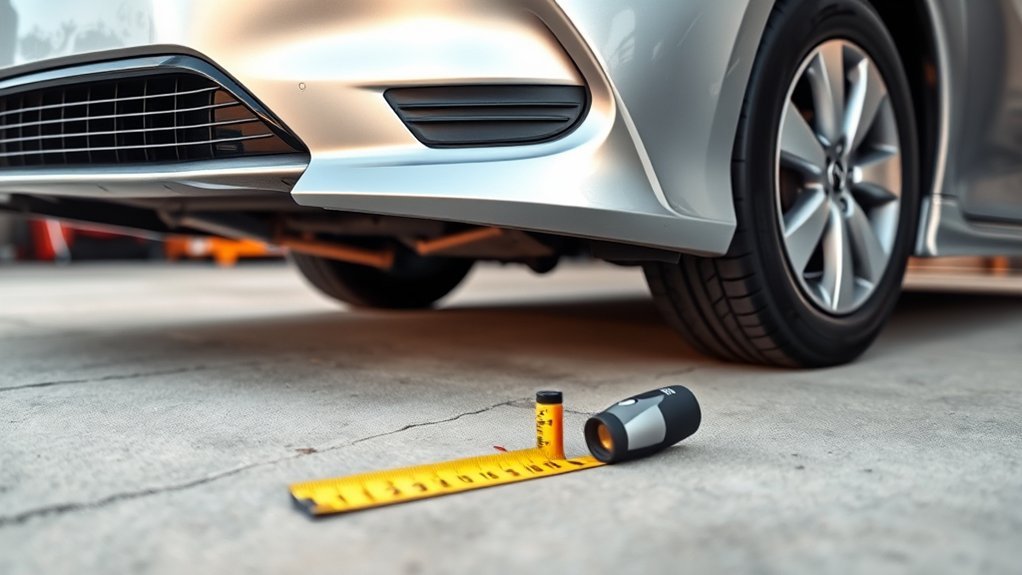
If the Camry starts scraping places it used to clear, inspect it before assuming the road changed. A loose plastic shield can hang below the intended lowest point, while tire, spring, alignment, or impact damage can change the car’s stance.
Common Warning Signs
- Fresh scrape marks on a shield, bumper underside, exhaust, or underbody panel
- Repeated contact on familiar driveway transitions or speed humps
- A rear-end sag when the trunk is empty
- One corner sitting lower than the others
- Clunking, rattling, or knocking after a pothole or curb strike
- Tire rubbing during turns or suspension movement
- A plastic panel or fastener hanging below the car
Simple Checks You Can Do at Home
- Look from outside with a flashlight: Check for hanging shields, missing clips, bent brackets, or fresh marks.
- Record a repeatable measurement: Note the exact point, load, tire pressure, and surface so later checks are comparable.
- Compare left and right: Measure matching wheel-arch or body reference points to identify a lean.
- Inspect the tires: Confirm size, cold pressure, damage, and uneven wear.
- Check after an impact: Arrange an inspection after a hard pothole hit, curb strike, new steering pull, or tire rubbing.
Pro Tip: Photograph each scrape mark and the surrounding part before repair. Matching a new mark to the same location can show whether the original cause was fixed.
When Should a Shop Inspect Lost Camry Clearance?
Schedule a professional inspection when the Camry sits lower while unloaded, one corner is visibly uneven, tire rubbing appears, or scraping starts after a pothole, curb strike, or underbody impact. A written diagnosis should identify the failed or displaced part before springs, struts, control arms, or alignment components are replaced.
[Products Worth Considering]

Fix-A-Flat provides a quick emergency solution for temporary flat tire repair and inflation, helping drivers get back on the road without a jack, spare tire, or tools. Its formula seals small tread punctures in seconds, is safe for tires and TPMS systems, and offers an eco-friendly alternative for roadside emergencies. Designed for standard tires, it is easy to keep in the trunk for dependable peace of mind.

This smart color coded tire tread depth gauge makes it easy to check tread wear at a glance with clear red, yellow, and green ranges. Calibrated from 0 to 1 inch in 1/32 inch increments, it helps you quickly assess tire condition for safer driving and timely replacements. The pocket clip design makes it convenient to carry and use on trucks, motorcycles, cars, and other passenger vehicles.

This tool kit is designed to remove and install the Rear-axle suspension bush compatible for Toyota MPV, Corolla, Camry and many more.
What the Inspection Should Confirm
- Whether a splash shield, exhaust hanger, bracket, or fastener is hanging below its intended position
- Whether a spring is broken, sagging, incorrectly seated, or mismatched side to side
- Whether a strut, mount, control arm, bushing, or wheel has impact damage
- Whether the installed tire size, pressure, and load rating match the vehicle label
- Whether alignment or body damage explains the uneven stance or rubbing
For bushing-related symptoms such as clunks, pulling, or unstable geometry, see the Camry control-arm bushing guide. Review the 2023 Camry warranty and owner documents before a major suspension or ride-height modification. [VERIFY: confirm the internal link target is live]
Which Checks Are Reasonable at Home?
Replacing an accessible splash-shield clip may be a basic repair. Springs, struts, control arms, and alignment-related parts carry much greater risk. A compressed spring stores dangerous energy, and incorrect fastener torque or alignment can make the car unsafe.
| Task | Typical level | Decision rule |
|---|---|---|
| Check pressure, tire size, load, and visible panels | Basic | Work from outside the car on level ground. |
| Replace a confirmed missing shield clip | Basic to moderate | Use the correct fastener and verify full support. |
| Inspect after fluid leakage, steering pull, rubbing, or a hard impact | Professional | Do not keep testing on the road until safety is confirmed. |
| Replace springs, struts, control arms, or alignment parts | Advanced/professional | Use service-manual procedures, correct torque, and alignment checks. |
What Should Be on the Written Estimate?
Ask the shop to separate parts, labor, alignment, shop supplies, and taxes. The estimate should name the failed component, explain how it changes stance or clearance, identify the part brand and warranty, and state whether an alignment is included. Repeat the same side-to-side stance measurements after repair.
Can Tires or Modifications Change Camry Ground Clearance?
Yes. Tire diameter, springs, coilovers, body kits, and loose exterior parts can change usable clearance. A modification can also reduce approach, departure, or breakover margin even when the lowest metal underbody point does not change.
[Products Worth Considering]

【Fitment】for Toyota Camry 2018-2024 FWD XV70 Front/rear drop length:2.0 inches

Lowers (1.8"F/1.4"R)
Lowers (1.8"F/1.4"R)
Wheel and Tire Changes
When changing tire size, check outside diameter, width, load index, speed rating, wheel offset, fender clearance, and suspension clearance. NHTSA recommends the original tire size or another size recommended by the vehicle manufacturer. The 2018–2024 Camry wheel-and-tire fitment guide explains offset, diameter, and rubbing checks for this generation. [VERIFY: confirm this internal link target is live]
Clearance formula: A tire-diameter change alters static ride height by about half that amount. A tire that is 0.6 inch smaller in overall diameter lowers the car by about 0.3 inch, assuming the same load, pressure, and suspension position. A taller tire can add the same amount, but only if it clears the body and suspension safely.
Lowering Springs and Body Kits
Lowering springs and coilovers reduce suspension ride height. Front lips, side skirts, rear diffusers, and bumper extensions reduce practical body clearance even when the suspension remains stock. The lowest add-on part may become the first point to scrape.
Warning: Do not lower the car or install a different wheel-and-tire package without checking full-lock steering clearance, suspension travel, load rating, alignment range, speedometer effect, and applicable inspection rules.
Safe Modification Checklist
- Keep overall tire diameter close to a manufacturer-approved size.
- Use the correct load index and speed rating.
- Confirm wheel width and offset before purchase.
- Check clearance at full steering lock and through suspension movement.
- Get a professional alignment after suspension-height changes.
- Keep parts, installation, alignment, and measurement records.
Frequently Asked Questions
Does the 2023 Camry TRD have less ground clearance?
Toyota’s 2023 brochure lists 5.7 inches of ground clearance for the TRD, the same published figure shown for the other trims. The brochure also states the TRD’s unique coil springs lower the vehicle by 0.60 inches. Because those statements may use different reference points, use 5.7 inches as the published clearance and do not calculate a different number by subtraction.
Will a 2023 Toyota Camry clear speed bumps?
It should clear many ordinary speed bumps when driven slowly, but bump height and shape vary. Abrupt private-lot humps, steep garage transitions, lowering kits, heavy loads, and loose underbody panels can still cause contact.
Will a 2023 Camry clear a parking block?
Usually. Typical parking-block heights run around 3.25–4 inches, well under the Camry’s published 5.7-inch clearance. But drivers still report scraping front bumper covers or lips on parking blocks, because that low front edge — not the flat underbody — is often the first thing to make contact if you pull in too far. Judge distance by feel and stop early rather than relying on the published number alone.
Does 5.7 inches mean a Camry can clear a 5.7-inch object?
No. The published number is not a guaranteed obstacle height. A front lip, splash shield, exhaust part, or added body piece may sit lower, and the suspension can compress as the wheels cross the obstacle. Obstacle width, shape, and position between the wheels also matter.
Is 5.7 inches enough for snow?
It can handle light, even snow on maintained roads, but a frozen center ridge can scrape the underbody before the tires lose contact with the road. Traction also depends on tire type, tread, temperature, and road treatment, not ground clearance alone.
Is ground clearance different for hybrid, gas, and AWD Camry models?
For the U.S.-market 2023 Camry, Toyota lists 5.7 inches for the gas, hybrid, AWD, and TRD configurations shown in its brochure. Check documentation for your exact market and model year because specifications can change.
How much does passenger or cargo weight reduce Camry clearance?
Toyota does not publish a simple inches-per-pound reduction. The change depends on load amount, where the weight is placed, spring condition, tire pressure, and the measurement point. Stay within the driver-side loading label and compare the car’s stance empty and loaded if clearance is a concern.
Can bigger tires increase Camry ground clearance?
A taller tire raises static ride height by about half the increase in overall tire diameter. The gain is usually small, and an oversized tire can rub, change speedometer accuracy, alter braking or steering feel, and carry the wrong load rating. Use a manufacturer-approved size.
How can you tell whether the suspension is sagging?
Look for one corner sitting lower, an empty rear end that appears low, repeated scraping on familiar roads, uneven tire wear, or a new side-to-side measurement difference. A shop should inspect the springs, mounts, control arms, and impact damage before parts are replaced.
Conclusion
The U.S.-market 2023 Toyota Camry has a published ground clearance of 5.7 inches, or about 145 mm, across gas, hybrid, AWD, and TRD trims. That is competitive for a midsize sedan and suitable for normal paved driving, many ordinary speed humps, and maintained roads. It still leaves limited margin for sharp crests, frozen center ridges, deep ruts, rocky tracks, parking blocks, and steep transitions.
If the car starts scraping a route it previously cleared, check cold tire pressure, tire size, load, loose shields, side-to-side stance, and recent impact damage first. Stop driving and arrange an inspection if scraping is followed by leaking fluid, a burning smell, steering pull, tire rubbing, or a dangling part. Record repeatable measurements before buying suspension parts or changing ride height.
Sources
- Toyota 2023 Camry eBrochure — official 5.7-inch ground-clearance table, trim specifications, and TRD suspension statement.
- Toyota USA Newsroom: 2023 Toyota Camry — official model-year press kit and product-specification hub.
- Toyota Owners: 2023 Camry Manuals and Warranties — official owner-document and warranty hub.
- NHTSA TireWise — tire size, cold pressure, loading-label location, maintenance, balance, and alignment guidance.
- Car and Driver: 2023 Hyundai Sonata Specifications — comparison ground-clearance listing.
- Edmunds: 2023 Kia K5 Specifications — comparison ground-clearance listing.
- Toyota Nation Forum: 2025 Toyota Camry — Parking Cement Block — owner discussion of parking-block heights and front-lip scraping on current-generation Camrys.