
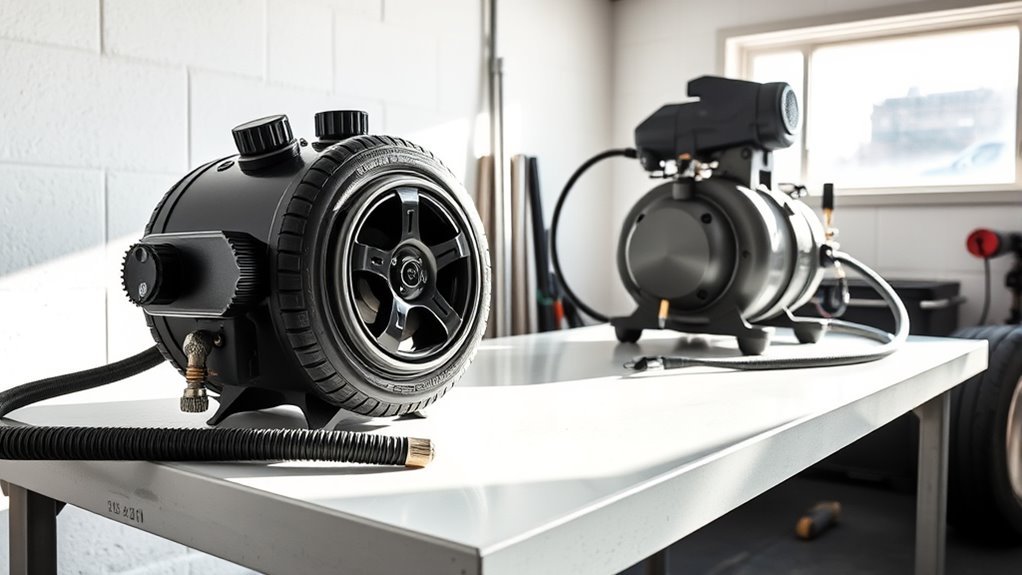
Tire inflators and air compressors both add air, but they are not built for the same job. A tire inflator is the better choice for quick tire top-offs, roadside use, and simple vehicle maintenance. An air compressor is better when you also need to run pneumatic tools, inflate larger items, or handle repeated shop tasks.
Quick Answer
Choose a tire inflator if your main goal is fast, portable tire inflation. Choose an air compressor if you need more stored air, higher airflow, and the ability to run tools like nailers, impact wrenches, or paint sprayers. For most drivers, a tire inflator is the simpler everyday tool.
Key Takeaways
- Tire inflators are compact, easy to store in a vehicle, and ideal for emergency tire inflation.
- Air compressors are larger and less convenient for travel, but they can power pneumatic tools and support more demanding jobs.
- PSI tells you pressure; CFM or SCFM tells you airflow. Air tools usually need both the right PSI and enough CFM.
- Always inflate tires to the vehicle placard or owner’s manual pressure, not the maximum PSI printed on the tire sidewall.
- The best choice depends on whether you need a tire-only tool or a more versatile workshop air system.
Tire Inflator vs Air Compressor: Quick Comparison
| Feature | Tire Inflator | Air Compressor |
| Best For | Car tires, bikes, motorcycles, balls, and emergency top-offs | Air tools, repeated inflation, larger tires, and workshop use |
| Portability | Usually compact and easy to keep in a trunk | Usually heavier and better suited to a garage or shop |
| Power Source | 12-volt vehicle outlet, rechargeable battery, or wall outlet depending on model | Usually wall outlet, larger battery platform, or gasoline engine |
| Air Storage | No storage tank; it pumps air directly | Tank stores compressed air for tools and repeated use |
| Main Limitation | Limited airflow and duty cycle | More space, noise, setup, and cost |
Understanding Tire Inflators: Key Features and Benefits

A tire inflator is a small pump designed to push air directly into a tire or inflatable item. Most portable models do not include a storage tank. Instead, the motor runs while the unit is filling the tire.
The biggest benefit is convenience. Many tire inflators fit in a glove box, cargo bin, or trunk storage pocket, which makes them useful for road trips and emergency kits. Some plug into a vehicle’s 12-volt outlet, while cordless models use rechargeable batteries. Models such as the Fanttik X8 Apex list a 150 PSI maximum rating, digital pressure display, and automatic shutoff, which are useful features for everyday tire maintenance.
Automatic shutoff is especially helpful because you can set the target pressure and let the inflator stop when it reaches that number. That reduces guesswork, although it is still smart to verify pressure with a separate tire gauge if accuracy matters.
Pro Tip: Keep a compact tire inflator and a quality tire pressure gauge in your vehicle. The inflator helps you fix low pressure, while the gauge gives you a quick independent check before long trips.
What Is an Air Compressor and How Does It Work?
An air compressor uses a motor to compress air and store it in a tank. When the tank reaches the set pressure, the compressor stops. As you use the air, pressure drops, and the motor turns back on to refill the tank.
This stored-air design makes compressors more versatile than tire inflators. They can inflate tires, but they can also run pneumatic tools, blow dust from equipment, power brad nailers, and support certain paint or cleaning tasks when the compressor is properly sized.
Basic Functionality Explained
Air compressors are rated by several numbers, but the most important are tank size, maximum PSI, and airflow. PSI means pounds per square inch, which tells you pressure. CFM or SCFM tells you how much air the compressor can deliver over time.
For example, the CRAFTSMAN CMEC6150K 6-gallon compressor lists 150 max PSI and 2.6 SCFM at 90 PSI. That means it can reach a tire-inflator-like pressure rating, but its tank and airflow rating also make it useful for certain air tools.
Types of Air Compressors
The most common air compressor types include piston compressors, rotary screw compressors, and diaphragm compressors. Piston compressors are common in home garages and small shops. Rotary screw compressors are more common in commercial and industrial settings because they are designed for steady, high-volume air demand. Diaphragm compressors are usually used for lower-volume or specialized applications.
For most homeowners, the practical choice is usually a small portable pancake compressor, hot-dog compressor, or twin-stack compressor. These models balance cost, portability, and enough airflow for light tools.
Applications and Uses
Air compressors are useful for more than tire inflation. Depending on size and CFM, they can run nail guns, air ratchets, impact wrenches, paint sprayers, airbrushes, and blow guns. The key is matching the compressor to the tool’s required PSI and CFM.
A compressor that is strong enough for a brad nailer may not be strong enough for continuous sanding or spray painting. Always check the tool’s air requirement before buying the compressor.
Portability: Tire Inflators vs. Air Compressors
Portability is where tire inflators clearly win. A portable tire inflator is designed to be carried, stored, and used quickly. It is the tool you want when you notice a low tire before work or need to add air in a parking lot.
Air compressors are less convenient on the road. Even portable models need more space, and corded compressors require an outlet. Larger units may also need a dedicated place in a garage or workshop.
Size and Weight
Tire inflators are usually small enough to store in a car without taking up much room. Many handheld or box-style models can sit under a seat or in a roadside emergency kit.
Air compressors are bulkier because of the motor, pump, frame, and tank. Small pancake compressors are still portable, but they are not as easy to keep in a vehicle every day.
Power Source Options
Tire inflators commonly use one of three power sources: a 12-volt vehicle outlet, a rechargeable battery, or a household wall outlet. The best choice depends on where you will use it. A 12-volt inflator is reliable for car emergencies, while a cordless inflator is easier to use away from the vehicle.
Air compressors usually run from a wall outlet, larger cordless battery system, or gasoline engine. This makes them better for planned work than unexpected roadside use.
Maximum PSI Ratings: Which Inflates Better?
Maximum PSI matters, but it should not be the only number you compare. Many passenger vehicles need roughly 30 to 35 PSI, although the correct number depends on the vehicle. The right pressure is listed on the vehicle’s tire information placard or in the owner’s manual, not on the tire sidewall.
A tire inflator with a 100 to 150 PSI rating can handle most passenger-car tire top-offs. Some compact models, including the Fanttik X8 Apex, list a 150 PSI maximum. That is more than enough for typical cars, crossovers, bicycles, and many motorcycles when used within the product’s limits.
Air compressors may offer similar or higher PSI depending on the model, but their advantage is usually airflow and stored air. If you only need to add a few PSI to a tire, a tire inflator is usually simpler. If you need to seat a bead, fill larger tires repeatedly, or run tools, a compressor is the better tool.
Note: PSI is pressure, while CFM or SCFM is airflow. A high-PSI inflator can top off tires, but it may not deliver enough airflow to run air tools or fill large-volume tires quickly.
[Products Worth Considering]
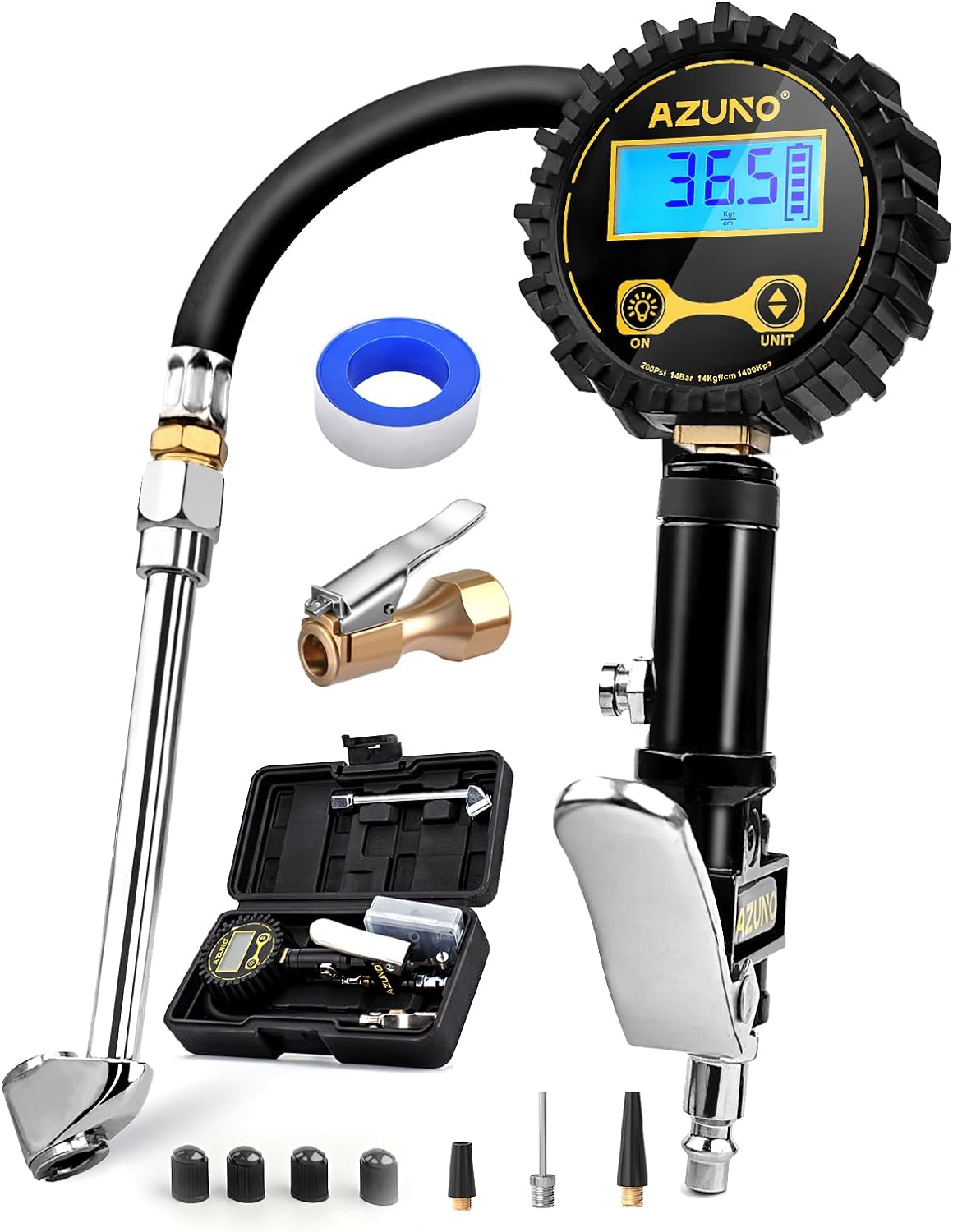
This digital tire inflator delivers accurate, easy-to-read pressure measurements with a bright backlit LCD and precise 0.1 resolution for confident inflation. Designed for single-handed use, it makes it simple to inflate or deflate tires while staying organized in the included portable carrying box. Built for a wide range of vehicles, it is a practical air compressor accessory for cars, trucks, SUVs, motorcycles, and more.

This portable tire inflator delivers fast, convenient inflation for cars, bikes, motorcycles, and balls with dual power options from a rechargeable battery or a 12V car cord. Its digital LCD pressure gauge and automatic shutoff help prevent over-inflation, while multiple preset modes and a custom setting make it easy to use for different inflation tasks. Built-in flashlight and USB power ports add extra emergency utility on the road.

This heavy-duty cargo net helps keep truck bed loads secure and organized during transport. Its expandable bungee mesh design offers flexible coverage for a range of cargo sizes, while the included metal carabiners make installation quick and dependable. Built for pickup owners who need reliable load containment, it is suitable for many popular truck models.
Versatility of Use: Air Tools and Beyond

Air compressors are more versatile because they can store and deliver compressed air for multiple tasks. A properly sized compressor can inflate tires, run nail guns, power some impact tools, operate airbrushes, and support light shop work.
This versatility depends on airflow. A nail gun may only need short bursts of air, while a paint sprayer or sander may need steady airflow for longer periods. Before buying, compare the tool’s required CFM at its working PSI with the compressor’s rating.
Tire inflators are more limited, but that is not a flaw if you only need tire inflation. Their smaller size, presets, and simple controls make them easier for casual users.
[Products Worth Considering]

This portable 12V tire inflator delivers fast, convenient inflation for cars, SUVs, trucks, motorcycles, and other inflatables. It features a digital display, bright LED lighting, auto shutoff, and multiple nozzle adapters to help you inflate accurately and safely, even in low-light situations. The long power cord and air hose make it easy to reach all tires and handle roadside emergencies or routine maintenance.

This portable air compressor makes it easy to inflate car tires and other inflatables from a standard vehicle power outlet. It features automatic shutoff, a digital pressure display, and bright LED lighting for convenient use day or night. With multiple nozzle adapters and a long power cord, it is designed for fast, versatile inflation on the go.

ADVANCED TRUEGAUGE SCREEN: This battery tire inflator includes updated sensor technology, capable of collecting pressure data from tire inflators at a frequency of 200 times per second. Its valid data rate is higher than 80%, which is 60% better than the market average. From routine maintenance to roadside emergencies, its accurate readings ensure confident pressure checks and a safer driving experience.Suitable as a Father's Day gift for your dad.
Cost Analysis: Tire Inflators vs. Air Compressors
Tire inflators are generally the more budget-friendly option for drivers who only need tire maintenance. They have fewer parts, no tank, and less shop-oriented hardware.
Air compressors usually cost more because they include a tank, pressure regulator, motor, pump, fittings, and often accessory kits. The extra cost makes sense if you will use air tools or need repeated inflation. It may not make sense if your only goal is topping off car tires once in a while.
Price Comparison Overview
Instead of choosing by price alone, think about how often you will use the tool and what you need it to do. A tire inflator is usually the better value for emergency kits, commuters, and road trips. An air compressor is usually the better value for DIYers, homeowners, and anyone who already owns pneumatic tools.
Value for Specific Needs
If you drive regularly and want a quick way to handle low tire pressure, buy a tire inflator. If you work in a garage, install trim, use nailers, or need shop air, buy an air compressor. If you want both convenience and versatility, a small tire inflator for the car plus a compressor for the garage is the best setup.
Noise, Duty Cycle, and Maintenance
Noise is another practical difference. Tire inflators can still be loud, but they usually run for short periods. Air compressors can be more disruptive because the motor cycles on and off while refilling the tank.
Duty cycle also matters. Many compact inflators need cooldown breaks after several minutes of use. That is normal for small motors. Air compressors also have limits, but larger tanks and stronger motors make them better for repeated jobs.
Maintenance is different too. A tire inflator mainly needs clean storage, battery care if cordless, and occasional hose inspection. A compressor may need the tank drained, fittings checked, filters inspected, and hoses replaced when worn. Oil-free compressors reduce maintenance, but they still need basic care.
Safety Tips Before You Inflate Tires or Use Compressed Air
Use the vehicle’s recommended cold tire pressure. The National Highway Traffic Safety Administration advises checking pressure when tires are cold or accounting for warm-tire readings. The correct pressure is usually on the driver-side door jamb placard or in the owner’s manual.
Do not use the maximum PSI printed on the tire sidewall as your normal inflation target. That number is the tire’s maximum cold inflation pressure, not necessarily the vehicle manufacturer’s recommended setting.
Keeping tires properly inflated can improve gas mileage by 0.6% on average and up to 3% in some cases, according to FuelEconomy.gov.
Warning: Never use compressed air to clean your body, clothing, or skin. OSHA workplace rules limit compressed air used for cleaning to below 30 PSI with proper guarding and protective equipment.
User Experiences With Tire Inflators and Air Compressors
Most users appreciate tire inflators for convenience. A good inflator can prevent a small pressure problem from becoming a flat tire, especially during travel or cold weather. Digital displays, presets, LED lights, and automatic shutoff make them easy to use even for beginners.
Air compressor users usually value power and flexibility. The tradeoff is setup. You may need to plug in the compressor, wait for the tank to fill, connect a hose, adjust a regulator, and store the unit afterward. That is worthwhile for workshop tasks but overkill for a simple tire top-off.
| User Priority | Better Pick | Why |
| Emergency tire top-offs | Tire inflator | Small, quick, and easy to keep in the vehicle |
| Air tools | Air compressor | Provides stored air and higher airflow |
| Apartment or small-car storage | Tire inflator | Takes much less space |
| DIY garage projects | Air compressor | More useful beyond tire inflation |
Ideal Use Cases: When to Choose Which Tool
Choose a tire inflator if you want a simple tool for car tires, bicycle tires, motorcycle tires, sports balls, or emergency use. It is also the better choice if you have limited storage or want something other drivers in the household can use easily.
Choose an air compressor if you need to run pneumatic tools, inflate large items repeatedly, maintain multiple vehicles, or work in a garage. A compressor is also better when you need a regulator, tank storage, and more airflow than a compact inflator can provide.
For many people, the best answer is not either-or. A portable tire inflator belongs in the vehicle, while an air compressor belongs in the garage.
[Products Worth Considering]

RAPID INFLATION & ROAD-READY PORTABILITY: Powerful 120W motor delivers up to 35L/min airflow—inflates a standard car tire (195/65 R15) from 30 to 36 PSI in under 1 minute under ideal operating conditions. Weighs only 2.2 lbs and fits glove compartments or trunks for daily commutes, road trips, and emergencies. Plugs into standard 12V DC car outlet with 15A fuse protection. AIRUN H features its cordless counterpart H2 Pro.

【PORTABLE & CORDLESS DESIGN】The OlarHike portable tire inflator now doubles as a power bank! Its compact, cordless design weighs only 1 pound, making it easy to carry wherever you go. Along with supporting four pressure units (PSI, BAR, KPA, kg/cm²) and multiple attachments, it features a built-in USB output for charging your phone or other devices on the go—perfect for drivers, cyclists, and adventurers.It also has a built-in slot for included accessories.

QUICK & ACCURATE: Built with the highest quality materials, Airmoto is a portable tire inflator for car, trucks, SUVs, motorcycles, and bicycles. Quickly inflate your vehicle's tires in just minutes with precision accuracy up to 120 PSI. Small and compact car air pump that fits in your glove box or trunk.
Warranty and Longevity: What to Expect

Warranty length and lifespan vary by brand and model, so check the product page before buying. In general, tire inflators are built for occasional inflation and emergency use. Their batteries, hoses, seals, and small motors can wear out faster if they are pushed beyond their duty cycle.
Air compressors are usually built for heavier use, but they also require more care. Draining moisture from the tank, keeping hoses in good condition, and avoiding overloaded electrical circuits can help a compressor last longer.
If you expect only occasional tire top-offs, a tire inflator should be enough. If you plan to use air tools every month, a compressor is the more durable long-term investment.
Making the Right Choice: Key Factors to Consider
Start with your main job. If the job is tire inflation, choose a tire inflator. If the job includes tools, shop work, or repeated high-air-volume tasks, choose an air compressor.
Then compare these factors:
- Portability: Tire inflators are easier to carry and store in a vehicle.
- PSI: Make sure the tool can reach the pressure your tires or equipment require.
- CFM/SCFM: For air tools, airflow is just as important as pressure.
- Power source: Decide whether you need 12-volt, cordless, or wall-outlet power.
- Duty cycle: Check how long the tool can run before cooling down.
- Noise and storage: Air compressors usually need more space and make more noise.
- Maintenance: Inflators are simpler; compressors require more routine care.
If you want the easiest tool for everyday drivers, buy a tire inflator. If you want the more capable tool for a garage, buy an air compressor.
Frequently Asked Questions
Is an inflator better than a compressor for tires?
For most car tire top-offs, yes. A tire inflator is easier to store, easier to use, and faster to set up. An air compressor is better if you need to inflate several tires repeatedly, work on larger tires, or use pneumatic tools.
Can a tire inflator be used as an air compressor?
A tire inflator can do some light jobs that people associate with compressors, such as inflating tires, balls, and small inflatables. It cannot replace a true air compressor for air tools because it lacks a storage tank and usually does not provide enough sustained airflow.
What is the difference between an air pump and an air compressor?
An air pump usually moves air directly into an item, such as a tire or inflatable. An air compressor compresses and stores air in a tank, then releases it through a hose and regulator. That storage tank is what makes compressors useful for tools and repeated jobs.
Is it worth buying a tire inflator?
Yes, a tire inflator is worth buying if you drive regularly. It can help you handle low tire pressure at home, at work, or on the road without searching for a gas-station air pump. It is one of the most useful tools to keep in a vehicle emergency kit.
Do I need an air compressor for car tires?
No, most drivers do not need a full air compressor just for car tires. A portable tire inflator is usually enough for regular pressure checks and top-offs. A compressor makes more sense if you also need shop air or pneumatic tools.
Should I inflate tires to the PSI on the tire sidewall?
No. Use the vehicle manufacturer’s recommended tire pressure, usually found on the driver-side door jamb placard or in the owner’s manual. The PSI on the tire sidewall is the tire’s maximum pressure rating, not the normal target for your vehicle.
Conclusion
A tire inflator is the best choice for most drivers because it is portable, simple, and designed for quick tire pressure fixes. An air compressor is the better choice for garages, DIY projects, pneumatic tools, and repeated high-air-volume work.
If your only concern is keeping your tires properly inflated, buy a good tire inflator and keep it in your vehicle. If you want one tool that can also handle air tools and shop tasks, invest in an air compressor that matches your PSI and CFM needs.
Sources
- National Highway Traffic Safety Administration — TireWise — supports tire pressure safety, cold-pressure checks, and placard guidance.
- FuelEconomy.gov — Keeping Your Vehicle in Shape — supports the fuel economy impact of proper tire inflation.
- Fanttik X8 Apex Tire Inflator — supports model-specific inflator features and 150 PSI rating.
- CRAFTSMAN CMEC6150K 6-Gallon Air Compressor — supports compressor PSI, tank size, and SCFM example.
- OSHA 1910.242 — Compressed Air Used for Cleaning — supports compressed-air cleaning safety guidance.



[…] For a broader explanation of the equipment categories, see the tire inflator vs. air compressor guide. […]