Supra Staggered vs Square Wheel Setup: Quick Answer
Last updated: July 31, 2026
How this guide was prepared: This is a research-based comparison using Toyota owner and model information, NHTSA and USTMA tire-safety guidance, Tire Rack fitment references, and published GR Supra fitment testing. It does not claim that every listed concept was physically tested on every Supra generation.
For a stock or mainly street-driven Supra, the safest default is to keep the factory wheel-and-tire layout for your exact model year and trim. On many modern GR Supras, that means a staggered setup with wider rear wheels and tires. A square setup can be a strong choice for autocross, track use, and drivers who want front-to-rear tire rotation, but only when the wheel width, offset, brake clearance, tire diameter, load rating, hardware, and alignment have been verified for the exact car.
Quick Answer
Choose factory-style staggered for the simplest street fitment, OEM-calibrated balance, and more rear traction under power. Choose square when tire rotation, front-end grip, track consistency, and one-size tire management matter more than maximum rear tire width. A wider rear tire does not automatically make drifting easier; it usually adds rear grip, so drift balance still depends on power, tire compound, pressure, alignment, and suspension tuning.
Key Takeaways
- Square setups use the same wheel and tire dimensions at all four corners, which can improve rotation options and may reduce understeer when the front tire is wider than stock.
- Staggered setups use different front and rear widths, usually with a wider rear tire on a rear-wheel-drive Supra. That supports acceleration grip but limits front-to-rear rotation.
- Street default: keep the factory arrangement unless you have a clear reason to change it and a verified fitment plan.
- Track default: square or near-square often improves tire management, but high-power cars may still benefit from extra rear width.
- A70, A80, and A90/A91 Supras use different hubs, brakes, offsets, and hardware. Never copy a fitment across generations.
- Confirm the tire placard, owner’s manual, wheel manufacturer data, tire manufacturer dimensions, and a physical test-fit before driving hard.
[Products Worth Considering]

These custom mud flaps are designed to fit select 2026 Toyota RAV4 models and help protect the lower body from mud, snow, gravel, sand, and road debris. Built for a no-drill installation using factory mounting points, they offer a clean, secure fit with added stability for everyday driving and harsh weather conditions.

These A-Premium mud flaps are designed to help protect compatible Toyota RAV4 models from mud, snow, road salt, gravel, and other road debris. Built from durable composite material and supplied with a complete installation kit, they offer dependable coverage for everyday driving without requiring drilling. They are intended for select model years and do not fit versions with side skirts or the Adventure trim.

This mud flap kit is designed for Toyota Camry LE and XLE models from 2018 through 2024, helping shield the lower body from snow, salt, sand, rocks, and road debris. Made from durable ABS material, it offers a direct-fit installation with included hardware for a secure and easy setup. The set includes four mudguards plus reflective stickers to help keep your vehicle cleaner and better protected in harsh driving conditions.
Quick Decision Guide: Staggered vs Square for Your Supra
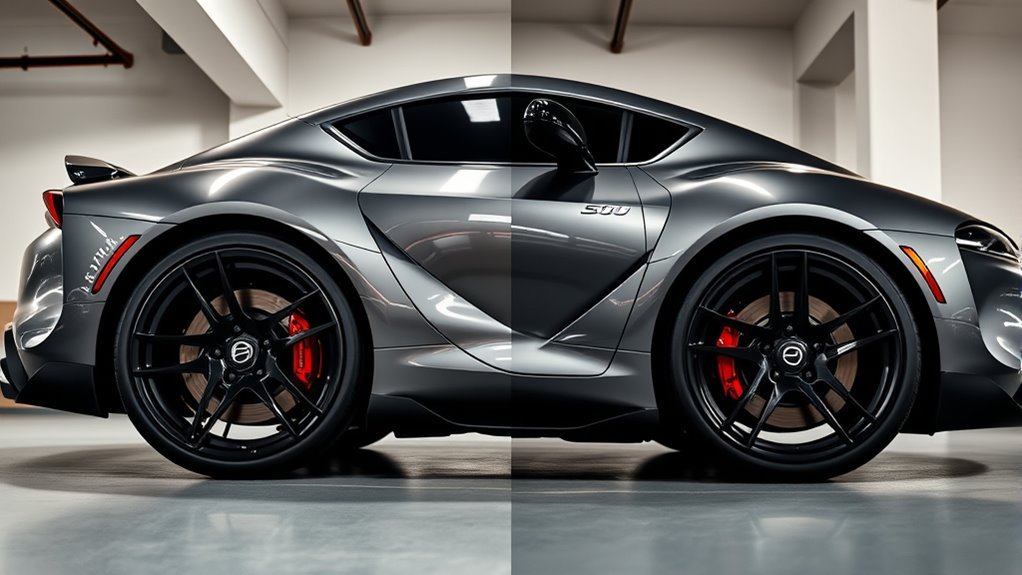
A square setup uses the same wheel diameter, wheel width, tire size, and normally the same offset at all four corners. Its main advantages are front-to-rear rotation, simpler tire purchasing, and the ability to increase front tire width relative to a factory staggered setup. Those changes can help a Supra turn in more cleanly, but they do not guarantee neutral handling. Tire compound, actual tread width, alignment, suspension, and driver inputs still matter.
A staggered setup uses different front and rear widths, usually with wider rear wheels and tires. Toyota uses staggered sizing on the modern GR Supra to support rear-drive grip. The wider rear contact patch can reduce wheelspin and improve stability under power, but it can also make the car more front-limited if the front tire is too narrow for the driving conditions.
| Priority | Best Starting Point | Why |
|---|---|---|
| Stock daily driving | Factory staggered | Keeps Toyota’s intended wheel, tire, brake, and stability-control baseline. |
| Lower long-term tire cost | Square, if verified | Allows front-to-rear rotation when the tire pattern and wheel offset permit it. |
| Autocross and technical tracks | Square or near-square | More front tire can reduce push and improve tire management. |
| High-power acceleration or drag use | Staggered | Extra rear width can increase traction at the driven axle. |
| Drifting | Depends on power and tire strategy | Rear width, compound, pressure, and spare-tire logistics matter more than the label alone. |
| Street stance | Usually staggered | A wider rear often matches the Supra’s body shape, but appearance never overrides clearance or load requirements. |
Scope: This page explains how to choose between square and staggered layouts. For year-by-year OEM sizes, use the Supra tire size and wheel fitment chart. For hub, bolt-pattern, and hardware differences, use the Supra bolt pattern and center bore guide.
Does the Best Setup Change by Supra Generation?
Yes. “Supra fitment” is not one platform. The A70, A80, and A90/A91 use different bolt patterns, hub designs, brake packages, factory wheel sizes, and hardware. A wheel that bolts onto an A80 does not bolt directly onto an A90/A91, and a wheel diameter that clears one brake package may fail on another.
| Generation | Useful Baseline | Main Warning |
|---|---|---|
| A70 / Mk3 | Factory and market-specific sizes vary; some U.S. cars used square 16-inch tire sizing. | Do not assume an A80 or modern GR Supra fitment applies. |
| A80 / Mk4 | Factory non-turbo and Turbo packages used different wheel and tire sizes, including staggered layouts. | Brake clearance, trim, market, and previous modifications must be checked. |
| A90/A91 GR Supra 2.0 | U.S. 2021–2024 models used 255/40ZR18 front and 275/40ZR18 rear tires on staggered 18-inch wheels. | The U.S. 2.0 ended after 2024; verify the exact market and brake package. |
| A90/A91 GR Supra 3.0 | U.S. 2020–2026 cars use a 255/35ZR19 front and 275/35ZR19 rear factory baseline. | The 2026 MkV Final Edition has larger front brakes and chassis changes, so aftermarket wheel clearance needs a current brake template or test-fit. |
Toyota’s 2025 U.S. lineup moved to 3.0 and 3.0 Premium grades, and the 2026 lineup adds the MkV Final Edition. Toyota also states that the Final Edition receives larger front brake discs, revised camber, suspension changes, and a stronger front stabilizer. Those changes make it especially important not to assume that a wheel verified on an earlier 3.0 automatically clears the 2026 Final Edition.
How Does a Staggered Setup Change Supra Handling and Tire Wear?
A staggered setup gives the Supra more tire capacity at the rear axle. On a rear-wheel-drive car, that can improve acceleration grip and reduce wheelspin when the tire compound, pressure, surface, and suspension are appropriate. It also preserves the factory-style front-to-rear balance on modern GR Supras.
The main trade-off is front-end capacity. If the rear tire is much wider or grippier than the front, the car may reach the front tire’s limit first and understeer. This does not mean a staggered Supra cannot oversteer. Throttle, differential behavior, tire temperature, road surface, and electronic settings can still make the rear step out. It means the wider rear tire generally adds rear grip rather than making power oversteer automatically easier.
Staggered tires also limit rotation. Different front and rear sizes normally cannot move front-to-rear. A same-axle left-to-right swap may be possible only when the tire is non-directional, the wheel offset is compatible, and the tire manufacturer permits that pattern. NHTSA advises owners to follow the vehicle manual and notes that different-size front and rear tires may not be rotatable.
[Products Worth Considering]

This custom-fit truck bed mat is designed for the 2022-2026 Toyota Tundra 6.5-foot short bed, providing full coverage without any cutting or drilling. Its anti-slip surface helps keep cargo stable on rough roads, while the durable TPE construction resists wear, cracks, and damage to help protect your truck bed for the long haul.

This 2-in-1 wireless adapter converts factory wired CarPlay into a convenient wireless connection for compatible vehicles, making every drive simpler and more flexible. It supports quick auto-connect, easy phone switching, and stable audio and navigation performance for iPhone and Android Auto users. Designed for plug-and-play use, it helps reduce cable clutter while keeping calls, maps, and music running smoothly.
![Hot Wheels '20 Toyota GR Supra [Silver] Then & Now 6/10, 157/250-1:64 Scale Diecast Toy Vehicle](https://m.media-amazon.com/images/I/411hWd6e5PL._SL500_.jpg)
2020 Toyota GR Supra in a Dazzling Silver Finish!
When a Staggered Setup Makes Sense
- Stock street cars: Staying near the factory stagger keeps the simplest fitment and handling baseline.
- Higher-power builds: Additional rear width may help manage torque at the driven wheels.
- Drag-focused use: Rear grip is the priority, but tire compound and suspension setup are as important as width.
- Appearance-focused builds: A wider rear can fill the arches without forcing an unnecessarily wide front package.
- Drivers who prefer a stable rear: More rear tire can make the car calmer during power application, provided the front still has enough grip.
Staggered Setup Drawbacks
- Limited rotation: Tire wear is harder to equalize because front and rear tires cannot normally trade places.
- Higher understeer risk: A large front-to-rear grip difference can make the front axle the limiting end.
- Different replacement timing: Rear tires may wear faster on a powerful rear-wheel-drive car.
- Two-size inventory: Replacement tires must be available in two compatible sizes and the same performance category.
- Wet-road balance: Very wide tires can be more sensitive to standing water, so tread design, depth, pressure, and speed matter.
Can a Square Setup Improve Front Grip, Rotation, and Track Consistency?
It can. A square conversion usually widens the front tire relative to the factory setup, narrows the rear relative to an aggressive stagger, or does both. More front tire can reduce understeer and improve braking and turn-in. Less rear tire can also make the car rotate more readily, but it reduces the rear grip reserve under power.
The other major gain is tire management. When all four wheels, tires, and offsets are rotation-compatible, you can move tires front-to-rear to spread wear. This is valuable on autocross and track cars that develop heavy front-shoulder wear, rear inner-edge wear, or heat differences between axles. Directional tires may still restrict cross-rotation, and some “square tire” builds use different front and rear wheel offsets that prevent a simple wheel swap.
A square setup does not guarantee a faster lap. It may improve consistency on a technical course, but lap time still depends on the tire model, actual tread width, alignment, brake performance, suspension, power level, surface, and driver. MotorTrend’s A90 track project used 18×10.5-inch wheels with 275-series tires at all four corners to add front contact patch, but that is an example of a tested build, not a universal prescription.
The practical value of a square setup is repeatability: one tire size, more rotation options, and a balance that can be tuned without relying on an oversized rear tire.
When a Square Setup Makes Sense
- Autocross: More front tire can help tight transitions and reduce push.
- Track days: A rotatable set can lower consumable cost and simplify carrying a spare.
- Dual-purpose street and track cars: One 18-inch square track set can be kept separate from the factory street wheels.
- Drivers managing uneven wear: Rotation can extend usable life when alignment and tire direction allow it.
- Budget-focused performance: One tire size can simplify ordering and replacement.
Square Setup Drawbacks
- Front clearance risk: Wider front wheels and tires may contact the spring perch, strut, liner, fender, or control arm.
- Reduced rear traction reserve: A high-power car may spin the rear tires sooner than with a wider staggered rear.
- Possible spacer or camber requirement: Some A90/A91 square fitments need extra front clearance.
- Wheel-offset complications: A tire-size-square setup is not fully rotatable if the front and rear wheels use different offsets.
- More setup sensitivity: Poor toe, pressure, and camber choices become obvious quickly when all four tires are the same size.
What Must You Check Before Buying Square or Staggered Supra Wheels?
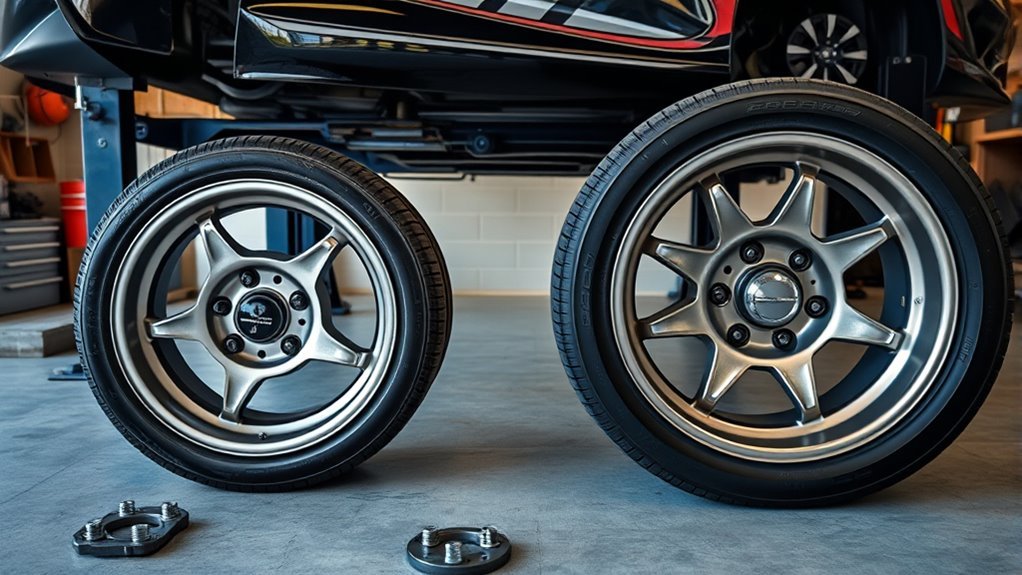
Fitment must be checked as a complete system. Confirm the wheel diameter, width, offset, center bore, bolt pattern, brake profile, tire dimensions, load index, speed rating, TPMS compatibility, hardware seat, hardware length, suspension travel, and alignment. A photo of another Supra is not enough because tire construction, ride height, brakes, camber, and wheel spoke shape can change clearance.
At a Glance
| Planning | Compare factory data, wheel drawings, tire dimensions, brake templates, and suspension clearance before ordering |
| Difficulty | Moderate for direct-fit wheels; advanced when spacers, camber plates, coilovers, or fender changes are involved |
| Tools Needed | Jack, stands, torque wrench, straightedge, tape measure, tread-depth gauge, tire-pressure gauge, and access to an alignment rack |
| Budget For | Wheels, tires, TPMS service, mounting, balancing, alignment, approved spacers or hardware, and possible suspension parts |
Wheel and Tire Sizes
Do not treat one wheel-and-tire combination as a universal Supra recommendation. The safe choice depends on the exact chassis, brake package, suspension, ride height, tire model, and wheel design. Use the Supra offset and backspacing guide to compare inward and outward movement, then verify the result physically.
For the A90/A91 GR Supra, one published example is an 18×10 ET30 square wheel with 275/35R18 tires. APEX lists this as a popular performance-street and track starting point, while also warning that taller or wider-running tires can contact the front spring perch and may need a spacer or added negative camber. A 285/35R18 tire on the same wheel can require at least a 5 mm front spacer, depending on the tire and suspension. These notes apply to that wheel design and tested platform; they are not blanket approval for every 18×10 ET30 wheel.
Check these points before committing:
- Overall diameter: Keep the new rolling diameter close to the factory baseline. Large changes can affect speedometer accuracy, gearing, ABS, traction control, and stability control.
- Front-to-rear relationship: On a staggered setup, compare the actual manufacturer-listed diameters of the exact front and rear tires, not only the nominal size.
- Wheel-width approval: Use a wheel width that falls within the tire manufacturer’s approved rim-width range.
- Offset and backspacing: Check both inner suspension clearance and outer fender clearance through full steering and suspension travel.
- Brake profile: Wheel diameter alone does not prove caliper clearance. Use a brake template or physical test-fit.
- Load and speed rating: Match or exceed the vehicle or tire manufacturer’s approved requirement.
- TPMS: Confirm sensor compatibility and the correct relearn or reset procedure for the exact model year.
- Actual tire dimensions: Two tires with the same sidewall size can have different section widths, tread widths, shoulder shapes, and measured diameters.
Warning: A setup that clears while parked may still rub at full steering lock, under braking, over a bump, or with the suspension compressed. Do not drive hard until brake, suspension, liner, fender, hub, and hardware clearances have been checked and the car has been aligned.
Spacers and Lug Bolts
Spacers are not a universal cure for a poor wheel choice. They move the wheel outward, which can improve strut or spring-perch clearance but reduce fender clearance and change steering geometry. Use a spacer only when the wheel or spacer manufacturer supports the application and the complete hardware stack has been verified.
- Measure first: Check hub seating, brake clearance, inner tire clearance, outer poke, liner clearance, and full-lock clearance before choosing spacer thickness.
- Use application-specific parts: Choose quality hub-centric spacers or adapters designed for the exact hub and wheel bore.
- Match the hardware: GR Supras use wheel bolts from the factory, while older Supras commonly use studs and lug nuts. Confirm thread pitch, bolt or stud length, seat type, and engagement.
- Do not stack spacers: Use one correctly engineered part per corner.
- Follow the approved torque procedure: Use the vehicle, wheel, and spacer manufacturer’s instructions, then perform any required re-torque inspection at the specified interval.
- Stop for vibration or looseness: A wheel that does not sit flush, centers poorly, or repeatedly loses torque must be removed and inspected.
Pro Tip: Record the final wheel width, offset, spacer thickness, tire model and size, measured ride height, camber, toe, and cold pressure. That build sheet makes future tire replacement and rubbing diagnosis much easier.
How Should Alignment and Sway Bars Change With Each Setup?
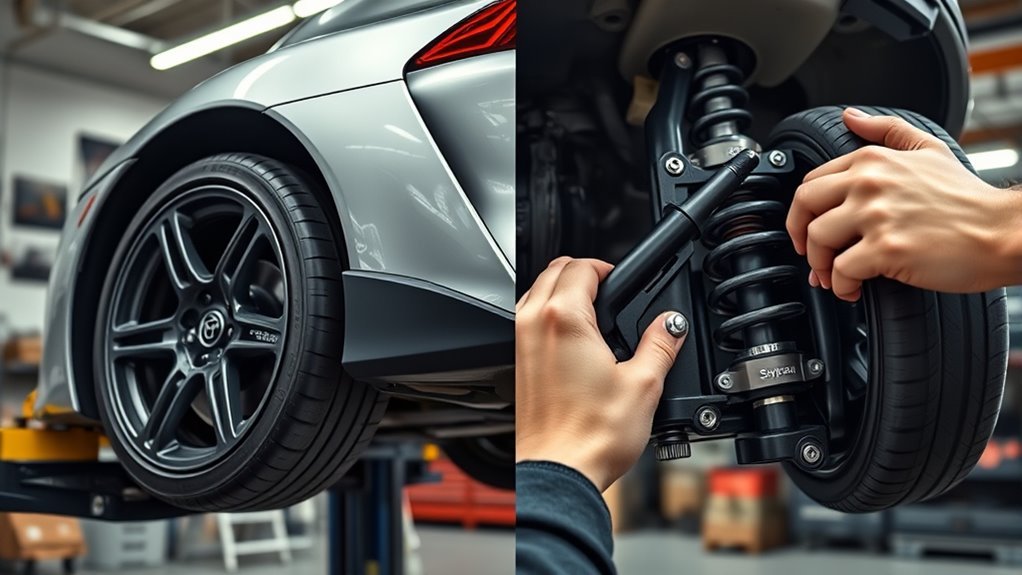
Start with a professional alignment and one change at a time. Wheel layout, tire compound, pressure, camber, toe, spring rate, damping, and anti-roll-bar stiffness all interact. A generic “square alignment” or “staggered alignment” is not safe enough because the correct setting depends on the generation, suspension, tire, ride height, and use.
Spring Rate, Camber, and Toe
Negative camber helps keep the outside tire flatter during cornering. A track-focused square setup often needs more front negative camber than a stock street alignment to use the wider front tire and control outer-shoulder wear. Too much street camber can reduce braking contact and accelerate inner-edge wear, especially when toe is not controlled.
- Street setup: Begin with Toyota’s factory alignment range for the exact model and inspect wear before adding aggressive camber or toe.
- Autocross setup: More front negative camber and carefully measured toe may improve turn-in, but changes should be based on tire wear and repeatable runs.
- Track setup: Use tire temperatures, shoulder marks, lap consistency, and wear across the tread to tune camber and pressure.
- Staggered setup: Do not neglect front camber. A wide rear tire cannot compensate for a front tire that rolls onto its outer shoulder.
- Any setup: Toe can destroy tires quickly. Recheck it after ride-height, control-arm, spring, spacer, or camber changes.
Sway-Bar Settings and Handling Balance
Do not automatically stiffen the front bar on a square setup. In general vehicle-dynamics tuning, more front anti-roll stiffness tends to increase understeer, while more rear anti-roll stiffness tends to increase rotation or oversteer. The reverse changes can add stability. The exact response can vary with suspension geometry, dampers, springs, tires, differential behavior, and road surface, so use small adjustments and controlled testing.
Use these diagnosis steps before changing bars:
- If the car understeers: Check front tire temperature and wear, front pressure, camber, toe, and tire width. If those are sound, a softer front bar or stiffer rear bar may reduce understeer.
- If the car oversteers abruptly: Check rear tire temperature, tread depth, pressure, toe, and throttle application. A softer rear bar or stiffer front bar may add stability.
- If the car is unstable over bumps: Reduce excessive roll stiffness or damping and inspect for binding, worn bushings, or poor bump travel.
- If the steering wanders: Return aggressive toe settings toward a stable street baseline and inspect tires, bushings, ball joints, wheel bearings, and hardware.
- If one change helps one corner but hurts another: Record the condition. Entry, mid-corner, and exit balance may need different solutions.
Note: Street alignment should prioritize stability, braking, and tire life. Aggressive track alignment belongs on a car that is measured, inspected, and driven in controlled conditions.
What Do Square and Staggered Setups Cost Over Time?
Square and staggered setups move cost to different places. A staggered layout may be cheaper if you keep the factory wheels and replace tires in the original sizes, but the front and rear tires can wear at different rates and cannot normally be rotated front-to-rear. A square conversion may reduce long-term tire waste, yet the initial change can require new wheels, approved spacers or hardware, TPMS service, alignment, or suspension parts.
| Budget Item | Square Setup | Staggered Setup |
|---|---|---|
| Initial conversion | May require four wheels, alignment, spacers, hardware, or camber parts | Lowest when retaining the factory wheels and sizes |
| Tire replacement | One size for all four corners | Two sizes must be sourced as a compatible set |
| Rotation | Front-to-rear possible only if wheel offsets and tire direction allow it | Usually same-axle only or not possible |
| Wear pattern | Easier to spread wear across the set | Rear tires may need replacement before the fronts |
| Track support | One spare wheel and tire size can cover any corner | Front and rear spares are different |
Follow the vehicle and tire manufacturer’s maintenance schedule. If no rotation interval is specified and the setup is rotatable, USTMA recommends rotation every 5,000 to 8,000 miles. NHTSA also advises checking pressure, tread, tire age, balance, alignment, and recall status. When only two tires are replaced, USTMA recommends installing the new pair on the rear axle for better wet-road stability, subject to the vehicle manufacturer’s instructions.
Which Setup Works Best for Daily Driving, Autocross, Track Days, and Drifting?
The best layout is the one that solves the car’s actual problem. A street car needs safe clearance, predictable wet and dry behavior, and easy replacement. An autocross car needs front bite and transitions. A track car needs heat control, repeatability, and manageable consumables. A drift car needs a repeatable rear grip level and enough spare tires.
[Products Worth Considering]
![DieCast Hotwheels '20 Toyota GR Supra - HW Speed Graphics 5/10 [White] 178/250 for unisex, children](https://m.media-amazon.com/images/I/512srWPcmdS._SL500_.jpg)
Authentic Design: Meticulously crafted die-cast model of the 2020 Toyota GR Supra featuring precise details and authentic styling in stunning white finish
Daily Driving
For a stock daily-driven Supra, keep the factory staggered layout unless you have a specific reason to change it. Toyota selected the original sizes as part of the car’s handling, braking, and electronic-control package. A properly engineered square setup can work on the street, but it should not be treated as automatically safer, cheaper, or better in rain. Tire quality, tread depth, pressure, and clearance matter more than the word “square.”
Autocross
A square or near-square setup is often useful because tight transitions expose a front-limited car quickly. More front tire, appropriate front camber, and pressure tuning may reduce understeer. Make one change at a time and compare repeatable runs rather than judging from one corner.
Track Days
Square setups are popular for road-course use because one tire size simplifies rotation, replacement, and spares. A high-power car may still be faster or easier to drive with a staggered rear, especially on tracks with long acceleration zones. Choose based on tire temperatures, lap consistency, wear, and the car’s failure mode, not appearance alone.
Drifting
Staggered does not automatically mean drift-friendly. A very wide or grippy rear tire may be harder for a low-power car to spin, while a powerful car may need that grip to maintain speed and control. Drift setup also depends on front steering grip, rear compound, pressure, differential, alignment, suspension travel, event rules, and how many spare rear tires are available.
Street Stance Builds
Staggered wheels often suit the Supra’s shape, but stance must remain secondary to safety. Avoid tire stretch outside the tire manufacturer’s approved rim range, wheel poke that exposes the tread, reduced hardware engagement, stacked spacers, and any rubbing through steering or suspension travel.
Frequently Asked Questions
Is a square setup better than staggered on a Supra?
A square setup is often better for tire rotation, front-end grip, and track consumable management. A staggered setup is usually the better default for a stock street Supra because it retains the factory balance and rear tire width. Neither layout is best without considering the exact generation, power, suspension, tire, and use.
Can I run a square setup on an A90 or A91 GR Supra?
Yes, verified square fitments exist for the A90/A91, especially for 18-inch track and performance-street wheels. Do not assume two factory rear wheels will fit the front without checking offset, spring-perch clearance, brake clearance, tire width, hardware, and alignment. The exact wheel design and tire model can change the result.
What is a common A90 GR Supra square tire size?
A published starting point is 275/35R18 on 18×10 ET30 wheels at all four corners. That combination is not universal: wheel spoke shape, tire width, suspension, ride height, and front spring-perch clearance still need verification. Wider or taller tires may require spacers, camber, or different suspension clearance.
Can I rotate tires on a staggered Supra?
Usually not front-to-rear because the sizes differ. A left-to-right swap on the same axle may be possible if the tire is non-directional, the wheel offset is compatible, and the tire manufacturer permits it. Follow the owner’s manual and tire manufacturer’s rotation instructions.
Do square setups make a Supra faster on track?
They can improve front grip, rotation, and tire consistency on technical tracks, but they do not guarantee a faster lap. Tire compound, actual width, alignment, suspension, braking, power, track layout, and driver skill can matter more than whether the setup is square or staggered.
Does a staggered setup make a Supra easier to drift?
Not automatically. A wider rear tire usually adds rear grip, which can make breakaway harder at the same power level. Drift behavior depends on power, rear tire compound and pressure, front grip, differential, alignment, suspension, surface, and event rules.
What is the best wheel spec for a Supra?
There is no universal best spec. The correct wheel depends on the Supra generation, model year, brake package, suspension, ride height, tire size, load requirement, and use. Start with the door placard and factory wheel data, then verify offset, hub, hardware, brake profile, and physical clearance.
Conclusion
Keep the factory staggered setup when the Supra is mainly a street car and you want the simplest, most predictable baseline. Consider a square setup when you have a clear performance or maintenance goal, such as more front tire, front-to-rear rotation, one-size spares, or lower track consumable waste.
Do not choose by width or appearance alone. Confirm the exact chassis, brake package, wheel design, tire dimensions, diameter relationship, load and speed ratings, hub fit, hardware, suspension travel, and alignment. A verified square setup can make a Supra more repeatable and front-responsive. A verified staggered setup can preserve rear traction and factory-style balance. A poorly planned version of either can rub, vibrate, wear tires quickly, or interfere with the car’s safety systems.
Sources
- Toyota 2026 Supra Owner’s Manual portal — current owner guidance and downloadable manuals for tire, TPMS, inflation, and maintenance procedures.
- Toyota 2026 GR Supra MkV Final Edition release — official model-year, brake, suspension, camber, stabilizer, and lineup updates.
- Toyota 2025 GR Supra release — official 3.0 and 3.0 Premium U.S. lineup information.
- Toyota 2026 GR Supra brochure — official wheel, tire, model, and equipment context.
- NHTSA TireWise — tire pressure, tread, rotation, size, balance, alignment, age, and recall guidance.
- U.S. Tire Manufacturers Association Tire Care Essentials — pressure, tread, rotation, and alignment recommendations.
- USTMA Replacing Tires — replacement-size, load-rating, and new-pair-on-rear guidance.
- Tire Rack Plus Sizing Guide — rolling diameter, speedometer, ABS, traction-control, stability-control, and wet-road considerations.
- Tire Rack Fitment Engineering Guide — offset, brake profile, wheel shape, and physical-clearance checks.
- Tire Rack Track and Autocross Pressure Guide — general understeer and oversteer tuning directions for pressure, camber, springs, and anti-roll bars.
- APEX GR Supra Wheel and Tire Fitment Guide — published A90/A91 square and staggered fitment examples and clearance notes.
- APEX 18-Inch GR Supra Technical Notes — measured tire dimensions, spring-perch interference, spacer, camber, and tire-model variation examples.
- MotorTrend GR Supra Shakedown Test — published track-build example using a 275-series square setup.