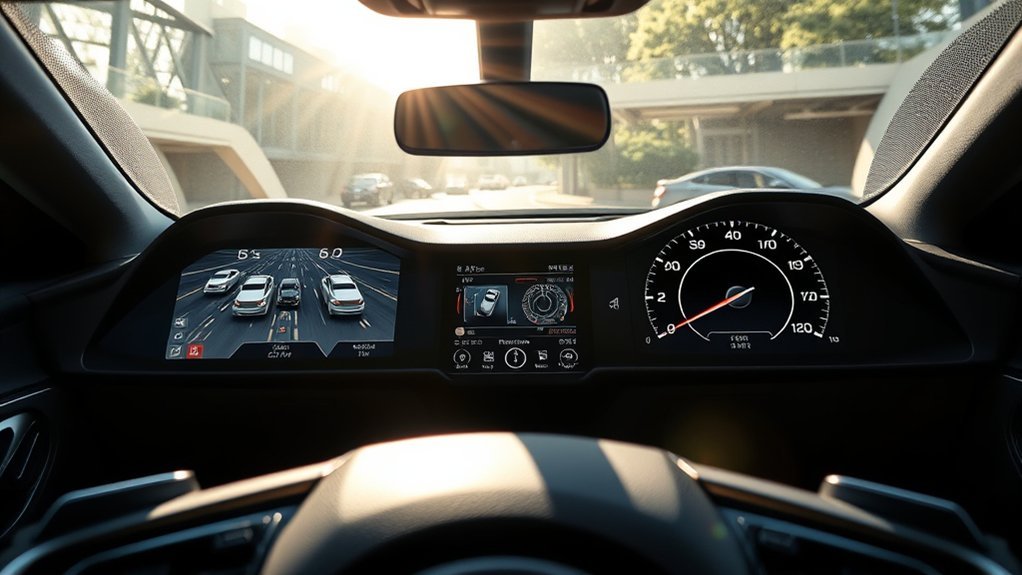
Radar cruise control and standard cruise control are not the same system. Standard cruise control holds the speed you select until you brake, cancel, or change the setting. Radar cruise control—more commonly called adaptive cruise control—can also slow or accelerate in response to a detected vehicle ahead while trying to maintain a driver-selected following gap.
Last updated: July 22, 2026
How this comparison was checked: This guide uses NHTSA definitions, manufacturer documentation, IIHS research, and real-world fuel-use research. Adaptive cruise behavior still varies by vehicle and model year, so your owner’s manual is the final source for operating instructions and limits.
Quick Answer
Radar cruise control is an advanced form of cruise control that can adjust your speed when it detects a slower vehicle ahead. Standard cruise control only holds a fixed speed and does not react to traffic. Radar cruise is more useful in changing highway traffic, but it still requires an alert driver and does not make the vehicle self-driving.
Key Takeaways
- Standard cruise control maintains one set speed and does not react to traffic ahead.
- Radar cruise control uses forward radar, cameras, or both to help maintain a selected following gap.
- Adaptive systems reduce speed-management workload, but the driver must still steer, monitor the road, and brake or accelerate when needed.
- Stop-and-go behavior, minimum operating speed, and restart requirements vary by vehicle and model year.
- Fuel savings are not guaranteed; real-world results depend on road, traffic, speed, vehicle, and system tuning.
- Avoid cruise control in poor weather, slippery conditions, sharp curves, construction zones, and any situation that requires frequent manual control.
Radar Cruise Control vs. Standard Cruise at a Glance
| Comparison | Standard Cruise Control | Radar/Adaptive Cruise Control |
|---|---|---|
| Speed behavior | Tries to hold one selected speed | Holds the set speed when clear and can slow for a detected lead vehicle |
| Traffic response | Driver must brake, cancel, or adjust speed | Can adjust speed within system limits |
| Forward sensors | Does not use a forward traffic sensor to follow another vehicle | Usually uses radar, a camera, or both |
| Best use | Open highways with light, steady traffic | Suitable highways where traffic speed changes gradually |
Why Cruise Control Matters for Safe Driving
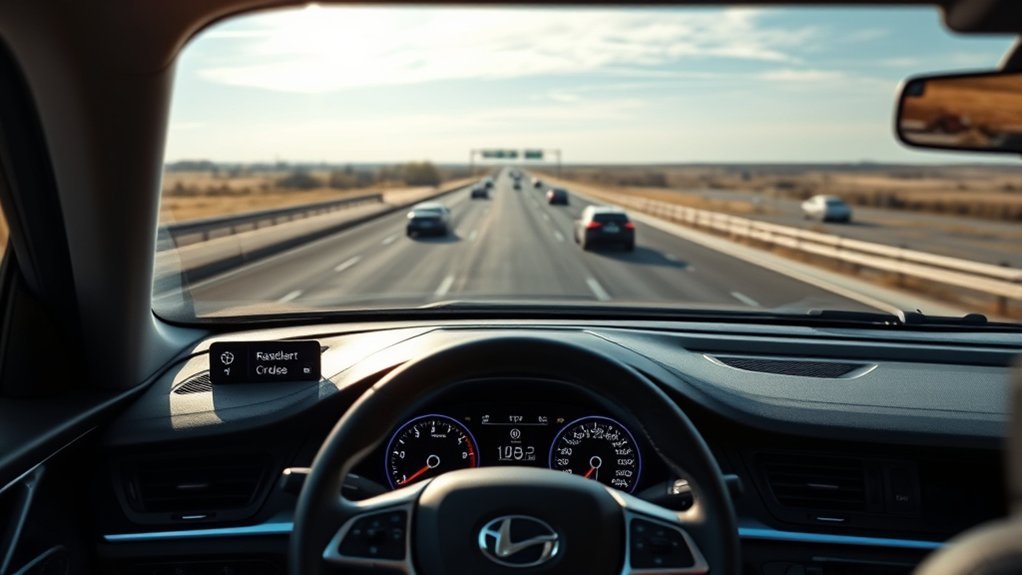
Cruise control can make long highway driving less tiring because it reduces the need to keep constant pressure on the accelerator. It can also help you maintain a steadier speed on open roads, which may improve comfort and reduce unnecessary speed changes.
Adaptive cruise control goes a step further. According to the National Highway Traffic Safety Administration, adaptive cruise control automatically adjusts vehicle speed to keep a preset distance from the vehicle in front. That makes it useful on highways where traffic speed changes gradually.
Warning: Radar cruise control is driver assistance, not self-driving. You are still responsible for steering, braking, accelerating when needed, watching traffic, and taking over immediately if the system does not respond correctly.
The best way to think about cruise control is simple: it can reduce workload, but it does not remove responsibility. The National Transportation Safety Board says drivers must constantly supervise the driving environment and driver-support features, remain alert, and be ready to take control at any time.
How Does Standard Cruise Control Work?
Standard cruise control lets you set a target speed, usually with buttons on the steering wheel or a stalk near the steering column. Once active, the vehicle tries to keep that speed without you pressing the accelerator. If traffic slows, you must brake, cancel the system, or reduce the setting yourself.
Where Standard Cruise Control Works Best
Standard cruise control works best on open, steady-speed roads. It is most useful when traffic is light, the road is dry, and you can travel for long stretches without frequent braking. It can reduce foot fatigue and make highway driving feel smoother.
Its biggest limitation is that it does not detect and follow the vehicle ahead. If another driver slows down, merges in front of you, or traffic suddenly backs up, standard cruise control will keep trying to hold the set speed until you intervene.
How Is Standard Cruise Control Activated?
Most standard cruise systems use similar controls: turn the system on, accelerate to your desired speed, press “set,” and then use “resume,” “cancel,” or plus/minus buttons to adjust it. Pressing the brake pedal usually cancels speed control immediately.
Every vehicle is different, so check the owner’s manual for the exact controls. Some vehicles limit cruise control use below a certain speed, in specific drive modes, or under other operating conditions.
What Is Radar Cruise Control and How Does It Work?
Radar cruise control is a common name for adaptive cruise control. Brands may use names such as Dynamic Radar Cruise Control, Adaptive Cruise Control, Distronic, Smart Cruise Control, or Mazda Radar Cruise Control. The core function is similar: the system helps manage speed while maintaining a selected gap behind a detected vehicle ahead.
Most current adaptive cruise systems use forward radar, a camera, or both. The exact sensor layout and operating limits vary by vehicle and model year. Honda, for example, describes a system that uses a camera and millimeter-wave radar to measure following distance and the speed difference between vehicles.
What Are the Main Adaptive Cruise Features?
- Speed adjustment: If the detected vehicle ahead slows, radar cruise control can reduce your speed. If the lane clears, it may accelerate back toward your set speed.
- Following-gap selection: Many systems let you choose among several gap settings. When conditions remain suitable for ACC, use a longer setting at night or in denser traffic. Cancel cruise control in heavy rain, snow, ice, poor visibility, or other conditions prohibited by the owner’s manual.
- Stop-and-go capability: Some systems can slow to a stop in traffic, but not all can. Depending on the vehicle and length of the stop, you may need to press a resume button or the accelerator before the system follows traffic again.
- System alerts: If sensors cannot detect traffic reliably, the system may display a warning, disengage, or tell you to take over.
How Does Adaptive Cruise Adjust Speed?
Adaptive cruise control compares your vehicle’s speed with the speed and distance of a detected vehicle ahead. If the gap becomes smaller than the selected setting, it can reduce throttle or apply the brakes. When the detected vehicle moves away or changes lanes, the system may accelerate back toward the speed you originally set.
| Feature | Standard Cruise Control | Radar Cruise Control |
|---|---|---|
| Holds a set speed | Yes | Yes |
| Responds to slower traffic ahead | No | Yes, within system limits |
| Maintains selected following gap | No | Yes, when it detects a valid lead vehicle |
| May stop in traffic | No | Only on systems with full-speed or stop-and-go operation |
| Useful in changing traffic | Limited | Better suited, but still requires supervision |
| Can make the car self-driving | No | No |
What Is the Main Difference Between Standard and Adaptive Cruise Control?
The main difference is how each system responds to traffic. Standard cruise control manages only your selected speed. Radar cruise control manages speed while also reacting to a detected lead vehicle.
- Speed management: Standard cruise control tries to hold one speed. Radar cruise can slow down and later accelerate toward the set speed.
- Traffic response: Standard cruise requires manual braking when traffic slows. Radar cruise can reduce speed automatically, but you must still be ready to brake.
- Sensor dependency: Standard cruise does not use a forward traffic sensor to follow another vehicle. Radar cruise depends on sensors that can be affected by dirt, weather, glare, road spray, damage, or misalignment.
- Driver workload: Radar cruise can reduce repeated speed adjustments, but overtrust can also make a driver less engaged.
- Low-speed behavior: Standard cruise usually operates only above a minimum road speed. Adaptive systems range from highway-only designs to full-speed stop-and-go systems.
- Repair complexity: Radar and camera systems may require inspection or calibration after bumper, grille, sensor, or windshield work.
- Vehicle-specific operation: Warning behavior, braking strength, restart rules, and conventional-cruise availability differ among vehicles.
Note: Adaptive cruise control is separate from automatic emergency braking and lane centering. A car may have one feature without the others, and feature names and functions vary by brand, trim, package, and model year.
What Are the Advantages of Adaptive Cruise Control?
Radar cruise control is most helpful on highways and expressways where traffic changes speed but remains orderly and predictable. It can reduce the need to repeatedly cancel, brake, reset, and resume cruise control.
| Advantage | What It Means |
|---|---|
| Less speed-management workload | The system can adjust speed when a slower vehicle is detected ahead. |
| More consistent selected gap | It helps maintain the gap setting as long as the lead vehicle is detected correctly. |
| Better comfort in moderate highway traffic | You may not need to change the set speed as often as you would with standard cruise. |
| Stop-and-go support on equipped vehicles | Full-speed systems may follow a detected vehicle to a stop and resume with or without driver input. |
Do not use automatic-emergency-braking statistics to estimate the safety benefit of adaptive cruise control. They are separate functions with different purposes and evidence.
The distinction matters. An updated Insurance Institute for Highway Safety analysis found that automatic emergency braking reduced rear-end crashes by 50%, while forward-collision warning alone reduced them by 27%. Those figures do not isolate adaptive cruise control.
IIHS has also reported little evidence that partial automation prevents more crashes than the crash-avoidance features commonly bundled with it. Treat ACC mainly as a convenience and workload-support feature—not as a replacement for automatic emergency braking or attentive driving.
What Are the Limitations of Standard Cruise Control?
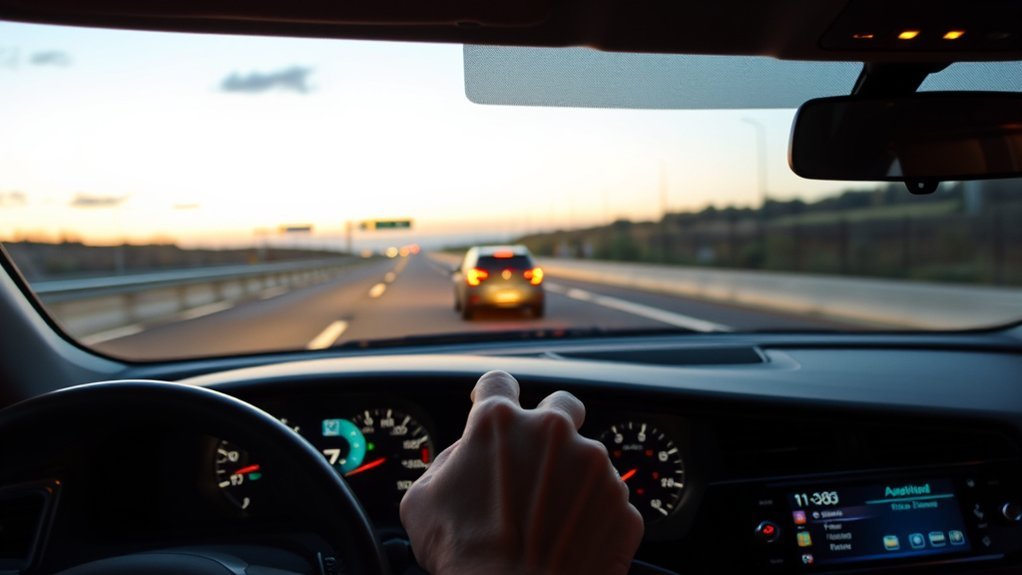
Standard cruise control is simple and useful, but it has clear limits. It does not monitor traffic, lane position, or road-surface conditions. Its primary job is to maintain the speed you selected.
- Changing traffic: If traffic slows, you must brake or cancel the system.
- Cut-ins: If another vehicle merges ahead, standard cruise will not react to it.
- Downhill speed: Behavior varies by vehicle. Some systems use downshifting or braking to limit speed, while others may allow the vehicle to exceed the set speed on a steep descent.
- Wet or slippery roads: Automatic speed maintenance can make smooth traction management more difficult.
- Urban driving: Stoplights, pedestrians, cyclists, parked cars, and frequent lane changes make standard cruise unsuitable.
When Should You Avoid Cruise Control?
Whether your vehicle has standard cruise control or radar cruise control, manual driving is safer whenever traction, visibility, traffic, or road shape requires frequent judgment and speed changes.
- Heavy rain, snow, fog, or road spray: Sensors may be blocked or limited, visibility may drop, and traction may be reduced.
- Icy, muddy, or loose gravel roads: Automatic speed control can make it harder to respond smoothly to changing grip.
- Sharp curves and winding roads: The system may not anticipate road shape or a vehicle outside the sensor’s current detection path.
- Construction zones: Temporary lane markings, barriers, workers, and sudden speed changes require direct control.
- Dense city traffic and intersections: Pedestrians, cyclists, cross traffic, signals, and abrupt stops are better handled manually.
- On-ramps and off-ramps: Curvature, merging vehicles, and rapid speed changes may exceed the system’s intended use.
- Towing or carrying a heavy load: Follow the owner’s manual because braking distance, handling, and system permissions may change. Some manufacturers specifically restrict ACC use with heavy loads.
Detection Limit: Adaptive cruise control is not a collision-avoidance system. Depending on the vehicle, it may fail to recognize stationary traffic, motorcycles, bicycles, pedestrians, animals, low trailers, debris, or a vehicle entering your lane abruptly. Brake and steer whenever the system does not respond correctly.
Pro Tip: When road and weather conditions remain suitable, use a longer following-gap setting in unpredictable traffic. The added space gives you more time to respond to cut-ins, sudden braking, or a hazard the system does not recognize.
How Do You Use Radar Cruise Control Safely?
The exact controls vary by vehicle, but the safest habits are similar across most systems.
- Start on a suitable highway. Engage the system only when the road is dry, visibility is clear, and traffic is predictable.
- Choose a realistic speed. The set speed must fit the speed limit, traffic flow, visibility, and road conditions.
- Select enough following distance. Avoid the shortest setting when traffic is dense or unpredictable.
- Keep both hands and your attention ready. The system manages speed, not the entire driving task.
- Watch for cut-ins and lane changes. A vehicle entering your lane may not be detected immediately.
- Look beyond the lead vehicle. Watch for brake lights, stopped traffic, road debris, work zones, and hazards farther ahead.
- Cancel early. Take over before entering complex traffic, ramps, sharp curves, poor weather, or reduced-traction conditions.
- Respond to unusual behavior. If the vehicle brakes late, brakes unnecessarily, accelerates unexpectedly, or displays a warning, take control first and troubleshoot later.
NHTSA classifies standalone adaptive cruise control as Level 1 driver assistance: the system may provide continuous acceleration and braking support, but the driver remains fully engaged and responsible for steering and monitoring the road.
[Products Worth Considering]
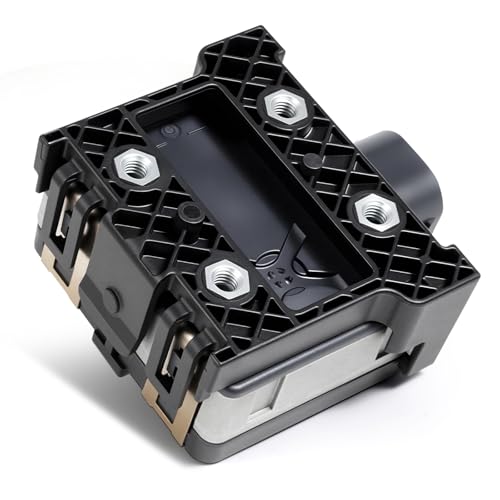
【Replacement OE Number】Perfectly fit 28438-5UD0A, 284385UD0A. Manufactured following strict OE standards to work like the original component.


Ideal match: Our Distance Sensor Milliwave Radar Cover is compatible for Honda Accord 2018-2022. This ensures a precise fit and simple installation
Does Radar Cruise Control Save Gas?
Radar cruise control does not guarantee lower fuel use. Smooth speed control may help in some situations, but real-world consumption depends on speed, traffic, road grade, vehicle type, powertrain, following-gap setting, and how aggressively the system accelerates after slowing.
A 2024 Nature Communications observational study found that ACC engagement was associated with an average fuel-consumption increase of 0.26 L/100 km across the studied fleet. The researchers described that as roughly a 2% fleet-level penalty.
The effect was not the same in every situation. Trips averaging below about 50 km/h showed potential benefits, while higher-speed trips were more likely to use additional fuel because the system maintained speed more rigidly. The study does not prove that every ACC-equipped vehicle will produce the same result.
The practical takeaway is to use cruise control for comfort and speed consistency, not as a guaranteed fuel-saving tool. For better fuel economy, keep speeds moderate, anticipate traffic, avoid hard acceleration, maintain correct tire pressure, and avoid carrying unnecessary weight.
How Do You Maintain and Troubleshoot ACC Sensors?
If radar cruise control stops working or displays a warning, the cause may be temporary. The forward radar cover, grille emblem, bumper area, or windshield camera can be blocked by dirt, ice, snow, bugs, condensation, road salt, or glare.
- Park safely before inspecting anything. Do not clean or examine sensor areas while stopped in an active traffic lane.
- Clean sensor areas gently. Remove mud, snow, ice, bugs, and road grime without scratching a radar cover or camera area.
- Check for damage. A minor bumper or grille impact can disturb radar alignment even when the damage appears cosmetic.
- Be careful after windshield replacement. A forward camera may require calibration after glass or camera-bracket work.
- Do not add unapproved accessories. Stickers, wraps, grille guards, license-plate hardware, or coatings can obstruct a sensor.
- Watch for repeated warnings. If a warning returns in clear conditions, have the system checked by a qualified repair facility.
- Use the owner’s manual. It identifies the sensor locations, warning messages, prohibited conditions, and calibration requirements for your vehicle.
[Products Worth Considering]


Compatibility:for Ram 1500 Big Horn, Laramie, Limited, Limited Longhorn, Lone Star, TRX, Tradesman 3.6L V6 - Electric/Gas, 5.7L V8 - Electric/Gas, 5.7L V8 - Gas, 6.2L V8 - Gas 2024, for Ram 1500 Big Horn, Laramie, Limited, Limited Longhorn, Lone Star, TRX, Tradesman 3.0L V6 - Diesel, 3.6L V6 - Electric/Gas, 5.7L V8 - Electric/Gas, 5.7L V8 - Gas, 6.2L V8 - Gas 2022, 2023
Is Radar Cruise the Same as AEB, Lane Centering, or Self-Driving?
No. These features may share sensors or be sold in one package, but they have different jobs.
| Feature | Primary Job | What It Does Not Do |
|---|---|---|
| Standard cruise control | Holds a selected speed | Does not react to traffic ahead |
| Radar/adaptive cruise control | Adjusts speed for a detected lead vehicle | Does not replace braking, steering, or judgment |
| Automatic emergency braking | May brake when an imminent collision risk is detected | Does not guarantee crash avoidance |
| Lane centering | Provides continuing steering support to remain near the lane center | Does not understand every lane, curve, road edge, or temporary marking |
| Driving automation | Performs defined parts of the driving task under specified conditions | Is not created merely by adding ACC to a vehicle |
NHTSA categorizes adaptive cruise control alone as Level 1 assistance because it supports acceleration and braking while the driver steers. When ACC is combined with lane centering, the vehicle may provide Level 2 assistance, but the driver must still remain engaged, monitor the road, and intervene immediately when needed.
Which Cruise-Control System Is Better for You?
The better choice depends on your driving environment and on the exact behavior of the vehicle you are considering.
- Choose standard cruise control if: you mostly drive on open highways with light traffic and want a simple speed-holding feature.
- Choose radar cruise control if: you often drive on highways where traffic speed changes and want help maintaining a selected following gap.
- Do not choose radar cruise because you want self-driving: ACC is not designed to replace attention, braking judgment, or steering.
- Do not assume every ACC system is equal: Full-speed operation, stopping, resuming, warning behavior, and braking smoothness differ.
[Products Worth Considering]

[Vehicle Fitment]: Compatible with Toyota Yaris 2007-2009, Venza 2009 & 2014-2015, Tundra 2005-2010 & 2014-2021, Tacoma 2005-2009 & 2014-2023, Solara 2004-2008, Sienna 2004-2010 & 2013-2015, RAV4 2004-2009, Prius 2004-2022, Matrix 2009-2010, Land Cruiser 2003-2009 & 2014-2021, Highlander 2005-2009, FJ Cruiser 2007-2009, Corolla 2009-2010 & 2014-2016, Camry 2005-2010 & 2014-2017, Avalon 2005-2013, 4Runner 2003-2009 & 2014-2019 --- without Adaptive Cruise Control & Collision Mitigation Braking

Applicable for Lexus CT200h (2011-2017), ES330 (2005-2006), ES350 (2007-2012), GS300 (2006), GS350 (2007-2011), GS430 (2005-2007), GS450h (2007-2011), GS460 (2008-2011), GX460 (2010-2019), GX470 (2003-2009), HS250h (2010-2012), IS F (2008-2014), IS250 (2006-2015), IS350 (2006-2015), LX470 (2001-2007), LX570 (2008-2021), RX330 (2004-2006), RX350 (2007-2015), RX400h (2006-2008), RX450h (2010-2015), iM (2016), tC (2005-2015), xB (2008-2015), xD (2008-2014)

Exact Fit for Specific Vehicles - Compatible for Toyota 4Runner 2003-2019; Avalon 2005-2015; Camry 2005-2017; Corolla 2009-2017; Corolla iM 2017-2018; FJ Cruiser 2007-2014; Highlander 2004-2013; Land Cruiser 2001-2021; Matrix 2008-2013; Prius 2004-2022; Prius AWD-e 2019-2022; Prius C 2012-2019; Prius Plug-In 2012-2015; Prius Prime 2017-2022; Prius V 2012-2017. Replaces OE: 84632-34011, 84632-08021, 84632-34017, 8463234011. Before purchasing check via Amazon's Fitment System or verify your vehicle's OE number to avoid "wrong purchase and return" hassles.
What Should You Check Before Buying a Vehicle With ACC?
- Minimum operating speed: Does the system work only at highway speed or through low-speed traffic?
- Full-stop ability: Can it follow a detected vehicle to a complete stop?
- Restart behavior: Does it resume automatically, only after a brief stop, or only after driver input?
- Conventional-cruise option: Can you switch to non-adaptive cruise if you prefer it?
- Steering support: Is lane centering included, optional, or absent?
- Warnings and controls: Are the display, gap controls, cancel action, and takeover alerts easy to understand?
Verify the exact trim, package, model year, and owner’s manual rather than relying on a general feature name. For a broader explanation of ACC equipment and operation, see our adaptive cruise control guide.
What Varies Between Vehicles and Model Years?
Adaptive cruise control is not one standardized experience. Older or basic systems may operate only above a minimum highway speed. Full-speed systems may follow traffic to a stop, while others disengage before the vehicle stops. Some resume automatically after a brief pause; others require the driver to press a button or accelerator.
Vehicles also differ in sensor design, following-gap choices, conventional-cruise availability, braking smoothness, curve behavior, lane-centering integration, driver-monitoring safeguards, and calibration procedures. When comparing vehicles, focus on what the specific model can do today and confirm it during a safe test drive.
What Is the Safest Way to Use Cruise Control?
Treat cruise control as an assistant. Use it on suitable roads in clear conditions, monitor traffic beyond the vehicle directly ahead, and cancel it before the situation becomes complex.
Never assume the system has detected every hazard. If the vehicle displays a sensor warning, brakes or accelerates unexpectedly, or fails to respond to traffic, take over immediately.
Frequently Asked Questions
Is radar cruise the same as cruise control?
Radar cruise control is a more advanced type of cruise control. Standard cruise control holds a selected speed, while radar cruise control can adjust speed to help maintain a selected gap behind a detected vehicle ahead.
What are the disadvantages of adaptive cruise control?
Adaptive cruise depends on sensors and may brake late, brake unnecessarily, react poorly to cut-ins, or miss stationary and small objects. Stop-and-go behavior varies, sensor repairs may require calibration, and overreliance can reduce driver attention.
Does radar cruise control use more gas?
It can. A large real-world observational study associated ACC use with an average increase of 0.26 L/100 km across the studied fleet, although some lower-speed trips showed benefits. Results vary by vehicle, traffic, speed, road grade, and control strategy.
What is the purpose of a radar cruise control system?
Its purpose is to reduce speed-management workload by helping the vehicle maintain a set speed and selected following gap. It is mainly a convenience feature for suitable highway and expressway driving, not a replacement for the driver.
Can radar cruise control stop the car completely?
Some systems can, but not all. Vehicles with full-speed range, stop-and-go, or low-speed-follow operation may slow to a stop behind a detected vehicle. Other systems work only above a minimum speed and may cancel or tell you to brake.
Can I use radar cruise control in rain or snow?
Avoid using it in heavy rain, snow, fog, ice, deep water, road spray, or other conditions that reduce visibility, sensor performance, or traction. Follow the restrictions in your owner’s manual and drive manually when conditions are poor.
Is adaptive cruise control the same as automatic emergency braking?
No. Adaptive cruise control manages cruising speed and following gap. Automatic emergency braking is a crash-intervention feature that may brake when an imminent collision risk is detected. Some vehicles have both, but they remain separate functions.
Conclusion
Standard cruise control is best for steady, open-road driving when you only need help holding a fixed speed. Radar cruise control is more useful in changing highway traffic because it can adjust speed for a detected lead vehicle and selected following gap.
Before relying on either system, confirm its controls and limits in the owner’s manual. With radar cruise, check whether the vehicle has full-speed operation, how it resumes after a stop, and what conditions can block its sensors. Use it for comfort—not as a safety guarantee—and remain ready to brake, steer, or cancel it at any moment.
Sources
- National Highway Traffic Safety Administration: Driver Assistance Technologies — definition of adaptive cruise control, Level 1 assistance, and driver responsibility.
- National Transportation Safety Board: Advanced Driver Assistance Systems and Automated Driving Systems — driver supervision and takeover responsibility.
- Honda Global: Adaptive Cruise Control Technology — camera and millimeter-wave radar operation, following assistance, stopping, and resuming.
- Insurance Institute for Highway Safety: Front Crash Prevention and Rear-End Crashes — updated AEB and forward-collision-warning crash-reduction findings.
- Insurance Institute for Highway Safety: Partial Automation and Crash Prevention — distinction between convenience assistance and proven crash-avoidance features.
- Nature Communications: Effect of Adaptive Cruise Control on Fuel Consumption in Real-World Driving Conditions — quantified fleet-level and speed-dependent fuel-use findings.
- Polestar Owner’s Manual: Adaptive Cruise Control Limitations — examples of weather, road, load, and object-detection limits that can apply to manufacturer systems.